Page 996 of 6145
1 994 995 996 997 998 6.145

‘My Faith in This World Is Gone.’ For Protesters Injured by Police, There’s No Real Recovery

‘My Faith in This World Is Gone.’ For Protesters Injured by Police, There’s No Real Recovery

Shantania Love was walking away from law enforcement officers at a protest in Oak Park, Calif., on May 29 when they started firing projectiles to disperse the crowd. Love believes it was a rubber bullet that permanently blinded her.

Ellen Urbani shook her head in disbelief as she scanned the cobwebbed shelves of her suburban garage, looking for items that might protect her at a Black Lives Matter protest. “This is absurd,” she thought. “I can’t believe I let people talk me into thinking I need this stuff.”

She dusted off her son’s snowboard helmet and hooked it onto a backpack that held her daughter’s swim goggles, her asthma respirator and a change of clothes in case the long-sleeved yellow V-neck she was wearing burned off from chemical gas. She scribbled her husband’s name and phone number on her thigh in permanent marker, in the event she became incapacitated. With her auburn hair braided into pigtails, the 51-year-old author then left the safety of her 43-acre farm outside Portland, Ore., on July 24 to link arms with hundreds of other mothers demanding justice for George Floyd.

By midnight, Urbani says, federal agents had enveloped the protesters in a cloud of gas, and flash grenades exploded. Projectiles as big as softballs began to fly. As the women around her choked and vomited from the fumes and as bodies began crashing into each other, Urbani reminded herself that she’s “just a mom,” a law-abiding former Peace Corps volunteer and a threat to no one. “Then I felt my bone break,” says Urbani. “It felt like being hit by a 90-m.p.h. baseball.”
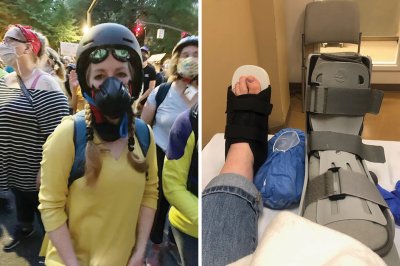
Ellen Urbani was hit in the foot by what she believes was a rubber bullet at a protest in Portland, Ore., on July 24.

Ellen Urbani was hit in the foot by what she believes was a rubber bullet at a protest in Portland, Ore., on July 24.
While taking part in the largest sustained social justice mobilization in modern U.S. history, dozens of people have been beaten with batons, hit by cars, doused in pepper spray and critically wounded by rubber bullets, beanbag rounds and other police weapons. More than 93% of Black Lives Matter protests across the U.S. have been peaceful, according to an analysis of more than 7,750 demonstrations from May 26 to Aug. 22 by the nonprofit Armed Conflict Location & Event Data Project. Even so, at least 115 protesters were shot in the head, face and neck with various projectiles, including bullets and tear gas canisters, from May 26 to July 27, according to a report by Physicians for Human Rights. The nonprofit health-advocacy group compiled its data from news and medical reports, social media posts and lawsuits.
Compared with other Black Lives Matter protesters injured by law enforcement, Urbani knows she is one of the luckier ones. She was hit in the foot by what she believes was a rubber bullet, which shattered her big toe. It’s slowly healing as she undergoes physical therapy, but her mental anguish is here to stay. “I never thought I’d be shot in my own city by my own countrymen,” says Urbani, who comes from a military family and who had always respected law enforcement.

«I never thought I’d be shot in my own city, by my own countrymen.»

In the competition to define what has happened in America’s streets since Floyd’s death on May 25, critics of the protests point to the handful of cities where stores were burned or looted. Advocates for protesters reply that, regrettable as those incidents may be, property can be restored. But the bodies of demonstrators have been irreparably damaged—often in incidents documented by cell-phone cameras, posted to social media and replayed on local and national news. Millions of people saw footage of a young woman being knocked to the ground in New York City and of an elderly man bleeding from his ear after being shoved to the pavement in Buffalo, N.Y. They watched as a New York Police Department (NYPD) vehicle sped up and drove into a crowd of protesters.

In each case, the outrage is compounded by the setting: a protest over police brutality. And months later, after the attention has shifted elsewhere, the injured are left to navigate a new set of challenges: mounting medical bills, job losses, unquenchable anger and time-consuming lawsuits that end up costing taxpayers more than they cost the targeted police department. Only occasionally do they see the officers who have changed their lives charged with crimes or fired from their jobs.
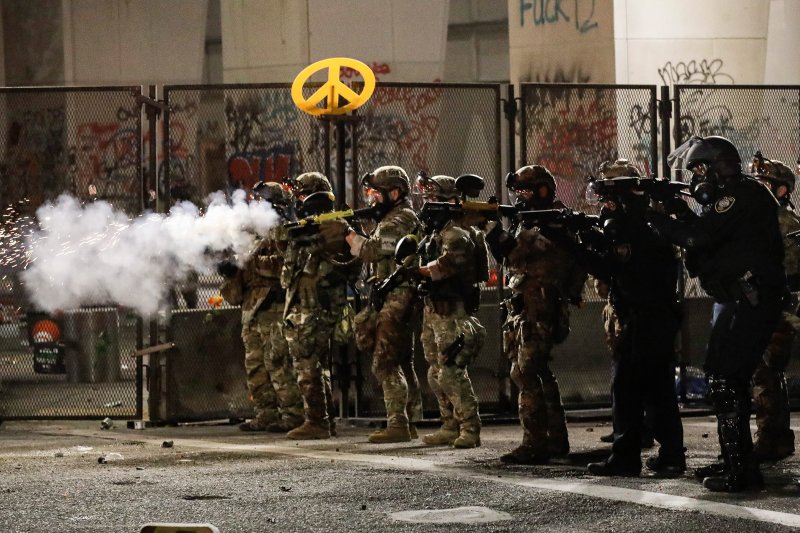
Federal agents use crowd-control munitions to disperse Black Lives Matter demonstrators during a protest in Portland, Ore., on July 24.

Federal agents use crowd-control munitions to disperse Black Lives Matter demonstrators during a protest in Portland, Ore., on July 24.
Marcio Jose Sanchez—AP

“It’s not the police departments that feel the weight and burden of it,” says Jennvine Wong, a staff attorney with the Legal Aid Society.

In New York City alone, taxpayers spent $220 million to settle more than 5,800 lawsuits filed against the NYPD during the 2019 fiscal year, according to the latest data released by the city comptroller. In 2018, Chicago taxpayers spent more than $113 million—the highest amount since at least 2011—to settle police-misconduct lawsuits and pay for outside lawyers, according to an analysis by the Chicago Reader. Breonna Taylor’s family settled with the city of Louisville, Ky., for $12 million after police shot her to death in her own apartment, but protests have continued over the decision not to prosecute officers for her killing.

“My faith in this world is gone,” says Dounya Zayer, the young woman who was pushed by a police officer during a Black Lives Matter march in New York City on May 29. The 21-year-old had a seizure after her head smacked against the curb and has yet to recover from the concussion and back injury that she suffered. “I’m angry and scared and depressed,” she says. “I know I’m not the only one.”

On July 11, Donavan La Bella was holding a stereo above his head at a Portland, Ore. protest, blasting a song by the artist Dax called “Black Lives Matter,” when a line of U.S. Marshals across the street began launching smoke canisters. Cell-phone footage shows La Bella, 26, calmly kicking aside a canister that landed at his feet, then picking it up and tossing it away before lifting the stereo above his head again. Seconds later, as La Bella stands in place, not moving toward the officers, he’s shot between the eyes with an “impact munition” and drops to the ground.

La Bella’s skull was fractured, and the bones around his left eye socket were broken. He has trouble concentrating and controlling his emotions and suffers from extreme sensitivity to light and sound and impaired vision, says his mother, Desiree La Bella. “Try to imagine having a migraine for a minimum of 12 hours a day for five, six weeks straight,” his mother says. “You can’t get away from that kind of pain.” La Bella spent most of the past two months in the hospital, having returned there on Aug. 17 for the third time to treat a sinus and brain infection as well as a cerebrospinal fluid leak, conditions related to his injuries.

Donavan La Bella was shot with impact munition at a protest in Portland, Ore., on July 11, fracturing his skull and breaking the bones around his left eye socket.

Donavan La Bella was shot with impact munition at a protest in Portland, Ore., on July 11, fracturing his skull and breaking the bones around his left eye socket.
Courtesy the La Bella Family

“The trauma we are facing now is long-lasting,” says Zayer, who still has seizures, suffers migraines and struggles to keep food down. The former competitive gymnast is in physical therapy up to five times a week when she’s not sitting in a waiting room to see multiple specialists. “Physically and mentally, I feel like a whole different person,” she says. “I don’t think I’m ever going to be the same.”

Zayer was one of dozens of protesters who testified in June about being shoved, kicked and violently wrangled by police, during a three-day public hearing held online by the New York attorney general. Some displayed cuts and bruises as they told investigators they were kicked in the jaw, thrown against brick walls and pushed off bikes. NYPD Commissioner Dermot Shea testified that hundreds of police officers were injured during the first few nights of protests as some demonstrators looted and threw bottles, bricks, trash cans and rocks at them. Others set fire to police vehicles and attacked precincts. “This was some of the worst rioting that occurred in our city in recent memory,” he said, adding that it’s difficult for officers to avoid interacting with peaceful protesters while dealing with violent ones. Since protests erupted in the city on May 28, an NYPD spokesperson said, more than 470 officers have been wounded, including 20 who have not yet recovered enough to return to work. Zayer and other witnesses challenged that narrative.

“I didn’t often see cases where protesters were fighting back,” said Whitney Hu, a Brooklyn activist who aided Zayer and more than a dozen others who were pepper sprayed or beaten with batons. “I saw protesters hiding or trying to help others who’ve been wounded.”

Shantania Love, a 30-year-old Sacramento mother of two, was walking away from law enforcement officers at a protest in Oak Park, Calif., around midnight on May 29 when they started firing projectiles to disperse the crowd. Love believes a rubber bullet hit her in the eye, permanently blinding her in that eye, as she turned around to look for her brother. “My eye was blown to pieces,” says Love, who underwent two surgeries in an attempt to save her vision. “It was probably the worst pain I’ve ever felt, and I pushed out two kids.”

Love now struggles with mundane tasks like pouring a cup of juice or walking up and down the stairs because of her skewed depth perception. For days, her youngest daughter, who is 5, cried when she saw Love’s wounded eye. Love hasn’t been able to return to work as a medical assistant and consequently lost her health benefits in August. “I have to pay for everything myself,” she says through tears.
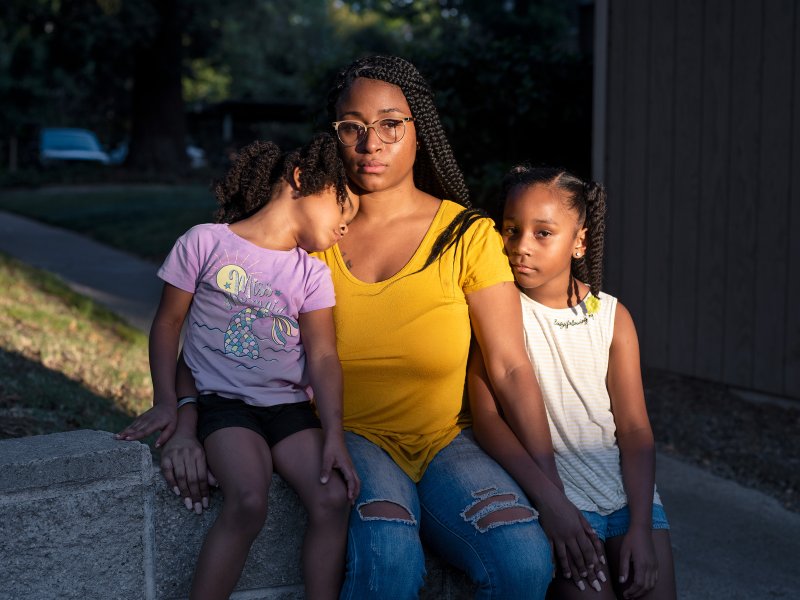
Love with her two daughters outside Sacramento on Oct. 4.

Love with her two daughters outside Sacramento on Oct. 4.
Andres Gonzalez for TIME

“Her life has been so radically altered, it’s just devastating,” says Love’s lawyer, Lisa Bloom, who filed a lawsuit against the city and county of Sacramento, the state of California and numerous officers for damages. “It may have been a split second for them to pull the trigger. It’s a lifetime of pain for her and many others.” A Sacramento Police Department spokesperson said the department has not yet confirmed it was responsible for Love’s injury, since multiple outside agencies responded to the protests. The incident is still under review.

Many of the weapons used by police in recent protests, like rubber bullets and beanbag rounds, are deemed “less-lethal” by law enforcement, even though they can maim and kill. From January 1990 to June 2017, at least 53 people died after such weapons were used for crowd control in incidents around the world, according to a 2017 study published in the medical journal BMJ Open. Three hundred others suffered permanent disability, often from being struck in the head and neck. “Bullets by another name are still bullets,” says Dr. Rohini Haar, the study’s lead author. As an emergency doctor in Oakland, Calif., Haar says she witnessed the damage of the projectiles firsthand in 2014, when rubber bullets were used on Black Lives Matter protesters amid unrest over a St. Louis grand jury’s decision not to charge the officer involved in Michael Brown’s shooting death. When police answered protests with violence in 2020, she was not surprised.

«The level of violence that police officers have used throughout history, against people exercising their constitutional right to protest, is really quite staggering.»

Neither were historians. Recent accounts of police aggression mirror those seen multiple times in American history, according to historian and author Heather Ann Thompson, who studies 1960s and ’70s policing and protest movements. Her book, Blood in the Water, about the Attica, N.Y., prison uprising, won the 2017 Pulitzer Prize in History. “There’s a long, long history of this,” says Thompson, citing the 1968 protest at the Democratic National Convention and a massacre that same year in Orangeburg, S.C., in which law enforcement killed three students and wounded more than two dozen others during a civil rights protest. “The level of violence that police officers have used throughout history, against people exercising their constitutional right to protest, is really quite staggering,” she says.

What’s new, Thompson says, is that police are militarized, often with surplus U.S. Army equipment designed for use in wars of occupation. And in 2020, police actions, and those of white, far-right groups claiming to want to protect businesses and towns from protesters, have been emboldened by a sitting U.S. President, she says. “None of these other presidents would have verbally celebrated white-vigilante, racist violence the way that Donald Trump has,” Thompson says.

Trump has generalized Black Lives Matter protesters as “violent anarchists” and threatened to quell demonstrations with federal forces. “These are not ‘peaceful protesters,’” he tweeted in part on Sept. 8. “They are THUGS.”

During the decade that Martin Gugino has spent protesting, the 75-year-old retiree has been arrested at demonstrations four times and faced charges ranging from misdemeanor trespassing to demonstrating without a permit. He had never been convicted in court or injured at a protest until June 4, when a police officer in Buffalo, N.Y., pushed Gugino onto the pavement. In some of the most graphic footage to emerge from the protest movement, Gugino is seen staggering backward, then falling on his back to the sidewalk, his head slamming to the ground. Blood leaks from his ear, and more than a dozen officers in riot gear stream past the apparently unconscious man without helping him.

The last thing Gugino remembers seeing is a line of helmeted officers coming toward him with batons. “When I was in the hospital,” Gugino says, “I thought, ‘What’s all the fuss about?’ And then I saw the video and I said, ‘Oh yeah, I get it.’” He suffered a fractured skull and concussion and was hospitalized for about a month—the last three weeks of which were spent in physical therapy, relearning how to walk. When he was first hospitalized, Gugino says he could not hear anything because his ears were full of blood. Gugino, who’s hoping for a full recovery, says the experience was a small sample of what Black people endure on a daily basis. “It’s unacceptable,” he says of police violence. “They need to be corrected. The cops have just got the wrong idea. And bad ideas have bad consequences.”
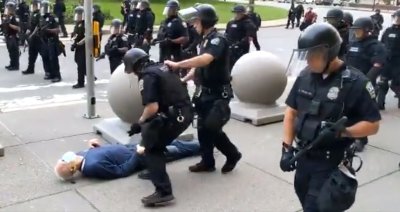
Martin Gugino was shoved by police officers in Buffalo, N.Y., on June 4.

Martin Gugino was shoved by police officers in Buffalo, N.Y., on June 4.
Mike Desmond—WBFO NPR/AFP/Getty Images

Some officers are facing those consequences. On June 6, prosecutors charged two officers involved in Gugino’s incident with felony assault. Four other law enforcement officers in Indiana and Philadelphia are facing assault charges for clashes caught on camera. One is accused of pepper spraying protesters in the face while they were kneeling. Another allegedly clubbed a college student on the head with a metal police baton, resulting in a gash that required about 20 staples and sutures, according to prosecutors.

The New York City police officer who pushed Zayer, Vincent D’Andraia, was charged with misdemeanor assault and faces up to one year in jail if convicted. D’Andraia was initially suspended from the force for 30 days without pay. He’s now on modified assignment while he awaits a court hearing, an NYPD spokesperson said. His lawyer declined to comment. “They put a Band-Aid on a bullet wound,” says Zayer, who wanted D’Andraia to be fired.

For people whose cases don’t end in charges against police—often because their injuries are not caught on camera—the only way to seek accountability is through civil lawsuits. On Aug. 24, Urbani and three other injured demonstrators filed a class-action lawsuit, claiming the federal agents Trump deployed to Portland used “unconstitutional and unnecessary force” against protesters. Attorney General William Barr defended the agents’ actions in testimony before the House Judiciary Committee on July 28, saying “violent rioters and anarchists have hijacked legitimate protests.”
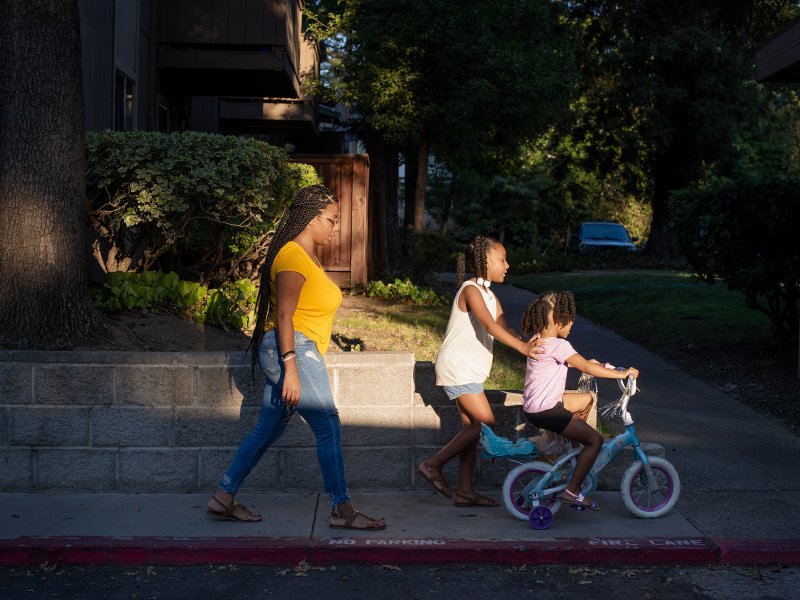
Love now struggles with mundane tasks like pouring a cup of juice or walking up and down the stairs because of her skewed depth perception.

Even when departments settle lawsuits, they’re rarely required to admit fault, meaning the injured may walk away with some funds to help pay medical expenses but no acknowledgment of wrongdoing. Love knows that, and that no amount of money will replace her eye. But she would rather fight for a piece of justice than do nothing.

“I have children,” she says. “I don’t want them to grow up in a world where this type of behavior is tolerated.”

Fuente de la Información: https://time.com/5894356/protesters-injured-police/

 

Comparte este contenido:

Pyka Bets The Path To The Future Of Passenger Planes Runs Through Banana Plantations In Latin America

Pyka Bets The Path To The Future Of Passenger Planes Runs Through Banana Plantations In Latin America

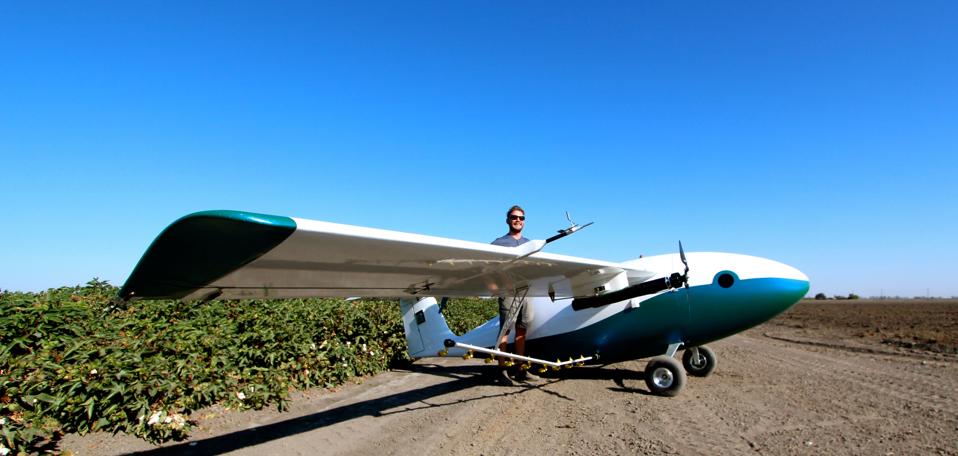
Pyka’s Pelican crop-spraying drone can carry more than its weight in chemicals and is designed to take off and land in 150 feet, half the length of a football field.

 COURTESY OF PYKA

Oakland-based Pyka shares a goal common to many high-tech California aviation startups: to build an autonomous electric passenger aircraft. However, its first steps to get there have taken the company far away from the pack, first to New Zealand and now to banana plantations in Costa Rica and Ecuador, where it’s preparing to field a robotic crop-spraying airplane called Pelican that CEO Michael Norcia says will prove out technology he believes will lead the way to an era of green, low-cost passenger planes.

The fat-bellied, 500-pound plane can carry more than its weight in liquid pesticides or fertilizer, and is engineered to take off and land in a ridiculously short space: 150 feet, half the length of a football field. Someday that short takeoff and landing capability may enable passenger service to be shoehorned into cities and suburbs in a different way than many other electric aviation startups are envisioning. For now, the 28-year-old Norcia is betting that agriculture is a more practical – and lucrative — avenue to pursue. Pyka says the Pelican will have 50% of the operating costs of manned crop-spraying planes and will remove pilots from harm’s way in a business where skimming fields at 140 miles per hour too often leads to accidents and death. And banana plantations, which are the most frequent users of aerial spraying in the world, may be the perfect environment for it to take wing.

Dozens of companies are trying to build futuristic-looking, autonomous electric “air taxis” that can take off and land vertically on city roofs, carrying one to a half-dozen passengers. Norcia, whose first job after graduating from UC Davis with a physics degree was at one of them, billionaire Larry Page’s Kitty Hawk, believes they’re a decade too soon – the limitations of current batteries and other technologies leave eVTOLs with too little range given how energy intensive it is to propel an aircraft straight up and down, he says.

Pyka’s strategy is to take the well-understood efficiencies of fixed-winged airplanes and marry it to advances in high-power electric motors to produce an airplane that can operate on radically shorter runways. “They like to fly,” Norcia says of fixed-wing airplanes. “By starting with something that looks like an airplane you start off on the right foot.”

Dozens of companies are trying to build futuristic-looking, autonomous electric “air taxis” that can take off and land vertically on city roofs, carrying one to a half-dozen passengers. Norcia, whose first job after graduating from UC Davis with a physics degree was at one of them, billionaire Larry Page’s Kitty Hawk, believes they’re a decade too soon – the limitations of current batteries and other technologies leave eVTOLs with too little range given how energy intensive it is to propel an aircraft straight up and down, he says.

Pyka’s strategy is to take the well-understood efficiencies of fixed-winged airplanes and marry it to advances in high-power electric motors to produce an airplane that can operate on radically shorter runways. “They like to fly,” Norcia says of fixed-wing airplanes. “By starting with something that looks like an airplane you start off on the right foot.”

Crop-spraying planes hug the ground in rural airspace that no one else is using, meaning Pyka doesn’t have to solve the thorny problems that drone package delivery services and autonomous urban air taxi hopefuls do of how to ensure their aircraft don’t crash into each other, or the airplanes and helicopters that already fill suburban and urban skies.

Another reason Norcia says they “fell in love” with crop spraying: profit potential.

“The unit economics are fantastic, stronger than any other use case we looked at,” says Norcia, including passenger service or cargo delivery, which a number of other startups are focused on as a more practical near-term target.

Pyka, which has raised $11 million from backers including Prime Mover Labs and Y Combinator, declined to discuss the numbers behind its analysis, but Norcia says of all crops, bananas offer the company the most fertile environment.

Just one variety, the Cavendish, accounts for 99% of the world’s banana exports; grown in Latin America on vast plantations that are susceptible to getting wiped out by funguses, the 15-foot-tall plants are sprayed aerially on a weekly basis. That will keep Pelican busy on the same fields, which is key for it be competitive now.

Before it can start spraying, Pelican’s operators have to survey the field, pinpointing boundaries and obstacles like telephone wires or irrigation towers that the plane will have to avoid. Down the road Norcia says Pelican, which is equipped with downward-facing Lidar and forward-facing lasers, will be able to map fields in 15 minutes, but for now it takes three hours, which means it’s not time or cost-competitive with manned aircraft unless the field needs frequent spraying.

That’s a lesson Pyka learned through experience in New Zealand, where it’s already sprayed crops with a smaller, earlier-generation version of its plane called Egret that the company says is the largest UAV yet to be used commercially. Pyka set up shop there due to a more experimentation-friendly regulatory environment that first attracted Norcia’s former employer Kitty Hawk, which has been flight-testing a two-seat autonomous aircraft in New Zealand since 2017, now in partnership with Boeing.

Norcia Pyka Egret

Michael Norcia with Egret, Pyka’s first crop-spraying drone.

 COURTESY OF PYKA

But worried that safety certification from New Zealand aviation authorities for such new technology wouldn’t be recognized in other countries, Pyka decided to shift to the U.S. for certification. The U.S. Federal Aviation Administration granted Pyka a special airworthiness certificate for Pelican two weeks ago that allows the company to start demoing it on farms in the U.S. and to train crews here on how to operate the airplane, which the company plans to lease to aerial spraying outfits. Norcia expects to receive full-fledged certification from the FAA by the end of the year to spray fields within line of sight of a safety monitor, which should allow the company to get under way at the banana plantations, given reciprocal recognition by those countries’ aviation authorities.

In the U.S., the largest aerial spraying market in the world with roughly $800 million in annual sales, by the estimate of the National Agricultural Aviation Association, drones have caught on for monitoring the health of crops, but not for applying pesticides, due to crop-spraying drones’ high cost and limited capacities. Pyka sees opportunity with crops like leafy greens and vegetables that need to look good on supermarket shelves – those often are sprayed five to 15 times a year, says Norcia.

Norcia concedes that Pelican will only be 40% as productive as the average manned crop-spraying plane, which carries roughly six times as much chemical as the 625-pound payload electric drone, and traverses fields at much faster speeds (140 mph vs. 80 mph for Pelican) but he says the electric drone will make up for it on the cost side. “It’s an order of magnitude less expensive per hour to run,” he says. Plus he says the robot will be able to apply its payload more accurately and efficiently than a human pilot, flying safely at night, when winds are often gentler, and minimizing drift, which would limit the chemical exposure of people who live by farms.

Andrew D. Moore, CEO of the National Agricultural Aviation Association, says his members will embrace any technology that makes them more efficient, but he says the jury is still out on how precise crop-spraying drones are given the air flow impact of their multiple rotors. The agricultural aviation industry has worked with the EPA for decades to reduce drift and optimize how single-propeller airplanes dispense chemicals, he says, intensively studying their aerodynamics and how to align spraying booms and nozzles. “When claims are made about the precision of UAVs, the research is not there,” Moore says.

Norcia says the design flexibility allowed by lightweight electric motors has enabled Pyka to place its three propellers – one high up on Pelican’s T tail and one on each wing — where they have no measurable impact on the drone’s spray pattern, which he says they’ve studied with top researchers in the field.

Damon Reabe, a third-generation crop sprayer who runs two businesses in Wisconsin that operate eight single-prop Air Tractor AT-502s and a helicopter, says Pyka isn’t taking account real-world problems that may torpedo its efficiency claims.

Pyka says Pelican is capable of spraying 135 acres an hour, landing every 15 minutes to refill its tank and with a battery swap after 45 minutes. Reabe says that means he’d need at least three of the drones to cover the same amount of ground in an hour as he can with a single Air Tractor. Given that each Pelican requires a crew of two (a remote pilot and a ground station operator) and a truck to haul the drone, chemicals and water to the field, Reabe says it sounds like “a logistical nightmare.”

Three trucks means recruiting three workers who hold commercial drivers’ licenses, who Reabe says are tough to recruit for seasonal work, as well as training more people on how to mix and handle the chemicals. And they all have to show up on time in order to get out to the farm for a full day’s work.

Once there, Reabe says it may be harder than Pyka realizes to find space for all that equipment on a busy farm, as well as for Pelican to take off and land, something he says he knows well from his helicopter operation, which also operates from a truck on site.

“I don’t want to disparage their efforts, but there are other problems that need to be solved,” says Reabe, “and once you do that you don’t know that it’s less expensive than putting the pilot in the aircraft.”

Norcia says Pyka’s efficiency case will be bolstered once it’s certified to fly beyond the pilot’s visual line of sight, and down the road a single pilot should be able to oversee multiple Pelicans.

The company says they have a three-year backlog covering the first 80 Pelican deliveries to agriculture aircraft operators.

Other startups are exploring the potential of short-takeoff-and-landing (STOL) airplanes: Electra.aero, founded by UAV pioneer John Langford of Aurora Flight Sciences, is developing a hybrid STOL passenger plane, while Marc Ausman, the chief strategist for Airbus’ shuttered Vahana eVTOL project, is heading a venture called Airflow that aims to build an electric STOL cargo plane.

Fuente de la Información: https://www.forbes.com/sites/jeremybogaisky/2020/10/12/pyka-bets-the-path-to-the-future-of-passenger-planes-runs-through-banana-plantations-in-latin-america/#fbde6d849042


Comparte este contenido:

Rusia: Angels and artillery: a cathedral to Russia’s new national identity

Angels and artillery: a cathedral to Russia’s new national identity

Cathedral of the Armed Forces blends militarism, patriotism and Orthodox Christianity to controversial effect

Angels hover above artillery, religious images are adorned with Kalashnikovs and the Virgin Mary strikes a pose reminiscent of a Soviet second world war poster. The imagery inside Russia’s vast Cathedral of the Armed Forces blends militarism, patriotism and Orthodox Christianity to breathtaking and highly controversial effect.

An hour’s drive from Moscow, the cathedral has a metallic, khaki-green exterior, topped with golden domes and crosses that rise to 95 metres (312ft). Inside is the largest amount of mosaic of any church in the world, with many of the work depicting battles from Russian history and the second world war in particular.

During Vladimir Putin’s two decades in charge of Russia, the Soviet victory in the Great Patriotic War, as the second world war is still called here, has gradually become the main building block of a new Russian national identity. Now, the war victory has its own religious shrine, and when future historians look back at the Putin era, they may well decide that this cathedral is its defining building.

A member of the armed forces attends a service in the cathedral.

A member of the armed forces attends a service in the cathedral. Photograph: Valery Sharifulin/TASS

Soviet war medals are rendered in stained glass on the ceilings, while mosaics show various key battles. Symbolic numbers have been coded into the dimensions – the diameter of the main dome, for example, is 19.45 metres. Trophy weapons and tanks seized from the Wehrmacht were melted down and used in the creation of the cathedral’s metal floors.

“Think of this as you step into the cathedral. As you walk across the floors, you are symbolically delivering a blow to the fascist enemy,” a guide told a tour group of older women in headscarves as they entered the building earlier this month.

The cathedral was the brainchild of Russia’s defence minister, Sergei Shoigu, and the opening was originally planned for the 75th anniversary of victory over the Nazis, in May. In the end, owing to the coronavirus pandemic, the ceremonial opening was delayed until June. Shoigu, Putin, and the Patriarch Kirill of Moscow attended the opening, on 22 June, the anniversary of the Nazi attack on the Soviet Union in 1941.

Performers dressed in Soviet era military uniforms dance in front of the cathedral.

Performers dressed in Soviet era military uniforms dance in front of the cathedral. Photograph: Sergei Ilnitsky/EPA

“Only a nation that loves God could build such a grand cathedral,” said Bishop Stefan of Klin, who heads the Russian Orthodox church’s department for cooperation with the army and regularly holds services at the cathedral, where he is the patriarch’s designated representative.

The 59-year-old bishop, who was an officer in the Soviet and Russian missile defence forces before becoming a priest, defended the use of Soviet symbols, saying the cathedral depicted “all the epochs of our state, Holy Rus” and it would be wrong to leave out the second world war, given how many Soviet soldiers were religious.

But the imagery has proved controversial. “For many priests, who were young in the 1970s and 1980s and personally came up against the repressive Soviet machine, which targeted the church, they are in shock and they can’t get over it,” said Sergei Chapnin, a religious scholar in Moscow. “This is not really an Orthodox cathedral, it’s a cathedral of our new post-Soviet civil religion,” he added.

A Soviet hammer and sickle is visible in the stained glass of the cathedral

A Soviet hammer and sickle is visible in the stained glass of the cathedral. Photograph: Mikhail Metzel/TASS

Some minor changes have been made after the original outcry earlier this year, most notably the removal of a mosaic about the Kremlin’s 2014 seizure of Crimea that featured images of Putin and Shoigu.

“It was the wish of our president, who is so modest that he thought it wasn’t right for him to be represented on the mosaic, to remove it,” said Stefan. The mosaic detailing the Crimea events now has no Putin, but does depict the infamous “little green men” – Russian special forces, without insignia, who ran the annexation of the peninsula and whose presence in Crimea was initially denied by the Kremlin.

In a large mosaic devoted to the Soviet and Russian armies since the second world war, two angels look down at a group of soldiers carrying modern weapons, and there is a list of commemorated conflicts, ending with “forcing peace on Georgia” in 2008, “the return of Crimea” in 2014 and the “fight against international terrorism” in Syria. There is space for future conflicts to be added.

Russian Orthodox Christian light candles near a mosaic depicting more recent conflicts.

Russian Orthodox Christian light candles near a mosaic depicting more recent conflicts. Photograph: Maxim Shipenkov/EPA

The panel also lists the two Russian wars in Chechnya, as well as Soviet military interventions to crush the Hungarian revolution in 1956 and the Prague spring in 1968, and the Soviet invasion of Afghanistan. Asked if the church really wanted to suggest that all these interventions were sacred, Stefan said it was wrong to focus on particular conflicts.

“We are not talking about the geopolitical background at any particular time, we are talking about the fact that our armed forces have sacred help from above, from God and from the heavenly saints. That’s what the cathedral is about.”

A Russian military band march in front of the cathedral during a military music festival in September.

A Russian military band march in front of the cathedral during a military music festival in September. Photograph: Mikhail Svetlov/Getty Images

The cathedral is located at Patriot Park, a “military Disneyland” that was opened by Putin five years ago. Three years ago, Shoigu was among 5,000 spectators who watched a re-enactment of the 1945 storming of the Reichstag at the park, involving tanks, planes and a giant model of the Berlin parliamentary building.

With the opening of the cathedral, there are even more options for a family day out. About 20,000 visitors a day have visited on recent weekends, and even on a Tuesday afternoon this week there were hundreds of people inside the cathedral, and many taking excursions.

Dancers and musicians of the paratroopers band perform during the military music festival in September.

Dancers and musicians of the paratroopers band perform during the military music festival in September. Photograph: Mikhail Svetlov/Getty Images

Wrapped around the cathedral’s perimeter, in a mile-long horseshoe, is a bombastic, interactive museum called 1418 Steps to Victory – one step for each day of the Soviet war effort – that opened at the same time as the cathedral. Many of the rooms have computer-game-style recreations of episodes from the war playing out on huge screens, and some also have temperature and “smell” elements. Children can pose for photographs with a mannequin of a surrendering Nazi soldier, and there are jigsaw puzzles, souvenir mugs and toy missile launchers for sale in the gift shop.

An aerial view of the cathedral.

An aerial view of the cathedral. Photograph: Mikhail Japaridze/TASS

But while there are plenty of war museums in Russia the cathedral is something altogether new, making explicit the quasi-religious subtext of the way the war is remembered in Russia.

Dmitry, a 28-year-old altar server working at the cathedral, claimed that the military and religious images on its mosaics, far from being a jarring combination, are in fact a perfect fit: “In the war, our soldiers martyred themselves so that we could be free and independent. Only Russians are capable of sacrificing themselves to save humanity, just like Jesus did.”

Fuente de la Información: https://www.theguardian.com/world/2020/oct/20/orthodox-cathedral-of-the-armed-force-russian-national-identity-military-disneyland


Comparte este contenido:

Japan, Vietnam Boost Defence Ties

Japan, Vietnam Boost Defence Ties
apan’s Prime Minister Yoshihide Suga (L) shakes hands with Vietnam’s National Assembly’s Chairwoman Nguyen Thi Kim Ngan in Hanoi on 19 October, 2020.
(AFP Photo)

apan and Vietnam agreed to step up security and defence cooperation Monday, reaching an agreement in principle for Tokyo to export defence equipment and technology to the Southeast Asian nation.

The deal comes as concerns mount over China’s increasing assertiveness in the contested South China Sea, with Beijing expanding its military presence in the region.

The pact would allow Japan to export equipment, likely including patrol planes and radar, to Vietnam, according to Japanese news agency Kyodo.

«It is a big step in the field of security and defence cooperation between the two countries that we reached an agreement in principle on the transfers of defence equipment and technology,» said Japanese Prime Minister Yoshihide Suga in Hanoi during his first visit overseas since taking office last month.

«And I believe that it will advance further.»

The resource-rich South China Sea is claimed in its entirety by Beijing but is also contested by Vietnam, the Philippines, Malaysia, Brunei and Taiwan.

China has reinforced its claim to the waterway by building up small shoals and reefs into military bases with airstrips and port facilities, and it launched ballistic missiles in the flashpoint waters in August as part of live-fire exercises.

«The two sides agreed to tighten cooperation before regional challenges including the issue of the South China Sea,» said Suga.

They would also work together on the issue of Japanese citizens kidnapped by North Korea, he said.

Japan suspects dozens of people who are still missing were abducted by North Korean agents in the 1970s and 1980s to train their own spies in the Japanese language and culture.

Japan and Vietnam also reached an agreement on starting «business track» flights after travel between the two nations was suspended in March.

This would allow executives and skilled workers to travel without a 14-day quarantine period provided they follow certain COVID-19 precautions, Kyodo said. – AFP

Fuente de la Información: https://theaseanpost.com/article/japan-vietnam-boost-defence-ties

Comparte este contenido:

Excombatientes marchan en Colombia pidiendo fin de la violencia

América del Sur/Colombia/25-10-2020/Autor(a) y Fuente: www.telesurtv.net

Los movilizados pretenden reivindicar el Acuerdo de Paz y exigir a Duque garantías de protección de sus vidas.

La Peregrinación en Defensa de la Vida y la Paz, iniciativa impulsada por los firmantes de la paz para rechazar los más de 230 asesinatos contra la población de excombatientes de las desmovilizadas Fuerzas Armadas Revolucionarias de Colombia – Ejército del Pueblo (FARC-EP), completaron este viernes su tercera jornada de marcha, acumulando 134 kilómetros recorridos.

La marcha que transcurre en el departamento del Meta, llegó este sábado a la ciudad de Villavicencio. La movilización partió del municipio de Mesetas después de los actos fúnebres en homenaje al dirigente del partido Fuerza Alternativa Revolucionaria del Común (FARC), Albeiro Suárez, recientemente asesinado.

En el transcurso de la jornada los movilizados marcharon por las principales calles de la capital del Meta, partiendo del parque los Libertadores hacia el colegio Francisco Arango, donde se instalaron para pasar allí la noche. La movilización tuvo la acogida de la población de la ciudad de Villavicencio, donde se solidarizaron con las exigencias de los caminantes.

El pasado viernes la Comisión de la verdad acompañó a la peregrinación, expresando el apoyo a esta iniciativa y la repulsa al asesinato de los reincorporados, pidiendo por la vida de los firmantes de la paz, líderes sociales y de los colombianos en sentido general.

Los organizadores anunciaron que desarrollarán diferentes actividades en la ciudad como reuniones, conversatorios, asambleas e intercambio con las comunidades, para seguir haciendo toda una jornada pedagógica reivindicando el Acuerdo de Paz, sus alcances y la necesidad de defender la implementación del mismo.

La peregrinación proyecta retomar la movilización por las carreteras del Meta para arribar a la ciudad de Bogotá del día 28 de octubre, donde esperarán la llegada de otras movilizaciones que ya empiezan a desarrollarse de diferentes latitudes del país.

Esta acción busca generar una reflexión nacional para defender el derecho a la vida, y demandar del Estado la implementación del acuerdo de paz para garantizar la integridad de los firmantes de la paz, sus familias y el cumplimiento de las transformaciones sociales y económicas acordadas.

Fuente e Imagen: https://www.telesurtv.net/news/colombia-excombatientes-marchan-pidiendo-fin-violencia-20201024-0018.html

Comparte este contenido:

Uruguay: Sindicato de profesores de Secundaria anuncia dos días de paro la semana que viene

América del Sur/Uruguay/25-10-2020/Autor(a) y Fuente: www.republica.com.uy

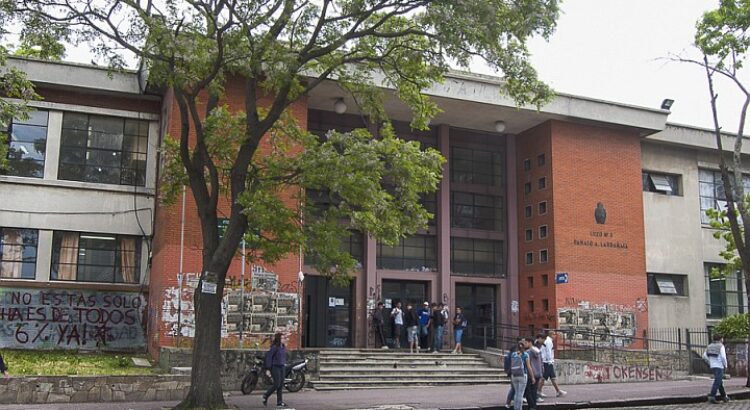
Será el martes 27 y el miércoles 28. El miércoles también hay paro de la Coordinadora de Sindicatos de la Enseñanza y ocupan el liceo Dámaso.

La Asociación de Docentes de Educación Secundaria (ADES) de Montevideo resolvió en asamblea convocar a un paro de 48 horas el próximo martes 27 y miércoles 28 de octubre.

La medida se toma en el marco de la discusión en el Parlamento de la ley de presupuesto.

Además, el liceo Dámaso Antonio Larrañaga de La Blanqueada será ocupado el miércoles 28, informa Montevideo Portal.

Sumando fuerzas

También ese miércoles está previsto un paro de la Coordinadora de Sindicatos de la Enseñanza y del Departamento de Funcionarios Públicos del PIT-CNT, que incluye una movilización frente al Palacio Legislativo.

El sindicato de profesores de Montevideo se suma a ese paro de 24 horas y agrega otro el día previo.

Fuente e Imagen: https://www.republica.com.uy/sindicato-de-profesores-de-secundaria-anuncia-dos-dias-de-paro-la-semana-que-viene-id794930/

Comparte este contenido:

Kenya: School heads to ensure next year’s candidates return to school

Africa/Kenya/25-10-2020/Author:Muraya Kamunde/Source: www.kbc.co.ke

All school heads in the country have been tasked to ensure that all students who sit for their KCPE and KCSE exams next year return to school.

University Education and Research Principal Secretary Amb. Simon Nabukwesi who was on weeklong visit to several learning institutions in Nyanza and Western Kenya regions to assess the learning progress observed that some learners had failed to report to their respective schools.

School Principals in the affected institutions cited pregnancies as some of the reasons to why some female students failed to turn up as they were nursing their babies whereas a few male students had engaged in business and absconded class.

The PS asked school heads to liaise with their parents and guardians to ensure all students return to school.

The University Education PS said the Government is concerned about the safety, hygiene and health of both learners and teachers and is currently monitoring the progress of the partial school re-opening in all counties to ascertain that the Covid-19 measures and protocols have been adhered to.

“Covid-19 pandemic is here with us but our lives have to continue, I urge you to observe the required protocols such as social distancing, frequent hand washing, wearing of face masks to avoid getting infected,”  he said.

The PS noted that public institutions had challenges but assured the school Heads that the Government is doing its best to ensure funds are availed to aid in the expansion of facilities and purchase of Covid-19 prevention requirements.

Source and Image: https://www.kbc.co.ke/school-heads-to-ensure-next-years-candidates-return-to-school/

Comparte este contenido:
Page 996 of 6145
1 994 995 996 997 998 6.145