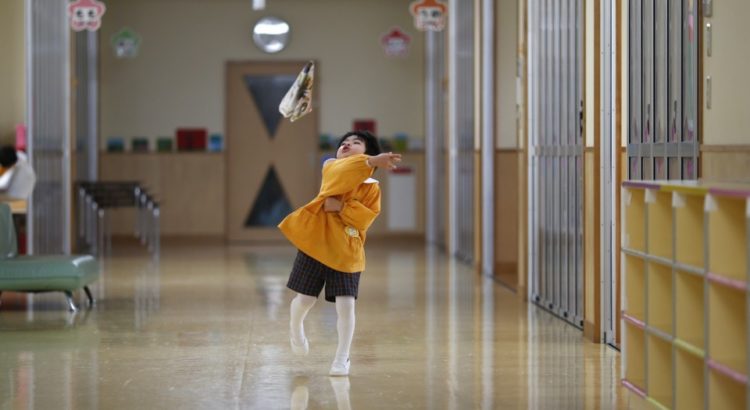
Japón/Agosto de 2017/Fuente: The Atlantic
Resumen: En muchos países, incluidos los Estados Unidos, los antecedentes económicos de los estudiantes a menudo determinan la calidad de la educación que reciben. Los estudiantes más ricos tienden a ir a las escuelas financiadas por altos impuestos a la propiedad, con instalaciones de primera categoría y personal que les ayudan a tener éxito. En los distritos donde viven los estudiantes más pobres, los estudiantes a menudo obtienen instalaciones de mala calidad, libros de texto obsoletos y menos consejeros de orientación. No en Japón. Según la Organización para la Cooperación y el Desarrollo Económicos (OCDE), un grupo de 35 países ricos, Japón ocupa un lugar destacado entre sus pares en proporcionar a sus estudiantes ricos y pobres con igualdad de oportunidades educativas: La OCDE estima que en Japón sólo alrededor del 9 por ciento De la variación en el rendimiento estudiantil se explica por los antecedentes socioeconómicos de los estudiantes. El promedio de la OCDE es del 14 por ciento, y en los Estados Unidos, del 17 por ciento. «En Japón, usted puede tener áreas pobres, pero usted no tiene escuelas pobres,»
In many countries, the United States included, students’ economic backgrounds often determine the quality of the education they receive. Richer students tend to go to schools funded by high property taxes, with top-notch facilities and staff that help them succeed. In districts where poorer students live, students often get shoddy facilities, out-of-date textbooks, and fewer guidance counselors.
Not in Japan. According to the Organization for Economic Co-operation and Development (OECD), a group of 35 wealthy countries, Japan ranks highly among its peers in providing its rich and poor students with equal educational opportunities: The OECD estimates that in Japan only about 9 percent of the variation in student performance is explained by students’ socioeconomic backgrounds. The OECD average is 14 percent, and in the United States, it’s 17 percent. “In Japan, you may have poor areas, but you don’t have poor schools,”
John Mock, an anthropologist at Temple University’s Japan campus, told me.
Perhaps as a result, fewer students in Japan struggle and drop out of school—the country’s high-school graduation rate, at 96.7 percent, is much higher than the OECD average and the high-school graduation rate in the United States, which is 83 percent. Plus, poorer children in Japan are more likely to grow up to be better off in adulthood, compared to those in countries like the U.S. and Britain (though Scandinavian countries lead in this regard). “It’s one of the few [education] systems that does well for almost any student,” Andreas Schleicher, who oversees the OECD’s work on education and skills development, told me, adding, “Disadvantage is really seen as a collective responsibility.”
For instance, in the village of Iitate, which was evacuated after being contaminated by radiation after the Fukushima nuclear-power-plant disaster in March 2011, many families still have not come back. Piles of contaminated soil, covered up, still dot the landscape, and many homes are shuttered. The local primary school has just 51 students, compared to more than 200 before the accident. Yet the quality of education given to returnees is top-notch. The government built a new school for students outside the radiation zone, in a town called Kawamata, and though the classes are still very small—first grade has only two students—the school is well staffed. In a classroom I visited, all five second-graders in the school watched a teacher demonstrate flower-arranging as three other teachers surrounded them, helping them with each step. In another, a math teacher quizzed students on odd and even numbers, and as the students split into groups to discuss a problem on the board, another teacher leaned in to help. Walking around the school, it almost seemed there were as many teachers as students.
“The quality of education is better than before March 11th [2011],” Tomohiro Kawai, a parent of a sixth-grader and the president of the school’s parent-teacher association, told me, citing the low student-teacher ratio. Many of the children who returned to the area are from single-parent families, a group prone to struggling economically; some parents moved back to Iitate because they needed help from their own parents in watching their children, according to Satoko Oowada, one of the school’s teachers. But the federal government takes pains to prevent economic hardship from affecting the quality of students’ education. It gave a grant to Iitate so that all students in the school would get free lunch, school uniforms, notebooks, pencils, and gym clothes. “Equality of education is very important for children in Iitate Village,” the school’s principal, Takehiko Yoshikawa, told me. “Everywhere, students receive the same education.”
The equity in Iitate stands in stark contrast to a place like New Orleans, which was also hit by a disaster. While Japan’s national government tried to ensure that students in the affected area got more resources after the accident, officials in New Orleans disinvested in the public educational system in their city. Public-school teachers were put on leave and dismissed, many students disappearedfrom schools’ rolls, and the New Orleans system now consists almost entirely of charter schools. (To be sure, New Orleans is something of an outlier—districts in New York and New Jersey, for example, received federal money to help deal with Hurricane Sandy’s impact on education.)
There are a number of reasons why Japan excels in providing educational opportunities. One of them is how it assigns teachers to schools. Teachers in Japan are hired not by individual schools, but by prefectures, which are roughly analogous to states. Their school assignments within the prefecture change every three years or so in the beginning of their careers, and then not quite as often later on in their careers. This means that the prefectural government can make sure the strongest teachers are assigned to the students and schools that need them the most. “There’s a lot going on to redirect the better teachers, and more precious resources, towards the more disadvantaged students,” Schleicher said.
It also means that teachers can learn from different environments. Young teachers are exposed to a series of different talented peers and learn from their methods. That’s a big contrast to some place like the United States, said Akihiko Takahashi, a onetime teacher in Japan and now an associate professor of elementary math at DePaul University’s College of Education. “Here in the U.S., the good teachers go to the good schools and stay there the whole time,” he told me.
Japan’s educational equality is also a matter of how funds are distributed. Teacher salaries are paid from both the national government and from the prefectural government, and so do not vary as much based on an area’s median household earnings (or, more often, property values). The same goes for the funding of building expenses and other fees—schools get more help from the national government than they would in the U.S. According to Takahashi, the Japanese educational system aims to benefit all students. “Their system is really carefully designed to have equal opportunity nationwide,” he said. This contrasts with the U.S. education system, he said, which he judges to raise up the best students but often leave everyone else behind.
What’s more, Japan actually spends less on education than many other developed countries, investing 3.3 percent of its GDP in education, compared to the OECD average of 4.9 percent. It spends $8,748 per student at the elementary school level, compared to the $10,959 that the United States spends. But it spends the money wisely. School buildings are not much to look at. Textbooks are simple and printed in paperback, and students and teachers are responsible for keeping schools clean. Japan also has fewer administrators on campuses—there is usually just a principal and a few vice principals, and not many others in the way of staff.
Despite the country’s relatively low spending on education, Japan’s teachers are paid more than the OECD average. And the profession has high barriers to entry: Much like the bar exam for American lawyers, Japan’s teacher entrance exams, which are administered by prefectures, are very difficult. Oowada told me she took the Fukushima Prefecture teaching exam five times before she passed it. She’s now a permanent teacher, guaranteed a pension and a job in the prefecture until age 60; she said that the year she passed, 200 people took the test, and only five passed. (Her co-teacher, Yuka Iinuma, had still not passed the test, and was working as a one-year contract teacher, moving from school to school each year. Many people who think they want to become teachers eventually give up when they can’t pass the exam, Oowada and Iinuma told me.) And even after their full certification, teachers have an incentive to perform better and better, as every three years they get reviewed for a promotion.
There are of course some downsides to being a teacher in Japan. Because they feel responsible for all students in their classes, teachers often spend lots of time outside of normal hours helping students who are falling behind. Yoshikawa, the school principal, told me of a teacher from Iitate who, when there was a gasoline shortage that prevented him from driving, rode his bike 12 miles to school each day from the evacuation zone to Kawamata, which includes an impressively hilly stretch. One teacher in Tokyo I talked to, who didn’t want her name used, said it wasn’t uncommon to work from 7 a.m. to 7:30 p.m., and said some teachers stayed until 9 at night. (There are teachers’ unions in Japan, but their power has eroded somewhat in recent years.)
Still, Japanese teachers are rewarded with a great deal of autonomy on how to improve student outcomes, Takahashi said. In a process called a “lesson study,” teachers research and design a new lesson over a set time period, and then present it to other teachers, who give feedback. Teachers also join together to identify school-wide problems, and organize themselves into teams to address those problems, sometimes writing a report or publishing a book on how to solve them, he said. “It’s not about an individual star teacher, but about teamwork,” he said.
Schleicher says that teachers’ focus on pedagogy contributes to the Japanese education system’s equality. The emphasis, he says, is not as much on absorbing content as it is on teaching students how to think. “They really focus on problem-solving, which means the ability to attack problems they had never seen before,” Takahashi said. In subjects like math, Japanese teachers encourage problem-solving and critical thinking, rather than memorization. For instance, Japanese students were explicitly taught how to solve just 54 percent of the problems on the international Trends in International Mathematics and Science Study (TIMSS) test, but received an average score of 565, according to the Lesson Study Alliance, an education nonprofit. Students in the U.S. were explicitly taught how to solve 82 percent of the problems, yet received a lower average score, 518. Ironically, some of these Japanese teaching methods came from the United States—in particular, from an American group, the National Council of Teachers of Mathematics, which urged American teachers to change their methods throughout the 1980s. But it was Japanese teachers who listened to this advice.
Japan’s educational equality is also a matter of how funds are distributed. Teacher salaries are paid from both the national government and from the prefectural government, and so do not vary as much based on an area’s median household earnings (or, more often, property values). The same goes for the funding of building expenses and other fees—schools get more help from the national government than they would in the U.S. According to Takahashi, the Japanese educational system aims to benefit all students. “Their system is really carefully designed to have equal opportunity nationwide,” he said. This contrasts with the U.S. education system, he said, which he judges to raise up the best students but often leave everyone else behind.
What’s more, Japan actually spends less on education than many other developed countries, investing 3.3 percent of its GDP in education, compared to the OECD average of 4.9 percent. It spends $8,748 per student at the elementary school level, compared to the $10,959 that the United States spends. But it spends the money wisely. School buildings are not much to look at. Textbooks are simple and printed in paperback, and students and teachers are responsible for keeping schools clean. Japan also has fewer administrators on campuses—there is usually just a principal and a few vice principals, and not many others in the way of staff.
Despite the country’s relatively low spending on education, Japan’s teachers are paid more than the OECD average. And the profession has high barriers to entry: Much like the bar exam for American lawyers, Japan’s teacher entrance exams, which are administered by prefectures, are very difficult. Oowada told me she took the Fukushima Prefecture teaching exam five times before she passed it. She’s now a permanent teacher, guaranteed a pension and a job in the prefecture until age 60; she said that the year she passed, 200 people took the test, and only five passed. (Her co-teacher, Yuka Iinuma, had still not passed the test, and was working as a one-year contract teacher, moving from school to school each year. Many people who think they want to become teachers eventually give up when they can’t pass the exam, Oowada and Iinuma told me.) And even after their full certification, teachers have an incentive to perform better and better, as every three years they get reviewed for a promotion.
There are of course some downsides to being a teacher in Japan. Because they feel responsible for all students in their classes, teachers often spend lots of time outside of normal hours helping students who are falling behind. Yoshikawa, the school principal, told me of a teacher from Iitate who, when there was a gasoline shortage that prevented him from driving, rode his bike 12 miles to school each day from the evacuation zone to Kawamata, which includes an impressively hilly stretch. One teacher in Tokyo I talked to, who didn’t want her name used, said it wasn’t uncommon to work from 7 a.m. to 7:30 p.m., and said some teachers stayed until 9 at night. (There are teachers’ unions in Japan, but their power has eroded somewhat in recent years.)
Still, Japanese teachers are rewarded with a great deal of autonomy on how to improve student outcomes, Takahashi said. In a process called a “lesson study,” teachers research and design a new lesson over a set time period, and then present it to other teachers, who give feedback. Teachers also join together to identify school-wide problems, and organize themselves into teams to address those problems, sometimes writing a report or publishing a book on how to solve them, he said. “It’s not about an individual star teacher, but about teamwork,” he said.
Schleicher says that teachers’ focus on pedagogy contributes to the Japanese education system’s equality. The emphasis, he says, is not as much on absorbing content as it is on teaching students how to think. “They really focus on problem-solving, which means the ability to attack problems they had never seen before,” Takahashi said. In subjects like math, Japanese teachers encourage problem-solving and critical thinking, rather than memorization. For instance, Japanese students were explicitly taught how to solve just 54 percent of the problems on the international Trends in International Mathematics and Science Study (TIMSS) test, but received an average score of 565, according to the Lesson Study Alliance, an education nonprofit. Students in the U.S. were explicitly taught how to solve 82 percent of the problems, yet received a lower average score, 518. Ironically, some of these Japanese teaching methods came from the United States—in particular, from an American group, the National Council of Teachers of Mathematics, which urged American teachers to change their methods throughout the 1980s. But it was Japanese teachers who listened to this advice.
Japan’s schools can also be extremely stressful places for students, who are sometimes bullied if they fall behind. “As long as I performed well in school, things were okay. But once I started to deviate just a little—they [parents and teachers] went to the extreme and started treating me incredibly coldly,” one student told Anne Allison, a cultural anthropologist at Duke University who has written extensively on Japan. Japanese students are also expected to belong to after-school clubs for sports or dance, which can keep them at school until 6 p.m. “When they come home, it’s already dark and all they have left to do is eat dinner, take a bath and do their home assignment and sleep,” the Tokyo teacher told me.
Despite these flaws, Japan’s educational system still sets an example for other countries to follow. That’s partly because Japan has different goals for its schools than somewhere like the United States does. “The Japanese education system tries to minimize the gap between the good students and everyone else,” Takahashi told me. That means directing more resources and better teachers to students or schools that are struggling. It also means giving teachers the freedom to work together to improve schools. This could be difficult to transplant to the United States, where education has long been managed on a local level, and where talk of sharing resources more often leads to lawsuits than it does to change. But Japan’s success is relatively recent, according to Schleicher. About 50 years ago, Japan’s schools were middling, he said. Countries can make their schools more equitable. They just need to agree that success for all students is a top priority.
Fuente: https://www.theatlantic.com/business/archive/2017/08/japan-equal-education-school-cost/535611/





 Users Today : 10
 Total Users : 35462323
 Views Today : 16
 Total views : 3423748