Page 4339 of 6757
1 4.337 4.338 4.339 4.340 4.341 6.757

26th International Conference on Teaching, Education and Learning (ICTEL), 08-09 Nov 2017, Singapore

Date: 08-Nov-17 to 09-Nov-17
Location: Nanyang Technological University / Singapore / Singapore
Category: Education Conferences & Trade Fairs
Conference Name: 26th International Conference on Teaching, Education and Learning (ICTEL), 08-09 Nov 2017, Singapore
Conference Dates: 08-09 Nov 2017
Conference Venue: Nanyang Technological University, Nanyang Executive Centre, Singapore
Deadline for Abstract/Paper Submissions: Nov 5, 2017
Contact E-Mail ID: info@adtelweb.org
Association President: Prof. Vivian Iglesia-Buhain
Language: English
(Vernacular Session, e.g., Persian, Bahasa, Thai, European Languages, Chinese, will be organized for minimum 5 or more participants of particular language)
(Only english language, full-length, original papers will be considered for publication in conference journals)

Visitors

Professors, Scholars, Researchers, Students

Exhibitors

Professors, Scholars, Researchers, Students
Source:
http://www.einnews.com/event/46252/26th_international_conference_on_teaching_education_and_learning_ictel_08_09_nov_2017_singapore
Comparte este contenido:

WomenStrong International Launches Menstrual Education Campaign to Reduce Obstacles Preventing Impoverished Girls from Finishing School

Africa – Asia – North America – Central America/23 may 2017/By: WomenStrong International/Source: http://www.kait8.com

WomenStrong International, a consortium of non-profit organizations in five nations supporting women-driven solutions to extreme urban poverty, today launched a campaign to increase menstruation education and reduce obstacles preventing girls from getting the education they need to create better, more prosperous lives.

WomenStrong invited those who care about women and girls to join #WomenStrongWarrior on Menstrual Hygiene Day, May 28, and support the fight for access to menstrual and reproductive health education, sanitary pads and basic facilities, such as school toilets.

«Our experience working with adolescent girls in sub-Saharan Africa and India demonstrates the importance of education, which is everything to a girl hoping for a better life,» said Dr. Susan M. Blaustein, WomenStrong Founder and Executive Director. «We call on schools, local governments, multilateral institutions, policymakers and international development organizations to help create a world where menstrual health is a human right and girls can grow up with dignity and joy in their womanhood.»

Studies show that most girls don’t receive the information they need on changes that occur at puberty and don’t have money to buy sanitary products. These gaps become insurmountable barriers to school attendance. Yet, education is known to be the most critical factor in a woman’s ability to delay marriage, survive childbirth, raise healthier and better-educated children, and emerge from poverty.  When a girl misses a week of school each month because of her period, or drops out, she is condemned to a life without resources or dignity. The impact of losing this girl resonates in the national economy since educating girls is now known to be one of the highest yielding investments in the economic growth of developing countries.

WomenStrong’s Consortium members working at the community level in the slums of Kisumu, Kenya; Kumasi, Ghana; and Madurai, India, have established Girls’ Clubs, providing thousands of adolescent girls with a safe place to make friends, build confidence, learn about sexual and reproductive health and rights, and exchange information with peers and mentors.  The Clubs have seen the substantial positive impact of training girls and boys on puberty and menstrual and reproductive health and hygiene. Including boys, men, mothers, teachers, health workers and others in trainings helps break the silence around menstruation, destroys negative myths and misinformation, and removes the stigma from this natural biological process.

But trainings alone aren’t enough. Girls also need school toilets with doors and locks for privacy, and basic menstrual supplies.  So, as often as possible, trainings are followed up with the provision of personal hygiene packs containing sanitary pads, soap and panties, all of which increase a girl’s chances of staying in school.

Research funded by The Bill and Melinda Gates Foundation found that 65% of Kenyan women and girls were unable to afford sanitary pads and often resorted to using rags or even leaves, the source of a variety of health risks. Families living on less than $2 per day are faced with choosing between buying sanitary pads for their daughters or food for the family.

«To a young girl, the obstacles seem huge, simply overwhelming. Confusion, embarrassment, no money to buy the supplies so many of us take for granted.  But it really takes so little to change a girl’s life,» Dr. Blaustein said.  «Even a small contribution makes a big difference to a girl, now and for years to come.»

  • $12 can buy a girl a year’s worth of sanitary pads
  • $25 pays for two packets of sanitary pads, a monthly recording chart and pencil
  • $50 buys a menstruation kit, with a year’s worth of pads, panties and soap
  • $100 buys a girl a menstruation kit for two years
  • $200 provides menstruation kits for four girls in a WomenStrong location of the donor’s choosing

#WomenStrongWarrior is a part of a growing global movement calling for menstrual hygiene education that informs and empowers girls and women to make decisions on managing their own bodies. Organizations and governments are calling for menstruation education to be part of national school curricula, as well as policies and programs for teen boys and girls.

For more information on WomenStrong International, and to stay updated on program news, innovations and stories that inspire from around the world, please visit www.womenstrong.org or follow us on Facebook, Twitter or Instagram.

ABOUT WOMENSTRONG INTERNATIONAL
WomenStrong International is a consortium of non-profit organizations in five nations supporting women-driven solutions to extreme urban poverty. WSI emerged from a decade of work at Columbia University’s Millennium Cities Initiative where we found the most successful programs were local and led by women. Through our Consortium members in Ghana, Kenya, Haiti, India and Washington, D.C., we help thousands of women and girls meet their 6 Essential Needs for health, shelter, safety, education, economic empowerment and a functioning urban environment. These women, in turn, improve the lives of their children, families, communities and nations. WomenStrong International believes the path out of poverty and toward a more just and prosperous world can be found by making women strong. For more information, visit www.womenstrong.org.

Media Contacts:
Melissa DiMercurio
Public Relations Manager
mdimercurio@delucchiplus.com

Natalie Dudas-Thomas
WomenStrong International
ndudasthomas@womenstrong.org

To view the original version on PR Newswire, visit:http://www.prnewswire.com/news-releases/womenstrong-international-launches-menstrual-education-campaign-to-reduce-obstacles-preventing-impoverished-girls-from-finishing-school-300460882.html

Source:

http://www.kait8.com/story/35485232/womenstrong-international-launches-menstrual-education-campaign-to-reduce-obstacles-preventing-impoverished-girls-from-finishing-school

Comparte este contenido:

EEUU: River Terrace farmers market prepares special education students for jobs

EEUU/23 may 2017/By:

 Main picture description:

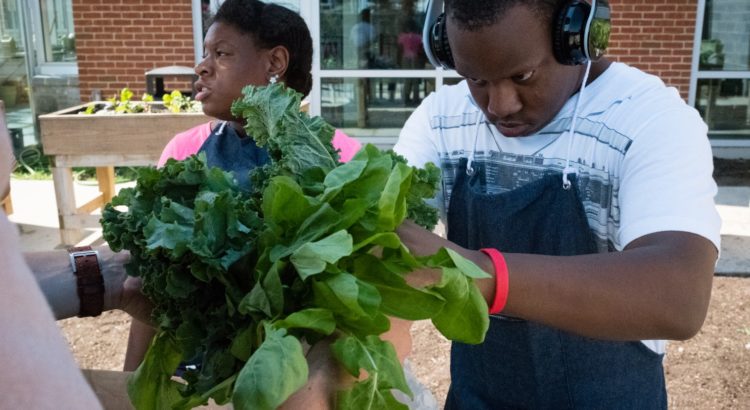
Jeanell Ward, 18, left, and Adrian Washington, 20, bag greens for customer orders. River Terrace Education Campus is a school for students with severe special education needs. (Sarah L. Voisin/The Washington Post)

————————–

Adrian Washington fills a large plastic bag with two cartons of ripe strawberries, potatoes, a bushel of kale and a few tomatoes.

He spends his Wednesday mornings this spring at River Terrace Education Campus’s farmers market in Southeast Washington filling orders for teachers and community members.

Some of the vegetables sold at the market are grown in the school’s greenhouse and garden. River Terrace, which opened in 2015, serves 130 D.C. students from kindergarten to high school who have severe physical or intellectual disabilities. It aims to give them more individualized attention and prepare older students for independent lives after graduation.

Washington, 20, who wears headphones and listens to rap music to help him focus on his work, is one of about a dozen students who run the market as part of the school’s horticulture program. They learn how to plant seeds, care for the seedlings as they grow into vegetables and plants and how harvest them. They also care for the school’s greenhouse and maintain its lawn and flower beds.

Many schools in the District and elsewhere have gardens that are used to teach students about healthy eating and the process of growing plants and vegetables. But the program at River Terrace goes a step further: It aims to give an often under-served population of students a chance to gain skills that they can use for permanent employment.

“I didn’t know what arugula was or what kale was, but I learned really fast,” Washington said. “I learned everything I needed to keep it growing.”

The horticulture program is part of the school’s workforce development training. Students from age 18 to 22 can choose to focus on hospitality, health sciences or, as Washington did, horticulture.

Washington said he once wanted to be a scientist so he could learn about chemicals and save people’s lives. But now he wants a career in landscaping.

“I like planting living things,” he said.

Kelly Custer, who is in charge of the horticulture program, said the goal is to prepare students like Washington to have a full-time job and to be able to take care of themselves by teaching them how to budget their money and dress for a job interview. Most of his students struggle to read and write and are several grade levels behind in their education.

The students in the program, who are paid a modest stipend as interns, work about 10 hours a week at local urban farms and on the school grounds. They help grow vegetables at the University of the District of Columbia’s greenhouse, which supplies some other local farmers markets.

They also clean up trash from the Anacostia River, near the River Terrace campus. In the winter, the students grew some wetland plants in their greenhouse, and in the next few weeks they will plant those near the river.

“We try to provide them a well-balanced experience in landscape and horticulture with the idea that they can get employment in the field,” Custer said.

On Tuesdays, Custer and the students walk around the neighborhood near the school distribute fliers to invite the locals to the market. But most of their clients are teachers and staff at the school.

The farmers market recently boasted crates of kale going for $2 for half a pound. Tomatoes went for $1 per pound. Arugula, potatoes and strawberries were also in stock. Most of the vegetables were brought in from local farms because the school’s plants were not ready to harvest.

It’s Washington’s job to ensure the orders get filled, and he serves as a mentor to the younger students. He takes the forms from teachers and other shoppers who have marked down how many crates of strawberries or bags of potatoes they want. The other students huddle around him as he tells them which veggies to place in the bag.

Once filled, he sends the bag to the teacher’s classroom with one of the students.

Meanwhile, other students are taking order forms, ensuring teachers place their money in the pink pencil case used to store their proceeds. Robert Cruz, 20, is busy sweeping dirt off the sidewalk, watering the Swiss chard plants and mopping the greenhouse.

He enjoys making sure everything is clean and in order. Custer said Cruz took it upon himself to sweep and mop the entire classroom when he heard The Washington Post was going to write about the market.

He expects to graduate from the program this summer, and was recently interviewed for a job at a local hotel.

“I like to work,” Cruz said.

Before noon, the students focused on filling 26 orders. Most of their fruits and vegetables sold out. But before they continued their work for the remainder of the day, Cruz, Washington and other students savored some sweet strawberries under the spring sun.

Comparte este contenido:

Oman’s education philosophy approved

Oman/23 may 2017/by ONA/Source/http://timesofoman.com

His Majesty Sultan Qaboos bin Said has approved the education philosophy which includes the main sources and the general aim and principles for education in the Sultanate, said Minister of the Diwan of Royal Court and Chairman of the Education Council.

The strategy will serve as a constructive reference for building national education policies and for guiding the development of all stages and types of education.

The Education Council on Monday held its second meeting of the year under the chairmanship of Sayyid Khalid bin Hilal Al Busaidi, Minister of the Diwan of Royal Court and Chairman of the Council.

The Council reviewed the measures taken with regard to pathways for the education system in the Sultanate and decided to continue study on this issue.

The Council also discussed the need for female teaching staff at the first cycle of basic education and means of meeting such needs, such as opening bachelor degree programme for this cycle, as well as take necessary measure to initiate this programme for preparing teachers for institutions in the Sultanate.

Within the framework of the efforts made to develop technical education and vocational training and enhance the level of its programmes to meet the economic needs of the Sultanate, the Council approved amending the names of vocational training centres to vocational colleges and change the name of the Fishermen Rehabilitation Institute in Al Khabourah’ to a professional college for maritime technologies and sciences.

The Council also discussed a proposal to provide children suffering from autism with high quality education and rehabilitation services that make them more adaptable with school environment.

The Council delegated the Ministry of Education with the task of taking necessary measure in this regard.

It also discussed providing private education and training institutions that are in the first category, as well as the training units at the higher education institutions with the licence to provide vocational diploma programmes. The Council gave instruction to complete necessary procedures in this regard.

Source:

http://timesofoman.com/article/109597/Oman/Government/Oman’s-education-philosophy-approved

Comparte este contenido:

España: Educación anuncia nuevas acciones contra el fracaso escolar para el próximo curso

España/22 mayo 2017/Fuente: La Provincia

«Nos hemos esforzado por lograr avances en todos y cada uno de los factores que inciden en la mejora del sistema escolar y en el aumento del éxito académico del alumnado», indicó ayer la consejera de Educación y Universidades del Gobierno de Canarias, Soledad Monzón, durante la presentación ante el Consejo Escolar, de la planificación y novedades más destacadas para el próximo curso 2017-2018.

Entre las mismas, figura dos programas dirigidos a combatir el fracaso escolar. En el primero, denominado Impulsa, 224 centros, seleccionados a través del número y características de alumnado con Necesidades Específicas de Atención Educativa (NEAE) y del Índice Social, Económico y Cultural (ISEC) del entorno, tendrán un refuerzo con 258 docentes dedicados en exclusiva a apoyar el progreso de las alumnas y alumnos con mayores dificultades, principalmente en las competencias lingüística y matemática.

Este programa está centrado en la etapa de Educación Infantil y los dos primeros cursos de Primaria, «que marcará una diferencia significativa en la tasa de éxito escolar, a través de una atención temprana a quienes más lo necesiten y que facilitará además el paso de una etapa educativa a la siguiente», apuntó Monzón.

Con este mismo fin, se implementará también el Programa Tránsito, dirigido a facilitar al alumnado el tránsito entre 6º de Primaria y 1º de la ESO. Con la participación de unos 50 docentes de apoyo, esta iniciativa permitirá además facilitar al profesorado la ampliación de sus competencias profesionales docentes y la aplicación de estrategias y metodologías que favorezcan el desarrollo de las competencias de Comunicación lingüística y la Competencia matemática y competencias en ciencia y tecnología del alumnado.

La finalidad de ambos programas entronca con el objetivo principal que se fijó la Consejería desde el inicio de esta Legislatura, como es el aumento de la equidad del sistema educativo canario. En este sentido, se reforzarán los Equipos de Orientación Educativa y Psicopedagógicos.

Fuente: http://www.laprovincia.es/sociedad/2017/05/21/educacion-anuncia-nuevas-acciones-fracaso/941074.html

Comparte este contenido:

Costa Rica insta a Centroamérica a atacar pobreza con visión multidimensional

Costa Rica/22 mayo 2017/Fuente: Terra

sta Rica expuso hoy, en un foro del Sistema de Integración Centroamericana (SICA), su experiencia en el abordaje de la pobreza con un índice multidimensional, e instó a la región a hacer lo mismo para generar movilidad social.

«Las políticas deben articularse en función de la carencia del ingreso, pero también de educación, salud, vivienda y empleo, utilizando el enfoque multidimensional e integral de la pobreza», expresó la vicepresidenta de Costa Rica, Ana Helena Chacón.

Este fue el punto clave de la exposición de la vicepresidenta costarricense durante el foro de un día «Pobreza multidimensional y ODS: Herramienta para la acción regional», realizado en Costa Rica en su condición de presidente pro témpore del SICA.

«Si seguimos midiendo la pobreza por ingreso, un mero subsidio hará que la persona ya no esté en la pobreza, pero no habremos generado la movilidad social para la transformación que necesitamos para que estas personas puedan vivir sin que sea solo el Estado el que haga cambios en sus vidas», afirmó Chacón.

La vicepresidenta destacó que los Objetivos de Desarrollo Sostenible y la Agenda 2030 tienen un robusto componente social que evidencia que con pobreza, desigualdad, hambre, sin educación y sin igualdad de género «será imposible que prosperemos».

«El Índice de Pobreza Multidimensional de la Universidad de Oxford da una visión amplia de las causas estructurales de la pobreza y no solo la ve como la carencia de un monto de dinero al mes», explicó Chacón.

Costa Rica acogió esta metodología en el 2015 y abarca datos de protección social, educación, vivienda, trabajo y salud, asociados al ingreso que determina la línea de pobreza.

La pobreza en Costa Rica afecta al 20,5 % de los hogares, el número más bajo de los últimos siete años.

El ministro de Desarrollo Humano e Inclusión Social de Costa Rica y presidente del Consejo de Integración Social Centroamericana, Emilio Arias, recordó que, según datos del 2014, 6 de cada 10 hogares centroamericanos tenían al menos una necesidad básica insatisfecha o se encontraban en pobreza, lo que hace necesario «un trabajo conjunto que trascienda las fronteras».

«En Costa Rica hemos logrado disminuir los índices de la pobreza y hoy aplicamos el Índice de la Pobreza Multidimensional como un instrumento que nos permite mediciones más allá del ingreso», comentó el ministro.

Al foro regional acudieron la vicepresidenta y canciller de Panamá, Isabel de Saint Malo; la vicepresidenta de República Dominicana, Margarita Cedeño; así como ministros y funcionarios de los países centroamericanos encargados de las políticas sociales.

La vicepresidenta panameña destacó los logros y planes para la erradicación de la pobreza multidimensional y la implementación de la Agenda 2030 en Panamá.

De Saint Malo resaltó que su país redujo la pobreza de 30 % en el 2007 a 23 % en el 2015, debido al sostenido crecimiento económico y a la consolidación de un Sistema de Protección Social Focalizado.

Fuente: https://www.terra.es/noticias/mundo/latinoamerica/costa-rica-insta-a-centroamerica-a-atacar-pobreza-con-vision-multidimensional,df9a8806137b04cb3043fb408cc0c9f2m5ktkux2.html

Comparte este contenido:

Argentina, Ministro de Educación Felipe de los Ríos: «El embarazo adolescente es un indicador de la deserción escolar»

Argentina/22 mayo 2017/Fuente: San Juan 8

El ministro de Educación estableció que el abandono escolar se ha abordado a través de diferentes programas nacionales y aún no se logra revertir las estadísticas. «La mejor escuela tiene que estar en la zona más carenciada y así se logrará romper con el circuito de la pobreza» dijo el funcionario.

Felipe de Los Ríos, ministro de Educación de la provincia, habló sobre la deserción escolar en San Juan y a nivel nacional y afirmó que uno de los factores que más afecta a esta problemática socio-educativa son los embarazos adolescentes.
 
«El embarazo adolescente es un indicador de deserción y ha sido abordado con infinidad de programas y aún no se logra revertir» dijo el funcionario. De todos modos también aclaró que hay otros factores para abandonar la escuela como la pobreza.
«La mejor escuela para romper con el circuito de la pobreza tiene que estar en la zona más carenciada» reconoció de los Ríos y explicó que si un alumno que tiene un entorno complejo pero asiste a un establecimiento digno con tecnología y equipamiento se preguntará si no merece eso para su futuro.
A nivel nacional y de acuerdo a los últimos datos de Unesco, solo el 43% de los estudiantes argentinos termina la escuela media en tiempo y en forma, mientras que países como Perú, con 70%, y Chile, con 68%, tienen un porcentajes más alto.
El futuro de cada chico dependerá, en gran medida, del lugar en que haya nacido o el tipo de escuela a la que haya asistido. Un informe del Centro de Estudios de la Educación Argentina muestra que el nivel de abandono en las escuelas públicas duplica al de las privadas.

Fuente: http://www.sanjuan8.com/san-juan/felipe-los-rios-el-embarazo-adolescente-es-un-indicador-la-desercion-escolar-n1400292.html

Comparte este contenido:
Page 4339 of 6757
1 4.337 4.338 4.339 4.340 4.341 6.757