Page 1750 of 6145
1 1.748 1.749 1.750 1.751 1.752 6.145

WC Education investigating alleged xenophobic attack at Salt River school

Africa/ 03.09.2019/ Fuente: www.capetalk.co.za.

A Grade 10 pupil at Salt River High School was attacked in an alleged bullying incident at the school following months of threats from her peers.

Speaking to Refilwe Moloto, Western Cape Education Department director of communications Bronagh Hammond says both pupils involved have been asked to stay at home.

Hammond says the ongoing investigations show that the girl who was attacked had classroom responsibilities.

Both learners have been asked to stay at home because of fact that when the learners were both there it sparked a protest action at the school.

— Bronagh Hammond, Director of Communications – Western Cape Education Department

The learner was a class monitor for quite a while and she was correctly putting down attendance levels of the learners involved and a few of the girls were getting agitated about this and that is where the tension arose.

— Bronagh Hammond, Director of Communications – Western Cape Education Department

Hammond says they will be investigating the xenophobia reports.

The learner that was attacked is from another African country and the other learners involved are from South Africa but that does not generally mean it could be xenophobia.

— Bronagh Hammond, Director of Communications – Western Cape Education Department

The school has been supportive of the girl who was attacked.

But I do think we need to provide her with trauma and social counselling support because she has gone through quite an ordeal.

— Bronagh Hammond, Director of Communications – Western Cape Education Department

Source of the notice: http://www.capetalk.co.za/articles/359664/wc-education-investigating-alleged-xenophobic-attack-at-salt-river-school

Comparte este contenido:

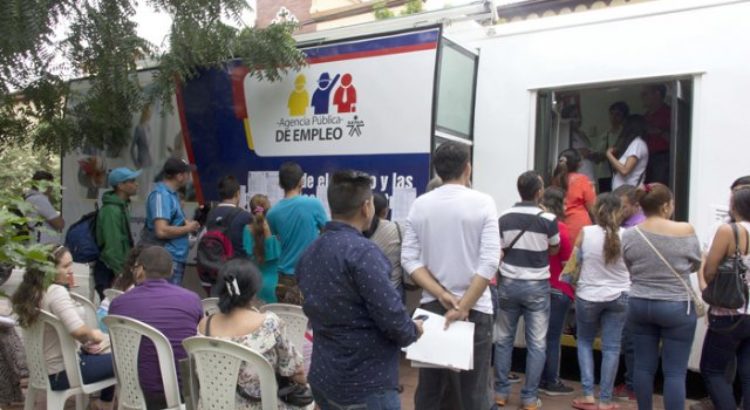
Educación para el empleo, un reto titánico

América del Sur/ Colombia/ 03.09.2019/ Fuente: www.laopinion.com.co.

En Cúcuta, uno de cada cuatro jóvenes entre 18 y 24 años ni trabaja ni estudia, según un estudio.

Una forma de medir el calibre aspiracional de una sociedad, sus líderes y ciudadanos, es saber qué tan comprometidos están con la educación y el empleo, en especial con sus jóvenes.

En Colombia existe una brecha gigantesca entre la formación académica y laboral frente a los espacios de empleabilidad que oferta el sector productivo. Es decir, no hay pertinencia de la educación, por falta de articulación educativa, colegio- empresa.

Según un estudio realizado por la Fundación Corona y la Red de ciudades Cómo Vamos, en Cúcuta, uno de cada cuatro jóvenes entre 18 y 24 años ni trabaja ni estudia, representando un problema en términos de ingresos, productividad y también aspectos sociales que limitan la reducción de las desigualdades.
 

El informe plantea un reto a los candidatos que aspiran a ocupar los proximos cargos gubernamentales, de impulsar una mejora sustancial de los índices de empleabilidad.

“En materia de género es aún más preocupante, porque para las mujeres el porcentaje es mayor. Esta preocupación de equidad de género se refleja en las brechas entre hombres y mujeres con educación técnica y tecnológica (TyT) que para el caso de Cúcuta en 2017 era del 7%”, explicó Mario Zambrano, director del programa Cúcuta Cómo Vamos.

La brecha salarial entre hombres y mujeres con formación T&T en la ciudad fue de 29,9%, ubicándose en el cuarto lugar.

Resultados preocupantes

Según Zambrano, el primer indicador para aproximarse al logro educativo de la población entre 18 y 24 años, son los años promedio de escolaridad total y por quintiles de ingreso de hogar para el año 2017.

En Cúcuta los años promedio de escolaridad con menores ingresos (el más pobre) son 9,7 y los de mayores ingresos son 12,6.

“Esto evidencia que el número promedio de años de escolaridad aumenta con el nivel de ingreso de los jóvenes (una brecha de 2,9). Los jóvenes de la ciudad con menores ingresos entran en condiciones desiguales, lo que afectará sus posibilidades no solo de engancharse laboralmente en mejores condiciones, sino en la realización exitosa de sus proyectos de vida”, agregó.

El economista explicó que Cúcuta ostenta una de las tasas de desempleo juvenil más altas del país (19,6%).

Lea además Empleos relativos al mercadeo, los más buscados

Por otro lado, quienes logran terminar una carrera universitaria entran a hacer parte de ese “ejército de reserva” en el mercado laboral.

La tasa de desempleo para profesionales es del 11,9%, y  según nivel educativo alcanzado, las ciudades con el menor porcentaje de población bachiller o con educación superior fueron Cúcuta (52,6%) y Pereira (59,6%).

“Temas claves como la desigualdad, la movilidad social y la pobreza son realmente un reto titánico para el territorio dadas estas cifras”, agregó Zambrano.

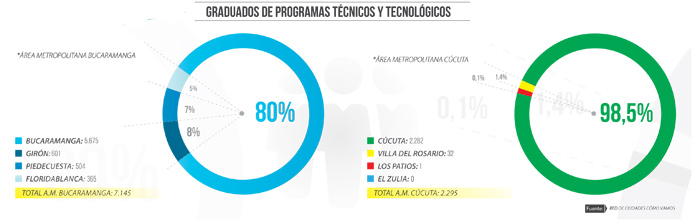
La ciudad también presenta el porcentaje más bajo de población con formación técnica y tecnológica T&T (7%), también la de menor ocupación con esta formación y la tasa de informalidad más alta con 44,4%.

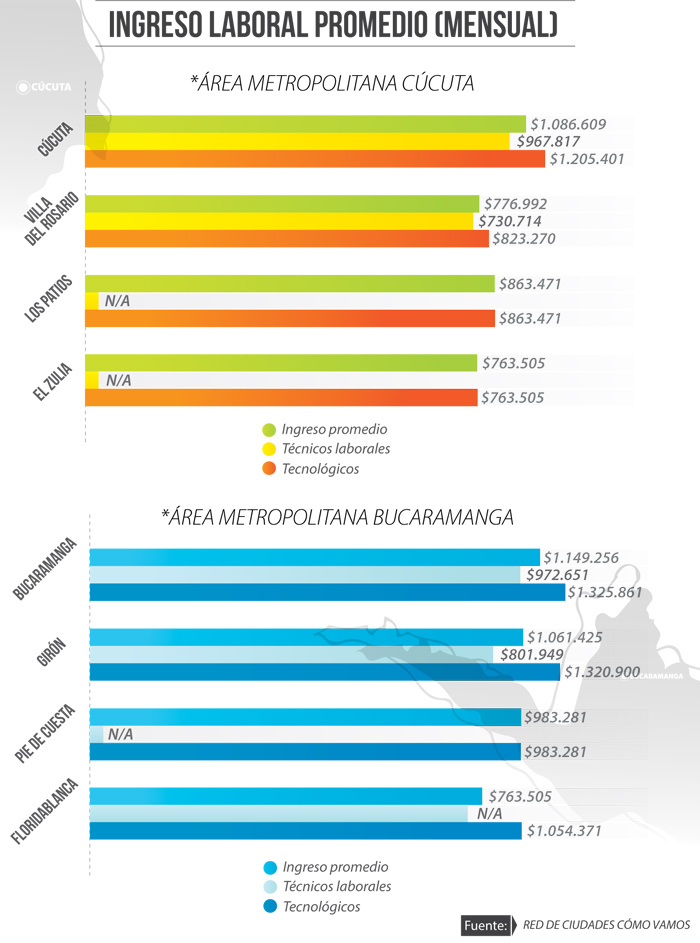
Por el lado de los ingresos mensuales según nivel educativo en T&T (25-64 años), el ingreso promedio es de 1,3 salarios mínimos legales vigentes (Ver gráficos).

Comparada con sus pares de la Red Cómo Vamos, Cúcuta se ubica entre los últimos tres puestos.
Baja formación en empleo  

Los representantes del sector empresarial y de la academia criticaron en su momento el papel que desempeñan los centros de formación en empleo en la ciudad.

Según los resultados del informe, el porcentaje de utilidad de estos cursos en Cúcuta es bajo, solo comparable con Quibdó.

Solo el 60% de la gente en Cúcuta manifestó que se sentía a gusto con el curso y que le había permitido mejorar su productividad laboral.

Sobre el tema, la secretaria de Educación de Cúcuta, Doris Angarita, señaló que la administración municipal hace control y vigilancia a estos centros educativos.

“Hemos cerrado muchos este año, les hacemos auditorías y no tienen el lleno de requisito que se les exige para ejercer tal actividad”, explicó la funcionaria.

Lea también Más personas están en edad de trabajar, pero el empleo no alcanza

Soluciones reales

La Fundación Corona cree que  el sector público y el privado deben estar articulados para la construcción y ejecución de esquemas novedosos que permitan proponer modelos de intervención social. Una de sus principales apuestas es promover la educación pertinente y el empleo inclusivo.

La pertinencia se determina por tres factores: las necesidades de los empleadores de talento humano en cada región, la congruencia con las necesidades y preferencias de los estudiantes, y el desarrollo del país a largo plazo. Si solo se trabaja en uno de estos factores no se logra un avance real, los territorios no progresan y las personas no mejoran su calidad de vida.

Fuente de la noticia: https://www.laopinion.com.co/economia/educacion-para-el-empleo-un-reto-titanico-182317#OP
Comparte este contenido:

Prueba Aprender: este martes 3 de septiembre evaluarán a 473 mil estudiantes secundarios

América del Sur/ Argentina/ 03.09.2019/ Fuente: www.perfil.com.

La evaluación nacional Aprender, impulsada por el Ministerio de Educación, Cultura, Ciencia y Tecnología, se realizará este martes 3 de septiembre en todas las escuelas secundarias de la Argentina y donde se evaluarán las áreas de Lengua y Matemática. Se espera que las respondan 473.000 estudiantes de 11.400 establecimientos educativos de todo el país.

En 2016, la Organización para la Cooperación y el Desarrollo Económico (OCDE) decidió excluir a la Argentina de su ranking internacional PISA (Programme for International Student Assessment, por su sigla en inglés) por no haber cumplido con los mínimos requisitos necesarios para ser evaluada en el marco de sus políticas educativas. Para el organismo internacional la muestra de estudiantes fue «insuficiente», pero lo concreto es que cada una de las pruebas que se venían efectuando en los últimos años, el nivel de los estudiantes argentinos se encontraba en el puesto 59.

El ex ministro Alberto Sileoni durante la presidencia de Cristina Fernández de Kirchner justificó entonces la exclusión de Argentina de la evaluación internacional en materia educativa conocida como PISA, señalando que «no mandamos algunas escuelas de la muestra anterior, porque esas escuelas no existen más, entonces, ésa es la explicación técnica».

Este miércoles 4, en tanto, se evaluará a otra muestra representativa de escuelas y en este caso responderán 21.600 estudiantes, en 300 escuelas de todo el país, sobre Ciencias Naturales y Educación Ciudadana. Desde la cartera correspondiente, a través de la Secretaría de Evaluación Educativa, se informó que lo que se busca es «generar información oportuna y de calidad para conocer los logros alcanzados y los desafíos pendientes en el sistema educativo», según consignó la agencia Noticias Argentinas.

En ese sentido detallaron: «De esta manera se busca aportar insumos que contribuyan al diseño de políticas educativas y la retroalimentación a las escuelas para promover procesos de mejora educativa continua y a disminuir las brechas de inequidad existentes». Educación: cómo acompañar a la escuela secundaria Con clases. Se aclaró asimismo que por la evaluación Aprender «no habrá suspensión de clases por lo que los estudiantes deberán asistir a la escuela en su horario habitual». Cifras. Del «operativo Aprender» participarán 35.450 personas: 942 coordinadores de cabecera 11.400 Directores-veedores  23.000 Docentes-aplicadores 108 Observadores Federales  En el censo del 3 de septiembre los estudiantes serán evaluados en Lengua y Matemática.  En la prueba primera, según se informó desde el ministerio, se evalúa «la comprensión lectora de diversos tipos de textos literarios y no literarios. Se indagará en tres capacidades cognitivas: interpretar, extraer y reflexionar y evaluar». Los tipos de textos evaluados serán cuentos breves de autores consagrados y textos expositivos de divulgación científica, textos argumentativos extraídos de diarios de circulación masiva e infografías. En relación a matemática se evalúa una capacidad cognitiva general que es «la resolución de problemas». En ese marco, revelaron: «A los efectos de la evaluación se indagará en las capacidades cognitivas incluidas en la resolución de problemas tales como reconocimiento de conceptos y propiedades, resolución de situaciones en contextos intramatemáticos o de la realidad y comunicación en Matemática. Los contenidos evaluados indagan en desempeños vinculados al número y sus propiedades, funciones, ecuaciones e inecuaciones, geometría y medida y estadística y probabilidad. Así cayó la inversión en educación en Argentina El miércoles 4 será el turno de Ciencias Naturales, donde «se evalúan las capacidades de Reconocimiento de conceptos, Comunicación y Análisis de situación. Los desempeños evaluados indagan en variadas temáticas referidas a los seres vivos, la materia, la energía y el medio ambiente». Por último, en la misma jornada será el turno de Educación Ciudadana, desde donde «se evalúan las capacidades de interpretar distintos tipos de fuentes, reconocer hechos, datos y conceptos y analizar situaciones o casos. Los contenidos evaluados indagan en aspectos vinculados con la Constitución de la Nación Argentina, la forma de gobierno, democracia y dictadura, autoridades nacionales, derechos y garantías, derechos humanos, el sistema electoral argentino, aspectos vinculados con identidad, violencia e igualdad de género y discriminación y educación vial». F.D.S./H.B. (Fuente www.perfil.com). El periodismo profesional es costoso y por eso debemos defender nuestra propiedad intelectual. Robar nuestro contenido es un delito, para compartir nuestras notas por favor utilizar los botones de «share» o directamente comparta la URL. Por cualquier duda por favor escribir a perfilcom@perfil.com

Fuente de la noticia: https://www.perfil.com/noticias/educacion/prueba-apender-martes-3-de-septiembre-en-argentina.phtml

Comparte este contenido:

Maestros inician huelga de hambre en el Palacio de Gobierno

América del Norte/ México/ 02.09.2019/ Fuente: www.multimedios.com.

Los docentes presentaron una prueba para ser directores y resultaron aptos, pero la Secretaría de Educación no les ha entregado los nombramientos, a pesar de que ya dio inicio el ciclo escolar.

Un grupo de maestros inició una huelga de hambre la noche del viernes en el Palacio de Gobierno para exigir que los dejen iniciar funciones como directores de diferentes planteles.

Los docentes presentaron una prueba donde resultaron aptos para ocupar la dirección de una escuela, sin embargo, la Secretaría de Educación no les ha entregado sus cargos, a pesar de que ya dio inicio el ciclo escolar.

Fuente de la noticia: https://www.multimedios.com/local/maestros-inician-huelga-de-hambre-en-el-palacio-de-gobierno

Comparte este contenido:

Australian state ends Chinese education program over foreign interference fears

Oceania/ Australia/ 02.09.2019/ Source: www.reuters.com.

Australia’s most populous state said it will ax a Chinese-funded education program that teaches Mandarin in schools amid fears over potential foreign influence.

The Confucius Institute program – administered by the Chinese government agency Hanban – teaches China’s official language in 13 public schools across New South Wales (NSW).

However, the NSW government said in a review issued late on Thursday that, while it found no specific evidence of interference, it was improper for the program to continue.

“The review found, however, a number of specific factors that could give rise to the perception that the Confucius Institute is or could be facilitating inappropriate foreign influence in the department,” the review said.

The government report said NSW was the only state government worldwide to have such a program and that the arrangement also placed Chinese government appointees inside the NSW education department.

The Chinese embassy in Canberra did not respond immediately to a request for comment.

NSW Education Minister Sarah Mitchell said the program would be replaced by Mandarin classes run by the state government.

Australia has in recent years sought to increase the teaching of Mandarin in schools in a bid to strengthen ties with its largest trading partner.

The removal of the program comes amid heightened concerns about Chinese activities in Australia and the neighboring Pacific region and a souring of relations in recent years.

In 2017, then prime minister Malcolm Turnbull accused China of meddling in Australia’s domestic affairs, a charge that Beijing denies.

Australia then further alienated China last year when it essentially banned the technology giant Huawei Technologies Co Ltd [HWT.UL] from supplying equipment for a 5G mobile network, citing national security risks.

China criticized that move as being politically motivated and urged Australia to abandon what it described as a Cold War mentality.

Australia has also moved in recent months to push back against China’s quest for greater influence in the Pacific.

Canberra fears Chinese lending in the region could undermine the sovereignty of small Pacific countries and has moved to increase economic aid and its diplomatic presence in the region.

At the same time, Australia has experienced disruption to its coal exports to China, including customs delays. China denies that Australian trade is being hampered because of bilateral tensions.


Source of the notice: https://www.reuters.com/article/us-australia-china-education/australian-state-ends-chinese-education-program-over-foreign-interference-fears-idUSKCN1VD009

Comparte este contenido:

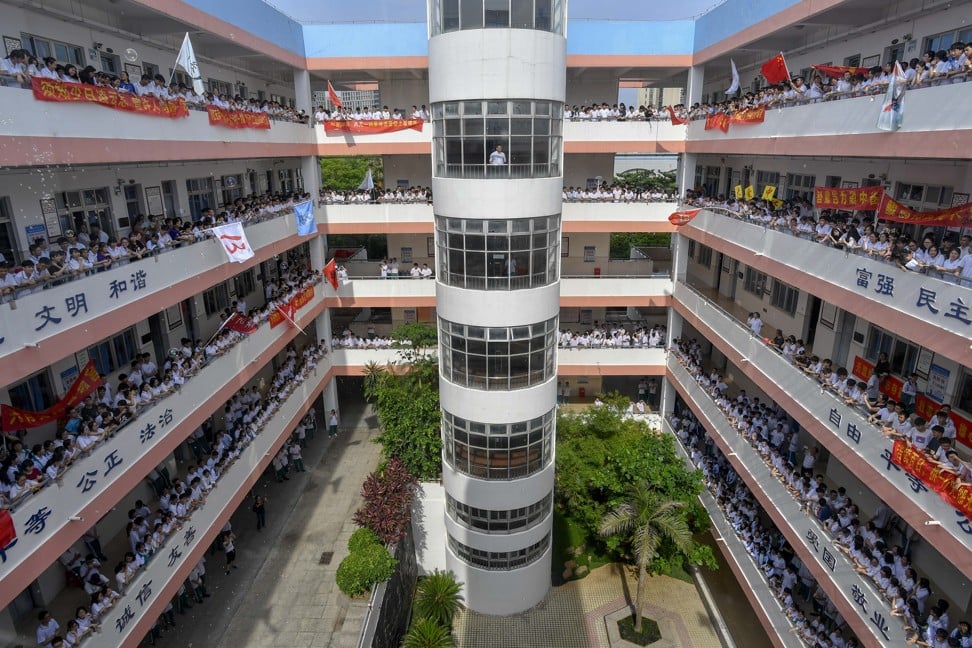
Shenzhen is set to be China’s new model city, so why are parents losing sleep over their children’s education?

Asia/ China/ 02.09.2019/ Source: www.scmp.com.

  • Only 35,000 students out of a total of nearly 80,000 were accepted into local public secondary schools last year for education between the ages of 16-18
  • Beijing’s new ambitious plan is to turn the home of the likes of Huawei, Tencent and DJI into a model city by 2035

Alice Xu’s worries about the education prospects of her nine-year-old daughter have caused sleepless nights over the last few days, and got so bad that the Shenzhen resident took herself to the doctors after hearing that fewer than half the children in the city are admitted to public secondary schools after completing the nine years of compulsory education.

“The doctor told me I’m not alone and that he had seen many patients like me who are anxious,” said Xu, who herself is a middle school teacher, teaching children aged between 14-16.

Her experience, and the experiences of other middle-class parents in China’s hi-tech capital threatens to tarnish Beijing’s plan to turn Xu moved to Shenzhen in 2005 as a young graduate, and has enjoyed the prosperity offered by the city’s rise. She now earns around 200,000 yuan (US$28,000) a year. Like many other citizens, she has always put her daughter’s education at the top of her priority list, given the common understanding that it is the only way to move up the social ladder in a highly competitive Chinese society. That meant paying 720 yuan (US$101) per hour for a one-on-one maths tutor for her daughter.

But despite her best efforts, the reality is that her daughter has more than a 50 per cent chance of failing to gain entry into an affordable and good-quality public school between the ages of 16-18 after completing her mandatory education.

“[We can only] talk and share the worries and depression anywhere and anytime,” she said, echoing the feelings of many helpless parents.

According to official data, only 35,000 students in Shenzhen out of a total of nearly 80,000 were accepted into local public secondary schools last year for education from 16-18, putting them on a path that would allow them to take the rigorous gaokao college entrance exam.

This leaves many forced to turn to expensive private secondary schools, and in some cases overseas establishments, while some leave Shenzhen to attend schools in their parent’s hometown with local authorities tending to focus on recruiting students who are born locally.

But taking into account private secondary schools, the chance of a child earning a place in a public secondary school would only rise to around 57 per cent. That would be just below the national average, but well behind the 86 per cent achieved in Beijing and the 69 per cent in neighbouring Guangzhou.

Shenzhen’s problem stems from its meteoric growth from a small fishing village of a few thousand in the 1980s to a city of 13 million, fed by a continuous inflow of domestic migrants, with the number of secondary schools failing to keep up with the expanding population.

The problem is also set to get worse as Shenzhen’s preschool system is already straining under the pressure of the city’s high birth rate. So, while Shenzhen is grabbing headlines for its impressive economic growth having grown bigger than neighbouring Hong Kong, and for being the home of prominent technology firms Huawei, Tencent and DJI, it is lagging in providing basic public services such as education.

The city has 344 primary schools, well below the 961 primary schools in Guangzhou, which has a comparable population of 15 million, according to official data. Guangzhou also has more primary school teachers – 44,749 compared to 27,795 – indicating its students are also receiving a better quality education.

A small group of delegates from the Shenzhen People’s Congress, the city’s ceremonial local legislature, have taken the unusual step of speaking in one voice to publicly urge increased investment in education, but the municipal education authority responded earlier this year that there is not enough land available to build new schools, according to local media reports.

Shenzhen’s problem stems from its meteoric growth from a small fishing village of a few thousand in the 1980s to a city of 13 million, with the number of secondary schools failing to keep up with the expanding population. Photo: Handout

One government official, who declined to be named as he is not authorised to speak to the media, said the municipal government does not support building new secondary schools because “it won’t be seen as a political achievement”.

“No district government in Shenzhen is willing to provide free or cheap land to build secondary schools,” the official said. Instead, land is often reserved for property developers or hi-tech projects that can boost local financial revenues and the political futures of the officials who support the projects, he added.

Shenzhen’s problems have been noticed by the central government, who, as part of its plan to make Shenzhen a model city, asked the city to expand its primary education services and to broaden its coverage of secondary school education.

Cici Deng, the mother of a 14-year-old girl in Shenzhen, said the underdeveloped public education services is tarnishing Shenzhen’s reputation as a model city. She added that the financial pressures of ensuring that a child obtains a place at a good public school can also be enormous.

“One method is to buy a flat near the school,” she said, because students living within a particular school district are automatically enrolled regardless of their exam scores.

Both teachers at the schools and other parents urge you to join after class education training programmes. That seems to be a must if a student wants to get a good scoreCici Deng

But that brings with it problems of its own for a middle-income household in the city because a three-bedroom flat can easily cost 10 million yuan (US$1.4 million).

In general, home prices in Shenzhen are broadly comparable with New York and Tokyo, with new homes selling at an average of about 5,100 yuan (US$712) per square foot, while those located near sought-after schools can cost up to 14,000 yuan (US$2,000) per square foot.

Alternatively, children who score in the top 44 per cent of the secondary school entrance exam are automatically enrolled. This is the method favoured by Deng, who is this month spending 12,000 yuan (US$1,675) to send her teenage daughter to a 15-day private tutorial session covering Chinese, maths and English which are the three key subjects covered by the exam.

“Both teachers at the schools and other parents urge you to join after class education training programmes,” said Li Yuchen, the mother of an eight-year-old boy. “That seems to be a must if a student wants to get a good score. Our children are always on their way to a class or going home after class.

“Because most children go to tutoring classes every day, your child would feel very bored at home if he doesn’t go because he won’t be able to find any peers to play with. Now, the situation in Shenzhen is particularly odd, that is, because children can only see friends and have partners in after school classes.

“Half of the mothers of my boy’s classmates quit their jobs and became full time moms to help their children study and score well. I also felt sharp chest pains after hearing that someone bought a house in a school district. It made me feel guilty about [not providing for] my child.”

Only 35,000 students in Shenzhen out of a total of nearly 80,000 were accepted into local public secondary schools last year for education from 16-18 years old. Photo: China News Service

Affluent families of primary and junior secondary school students have been paying between 100,000 (US$14,000) and 200,000 yuan per year for private schools that focus on English and internationally recognised diplomas to better prepare them for secondary schools and universities abroad.

But now, even they are worried about the risks of changing government policies after China’s education ministry announced in March its latest measures to prevent primary and junior secondary school students – either public or private – from enrolling in international schools or international sections of regular schools.

In addition, schools set up for the children of foreign workers are not allowed to admit any Chinese students, the ministry said.

“The uncertainty over China’s education policies is increasing,” said parent Cheng Li. “My child’s school just added many new Chinese compulsory education subjects to the curriculum to match the policy.

“We feel the climate for education, business, and society is turning conservative. We do worry about the change.”

Fuente de la noticia: https://www.scmp.com/economy/china-economy/article/3024730/shenzhen-set-be-chinas-new-model-city-why-are-parents-losing

Comparte este contenido:

Funding Sought for Emergency Education for Millions of Children in Crisis

Africa/ Cameroon/ 02.09.2019/ Source: www.voanews.com.

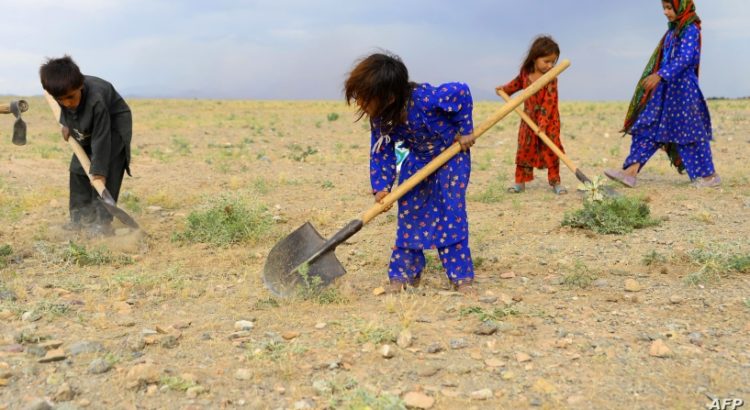
A global fund for education in emergencies is seeking $1.8 billion by 2021 to provide schooling for nine million children and youths caught in conflict and other situations of crisis.  The fund, called Education Cannot Wait was set up at the World Humanitarian Summit in 2016 to provide education for children deprived of this opportunity.

The Fund has raised $500 million since it began operating in 2017. In its first two years, it has provided emergency education for more than 1.5 million young people caught in armed conflict, forced displacement, natural disasters and other crises in 29 countries.

Director of Education Cannot Wait, Yasmine Sherif, said significant investments are being made in the Sahel, in countries such as Burkina Faso and Niger where the needs are among the greatest on earth. She said children in Cameroon have not gone to school for two years as a part of a tactic of war.

She told VOA education is specifically designed to deal with the suffering experienced by children caught in armed conflict, all of whom are seriously traumatized.

«So, quality education requires mental health and psycho-social services. That is number one. And, that is one of our absolute top priorities…Two. It requires inclusiveness and gender equality to ensure that every girl is put at the forefront, that they are not left the furthest behind of all those left furthest behind,» she said.

Sherif said the fund is working with the Government of Afghanistan to bring girls back to school. She said displaced children in Democratic Republic of Congo are being provided with an education now, so they do not have to wait until the conflict ends.

A recent report by the U.N. refugee agency finds half of the more than seven million refugee children in the world do not go to school. Sherif said almost 50 percent of the fund’s beneficiaries are girls. She said 46 percent are refugees and displaced youngsters and 14,000 are children with disabilities.

She said children who go to school are inoculated against many dangers.  She said those who do not have access to education, are at high risk of exploitation and abuse, sexual violence, early marriage and pregnancies, and forced recruitment by armed groups.

Fuente de la noticia: https://www.voanews.com/europe/funding-sought-emergency-education-millions-children-crisis

Comparte este contenido:
Page 1750 of 6145
1 1.748 1.749 1.750 1.751 1.752 6.145