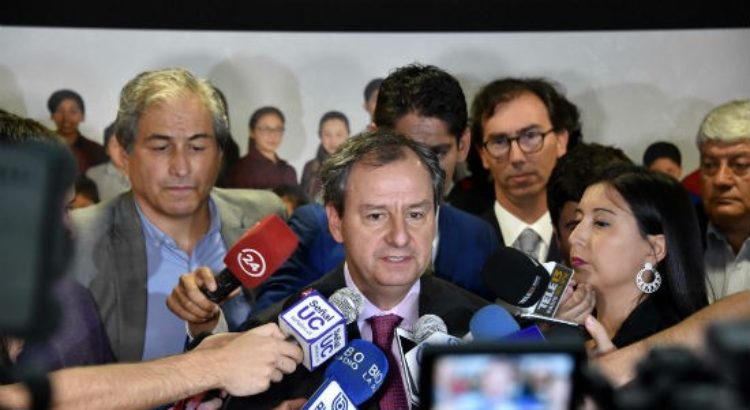
Este martes, y por cerca de una hora y media, el ministro de Educación, Gerardo Varela, se reunió con la directiva nacional del Colegio de Profesores, encabezada por su presidente Mario Aguilar.
Tras el encuentro, en el que también participó el subsecretario de Educación, Raúl Figueroa, y el jefe de la División de Educación General, José Palma, el secretario de Estado expresó que “ha sido una reunión muy productiva, muy franca. Además, hemos visto la lista de temas que preocupan al Colegio de Profesores, nosotros le hemos manifestado que en el centro del programa de Gobierno está la calidad, que la calidad se logra en el aula y que quienes lideran esa aula son los profesores, de manera que son la columna vertebral de recuperar la educación de calidad que nunca debimos olvidar”.
El ministro Varela también comentó que se creará una mesa de trabajo bilateral entre el Ministerio de Educación y el Colegio de Profesores, que tiene como objetivo debatir y ser un aporte en la implementación de las leyes aprobadas durante los últimos años. “Tenemos que tener una relación fructífera con los profesores, los niños lo demandan, la educación de calidad demanda, de manera que vemos como muy positivo el inicio de un diálogo”, expresó.
Finalmente, el ministro de Educación agradeció también la asistencia de la directiva. “Es bueno conocernos, es bueno saber que podemos trabajar juntos y que tenemos en común la búsqueda de la mejor calidad posible para los niños de Chile”, sentenció.
La realidad en las últimas décadas ha cambiado tanto que ha afectado también a nuestro estilo de educación. Cito algunos de estos cambios:
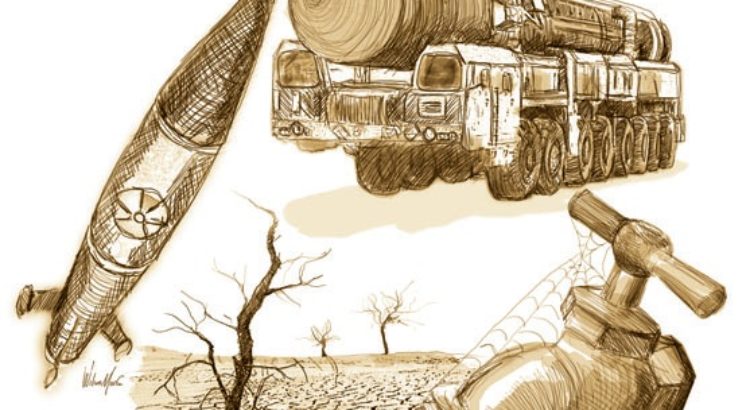
Hemos construido el principio de nuestra autodestrucción con armas nucleares, químicas y biológicas. Nada es absolutamente seguro y un accidente cualquiera puede destruir nuestra civilización.
El calentamiento global crece día a día. Si no hacemos nada, como la comunidad científica norteamericana ha advertido, podemos conocer dentro de algunos años un calentamiento abrupto de hasta 4-6 grados Celsius. Con eso, la mayoría de los seres vivos conocidos no resistirán y desaparecerán. Y parte de la humanidad también.
La escasez de agua potable (sólo el 0,3% es accesible a los seres humanos y a los animales) puede provocar guerras letales para garantizar el acceso a fuentes de agua dulce. O también alianzas de cooperación.
La planetización es un hecho nuevo en la historia de la Tierra y de la Humanidad. Salimos un día de África, donde estuvimos durante 4-5 millones de años y por eso somos todos africanos, y después nos esparcimos por los continentes; ahora estamos volviendo y encontrándonos en un solo lugar: la Casa Común, la Tierra.
La crisis ecológica afecta directamente al sistema-vida y al sistema-Tierra. Estamos destruyendo las bases físico-químicas que sostienen la vida. De continuar la sobrerexplotación de la Tierra, ella no aguantará y nuestra civilización estará amenazada.
Existe el peligro de que superbacterias que perdieron su hábitat por la deforestación puedan invadir ciudades y diezmar a miles de personas, sin que sepamos cómo enfrentarlas con potentes antibióticos.
Estos son datos, no fantasías. La gran mayoría de las personas no tiene conciencia de los peligros que corre. Es como en tiempos de Noé: todos se divertían y se reían del anciano, y vino el diluvio. Sólo que hoy es diferente: no tenemos un Arca de Noé que pueda salvar a algunos y dejar perecer a los otros. Todos podemos perecer.
Todo esto nos obliga a pensar sobre el futuro común de nuestra especie y de la Casa Común. Todo debe comenzar con una sensibilización general. En casa y en la escuela es donde tal nueva conciencia debe surgir.
Veamos qué tareas nuevas se presentan a los maestros y qué nueva percepción deben desarrollar en los educandos. Lógicamente la escuela debe llevar adelante su tarea básica, como la enunció la UNESCO:
(1) Aprender a conocer todo lo que el pasado nos legó. Como escribió Montaigne (1533-1592) en sus Ensayos: «el educador debe tener la cabeza sobre todo bien montada, más que bien llena». Es decir, saber la situación real de la Tierra y trasmitirla a los estudiantes;
(2) aprender a pensar, sabemos mucho y todo está en Google, pero no pensamos lo que sabemos. El saber es un poder que puede construir una bomba atómica o un antibiótico. El saber no es neutro. Pensar es detectar a quien sirve el saber y quiénes son los dueños del saber;
(3) aprender a vivir, que es crear un carácter recto, amante de la verdad, es ser un buen ciudadano participativo con un proyecto solidario de vida;
(4) aprender a convivir, pues hoy vivimos en medio de las mayores diferencias de raza, religión, ideas, opciones sexuales; no permitir que la diferencia se transforme en desigualdad; todos tienen derecho de vivir su modo de ser; importa estar abierto en las redes sociales al destino de los pueblos, muchas veces trágico como ahora en Siria; interesarse por el sufrimiento de los más pobres y excluidos;
(5) aprender a cuidar. Esto es nuevo pues sabemos que el cuidado es la ley básica de todos los seres vivos y también del universo; si no cuidamos del agua, la basura, de nosotros mismos y de las relaciones sociales, podemos dar espacio a la degradación; todo lo que amamos, lo cuidamos, y todo lo que cuidamos, lo amamos;(6) aprender a tener una ética y una espiritualidad. La religión puede ayudar pero no necesariamente, pues muchas hacen guerra y matan; ser ético es orientarse hacia el bien, asumir las consecuencias de nuestros actos, buenos o malos; optar por el bien común, por la verdad contra toda corrupción.
La espiritualidad es una dimensión antropológica, como lo es la razón, la voluntad y la libido; somos espirituales cuando planteamos preguntas últimas: ¿por qué estoy aquí, cuál es el sentido del universo, de la vida y de mi propia existencia…? Ser espiritual es desarrollar lo que neurólogos y neurolingüistas llaman el “punto Dios en el cerebro”: siempre que abordamos aspectos de lo sagrado y del sentido último de la vida hay una aceleración de nuestras neuronas; es el “punto Dios”, que nos permite intuir que por detrás de todas las cosas hay una Realidad amorosa y poderosa que sustenta todo, las estrellas y también nuestras vidas. El “punto Dios” está hecho de amor, de compasión, de solidaridad y de devoción; nos hace más sensibles a los otros, y más humanos; cultivar el “punto Dios” es superar el materialismo actual y nutrir la esperanza sobre el fin bueno de todo.
Los educadores deben imbuirse de estos nuevos desafíos y enseñárselos a sus educandos. Sólo así estaremos a la altura de los graves peligros que se nos presentan.
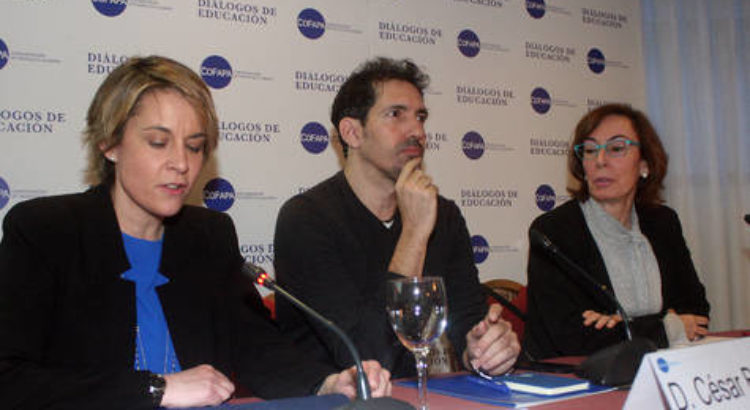
“Cuando los políticos se meten en la educación todo se complica porque tienen la ‘virtud’ de enfrentarse continuamente. Cuando la educación es cosa de los maestros, los niños y las familias, todo es más fácil”. César Bona (Zaragoza, 1972) no se ha andado con rodeos durante su intervención este miércoles en Madrid en los Diálogos de Educación que organiza la Confederación de Padres y Madres de Alumnos (COFAPA). El considerado el mejor maestro de España ha hablado alto y claro en un momento en el que toda la oposición ha abandonado la subcomisión creada en el Congreso de los Diputados para un pacto de estado educativo, dejando solos a PP y Ciudadanos. “El pacto es necesario y sería muy bueno”, ha dicho siempre Bona, “pero es vital que en el mismo participen también los docentes. Si no quedará cojo”.
Maestro y escritor, licenciado en Filología Inglesa y Diplomado en Magisterio en Lengua Extranjera, fue nominado, tras sus 16 años de trayectoria profesional, como uno de los 50 mejores maestros del mundo según el Global Teacher Prize. En mayo de 2017 formó parte del Jurado de los Premios Princesa de Asturias, en la categoría de Comunicación y Humanidades. Es autor de numerosas publicaciones que están sirviendo de referencia en muchas universidades y, sin duda, se ha convertido en un auténtico ‘gurú’ que llena auditorios allí por donde va. En su periplo madrileño de estos días, además del acto de Cofapa, que fue presentado por la presidenta de la organización, Begoña Ladrón de Guevara y la directora general de la Fundación Atresmedia, Carmen Bieger, ha participado en diversas conferencias en Móstoles, invitado por el ayuntamiento de la localidad, o en la Universidad de Alcalá de Henares, ante unos auditorios llenos y entregados a las enseñanzas de este maestro que está “deseando volver a las aulas, con los niños, cosa que haré en un año o año y medio”.
Esta mañana del miércoles 21 de marzo, ante un auditorio compuesto principalmente por docentes y padres de alumnos, César Bona ha dejado claro que apuesta por una escuela “pública, abierta y participativa” en la que “los niños se sientan como en casa y tengan ganas de volver al día siguiente al aula”. Y, sobre todo, una escuela cuyas enseñanzas “no sean en un 90% una transmisión de conocimientos memorísticos que se olvidan en 30 días. Hay que dar menos información y fomentar más la participación, que educa para la vida, que es su principal función”. Y es que “los principales problemas a los que nos enfrentamos los maestros son el currículum y la burocracia”.
Bona incidió una y otra vez durante su charla-coloquio, en que la escuela “no debe ser una burbuja sino una entidad abierta donde entran los niños y donde éstos deben de tener a su disposición unas gafas especiales para mirar. Educamos para la vida”, dijo, para sentenciar que todo el ciclo educativo no debe de estar enfocado, “como a veces parece”, a “ese examen, el examen de acceso a la universidad” porque “la etapa más importante en nuestra educación es la infantil, no la universidad”.
El maestro aragonés habló de la importancia de “sacrificar” en ciertos momentos el temario y los planes de estudios por tutorías y asambleas “para que los chicos se conozcan, conozcan a quién tienen a su lado, a su escuela, a su profesor… y puedan exponer en público sus preocupaciones, dialogar con el otro…” Es, “paradójico que en una etapa como la de secundaria, cuando el chico más necesita sentirse querido, encontrarse… no le dejemos hablar ni expresarse y le impongamos una batería de conocimientos con los que informamos más que educamos”.
César Bona habló también de la vocación de muchos maestros, de su “maravilloso trabajo”, y de que en la Universidad, se quejó, “nos imparten conocimientos, muchos conocimientos, pero no nos enseñan a saber tratar con las emociones humanas, a tratar con las personas, no nos dan los herramientas que necesitamos para educar a los niños y niñas”.
El maestro zaragozano habló también de la “extraordinaria importancia” de las familias en la formación de los niños “que es un trabajo en equipo entre la familia y la escuela”. La frase de que en la familia se educa y en la escuela se enseña «ha hecho mucho daño”, aseguró, y “ha levantado un muro entre ambos estamentos, cuando la educación y formación de un niño es un trabajo en equipo”.
Bona también quiso poner en valor a la escuela española porque, “con sus problemas”, aquí “también se hacen cosas muy buenas en educación, peor a veces tenemos la tentación de fijarnos sólo en lo que está muy lejos, por ejemplo en Finlandia” (considerada en muchas clasificaciones la mejor educación del mundo), “sin ver lo bueno que hacemos aquí”. César Bona, en fin, pronunció una nueva conferencia sobre educación que podría resumirse en las siguiente frase: “Hay que terminar con esa frase de que tengo que entrar en el aula y cerrar la puerta, es lo contrario: voy a entrar en mi aula y abrir la puerta, voy a compartir porque no educamos individuos sino entes sociales para la vida”.
Centro América/Puerto rico/22 Marzo 2018/Fuente: Telesur Tv
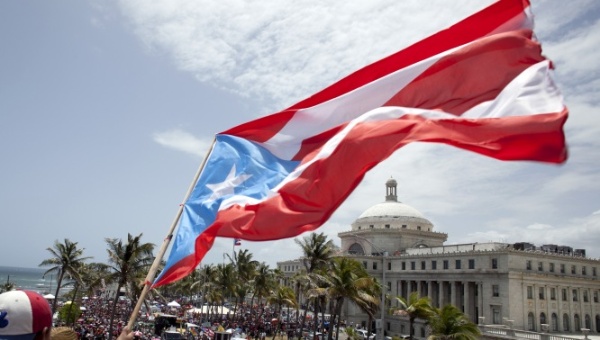
Maestros del sistema público puertorriqueño rechazan la reforma que entrega la administración de las escuelas públicas a sectores privados.
El Senado de Puerto Rico aprobó este lunes la reforma educativa impulsada por el gobernador, Ricardo Rosselló.
La reforma pretende imponer las escuelas charter, que son escuelas públicas administradas por empresas privadas y son rechazadas por los docentes.
Con un total de 19 votos a favor, ocho en contra, una abstención y dos ausentes fue aprobado el proyecto.
Los votos en rechazo a la ley de transformación educativa provinieron del oficialista Partido Nuevo Progresista (PNP) y del opositor Partido Popular Democrático (PPD).
Por su parte, el gobernador Rosselló agradeció el respaldo al proyecto dirigido a cambiar el sistema de educación pública, que a su parecer potencia la educación privada.
Desde que se presentó la propuesta de las escuelas charter en Puerto Rico los docentes se han expresado en contra de este modelo de administración escolar, cuyos resultados en Estados Unidos señalan de cuestionables.
“Estamos complacidos con el trabajo titánico que hizo la delegación de mayoría en el Senado y en la Cámara para mejorar el proyecto del Ejecutivo para transformar nuestro sistema de enseñanza público”, señaló Rosselló.
Este proyecto fue discutido y aprobado por la Cámara de Representantes el lunes de la semana pasada.
Rosselló aseguró que con esta medida los niños y niñas tendrán un mejor sistema de educación y agregó que no se trata de una reforma curricular, sino de una repartición de los fondos públicos.
“Es hora que el estudiantado tenga alternativas efectivas de educación sin importar los recursos económicos de sus padres”, añadió el gobernador.
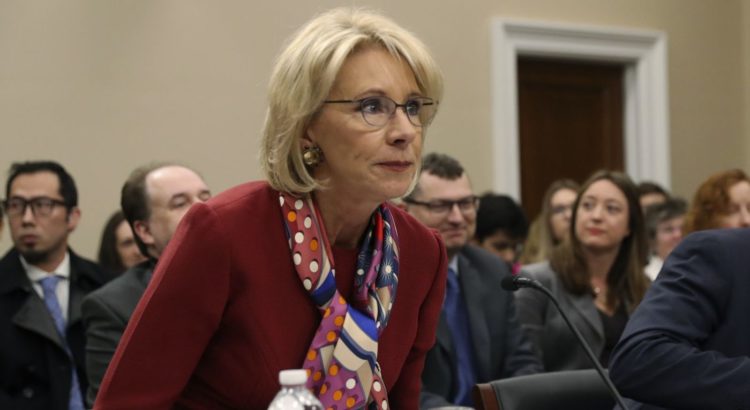
Education Secretary Betsy DeVos faced blistering questioning from House Democrats on Tuesday as they confronted her on gun control, racism and LGBTQ rights.
DeVos’ testimony before the House Appropriations subcommittee got so tense that the chairman made a point of thanking DeVos for her poise when he concluded the meeting.
DeVos, already reeling after a series of rocky, high-profile interviews, unveiled some details of a federal commission on school safety that she will be chairing. The commission, formed after the Florida high school shooting in which 17 people were killed, will be composed of herself and the heads of the Homeland Security, Health and Human Services and Justice departments.
DeVos said the commission will begin work within the next few weeks. A spokeswoman for DeVos later added that the panel also will involve students, teachers, law enforcement and mental health professionals as experts.
DeVos said the commission will, among other things, consider whether to ban gun sales to people younger than 21. Trump initially spoke in favor of such a proposal but backtracked after meeting with representatives of the National Rifle Assn. DeVos would not tell the subcommittee whether she personally supports the idea or not.
DeVos also defended states’ and communities’ rights to decide whether to arm teachers.
«The question of school personnel being armed is very much one for local communities and states to grapple with,» she said.
DeVos added, «If there are going to be guns in schools, they need to be in the hands of the right people, those who are going to protect students and ensure their safety.»
Patty Murray of Washington state, the top Democrat on the Senate committee overseeing education, was upset that DeVos did not include any Democrats or any experts in the subject matter on the school safety commission.
«I am not very optimistic that that will accomplish anything,» Murray told the Associated Press. «Real experience is absolutely critical to get anything done.»
DeVos also faced scathing criticism from Rep. Barbara Lee, D-Calif., who said minority students were being disciplined much more frequently than their white peers for similar infractions. The Obama administration issued guidance in 2014 that instructed schools to pay attention to the problem. DeVos is now reviewing that guidance, and civil rights groups fear she intends to rescind it. She would not talk about her plans at the hearing.
«Your head is in the sand about racial bias and racial discrimination,» Lee said. «Madame Secretary, you just don’t care much about the rights of black and brown children. This is horrible.»
Rep. Katherine Clark, D-Mass., launched into a tense back-and-forth with DeVos on whether she would require private schools that receive federal funding to follow federal civil rights laws that prohibit sexual, racial and religious discrimination.
DeVos has been pushing to increase public funding of alternatives to traditional neighborhood schools — such as charter school or private school programs. Critics say private schools get to choose which students to admit and may discriminate against minorities.
«Will you guarantee as secretary of Education that that money is included with non-discrimination policies for those private schools?» Clark asked.
«Federal law must be followed when federal money is involved,» DeVos said.
The foundation of any civilised society is surely the sanctity of the human life and the principle that all lives have the same inherent value.
I can’t imagine that many would differ from these statements. Until one spells it out: the value of a new-born baby of a president, a billionaire or a celebrity has to be valued at exactly the same level as the new-born baby of a labourer, an unemployed person living in a squatter camp, or a vagrant.
A baby doesn’t choose his/her parents. No civilised society can tolerate it that a baby’s worth and fate are determined by where his/her parents feature on society’s hierarchy or by the amount of money they make.
When South Africa became a democracy in 1994, it wasn’t possible to eradicate inequality, poverty and unemployment with the stroke of a pen. We could not eradicate the legacy of colonialism and apartheid in an instant, but we could and should have assured a new and better future for our new generations right from the day the first democratic government took office.
Our challenge was to steadily undo the damage of the past by making sure that the new generation of children being born all have an equal chance to live fulfilling and healthy lives and develop to their full potential; that they could escape the poverty trap their parents were caught in.
Children like Lumka Mketwa, the five-year-old girl who died the most horrible death when she fell down a pit latrine at her Bizana school last week and drowned in human excrement. On the same day we heard of Lumka’s death, we also heard that R34 million of taxpayer money was spent on the private court actions of former president Jacob Zuma and R22 million by former SABC chief Hlaudi Motsoeneng.
My builder friends tell me that the state could have built more than seven thousand safe toilets for schools with that R56 million, and then Lumka would have been able to walk to her school this morning.
My teenage daughter’s school is a brilliant institution where she is treasured as an individual, intellectually stimulated and sensitively prepared for adult life. She only has that privilege because her father can afford it and lives in the right middle class neighbourhood. There are girls her age and with her intellectual capabilities a mere five kilometres from her school who daily walk to school dodging gangster bullets.
Their school has no laboratory, library or computers and there are fifty learners in each class, often being taught by a totally under-qualified teacher. These girls have very little chance to compete with my child once they’re out of school, and not because of anything they did or did not do.
It is in such schools, probably most state schools, where youngsters with dyslexia, attention deficit disorder, Asperger’s syndrome or other challenges on the autism spectrum, or serious trauma because of their domestic situation are called stupid and difficult. With a little bit of understanding these kids could have been top performers in their class.
The statistics are there for anyone to look up: If your father and mother are poor, the chances are overwhelming that you will also be poor and unsuccessful as an adult. In this way we perpetuate the inequality and injustice that is increasingly polarising and destabilising our society, because almost all the schools without proper infrastructure, facilities or qualified teachers are in the townships or the deep rural areas.
According to all indications, the education our children get in these schools are of the worst in the world, while most of our suburban schools are above the world average. We have been perpetuating apartheid. The way the elected governments since 1994 have treated the education of our black children is tantamount to a crime against humanity.
I fully support the idea of free tertiary education, but what sense does it make to spend so many extra billions of rands on students at universities when primary education is of such a low standard – and children drown in pit latrines?
Unless President Cyril Ramaphosa’s «new deal» is an election gimmick, it will have to start off with a massive and ambitious intervention in basic education. It was largely through civil society’s activism that South Africa got rid of the Zuma/Gupta nest of corruption and restored political accountability.
The education of our children should surely be civil society’s next target?
Disclaimer: News24 encourages freedom of speech and the expression of diverse views. The views of columnists published on News24 are therefore their own and do not necessarily represent the views of News24.
Six months after the explosive allegations of sexual harassment against Hollywood producer Harvey Weinstein came to light, giving impetus to the #MeToo movement, this series looks at the aftermath of the movement, and if it has brought about lasting change to sexual harassment and gender equality.
The #MeToo movement has generated much needed discussion about inappropriate sexual behaviour and what constitutes consent to any sexual encounter. Despite some backlash, there is a sense women have reached a new level of agitation that won’t settle. The groundswell of anger might be sufficient to sustain a deep dismantling of systems of sexual discrimination against women.
But such cultural revolutions require change at many levels, from the interpersonal to the institutional. Young people are important in this revolution – many are leaders of the movement. Others need the knowledge and skills to recognise and interpret signals, and assert their own positions within the complex, often confusing situations that require sexual negotiation and consent.
These are learned informally from parents, carers, peers and the media. Formal school education is widely accepted as one of the appropriate institutions for teaching children and adolescents about relationships, sexual and reproductive health, and personal responsibility.
Post-#MeToo, teachers who are already engaged in skills-building in the area of consent might explore its nuances. They might delve deeper into sexual harassment and what it looks and feels like. And help shift young people’s understanding that consent is not just about (mainly) girls saying “no”, but also (mainly) boys understanding “yes”.
The importance of sexuality education
This year, the United Nations Educational, Scientific and Cultural Organisation (UNESCO) published a revised version of their 2009 International Technical Guidance on Sexuality Education.
This report summarises decades of evidence of the positive impact comprehensive sexuality education has on measurable aspects of sexual behaviour. These include delaying commencement of sexual intercourse, reducing the number of partners and increasing use of contraception and condom use.
Other desirable outcomes, such as less gender discrimination and gender-based violence, and healthy relationships, have been less rigorously studied. But these are also likely to be positively impacted by comprehensive sexuality education.
Teaching consent
In Australia, the principles of sexuality education are covered by the national Health and Physical Education curriculum. This includes a range of topics broadly classified as aspects of consent.
As early as kindergarten, the curriculum areas include:
Understanding in what situations parts of the body should be kept private
recognising one’s own emotions and learning how to express them, and
being able to name people you trust and places you feel safe.
As the curriculum progresses through primary and secondary school, these themes continue. Attention is paid to understanding the body as it develops, recognising emotion, exploring empathy and respectful relationships, particularly between peers.
During the mid-adolescent years, risk-taking behaviours and peer influences are a natural feature of development. At this point, the curriculum articulates the need for students to learn “practising skills to deal with challenging or unsafe situations” and “asserting their stance on a situation, dilemma or decision …”
Young people are playing an important role in dismantling of systems of sexual discrimination against women.Photo by Nicole Adams on Unsplash
All states and territories will adopt or use the national curriculum as a basis to develop their own health and physical education syllabuses, where additional detail can be found. For example, in New South Wales, the current syllabus for years seven to ten (circa 2003) explicitly discusses teaching the role gender can play in a range of attitudes, behaviours and health outcomes.
Power in relationships is also specifically mentioned. So too is a detailed list of learning outcomes about communication, assertiveness and negotiation.
The new draft NSW syllabus mentions the word consent in three places in years seven and eight, and years nine and ten. But this is done in the broad context of ethical relationships, not specifically sexual.
The Victorian curriculum (circa 2016) also articulates principles of respect and ethics in relationships and discusses power and gender. A search through the health curricula of other states and territories finds similar themes.
The average age of first intercourse among Australian secondary students is 16 years. But by this time, the majority have experienced some form of (non-penetrative) sexual activity. It’s reassuring that notions of consent appear in the early secondary years alongside learning about personal boundaries, recognising one’s own emotions, and communication skills.
Despite most sexually active secondary students reporting that they have had pleasurable sexual experiences (an important indicator of sexual health), a high proportion consistently report having had unwanted intercourse, with significant gender differences. In 2013, our five-yearly national survey found 28% of female students had had unwanted sex compared to 19% of males.
Intoxication was a common reason (around 50%) for all students, but for females, pressure from a partner was the most common, at 61%. Being frightened was cited by 34%.
About 300 health and physical education teachers in public, independent and Catholic schools across Australia were surveyed in 2011. A whopping 89.6% indicated they had taught communication and negotiation skills with a partner. The evidence looks promising – although “consent” is not specifically named, it is implied.
Will #MeToo help?
Our national curriculum and state syllabuses refer specifically to gender-based and sexual violence and abuse. It is not surprising, however, that despite best intentions, school curricula and quality classroom teaching alone are not sufficient to prevent them.
Perhaps #MeToo will be a signpost, a guide to future classroom discussions. It’s noteworthy that the NSW Minister for Education, Rob Stokes, and Premier Gladys Berejiklian made statements that the #MeToo movement provided new opportunities for teachers to have “open and frank” conversations with students.
This will involve conversations about the building blocks of respect. Teachers and students need to examine why women and their bodies are still objectified despite four waves of feminism. They might also explore the unconscious ways sexism writes the sexual scripts that children and adolescents learn.
This is rich material for many subject curricula, and our teachers have the skills to do this well. It’s only one component of the revolution, but playing an active part is surely what lies at the heart of the #MeToo movement.
OtrasVocesenEducacion.org existe gracias al esfuerzo voluntario e independiente de un pequeño grupo de docentes que decidimos soñar con un espacio abierto de intercambio y debate.
¡Ayúdanos a mantener abiertas las puertas de esta aula!


 Users Today : 97
 Total Users : 35490794
 Views Today : 131
 Total views : 3604199