Page 3519 of 6195
1 3.517 3.518 3.519 3.520 3.521 6.195

Australia: Primary schools are losing more and more male teachers, so how can we retain them?

Oceanía/Australia/Agosto del 2017/Noticias/https://theconversation.com/

The percentage of male primary school teachers in Australia has decreased in recent decades, from 30.24% in 1983 to 18.26% in 2016. Education authorities have responded to this with recruitment-focused initiatives, such as scholarships and quota systems.

But the continuing decline suggests more attention needs to be given to retaining those already in the profession.

Why the decline?

Men often leave teaching because of the gender-related challenges they face.

My PhD research has found the biggest challenges male primary school teachers face are:

  • uncertainty about physical contact with students;
  • an increased workload due to expectations to take on masculine roles; and
  • social isolation caused by difficulties in developing positive professional relationships with colleagues.

If male primary teachers have more effective coping strategies they might be able to deal better with these challenges, and consequently persist in the profession.

What are some coping strategies?

Participants in this study detailed several coping strategies and supports that enabled them to deal with these challenges and persist with teaching.

Some men described how they dealt with their fear and uncertainty about physical contact by employing a strict no-contact policy for their own self-protection. They used humour and playing sport with students at break times to build relationships with their students in ways that did not involve the physical contact strategies that their female colleagues used.

Other strategies they described included:

  • setting up their classrooms to minimise incidental physical contact;
  • never being one-on-one with students; and
  • moving to a public location to talk with students.

Many indicated they were happy to give an upset child a hug. However, they were fearful of other people perceiving the contact as inappropriate and making a career-ending accusation.

Those men who were prepared to make the same physical contact as their female colleagues were generally older, more experienced and had worked in their schools for many years. This had allowed them to develop trust and rapport within their school community.

Several participants discussed the gendered double standards on physical contact. They noted the media sensationalising of inappropriate behaviour by male teachers, with much less attention when accusations were later proved false.

Teaching has intensified

Although the substantial intensification of workload in recent decades has affected all teachers, previous research has noted that male primary school teachers report higher workloads than their female colleagues. This is because of expectations to perform roles such as behaviour management, manual labour, sports coaching, and being responsible for subjects such as science and ICT.

Participants reported they were expected to perform these roles, and seemed to have accepted this as a part of their job.

Men primarily employed strategies such as arriving early at school and recycling lessons from previous years to use their time more effectively, and cope when additional behaviour issues arose. They also sought help from other men working at the school, such as the groundsman to help with manual labour.

Many said strong support from their principal was a vital component of their ability to cope with this challenge.

Participants said they generally got on well with their female colleagues. But they felt socially isolated because they did not have many colleagues, particularly male ones, with common interests. This isolation was particularly evident in the staff room at break times.

Men coped with this challenge by using strategies such as being proactive in identifying common interests for conversation topics, developing positive professional relationships with trusted female colleagues they could rely on for support, and pursuing out-of-school hobbies such as clubs and sport. There they could interact with more men and “balance” their female-dominated work environment.

Men also described self-isolating behaviours such as reading the paper and going back to their office to do work.

Several themes emerged as participants described their strategies for dealing with these gender-related challenges. These included the influence of traditional constructions of how men should and shouldn’t act, schools perpetuating these societal constructions, and the importance of having strong support from colleagues and school leaders.

These factors all need to be considered if more men are to be retained in teaching.

Fuente: https://theconversation.com/primary-schools-are-losing-more-and-more-male-teachers-so-how-can-we-retain-them-82017

Fuente Imagen:

https://lh3.googleusercontent.com/vXsgGbakJvke6_IU6Vfd9ljFudnyLrDECtR17S5-rQ_o2KGZZrS5dLXNGe4Cw6BS__M0OQ=s85

Comparte este contenido:

Canada: How to save zoos? Focus on education, conservation

América del Norte/Canada/Agosto del 2017/Noticias/https://theconversation.com

One of my earlier memories from my childhood is visiting the Frankfurt zoo in Germany. I watched several elephants in an indoor enclosure, and while they were huge and fascinating, it also saddened me to see such magnificent animals in captivity. I also remember having straw thrown in my face by one of those elephants, although my parents dispute this.

Now, with my own children, we visit the Toronto Zoo with all of its animals in more naturalistic enclosures, and the many educational and conservation programs and displays. It’s a different world.

For many, zoos are central to some of their favourite memories as children. Seeing lions, tigers and elephants and other less familiar animals, never mind smelling them, can be a wonderful experience.

But the role of zoos in society has led to serious discussion about whether zoos should even exist. A strike earlier this year by workers at the Toronto Zoo had many musing about whether the zoo should re-open at all. The Toronto Star reported that social media and emails they received argued “zoos are outdated, inhumane attractions that should be closed outright, or converted to animal sanctuaries.”

That’s a widespread sentiment, manifested in part by the existence of organizations such as Zoocheck, which acts to “promote and protect the interests and well-being of wild animals,” including those held in captivity.

Zoos a thing of the past?

Some of the negative perceptions of zoos may be the result of their past. The modern zoo is based on a history of colonialism in which exotic animals from faraway lands were brought back for public amusement. A particularly ugly aspect of this history occurred when Indigenous people from colonized countries were also brought to Europe and the United States for display at human zoos, even as late as the 1950s.

While the ethical questions surrounding zoos today are not as controversial, they are no less important.

The social contract that zoos have with society has changed. Due largely to animal welfare concerns, the general public now has a predominately negative view toward the display of animals solely for entertainment, and the traditional zoo as a menagerie is no longer considered acceptable.

The modern zoo must become more than a source of entertainment, and must embrace conservation, research and education as part of its mandate. For example, in its most recent strategic plan, the Toronto Zoo has stated one of its goals is to become a zoo-based “conservation centre of excellence.”

A lion at the Toronto Zoo.

Increasingly, zoos must also now be accredited. For example, in Canada, CAZA (Canada’s Accredited Zoos and Aquariums) has an accreditation program that ensures animal welfare and promotes conservation research and outreach with the public.

Similar organizations exist globally, including in the United States (where the AZA has taken a global lead in zoo accreditation requirements) and Europe (EAZA). While there is room for criticism about how these organizations manage their programs, it’s clear that accredited zoos are the standard to which the modern zoo must be held.

Modern zoos are institutions that reflect complicated and sometimes conflicting values related to entertainment, conservation and animal welfare. Modern zoos in many ways represents a paradox – they’re organizations with a mandate to support conservation and education of the public regarding wild animals and nature that also manage captive wildlife. It’s this paradox that fuels much of the criticism of zoos.

In the United States, where arguably this transition from menagerie to conservation organization is most advanced, zoos such as the San Diego Zoo and the National Zoo in Washington, D.C., have rebranded themselves (e.g. San Diego Zoo Global), highlighting their contributions to conservation, research and the training of conservation professionals.

In Canada, the Toronto Zoo, the Calgary Zoo and the Vancouver Aquarium probably have the most developed research and conservation programs. But they fall short relative to their American counterparts in terms of the scope of these activities, in part because of the huge disparity in financial support.

Nonetheless, there’s no doubt that zoos make significant contributions to conservation.

Endangered species saved

Captive breeding programs and the accompanying reintroductions have saved many endangered species from extinction. Currently, captive breeding by Canadian zoos is a significant component of the conservation programs for a number of species, mostly of those native to Canada (e.g. the Vancouver Island marmot, the Eastern loggerhead shrike, wood turtle, burrowing owl, and black-footed ferret).

The endangered black-footed ferret.(Shutterstock)

These programs often stand between the extinction and the survival of these species. In addition, the people who work for conservation and education in the zoos are passionate and skilled.

But there remain untapped opportunities for zoos to enhance their work in conservation and research. Zoos should be pressured by the general public to ensure that the conservation and education mandate of the modern zoo is upheld.

Determining the efficacy of conservation and education efforts by zoos is important and will give confidence to the general public that zoos are fulfilling the evolving social contract with society.

Do zoos actually do good?

For example, how do we know that education programs at zoos actually work?

The research of my colleague Dr. Chantal Barriault (Director of the Science Communication graduate program at Laurentian University) indicates that the general public doesn’t learn as much as we would like or expect.

The efficacy of conservation programs should also be examined. How successful are the captive breeding and reintroduction programs? Are there ways to improve these conservation outcomes? As zoos evolve into conservation organizations, in Canada and globally, it is critical that appropriately trained conservation professionals support these efforts.

While the zoo community has tremendous veterinary expertise related to the care and captivity of animals, there is an opportunity for professionals trained in evolution, population genetics and other conservation-oriented disciplines to support zoo conservation.

Clearly, zoos are already asking these questions of themselves. The public should encourage more of this self-examination so that zoos evolve into more valuable institutions.

Fuente : https://theconversation.com/how-to-save-zoos-focus-on-education-conservation-81005

Fuente imagen:

https://lh3.googleusercontent.com/5L7oZf57gOSvj6eE4pLHn7bdHl7qdwmgfZ4DLYY7kiG2orSH3zQcxpnnEO2NnDrrJhQPOA=s170

Comparte este contenido:

EEUU: St. Paul charter school, family settle discrimination complaint over transgender student

América del Norte/Minnesota/Agosto del 2017/Noticias/http://www.startribune.com/

The parents of a transgender child and Nova Classical Academy recently reached a $120,000 settlement and an agreement that revised the school’s policy supporting transgender and gender nonconforming students.

Parents Dave and Hannah Edwards said they hope other schools learn from their case. “Hopefully, no other family will have to go through this,” Hannah Edwards said.

The controversy began when the parents wanted their child to socially transition at the St. Paul public charter school without fear of being harassed or bullied.

The family withdrew their child from Nova in February 2016 and filed a case with the city of St. Paul, alleging the school was violating the city’s human rights ordinance. A year later, the city determined that there was probable cause that the child was discriminated against, prompting the parents and school officials to resolve the issue through mediation.

In a written statement, school officials said they “strongly disagreed” with the probable cause finding but agreed to confidential mediation in hopes of avoiding a costly lawsuit. Last month, both sides reached a settlement and the parents agreed not to sue the school.

The conflict began before the start of the 2015-16 school year when the Edwards family informed Nova that their 5-year-old child was gender nonconforming. They asked the school to protect their kindergartner from harassment and asked that Nova clarify its policies so that their child be allowed to wear any of the approved uniform clothing rather than being restricted to wearing clothing labeled for boys.

Nova attorney Laura Booth said the family and school began working together in late August 2015. She said an antibullying policy was in place that would prohibit harassment against a nonconforming or transgender student. The school hired an expert to train its staff and inform the community to create an environment where the student was “very much accepted” and then a couple of incidents happened, Booth added.

From the school’s perspective, the incidents were primarily remarks by 5-year-olds who were curious, Booth said.

“The pushback, the anger and the ugly stuff came from outside the Nova community,” Booth said.

From the family’s perspective, their child faced harassment for her gender expression and they formally requested in November 2015 that the school adopt a gender inclusion policy.

“Initially, they wanted the school to be proactive about helping teachers and students to interact positively and do some very basic education about gender inclusivity and gender diversity,” said Lisa Stratton, an attorney and co-founder of Gender Justice, a St. Paul nonprofit organization that represented the family in their case against Nova.

“Certainly they were advocating for their child but they were also trying to make the school welcoming and inclusive to all gender diverse kids who are there.”

In January 2016, school officials agreed to create a task force to put together a gender inclusion policy.

“But there was no time frame or guarantee that it would go through,” Dave Edwards said. “It left a lot of space for hate and a lot of misinformation.”

That same month, the Minnesota Family Council, which rented space at the school to discuss the issues unfolding at Nova, argued that parents be allowed to opt out of gender discussions with their children.

“People have a right to believe what they believe at home but in a public school, everyone needs to be safe,” Dave Edwards said.

By May 2016, Nova adopted a gender inclusion policy in a quicker time frame than normal, Booth said.

It was too late for the Edwards family. The parents had pulled their daughter out of Nova three months earlier because the child planned to transition to using a female name and pronouns but they felt their child wouldn’t be safe from harassment.

Policy updates

The Edwards were pleased the school eventually passed the policy because “there are other kids who are trans at Nova and they still needed the policy,” Dave Edwards said.

Not all families welcomed the policy, which prompted fewer than five families to withdraw their children from Nova, Booth said.

The agreement reached last month revised that policy because it was “still discriminatory against trans kids,” Dave Edwards said.

School officials called the changes “minor revisions and clarifications” and noted that its insurance company will pay $100,000 of the $120,000 in damages that will be paid to the Edwards family.

“Nova Classical Academy has never wavered in its commitment to providing a school environment free of discrimination of any kind, where every student feels safe, welcomed, accepted and valued,” school officials said in a written statement.

Fuente:http://www.startribune.com/st-paul-charter-school-family-settle-discrimination-complaint-over-transgender-student/439326463/

Fuente Imagen:

https://lh3.googleusercontent.com/xaYzKJbA4E-y_BvgeAhHBELbRgq4BmhUeYBmCOzqocLX6b6fPygmzPczCnYgbkgNd6t6xQ=s85

Comparte este contenido:

México: Marcharán contra la guía de sexualidad

América del Norte/México/Agosto del 2017/Noticias/http://www.elpais.com.uy


Unas horas después de que el Consejo Directivo Central de la ANEP respaldara la guía de educación sexual de Primaria, un conglomerado de organizaciones impulsó desde las redes sociales una concentración contraria a la propuesta didáctica. La cita será el próximo viernes a las 18.30 horas frente a la sede del Ministerio de Educación y Cultura, en la calle Reconquista 535.

«Nos juntaremos para que las autoridades de gobierno y la prensa tomen en cuenta que esto traerá problemas irreversibles a nuestros niños», dice la convocatoria que entre sus principales promotores tiene al pastor Sebastián Vilar, aunque se llama a no concurrir con banderas religiosas ni políticas.

Los autoconvocados señalan que la guía tiene imágenes «pornográficas» y una clara «ideología» que «promueve la homosexualidad». Y ante eso dicen que «no se respeta» el derecho constitucional de los padres a educar a sus hijos.

Los manifestantes harán entrega de una carta dirigida a la ministra María Julia Muñoz y portarán carteles al estilo: «A mis hijos no se los toca» y «respeten nuestros derechos como padres».

Fuente

http://www.elpais.com.uy/informacion/marcharan-contra-guia-sexualidad.html

Fuente Imagen: https://lh3.googleusercontent.com/NhCt0Oge5AGqJe8emTj_yBA2NlDJI-TRQb-g7z26ksL4VkQRMi5KGa1uTjH6nxQ72H_S4i4=s85

Comparte este contenido:

Estrategia de enseñanza-aprendizaje: manejo de aula

Agosto del 2017/Denisse Morales,

El presente documento es una guía y complemento del  módulo de Estrategias Didácticas del Modelo Educativo de UNIBE. En el mismo se presentan pautas a tomar en cuenta para un manejo adecuado del aula y complementar con una serie de artículos que detallan el paso a paso de las técnicas didácticas.

El concepto mismo de aula y las estrategias que utilizamos o que debemos utilizar para lograr un aprendizaje significativo e integrado, nos impulsan a reflexionar y a tomar acciones con modelos innovadores para que los estudiantes adquieran las competencias inherentes de cada asignatura que han de cursar en su devenir universitario, y estén capacitados a ofrecer soluciones a los problemas profesionales, sociales, de su entorno y de la vida misma.

Por lo cual, ofrecemos a continuación pautas sobre el manejo de las estrategias educativas en el aula, con la finalidad de generar:

  • Ambientes que propicien la construcción de conocimientos pertinentes, actitud abierta, reflexiva y analítica, flexible y colaborativa.
  • Una enseñanza centrada en la condición humana, enfocada en las competencias que el estudiante debe tener al finalizar la asignatura, incentivando a su vez el desarrollo de una actitud emprendedora y creativa, así como el aprendizaje a lo largo de la vida.
  • El respeto a la multi-diversidad de conocimientos, cultural, social, religioso, político, de enfoque ante la vida, de género.

Para lograr un buen manejo en las aulas, debemos:

Diseñar previamente las estrategias y actividades a realizar en las mismas, mediante la planificación de su asignatura, utilizando como herramienta el sílabo y la agenda del día, estas clases deben ser:

  • Motivadoras y dinámicas.
  • Las actividades y técnicas didácticas a usar deben ser creativas y no repetitivas.
  • Deben propiciar el conocimiento permanente a través del aprendizaje por descubrimiento, la solución de problemas, la indagación o la investigación, la lectura, la reflexión, el análisis y la aplicación en su área del saber.
  • Propiciar la criticidad constructiva, la interacción y la actitud colaborativa que los dote de liderazgo creativo, capaces de aprender, progresar, realizar aportaciones relevantes en su ámbito de acción .
  • Fomentar los valores y el respeto a la diversidad, y la sensibilidad social ante el mundo que nos rodea.
  • Comprometer y comprometerse con los problemas de su sociedad, promoviendo alternativas de ayuda y/o respuestas a solucionarlo.
  • Humanizar y humanizarse.
  • Evitar los prejuicios.

Mantener la disciplina, a través de:

  • Políticas claras, que aceptamos y que no aceptamos.
  • Clases dinámicas que fomenten las potencialidades de los estudiantes, mediante estrategias de compensación, motivación y superación.
  • Evitar la repetición en una misma técnica, lo cual crea tedio y aburrimiento.
  • Incentivar la participación activa de TODOS LOS ESTUDIANTES, respetando el tiempo de exposición o desarrollo de una actividad de acuerdo a su tiempo en igualdad de derechos para todos.
  • Diseñar las prácticas y exámenes tomando en cuenta 25 minutos más del tiempo que les tomaría a usted en desarrollarlo, en estudiantes de condiciones normales y más tiempo en aquellos con problemas de aprendizaje.
  • Comprender la diversidad de aprendizaje, tomando en cuenta al diseñar las técnicas o actividades, lo que hace diferente a cada estudiante, como:
    • Inteligencias múltiples
    • Tipos de memorias
    • Estilos de aprendizaje
    • Personalidad
  • Mantener la disciplina mediante un ambiente relajado, flexible, cambiante, que permita la interacción, y promueva el desarrollo de la inteligencia interpersonal de los estudiantes, el trabajo colaborativo, la participación y el cuestionamiento continuo de los temas que se presentan en el aula.

Los docentes para un buen manejo de aula y adecuado uso de estrategias de enseñanza – aprendizaje, deben tener:

  • Manejo de comunicación oral y gestual
  • Dinamismo y flexibilidad, moverse constantemente entre los grupos, durante exposiciones, en el uso de Data Show y crear estrategias que evite la dispersión.
  • Ser motivadores
  • Ser respetuosos y darse a respetar
  • Ser investigadores junto a sus estudiantes
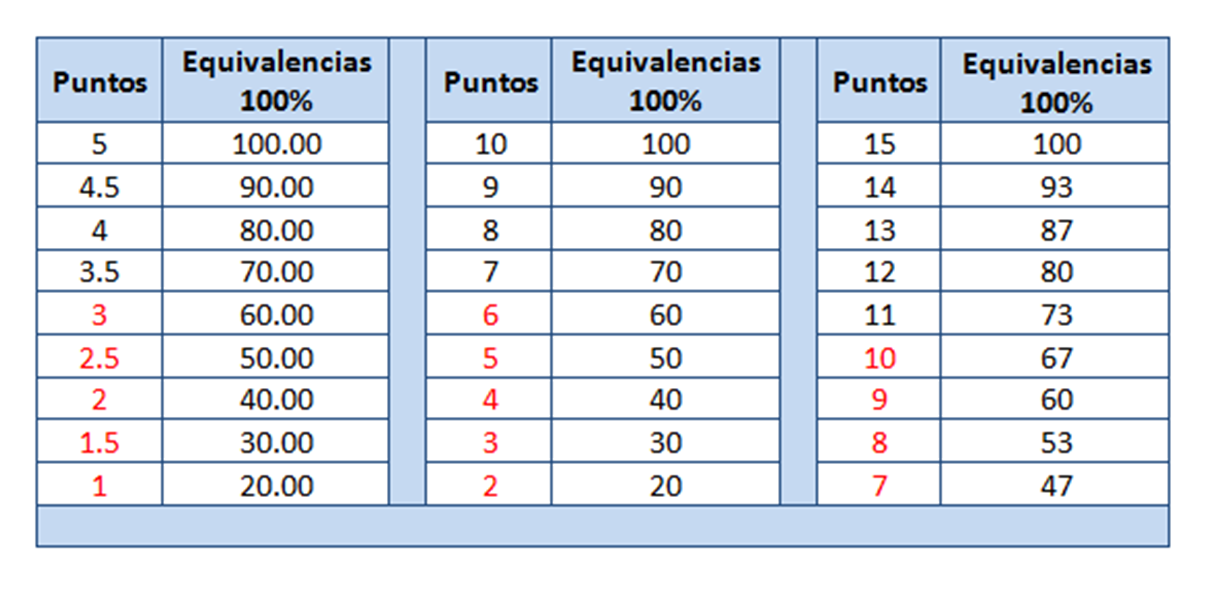
  • Establecer criterios claros de evaluación, a través de las rúbricas de evaluación, que deben tener la puntuación de cada rubro a evaluar.
  • Aplicar correctamente las equivalencias de las rúbricas de evaluación, pues al evaluar debemos tener en cuenta, que al asignar los puntos de cada rubro tiene un impacto de acuerdo a su equivalencia de 100%.

Puntos de evalaución y sus equivalencias en relación al 100%

Picture1

Los resultados de la evaluación al final de una asignatura de grado de una institución universitaria, son:

  • Satisfactorio: 100-70 % (A: 100-90, B: 89-80, C: 79-70)
  • Insatisfactorio: 69-0 % (D: 69-60, F: 59-0)

Una evaluación insatisfactoria, el estudiante debe repetir la asignatura.

Observaciones: Se recomienda cuando un docente tiene un estudiante responsable, que siempre asiste, entrega sus asignaciones y obtiene SIEMPRE calificaciones insatisfactorias, dar seguimiento al proceso de aprendizaje, ver dónde está el problema, asistirlo o recomendar tutorías de recuperación.

Las estrategias y técnicas didácticas que contemplaremos en los artículos del paso a paso de las técnicas didácticas para incentivar el proceso enseñanza-aprendizaje, son las siguientes:

  • Método Expositivo
  • Debate Académico
  • Mesa Redonda
  • Panel
  • Lluvia de Ideas
  • Simulación o juego de roles
  • Método socrático o de resolución de problemas
  • Esquemas mentales


Fuente: http://docentes.unibe.edu.do/estrategia-de-ensenanza-aprendizaje-manejo-de-aula/

Fuente Imagen:https://lh3.googleusercontent.com/6P69cf8NXFrHpIwtKhIlJqiNdz37rzpZjTu31d6iqvRh5lVBolH0SfhhOhGT7FiJLyiy=s85


Comparte este contenido:

Bolivia ratifica línea gubernamental para desarrollar la educación

América del Sur/Bolivia/Agosto del 2017/Noticias/http://prensa-latina.cu/

La Paz, 10 ago (PL) El presidente boliviano Evo Morales inauguró hoy una unidad educativa en el departamento de Tarija como parte del programa gubernamental destinado a fomentar la enseñanza en todos los niveles.

Durante la ceremonia, Morales ratificó el compromiso del ejecutivo nacional con el desarrollo de la educación en Bolivia por considerarla vital para el futuro del país.

Luego de una inversión de más de un millón de dólares, la nueva infraestructura constituye una ampliación del colegio Víctor Zeballo y consta de 12 aulas, un campo deportivo, cocina-comedor y talleres, entre otras áreas.

En otro momento de su intervención, Morales recordó que la entrega de obras de este tipo son resultado de la nacionalización de los hidrocarburos y la recuperación de empresas, antes en manos de compañías extranjeras.

Luego de la nacionalización ha cambiado la realidad en Bolivia, aseveró el presidente al destacar las conquistas sociales y económicas después del proceso realizado hace una década.

En ese sentido, se refirió al desarrollo económico alcanzado por el país gracias a la soberanía sobre sus recursos naturales.

Uno de los programas más exitosos de la gestión del gobernante es Bolivia cambia, Evo cumple, mediante el cual el gobierno gestiona y financia la ejecución de obras sociales como escuelas, hospitales y viviendas. jcm/clp.

Fuente:
http://prensa-latina.cu/index.php?o=rn&id=107011&SEO=bolivia-ratifica-linea-gubernamental-para-desarrollar-la-educacion
Fuente Imagen:
https://lh3.googleusercontent.com/iGxKqM63cfoK1c7vBJjx8Ijc9xPzLmPujoXW7oZMq9umXsAa167qCKSNrgSLc_W9ezHGvw=s85
Comparte este contenido:

República Dominicana: Educación dará lista de los maestros que continúan bloqueados en nómina

Centro américa/República Dominicana/Agosto del 2017/http://eldia.com.do/

Santo Domingo.-El ministro de Educación, Andrés Navarro, prometió ayer que entregará a la Asociación Dominicana de Profesores (ADP) las nominillas con la lista de los más de tres mil maestros que continúan bloqueados para que puedan revisarlos individualmente.

Eduardo Hidalgo, presidente de la ADP, aseguró que ese sindicato apoya la transparencia de la nómina del Ministerio de Educación, pero así como tuvieron razón al señalar que los hoy desbloqueados estaban trabajando, cuentan con datos de que en esos 3,929 aún impedidos de cobrar, hay casos que laboran y están en esa lista por un error del auditor.

“Estamos pidiendo al ministro que nos envíe una señal positiva, procurando la estabilidad y la paz en el año escolar llamado a iniciarse el próximo día 21. Son solo tres puntos que nos entreguen las nominillas, incluidos nombres, cédulas, escuelas y distritos educativos de los 3,929 bloqueados y la otra de los desbloqueados”, dijo Hidalgo.

simismo, pidió crear una comisión mixta para verificar los profesores suspendidos y unificar criterios para que las comisiones que auditan las diferentes regionales educativas tengan un mismo perfil para determinar a quién bloquean o no.

El sindicalista aclaró que si se demuestra que algún maestro tiene el sueldo retenido y está laborando, en licencia médica, en proceso de jubilación o de pensión, la ADP apelará a los medios legales que considere necesarios.

En relación a los 117 millones de pesos que anunció Navarro que se ahorrará para el aumento de un 10% en agosto a los docentes, Hidalgo dijo no estar de acuerdo que el incremento salarial de un profesor se condicione a la cancelación de otro maestro, Porque sería lo mismo decir desvestir a un santo para vestir a otro.

Llama  estar atentos

Hidalgo llamó a los dirigentes y maestros a estar atentos a las orientaciones de su sindicato, pues el Comité Ejecutivo Nacional de la ADP será convocado  para evaluar dicha situación y trazar las vías institucionales.

Fuente:http://eldia.com.do/educacion-dara-lista-de-los-maestros-que-continuan-bloqueados-en-nomina/

Fuente Imagen:

https://lh3.googleusercontent.com/Q9wuVtjkGjdkNEKZEKZfWWs6g8Z1yZB8gAAOnnAbjGxI8t86_gWxsokUslEIuU4M5YR6=s85

Comparte este contenido:
Page 3519 of 6195
1 3.517 3.518 3.519 3.520 3.521 6.195