Europa/España/Octubre de 2016/Fuente: 20 Minutos
Fuente: http://www.20minutos.es/noticia/2859701/0/upo-acoge-noviembre-xv-congreso-nacional-educacion-comparada/
Europa/España/Octubre de 2016/Fuente: 20 Minutos
Fuente: http://www.20minutos.es/noticia/2859701/0/upo-acoge-noviembre-xv-congreso-nacional-educacion-comparada/
América del Norte/Estados Unidos/Octubre de 2016/Autor: Karl Evers-Hillstroom/Fuente: Inforum
RESUMEN: Los padres de un estudiante que asiste a secundaria deFulda han presentado una demanda contra el distrito escolar independiente de 505, afirmando que el distrito escolar violó la cláusula de la Enmienda 14 de la Constitución de los Estados Unidos de dar igual protección mediante la adopción de una política que requiere que algunos estudiantes salgan del edificio de la escuela durante el día.«Todos los días, el Distrito pone en riesgo a mi hija obligándola a salir de las instalaciones», dijo Westra. «Ella tiene que conducir o caminar a un lugar de refugio porque ella es expulsada del edificio de la escuela pública. Como ya he dicho en repetidas ocasiones, usted no tiene mi permiso para obligar a mi hija a salir desde el edificio de la escuela pública durante el día escolar «. La denuncia, presentada ante la Corte de Apelaciones del Estado de Sep. afirma que el distrito escolar está infringiendo los derechos civiles al restringir el acceso a la educación pública.
Parents of a student attending Fulda High School have filed a lawsuit against Independent School District 505, asserting the school district violated the Equal Protection Clause of the 14th Amendment of the United States Constitution by adopting a policy requiring some students to leave the school building during the day.
The relators are Kayla and Dayton Westra and their daughter, whose name is redacted to the initials C.W. for the case.
The lawsuit’s roots originate with a new policy adopted by the Fulda School Board in July. The policy prohibits students who take classes at post-secondary schools for college credit under the Postsecondary Enrollment Options (PSEO) Act from being on the Fulda High School campus when they are not being instructed by teachers at the high school.
Because PSEO students must travel to post-secondary institutions, they have gaps in their scheduled classes during the school day compared to students taking only high school classes.
According to a statement from Dayton Westra, that means his daughter is forced to leave the school when she has such a gap in her schedule.
“Every day, the District puts my daughter at risk by forcing her to leave the premises,” Westra said. “She must drive or walk to a place of refuge because she is expelled from the public school building. As I have stated repeatedly, you do not have my permission to force my daughter from the public school building during the school day.”
The complaint, filed with the state Court of Appeals on Sep. 28, asserts the school district is infringing on civil rights by restricting access to public education. It also asserts the district does not have the right to make such a decision.
“Not a single person, organization, or institution has the right to restrict or deny public education to individuals without due cause or due process,” Westra said.
According to a memorandum submitted by the relators on Oct. 7, the school district has a policy that allows students to request “special permission” from district administrators to remain in the school building during breaks without a class, but they rejected C.W.’s request for such a permission.
The relators claimed the school adopted the policy to discourage students from taking PSEO classes, thus maximizing its possible state aid. When a student enrolls in a PSEO course, the student’s primary school loses funding.
The Westras referenced Tinker v. Des Moines Independent Community School District, a 1969 case that ruled, “A school district may not interfere with a student’s known rights, even if a school district believes that it is for a public good.”
The school district issued a response Oct. 4 stating that the district would “follow its policy as there was no legal justification or basis for setting it aside.”
In the statement, the district claimed it created the policy because of “problems with supervising and ensuring the safety of students enrolled in PSEO during their numerous free periods” and that the “increased demand for resources, such as teacher assistance on non-district courses, study halls, the library, and computers by students enrolled in PSEO courses put a strain on the district by taking away resources available to students who needed them for district courses.”
The respondents also claimed that the Westras did not follow the proper procedures for dealing with the situation, as they “passed up an opportunity to appeal the board’s decision to adopt the policy when they failed to challenge the policy within 60 days.”
Another argument given by the district is that the court cannot grant the appeal because it does not have jurisdiction. The statement claims that the court cannot review the school district’s decision to enforce a policy created by the school board.
“The ramifications of the Court letting this appeal continue would be unprecedented and would carry the grave potential of crippling the Court,” said the statement. “This means that every time any school district administrator assigns detention for an infraction or tells a student to put a cell phone away or instructs a student to attend class, all in the name of enforcing school district policies, these decisions would be eligible for review by this Court.”
Fuente: http://www.inforum.com/news/4135754-mn-family-sues-school-district-over-rule-requiring-students-leave-school-grounds
América del Sur/Argentina/Octubre de 2016/Fuente: SUTEBA
Desde SUTEBA/CTERA hemos dicho muchas veces que consideramos a la evaluación como una herramienta fundamental e inescindible de la experiencia educativa; que buscamos que la misma esté contextualizada y que considere las condiciones de trabajo, los procesos de enseñanza y de aprendizaje y las políticas educativas.
Las/os docentes queremos tener voz en la construcción de las evaluaciones, porque somos quienes conocemos a los niños/as y jóvenes y a sus comunidades, por lo que no podemos quedar fuera del debate.
Porque somos «docentes» y no veedores ni aplicadores, nosotros también queremos evaluar, tenemos el derecho a evaluar.Porque sabemos que nuestra tarea no está escindida de las condiciones de vida de nuestros pibes y pibas y porque entendemos que las políticas educativas favorecen u obstaculizan nuestro trabajo y los aprendizajes de los y las estudiantes.
Por lo tanto no acordamos con pruebas estandarizadas, que fracturan la enseñanza de la evaluación, producen ruptura del lazo pedagógico, impiden recuperar las ideas que los estudiantes ponen en juego para responder, no retro alimentan las prácticas pedagógicas.
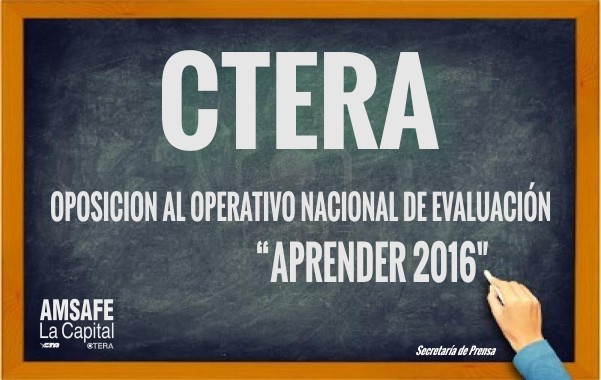
Es por esto que suteba/ctera vienen expresando su rechazo al operativo nacional de evaluación » aprender 2016″. Y En el marco de las jornadas de lucha de los días 18 y 19/10, realizaremos una CONTRAEVALUACION EDUCATIVA. Los trabajadores de la educación realizaremos una evaluación colectiva de políticas educativas nacionales y provinciales, el financiamiento, la gestión y al sistema educativo.
Fuente: http://www.suteba.org.ar/contraevaluacion-15688.html
Imagen: http://www.amsafelacapital.org.ar/noticia_completa.php?ID=2001
Oceanía/Australia/Octubre de 2016/Autora: Kate Bastians/Fuente: Daily Telegraph
RESUMEN: El Ex-Director del Departamento de Educación Regional de Sydney, Phil Lambert ha dicho que el departamento tenía un plan para mover los burócratas de la Escuela Pública de Bondi si la escuela necesita el espacio para las aulas. El Sr. Lambert trasladó el personal del departamento de nivel inferior del edificio en 2013 cuando la población estudiantil comenzó a crecer, pero el nivel superior todavía está siendo utilizado por un puñado de burócratas de la Oficina del Distrito de Bondi a pesar de que las cifras muestran que la escuela está en el 141 por ciento de su capacidad.«La intención es que vamos a seguir examinando el crecimiento de la escuela y deberíamos (la población) llegar a un punto, que sería lógicamente conducir a la transferencia de personal del departamento a otro, no me dan ninguna garantía, pero me dijo que debería ser monitoreado y revisado cada seis meses para asegurarse de que estaba justificado para moverlos ya que eso tiene un costo.»
FORMER Department of Education Sydney Regional Director Phil Lambert has said the department had a plan to move bureaucrats out of Bondi Public School if the school needed the floor they are housed in for classrooms.
Mr Lambert moved department staff out of the bottom level of the building in 2013 as the student population started to grow but the top level is still being used by a handful of bureaucrats from the Bondi District Office despite figures showing the school is at 141 per cent capacity.
“The intention was that we would continue to review the growth of the school and should (the population) reach a point, that it would logically lead to transferring department staff to another location subject to ongoing review,” Dr Lambert told the Wentworth Courier from Italy.
“My view was that if it was justified, they would move out and that looked like the likely scenario with the growth in numbers and the movement of staff out of the bottom floor was a signal of that intention.”
“I didn’t give any guarantee but I said it should be monitored and reviewed every six months to ensure it was justified to move them out as that would come at a cost.”
Dr Lambert led the development of Australia’s first national curriculum and is now an education consultant and adjunct professor at the University of Sydney.
On Friday shadow education minister Jihad Dib wrote to Education Minister Adrian Piccoli to question why bureaucrats had not been moved out of the building, which was purpose built for four classrooms before it became a regional office about 30 years ago.
“Blind Freddy could see there will be even more kids enrolling at the school next year because of (The Moreton) development across the road,” said Mr Dib.
He called on the local members Gabrielle Upton and Bruce Notley-Smith to come up with an alternative location for the staff at a meeting with the P & C executive next Tuesday.
He also called on the department to answer questions about how many staff used the huge space after sources told Wentworth Courier there were no more than four staff based there.
The department has refused to answer questions about how many staff are currently located there and what support they provide specifically to the school.
Labor’s Vaucluse spokesman Walt Secord said it was “ludicrous” for bureaucrats to be taking up valuable space which could accommodate up to 120 students.
“Space at the school should be used for the children’s education rather than accommodating bureaucrats who want to have office space at beautiful Bondi near the breezy beach,” Mr Secord said.
P & C vice president Rachel Blackley said department was facing a “costly band-aid solution” to convert their old hall into two classrooms if the staff did not move out of a the building.
“The old hall is used for our philosophy program, our brilliant after care service and for various teaching activities,” she said.
“We are not asking for their space or for new resources or buildings — we are just asking for our space back.
“Dr Lambert has confirmed the top level was to be returned to the school when it was needed so it is now time for the department to follow through with that commitment.
“They need to let us know exactly when they will vacate the classrooms and return the top level to the school.”
She questioned why the staff could not move to Bondi Junction where there was an abundance of office space.
Mr Piccoli said nine extra classrooms had been provided at the school since 2013 to cater for additional students.
“The school has a plan for 2017 and at this time it does not intend to use the old hall as classrooms,” he said.
A spokesman for the department said the staff provided direct support to schools in the eastern suburbs.
Fuente: http://www.dailytelegraph.com.au/newslocal/wentworth-courier/a-former-sydney-schools-director-has-recalled-a-plan-to-move-bureaucrats-out-of-a-building-if-it-was-needed-by-bondi-public-school/news-story/bb7ef669e08eec8f7e4d3faa5246978c
América del Norte/México/Octubre de 2016/Autora: Laura Poy Solano/Fuente: La Jornada
Maestros disidentes marcharon del Ángel de la Independencia a la sede de la Secretaría de Educación Pública (SEP) para reiterar su exigencia de reinstalación de todos los docentes cesados en la Ciudad de México, que incluye a 21 educadores que se sumaron a acciones de protesta contra la reforma educativa, y 11 más que no acudieron a la evaluación del desempeño en marzo pasado.
Poco después de las 14 horas, el contingente que se concentró en las inmediaciones del citado monumento comenzó a avanzar por carriles centrales de Paseo de la Reforma, pero un grupo de granaderos intentó restringir el paso de los manifestantes a tan sólo dos carriles y mantener abierta parcialmente la vialidad. Ante la negativa de los docentes, hubo conatos de enfrentamiento, y por momentos los educadores bloquearon de forma intermitente ambos sentidos de la avenida.
Poco más de 500 maestros permanecieron en los carriles centrales de Paseo de la Reforma por casi una hora, hasta que se permitió su paso hacia la dependencia federal, aunque el contingente fue custodiado por elementos del cuerpo de granaderos y de la policía de tránsito.
En el mitin, realizado en la Plaza de Santo Domingo, profesores despedidos de las escuelas primarias Leonardo Bravo, Alfredo E. Uruchurtu, José López Portillo y Rojas y Ricardo Flores Magón afirmaron que su cese es parte de la venganza de las autoridades educativas contra el magisterio que se opone a la reforma educativa
, y advirtieron que con el apoyo de los padres de familia continuarán en la lucha para recuperar su empleo.
Enrique Enríquez Ibarra, secretario general de la sección 9, informó que la Coordinadora Nacional de Trabajadores de la Educación (CNTE) iniciará una defensa jurídica de los educadores, por lo que anunció que se presentarán denuncias por despido injustificado ante las instancias laborales correpondientes, así como recursos de amparo.
Fuente: http://www.jornada.unam.mx/2016/10/14/politica/016n2pol
América del Norte/EE.UU./14 de octubre de 2016/www.prwatch.org/Por: Jeff Bryant
Resumen: Los políticos siempre prometen que van a encargarse del despilfarro, el fraude y el abuso, sin embrago, son pocos los esfuerzos que pueden evidenciarse de forma clara en este particular en la Educación, pues, esta semana el gobierno federal estadounidense ha entregado casi cuatro mil millones de dólares a las escuelas denominadas Charter. Las escuelas Charter son el gran negocio del estado y les mantiene (el estado federal) con dinero cortesía de los contribuyentes. El Departamento de Educación de los Estados Unidos, informó que en con motivo de la Semana de la Educación, el dinero va a ocho estados y en 15 redes de escuelas charter del Programa de Escuelas Charter, una operación del gobierno federal que reparte millones cada año para iniciar nuevas escuelas independientes. Independientemente de cómo se imparte la educación en estas escuelas, se está más preocupado por cómo se utilizará este nuevo desembolso de gobierno para las charter, en base a la amplia trayectoria de malversación financiera en estas escuelas. De hecho, poco después del anuncio USDE, propio auditor del Departamento advirtió que el dinero es en gran medida está en riesgo, pues, puede acabar en los bolsillos de los defraudadores y estafadores en lugar de en las aulas de los estudiantes diligentes y dedicados maestros.
Noticia original:
Politicians always promise they will rid government of «waste, fraud, and abuse,» so let’s hope at least one political leader or policy maker will denounce our federal government’s new gift of nearly a quarter-billion dollars to charter schools.
The cash dump to charters, courtesy of taxpayers, is from the U.S. Department of Education. As Education Week reports, the money is going to eight states and 15 charter school networks from the Charter Schools Program, a federal government operation that doles out millions every year to start new charter schools.
This money is the latest installment of an over $3 billion gravy train the federal government has funded to help launch over 2,500 charter schools across the nation.
Regardless of how you feel about these schools, you should be concerned about how this new government outlay to charters will be used, based on the extensive track record of financial malfeasance in these schools.
Indeed, shortly after the USDE announcement, the Department’s own auditor warned that the money is very much at risk of ending up in the pockets of fraudsters and con artists rather than in the classrooms of diligent students and dedicated teachers.
Again Education Week reports, the audit by the agency’s inspector general’s office examined 33 schools in six states and concluded that because of a general lack of oversight of charters there was a «risk that federal programs are not being implemented correctly and are wasting public money.»
The risk stems from the «cozy relationships,» the EdWeek reporter’s words, between charter schools and companies that operate them, called Charter Management Organizations (CMOs).
Of the 33 charter schools the audit examined, 22 had examples, sometimes multiple examples, of how CMOs take advantage of the unusual business relationship they have with their client charters to exploit federal education funds and redirect precious taxpayer dollars to private interests that have nothing to do with education.
In one of the more egregious examples the audit round, «the CEO of one CMO in Pennsylvania had the authority to write and issue checks without charter school board approval and wrote checks to himself from the charter school’s accounts totaling about $11 million.»
At another Pennsylvania charter, a vendor that supplied services to the school was owned by the charter school’s CMO and received $485,000 in payments from the school without charter school board approval.
In Florida, a charter and a CMO that shared the same board entered into an expensive lease agreement for the school building, then expanded the facility, extended the lease, and increased the rental payments to the CMO.
One CMO the audit examined, which operated three charters in Michigan and one in New York, required the charter schools to remit all federal, state, and local funds to the CMO and gave the CMO total responsibility, with no oversight by the charter board, for paying school expenditures.
The auditor’s report doesn’t provide the names of these schools, so we don’t know if they have received federal grant money in the past or are some of the ones getting the new money.
However, three of the six states the audit looked at – California, Texas, and Florida – are the same states the Department of Education just decided to send more money to. The other three – Michigan Pennsylvania, and New York – have received federal money for charters in the past, either sent to the state or to charter organizations operating in the state.
These states, and presumably many others the feds send charter money to, often don’t sufficiently track how the money is used, according to the audit. Of the six states examined, half could not provide consistent funding data on charter schools with CMOs, a third could not identify which charter schools used CMOs, and a third that tracked whether charter schools used CMOs had unreliable information because charter schools self-reported their operations.
A study released last year by the Center for Media and Democracy found «charter spending is largely a black hole.» That’s because the «flexibility» charters have been granted by the government is often being used not to create education innovations but to «allow an epidemic of fraud, waste, and mismanagement that would not be tolerated in public schools,» the CMD report found.
Based on its extensive research on charters, CMD examined the list of new award grantees and noted Florida, that’s getting a grant of $58,454,516, has closed over 120 charter schools in a little over a decade. Texas, which is getting $30,498,392, has «an unknown number» of charter schools «housed in churches» and «closely tied to, religious groups.»
Tennessee, which is getting $15,172,732, is famous for having a statewide online charter school that is so bad, the state education chief tried to get rid of it but couldn’t because of political maneuvering by the charter lobby and lack of regulatory accountability.
California, which is getting $27,329,904, has some of the worst charter school scandals in the nation, according to a report from the Center for Popular Democracy, which uncovered over $81,400,000 in fraud, waste, and abuse in the state. CPD call the alarming figure «likely just the tip of the iceberg.»
Louisiana, another grantee getting $4,836,766 from the feds, has been ripped off by «tens of millions of dollars in undiscovered losses» from charter schools in the 2013-14 school year, according to another CPD analysis. «The state has insufficiently resourced financial oversight,» CPD contends, and has yet to put into place adequate reporting, staffing, and auditing.
Three other states – Georgia, Massachusetts, and Washington – are getting the money just when they are deeply embroiled in heated controversies over charter schools.
Georgia has a ballot initiative in November on whether to allow the state to operate an Opportunity School District that would summarily take over local schools and hand them over to charter operators. Massachusetts also has a November ballot initiative, called Question 2, that would allow the state to lift the cap on the number of charters allowed to operate in the state. And in Washington, a charter school battleground for over 20 years, court rulings, legislative shenanigans, lawsuits, and counter lawsuits related to charter schools continue to rage across the state.
No doubt, this new money – over $41 million altogether for these three states – may now sweeten the pot if pro charter forces get their way.
Regarding the individual CMOs the Department is sending money to, one of them, Uncommon Schools, is a charter chain which used to be led in part by the current head of USDE, Secretary John King. Uncommon is getting $8,004,576. No conflict of interest there.
Another recipient – the Denver School of Science and Technology charter chain in Colorado, with a grant of $4,043,361 – has paid out between $20 to $50 million to a for-profit corporation owned by two of the charter chain’s director, according to another CPD analysis.
A charter school chain in Indiana getting $1,923,866 is plagued with financial problems, low enrollment, and controversy over how the CEO spends money. No doubt the infusion of federal cash will help.
The federal auditor’s report recommends the convening of a formal oversight group to look into charter school financial malfeasance, more rigorous review of charter school operations by federal agencies, and legislative changes in Congress to firm up government oversight.
Here’s another recommendation: Stop federal funding to expand these schools.
Tomado de: http://www.prwatch.org/news/2016/10/13158/federal-government-continues-feed-charter-school-beast-despite-auditors-warning

América del Sur/Venezuela/Octubre de 2016/Autor: MG Munos/Fuente: MPPEUCT
El Centro Internacional Miranda (CIM), cumpliendo la misión de debatir las principales corrientes del pensamiento actual en las áreas prioritarias de formación, investigación e incidencia política abrió la convocatoria al primer Circuito Nacional de Seminarios Investigativos sobre Comunicación Popular Alternativa el 21 de octubre, en Caracas.
La convocatoria está dirigida a comunicadores y comunicadoras populares, miembros de medios de comunicación popular alternativa, investigadoras e investigadores en Ciencias Sociales y el público en general.
El proceso de inscripción se realizará hasta el 19 de octubre, comprende la postulación en línea mediante el enlace: http://bit.ly/2e4oIMe que, además, ofrecerá a los usuarios y usuarias información de la oferta formativa y, posteriormente, la consignación de documentos en la sede principal del CIM en el Hotel Res. Anauco, PH, Parque Central, dando paso a la formalidad del registro.
Los Seminarios en Comunicación Popular Alternativa han sido forjados como espacios de discusión temática e investigación colectiva sobre temas vinculados a la comunicación popular alternativa, los cuales serán desarrollados en el proyecto de formación por los profesores Gonzalo Gómez, Lilliane Blazer, Alba Carosio, Rafael Rivas, entre otros.
Además, contará con dinámicas pedagógicas presenciales de periodicidad mensual.
Para mayor información estará disponible el equipo coordinador a través del número telefónico 0212-576.8274 y el correo electrónico cesav.cim@gmail.com
Fuente: http://www.mppeuct.gob.ve/actualidad/noticias/cim-inicia-seminarios-investigativos-en-comunicacion-popular-alternativa