Page 4889 of 6193
1 4.887 4.888 4.889 4.890 4.891 6.193

Inglaterra: England guarantees funding for EU students starting courses next year

Inglaterra / 12 de octubre de 2016 / Por: John Morgan / Fuente: https://www.timeshighereducation.com/

Current funding and fee levels apply for duration of 2017-18 courses even if UK leaves EU

EU students applying to start courses at English universities in 2017-18 will continue to be eligible for funding for their whole course, the government has guaranteed.

The Department for Education announced the move today, saying that the funding guarantee will mean that “their eligibility will continue throughout their course, even if the UK exits the European Union during that period”.

The move, which also means that EU 2017-18 entrants will have fees capped at the same £9,250 maximum as home students, will “help give universities and colleges certainty over future funding, while assuring prospective students applying to study at one of the UK’s world leading universities that they will not have the terms of their funding changed if the UK leaves the EU during their studies”, the Department for Education said.

Universities had been urging the government to offer EU students starting courses in 2017-18 a guarantee on funding, amid uncertainty caused by the UK’s vote to leave the union.

Jo Johnson, universities and science minister, said: “International students make an important contribution to our world-class universities, and we want that to continue.

“This latest assurance that students applying to study next year will not only be eligible to apply for student funding under current terms, but will have their eligibility maintained throughout the duration of their course, will provide important stability for both universities and students.”

Dame Julia Goodfellow, Universities UK president and University of Kent vice-chancellor, said the announcement “provides much-needed clarity for EU students applying to start courses at English universities in autumn 2017”.

She added: “Every effort must now be made to ensure that this announcement is communicated effectively to prospective students across Europe.

“We hope that this announcement by the UK government will be followed by similar reassurances by governments in the devolved nations shortly.”

Dame Julia continued:  “European and international students are a valuable part of cultural and academic life on British university campuses and play an important role in UK towns and cities, creating jobs and supporting local businesses.

“Looking ahead, as the government develops plans post-Brexit Britain, a commitment is needed to ensure that students, from Europe and beyond, are able to continue to come to the UK to study without unnecessary bureaucratic burdens.”

Under current rules, EU students are eligible to receive undergraduate tuition fee loans if they have resided in the European Economic Area for at least three years prior to study.

EU nationals who have resided in the UK for more than five years are also able to apply for undergraduate maintenance support and master’s loans.

Today’s announcement means those rules will continue to apply for 2017-18 entrants.

“The migration status of EU nationals in the UK is being discussed as part of wider discussions with the EU as the government works on reaching an agreement protecting the status of EU nationals here and our citizens in Europe,” the Department for Education said in its statement.

john.morgan@tesglobal.com

Fuente noticia: https://www.timeshighereducation.com/news/england-guarantees-funding-eu-students-starting-courses-next-year

Comparte este contenido:

Finlandia: Varsity professors disgruntled with employers

Finlandia / 12 de octubre de 2016 / Fuente: http://www.finlandtimes.fi/

Professors are only marginally satisfied with their university employers, according to a survey on university by professors.
Over 500 professors responded to an email questionnaire from the Finnish Union of University Professors and more than every other felt that senior university management is not interested in their opinions.
Almost 40 per cent of respondents also criticised the lack of possibilities for research or artistic work. In this respect, the most dissatisfied were professors at the Lappeenranta University of Technology, the Åbo Akademi University, and the University of Oulu.
The schools with the highest satisfaction rating in this regard were the Hanken School of Economics, and the Jyväskylä University.
About six out of 10 respondents felt that they did not receive timely information regarding their universities top management operations.
About half the respondents believed that they could not rely on the decisions made by senior university management.
“In the light of the answers, we can already talk about a crisis of confidence,” said the chairman of the professors’ association, Kaarle Hämeri.
Overall, employers were given a rating of 6.9. The best rated institutions were the University of Lapland and the Hanken School of Economics, which both averaged a rating over 8.
“The tightened financial situation is reflected in the opinions of the professors, because negative feedback is coming from most universities, where there has been a major reduction of personnel following codetermination negotiations,” Hämeri added.
Fuente noticia: http://www.finlandtimes.fi/education/2016/10/05/30612/Varsity-professors-disgruntled-with-employers#prettyPhoto
Comparte este contenido:

España: Economía y Educación impulsan el sistema integrado de cualificaciones y FP

España / 12 de octubre de 2016 / Fuente: http://www.entornointeligente.com/

El Departamento de Economía destina 700.325 euros a este programa que se desarrollará en distintos centros de Formación Profesional.

El Consejo de Gobierno ha dado hoy el visto bueno a un convenio de colaboración entre el Departamento de Economía, Industria y Empleo -a través del Instituto Aragonés de Empleo- y el de Educación, Cultura y Deporte para la realización de acciones vinculadas con el desarrollo del sistema integrado de cualificaciones y formación profesional en Centros Públicos Integrados de Formación Profesional. El acuerdo está dotado con un total de 700.325 euros, que corren a cargo de Economía.

El Instituto Aragonés de Empleo y el Departamento de Educación, Cultura y Deporte consideran necesaria la suscripción de un convenio de colaboración, dado el interés social de las actuaciones contempladas en este convenio, cuyo objetivo es realizar una gestión integrada de los recursos públicos y reforzar los vínculos entre los sistemas formativos y productivo, pudiendo abarcar esta colaboración tanto el ámbito de la formación profesional como en el de la información y orientación profesional, el de la evaluación y acreditación de competencias adquiridas por la experiencia laboral o el de la evaluación del sistema integrado.

Los centros integrados en el convenio son los siguientes: CPIFP Montearagón, CPIFP Corona de Aragón, CPIFP Los Enlaces, CPIFP Bajo Aragón, CPIFP Pirámide, CPIFP San Lorenzo, CPIFP San Blas y CPIFP Movera.

Fuente noticia: http://www.entornointeligente.com/articulo/9078695/Economia-y-Educacion-impulsan-el-sistema-integrado-de-cualificaciones-y-FP

Comparte este contenido:

Venezuela: Empresa minera estatal y universidades coordinan proyectos del Arco Minero

Bolivar / 12 de octubre de 2016 / Por: MGMUNOZ / Fuente: http://www.mppeuct.gob.ve/

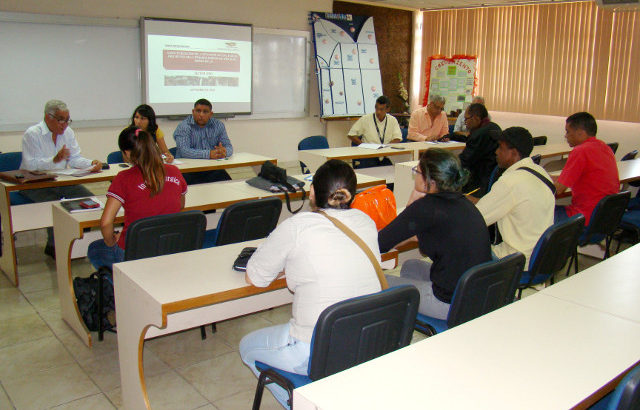
En mesa de trabajo conformada por directivos y expertos de Minerven y de la Universidad Nacional Experimental Politécnica Antonio José de Sucre (Unexpo), Instituto Universitario de Tecnología del estado Bolívar (Iuteb), Corporación Venezolana de Minería, Universidad Nacional Experimental de Guayana (Uneg), Instituto Nacional de Estadística (Ine), Fundación Instituto de Ingeniería, Misión Árbol e investigadores particulares

La empresa estatal Industria General de Minería (Minerven) sumará esfuerzos con universidades e innovadores del estado Bolívar para potenciar proyectos vinculados al Arco Minero del Orinoco, promovido por el presidente Nicolás Maduro, para aprovechar en beneficio del país los grandes recursos mineros que poseen los estados del sur.

Este planteamiento fue hecho en mesa de trabajo conformada por directivos y expertos de Minerven y de la Universidad Nacional Experimental Politécnica Antonio José de Sucre (Unexpo), Instituto Universitario de Tecnología del estado Bolívar (Iuteb), Corporación Venezolana de Minería, Universidad Nacional Experimental de Guayana (Uneg), Instituto Nacional de Estadística (Ine), Fundación Instituto de Ingeniería, Misión Árbol e investigadores particulares.

El presidente de la Unidad Territorial (Fundacite) Bolívar, ente adscrito al Ministerio del Poder Popular para Educación Universitaria, Ciencia y Tecnología en el estado  Luis Cárdenas, indicó que se busca sumar esfuerzos desde diversas fuentes propuestas que permitan desarrollar el Arco Minero atendiendo a la vez la problemática ambiental, social y económica generada por la minería ilegal.

«Los innovadores locales, universidades y centros de investigación del estado Bolívar pueden apoyar tareas como los estudios de factibilidad, la formación y asesoría de los pequeños mineros; la articulación interinstitucional; el tratamiento a las comunidades indígenas y los orfebres, y garantizar los planes de recuperación de zonas afectadas», señaló.

El Motor Minero es uno de los 14 motores de la Agenda Económica Bolivariana activada por el presidente Maduro para reactivar el aparato productivo nacional.

A tal fin se busca el aprovechamiento tecnificado de recursos como la bauxita, el oro, diamantes y piedras preciosas, cobre, coltrán, hierro y otros minerales tanto industriales como preciosos presentes en parte de Amazonas, Bolívar y Delta Amacuro.

Prensa Mppeuct/UT Bolívar

Fuente noticia: http://www.mppeuct.gob.ve/actualidad/noticias/empresa-minera-estatal-y-universidades-coordinan-proyectos-del-arco-minero

Comparte este contenido:

Estados Unidos: 5 Stories To Read For International Day Of The Girl

Estados Unidos / 12 de octubre de 2016 / Por: Kat Lonsdorf / Fuente: http://www.capradio.org/

Today is International Day of the Girl. Don’t know what that is? That’s alright; it’s pretty new. The day was created by the United Nations five years ago to spread awareness and spark discussion about the unique challenges confronting the world’s 1.1 billion girls.

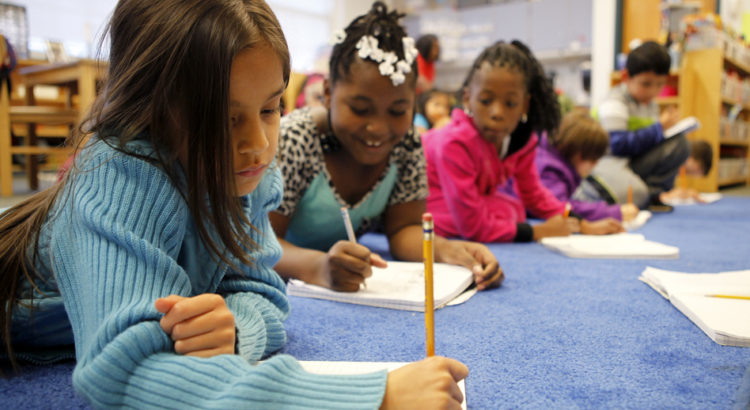
Those challenges are many, and education is a common theme. Millions of girls around the world aren’t in school, and nearly two-thirds of the world’s illiterate people are female, according to a recent UNESCO report. And that’s just the tip of the iceberg.

Here are a few NPR stories from the last few years — both in the United States and abroad — to get you thinking about what girls have to go through to get an education.

Are schools failing to prepare our girls for the workforce?

Around the U.S., many parents think schools are not adequately preparing girls for the workforce, often focusing on college as the only post-high school option.

Read about one high school girl set on becoming a mason.

In some countries you have to pay to stay in school — and often, that means girls drop out.

Part of Goats and Soda‘s #15Girls series last year, this story follows a tenth-grade girl in Zambia trying to finance her education.

(They recently checked back in on a few of the girls they followed — here’s an update.)

Black girls are suspended six times more often than white girls.

Recent research has documented that black girls are punished at school at rates that are even more disproportionate than those experienced by black boys.

Young black girls share their stories.

During the five years of the Syrian civil war, the majority of Syrian children have been forced out of school.

At the same time, there’s been a huge rise in child brides.

In an effort to keep Syrian kids learning, Marcell Shehwaro, a 32-year-old Syrian activist, runs a network of informal schools out of the basements of Aleppo, one of the most devastated cities in Syria. «When I am tired and I want to quit, I say, ‘OK, 100 girls went back to school [last month] so I will keep going,'» she says. Here’s her story.

Girls are often judged on their appearance — even in school.

Researchers found that women judged as least attractive earned significantly lower grades, after controlling for their ACT scores. The best-looking women earned higher grades. And male professors were more likely than female professors to give better-looking women higher grades.

Read about the study here.

Fuente noticia: http://www.capradio.org/news/npr/story?storyid=497526706

Comparte este contenido:

Paraguay: Levantan toma de colegio en Luque

Paraguay / 12 de octubre de 2016 / Fuente: http://www.paraguay.com/

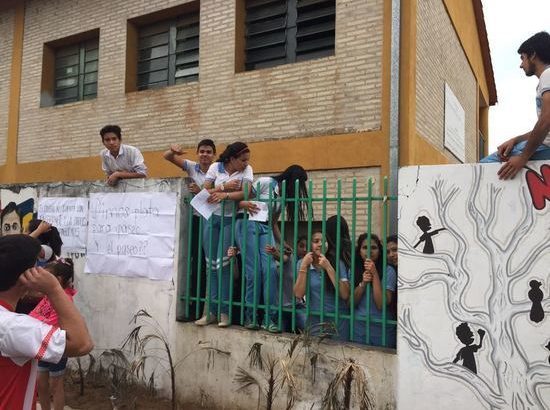
Tras la mediación del MEC, alumnos del Colegio Nacional Teniente Herrero Bueno de Luque levantaron la toma de la institución luego de sentar acuerdos que tiene como fin principal auditar la administración saliente.

La Coordinadora del Departamento Central, Mirian Fernández y supervisores de la zona, fueron hasta el centro educativo ubicado en la compañía Itapuamí en donde se reunieron con los alumnos y los padres a fin de escuchar sus inquietudes.

El principal malestar de los estudiantes estaba dirigido hacia el manejo de los fondos de la institución. Además, reclamaban mejores espacios para desarrollar las clases ya que incluso una sala era compartida por dos cursos y solo estaba dividido por una cortina.
Entre otras irregularidades, mencionaron supuestos casos de nepotismo e incluso maltratos por parte de la directora y otros docentes.
Tras la mediación, se logró firmar compromisos como la apertura de una auditoría a la directora saliente de la institución, la designación del profesor Silvio Ayala como Encargado de Despacho, también se realizará la reingeniería de rubros del colegio.
Por otra parte, la Dirección de Educación Media realizará con celeridad la nominación del Encargado de Despacho como uno de los puntos más importantes para levantar la toma.
Los supervisores se comprometieron para realizar un acompañamiento cercano para garantizar el cumplimiento de los acuerdos.
Fuente noticia: http://www.paraguay.com/nacionales/levantan-toma-de-colegio-en-luque-152319
Comparte este contenido:

Panamá: Educar niños y niñas sobre autoestima en Panamá es labor del Dove Day Panamá

Panamá / 11 de octubre de 2016 / Fuente: http://www.panamaon.com/

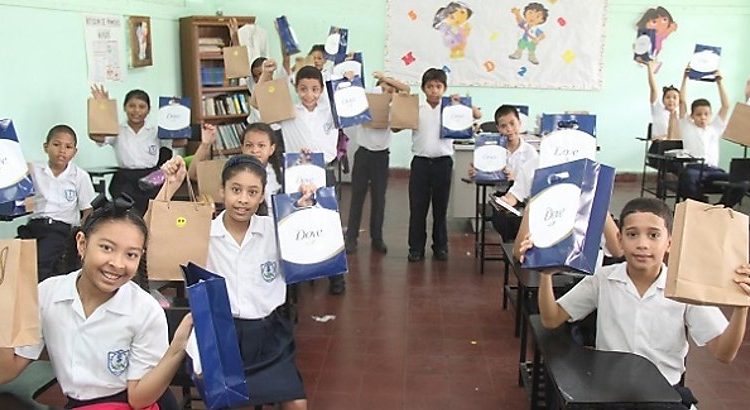
Dove day es una inicitiva global que ha llegado ya a 35 países a nivel mundial impactando mas de 19 millones de niños y niñas. Dove Day Panamá , es una actividad que busca impactar 150 niños y niñas de de la escuela Dr. Belisario Porras con educación básica sobre autoestima.

Dove Day, la iniciativa global de Responsabilidad Social de Dove Masterbrand, diseñada para brindarles la oportunidad a miles de colaboradores de Unilever de impactar a niños y niñas con educación básica sobre autoestima y promoverla en ellos, llegó a Panamá, por tercer año consecutivo, con el objetivo de educar a 150 niños y niñas de la escuela Dr. Belisario Porras ubicada en San Francisco.

Esta iniciativa se ha llevado a cabo en más de 20 países de Europa y América del Norte, en América Latina se ha realizado en 14 países, en los cuales se han involucrado a mas 1,500 empleados en los últimos años.

Dove Day nace en el 2005 luego de que en la investigación realizada por Dove Global en el año 2004 (The Real Truth About Beauty), se revelara que 9 de cada 10 niñas quieren cambiar algo de su apariencia física y 6 de cada de 10 se niegan a participar en actividades debido a su baja confianza en sí mismas. En la actualidad se han educado a más de 19 millones de niños y niñas en todo el mundo y se espera aumentar esta cifra en lo que resta del año 2016.

Dove Day Panamá se llevó a cabo el pasado 7 de octubre, justo unos días antes del 11 de octubre, Día Internacional de la Niña declarado por la Unicef, en la escuela Dr. Belisario Porras. Los estudiantes estuvieron involucrados en diversos talleres y actividades co-creados por un gran equipo de expertos en educación básica sobre autoestima con los cuales se quiere lograr un aumento en la autoconfianza de todos los niños y niñas del colegio.

De esta manera Unilever – Panamá se une a esta gran iniciativa para aportar su granito de arena y lograr así que esta actividad global logre la cifra de impactos proyectados para el próximo año.

Las temáticas del taller son basadas en la imagen corporal, bajo el título Talleres sobre la Confianza Corporal, que abordó los siguientes temas: a) Confianza en nuestro propio cuerpo; b) Presiones relacionadas con la apariencia; c) Medios profesionales y d) Redes personales y sociales.

Unilever, a través de su Plan de Vida Sostenible, lleva a cabo este tipo de acciones que buscan mejorar el bienestar de las personas en las regiones en donde trabaja. El Plan de Vida Sostenible es una estrategia transversal que la compañía implementa desde 2010, cuyo objetivo es seguir haciendo crecer el negocio mientras reduce la huella ambiental de sus productos y aumenta el impacto social positivo. Asimismo, busca contribuir a un futuro mejor para todos, encabezando el desarrollo y comercialización de productos más sostenibles y la generación de oportunidades en toda la cadena de valor.

Fuente noticia: http://www.panamaon.com/noticias/educacion/15171-educar-ninos-y-ninas-sobre-autoestima-en-panama-es-labor-del-dove-day-panama.html

Comparte este contenido:
Page 4889 of 6193
1 4.887 4.888 4.889 4.890 4.891 6.193