Page 314 of 400
1 312 313 314 315 316 400

Estados Unidos: El homenaje más emotivo de 400 alumnos a su profesor enfermo de cáncer

Estados Unidos/Septiembre de 2016/okdiario

Un vídeo simplemente conmovedor. El cantante de country estadounidense Tim McGraw ha publicado unas imágenes en su cuenta de Facebook en las que se ve cómo los alumnos de un instituto en Nashville (Tennessee, EE UU), mostraron de una manera entrañable su apoyo a uno de sus profesores, Ben Ellis, enfermo de cáncer.

Los chavales se acercaron a casa del profesor a rendirle homenaje con una canción. Cuando Ellis se asomó a su ventana, más de 400 personas entonaron al unisono la canción Holy spirit, una melodía que no dudó en tararear el emocionado maestro.

Este emotivo vídeo ya lo han visto más de 19 millones de personas en todo el mundo.

http://okdiario.com/videos/2016/09/13/profesor-enfermo-cancer-homenajeado-mas-400-alumnos-372487


Comparte este contenido:

La educación sexual en secundaria: alejada de la realidad, sin utilidad y con profesores avergonzados

Por: SINC

La educación sexual en secundaria es a menudo negativa, alejada de la realidad y con un fuerte sesgo heterosexual. Además, está normalmente impartida por profesores poco capacitados y que se sienten avergonzados, según un estudio publicado en BMJ Open, que incluye una síntesis de opiniones y experiencias de jóvenes de diferentes países.

La investigación, llevada a cabo por tres investigadoras de la Escuela de Medicina Social y Comunitaria de la Universidad de Bristol (Reino Unido), señala que el fracaso de las escuelas para reconocer que la educación sexual es un tema especial con desafíos únicos está haciendo un gran daño a los jóvenes. También supone una oportunidad perdida en el objetivo de proteger y mejorar la salud sexual de los alumnos.

Estudios cualitativos

Las expertas han basado sus conclusiones en 55 estudios cualitativos que exploran las opiniones y experiencias de jóvenes que habían recibido clases de educación sexual y relaciones en centros de Reino Unido, Irlanda, EEUU, Australia, Nueva Zelanda, Canadá, Japón, Irán, Brasil y Suecia, entre 1990 y 2015. Las autoras sintetizaron las valoraciones y encontraron que, pese a la gran variedad geográfica de los estudios, las opiniones de los jóvenes eran muy consistentes.

El estudio pone de relieve que los centros educativos fallan a la hora de reconocer el carácter distintivo de la educación sexual. Por ello, la suelen tratar como hacen con el resto de las materias.

Sin embargo, las encuestas del estudio indican que se afrontan a retos diferentes al enseñar este tipo de tema. En las clases mixtas, los jóvenes sentían humillación si no eran sexualmente experimentados y decían que a menudo armaban jaleo para enmascarar sus ansiedades. Por su parte, las chicas se sentían con frecuencia acosadas y juzgadas por sus compañeros masculinos.

Los jóvenes también criticaron el enfoque excesivamente ‘científico’ de las relaciones sexuales, que ignoraba el placer y el deseo. Y señalaron que percibían que el sexo se presentaba muchas veces como un «problema» que ha de ser gestionado. Los estereotipos también son frecuentes: a las mujeres se las representa como pasivas y a los hombres, como depredadores. También critican que se trate poco o nada el tema de la homosexualidad, la bisexualidad o el sexo transgénero.

Otro tema importante es que los centros parecen tener dificultades en aceptar que algunos de sus estudiantes sean sexualmente activos, lo que lleva a un contenido que está fuera de la realidad de muchos jóvenes, con la consiguiente falta de discusión sobre cuestiones que son relevantes para ellos, dicen las investigadoras.

Los jóvenes se quejaron además del énfasis que esta educación hace de la ‘abstinencia moralizante’, y una falta de reconocimiento de toda una gama de actividades sexuales en las que hayan podido participar. La educación sexual llega demasiado tarde para algunos alumnos, indican.

Una educación vital

Este tipo de educación también adolece de fallos en el suministro de información útil y práctica, tal como la disponibilidad de servicios de salud de la comunidad, lo que se puede hacer en caso de embarazo, los pros y los contras de los diferentes métodos de anticoncepción, o las emociones que pueden acompañar a las relaciones sexuales.

A los estudiantes también les desagrada que sus profesores les den educación sexual, no solo porque perciben que están mal entrenados y sienten mucha vergüenza, sino también debido a la posibilidad de que se vea afectada la relación profesor-alumno y se quiebren los límites.

Las autoras señalan que a pesar del bajo nivel de esta enseñanza, la educación sexual es considerada como vital por los responsables políticos para proteger la salud de los jóvenes, así como de los embarazos no deseados, el abuso y la explotación sexual.

La evidencia sugiere que los propios alumnos quieren que la educación sexual que se enseñe en los colegios e institutos utilice un enfoque positivo del sexo, con el objetivo de que los jóvenes disfruten de su sexualidad de una manera que sea segura, consensual, y saludable.

Fuente: http://ecodiario.eleconomista.es/salud/noticias/7821713/09/16/La-educacion-sexual-en-secundaria-alejada-de-la-realidad-sin-utilidad-y-con-profesores-avergonzados.html

Comparte este contenido:

Chomsky: Malestar social amenaza la democracia

America del Norte/EEUU/Cambridge.

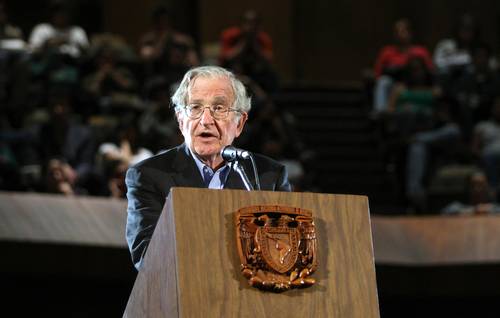
Noam Chomsky, uno de los intelectuales estadounidenses más prestigiosos de la actualidad, cree que la baja valoración de los políticos a nivel mundial no es exclusiva de la cúpula dirigente, sino que se extiende a empresas y a otras instituciones, como parte de un malestar social general.

La escasa popularidad de los actuales candidatos a la Presidencia de Estados Unidos no es algo excepcional, sino que forma parte «de un gran malestar social que amenaza a la democracia», explicó el lingüista y filósofo, de 87 años, en entrevista con dpa en Cambridge.

«Estados Unidos se desarrolló desde una democracia hacia una plutocracia con apéndices democráticos», opinó Chomsky. «Tres cuartas partes de la sociedad se encuentran simplemente subrepresentadas», analizó.

Respecto del actual auge del candidato republicano Donald Trump, pese a su discurso polémico y agresivo, el autor de Los guardianes de la libertad cree que se fundamenta en gran medida en el desprecio durante décadas a la clase trabajadora.

«Los que respaldan a Trump no son los pobres. La mayoría son de la clase trabajadora blanca que en el periodo del neoliberalismo fueron marginados. Ahora, estas personas están amargadas y tienen rencor».

El profesor emérito del Massachusetts Institute of Technology (MIT) apuntó como segunda razón un fortalecimiento del populismo y el ultranacionalismo, algo que también se ve en Europa: «Hay una correlación directa entre el apoyo a populistas autoritarios y los entusiasmados con Trump».

A diferencia de lo sucedido anteriormente, esta vez a los líderes republicanos no les fue posible impedir el protagonismo de un candidato peligroso. «Trump es singular. Nunca hubo algo como él en naciones industrializadas occidentales», señaló Chomsky.

Sin embargo, el proceso se enmarca en su opinión en una transformación más amplia del sistema político estadunidense, que él ve históricamente como de partido único con dos facciones, republicanos y demócratas. «Eso ya no es así. Seguimos siendo un país de partido único, el Partido de los Negocios. Pero ya sólo hay una facción».

De hecho, cree que quienes apoyaron a Bernie Sanders en la precampaña demócrata podrían formar un nuevo partido independiente del demócrata si avanza la transformación del sistema. Sanders se enfrentó desde la izquierda en las primarias a la actual candidata, Hillary Clinton, pero perdió.

«Si tuviéramos un movimiento trabajador activo y luchador del estilo del que hubo en Estados Unidos en los años 30, probablemente uniría a los seguidores de Trump con los de Sanders», señaló este lingüista, que a nivel político se ha definido a sí mismo como anarquista o socialista libertario.

«Son muy diferentes en muchas cosas, pero comparten centralmente la misma furia por el ataque a la clase trabajadora blanca y a los pobres. Eso podría ser el comienzo de algo totalmente nuevo».

Fuente: http://www.jornada.unam.mx/ultimas/2016/09/16/malestar-social-amenaza-la-democracia-chomsky

Comparte este contenido:

Donald Trump and the Plague of Atomization in a Neoliberal Age

Henry A. Giroux

This week, Donald Trump lowered the bar even further by attacking the Muslim parents of US Army Captain Humayan Khan, who was killed in 2004 by a suicide bomber while he was trying to save the lives of the men in his unit.

This stunt was just the latest example of his chillingly successful media strategy, which is based not on changing consciousness but on freezing it within a flood of shocks, sensations and simplistic views. It was of a piece with Trump’s past provocations, such as his assertion that Mexicans who illegally entered the country are rapists and drug dealers, his effort to defame Fox News host Megyn Kelly by referring to her menstrual cycle, and his questioning of the heroism and bravery of former prisoner-of-war Senator John McCain. This media strategy only succeeds due to the deep cultural and political effects of neoliberalism in our society — effects that include widespread atomization and depoliticization.

For more original Truthout election coverage, check out our election section, «Beyond the Sound Bites: Election 2016.»

I have recently returned to reading Leo Lowenthal, particularly his insightful essay, «Terror’s Atomization of Man,» first published in the January 1, 1946 issue of Commentary and reprinted in his book, False Prophets: Studies in Authoritarianism. He writes about the atomization of human beings under a state of fear that approximates a kind of updated fascist terror. What he understood with great insight, even in 1946, is that democracy cannot exist without the educational, political and formative cultures and institutions that make it possible. He observed that atomized individuals are not only prone to the forces of depoliticization but also to the false swindle and spirit of demagogues, to discourses of hate, and to appeals that demonize and objectify the Other.

Lowenthal is helpful in illuminating the relationship between the underlying isolation individuals feel in an age of precarity, uncertainty and disposability and the dark shadows of authoritarianism threatening to overcome the United States. Within this new historical conjuncture, finance capital rules, producing extremes of wealth for the 1 percent, promoting cuts to government services, and defunding investments in public goods, such as public and higher education, in order to offset tax reductions for the ultra-rich and big corporations. Meanwhile millions are plunged into either the end-station of poverty or become part of the mass incarceration state. Mass fear is normalized as violence increasingly becomes the default logic for handling social problems. In an age where everything is for sale, ethical accountability is rendered a liability and the vocabulary of empathy is viewed as a weakness, reinforced by the view that individual happiness and its endless search for instant gratification is more important than supporting the public good and embracing an obligation to care for others. Americans are now pitted against each other as neoliberalism puts a premium on competitive cage-like relations that degrade collaboration and the public spheres that support it.

To read more articles by Henry A. Giroux and other authors in the Public Intellectual Project, click here.

Within neoliberal ideology, an emphasis on competition in every sphere of life promotes a winner-take-all ethos that finds its ultimate expression in the assertion that fairness has no place in a society dominated by winners and losers. As William Davies points out, competition in a market-driven social order allows a small group of winners to emerge while at the same time sorting out and condemning the vast majority of institutions, organizations and individuals «to the status of losers.»

As has been made clear in the much publicized language of Donald Trump, both as a reality TV host of «The Apprentice» and as a presidential candidate, calling someone a «loser» has little to do with them losing in the more general sense of the term. On the contrary, in a culture that trades in cruelty and divorces politics from matters of ethics and social responsibility, «loser» is now elevated to a pejorative insult that humiliates and justifies not only symbolic violence, but also (as Trump has made clear in many of his rallies) real acts of violence waged against his critics, such as members of the Movement for Black Lives. AsGreg Elmer and Paula Todd observe, «to lose is possible, but to be a ‘loser’ is the ultimate humiliation that justifies taking extreme, even immoral measures.» They write:

We argue that the Trumpesque «loser» serves as a potent new political symbol, a caricature that Trump has previously deployed in his television and business careers to sidestep complex social issues and justify winning at all costs. As the commercial for his 1980s board game «Trump» enthused, «It’s not whether you win or lose, but whether you win!» Indeed, in Trump’s world, for some to win many more must lose, which helps explain the breath-taking embrace by some of his racist, xenophobic, and misogynist communication strategy. The more losers — delineated by Trump based on every form of «otherism» — the better the odds of victory.

Atomization fueled by a fervor for unbridled individualism produces a pathological disdain for community, public values and the public good. As democratic pressures are weakened, authoritarian societies resort to fear, so as to ward off any room for ideals, visions and hope. Efforts to keep this room open are made all the more difficult by the ethically tranquilizing presence of a celebrity and commodity culture that works to depoliticize people. The realms of the political and the social imagination wither as shared responsibilities and obligations give way to an individualized society that elevates selfishness, avarice and militaristic modes of competition as its highest organizing principles.

Under such circumstances, the foundations for stability are being destroyed, with jobs being shipped overseas, social provisions destroyed, the social state hollowed out, public servants and workers under a relentless attack, students burdened with the rise of a neoliberal debt machine, and many groups considered disposable. At the same time, these acts of permanent repression are coupled with new configurations of power and militarization normalized by a neoliberal regime in which an ideology of mercilessness has become normalized; under such conditions, one dispenses with any notion of compassion and holds others responsible for problems they face, problems over which they have no control. In this case, shared responsibilities and hopes have been replaced by the isolating logic of individual responsibility, a false notion of resiliency, and a growing resentment toward those viewed as strangers.

We live in an age of death-dealing loneliness, isolation and militarized atomization. If you believe the popular press, loneliness is reaching epidemic proportions in advanced industrial societies. A few indices include the climbing suicide rate of adolescent girls; the rising deaths of working-class, less-educated white men; and the growing drug overdose crises raging across small towns and cities throughout America. Meanwhile, many people often interact more with their cell phones, tablets and computers than they do with embodied subjects. Disembodiment in this view is at the heart of a deeply alienating neoliberal society in which people shun in-person relationships for virtual ones. In this view, the warm glow of the computer screen can produce and reinforce a new type of alienation, isolation and sense of loneliness. At the same time, it is important to note that in some cases digital technologies have also enabled young people who are hyper-connected to their peers online to increase their face-to-face time by coordinating spontaneous meetups, in addition to staying connected with each other near-constantly virtually. How this dialectic plays out will in part be determined by the degree to which young people can be educated to embrace modes of agency in which a connection to other human beings, however diverse, becomes central to their understanding of the value of creating bonds of sociality.

Needless to say, however, blaming the internet itself — which has also helped forge connections, and has facilitated movement-building and much wider accessibility of information — is too easy. We live in a society in which notions of dependence, compassion, mutuality, care for the other and sociality are undermined by a neoliberal ethic in which self-interest and greed become the organizing principles of one’s life and a survival-of-the fittest ethic breeds a culture that at best promotes an indifference to the plight of others and at worst, a disdain for the less fortunate and support for a widespread culture of cruelty. Isolated individuals do not make up a healthy democratic society.

New Forms of Alienation and Isolation

A more theoretical language produced by Marx talked about alienation as a separation from the fruits of one’s labor. While that is certainly truer than ever, the separation and isolation now is more extensive and governs the entirety of social life in a consumer-based society run by the demands of commerce and the financialization of everything. Isolation, privatization and the cold logic of instrumental rationality have created a new kind of social formation and social order in which it becomes difficult to form communal bonds, deep connections, a sense of intimacy, and long term commitments.

Neoliberalism fosters the viewing of pain and suffering as entertainment, warfare a permanent state of existence, and militarism as the most powerful force shaping masculinity. Politics has taken an exit from ethics and thus the issue of social costs is divorced from any form of intervention in the world. For example, under neoliberalism, economic activity is removed from its ethical and social consequences and takes a flight from any type of moral consideration. This is the ideological metrics of political zombies. The key word here is atomization, and it is the defining feature of neoliberal societies and the scourge of democracy.

At the heart of any type of politics wishing to challenge this flight into authoritarianism is not merely the recognition of economic structures of domination, but something more profound — a politics which points to the construction of particular identities, values, social relations, or more broadly, agency itself. Central to such a recognition is the fact that politics cannot exist without people investing something of themselves in the discourses, images and representations that come at them daily. Rather than suffering alone, lured into the frenzy of hateful emotion, individuals need to be able to identify — see themselves and their daily lives — within progressive critiques of existing forms of domination and how they might address such issues not individually but collectively. This is a particularly difficult challenge today because the menace of atomization is reinforced daily not only by a coordinated neoliberal assault against any viable notion of the social but also by an authoritarian and finance-based culture that couples a rigid notion of privatization with a flight from any sense of social and moral responsibility.

The culture apparatuses controlled by the 1 percent, including the mainstream media and entertainment industries, are the most powerful educational forces in society and they have become disimagination machines — apparatuses of misrecognition and brutality. Collective agency is now atomized, devoid of any viable embrace of the social. Under such circumstances, domination does not merely repress through its apparatuses of terror and violence, but also — as Pierre Bourdieu argues — through the intellectual and pedagogical, which «lie on the side of belief and persuasion.» Too many people on the left have defaulted on this enormous responsibility for recognizing the educative nature of politics and the need for appropriating the tools, if not weapons, provided by the symbolic and pedagogical for challenging this form of domination, working to change consciousness, and making education central to politics itself.

Donald Trump’s Media Strategy

Donald Trump plays the media because he gets all of this. His media strategy is aimed at erasing memory, thoughtfulness and critical dialogue. For Trump, miseducation is the key to getting elected. The issue here is not about the existing reign of civic illiteracy, it is about the crisis of agency, the forces that produce it, and the failure of progressives and the left to take such a crisis seriously by working hard to address the ideological and pedagogical dimensions of struggle. All of which is necessary in order, at the very least, to get people to be able to translate private troubles into wider social issues. The latter may be the biggest political and educational challenge facing those who believe that the current political crisis is not simply about either the election of Trump, the ruling-class carnival barker, or Clinton, the warmonger, both of whom are in the end different types of cheerleaders for the financial elite and big corporations.

At the same time, it is important to recognize that Trump represents the more immediate threat, especially for people of color. As the apotheosis of a brutal, racist, fascist expression of neoliberalism, Trump would eliminate 21 million from the ranks of those insured under Obamacare, would deport 11 million undocumented immigrants and would stack the Supreme Court with right-wing ideologues who would implement reactionary polices for the next few decades.

At stake here is a different type of conflict between those who believe in democracy and those who don’t. The upcoming election will not address the ensuing crisis, which is really a fight for the soul of democracy. One consequence will be that millions one way or another will once again bear the burden of a society that hates democracy and punishes all but the financial elite. Both candidates and the economic and political forces they represent are part of the problem and offer up different forms of domination. What is crucial for progressives to recognize is that it is imperative to make clear that neoliberal economic structures register only one part of the logic of repression. The other side is the colonization of consciousness, the production of modes of agency complicit with their own oppression.

This dual register of politics, which has been highlighted by theorists extending from Hannah Arendt and Antonio Gramsci to Raymond Williams and C. Wright Mills, has a long history but has been pushed to the margins under neoliberal regimes of oppression. Once again, any viable notion of collective resistance must take matters of consciousness, identity, desire and persuasion seriously, so as to speak to the underlying conditions of atomization that depoliticize and paralyze people within orbits of self-interest, greed, resentment, misdirected anger and spiraling violence.

Addressing the affective and ideological dimensions not only of neoliberalism but also of the radical imagination is crucial to waking us all up to our ability to work together, recognize the larger social and systemic structures that dominate our lives, and provide each other with the tools to translate private troubles into broader systemic issues. The power of the social does not only come together in social movements; it is also central to the educative force of a politics that embraces democratic social relations as the foundation for collective action.

Overcoming the atomization inherent in neoliberal regimes means making clear how they destroy every vestige of solidarity in the interest of amassing huge amounts of wealth and power while successfully paralyzing vast numbers of people in the depoliticizing orbits of privatization and self-interest. Of course, we see examples of movements that embrace solidarity as an act of collective resistance — most visibly, the Movement for Black Lives. This is model that needs to take on a more general political significance in which the violence of apparatuses of oppression can be connected to a politics of atomization that must be addressed as both an educational and political issue. Neoliberal precarity, austerity and the militarization of society inflict violence not just on the body but on the psyche as well. This means that the crisis of economic structures must be understood as part of the crisis of memory, thinking, hope and agency itself.


Comparte este contenido:

Abrazar árboles trae beneficios para la salud. Ahora ha sido oficialmente validado por la ciencia

América del Norte/Estados Unidos/17 Septiembre 2016/Fuente: Ecoportal

“Treehugger” (abrazadores de árboles) es un término que se utiliza como un insulto contra los ambientalistas, pero que felizmente han adoptado. Es una manera notoria que muestra que una persona se preocupa por los árboles. Pero científicos aseguran que abrazar árboles vale mucho más que eso.

Cegados por la ciencia, un libro publicado por Matthew Silverstone, demuestra que los árboles en realidad pueden impartir impactos positivos para la salud como en la depresión, los niveles deconcentración, el estrés, y algunas formas de enfermedad mental. También encontró que pasar tiempo cerca de los árboles, y abrazarlos quita dolores d cabeza.

Estudios en niños han mostrado una mejora psicológica y fisiológica significativa en su salud cuando están involucrados con plantas y árboles. Algunas investigaciones mostraron que los niños funcionan mejor en entornos verdes y son más creativos en entornos verdes naturales.

Un estudio realizado por el investigador Marc Berman, asegura que la naturaleza es realmente eficaz para aliviar los síntomas de la depresión, e incluso promover la atención y la memoria en el trabajo.

“Los espacios verdes seguros pueden ser tan eficaces como los medicamentos recetados en el tratamiento de algunas enfermedades mentales.» Explicaron científicos de la Universidad de Stanford.

Silverstone demuestra cómo las propiedades vibracionales de los árboles y plantas son en realidad lo que nos da los impactos netos positivos para la salud. Se ha demostrado que un vaso de agua tratada con una vibración de 10 Hz es capaz de causar que la coagulación de su sangre cambie casi de inmediato. Es lo mismo con los árboles, ya que tienen diferentes patrones vibratorios que tú.

Fuente: http://www.ecoportal.net/Eco-Noticias/Abrazar-arboles-trae-beneficios-para-la-salud.-Ahora-ha-sido-oficialmente-validado-por-la-ciencia

Comparte este contenido:

EEUU: Nearly half a million U.S. citizens are enrolled in Mexican schools. Many of them are struggling

América del Norte/Estados Unidos/16 de Septiembre de 2016/Autora: Kate Linthicum/Fuente: Los Angeles Times

RESUMEN: Hace dos décadas, un equipo de investigadores de Estados Unidos y México descendió en Dalton, Ga., para estudiar el creciente número de inmigrantes mexicanos que habían venido a trabajar en las fábricas de alfombras de la ciudad. Victor Zuñiga, sociólogo de la Universidad de Monterrey, estaba interesado en  el cambio demográfico destinado a escuelas locales, así que se sentó con un profesor que le dijo algo que no podía sacar de su cabeza. «El problema con los estudiantes latinos», dijo, «es que desaparecen.» Zuñiga regresó a México con la intención de descubrir lo que había sucedido a esos niños, muchos de los cuales habían salido de los EE.UU. después de que miembros de la familia fueron deportados. Lo que descubrió fue preocupante: Muchos estudiantes se esforzaban por integrarse en las escuelas mexicanas porque no podían leer ni escribir en español. Otros no estaban en la escuela en absoluto porque carecían de las acreditaciones necesarias. En total, cerca de un tercio o bien habían  repetido un año o habían perdido un año o más de la escuela. «Sufren tanta humillación», dijo Zúñiga. «Ellos son invisibles.»

Two decades ago, a team of U.S. and Mexican researchers descended on Dalton, Ga., to study the growing number of Mexican immigrants who had come to work in the city’s carpet mills.

Victor Zuñiga, a sociologist at the University of Monterrey, was interested in what the demographic shift meant for local schools, so he sat down with a teacher who told him something he couldn’t get out of his head.

“The problem with Latino students,” she said, “is they disappear.”

Zuñiga returned to Mexico intent on finding out what had happened to those kids, many of whom had left the U.S. after family members were deported.

What he discovered was troubling: Many students struggled to integrate into Mexican schools because they couldn’t read or write in Spanish. Others weren’t in school at all because they lacked the necessary accreditations. In all, nearly a third had either been held back a grade or had missed a year or more of school.

“They suffer so much humiliation,” Zuñiga said. “They are invisible.”

This week, Zuñiga joined more than 100 academics, advocates and lawmakers from both sides of the border in Mexico City for a symposium on the issue organized by UCLA. The conference was called: “The Students We Share.”

On the grounds of a 19th century mansion owned by the university on the city’s verdant south side, researchers presented a series of staggering statistics to an audience that included a White House education advisor, Mexico’s deputy secretary of education and a group of elected officials from the California Legislature.

Nearly half a million children who are U.S. citizens are enrolled in Mexican schools, according to the Mexican government. And there are at least another half a million Mexican-born young people who spent part of their life in the U.S. who have now returned home, according to estimates.

Most of the students educated in the U.S. and now living in Mexico are clustered in the northern border states, including Chihuahua and Baja California, said Monica Jacobo, a researcher at the Center for Research and Teaching in Economics. About half of elementary school-age children born in the U.S. arrive in Mexico without the necessary identity documents to enroll in school, she found, and many end up missing class or even entire grades while their parents scramble to obtain the paperwork.

“Mexico is failing us,” said Maggie Loredo, a 26-year-old translator who lives in the central Mexican state of San Luis Potosi.

Loredo was born in Mexico but moved to Georgia with her parents illegally at age 3. By the time she was 18, she realized she couldn’t get a driver’s license, apply for college scholarships or legally work in the U.S., and decided to return to a country she barely knew.

Loredo didn’t apply for Mexico’s public universities because she couldn’t pass the entrance exams, which require written Spanish and a knowledge of Mexican history. The private school she sought to attend wouldn’t accept her U.S. high school transcripts.

“We often feel like foreigners,” she said. “We need programs that will help us adapt in our country. We need resource centers for deportees and returnees at universities. Why not support us with scholarships and leadership programs?”

“These kids we’re talking about have enormous potential, but we’re losing them,” said Patricia Gandara, the UCLA education professor who helped organize the conference. “We want to reframe these kids as bilingual, bicultural assets as opposed to problems.”

The responsibility lies with the U.S. government, as well as with Mexico, Gandara said.

“Many of these [students] are U.S. citizens, and a lot of them will come back,” she said. “We can’t just wash our hands of them while they’re in Mexico.”

The focus of the conference was not only to bring to light the challenges of return migration, but also to devise solutions.

Most agreed that increasing bilingual education on both sides of the border is a good way to start. Students in Mexico who attended school in Texas, where bilingual education is common, adapted better than those who attended school in Arizona, where voters passed a ballot measure limiting the use of Spanish in the classroom, said Rocio Inclan, director of the office of civil and human rights at the National Education Assn.

Mexican officials also spoke of the need to increase the amount of English spoken at Mexican schools. In an interview, Javier Treviño, Mexico’s deputy secretary of education, said he would like to see young returnees be trained as teachers, to help shore up the sparse ranks of Mexican teachers who speak English.

“They have the right to education, and we have the duty to provide it,” Treviño said.

Many at the conference called on Mexico to do more to ease the burden on returning or U.S.-born students. Although the Mexican government recently changed requirements that once forced students to have all U.S. identity documents and diplomas “Apostilled,” a lengthy and cumbersome certification process, many schools continue to refuse to accept transcripts and other documents from U.S. schools, meaning some students end up having to repeat grades.

Thanks to increased border security, an increase in deportations and fallout from the Great Recession, more Mexican immigrants have returned to Mexico than have migrated to the U.S. in recent years.

From 2009 to 2014, 1 million Mexicans and their families left the U.S. for Mexico, according to a Pew Research Center. During the same period, an estimated 870,000 Mexican nationals left Mexico for the U.S.

One in 4 ninth-graders in Mexico had a parent who migrated to the U.S. at some point, according to a study presented by Brian Jensen, an assistant professor at Brigham Young University.

What happens to those who return is an area of study that has long been overshadowed by research into immigrant life in the United States.

But the issue isn’t going away anytime soon, said Jill Anderson, an independent researcher and activist who co-wrote a book of stories of return migration called “Los Otros Dreamers,” or “The Other Dreamers.”

“Because they’re children, this is like a 20-year public policy issue,” she said.

Fuente: http://www.latimes.com/world/mexico-americas/la-fg-mexico-return-migration-schools-20160913-snap-story.html

Comparte este contenido:

EEUU: Refugees and migrants reproductive health needs overlooked

América del Norte/Estados Unidos/16 de Septiembre de 2016/Fuente: UNFPA

RESUMEN: Mientras los líderes mundiales se reúnan en Nueva York para la Asamblea General de las Naciones Unidas, que se dispuso a abordar algunas de las mayores catástrofes en una generación: la molienda de conflictos que han establecido poblaciones enteras a la deriva, aplastando la pobreza y la desigualdad que empujan a las familias a buscar oportunidades a través de los océanos y continentes, y el lento veneno de la discriminación y la persecución que impulsa a comunidades marginadas a buscar en el extranjero un futuro mejor. Muchos de estos refugiados y migrantes se encontrará con entornos extraterrestres y territorio hostil. Algunos serán satisfechas por la explotación o más derramamiento de sangre. Muchos encontrarán hospitalidad y una nueva vida, un cojinete de poca semejanza con el mundo que habían conocido.

As world leaders gather in New York for the United Nations General Assembly, they will set out to address some of the greatest catastrophes in a generation: grinding conflicts that have set whole populations adrift, crushing poverty and inequality that push families to seek opportunities across oceans and continents, and the slow poison of discrimination and persecution that compels marginalized communities to look abroad for a better future.

Many of these refugees and migrants will encounter alien environments and hostile territory. Some will be met by exploitation or more bloodshed. Many will find hospitality and a new life, one bearing little resemblance to the world they used to know.

But all of them will need something critical on the passage to safety: sexual and reproductive health care.

Pregnant and on the run

“We were afraid to take the trip because she is pregnant, but we had to go,” said Shagah, the 37-year-old husband of Morsay, 16. Refugees from Afghanistan, they had spent two months on the road, passing through Pakistan, Iran, Turkey and Greece before crossing into the former Yugoslav Republic of Macedonia.

They are part of the largest wave of forcibly displaced people in history – some 65.3 million people are currently displaced, according to the UN Refugee Agency (UNHCR). UNHCR estimates 21.3 million of these people are refugees, and 10 million are stateless.

It is part of an unprecedented level of global migration. In 2015, the UN estimated 243.7 million people were international migrants – an increase of nearly 60 per cent since 1990.

Women of childbearing age comprise a significant proportion of every displaced community. Many of these women are pregnant or will become pregnant during their time on the move.

“When we arrived, we thought that we would be here for around two to three months,” Mohammad Suliman told UNFPA in the Zaatari refugee camp in Jordan. In fact, refugees spend an average of about 20 years in exile.

“But when we realized that it was going to be a much longer time,” he said, “we decided to start a family here.”

His second daughter, Rima, was the 5,000th baby born at the UNFPA-supported women’s clinic in the camp.

UNFPA and its partners train and deploy midwives and other health professionals, and distribute health supplies to support antenatal consultations, safe delivery services and postnatal care for pregnant women and their babies.

But as the volume of refugees and migrants grows, too many women remain out of reach.

Access to care and information disrupted

And women and newborns are not the only ones in need of care.

All people should be able to access contraceptives, including condoms, to prevent unwanted pregnancy and disease. All young people require information about their bodies and how to keep themselves healthy and safe.

Yet humanitarian crises, poverty, dislocation and insecurity routinely disrupt access to reproductive health care and sexual health information.

Humanitarian responders are working to provide these vital services. For example, Irene Ayo, a South Sudanese refugee living in south-western Uganda, is working with a UNFPA-supported group to help other young women in the refugee settlement access family planning.

“I encourage other girls and women to use it so as to plan their futures,” she said.
Threatened by abuse, exploitation

Tragically, not enough people have the option to plan their futures.

Refugee and migrant women and girls endure heightened vulnerabilities that affect their access to care. These include threats of gender-based violence, exploitation and even harmful coping mechanisms.

Families under intense strain, for example, may believe marrying their underage daughters off will relieve financial pressure or even keep their daughters safer. In fact, child marriage exposes girls to a whole host of additional risks, including abuse, pregnancy complications and maternal death.

“I thought Haneen would be safe if she got married,” said the girl’s father after he arranged her marriage to a Turkish man whose name he did not even know. The family had fled from Syria and was struggling to survive with 11 children.

Haneen, only 13 at the time, was frequently and brutally beaten. She tried twice to commit suicide, and by the time her mother was able to bring her home, she was pregnant. Because Haneen’s marriage was not formal, she struggled to find health care.
Greater efforts needed

Next week, during the 71st United Nations General Assembly in New York, global leaders will attend the first-ever Summit on Refugees and Migrants to discuss the escalating numbers of people on the move.

UNFPA will underscore the unmet reproductive health needs of this population, and call for greater efforts to fulfil their human rights, including their rights to dignity and health care.

And UNFPA will draw attention to the need to meet the rights and needs of vulnerable populations at home, where improving opportunities and conditions may reduce the drive to leave in the first place.

Fuente: http://www.unfpa.org/es/node/15240

Comparte este contenido:
Page 314 of 400
1 312 313 314 315 316 400