América del Norte/Estados Unidos//11-06-2021/Autor(a) y Fuente: www.andina.pe
El curso finaliza el 31 de agosto.
La Universidad de Michigan, una de las primeras universidades públicas de los Estados Unidos, está brindando una serie de cursos virtuales gratuitos para el público, entre ellos: programación en Python. No tiene prerrequisitos, dura 7 semanas y los ejercicios se pueden realizar desde un celular o computadora.
Este curso de Python tiene el objetivo de enseñar a todos lo básico de la programación de computadoras usando Python. El estudiante conocerá cómo construir un programa a partir de una serie de instrucciones simples en Python y cubrirá los capítulos 1-5 del libro «Python para Todos». El curso de programación no tiene prerrequisitos y puedes inscribirte aquí
Una vez que un estudiante completa este curso, estará listo para tomar cursos de programación más avanzados. Los ejercicios o las tareas de programación se pueden realizar en un teléfono o computadora.
El curso tiene una duración de 7 semanas es virtual y gratuito. Será dictado en español y puedes llevarlo a tu ritmo. Con un costo adicional puedes obtener un certificado verificado.
Lo que aprenderás
-¿Qué es un programa?
-Usar variables en programas
-Ejecución condicional
– Ejecución / bucles repetidos
– Funciones y reutilización de Código
-Aprende Python y cómo programar desde cero
El curso termina el 31 de agosto del 2021. Una vez finalizado el curso, el contenido del curso se archivará y dejará de estar activo.
Los cursos de MichiganX proceden de programas académicos 101 clasificados entre los 10 primeros y se ajustan a las prioridades estratégicas institucionales, como las colaboraciones interdisciplinarias, la diversidad y la inclusión, el acceso y la asequibilidad, y la internacionalización.
Han surgido preocupaciones sobre las mociones sobre el conflicto israelí-palestino planteadas en algunas de las ocho reuniones del Área UTLA de este mes. Las mociones fueron debatidas y discutidas, y fueron aprobadas en algunas de las reuniones de Área. No aprobaron en todas las reuniones.
Esto es parte de nuestro proceso democrático como sindicato. Cualquier miembro de UTLA puede traer un tema a nuestras reuniones de Área para ser discutido y debatido. Las mociones que se aprueban luego se trasladan a la Cámara de Representantes de UTLA, nuestro órgano más alto de toma de decisiones, cuya próxima reunión tiene lugar en septiembre. Las mociones presentadas por los miembros de UTLA en las reuniones regionales del Área no son opiniones oficiales expresadas por UTLA o sus líderes electos.
El debate y el desacuerdo son esenciales para la democracia y para nuestra unión, incluso cuando hay emociones profundas y conflictivas en ambos lados.
Como educadores, nuestro trabajo es crear entornos enriquecedores y seguros para todos nuestros estudiantes. UTLA se opone al racismo, sexismo, antisemitismo, xenofobia, homofobia, islamofobia y opresión en todas sus formas. Nos oponemos tanto al odio y la violencia antijudíos como al odio y la violencia antiárabes dondequiera que ocurran, y denunciamos los recientes ataques contra el pueblo judío en Los Ángeles.
Lamentamos la pérdida de todos los niños inocentes que se han visto atrapados en medio de este conflicto. Deploramos la destrucción de escuelas en ambos lados y la necesidad de convertir los lugares de aprendizaje en refugios de emergencia para albergar a las personas desplazadas. Obtener una excelente educación pública es y sigue siendo un derecho humano sin importar en qué país o territorio resida. Este principio debería unirnos a todos como una comunidad global de educación pública.
Not everyone who speaks English is treated the same way. What happens when accent discrimination creeps in to our conscious and unconscious – and what do we do about our biases?
Last summer, Triangle Investigations, a New York-based HR consultancy, examined allegations of accent discrimination at a global non-profit organisation. An Ethiopian-accented staff member had reported that his colleagues frequently interrupted him during Zoom calls, commented on the unintelligibility of his English and excluded him from meetings. He became self-conscious during the meetings that he was able to attend, and ended up using the chat feature instead of speaking up, says Kia Roberts, Triangle’s founder and principal.
When Roberts and her team looked into the matter, they found that the allegations had substance, and that employees of colour had been treated differently; they were being spoken to disrespectfully, as if they weren’t competent to hold their positions, and their opinions and suggestions weren’t being taken seriously. The investigation ultimately led the non-profit to introduce employee training and periodic HR check-ins to try and remedy the issue.
Of course, this case of linguistic discrimination wasn’t an isolated episode. Globally, more people are using English than ever, and it’s a dominant language in business, science and government. English is constantly evolving, because of the diverse ways different nations and groups use it. Yet instead of embracing this linguistic diversity, we still rank particular types of English higher than others – which means that both native and non-native speakers who differ from what’s considered ‘standard’ can find themselves judged, marginalised and even penalised for the way their English sounds.
Not every type of linguistic discrimination is intentional; many people who think they’re being inclusive don’t understand that their inherent biases are pushing them to make judgements they don’t even know they’re making. Yet no matter what’s driving these kinds of incidents, workers feel lasting, often demoralising, effects. And, as these kinds of situations continue – especially when companies don’t recognise or stop them – things can get worse for workers, as they’re side-lined or flat-out excluded in the workplace.
As the globe becomes even more connected in a remote-work world, the ability for workers to be able to speak to each other effectively and respectfully is imperative. So, how do we end linguistic discrimination – and create a more inclusive, functional use of language to benefit native and non-native speakers alike?
Covert or overt
Globally, non-native speakers of English outnumber native speakers three to one, although defining the term ‘native English speaker’ is complicated. The term usually refers to anyone who speaks English from early childhood, as their first language. But many children grow up learning multiple languages simultaneously – for instance, if their parents are from different places, or if a nation has several official languages.
A particular status is attached to English that sounds as if it comes from countries that are wealthy, majority white and mostly monolingual. According to this limited view, multilingual countries like Nigeria and Singapore have less ‘legitimate’ and desirable forms of English (even though English is an official language in both). Globally, the most respected types of English are varieties such as British, American and Australian, says Sender Dovchin, a sociolinguist at Curtin University in Perth, Australia.
Within any country, certain forms of English bring fewer benefits. To give just one example from the US, African-American English remains misunderstood and discriminated against. And on an international level, certain types of speakers face judgements based on perceptions of their nationality or race, rather than their actual communication skills. “When English is spoken by some Europeans, including for example French-, German-, Italian-accented English, they can be considered really cute, sophisticated, stylish and so forth,” explains Dovchin. But, she adds, English spoken by Asians, Africans or Middle Easterners may be viewed as challenging and unpleasant.
English spoken by Asians, Africans or Middle Easterners may be viewed as challenging and unpleasant
This linguistic stereotyping applies even when those Asians, Africans or Middle Easterners are in fact native speakers of English. Just seeing an Asian face makes some Americans consider that speaker’s English to be hard to understand, regardless of how they actually speak or where they were born. I was born in the US, hold a UK passport and have an English degree, but like many other people of Asian descent, I’ve had the surreal experience of people complimenting my English fluency.
These perceptions feed into linguistic racism, or racism based on accent, dialect and speech patterns. The overt form of linguistic racism can involve deliberate belittling or shaming, such as “ethnic-accent bullying” that occurs despite someone’s actual English proficiency. Or it can be more covert, like the unwitting social exclusion of people with foreign-accented English, or a seemingly well-intended compliment toward an Asian American’s English.
These examples show that it may not be obvious to the perpetrators what they’re doing, because there are a number of subtle psychological mechanisms at play. Cognitively, it takes more work to understand a less familiar accent. The extra brainpower involved, as well as warmer feelings toward members of one’s own group, can lead to negative attitudes toward a person speaking a different type of English. Overall, it’s common to assume that non-native speakers are less truthful, less intelligent and less competent; psychology studies suggest that people attach less credibility to statements spoken in a foreign accent.
These subtle mechanisms feed into behaviours that can impact negatively on people speaking different forms of English. I’ve been guilty of this in practice. I’ve found myself gravitating to colleagues I can easily banter with (so that I don’t have to explain or replace Americanisms like ‘inside baseball’ or British terms like ‘take the piss’). I’ve edited away Indian English expressions in reports, like ‘upgradation’, without wondering why I treat ‘upgrading’ as the better term. And in bouts of impatience during work conversations, I’ve spoken over or finished the sentences of colleagues who are more hesitant.
This type of bias can take a significant psychological toll. Dovchin’s research shows that many people who are shamed or excluded because of their language develop inferiority complexes, and start to believe that they’re actually less intelligent. Lots of multilingual people report being fairly confident in their English-language skills in their home countries, then losing their confidence due to the way they’re treated in English-first countries.
The discrimination might also mean that certain people don’t even get through the door. For instance, Paul Graham, the founder of Y Combinator, which directs seed funding to start-ups, has openly admitted that the programme is biased against applicants with strong foreign accents. In an interview with business publication Inc., he speculated that “it could be that anyone with half a brain would realise you’re going to be more successful if you speak idiomatic English, so they must just be clueless if they haven’t gotten rid of their strong accent”. An outcry followed these comments, but Graham was unrepentant, writing “you can’t make it be work to understand you”. This is a classic expression of native-speaker privilege: the minority of global English speakers demanding that the majority change.
How to chip away at linguistic racism
Linguistic racism needs to be tackled head on, both at a corporate and individual level. “If we wait for it to happen organically, it will never happen,” believes Dovchin.
First, organisations need to be strategic about having ongoing conversations about linguistic diversity as a type of diversity, educating staff about how language-related biases affect communications and opportunities and incorporating this into policies.
But, on an individual level, speakers of English as a first language can make their English more accessible. They can slow down, and avoid inside jokes and idioms, for instance. They can talk less in meetings to give more space to non-native speakers, while also allowing non-native speakers to chair meetings and set the tone for communications. They can also pay attention to body language and improve their listening skills – for instance, by seeking out popular culture featuring varied groups of people, and thus varied ways of communicating. With greater exposure, the brain becomes better at understanding differently accented speech. Overall, everyone can become more aware of language-related biases.
Research shows that many people who are shamed or excluded because of their language develop inferiority complexes
Suresh Canagarajah, a linguist at Pennsylvania State University, US, says that given how transnational work has become, we all need to get better at communicating with people speaking all kinds of English. “You can’t afford to say ‘I don’t understand Chinglish or I don’t understand Indian English’, because you’re going to lose out on that market.” This certainly applies to hiring decisions; highly qualified candidates may be overlooked if they trigger a hiring manager’s biases about less prestigious types of English. There, says Canagarajah, “You’re focusing on the wrong thing, and maybe losing on a lot of expertise.”
Yet even if companies and individuals do what they can to level the playing field, another option is to change our ideas about what constitutes ‘good’ English. In many workplace settings, it would make more sense to focus on effective communication rather than flowery prose or slangy chat. In functional settings, someone who is adept at understanding varied types of English is actually a better communicator than a person who can only understand their own form, whether it’s considered native or not.
I’ve been reflecting a lot on the extent to which my career depends on my privilege as a so-called native English speaker. To teach English in Romania, I wasn’t required to have any teaching qualifications; simply being American was enough. To be hired to write and edit publications, my primary asset has been my familiarity with the kind of English that carries global cachet.
The very least that I, and others like me, can do with this privilege is to become aware of its effects and reduce the ways that we contribute to it. Individual acts of thoughtfulness can’t dismantle the structures of power that keep North American and Western European English dominant. But they can help cultivate an appreciation of English in all its diversity.
Fuente de la Información: https://www.bbc.com/worklife/article/20210528-the-pervasive-problem-of-linguistic-racism
Florida se convirtió en el último estado en EE.UU. en prohibir a las niñas y mujeres transgénero participar en deportes femeninos en escuelas públicas y universidades.
El gobernador republicano del estado, Ron DeSantis, promulgó la polémica ley el martes.
La legislación dice que las mujeres y niñas deben jugar en los equipos que corresponden al sexo biológico registrado en sus certificados de nacimiento.
Activistas LGBT calificaron la medida como «discriminatoria», y un grupo dijo que entablaría una demanda.
«Creemos que es muy importante preservar la integridad de estas competencias», dijo DeSantis al firmar la ley en una escuela cristiana en la ciudad de Jacksonville.
«Nos vamos a guiar por la base biológica, no la base ideológica cuando practiquemos deportes».
La medida se da en el marco de una reacción de estados republicanos contra las políticas favorables a la comunidad LGBT apoyadas por el gobierno demócrata del presidente Joe Biden.
La medida va a contracorriente de las políticas del gobierno de Joe Biden, que fomenta medidas de apoyo a la comunidad LGBT.
¿Qué dice la ley?
La nueva ley de Florida define el sexo de un atleta según cómo quedó registrado en los documentos oficiales al nacer.
La ley, conocida como el Acta de Justicia en los Deportes de Mujeres, establece que los equipos deportivos femeninos «no podrán estar abiertos a estudiantes del sexo masculino».
No está claro si ahora todas las atletas mujeres deberán mostrar sus certificados de nacimiento para participar en los equipos deportivos.
La ley no prohibiría a las atletas femeninas participar en equipos de niños u hombres.
Además, la ley también permite a cualquier estudiante entablar una demanda contra la institución educativa si siente que se está violando el acta y se le ha «privado» de «una oportunidad atlética».
Adeptos de la ley sostienen que las atletas femeninas transgénero tienen una ventaja injusta, al haber sido designadas como varones al nacer pero que luego hicieron la transición.
Sin embargo, los críticos señalan que es innecesario y discriminatorio vetar a las niñas y mujeres transgénero de los deportes.
La ley sólo aplicará a las escuelas secundarias, colegios y universidades cuando entre en efecto el 1 de julio.
¿Cuál ha sido la reacción?
El diputado estatal de Florida Carlos Smith, demócrata que se identifica como latino y gay, rechazó la legislación llamándola «espantosa».
«Esto alimenta la fobia a los transexuales y pone en riesgo a jóvenes vulnerables sin razón alguna», escribió en Twitter.
Very proud of all of the trans leaders and allies who came together on short notice to speak out against and condemn @GovRonDeSantis for signing the trans sports ban into law.
When trans kids are under attack, what does Orlando do?
— Rep. Carlos G Smith (@CarlosGSmith) June 2, 2021
Fin del contenido de Twitter, 1
Otro legislador demócrata, el senador estatal Shevrin Jones, criticó lo que llamó la coincidencia «insultante» de la promulgación de la ley el 1 de junio, el primer día del Mes del Orgullo, una celebración anual de la comunidad LGBT.
No obstante, Kelli Stargel, senadora estatal republicana, negó que la ley fuera discriminatoria.
«Esta ley es apenas para asegurar que las mujeres puedan competir de forma segura, tener oportunidades y ser físicamente capaces de sobresalir en un deporte para el que se han entrenado, preparado y exigido», declaró Stargel.
La Campaña de Derechos Humanos (HRC, por sus siglas en inglés), un grupo defensor de los derechos LGBT, comunicó que entablaría una demanda contra la medida.
«El gobernador DeSantis y los legisladores de Florida están legislando en base a una premisa falsa y discriminatoria que pone en riesgo la seguridad y bienestar de menores transgénero», declaró el presidente del grupo, Alphonso David.
«Los niños transgénero son niños; las niñas transgénero son niñas. Como todos los menores, merecen tener la oportunidad de jugar deportes con sus amigos y ser parte de un equipo».
FUENTE DE LA IMAGEN,GETTY IMAGES
Pie de foto,
La promulgación de la ley coincidió con el inicio del Mes del Orgullo.
Alabama, Arkansas, Mississippi, Montana, Tennessee y Virginia Occidental aprobaron legislaciones similares.
La acción de Florida sucede en el marco de las medidas de mayor equidad que han estado tomando mayor impulso a nivel nacional.
En su primer día en el poder, el presidente Biden firmó una orden ejecutiva con miras a impedir la discriminación basada en la orientación sexual o identidad de género.
Con la intención de lograr que la orden ejecutiva de Biden tuviera un carácter más permanente, la Cámara de Representantes de EE.UU. impulsó el Acta de Igualdad -considerado el proyecto de ley pro LGBT en la historia del país.
Este martes, Biden instó a los legisladores en el Congreso a aprobar el Acta de Igualdad al tiempo en que emitió una proclamación para marcar el inicio del Mes del Orgullo.
Pero sin el apoyo de los republicanos, el proyecto de ley no tiene probabilidades de ser aprobado en el Senado, la Cámara Alta del Congreso.
Traducido del francés para Rebelión por Beatriz Morales Bastos
Según un nuevo estudio de la Universidad de Washington, la cantidad de personas muertas por el covid-19 en el mundo se eleva a casi siete millones, más del doble de la cantidad de la que se informa. Estas nuevas cifras nos permiten entender la gravedad de la pandemia. En vista de las nuevas variantes, es muy importante.
Unas cifras muy inferiores
Medir es conocer y especialmente en época de pandemia es muy importante medir correctamente. Las cifras que utilizamos habitualmente de muertes por covid-19 son las que proporcionan las autoridades nacionales. Pero estas cifras resultan ser muy inferiores a las cifras reales.
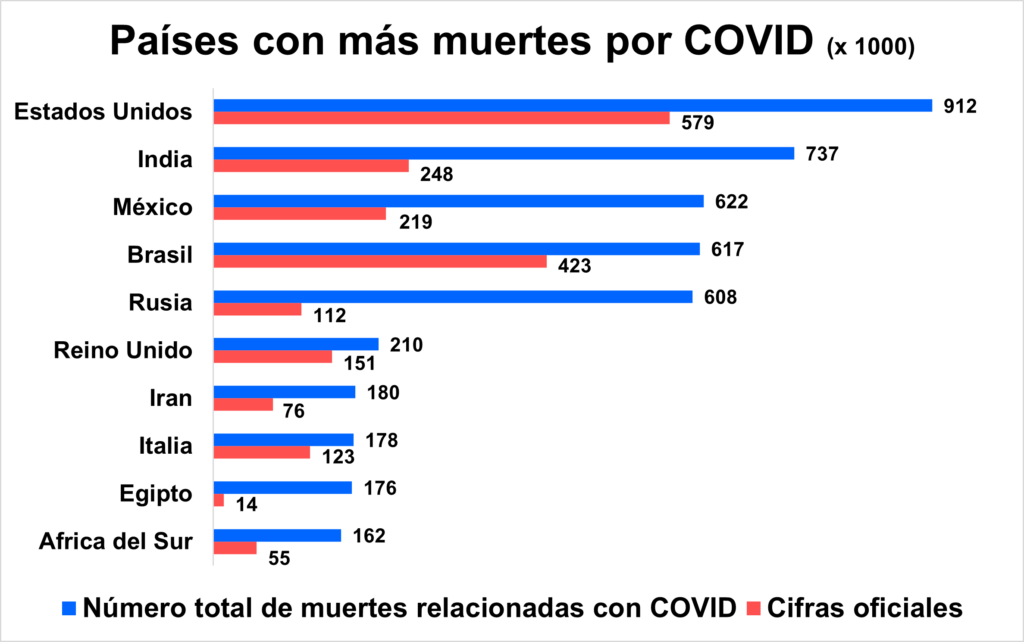
Basándose en las cifras proporcionadas por las autoridades, la Universidad Johns Hopkins y Worldometer llegan a un total de 3,4 millones de personas muertas en el mundo actualmente. En realidad la cantidad de personas muertas por covid es de 6,9 millones, es decir, más del doble que la cifra de la que se ha informado oficialmente.
Es la conclusión a la que llega el Instituto de Métricas y Evaluación de la Salud (IMHE, por sus siglas en inglés) de la Universidad de Washington. “Muchos países han hecho un esfuerzo extraordinario para medir el balance la pandemia, pero nuestro análisis muestra hasta qué punto es difícil hacer un seguimiento preciso de una enfermedad infecciosa nueva y que se propaga rápidamente”, declaró Christopher Murray, director del IHME. Este análisis confirma lo que muchos expertos sospechaban, es decir, que las tasas de mortalidad oficiales a menudo eran muy inferiores a las reales (1).
Casi todas las regiones del mundo dejan constancia de una cantidad demasiado baja de personas muertas por la enfermedad, pero en algunos países la cifra es particularmente crítica. En Bielorussia hay 17 veces más personas muertas de covid-19 que las declaradas. En Kazajastán y Azerbayán es casi 15 veces más elevada. En Egipto, 13 veces y, por sorprendente que parezca, en Japón 10 veces. En Rusia es cinco veces más baja y en México tres.
El 24 de mayo de 2021 España declaró 79.620 personas muertas de covid. Según el IMHE, hay 48.292 personas más, es decir, 127.912, de modo que, en realidad, hay un 60% más de muertes por covid de las que se declaran oficialmente.
Motivos de esta evaluación a la baja
¿Cuáles son las razones de esta estimación a la baja? En primer lugar, la capacidad de hacer pruebas varía mucho de un país a otro. Si hay poca capacidad para detectar los casos, la cantidad de muertes por covid no se incluye en las cifras.
Además, en muchos países las muertes por covid-19 solo se notifican si se producen en hospitales o en el caso de pacientes cuya infección se ha confirmado. No se contabilizan aquellos pacientes que mueren en casa o cuya infección no se ha diagnosticado. En algunos países estas cifras son altas debido a que los sistemas de información sanitaria son pobres o al limitado acceso a la atención sanitaria. En muchos países que tienen ingresos altos no se registraron muchas muertes por covid-19 de personas mayores en residencias durante los primeros meses de la pandemia.
Metodología
Según el IMHE, es importante calcular correctamente la cantidad total de muertes por covid-19 para comprender las causas de las pandemias más o menos importantes en los diferentes países, con el fin de calcular correctamente la gravedad de la epidemia y también con el fin de hacer previsiones mejores concernientes a la propagación del virus.
El IHME calcula la cantidad total de muertes por covid-19 comparando la cantidad esperada de muertes debidas a todas las causas, sobre la base de las tendencias antes de la pandemia, con la cantidad real de muertes debidas a todas las causas durante la pandemia. Este exceso de mortalidad se corrige eliminando las muertes que se pueden atribuir indirectamente a la pandemia (por ejemplo, el aplazamiento de operaciones urgentes debido a la falta de camas en la UCI) o las muertes que se evitan gracias a la pandemia (por ejemplo, menos muertes en accidentes de tráfico debido a la reducción de la movilidad) (2). Así se obtiene la cantidad de muertes causadas directamente por el SARS-CoV-2, en otras palabras, las muertes debidas al covid-19.
Las muertes del covid-19 en el mundo
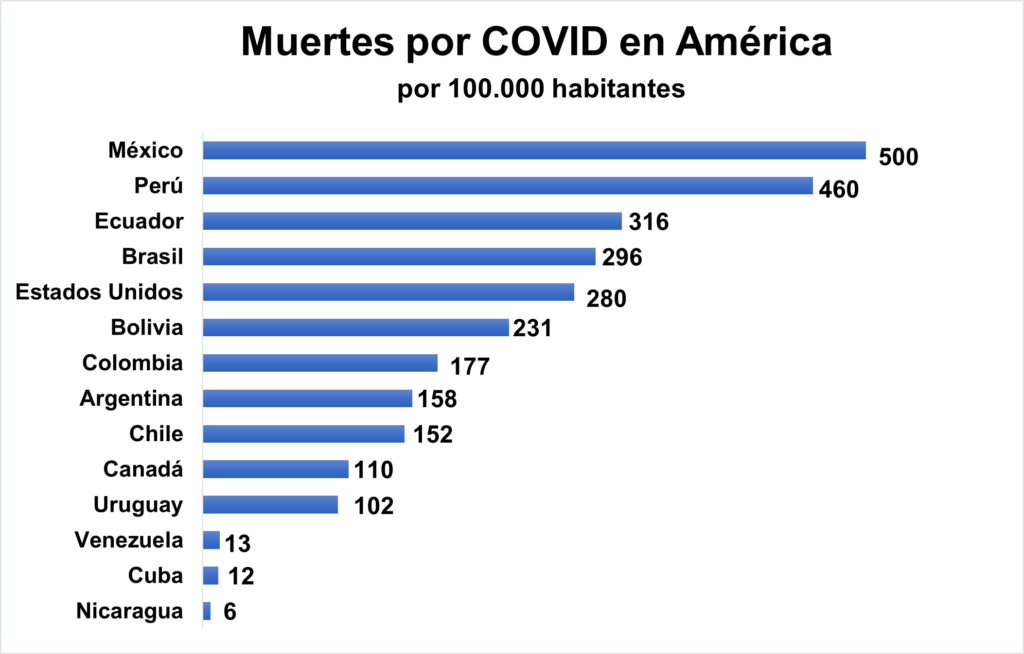
El estudio del IMHE nos proporciona el cuadro real de la pandemia en el mundo. Estados Unidos cuenta actualmente con más de 900.000 muertos de covid-19 e India con aproximadamente 650.000. En México, Brasil y Rusia la cifra es de aproximadamente 600.000. Entre los diez primeros puestos hay dos países europeos, Reino Unido e Italia.
Azerbayán tiene el dudoso honor de ocupar el primer lugar de muertes debidas al covid-19 por 100.000 habitantes, es decir, 659. Vietnam tiene la mejor puntuación con 0,1 por 100.000 habitantes.
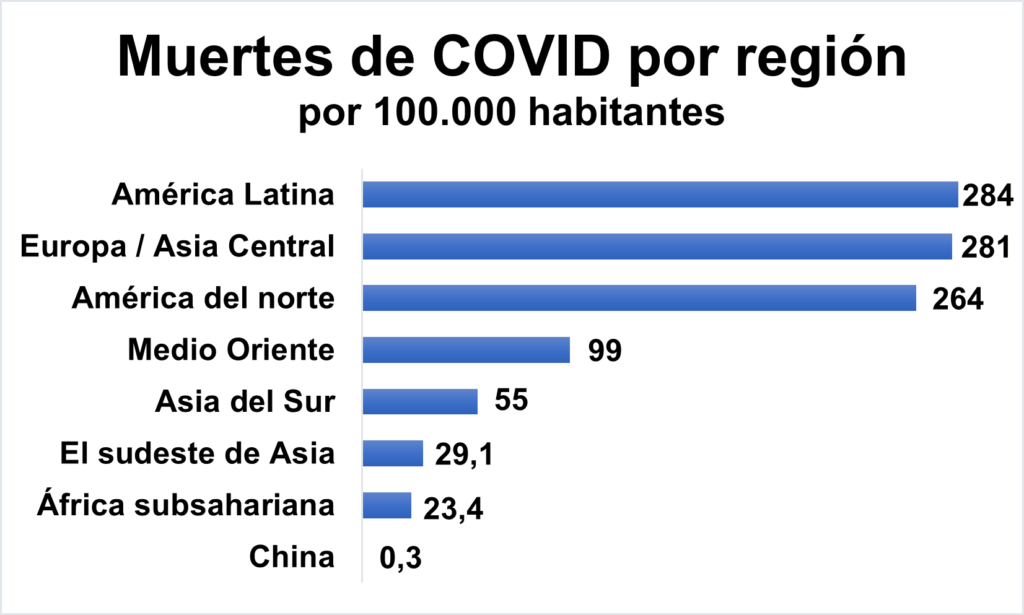
China tiene la mejor puntuación de todas las regiones o países grandes de muertes por covid-19 por habitante (3). Por el momento, África y Asia salen bien paradas globalmente. En América del Norte y del Sur, en Europa y en Asia central hay una media diez veces mayor de muertes por covid por habitante que en África.
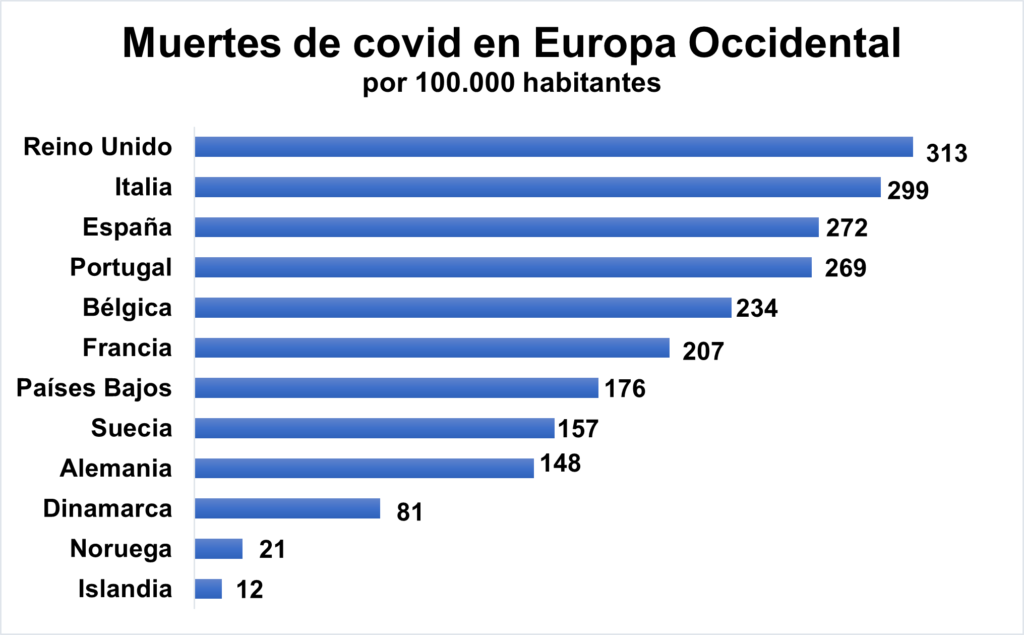
El peor alumno en Europa occidental es Reino Unido, seguido de Italia, España, Portugal y Bélgica. Islandia es con mucho el mejor alumno, seguido de Noruega y Dinamarca.
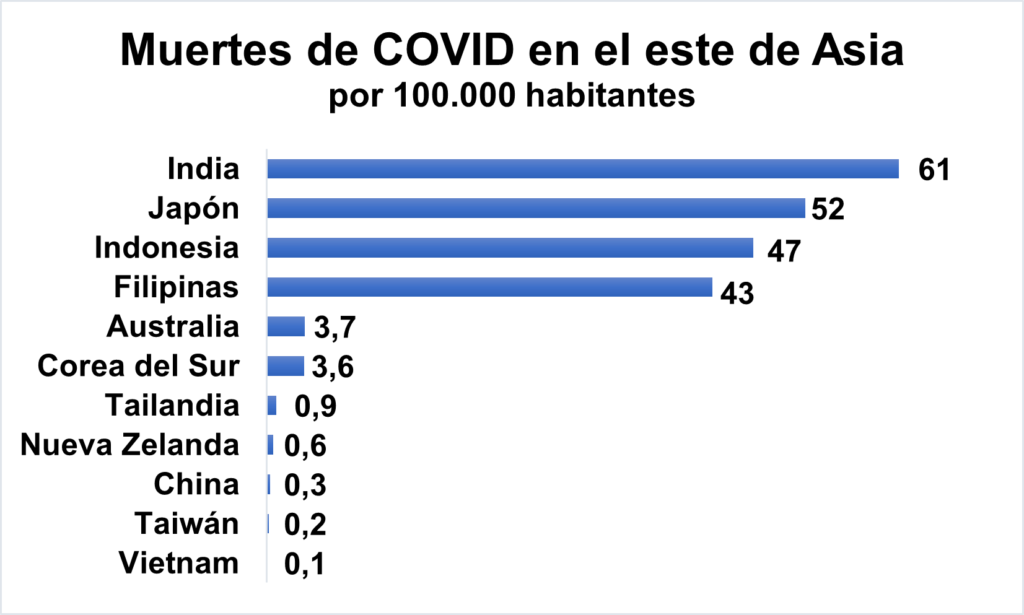
Algunos países de Asia Oriental han cortado el virus de raíz: Vietnam, Taiwán, China, Nueva Zelanda, Singapur, Tailandia, Corea del Sur y Australia. En comparación, países como Japón, India, Indonesia y Filipinas lo han hecho bastante peor.
Al igual que Asia Oriental, el continente americano presenta importantes diferencias. Los tres países más grandes, Estados Unidos, Brasil y México, salen muy mal parados, lo mismo que Perú, Ecuador y Bolivia. En cambio, las cifras son notablemente buenas para Nicaragua, Cuba y Venezuela, lo que resulta tanto más sorprendente cuanto que los tres países sufren fuertes sanciones económicas. En los resultados de estos tres países tiene mucho que ver tanto la calidad de la atención sanitaria como con la movilización de la población.
Perspectivas para el covid-19
Basándose en las cifras actuales, el IHME prevé entre 9 y 10 millones de muertes en el mundo de aquí a principios de otoño. La gripe normal mata a una media de 650.000 personas al año. El balance de la gripe rusa (1889), de la gripe asiática (1957) y de la gripe de Hong Kong (1968) fue de aproximadamente un millón de muertos. La gripe porcina (2009) provocó 200.000 víctimas.
Las cifras actuales y provisionales todavía son muy inferiores a las de la gripe española (1918), que causó decenas de millones de muertos. Pero entonces no existía vacuna, las medidas higiénicas eran casi inexistentes y la atención sanitaria era todavía muy rudimentaria. En todo caso, está claro que no nos enfrentamos a una “gripecita”, como a veces se creyó al principio de la pandemia.
La buena noticia es que actualmente las vacunas están dando buenos resultados ya que reducen la cantidad de personas contagiadas y la cantidad de ingresos hospitalarios (4). Pero lo que provoca incertidumbre cara al futuro son las variantes. Se desconoce si las vacunas ofrecen protección contra las variantes india y brasileña, por ejemplo, y en qué medida.
Por consiguiente, es importante vacunar lo más rápido posible a toda la población del mundo y no solo los países ricos. Una condición previa absoluta para lograrlo es la liberación de las patentes.
Traducido del neerlandés al francés por Anne Meert para Investig’action
Notas:
(1) Según un estudio reciente de The Economist, esta cifra es todavía más alta, entre 7 y 13 millones.
(2) Véase aquí una descripción más detallada de la metodología.
(3) En referencia a las muertes por covid-19, no es evidente comparar países, porque factores determinantes, como la demografía, la densidad de población y la movilidad, pueden variar de un país a otro. Ahora bien, este tipo de comparación es pertinente e interesante cuando se trata de países en los que los factores son similares. Así, se puede comparar Nicaragua con Ecuador y Perú. La comparación también es útil cuando las diferencias entre las tasas de mortalidad son grandes o muy grandes. Las diferencias entre China y Japón o India, por ejemplo, son muy llamativas y significativas.
(4) Donde la tasa de vacunación es más alta se suelen suavizar o reducir las cifras de mortalidad. En este momento hay al menos ocho lugares en los que se ha vacunado lo suficiente para cubrir al menos al 40 % de la población.
Early education is in an ‘unsustainable cycle.’ Could service districts help?
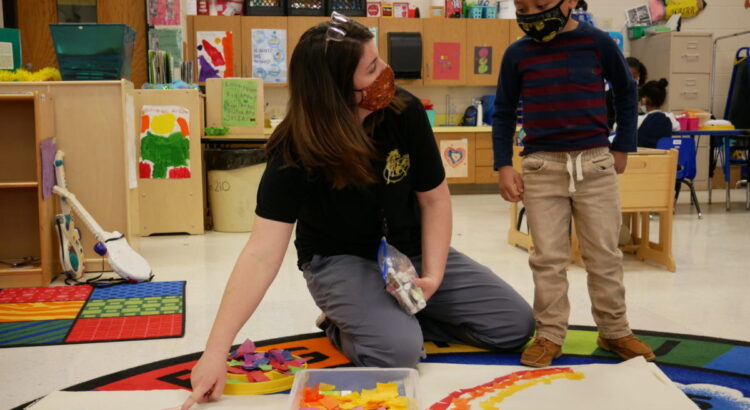
Amy Hairr, NC Pre-K teacher at LC Kerr Elementary in Clinton City Schools, helps student Byron R. with a rainbow arts activity. Liz Bell/EducationNC
County commissioners in North Carolina could create “service districts” to fund early education programs under a bill the House passed this month.
House Bill 664, which has bipartisan sponsorship and now sits in the Senate rules committee, would add “early childhood education programs” to the list of purposes for which counties can levy property tax.
The change could enable a source of public funds for an early care and education system that largely relies on private rates. Those rates, though unaffordably high for many, do not cover the cost of quality early learning, including fair wages for the educators, said Rep. Ashton Clemmons, D-Guilford, one of the bill’s primary sponsors.
Across the state and country, policymakers are grappling with how to lower costs and increase access to early childhood education programs while maintaining quality, Clemmons said.
“How do we get out of that cycle that we’re in right now? I think this is a tool in the toolbox. I think we need many tools in the toolbox,” she said.
“This just gives the option for a county to decide that this is an investment that we want to make in our community.”
Service districts are defined areas within a town or county in which the local government can raise property taxes for a specific service that would benefit those within the district, from sewage collection and disposal to recreation.
A 35-year-old model in Florida
In Florida, counties are able to create service districts to fund services for children and families. A state law, passed in 1986, allows counties to establish Children’s Services Councils (CSCs), which are considered another type of local government, to oversee those funds.
In Palm Beach County, more than 70% of the council’s funds go to early childhood services, from universal screening and early intervention services to child care scholarships, said council CEO Lisa Williams-Taylor.
“Nobody else was really funding in that area,” Williams-Taylor said.
The council also funds community centers called bridges, children’s literacy programs, home visiting services, and supports for maternal health during and after pregnancy.
Within formal early learning environments, the council funds education-based wage supplements and professional development for early educators and child care scholarships — including for children in home visiting programs and for older siblings who need after-school or summer care.
Through the pandemic, Williams-Taylor said, the council has been able to support smaller nonprofits while similar organizations have shut their doors in other counties. She said she hopes to provide PPE and sanitation materials to child care providers soon.
“We’ve been focused on early childhood for, certainly, the 16 years I’ve been here,” she said. “It really was over time, a shift to say the earlier we start, the better off.”
Nine councils across Florida are members of a statewide association called Florida Children’s Council. Michele Watson, CEO of the council, said locally funded initiatives can be measured against desired outcomes. Successful strategies can then be scaled across the state.
“That’s where the association really comes in, is taking all this great innovation … to the state-level decision-makers and working with policymakers to pass those policies to better support all the state’s children,” Watson said.
Watson pointed to the state’s alignment of subsidy and pre-K requirements as a statewide early childhood policy success that resulted from local investments from children’s councils.
Perpetuating inequities
Watson said Florida faces similar early childhood financing challenges that will require state investments that create “a true system that can be supportive and self-sustaining.”
“Without being able to supplement the ability for parents to have access to high-quality child care, we as a community and as a state are always going to create these haves and have-nots.”
Michele Rivest, senior campaign director for the NC Early Education Coalition, pointed to local universal pre-K initiatives in Durham, Wake, and Mecklenburg counties. She said this legislation could help some counties who have similar local initiatives but lack the state or federal resources to move forward.
“This tool is certainly important right from a local community perspective,” Rivest said.
Yet this policy without significant state and federal investments could perpetuate inequities in affordability and access, Rivest said.
“It’s not a statewide solution to the financing crisis in our state,” she said. “Why doesn’t the state set up a special taxing mechanism to fund early childhood services so that it could be equitable across the state? I would rather see that.”
A different strategy is needed to ensure equitable access to high-quality learning, Clemmons said.
“A 2-year-old in a community that does have a greater tax base is no more or less deserving of high-quality early child care than a 2-year-old in a community with a really depleted tax base,” she said. “Any time that we are not making the investments we should at the state level and pushing those down to the local level, it creates an opportunity to have inequities … I see this as a tool, but it is definitely not the best tool to solve the bigger problem. I think we need many many more conversations and work in that area.”
Fuente de la Información: https://www.ednc.org/2021-05-28-early-education-funding-service-districts-property-tax-north-carolina-bill/
Virginia educator placed on leave after speech asserting he won’t ‘affirm that a biological boy can be a girl and vice versa’
A Virginia elementary school physical education instructor was put on leave after he gave a speech telling his school board he refused to «affirm that a biological boy can be a girl and vice versa.»
Byron «Tanner» Cross, the teacher, voiced his opinion to the Loudoun County School Board during a Tuesday meeting, speaking against the county’s policies surrounding gender, according to a video of the meeting.
«My name is Tanner Cross, and I am speaking out of love for those who suffer with gender dysphoria,» Cross, who teaches at Leesburg Elementary School, told the board. He went on to discuss a Sunday 60 Minutes segment that aired on CBS about healthcare issues facing the transgender community.
«It’s not my intention to hurt anyone, but there are certain truths that we must face when ready. We condemn school policies … [that] would damage children, defile the holy image of God,» Cross said.
Cross was referring to the school board’s policy 8040, which makes it compulsory for Loudoun County Public Schools staff to use the preferred pronouns of students who do not identify with the gender they were assigned at birth.
«I love all of my students, but I will never lie to them regardless of the consequences. I’m a teacher, but I serve God first, and I will not affirm that a biological boy can be a girl and vice versa because it’s against my religion. It’s lying to a child, it’s abuse to a child, and it’s sinning against our God,» he said.
Cross was placed on administrative leave with pay on Friday, an LCPS spokesperson told the Washington Examiner.
«Building principals cannot put employees on leave,» the spokesperson added, confirming that the elementary school’s principal had nothing to do with the decision.
When asked whether Cross’s removal was about his refusal to comply with policy 8040, the spokesperson said the school could not disclose the reason for the decision due to state and federal confidentiality laws.
Fuente de la Información: https://www.washingtonexaminer.com/news/loudoun-county-educator-on-leave-after-disputing-biological-boy-can-be-girl
OtrasVocesenEducacion.org existe gracias al esfuerzo voluntario e independiente de un pequeño grupo de docentes que decidimos soñar con un espacio abierto de intercambio y debate.
¡Ayúdanos a mantener abiertas las puertas de esta aula!









 Users Today : 56
 Total Users : 35490971
 Views Today : 98
 Total views : 3604446