Henry Giroux
Donald Trump’s blatant appeal to fascist ideology and policy considerations took a more barefaced and dangerous turn this week when he released a statement calling for «a total and complete shutdown of Muslims entering the United States.» Trump qualified this racist appeal to voters’ fears about Muslims by stating that such a ban is necessary «until our country’s representatives can figure out what is going on.»
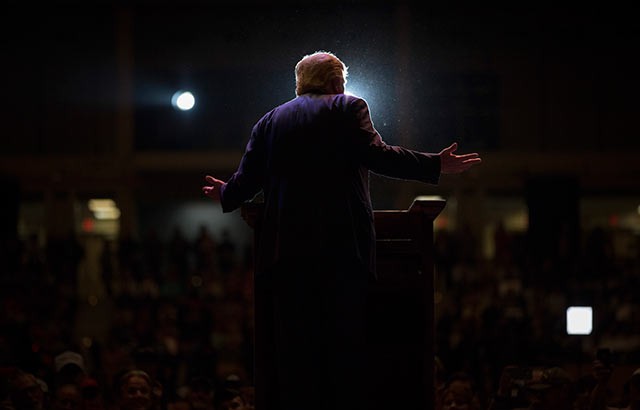
When Trump proposed the ban at a rally at the USS Yorktown in South Carolina, his plan drew loud cheers from the crowd. Many critics have responded by making clear that Trump’s attempts to place a religious test on immigration and travel are unconstitutional. Others have expressed shock in the face of a proposal that violates the democratic ideals that have shaped US history. Fellow Republican Jeb Bush called Trump «unhinged.»
Trump’s call to do «the unthinkable» is a fundamental principle of any notion of totalitarianism.
What almost none of the presidential candidates or mainstream political pundits have admitted, however, is not only that Trump’s comments form a discourse of hate, bigotry and exclusion, but also that such expressions of racism and fascism are resonating deeply in a landscape of US culture and politics crafted by 40 years of conservative counterrevolution. One of the few politicians to respond to Trump’s incendiary comments was former Maryland Gov. Martin O’Malley (D), who stated rightly that Donald Trump is a «fascist demagogue.»
This overtly fascistic turn also revealed itself in November when Trump mocked Serge Kovaleski, a New York Times investigative reporter living with a disability, at a rally in South Carolina. This contemptuous reference to Kovaleski’s physical disability was morally odious and painful to observe, but not in the least surprising: Trump is consistently a hatemonger and spreads his message without apology in almost every public encounter in which he finds himself. In this loathsome instance, Trump simply expanded his hate-filled discourse in a new direction, after having already established the deeply ingrained racism and sexism at the heart of his candidacy.
Trump’s mockery of Kovaleski and his blatantly discriminatory policy proposals against Muslims are of a piece with his portrayal of Mexican immigrants as violent rapists and drug dealers, and with his calls for the United States to put Syrian refugees in detention centers and create a database to control them. These comments sound eerily close to SS leader Heinrich Himmler’s call for camps that held prisoners under orders of what the Nazis euphemistically called «protective custody.» This fascist parallel only gains currency with Trump’s latest efforts to ban Muslims from the United States. To quote the Holocaust Encyclopedia:
In the earliest years of the Third Reich, various central, regional, and local authorities in Germany established concentration camps to detain political opponents of the regime, including German Communists, Socialists, trade unionists, and others from left and liberal political circles. In the spring of 1933, the SS established Dachau concentration camp, which came to serve as a model for an expanding and centralized concentration camp system under SS management.
Moreover, Trump’s hateful attitude toward people with disabilities points to an earlier element of Hitler’s program of genocide in which people with physical and mental disabilities were viewed as disposable because they allegedly undermined the Nazi notion of the «master race.» The demonization, objectification and pathologizing of people with disabilities was the first step in developing the foundation for the Nazis’ euthanasia program aimed at those declared unworthy of life. This lesson seems to be lost on the mainstream media, who largely viewed Trump’s despicable remarks toward people with disabilities as simply insulting.
What is truly alarming is how many corporate media figures and intellectuals are defending Trump, not realizing that his candidacy is rooted in the brutal seeds of totalitarianism being cultivated in US society. Trump represents more than the anti-democratic practices and antics of Joseph McCarthy; he illustrates how totalitarianism can take different forms in specific historical moments. Rather than being dismissed as a wild card in US politics, as «careless and undisciplined,» as some of his conservative supporters claim, or not a true member of the Republican Party as Ross Douthat has written in The New York Times, it is crucial to recognize that Trump’s popularity represents what Victor Wallis has described as a dangerous «political space … in both the wider culture and in recent history.» This is evident not only in his race-baiting, his crude comments about women and his call to round up and deport 11 million immigrants, but also in his increasing support for violenceagainst protesters at his rallies.
There is a disturbing totalitarian message in his call to «make American great again» by any means necessary. The degree to which Trump expresses his support of violence, racism and the violation of civil liberties, visibly and without apology, is unprecedented in recent national political races. But the ideas he espouses have always been present under the surface of US politics, which is perhaps why the public and media on the whole seem unperturbed by such comments as: «We’re going to have to do things that we never did before. And some people are going to be upset about it, but I think that now everybody is feeling that security is going to rule … And so we’re going to have to do certain things that were frankly unthinkable a year ago.» Trump’s call to do «the unthinkable» is a fundamental principle of any notion of totalitarianism, regardless of the form it takes.
We heard this same hatred in the words of Hitler, Mussolini, Pinochet and other demagogic orators.
The roots of totalitarianism are not frozen in history. They may find a different expression in the present, but they are connected in all kinds of ways to the past. For instance, Trump’s demagoguery bears a close resemblance to the discourse characteristic of other fascist leaders. There are traces of fascism’s past most particularly in what has been called by Patrick Healy and Maggie Haberman, Trump’s «dark power of words.» As Healy and Haberman point out in a recent New York Times article, Trump’s use of fearmongering and bombastic language is characterized by «divisive phrases, harsh words and violent imagery» characteristic of demagogues of the past. Moreover, Trump, like many past demagogues, presents himself as a prophet incapable of being wrong, disdains any sense of nuance and uses a militarized discourse populated by words such as «kill,» «destroy,» «attack» and «fight,» all of which display his infatuation with violence and deep disdain for dialogue, thoughtfulness and democracy itself. Trump is an anti-intellectual who distorts the truth even when proven wrong, and his appeals are emotive rather than based on facts, reason and evidence.
Trump and his ilk merge a hypernationalism, racism, economic fundamentalism and religious bigotry with a flagrant sense of lawlessness. His hate-filled speech is matched by an unsettling embrace of violence against immigrants and other oppositional voices issued by his supporters at many of his rallies. This type of lawlessness does more than encourage hate and violent mob mentalities; it also legitimates the kind of inflammatory rhetoric that gives credibility to acts of violence against others. There has been an eerie silence from Trump and other Republican Party presidential candidates in the face of the killing of three people at a Planned Parenthood clinic in Colorado, the shooting of Black Lives Matter protesters by white supremacists in Minneapolis, the increasing attacks on mosques throughout the United States, and the alarming number of shootings of Black men and youth by white police officers, not to mention the recent shooting in San Bernardino, California.
Trump and his fellow right-wing extremists rail against Mexican immigrants, Syrian refugees and young people protesting police violence but said nothing about the police officer who shot Laquan McDonald, a Black 17-year-old, 16 times, or about the Chicago Police Department’s refusal to make public a year-old squad-car video of the incident. And Trump’s camp has remained silent about the threat of white supremacists groups in the United States, the US drone strikes that killed members of a wedding party in Afghanistan and the illegal targeted assassination of alleged terrorists.
This is not simply the behavior of moral and political cowards; it is the toxic affirmation of the machineries of death we associate with fascism. Such acts point to a large climate of lawlessness in US society that makes it all the easier to ignore human rights, justice and democracy itself. There are historical precedents for this type of violence and for the hate-filled racist speech of the politicians who create the climate that legitimates it. We heard this same hatred in the words of Hitler, Mussolini, Pinochet and other demagogic orators who have ranted against Jews, communists and others alleged «infidels.»
Totalitarianism lives on in new forms and it is just as terrifying and dangerous today as it was in the past.
Trump’s recent call to bring back waterboarding and to support a torture regime far exceeds what might be called an act of stupidity or ignorance. Torture in this instance becomes a means of exacting revenge on those whom the right considers to be «other,» un-American and inferior – principally Muslims, immigrants and activists taking part in the movement for Black lives. We have heard this discourse before during the totalitarian regimes of the 1930s and later during the dictatorships in Latin America in the 1970s. Heather Digby Parton is right when she writes that Donald Trump «may be the first openly fascistic frontrunner for the Republican presidential nomination but the ground was prepared and the seeds of his success sowed over the course of many years. We’ve had fascism flowing through the American political bloodstream for quite some time.» (1)
This is a discourse that betrays dark and treacherous secrets not simply about Trump, but also about the state of US culture and politics. Trump’s brutal racism, cruelty and Nazi-style policy recommendations are more than shocking; they are emblematic of totalitarianism’s hatred of liberalism, its call for racial purity, its mythic celebration of nationalism, its embrace of violence, its disdain for weakness and its anti-intellectualism. This is the discourse of total terror. These elements of totalitarianism have become the new American normal. The conditions that produced the torture chambers, intolerable violence, extermination camps and the squelching of dissent are still with us. Totalitarianism is not simply a relic of the past. It lives on in new forms and it is just as terrifying and dangerous today as it was in the past. (2)
Trump gives legitimacy to a number of fascist policies through his appeal to hypernationalism and disdain of human rights, his portrayal of Muslims and immigrants as a racial and religious threat, a rampant sexism, his obsession with national security, his aggressive mobilization of a culture of fear, his targeting of dissent and individual groups, his endorsement of human rights abuses such as torture, his support for the ongoing militarization of public life, his invocation of an external enemy as a threat to «our way of life,» his call for the creation of a detention system as part of a state of emergency, support for a blind patriotism, his calls for the suspension of the rule of law, his affirmation of a belligerent masculinity, and his support for an aggressive imperial policy.
Mark Summer is right in arguing that the ghost of fascism runs through US society, indicating that fascist sympathies never went away and that the threat of fascism has to be taken seriously. Summer writes that fascism didn’t win on the battlefield, but it won ideologically:
It won because the same fears, the same greed, the same hatred that fueled its growth in the first part of the twentieth century never went away. The symbols of fascism became anathema, but the causes … went deep. And gradually, slowly, one step at a time, all those vices became first tolerated, then treated as virtues, and then as the only acceptable view…. [For instance,] our long, stumbling lurch to the right; the building force of corporate power; the relentless need for war; a police whose power of enforcement is divorced from law; a preening nationalism that rewards the full rights of citizenship only to those who fit an ever-narrower mold … I’m not saying we’re moving toward fascism. I’m saying we started that drift a long time ago, and now we’re well across the line.
Trump is not just an ethically dead aberration. Rather, he is the successor of a long line of fascists who shut down public debate, attempt to humiliate their opponents, endorse violence as a response to dissent and criticize any public display of democratic principles. The United States has reached its endpoint with Trump, and his presence should be viewed as a stern warning of the nightmare to come. Trump is not an isolated figure in US politics; he is simply the most visible and popular expression of a number of extremists in the Republican Party who now view democracy as a liability. Ben Carson, Ted Cruz and Marco Rubio all support an ideology that reduces certain human beings «to anonymous beings.» Think about their prevailing attacks on Mexican immigrants, Black people and Syrian refugees. Primo Levi, the great writer and survivor of Auschwitz, called this use of dehumanizing abstractions one of the core principles of Nazi barbarism. Fast forward to Trump’s endorsement of violence at his rallies, coupled with his overt racism, his call for mass surveillance, his discourse of mass hatred and his embrace of politics as an extension of war.
This is not the discourse of Kafka, but of those extremists who have become cheerleaders for totalitarianism. Trump is not a straight talker, as some writers have claimed, or merely entertaining. As David L. Clark pointed out in a personal correspondence, the frankness of Trump’s call for violence coupled with his unapologetic thirst for injustice position him as the «latest expression of a fascism that has poisoned political life throughout modernity. He is unabashedly vicious because he is both an agent and a symptom of a barren political landscape in which viciousness goes insolently unhidden.» (3) Trump is a monster without a conscience, a politician with a toxic set of policies. He is the product of a form of finance capitalism and a long legacy of racism and violence in which conscience is put to sleep, democracy withers and public values are extinguished. This is truly a time of monsters and Trump is simply the most visible and certainly one of the most despicable.
What must be acknowledged is that Trump is the most extreme visible expression of a new form of authoritarianism identified by the late political theorist, Sheldon Wolin. According to Wolin, all the elements are in place today for a contemporary form of authoritarianism, which he calls «inverted totalitarianism.» Wolin writes:
Thus the elements are in place: a weak legislative body, a legal system that is both compliant and repressive, a party system in which one part, whether in opposition or in the majority, is bent upon reconstituting the existing system so as to permanently favor a ruling class of the wealthy, the well-connected and the corporate, while leaving the poorer citizens with a sense of helplessness and political despair, and, at the same time, keeping the middle classes dangling between fear of unemployment and expectations of fantastic rewards once the new economy recovers. That scheme is abetted by a sycophantic and increasingly concentrated media; by the integration of universities with their corporate benefactors; by a propaganda machine institutionalized in well-funded think tanks and conservative foundations; by the increasingly closer cooperation between local police and national law enforcement agencies aimed at identifying terrorists, suspicious aliens, and domestic dissidents. (4)
Totalitarianism destroys everything that makes politics possible. It is both an ideological poison and a brutal mode of governance and control. It puts reason to sleep and destroys any viable elements of democracy. Trump reminds us of totalitarianism’s addiction to tyranny, its attachments to the machineries of death and its moral emptiness. What is crucial to acknowledge is that the stories, legacies and violence that are part of totalitarianism’s history must be told over and over again so that it becomes possible to recognize how it appears in new forms, replicated under the banner of terror and insecurity by design, and endlessly legitimated by the image-making of the corporate disimagination machines. The call to safety in authoritarian societies is code for illicit spying, treating people as criminals, militarizing the police, constructing a surveillance state, allowing the killing of Black people as acts of domestic terrorism, and ultimately making disappear those individuals and groups that we dehumanize or consider threatening. The extremist fervor that Trump has stirred up should be a rallying cry for a struggle not simply against a crude and reactionary populism, but also against the tyranny of totalitarianism in its new and proto-fascist forms.
Note: This article was adapted from a much shorter article that appeared previously on CounterPunch.
Footnotes
1. Heather Digby Parton, «The Unprecedented Nightmare of Donald Trump: He’s Actually a Fascist,» AlterNet, [November 25, 2015]. Online:http://www.alternet.org/news-amp-politics/unprecedented-nightmare-donald-trump-hes-actually-fascist. It is interesting to note that John Kasich released an ad directly connecting Donald Trump to the Nazis. Hopefully, the corporate media will wake up and do the same thing. See TrueBlueMontaineer, «Kasich’s new Trump ad goes full on Godwin and it’s a doozy,» Daily Kos (November 24, 2015). Online:http://www.dailykos.com/stories/2015/11/24/1454059/-Kasich-s-new-Trump-ad-goes-full-Godwin-and-it-s-a-doozy?detail=email
2. See, especially, Hannah Arendt, The Origins of Totalitarianism, (Houghton Mifflin Harcourt, New York: 2001).
3. Personal correspondence with David L. Clark. November 30, 2015.
Copyright, Truthout. May not be reprinted without permission of the author.





 Users Today : 23
 Total Users : 35490835
 Views Today : 24
 Total views : 3604247