Page 6049 of 6793
1 6.047 6.048 6.049 6.050 6.051 6.793

Alemania: No grades, no timetable: Berlin school turns teaching upside down

Europa/Alemania/julio de 2016/TheGuardian

RESUMEN: En la escuela de Oberländer, no hay grados hasta que los estudiantes cumplen 15 años, sin horarios y sin instrucciones, de estilo conferencia. Los alumnos deciden qué temas quieren estudiar para cada lección y cuando quieren tomar un examen. Establecer temas se limitan a las matemáticas, alemán, inglés y estudios sociales, complementados con cursos más abstractos como «responsabilidad» y «desafío». Para el desafío, los estudiantes de entre 12 y 14 están dadas € 150 (£ 115) y se envían a una aventura que tienen que planificar por ellos mismos. Algunos van kayak; otros trabajan en una granja. Un adolescente, Anton, curso senderismo a lo largo de la costa sur de Inglaterra. La filosofía detrás de estas innovaciones es simple: como los requerimientos del mercado de trabajo están cambiando, y los teléfonos inteligentes y el Internet están transformando las formas en que los jóvenes procesan la información, la directora de la escuela, Margret Rasfeld, argumenta que, la habilidad más importante de una escuela es poder transmitir a sus alumnos la capacidad de motivarse a sí mismos.

Por: Philip Oltermann
Anton Oberländer is a persuasive speaker. Last year, when he and a group of friends were short of cash for a camping trip to Cornwall, he managed to talk Germany’s national rail operator into handing them some free tickets. So impressed was the management with his chutzpah that they invited him back to give a motivational speech to 200 of their employees.
Anton, it should be pointed out, is 14 years old.
The Berlin teenager’s self-confidence is largely the product of a unique educational institution that has turned the conventions of traditional teaching radically upside down. At Oberländer’s school, there are no grades until students turn 15, no timetables and no lecture-style instructions. The pupils decide which subjects they want to study for each lesson and when they want to take an exam.
The school’s syllabus reads like any helicopter parent’s nightmare. Set subjects are limited to maths, German, English and social studies, supplemented by more abstract courses such as “responsibility” and “challenge”. For challenge, students aged 12 to 14 are given €150 (£115) and sent on an adventure that they have to plan entirely by themselves. Some go kayaking; others work on a farm. Anton went trekking along England’s south coast.
The philosophy behind these innovations is simple: as the requirements of the labour market are changing, and smartphones and the internet are transforming the ways in which young people process information, the school’s headteacher, Margret Rasfeld, argues, the most important skill a school can pass down to its students is the ability to motivate themselves.
“Look at three or four year olds – they are all full of self-confidence,” Rasfeld says. “Often, children can’t wait to start school. But frustratingly, most schools then somehow manage to untrain that confidence.”
The Evangelical School Berlin Centre (ESBC) is trying to do nothing less than “reinvent what a school is”, she says. “The mission of a progressive school should be to prepare young people to cope with change, or better still, to make them look forward to change. In the 21st century, schools should see it as their job to develop strong personalities.”
Making students listen to a teacher for 45 minutes and punishing them for collaborating on an exercise, Rasfeld says, was not only out of sync with the requirements of the modern world of work, but counterproductive. “Nothing motivates students more than when they discover the meaning behind a subject of their own accord.”
Students at her school are encouraged to think up other ways to prove their acquired skills, such as coding a computer game instead of sitting a maths exam. Oberländer, who had never been away from home for three weeks until he embarked on his challenge in Cornwall, said he learned more English on his trip than he had in several years of learning the language at school.
Germany’s federalised education structure, in which each of the 16 states plans its own education system, has traditionally allowed “free learning” models to flourish. Yet unlike Sudbury, Montessori or Steiner schools, Rasfeld’s institution tries to embed student self-determination within a relatively strict system of rules. Students who dawdle during lessons have to come into school on Saturday morning to catch up, a punishment known as “silentium”. “The more freedom you have, the more structure you need,” says Rasfeld.
The main reason why the ESBC is gaining a reputation as Germany’s most exciting school is that its experimental philosophy has managed to deliver impressive results. Year after year, Rasfeld’s institution ends up with the best grades among Berlin’s gesamtschulen, or comprehensive schools, which combine all three school forms of Germany’s tertiary system. Last year’s school leavers achieved an average grade of 2.0, the equivalent of a straight B – even though 40% of the year had been advised not to continue to abitur, the German equivalent of A-levels, before they joined the school. Having opened in 2007 with just 16 students, the school now operates at full capacity, with 500 pupils and long waiting lists for new applicants.
Given its word-of-mouth success, it is little wonder that there have been calls for Rasfeld’s approach to go nationwide. Yet some educational experts question whether the school’s methods can easily be exported: in Berlin, they say, the school can draw the most promising applicants from well-off and progressive families. Rasfeld rejects such criticisms, insisting that the school aims for a heterogenous mix of students from different backgrounds. While a cross adorns the assembly hall and each school day starts with worship, only one-third of current pupils are baptised. Thirty per cent of students have a migrant background and 7% are from households where no German is spoken.
Even though the ESBC is one of Germany’s 5,000 private schools, fees are means tested and relatively low compared with those common in Britain, at between €720 and €6,636 a year. About 5% of students are exempt from fees.
However, even Rasfeld admits that finding teachers able to adjust to the school’s learning methods can be harder than getting students to do the same.
Aged 65 and due to retire in July, Rasfeld still has ambitious plans. A four-person “education innovation lab” based at the school has been developing teaching materials for schools that want to follow the ESBC’s lead. About 40 schools in Germany are in the process of adopting some or all of Rasfeld’s methods. One in Berlin’s Weissensee district recently let a student trek across the Alps for a challenge project. “Things are only getting started,” says Rasfeld.
“In education, you can only create change from the bottom – if the orders come from the top, schools will resist. Ministries are like giant oil tankers: it takes a long time to turn them around. What we need is lots of little speedboats to show you can do things differently.”
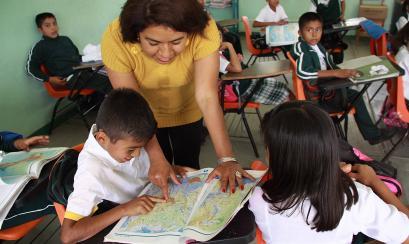
Foto: A teacher with a pupil at the Evangelical School Berlin Centre. Photograph: Handout
https://i.guim.co.uk/img/media/bc8ae39ab870a2f054e0545c1f4092d43ac81d72/0_81_2048_1229/master/2048.jpg?w=700&q=55&auto=format&usm=12&fit=max&s=dbef0854176feb57b9d8c979f93f4b11
Fuente: https://www.theguardian.com/world/2016/jul/01/no-grades-no-timetable-berlin-school-turns-teaching-upside-down

Comparte este contenido:

México: Estudiantes crean plástico biodegradable con caña de azúcar

México: Estudiantes crean plástico biodegradable con caña de azúcar

Novedad estudiantil/México/julio de 2016/Informador.Mx

La investigación pretende generar un material que proteja al medio ambiente

Un grupo de estudiantes mexicanos de ingeniería logró obtener plástico biodegradable del bagazo de caña de azúcar, lo que podría reducir los costos en la obtención de este tipo de materiales y ayudaría a proteger el medio ambiente.

En una entrevista con la Agencia Informativa del Consejo Nacional de Ciencia y Tecnología (Conacyt), la estudiante del Instituto Tecnológico de Colima (Itec), Verónica Citlali Salazar, señaló que el proyecto denominado BioCane pretende crear un plástico biodegradable que proteja al medio ambiente con el residuo de la industria cañera.

«Con este proyecto se logrará reducir la generación de plásticos derivados del petróleo, se le dará más vida útil a los rellenos sanitarios y se reducirá la contaminación atmosférica, ya que últimamente se quema el bagazo de la caña de azúcar», indicó la alumna de ingeniería ambiental.

Por su parte, el asesor del proyecto, Olimpo Lúa Madrigal, mencionó que con este trabajo se aprovechará el residuo que surge de los ingenios de azúcar, el cual se usa de manera indebida al tirarse o quemarse.

«Aunque, en algunas partes, el bagazo se da como alimento para ganado, todavía no se ha aprovechado al 100 por ciento. Por ello se pretende convertirlo por medio de un proceso en bioplástico para que tenga varias aplicaciones, como película de empaque o para hacer ángulo perfil que se utiliza para los empaques de limón o de mango», puntualizó.

Para obtener el material, los estudiantes sometieron al bagazo de la caña de azúcar a un proceso de secado y triturado para conformar una pasta, que luego se depositó en moldes hasta lograr su enfriado, lo que generó una estructura molecular parecida al plástico.

Fuente: http://www.informador.com.mx/tecnologia/2016/669313/6/estudiantes-crean-plastico-biodegradable-con-cana-de-azucar.htm

Comparte este contenido:

Argentina: Inscriben para seminario sobre Educación

Seminario/Argentina/julio de 2016/El Liberal

Desde el próximo lunes al jueves 7 de julio, en el horario de 15 a 21 horas, se dictará el curso «Análisis sociológico de la educación», en la Escuela para la Innovación Educativa de la Unse. El mismo es parte del Doctorado en Educación, y es abierto a todos quienes estén interesados en el abordaje sociológico de la educación.
El Doctorado en Educación de la Escuela para la Innovación Educativa, posgrado que dirige el Dr. José Yuni, convoca a participar del curso a cargo de la Dra. Nora Gluz, quien es licenciada en Ciencias de la Educación por la UBA, Máster en Ciencias Sociales por la Flacso y doctora en Educación por la UBA y tiene una amplia trayectoria en investigaciones vinculadas a las relaciones entre desigualdad social y escolarización, focalizando tanto en las intervenciones sociales del Estado sobre esta cuestión como en las resistencias colectivas a la subalternidad.
Los interesados podrán inscribirse por correo a pos grado @eie.unse.edu .ar.
Fuente: http://www.elliberal.com.ar/noticia/270055/inscriben-para-seminario-sobre-educacion

Comparte este contenido:

Kenia: Kenya’s school arson attacks lead to national debate

Africa/Kenia/Junio de 2016/BBC

RESUMEN: Esta semana, se han producido otros cuatro incendios en las escuelas, y los informes de los medios dicen que ha habido al menos 16 incidentes de fuego en las escuelas en el oeste de Kenia este año, sobre todo alrededor de Kisii.
Los kenianos han estado debatiendo el tema en los medios sociales y los programas de radio. Algunos sugieren que se trata de una cuestión de indisciplina, causada por la mala crianza de los hijos, y que el apaleamiento debe ser presentada de nuevo.
Kenya prohibió el castigo corporal en el año 2001. Los expertos y los políticos también están estudiando el problema para ofrecer sus propias soluciones.
Los periódico Estándar de Kenia informan que los funcionarios de educación han identificado varias razones detrás de los disturbios de la escuela.

Por: Dickens Olewe
School arson attacks carried out by students appear to have become a trend in Kenya, leaving people to speculate about the causes, although no-one seems to agree.
Last Saturday’s incident, when dormitories were burned down at a boarding school in western Kenya, was one of many this year.
But it caught people’s attention as it appeared to be the result of anger that students were not allowed to watch a live broadcast of a Euro 2016 football match.
Many thought that there must be a more profound reason.
This week alone, there have been four other school fires, and media reports say there have been at least 16 fire incidents in schools in western Kenya this year, mostly around Kisii.
Kenyans have been debating the issue on social media and radio talk shows.
Some suggest that this is a matter of indiscipline, caused by poor parenting, and that caning should be reintroduced.
Kenya banned corporal punishment in 2001.
The experts and politicians are also looking into the issue and offering their own solutions.
Kenya’s Standard newspaper reports that education officials have identified several reasons behind the school unrest.
These include:
• students panicking about expected stricter supervision in national exams
• poor school leadership
• the imposition of stricter rules
• drug abuse.
There was also the suggestion that some teachers may have been involved in the planning of the attacks.
Kenya’s Education Minister Fred Matiang’i joined the chorus of people blaming parents for the indiscipline.
He said they should take responsibility for «instilling the right values» and prevent students from taking antisocial behaviour into schools.
On a visit to the school affected on Saturday, Mr Matiang’i said the parents of those behind the arson should pay for the damage.
Deputy President William Ruto proposed his own solutions, calling for student mentoring and more prayers in schools.
Meanwhile, some local education officials have blamed politicians for not being good role models.
‘Bad teacher training’
John Mugo, head of education charity Twaweza, believes the problem lies with poorly prepared teachers.
He told the BBC that indiscipline was the result of the absence of guidance to teachers on how to manage students’ behaviour.
«The government banned caning in schools and has failed to introduce alternative ways of dealing with indiscipline,» he added.
He also thinks that the ministry of education, school management and students are not properly communicating with each other.
As if to underline how serious and difficult the problem is, on Monday, hours after the education minister visited a school to talk about arson there was a fire in one of its dormitories.
Generation gap
The Nation newspaper reported that school officials blamed an electrical fault rather than student action.
Fires were also reported at two other schools on Wednesday but the causes are yet to be established.
As Kenyans mull over who or what to blame for the worrying and frequent cases of school fires, a Facebook post which has been widely shared suggests that there is a yawning generation gap that will never be bridged.
«The average high school student does not know what [Minister] Matiang’i looks like, and they don’t care… They wouldn’t listen to authority from Nairobi even if it came with a fire-breathing dragon.»
Foto: Students set fire to school dormitories at Itierio Boys High School on Saturday night
http://ichef.bbci.co.uk/news/872/cpsprodpb/C74F/production/_90132015_arsonkenya2.jpg

Fuente: http://www.bbc.com/news/world-africa-36651683

Comparte este contenido:

India: WEF exposes the great Indian gap between education and jobs

Asia/India/Julio de 2016/The Financial Express

RESUMEN: La India se coloca en pobreza entre 105 de 130 países en el índice de capital humano WEF clasificación muestra claramente que el sistema educativo está fuera de sintonía con el mercado de trabajo. El gobierno debe cambiar su política de educación para llenar este vacío con la ayuda de la revolución digital. Las perspectivas de crecimiento de un país, en gran medida, depende de su capacidad para crear, desarrollar y desplegar el capital humano, y en India con una población de más de 132 millones de rupias, esto va a desempeñar un papel crucial en la consecución de un alto crecimiento y trayectoria de alrededor del 10%. Sin embargo, la mala noticia es que el país, a pesar de la mejora en los niveles de educación en los últimos años, todavía tiene que viajar una distancia considerable en términos de utilización de su capital humano – en el último ranking del Foro Económico Mundial (FEM), la India ocupa el puesto de pobreza 105 en el índice de capital humano en todo el mundo que cubren 130 países.

Por: Santosh Tiwari
India being placed at a poor 105 out of 130 nations in the WEF human capital index ranking clearly shows that the educational system is out of tune with the job market. The government must change its education policy to fill this gap with the help of the digital revolution.
The growth prospects of a country, to a large extent, depends on its ability to create, develop and deploy the human capital, and for India with a population of over 132 crore, this is going to play a crucial role in attaining a high growth trajectory of around 10%.
But, the bad news is that the country, despite improvement in the educational levels over the years, still needs to travel quite a distance in terms of utilization of its human capital – in the latest World Economic Forum (WEF) rankings, India is ranked a poor 105 on the worldwide human capital index covering 130 countries.
Thanks to a low optimization of 57.73% of its human capital as compared to Finland which is at the top with 85.86%, India is placed much below China, ranked 71st, and even Bangladesh, Bhutan and Sri Lanka are better placed than it.
Even after all the talks of skill development initiatives, the situation has not improved from last year when the country was placed 100th out of total 124 countries. That India is lacking badly in the efforts to attune its educational system and infrastructure to match the employment needs is quite visible from the WEF index pointers for different age groups.
For the 0-14 year segment, the country’s human capital rank is a much better 62, obviously because of the improved enrollment levels in schools, but as one moves up in the age-group from here, the ranking starts deteriorating because of the lack of vocational and other training facilities which play a big role in enhancing the employability.
In the age group 15-24, it is placed at the 106th position, and in the critical 25-54 years band, it is at 119. This state of affairs continues in the 55-64 years age group with the 120nd rank and it stays at this level with 119th position again, for the 65+ age group.
While the overall rankings are clearly not encouraging, there are silver linings like a much better 39th rank in quality of education, 46th in on the job training and 45th in ease of finding skilled employees, reflecting the change in the country’s business profile with the emergence of India as a major supplier of skilled manpower in the technology-intensive areas.
But, this is clearly limited to a small portion of the educated population even today. At a time when the government is looking at bringing in the necessary changes in the education system, it would do well by focusing on the creation of a workforce that is easily employable and not just end up becoming graduates and post graduates without any job.
All those getting into the tertiary education, must have the opportunity to engage in studies that equip them to be absorbed in the job market or become self-employed. The WEF report rightly points out how a country adapts its education system to the digital revolution would be critical here.
Digital India, therefore, could play a big role in this, in India, if the private sector is also brought on board.
Foto: WEF human capital index ranking: Thanks to a low optimization of 57.73% of its human capital as compared to Finland which is at the top with 85.86%, India is placed much below China, ranked 71st, and even Bangladesh, Bhutan and Sri Lanka are better placed than it. (PTI)
http://images.financialexpress.com/2016/06/students-l-pti-2.jpg

Fuente: http://www.financialexpress.com/article/fe-columnist/wef-exposes-the-great-indian-gap-between-education-and-jobs/302642/

Comparte este contenido:

Estados Unidos: The real problem isn’t teachers

América del Norte/Estados Unidos/Julio de 2016/ washingtonpost

RESUMEN: En abril, un tribunal de apelaciones en California confirmó las leyes del estado con respecto a la tenencia de maestros y despidos por el vuelco de la decisión anterior por un tribunal inferior para la revisión de los estatutos de protección de trabajo en vista del caso muy publicitado “Vergara v. California”. Los demandantes en Vergara eran estudiantes de la escuela públicas respaldadas por un grupo de reforma de la defensa escuela llamada “estudiantes materia” y afirmaron que las leyes de protección laboral para los maestros son la razón por la que los niños pobres y de minorías terminan con los maestros más ineficaces. La corte encontró que las pruebas no demuestran que los estatutos impugnados causan inevitablemente impacto en los demandantes afirmó. Activistas de la reforma y antisindicales han prometido continuar la lucha legal contra las leyes de protección del trabajo docente que dicen ser contra los estudiantes. Tales retos legales son sólo una parte de lo que muchos profesores consideran que es una guerra en su profesión por los reformadores escolares y los políticos que han tratado de «interrumpir» la educación pública con los sistemas y programas que los educadores piensan robarles su profesionalismo y generar daños al proceso de aprendizaje.

Por: Valerie Strauss
In April, an appeals court in California upheld the state’s laws regarding teacher tenure, dismissal and layoffs by overturning a lower court’s earlier decision to scrap job-protection statutes in the highly publicized Vergara v. California case. The plaintiffs in Vergara were public school students backed by a school reform advocacy group called Students Matter, and they claimed that job protection laws for teachers are the reason that poor and minority children wind up with more ineffective teachers who are hard to fire. The court found that “the evidence did not show that the challenged statutes inevitably cause” the impact the plaintiffs claimed. Reform and anti-union activists have promised to continue the legal fight against teacher job protection laws that they say work against students.
[California appeals court upholds teacher tenure, a major victory for unions]
Such legal challenges are just part of what many teachers consider to be a war on their profession by school reformers and policymakers who have attempted to “disrupt” public education with systems and programs that educators think rob them of their professionalism and hurt the learning process.
Teachers unions again made national news this week when the Supreme Court denied a petition from plaintiffs in Friedrichs v. California Teachers Association to rehear the case. A group of California teachers had challenged a law that they said violates their First Amendment rights by requiring them to pay dues to the state’s teachers union. California is one of about 20 states in which public employees are required to either join the union or pay a fee to support the union’s collective-bargaining activities — which support all workers, whether or not they are union members.
With this decision, it seems to be a good time to look again at how teachers are faring. Here’s a post about how and why teachers have become scapegoats for problems in public education and what should be done to change the dynamic. It was written by Alexander W. Wiseman, associate professor and director of the Comparative and International Education (CIE) program at Lehigh University’s College of Education. He has more than 20 years of professional experience working with government education departments, university-based teacher education programs, community-based professional development for teachers and as a classroom teacher in both the United States and East Asia.

By Alexander W. Wiseman
Recent U.S. education reform efforts — such as the Vergara vs. California lawsuit filed on behalf of nine students and similar suits in Minnesota and New York — point to teacher job protections negotiated by unions as a root cause of a troubling reality: unequal access to high-quality education. But this is at the least a distraction and at the most a purposeful misdirection of attention from the real problem.
Critics argue that the rules governing the hiring and firing of teachers, such as tenure, have the unintended consequence of burdening the most economically disadvantaged schools with the least effective or prepared teachers, thereby providing a sub-par education to the very students who need public education the most.
It does not take an expert to spot the absurdity of blaming the unequal distribution of highly effective teachers for the fundamental inequalities that pervade American society. Unequal access — to education, to jobs, to bathrooms, for goodness sake — because of one’s race, gender, sexual orientation, economic status, geography or nationality pervades our society. The damage inflicted on our young people as a result of these inequities vastly outweighs the ill effects of a handful of bad teachers.
Teachers are such easy scapegoats. Having worked in and with education systems in the United States, Saudi Arabia, Indonesia, South Africa, and Germany, I can confidently declare teacher shaming to be a worldwide phenomenon. In this country, myths depicting teachers as either lazy clock-punchers or rousing saviors — chronicled recently in a New York Times article, “Why teachers on TV have to be either incompetent or inspiring” — only serve to perpetuate the idea that if a kid fails to learn, his teacher is wholly to blame.
The high-profile lawsuits in California, Minnesota and New York have raised two important questions:
One, how much responsibility for unequal education can be reasonably laid at the feet of public schools and teachers — and how much belongs to the broader community for failing to dismantle persistent and durable barriers to equal opportunity such as poverty, systemic racism and income inequality?
Two, is the way we currently measure teacher quality helpful, or even accurate?
Given pursuits such as the Vergara trial, it seems clear that the balance between a school’s responsibility and the community’s is currently too heavily weighted in the school’s direction. When it comes to addressing the challenges we face as a nation, access to high quality education must be a part of the solution — but it cannot be the whole package.
For example, access to a good education is not going to make up for the fact that mom and dad lack jobs or that their full-time jobs do not pay enough to keep the family clothed, housed, healthy, and fed. The highest-quality teachers in the world do not have the power to lift an individual student out of poverty if the country’s system of wealth distribution is rigged against her. Teachers and public schools are not equipped to end the systemic racism that underlies the fact that five times more young black men are shot dead by U.S. police than young white men and that one in three black men can expect to go to prison in their lifetime. There are some problems in the community that cannot be surmounted by education alone, yet education and teachers are persistently portrayed as a panacea for all of society’s ills.
Collectively, we are failing to accurately measure teacher quality and, thus, failing to help teachers succeed. The current discourse on teacher quality focuses disproportionately on teachers’ influence on students’ test scores. Test scores are only one piece of the larger picture of teacher and student success. Positive changes in a student’s attitude toward a subject, as well as increased confidence, is linked with improved academic success and must be included in any assessment of teaching quality.
Education questions and answers, in your inbox weekly.
Context also plays an important role in a teacher’s craft and is rarely considered. What are teachers doing in the classroom? How are they teaching? Are they simply babysitting or are they helping their students to engage the curriculum? And, are they modifying it for the students depending on their needs?
In addition, a teacher’s background — socio-economic status, gender, ethnicity, race, level of education, whether they are teaching in the field in which they are trained — as well as the backgrounds of his or her students come into play. Incorporating some of these factors into teacher evaluations would not only allow for a more complete assessment of a teacher’s quality than test scores alone, it would also provide a professional development road map by which to help teachers training and improvement.
If we want highly effective teachers in every classroom, we must re-balance the scales, admit that teachers and schools can bear only so much of the responsibility for unequal access to education, and accept that some of the fault is in our collective failure to provide equal opportunity.
For U.S. education to live up to its promise as “the greater equalizer,” we must abolish outdated ideas that teachers are either incompetent or Jaime Escalante. Developing an evaluation system focused on helping teachers succeed is one way to start.
Fuente: https://www.washingtonpost.com/news/answer-sheet/wp/2016/06/30/the-real-problem-isnt-teachers/

Comparte este contenido:

Les gènes peuvent influencer jusqu’à 80 % les résultats scolaires

Novedad estudiantil/ julio de 2016/The Conversation

Resumen: Los estudios muestran que el genoma de un estudiante puede tener una influencia considerable en sus resultados. Para algunos, esto significa que no se puede hacer mucho más para los niños que lo necesitan, y que es inútil gastar un centavo más para ayudar.
Les études montrent que le génome d’un élève peut avoir une influence considérable sur ses résultats. Pour certains, cela signifie qu’on ne peut pas faire grand chose pour les enfants en difficulté, et qu’il est donc vainde dépenser un centime de plus pour les aider.
Mais est-ce vraiment le cas?
L’idée que notre avenir dépend uniquement de facteurs génétiques est aussi répandue qu’erronée: ceux-ci n’expliquent pas tout. En effet, les facteurs environnementaux jouent aussi un rôle dans la réussite scolaire de l’enfant. Bien conçues et bien appliquées, des solutions peuvent compenser les facteurs génétiques défavorables qui freinent certains élèves.
Ce que l’on sait de l’influence génétique
C’est essentiellement grâce à la méthode des jumeaux, qui compare la similarité génétique entre vrais et faux jumeaux, que l’on a découvert le rôle des gènes dans l’aptitude scolaire.
Si les vrais jumeaux ont des résultats scolaires similaires, contrairement à ceux des faux jumeaux, cela valide l’hypothèse d’une influence génétique car les vrais jumeaux ont exactement les mêmes gènes, tandis que les faux jumeaux n’en partagent que la moitié. Dans les deux cas, ils ont en commun un foyer et un établissement scolaire.
Les chercheurs peuvent ainsi déterminer l’influence des gènes sur la réussite scolaire, au-delà des effets d’un environnement commun. En d’autres termes, cela leur permet d’estimer l’héritabilité des facultés d’apprentissage. Comme les faux jumeaux peuvent être de sexe opposé, ces études identifient également les différences éventuelles entre garçons et filles dans le rôle joué par la nature et l’environnement.
Pour l’essentiel, les deux sexes semblent affectés par les mêmes gènes bien que le discours populaire ait tendance à exagérer l’influence du genre.
Des études de jumeaux visant à déterminer l’impact de la génétique sur les capacités à lire, écrire et compter ont été menées dans le monde entier, y compris en Australie, aux États-Unis, au Royaume-Uni, en Europe, en Asie et en Afrique.
Les chiffres varient quelque peu selon les régions et les matières, mais l’influence des gènes oscillerait entre 50% et 80%. Ces études se fondent à la fois sur des tests standardisés et les évaluations menées par les écoles.
On en sait moins sur les domaines créatifs et techniques, pour lesquelles il existe clairement des talents spécifiques.
Et l’environnement dans tout ça?
Avec ce genre d’études, on peut également décomposer l’influence de l’environnement en différentes facteurs: ceux qui sont communs aux jumeaux, comme la situation socio-économique du foyer et l’école fréquentée, et ceux qui ne le sont pas: maladies, enseignants différents (ce qui arrive souvent), etc.
Contrairement à ce que l’on pourrait penser, certains facteurs communs, comme la situation socio-économique et l’établissement fréquenté, ont une influence relativement mineure une fois que l’on tient compte du patrimoine génétique.
Il faut cependant noter que des circonstances environnementales défavorables, notamment de faibles taux de scolarisation et d’assiduité, peuvent entraîner chez certains groupes une moindre réussite scolaire.
Pour d’autres, un environnement inhabituel peut entrer en jeu. Par exemple, une contamination aux métaux lourds, due à des activités minières ou de transformation, peut être liée à des résultats plus bas au NAPLAN (National Assessment Program – Literacy and Numeracy), une évaluation standardisée utilisée en Australie.
Le rôle des interventions pédagogiques
Des interventions bien conçues, appliquées de manière pertinente et au bon moment, peuvent aider des enfants en difficultés à atteindre des niveaux de réussite normaux, ou du moins à s’en approcher.
Ces interventions, généralement pensées pour des enfants spécifiques ou des petits groupes, se sont avérées efficaces lorsqu’elles étaient appliquées au niveau académique.
Il ne s’agit pas de prétendre que l’on peut facilement compenser les désavantages génétiques, mais en faisant preuve de bonne volonté, on constate de réels progrès dès lors que l’on assure un suivi, que l’on met en évidence les liens entre l’alphabet et les sons produits par la parole, et que l’on accompagne le tout d’exercices de lecture assistés.
Implications budgétaires
En conclure qu’il serait inutile d’engager des dépenses supplémentaires face à l’influence génétique est donc indûment pessimiste.
Au contraire: si les difficultés de certains enfants à apprendre à lire, écrire et compter ont une origine biologique, alors une aide budgétaire spécifique est précisément la solution. Elle est particulièrement nécessaire si l’on souhaite lutter contre des décalages croissants entre les élèves les plus brillants et ceux qui sont en difficulté.
Les implications pour le corps enseignant
Certains professeurs ont du mal à admettre le rôle des gènes dans la réussite scolaire, peut-être à cause d’une aversion envers toute explication biologique (le pseudo « déterminisme biologique ») ou du sentiment, erroné, que les gènes ont une plus grande influence que leur enseignement.
Cela a notamment eu pour conséquence de souligner de manière exagérée le talent et l’implication pédagogiques comme facteurs déterminants dans la réussite de certains élèves et l’échec des autres.
Les jumeaux nous apportent une preuve directe que les différences entre enseignants n’influent pas de manière significative sur les différences d’alphabétisation. Le rôle des instituteurs reste déterminant, car c’est grâce à eux que nos enfants en savent plus à la fin de l’année qu’au début, mais leur efficacité est bien plus homogène que la plupart des gens ne l’imaginent.
Le cas du Colorado
Malheureusement, dans certains systèmes éducatifs, comme celui du Colorado, l’emploi et la rémunération des enseignants dépendent d’évaluations qui accordent une trop grande importance aux progrès des élèves.
C’est ignorer le fait que les difficultés de certains sont liées à des obstacles biologiques, qui certes peuvent être surmontés dans une certaine mesure, à condition de disposer des ressources adaptées.
Aux États-Unis, le moral des enseignants a atteint un abîme historique. Ailleurs, comme en Australie, ils sont assaillis de critiques dans les médias et les discours politiques.
Ce dont nous avons besoin
Il est indispensable d’avoir une perception plus nuancée des facteurs qui déterminent la réussite scolaire, y compris du rôle joué par les gènes. Dans le même temps, nous devons éviter le pessimisme injustifié qui accompagne la reconnaissance de l’influence génétique, ce qui menace non seulement la réussite scolaire mais aussi la santé physique et mentale des enfants.
Il faut aussi faire confiance aux interventions qui reposent sur des bases scientifiques: dans les mains d’enseignants disposant des ressources suffisantes, elles peuvent faire toute la différence pour les élèves qui ont du mal à appréhender certaines matières.
Foto: Les vrais jumeaux ont des résultats scolaires plus semblables que ceux des faux jumeaux. Shutterstock
Fuente: https://translate.google.com/translate?hl=es&sl=fr&tl=es&u=https://theconversation.com/fr/education

Comparte este contenido:
Page 6049 of 6793
1 6.047 6.048 6.049 6.050 6.051 6.793