The Architecture of Hairline Restoration: Choosing Between FUE and DHI Surgical Transplants
A receding hairline can significantly alter facial symmetry and impact self-confidence. For individuals seeking a permanent solution to hair loss, modern hair restoration has evolved far beyond the unnatural-looking hair plugs of the past. Today, the field is dominated by two highly sophisticated, permanent surgical techniques: Follicular Unit Extraction (FUE) and Direct Hair Implantation (DHI).
Both methods offer lifelong results by harvesting healthy, DHT-resistant hair follicles from a patient’s donor zone—typically the Dr. Debatri Datta dense hair at the back of the scalp—and systematically relocating them to the thinning frontal hairline. Once transplanted, these follicles retain their genetic programming, continuing to grow naturally for decades. However, while the extraction process is similar, the way these follicles are implanted differs completely, altering your recovery, density, and final aesthetic results.
Understanding the Extraction Foundation
Before analyzing the differences, it is crucial to recognize what FUE and DHI have in common. Both methods utilize an individual extraction philosophy. Rather than cutting away a long strip of scalp tissue (as seen in older FUT surgeries), a surgeon uses a motorized micro-punch tool to isolate and pull individual follicular units (grafts containing one to four hairs) directly from the skin. This leaves behind tiny, microscopic dot scars that heal within days, allowing patients to wear short hairstyles without visible scarring.
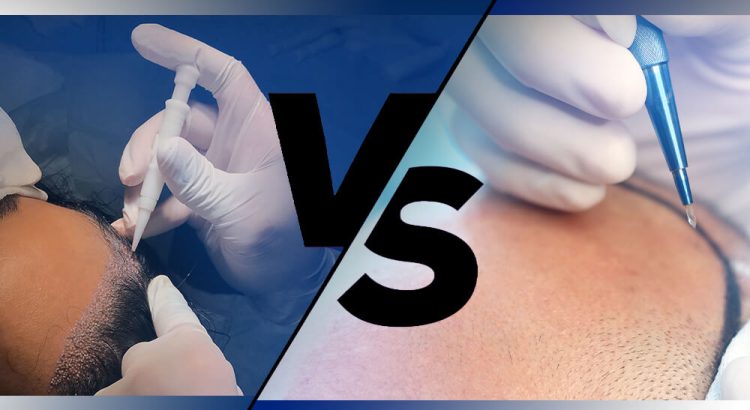
The Implantation Divide: FUE vs. DHI
The clinical divergence between these two modern heavyweights lies entirely in how the harvested hair follicles are introduced to the receding hairline.
Follicular Unit Extraction (FUE): The Classic Two-Step Method
In standard FUE, the surgeon treats channel creation and graft placement as two entirely separate phases. After extraction, the surgeon uses micro-blades or sapphire tips to cut thousands of microscopic slits (channels) across the recipient hairline. Once all the incisions are made, the surgical team manually inserts the extracted grafts into these open channels using specialized fine forceps.
- Best For: Large-scale coverage. Because channel creation is streamlined, a skilled surgical team can work in tandem to quickly place 3,000 to 4,500 grafts in a single session. This makes FUE the absolute gold standard for filling extensive baldness or diffuse thinning across the entire crown.
Direct Hair Implantation (DHI): The Single-Step Precision Method
DHI utilizes a proprietary tool known as the Choi Implanter Pen. Instead of cutting open channels beforehand, the extracted hair follicles are loaded directly into the hollow needle of this spring-loaded device. The surgeon then uses the pen to puncture the skin and instantly inject the follicle into the scalp in a single, fluid motion.


 Users Today : 10
 Total Users : 35509757
 Views Today : 10
 Total views : 3637548