Page 1386 of 6145
1 1.384 1.385 1.386 1.387 1.388 6.145

España: El Ministerio de Educación y Formación Profesional y RTVE lanzan hoy ‘Aprendemos en casa’

El Ministerio de Educación y Formación Profesional y RTVE lanzan hoy ‘Aprendemos en casa’

El objetivo es facilitar el aprendizaje de todo el alumnado durante la suspensión de las clases presenciales a causa de la crisis del coronavirus Covid-19.

Hace 50 años, las marionetas de Barrio Sésamo, su llegada a los hogares estadounidenses, resultó revolucionaria. En plena Guerra Fría, EEUU quería vencer a la URSS en todo, y descubrió que, de todas las variables, la que más influía en que los rusos estuvieran aventajándoles en la carrera espacial, era que los niños rusos a los cinco años ya tenían todos los prerrequisitos para leer.

Entonces, con la incorporación masiva de la mujer al mercado de trabajo, los niños estadounidenses pasaban muchas horas en casa solos y sin demasiada atención. Por ello surge Barrio Sésamo, como programa de compensación educativa (“Soy el 1, soy el 2…”, “Izquierda, derecha…”) para tratar de subsanarlo. Se puede ver por ejemplo en Mad Men, cuando Joan trabaja desde casa mientras su hijo pequeño ve a los personajes de Barrio Sésamo en la televisión de la cocina.

50 años después, y en plena emergencia sanitaria (otra guerra), el Ministerio de Educación y Formación Profesional se ha fijado en la televisión, ese aparato con que el 99,1% de los hogares españoles cuentan, según el INE, frente al 80,9% que cuentan con ordenador y el 56,8% con tablet, según la misma encuesta. El 91,4% tiene acceso a internet.

Lo ha hecho de la mano de RTVE para lanzar ‘Aprendemos en casa’, que, desde hoy ofrece una programación especial de televisión impulsada para paliar la falta de clases presenciales motivada por la crisis del coronavirus, “especialmente entre el alumnado socialmente más vulnerable”, un sector que requiere una atención prioritaria en esta situación, como ONG como Save the Children han resaltado los últimos días.

Programación

La programación incluye cinco horas diarias de contenidos educativos dirigidos a estudiantes de 6 a 16 años en abierto en la franja matinal de Clan TV y La 2 de TVE.

En ella ha sido clave la colaboración de distintas editoriales y portales educativos (Edebé, Edelvives, McGraw-Hill, Planeta, Santillana, MacMillan, SM, Anaya, Bromera, Bruño, Algaida, Oxford University Press, Bristish Council, Editorial Casals, Pearson, LingoKids, Smile&Learn, Unicoos, Unprofesor.net, Happy Learning, Quantum, Derivando y La cuna de Halicarnaso) a la hora de ofrecer sus contenidos para elaborar estos espacios. El MEFP ha formado varios equipos de trabajo para revisar y filtrar los materiales audiovisuales para asegurar su calidad de trabajo, mientras que RTVE ha creado otro grupo de trabajo que colabora con el MEFP.

La programación pretende ser una “ayuda anímica” para los menores y sus familias en medio del confinamiento. Además de incluir contenidos relacionados con las distintas áreas de conocimiento trabajará las competencias emocionales para mejorar la convivencia en familia y fomentar que todos aprendan en casa de esta situación. Entre los objetivos figura desde el fomento de la lectura y el estímulo de la curiosidad hasta el refuerzo de la actividad física y los valores solidarios.

  • De 6 a 8 años: Lunes-Matemáticas; Martes-Ciencias Sociales; Miércoles-Educación Artística y Educación Física; Jueves-Lengua e idiomas, Viernes-Ciencias Naturales. De 9.00 a 10.00 en Clan TV. 
  • De 8 a 10 años: Lunes-Matemáticas; Martes-Ciencias Sociales; Miércoles-Educación Artística y Educación Física; Jueves-Lengua e idiomas, Viernes-Ciencias Naturales. De 10.00 a 11.00 en Clan TV.
  • De 10 a 12 años: Lunes-Matemáticas; Martes-Ciencias Sociales; Miércoles-Educación Artística y Educación Física; Jueves-Lengua e idiomas, Viernes-Ciencias Naturales. De 11.00 a 12.00 en Clan TV. 
  • De 12 a 14 años: Lunes-Matemáticas; Martes-Ciencias Sociales; Miércoles-Educación Artística y Educación Física; Jueves-Lengua e idiomas, Viernes-Ciencias Naturales. De 12.00 a 13.00 en La 2 TVE.
  •  De 14 a 16 años: Lunes-Matemáticas; Martes-Ciencias Sociales; Miércoles-Educación Artística y Educación Física; Jueves-Lengua e idiomas, Viernes-Ciencias Naturales. De 13.00 a 14.00 en La 2 TVE.

Fuente de la Información: https://www.magisnet.com/2020/03/el-ministerio-de-educacion-y-formacion-profesional-y-rtve-lanzan-hoy-aprendemos-en-casa/

Comparte este contenido:

Technology is improving Education in Africa

Technology is improving Education in Africa

SEATTLE, Washington — Africa has seen significant growth in the area of education in recent years. The U.N. reports that the average primary school enrollment in Africa is more than 80 percent. Furthermore, more children than ever are enrolling in elementary school. This increase in education may be in part due to the ways technology is improving education in Africa.

EdTech: Television, CDs and Mobile Devices

The website Worldremit defines EdTech, or educational technology, as a set of tools that provides a way for students to learn digitally. According to Worldremit, EdTech is an industry started back in the 1960s. Television and radio were utilized in order to provide educational content to certain African countries as well as training opportunities for teachers. The use of media continued into the 1990s with education software and CDs.

This set the groundwork for the strategies employed in the present day. Now students use tablets and other mobile devices. These devices allow students access to books and information that they may not have otherwise been able to access. The use of mobile devices has seen particular success in Uganda, Kenya and South Africa. This use of EdTech may help Africa overcome the reported 100 years of catching up that Brookings.edu reports African students are facing in order to match “high-income countries.”

Unicaf University’s Continental Reach

Unicaf University is one example of how technology is improving education in sub-Saharan Africa. The New York Times reports that Unicaf University reaches 18,000 students.It goes beyond sub-Saharan Africa and reaches the entire continent. Unicaf University offers ways for African citizens to afford admission fees through low-cost digital learning and scholarships. The “average per capita income” is about $315 in the region. One student earned a full-ride after winning a business competition that Unicaf University had sponsored.

The founder of Unicaf University, Nicos Nicolaou, said that one way Unicaf factors into how technology is improving education is by providing students with tablets and the ability to download their course materials to access them offline. This helps to combat the concern of how internet access may impact the idea of an online classroom. Online classrooms may help students by bringing the classroom to them in a country where access to higher education is limited.

Many of the ways technology is improving education in Africa rely on some kind of internet connection in order to be used to their highest potential. There have been advancements made in order to connect Africa with the online world. The mobile industry in Africa already accounted for 8.6 percent of Africa’s GDP in 2018. if current trends continue, Africa’s internet use might make up 12 percent of the world’s internet use by the end of 2020.

Learning Management Services

One way that this access to the internet is being used for the benefit of education is through learning management services (LMS). Learning management services help students by providing one place to access materials for class. The website Elearningindustry.com reports that using an LMS has shown to be both cost-effective and easy to use, especially when an open-source LMS is considered. Examples of open-source learning management services include Moodle, Sakai and A-tutor.

These are just four ways that technology is improving education in Africa. While some of these methods once faced the issues of internet access, technology availability and affordability to the general public, advancements have been made to ensure that the right technology is getting into the hands of the people that need it.

– Jacob Creswell

Fuente de la Información: https://www.borgenmagazine.com/technology-is-improving-education-in-africa/

Comparte este contenido:

US education website now open to Kenyan learners

US education website now open to Kenyan learners

The educationists, led by Prof Benard Manyibe of Langston University in Oklahoma, said this is meant to ensure the children are kept busy while at home.

Dr Manyibe, who is the brain behind EduMonitor, a popular online learning platform in the US, says learners can now access several learning materials on theeducationmonitor.com website.

OPEN AND FREE

“EduMonitor wishes to inform parents, teachers and students around the world and particularly in Kenya that our website is open and free to all who need learning resources.

In addition, EduMonitor has reduced the prices of all books that are mainly distributed through Amazon.com,” said Prof Manyibe in a statement to the Nation.

He said the subjects covered include mathematics, language, science, and social sciences among others.

“Other learning resources found are colouring sheets, worksheets, workbooks, and online education games for children in [lower] grades and preschool,” said the former officer at the Ministry of Education.

KICD RADIO LESSONS

Kenya Institute of Curriculum Development (KICD) has already released a radio lessons timetable for learners in primary and secondary schools. The lessons will be broadcast by KBC English Service from Monday to Friday.

The move comes after President Uhuru Kenyatta ordered the closure of all learning institutions as a precautionary measure to limit the spread of Covid-19 in the country.

The radio programmes target learners in Grades 3 and 4 as well as classes 5, 7 and 8.

The lessons will cover English, Kiswahili, Mathematics, Science, Hygiene and Nutrition, CRE, Social studies, Life Skills and Civic Education.

There will also be lessons on drug and substance abuse and peace education. Others are Business Studies, Geography, Biology, Agriculture and Kiswahili Fasihi.


Comparte este contenido:

12 Critical Issues in Education Due to the Coronavirus

12 Critical Issues in Education Due to the Coronavirus

At the end of December, I posted a column focusing on 12 critical issues facing education in 2020. Although I stick by all of them, I clearly missed a very big critical crisis that we are now facing in 2020, and that is Covid-19.

If you told me that we would be seeing thousands of people around the world contracting a disease, the NBA suspending its season, March Madness canceled (although we are experiencing our own March Madness right now), Disney World and Disneyland closing, countries closing their borders to prevent the spread of the disease, and the U.S. president doing briefing sessions every single day to announce new precautions, I would have thought it was the trailer to a new Hollywood blockbuster. 

I kept waiting for Will Smith to enter into the movie at any time. We now know that this is our reality, and not a movie at all. 

For full disclosure, I go through a daily dose of feeling optimistic that we will all get through this and a few moments of sadness at the state of the world. So, because I clearly missed a critical issue on my list from the end of 2019, I thought I would offer a list of critical issues that are developing because of the coronavirus.

Most times, writing is my way of working through an issue, and one of the feelings that I am consistently trying to come back to is that, through all of the devastation this has occurred around the world, we need to find moments of positivity.

12 Critical Issues
These education- and child-focused issues are not written in any particular order, although there are a few that are unlike anything we have ever seen. Every day we learn more, and that contributes to the list because so much of our world is living through the unknown, but we know that that will change soon and we will have much more information.

The most important issue in the world, and for humanity, is the health and safety of everyone. There have been thousands of deaths due to the Coronavirus, which is devastating. The world has stopped, tried to come together, and we are all trying to take every precaution we can to be healthy and safe. The list that follows is not meant to minimize the deaths, but rather open up a discussion about how this virus has impacted leaders, teachers, families and students where education is concerned.

The 12 critical issues we are seeing are:
One billion students out of school – Perhaps out of all the issues, this is the one that is most critical. UNESCO reports «1,254,315,203 affected learners, 72.9 percent of total enrolled learners, and 124 countrywide closures.

We don’t we have coronavirus toolkits – Leaders, teachers, and staff had to scramble because they did not have coronavirus toolkits. The reality is that this is not something you learn about in your preservice teaching programs, nor do you learn about it in leadership school. Leaders learn how to work through most emergencies (i.e., flooding, school shootings, sudden death of a student or staff member, etc), but a virus that prevents students from going to school for months is not one of them. Corwin Press created a free resource kit for leaders in case they still need one. Please find it here.

Feed the children – According to US News and World Report, over 30 million students across the country receive free and reduced-price lunch. For those of us who work or have worked in schools, we know there are families that do not always fill out the paperwork, so that is why I put over 30 million students. When all is said and done, this will be one of the saddest issues that most people will learn during this crisis. I have had many friends and family members who said they had no idea that so many children go hungry. Thank you to the thousands of volunteers across the country who are working to get these students fed.

Parents as homeschool teachers – My niece is a bartender at a popular restaurant chain that has closed down. She and her husband have three children who are really great kids, and as much as she loves them, she never considered homeschooling. Now she doesn’t have a choice, along with millions of other parents and caregivers around the world. It’s important that they remember that they are not expected to do all of the things that teachers do during the day. Many school districts are making this a time of review for students. Kudos to all of the parents and caregivers who are stepping up to the plate during this difficult time.

Teacher appreciation – Over the last decade, I have felt like people do not appreciate teachers, or even, public education. The rhetoric around teaching has not been kind, but over the last two weeks, a lot of that has changed. People are now understanding that teaching is not easy, and they have seen their child’s teachers step up and provide opportunities for learning through online resources, and all of this happened during a time when they had zero time to prepare. Can we please start appreciating our teachers and leaders a bit more?

High-stakes tests canceled – On March 15thI wrote this blog asking if this is now the time to cancel high-stakes testing. At that time, most state education departments had not canceled high-stakes testing although students were at home learning through quickly developing online methods. Thankfully, all standardized-testing requirements have been waived.

Too many resources, too little time – This will be addressed again later in the list, but one of the issues taking place this week is that parents and caregivers were hit with too many resources. We know this is better than having none at all, which is what other parents and caregivers may be experiencing right now. To further exacerbate the issue, many organizations and consultants are offering resources to teachers and leaders. Most are in an effort to help, so we just need to do our best to choose one that is credible and we can use, and begin using it.

Seniors in high school lose out – Remember your senior year in high school or college? Our present seniors in high school and college are losing out on their last semester. There have been many on social media who say they need to get over it, but the reality is that this is a time when they would be experiencing closure with their friends and their studies and getting ready to transition into the next phase of their lives. Now that next phase seems so uncertain. This is when we long for the simple times, but their simple times will have one less experience to long for.

Inequities – The coronavirus pandemic is highlighting one thing that most of us knew already. Some schools have countless resources to share with families and caregivers, and other schools have very little at all. Some families have wireless, and one parent or caregiver can stay home and work, while they try to homeschool at the same time, and others are being forced to stay home, and only have homework packets to provide to their children.

Habits need to change – We have finally found the time to say that students can play several times a day, and it is OK. Teachers have found that they need to home in on what is most important when it comes to educating students from afar, and that the control freak in all of us needs to take a break, because we do not have full control in this situation. Principals and school leaders are finding that there are many issues that can be solved in emails, and others that need more clarity.

Science – There has been a steady push for STEM over the last decade, and a global pandemic is one more way to get our students interested in science and technology. Whether it be helping more in isolation learn how to connect, or the next doctor who will create a vaccine, this is a time when people are greatly understanding the role of science.

Additionally, what we are learning is that the world is healing itself a bit these days. Carbon emissions are down for obvious reasons, and cities like Venice are seeing that the water is clearer than it has in decades, and there has been an increase in sea life showing up. Perhaps a bit of a silver lining in a cloud of doubt?

Social-emotional learning – One of the topics that I write about quite often is that of social-emotional learning, and it is the topic that gets the most pushback, because critics say there is no place for it in school. During this time, social-emotional learning is one of the most important things we can learn.

In the end
When all of this is said and done, I hope we do not have to hear the words «social distancing» and «self-quarantine» for a long, long time. For most of us, this may be one of the most difficult times we will experience. When I am feeling overwhelmed, I turn to my meditation practices and connect with family.

I hope that you are all finding your way through this, doing your best to stay healthy and not hoard toilet paper, and will learn to slow down and continue the slowdown after all of this is over.

In the wildly popular play «Hamilton,» the famous line is, «Immigrants. We get the job done.» Maybe we can change that a bit and say, «Humans. We get the job done.»

If you would like a moment to take a break from the stress of watching news, Check out this fun video created by the Salinas Union High School district’s Japanese teachers in Salinas, Calif.

Fuente de la Información: http://blogs.edweek.org/edweek/finding_common_ground/2020/03/12_critical_issues_in_education_due_to_the_coronavirus.html

Comparte este contenido:

Perú: Cuento en 10 lenguas originarias es la primera entrega de la estrategia «Aprendo en casa»

América del Sur/Perú/22-03-2020/Autor(a) y Fuente: www.andina.pe

Disponible en awajún, ashaninka, aimara, shipibo-konibo, yanesha, wampis, shawi y quechua en sus 3 variantes.

Desde hoy, y como parte de la estrategia «Aprendo en casa», los escolares que hablan diversas lenguas originarias y asisten a escuelas interculturales bilingües pueden escuchar el cuento “Los niños contra el coronavirus”, a través del canal de Spotify del Ministerio de Educación. Y muy pronto a través de las ondas de Radio Nacional y emisoras de alcance regional.

El cuento, una adaptación del relato “Rosa contra el virus”, de la psicóloga española Mercedes Bermejo, ha sido grabado en 10 lenguas originarias por especialistas bilingües del Ministerio de Educación (Minedu) con el propósito de contribuir con el estado socioemocional de los niños y fomentar la reflexión acerca de los cuidados y acciones que deben seguirse para prevenir el contagio del Covid-19.
El texto ha sido grabado en las lenguas awajún, ashaninka, aimara, shipibo-konibo, yanesha, wampis, shawi y quechua, en sus variantes collao, chanka y central.
Educación intercultural bilingüe
Según el registro de instituciones educativas de educación intercultural bilingüe, hay más de 21,000 estudiantes pertenecientes al pueblo ashaninka, de los cuales 7,193 tienen entre 3 y 5 años, y 14,267 entre 6 y 11 años.
Asimismo, hay 328,322 estudiantes que hablan quechua en sus diferentes variantes, de los cuales 93,877 tienen entre 3 y 5 años, y 234,445 entre 6 y 11 años.
El pueblo aimara tiene cerca de 29,000 estudiantes; el awajún, más de 18,000; el pueblo shipibo-konibo cuenta con 10,111 estudiantes, y el shawi, con 6,467 alumnos.
En el país hay cerca de 27,000 instituciones educativas que ofrecen el servicio de educación intercultural bilingüe, según el Minedu.
El ministro de Educación, Martín Benavides, anunció el viernes 20 de marzo la puesta en marcha de la estrategia «Aprendo en casa», que busca brindar herramientas de aprendizaje a las familias durante el periodo de emergencia.
Esta estrategia de educación a distancia combinará la difusión de contenidos por medios digitales, televisión y radio para tener una mayor cobertura y tendrá carácter inclusivo, pues también se desarrollará en 10 lenguas originarias y el lenguaje de señas.
(FIN) NDP/LZD
Fuente e Imagen: https://www.andina.pe/agencia/noticia-cuento-10-lenguas-originarias-es-primera-entrega-de-estrategia-aprendo-casa-789424.aspx
Comparte este contenido:

México: Albergues de migrantes, a su suerte ante la pandemia

América del Norte/México/22-03-2020/Autor(es/as) : L. Ramos, E. Henríquez y R. Villalpando/Fuente: www.jornada.com.mx

Ninguna autoridad les ha indicado qué medidas tomar.

Albergues de migrantes en las fronteras norte y sur del país comenzaron a aplicar medidas para evitar la propagación del coronavirus Covid-19, como protocolos de prevención, cancelación de recepción de documentos, así como dotación de equipo para detectar casos sospechosos y entrega de productos de higiene para hacer frente a la contingencia.

Encargados de algunos de los refugios afirmaron que ningún representante del gobierno federal les ha dado indicaciones sobre cómo actuar ante la pandemia con población migrante y refugiada, y que tampoco existe información internacional sobre el tratamiento que se debe dar a personas desplazadas en medio de una pandemia.

Ante la emergencia internacional a causa de la propagación del Covid-19, la Casa del Migrante de Saltillo, en Coahuila, creó el primer protocolo de prevención para el nuevo coronavirus, dada la alta movilidad de personas provenientes de varios países en esa estancia.

Alberto Xicoténcatl Carrasco, director del recinto, informó que el documento fue elaborado luego de hacer diversas consultas con organizaciones de la sociedad civil que trabajan con migrantes y refugiados en el sur, centro y norte de México. Señaló que ningún funcionario federal se ha comunicado para advertir qué medidas y acciones deben aplicarse en albergues.

Según datos oficiales de personas infectadas, se puede establecer que las personas migrantes de Centroamérica no son, hasta ahora, potenciales portadores del virus.

Sin embargo, la repatriación hacia México de indocumentados que intentan ingresar a territorio estadunidense coloca a la población en riesgo de contagio, sobre todo en las ciudades cercanas a aeropuertos, industrias y polos económicos donde se efectúan viajes internacionales.

Otro factor a considerar ante esta pandemia es la cercanía con Nuevo León, estado con alto ingreso de personas de otros países y con mucha movilidad hacia Saltillo, capital de Coahuila.

Aunadas a las medidas de higiene que implementarán en la Casa del Migrante, bajo la supervisión de la Jurisdicción Sanitaria 8, se llevará a cabo un registro sintomático de todas las personas refugiadas para identificar posibles casos de infección por Covid-19.

Además, las personas que tengan que ir a firmar cada semana al Instituto Nacional de Migración serán trasladadas por conductores y regresados al refugio para evitar el uso de transporte público.

Xicoténcatl Carrasco dijo que dicho documento se irá actualizando de acuerdo con las recomendaciones de la autoridad y a la prevalencia del Covid-19.

En tanto, como medida para prevenir posibles contagios del coronavirus, los albergues para migrantes Belén y Jesús El Buen Pastor, ubicados en Tapachula, Chiapas, informaron que suspendieron la recepción de indocumentados a sus instalaciones.

Puntualizaron que mientras pasa la emergencia, mantendrán la atención a los indocumentados que ya se encuentran en los refugios.

El sacerdote César Cañaveral Pérez, director del albergue diocesano Belén, dio a conocer que los servicios de recepción de migrantes o solicitantes queda suspendido en lo que termina la emergencia.

Precisó que únicamente se atenderá a las alrededor de 350 personas que están en el refugio. Representantes de la casa Jesús El Buen Pastor, que dirige Olga Sánchez Martínez, también decidieron interrumpir el ingreso de migrantes; el miércoles se instalaron dos centroamericanos.

No se permitirá el ingreso de más indocumentados, pero serán atendidos unos 500, la mayoría hondureños, alojados en sus instalaciones..

Mientras, en una reunión del comité técnico para atender el problema del Covid-19 en Ciudad Juárez, Chihuahua, las autoridades determinaron dotar a los 17 albergues de migrantes que hay en esa localidad de termómetros infrarrojos para detectar casos sospechosos.

Fuente: https://www.jornada.com.mx/2020/03/20/estados/025n1est
Comparte este contenido:

Argentina: Solidaridad en tiempos de cuarentena: sanjuaninos ofrecen servicios online para ayudar

América del Sur/Argentina/22-03-2020/Autor(a) y Fuente: www.diariodecuyo.com.ar

Por: Redacción Diario De Cuyo

Desde psicólogos y médicos hasta docentes se ponen a disposición para colaborar en momentos en los que no se puede salir de casa.

Desde este viernes el país vive una situación inédita: la de la cuarentena total que implementó el Gobierno de la Nación para tratar de contener la expansión del coronavirus. En ese contexto, algunos profesionales sanjuaninos utilizaron las redes para poner a disposición de todos sus servicios en forma gratuita. Desde psicólogos, pasando por docentes y hasta personas dispuestas a salir a hacerles las compras a quienes integran los grupos de riesgo escribieron sus mensajes.

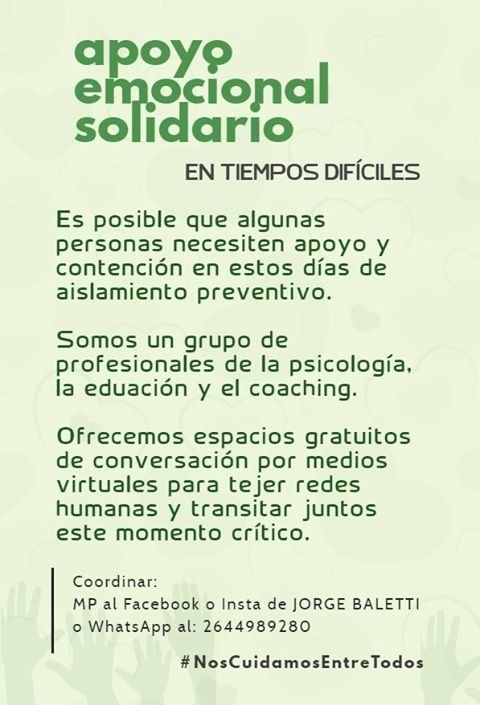
“Con un grupo de profesionales de la psicología, el coaching y docentes estamos llevando a cabo una acción de apoyo emocional por vías virtuales (teléfono, chat, videollamada, zoom, skype, etc.). Está dirigido a cualquier persona que en este contexto de asilamiento y crisis sienta la necesidad de compartir sus inquietudes y hablar de sus emociones. Es completamente gratuito y anónimo”, escribió Jorge Baletti.

Al respecto, comentó que armó un listado de profesionales voluntarios que él mismo coordina para trabajar con las personas que necesiten la colaboración. Su celular es 264-4989280 y su cuenta de Facebook e Instagram a las que se le puede escribir mensajes privados es Jorge Baletti.

* Comprar para quienes no pueden salir

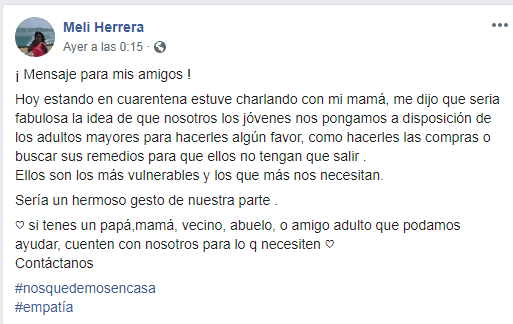
«Estando en cuarentena estuve charlando con mi mamá, me dijo que seria fabulosa la idea de que nosotros los jóvenes nos pongamos a disposición de los adultos mayores para hacerles algún favor. Ellos son los más vulnerables y los que más nos necesitan», relató en torno al modo en que se le ocurrió la idea.

E invitó a otros a sumarse a la iniciativa: «Sería un hermoso gesto de nuestra parte», afirmó. Quienes quieran comunicarse con ella pueden hacerlo a la cuenta de Facebook, Meli Herrera.

* Música en vivo y a la carta

Durante la cuarentena, cada noche, a las 23, regalarán a la gente una canción interpretada en vivo. «Obvio, pueden hacer pedidos y vamos armando lista!!!», aseguraron Pierina Ciallella y Marcelo Bartolomé.

La transmisión en vivo se realiza en su cuenta de Facebook: Dúo Mixtura.

* Ayuda con la tarea I

«Soy profesora de Educación Física y con mucho gusto te resolveré tus dudas a distancia. Mientras estamos en casa, si necesitas ayuda sobre algo que le hayan encargado a tu hijo o hija, contactame y sin ningún tipo de costo te apoyo. ¡Vamos a salir de esto juntos!», escribió.

Su cuenta de Facebook: Celi Correa.

* Ayuda con la tarea II

Martín Olivares se ofreció también para ayudar con la tarea realizada en el hogar, pero en torno a materias relacionadas con contabilidad y economía.
«Contactame por privado y ayudo sin cargo por medio de un tutorial, video de WhatsApp o con un simple chat», escribió. Y destacó: «En esta pandemia nos ayudamos entre todos».
Para contactarse con él se puede acceder a la cuenta de Facebook con su nombre.

* Médico digital

Un médico sanjuanino que vive en Córdoba se ofreció a ayudar de modo online a quienes tengan dudas en torno al coronavirus o síntomas leves compatibles con la enfermedad.

* Para cuidar la alimentación y entretenerse

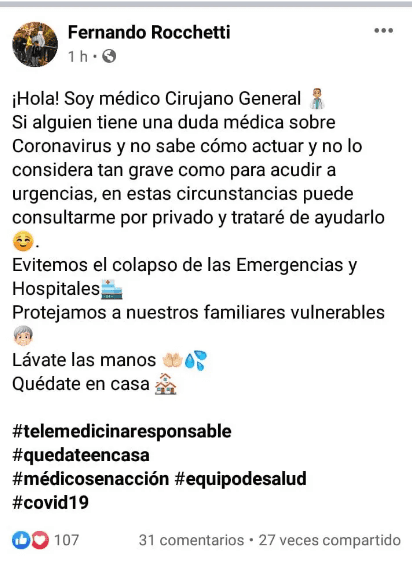
A todos ellos se suman los otros dos profesionales que ya habían sido noticia por su solidaridad: el médico Fernando Rocchietti y la psicóloga infantil Maria Eugenia Torres Flores.

Fuente e Imagen: https://www.diariodecuyo.com.ar/sanjuan/Solidaridad-en-tiempos-de-cuarentena-sanjuaninos-ofrecen-servicios-online-para-ayudar-20200320-0021.html


Comparte este contenido:
Page 1386 of 6145
1 1.384 1.385 1.386 1.387 1.388 6.145