Page 1448 of 6195
1 1.446 1.447 1.448 1.449 1.450 6.195

Asia school closures for coronavirus expose digital divide

Asia school closures for coronavirus expose digital divide

Bangkok, Thailand
Thomson Reuters Foundation

Millions of children in Asia risk falling behind because of school closures amid the coronavirus outbreak, with unequal access to the internet hurting poorer kids as classes go online, technology and human rights experts warned on Friday.

Worldwide, an unprecedented 363 million children and youth are affected by closures of schools and universities, according to data released by this week by the United Nations’ education agency UNESCO.

That number is expected to rise as more countries implement lockdowns.

«The global scale and speed of the current educational disruption is unparalleled and, if prolonged, could threaten the right to education,» UNESCO Director-General Audrey Azoulay said in a statement.

As countries deal with the situation, it is important to «ensure this crisis promotes innovation and inclusion and does not exacerbate learning inequalities,» she said.

Schools are deploying distance-learning programmes and education applications and platforms, including radio and the internet to reach students remotely.

But the so-called «digital divide» – which refers to the gap between those who have access to computers and the internet, and those with limited or no access – is a challenge.

About 54 per cent of the global population – or 4.1 billion people use the internet. But only two out of 10 in the least developed countries are online, according to the International Telecommunication Union, the UN’s internet and telecoms agency.

«Digital exclusion in general reflects and entrenches broader patterns of disadvantage across age, gender, social and economic dimensions,» said Julian Thomas, a communications professor at Australia’s RMIT University.

«The cost of internet access can be prohibitive for low-income families, and the infrastructure and services necessary for everyone to be able to use the internet at home is unevenly distributed across urban, rural and remote areas,» he said.

Low-income families are particularly dependent on mobile devices for internet access, which may not be suited for learning purposes, he told the Thomson Reuters Foundation.

Those families also tend to rely on schools, libraries, workplaces and community centres for internet access, and are «substantially disadvantaged» when these are closed, he said.

In India, where primary schools in Delhi, and schools and colleges in Kerala state are closed until April to fight the spread of the coronavirus outbreak, education charities say they are worried about girls dropping out.

Nearly a fourth of the country’s girls leave school before puberty, with the result that the female literacy rate is 66 per cent compared to 80 per cent for men, according to census data.

In Delhi, the closure coincides with the holiday period. If it extends beyond 31st March, then parents may be involved in lessons, and some classes may be moved online, said Shailendra Sharma, principal advisor at the directorate of education.

«We recognise that in government schools, many students are first-generation learners, so parents may not be able to help much. Nor does every student have access to a smartphone or tablet,» he said.

«So there may be challenges if the shutdown lasts longer.»

Fuente de la Información: https://www.sightmagazine.com.au/news/15104-asia-school-closures-for-coronavirus-expose-digital-divide


Comparte este contenido:

Coronavirus: Special schools in Belfast to close from Monday

Coronavirus: Special schools in Belfast to close from Monday

All 10 special schools in Belfast are to close indefinitely from Monday because of coronavirus.

Principals said this would allow them to seek clear guidance on the health and safety issues facing their pupils.

Some principals had previously expressed concerns over the effect of coronavirus on pupils with complex needs.

A number of other schools in Northern Ireland have also announced short term closures.

All schools and colleges in the Republic of Ireland have closed, but this is not the case in Northern Ireland.

Eleven new cases of coronavirus were confirmed in Northern Ireland on Sunday, bringing the total to 45.

In a joint message to parents, Belfast special school principals said their schools would close from Monday.

«This will allow principals to seek clear guidance from the Education Authority (EA) on the considerable health and safety issues concerning the well-being and vulnerability of children with special needs in relation to the COVID-19 virus,» it said.

BBC News NI was told by a representative of the principals that the closure would last «indefinitely» until direction came from the EA.

The schools affected are: Fleming Fulton school, Glenveagh Special School, Harberton School, Park School, Mitchell House, Greenwood, St Gerard’s, Clarawood, Cedar Lodge and Oakwood School.

All have pupils with special educational needs (SEN) which range from moderate to profound, including some with life-limiting conditions.

Voluntary closures

Meanwhile, a number of other schools in Northern Ireland have also decided to close in the short term.

Dean Maguirc College in Carrickmore in County Tyrone is to close until at least 30 March.

In a message to parents, the school governors said that their decision had been taken «to curtail the spread of the coronavirus.»

Other schools, including Lisneal College in Londonderry and St Joseph’s Grammar in Donaghmore have said they are closing to pupils on Monday for one day only.

The schools said that would allow staff to prepare online learning materials for pupils in the event of a longer closure.

A number of primary schools in north Belfast have also told parents they will close on Monday as they await further guidance and hygiene materials from the EA.

Many schools will then close as planned on Tuesday for St Patrick’s Day.

BBC News NI understands that the Department of Education plans to issue updated coronavirus guidance to schools on Monday.

Education Minister Peter Weir said on Sunday he would continue to be guided «by the science and professional health advice».

He added: «The Department is continuing to work on the preparations for education moving ahead as well and is aiming to give more public health advice to schools tomorrow.

«In this critical time let us all keep calm heads to help save lives and try to move forward together.»

First Minister Arlene Foster said on Saturday school closures would be introduced when «medical evidence» advised it was necessary but they could last up to 16 weeks.

Deputy First Minister Michelle O’Neill has repeatedly called for schools in Northern Ireland to close immediately.

SDLP leader Colum Eastwood and Archibishop Eamon Martin, the leader of the Catholic Church in Ireland, also said schools should shut now.

Fuente de la Información: https://www.bbc.com/news/uk-northern-ireland-51901158


Comparte este contenido:

Schools to implement COVID-19 distancing measures

Schools to implement COVID-19 distancing measures

The NSW Department of Education sent out a media release this afternoon outlining the introduction of measures to limit the impact of COVID-19 in our schools.

Mark Scott, Secretary of the Department of Education announced today (Sunday, March 15) that schools would adopt social distancing measures requiring them to cancel assemblies, excursions, travel, some events and conferences.

Mr Scott said these measures are precautionary and designed to reduce exposure via non-essential gatherings.

‘Schools have been a focus of the community and the government as the impacts of coronavirus have developed globally,’ said Mr Scott.

‘From Monday onwards, I expect school assemblies and substantial gatherings to be cancelled, along with all excursions.

The community expects schools to be as safe

Mr Scott said the community expects schools to be as safe as possible. ‘We are implementing these measures to provide peace of mind for students, parents and staff.

These cancellations also extend to inter-school arts, sports, initiative activities and events.

All major activities and events will temporarily be ceased

All major arts, sports and initiative activities and events will temporarily be ceased until further notice. This includes whole school sporting events and inter-school events involving three or more schools.

‘Local inter-school sport and other activities, can proceed but we ask organisers to ensure that as far as possible, reasonable precautions are taken,’ he said.

‘I trust our principals and staff to show leadership during this time.

Schools will be provided with more detailed advice and suggestions on how they can adjust their day to day activities with minimal disruption.

The Department is continuing to prepare for further closures if necessary with scaling up of technology, additional training of staff and preparation of offsite lessons.

Useful links for families and students in self-isolation can be found here: https://education.nsw.gov.au/teaching-and-learning/curriculum/continuity-of-education

And general COVID-19 advice for schools here:

https://education.nsw.gov.au/public-schools/school-safety/novel-coronavirus.html

Fuente de la Información: https://www.echo.net.au/2020/03/schools-to-implement-covid-19-distancing-measures/

Comparte este contenido:

Education association requests Idaho’s public schools close for 3 weeks because of coronavirus

Education association requests Idaho’s public schools close for 3 weeks because of coronavirus

The Idaho Education Association released a statement Sunday morning calling on the state to close all schools for at least three weeks, including spring break, with ongoing evaluations of the situation, to help address the COVID-19 health crisis.

“Education leaders are uniquely positioned to help ‘flatten the curve’ and stave off a massive health crisis,” Layne McInelly, association president, said in the release. “Recognizing that school buildings often hold more than 250 people, five days a week, we must close our schools immediately for the health of our communities, students and staff.”

Idaho has five confirmed cases of COVID-19 as of Saturday evening, including two in Ada County. Government operations, large events and athletic activities have been canceled, scaled back or postponed.

Idaho’s public higher education institutions are moving classes to online only, and many private colleges have announced plans to do the same.

Late last week, Gov. Brad Little said individual school districts can close down if their directors feel it is necessary. Idaho Superintendent of Public Instruction Sherri Ybarra said school district superintendents had a teleconference Thursday when they discussed ways classes could continue for students in the event shutdowns did occur. A majority of Idaho’s school districts are able to conduct classes online, she said, and the superintendents also discussed options for pick-up points for homework for younger children for whom online classes would not be appropriate.

In the IEA’s statement Sunday, McInelly said, “Closing our schools will help prevent this disease from peaking, which would severely compromise our healthcare system and force a triage of life-saving care for patients. Schools are environments where viruses are likely to spread exponentially. The day a case is confirmed in one of our schools is the day after we should have closed the schools. The time to act is now.»

Fuente de la Información: https://www.idahopress.com/news/local/education-association-requests-idaho-s-public-schools-close-for-weeks/article_6f47e558-66be-59fe-97f0-75d0d8eae322.html

Comparte este contenido:

Higher Education and the National Crisis

Higher Education and the National Crisis

No earthly country has no problems. But some countries have far too few problems compared to this so-called Christian Nation, Zambia. To borrow from the philosopher Thomas Kuhn, every scientific paradigm is faced with problems. That’s why the paradigm exists to resolve those problems. But problems can turn into crises and the paradigm is under threat. Not under threat from outside, but from within. The paradigm’s own failure to solve its problems are the seeds of its downfall. According to Kuhn, problems become crises when they are too many, too serious, or last for too long without being resolved.

Going by these criteria from philosophy of science, by analogy, is the Zambian government in crisis? Are the problems under the Patriotic Front too many, too serious, and have lasted too long? Vernon Mwaanga says it would be folly for anyone to think things are well in Zambia. And he ably justified his claim. In this article, I want to link our national crisis with higher education (HE) especially grant-aided public institutions, the University of Zambia (UNZA) and the Copperbelt University (CBU).

The Bible puts it very categorically, and I agree, that lack of knowledge can lead to a people perishing. Plato’s philosophy is an exaltation of knowledge; the search for ultimate reality and the truth; the search for clarity of meaning; and the search for true morality to guide both our private lives and political institutions. So much was Plato committed to the knowledge that rulers for his kallipolis (ideal or beautiful state) had to be philosopher-kings. This is not rule by the educated, simpliciter.

Plato’s rulers were knowledgeable but, in addition, they had to be virtuous and in possession of proven practical wisdom. Plato was aware that an educated fool is not an oxymoron or contradiction. So, he required that his rulers also receive moral education and demonstrate it in administration of public affairs. Rulers thus trained would preside justly over a meritocratic materially prosperous and secure state. Can we learn from Plato? Could Zambia’s crisis be due to the low premium we place on knowledge and moral education in our private lives and public organisations? Memory lane.

UNIP and the MMD

The founders of the Zambian Republic exhibited great thirst for knowledge. My history isn’t too exact. Those who want the proper history must look elsewhere, sorry. But Kenneth Kaunda is an intellectual, a statesperson per excellence, a visionary. Both his domestic and foreign policies were guided by an ideology. Although the late philosopher Ronnie Khul Bwalya criticised Kaundaism as “not philosophical with attendant arguments”, he acknowledged the ideology “was formed in all seriousness for the purpose of completing the liberation process”. Partly because Kaunda had an intellectual ethos guiding his politics, he found concord with many great leaders of his time stretching from Africa, Latin America, to Asia. Kabusha takolelwe bowa: “Who are President Lungu’s political friends internationally?”

With a humble formal education, Kaunda set in motion a robust socio-economic developmental agenda in line with his humanist paradigm. He galvanised the nation to build the University of Zambia. A people’s university. On the day KK was unveiled as the university’s Chancellor, he wept genuine tears of deep sadness and joy. He wept with sadness at the colonial educational legacy that had ostracised on racial lines the indigenous population from meaningful higher education. He cried with joy for the dawn of a new day in Zambian higher education.

The university would be the intellectual springboard for national development and governance. During his rule, Kaunda proudly presided over the University of Zambia as Chancellor. This may be a sign of his passion for HE, dedicating his attention to ensuring the institution did not lack. The University of Zambia came complete with a publishing outfit, UNZA Press which ran then internationally prominent journals. The Kenneth Kaunda Foundation further shows Kaunda valued knowledge as the cornerstone of his nation-building project.

Intellectualism flourished as young men and women from the breadth and width of the country trekked to Lusaka to drink at the fountain of knowledge from fine brains, both local and international. Several monographs and edited volumes dated during the Kaunda tenure attest to the University being a top institution during the Kaunda years. Oral tradition from lecturers and alumni alike speak of a golden age of a university that was a continental icon.

Frederick Chiluba pretty much hired graders and razed to the ground almost everything Kaunda had built. Academic morale hit its nadir under the stylish, well-spoken Pentecostal president. Education wasn’t his cup of tea. His hostility to HE disoriented some of our best brains. And Botswana et al said, “Thank you very much. Just what we need to develop our country!” The University of Zambia plummeted on university rankings. A shambolic academic calendar saw UNZA lose its place as a destination of choice for international students as well as some local students, exchange programmes became unsustainable.

To be sure, Chiluba assembled what appeared to be a powerful team of educated individuals. Unfortunately, he told them it was time to eat, not to work. After his downfall, the courts were not short of professors and PhDs implicated in plundering national resources. That’s what happens when the head of the fish is rotten. Chiluba was more concerned about appearing tall, dandy, pious, and educated. He was quick to announce a Christian nation that is still haunting the nation nearly three decades later.

Present Day: The Patriotic Front

Michael Sata, with little known education, appointed lecturers to his cabinet and senior government positions. He brought in from the UK a renowned engineer to resuscitate our railway transport. He knew Zambia had lost vast human resource to the diaspora and extended an olive branch to them. Contrasted with Lusambo who sees our emigrants as toilet cleaners, Sata saw in the diaspora a critical human resource that could power Zambia’s human development.

Sata remunerated lecturers competitively and timely. The morale in public HE was high, and a number of lecturers sponsored themselves for further studies, selflessly bolstering the number of PhDs at the university and in the country. Although Sata correctly diagnosed educated people as the worst cowards, he passionately believed in their knowledge as key for national development. And he was very confident surrounded by educated people! Some educated people will let you down, but it’s always the wiser bet. Unfortunately, it will be impossible to evaluate Sata’s legacy on HE because he was unwell and died too soon. But someone else was unleashed. Sata’s very anti-thesis.

The PF under President Edgar Lungu is ostensibly anti-intellectual. The president will host just about anybody. But he will not host the University of Zambia Management or Union. Davies Mwila is the PF chief administrative officer. Mumbi Phiri his deputy. Given Lubinda is marshalling the constitutional amendment process. Tutwa Ngulube is the party’s foremost legal mind. Bowman Lusambo, aka, President of Lusaka, has been tasked consecutively with overseeing two of the country’s most economically vital provinces, the Copperbelt and Lusaka. Davies Mwila has publicly shown contempt for educated people because they ask about inflation and exchange rates under the PF. Exaltation of religion and religious ‘solutions’ to the country’s crises is the icing on the cake of the PF’s anti-intellectualism.

The PF have a very haphazard approach to HE and UNZA and CBU have been badly hit; from the toxicity of Professor Nkandu Luo to the incoherence of Dr Brian Mushimba. CBU and UNZA are in purgatory with no redemption in sight. If the little money for HE can be shuttled to better funded ministries, it’s clear HE is not top priority for the PF. Even when the equation is straightforward: If the public universities are not funded adequately and on time, lecturers will not teach and research well. If lecturers are not teaching and researching optimally, the students are being half-baked. If the students are being half-baked, society will stagnate. We end up in Thomas Hobbes’ chaotic state of nature in which life is “solitary, poor, nasty, brutish, and short”. And under the PF we have tasted this life, but it could get worse or better!

Way forward

UNZA and CBU do not need privatisation to flourish. That’s cynical and reckless. They need government political will, a sensible opposition, an alert civil society, a concerned public, and courageous intellectuals. Mushimba should calm down and not try to be populist with HE. With his entire HE team, he needs to visit UNZA, CBU and get a first-hand impression. Talk to management, staff, and students earnestly. Stop sending PF party functionaries to pontificate about HE, demean professors, and issue threats to academics.

Appoint managers not based on political correctness but professional women and men with managerial or corporate pedigree, acumen, and clout. Ability to dissect mosquitoes, classify books, split atoms, sequence genes, analyse data, or philosophise does not translate automatically into managerial competence that UNZA/CBU needs direly. Councils must not be an employment opportunity but a service opportunity. Appoint service-seekers and not job-seekers; people who have made it in life and not those who want to make it quick via auctioning and syphoning public varsities.

Through well-researched questions in parliament, op-eds, tweets, the opposition can make the government deliver better in HE and everywhere. Or show that they are a viable alternative come 2021. So far no opposition is indicating they have a tangible roadmap for HE. HE needs a paradigm shift and not necessarily regime change. Regime change without paradigm shift is merely a chimera. What’s your plan to bring UNZA global ranking into 1000s and CBU into 2000s? The opposition here are challenged.

Fuente de la Información: https://www.themastonline.com/2020/03/15/higher-education-and-the-national-crisis/
Comparte este contenido:

Chalecos amarillos marchan en vísperas de elecciones en Francia

Europa/Francia/15-03-2020/Autor(a) y Fuente: www.telesurtv.net

La movilización se efectuó un día antes a la primera ronda de las elecciones municipales en el país y cuando el presidente había prohibido las concentraciones por el coronavirus.

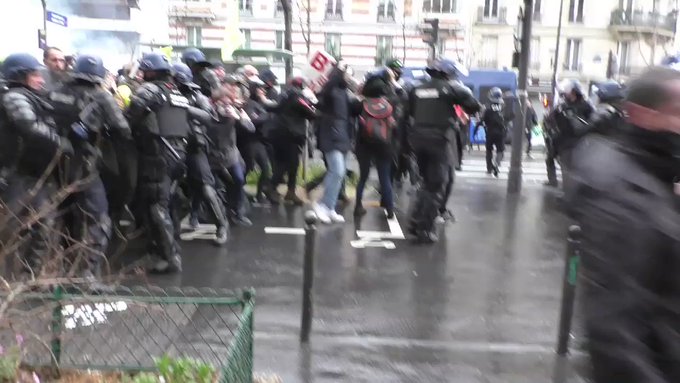
Activistas de los chalecos amarillos de Francia, marcharon este sábado por las principales vías de París (capital) expresando su rechazo a las políticas impulsadas por el presidente Emmanuel Macron.

La jornada suscitó un día antes de la primera ronda de las elecciones municipales, asimismo, se efectuó en medio del anuncio del Ejecutivo que prohibía cualquier concentración que superara las 100 personas a causa del coronavirus.

Asimismo, varias organizaciones sindicales se unieron a la manifestación, la Cerveaux Non Disponibles, reiteró que las manifestaciones son un derecho Constitucional, «la democracia no puede ser aplazada por el coronavirus», agregan.

©halecos Amarillosᴳᴸᴼᴮᴬᴸ 🔥ʷAͤNͣOͬNͤYˡMͤOᵍUͥSͦⁿ🔥@ChalecosAmarill

📽🆘 🔺 ✊🏼✊🏼

🔥Pese a la crisis del por 70 semana consecutiva en pie!!!

😡Al menos 36 personas detenidas

Video insertado

388 personas están hablando de esto
La Prefectura de Policía de París, informó que durante la jornada se realizaron cerca de 1.200 controles, 76 denuncias y 52 detenciones.

Las masivas movilizaciones completan más de un año a nivel Nacional, inicialmente fue provocada por el aumento arancelario al combustible y posteriormente, por la polémica reforma pensional que finalmente se aprobará por decreto por parte del presidente.

Fuente e Imagen: https://www.telesurtv.net/news/francia-chalecos-amarillos-marchan-visperas-elecciones-20200314-0014.html

Comparte este contenido:

España: Un ‘Facebook’ con IA para que los adolescentes usen las redes sociales de manera segura

Europa/España/15-03-2020/Autor(a) y Fuente: www.agenciasinc.es

Por: SINC

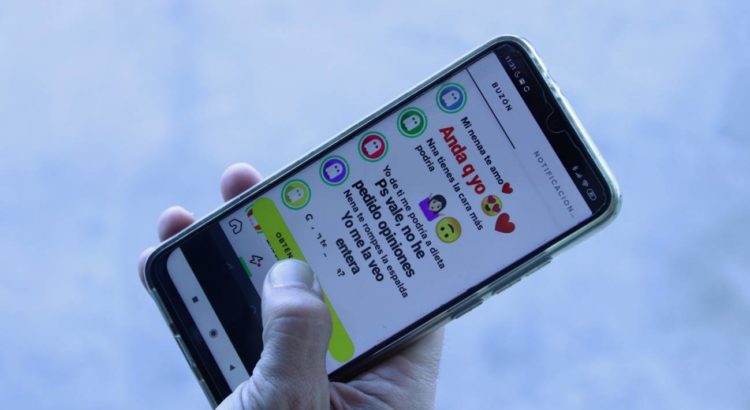
Una nueva red social, llamada PESEDIA, utiliza inteligencia artificial (IA) y juegos educativos para advertir a los adolescentes del alcance y los riesgos de la información que van a publicar en internet. Ha sido desarrollada por investigadores de la Universidad Politécnica de Valencia.

PESEDIA se basa en técnicas de inteligencia artificial e incluye diferentes juegos educativos. Esta red social, desarrollada por investigadores de la Universidad Politécnica de Valencia (UPV) es capaz de advertir al usuario de forma muy gráfica sobre el alcance y riesgos de la información que va a publicar. Incluye también un analizador de contenido que detecta información sensible del usuario y es capaz de discernir sus sentimientos y nivel de estrés al escribir sus mensajes.

La red incluye un analizador de contenido que detecta información sensible y es capaz de discernir el nivel de estrés al escribir los mensajes

“Se trata de una red dirigida principalmente a adolescentes, ya que nuestro objetivo es que sirva como una plataforma educativa en el uso de las redes sociales. Hasta el momento, se ha utilizado ya en talleres de las cuatro últimas ediciones de l’Escola d’estiu de la UPV, con los niños y niñas de entre 11 y 14 años. Ahora bien, nuestro objetivo es poder trasladar la tecnología desarrollada a otras redes sociales para que pueda ser usada no solamente por adolescentes, sino por un público más general, que desee disponer de un agente personalizado asesor en privacidad”, destaca Estefanía Argente, investigadora de la UPV.

Para el desarrollo de PESEDIA, el equipo clasificó la sensibilidad de diferente información del usuario: edad, nombre, fecha de nacimiento, peso… y así hasta 74 variables distintas. Además, identificó aquellos factores más relevantes que hacen que un usuario acepte determinadas sugerencias mientras navega por la red social.

“También hemos desarrollado un módulo que permite analizar los datos de velocidad y forma de escritura de los usuarios cuando escriben mensajes en PESEDIA, información de la que se puede inferir los sentimientos y niveles de estrés del usuario”, explica Argente.

‘Paternalismo blando’ 

Con todo ello, los investigadores propusieron dos mecanismos de ‘paternalismo blando’ que ofrecen información al usuario sobre el riesgo para la privacidad de publicar un determinado contenido. Según la investigadora, esta idea consiste en mostrar mensajes al usuario, del tipo“El riesgo de privacidad de tu mensaje es alto; la publicación podrá ser vista por más de 1000 usuarios”, con el fin de tratar de influir en su decisión, pero sin limitarla.

Usa  también mecanismos de argumentación y persuasión para informar sobre el riesgo de privacidad de las publicaciones

Explica que han trabajado con lo que se denomina ‘empuje mediante imágenes’ mostrando, por ejemplo, las imágenes de perfil de algunos de los usuarios a los que podría llegar su mensaje, y con ‘empuje mediante números’ para indicar cantidades de usuarios a los que alcanzará la publicación.

“En este sentido –dice Argente– advertimos al usuario de que podría estar dando información de dónde está o a dónde va, y podemos darle más razones para ayudarle a decidir sobre si publicar o no el mensaje correspondiente, en función de la audiencia del mensaje, del contenido del mismo –si revela datos médicos, personales–, y a los posibles problemas sociales que pudiera ocasionar. Por ejemplo, si el mensaje implica a terceras personas que podrían verse afectadas”.

Referencia bibliográfica:

J.Alemany, E.del Val, J.Alberola, A.García-Fornes. “Enhancing the privacy risk awareness of teenagers in online social networks through soft-paternalism mechanisms”. International Journal of Human-Computer Studies. DOI:10.1016/j.ijhcs.2019.03.008

Fuente:

UPV
Fuente e Imagen: https://www.agenciasinc.es/Noticias/Un-Facebook-con-IA-para-que-los-adolescentes-usen-las-redes-sociales-de-manera-segura
Comparte este contenido:
Page 1448 of 6195
1 1.446 1.447 1.448 1.449 1.450 6.195