Page 3689 of 6193
1 3.687 3.688 3.689 3.690 3.691 6.193

España: Denuncian que la conselleria de Educación permite el veto a la asignatura de Religión

España/04 de julio de 2017/Autora: Mayte Amorós/Fuente: http://www.elmundo.es

Nueve colegios de Ibiza no han dado Religión en la etapa de Infantil (de tres a cinco años) durante el curso 2016-17, y al menos siete seguirán sin impartirla el próximo año. Según denuncia el delegado diocesano de Educación en Ibiza, Pascual Lázaro, existe «cierto rechazo» a esta asignatura por parte de la Conselleria de Educación, que está haciendo la vista gorda ante los colegios que incumplen su obligación de ofrecerla, lo que provoca la progresiva merma de la oferta formativa.

«Hemos estado todo el año en una situación anómala porque los centros no están dando correctamente esta asignatura», se queja el delegado diocesano de enseñanza de Ibiza, Pascual Lázaro, que lamenta que el próximo curso continuará sufriendo la «cristanofobia» con el beneplácito del departamento que dirige Martí March.

El problema, cuenta Lázaro, no es sólo el veto de algunos centros, que directamente no ofertan la asignatura a los niños, sino que desde la Conselleria se está denegando la ampliación de horas de Religión a los centros que así lo solicitan, amparándose en su autonomía de centro, y permitiendo que, en algunos casos, se de por debajo del tiempo mínimo reglamentario (60 minutos).

La normativa obliga a que los centros oferten esta materia, aunque es opcional para los alumnos. Sólo se apunta quien quiere y el colegio e instituto debe garantizar que se imparta a los que la soliciten. El mínimo es una hora y media semanales en Infantil (media en 3º, media en 4º y otra media en 5º) y seis horas semanales en Primaria (una hora en cada curso). «Sin embargo, la realidad es que en algunos centros no se alcanza ni ese mínimo de 60 minutos», afirma Lázaro.

Por ejemplo, en Sant Antoni de Portmany, el director de un centro no oferta Religión en Infantil; y en primaria junta 1º y 2º, además de reducir las clases a 50 minutos. «Así con un solo día tiene suficiente para la asignatura de Religión», denuncia el responsable diocesano, que alerta de que estas artimañas son ilegales porque no se pueden juntar dos cursos diferentes, ya que son temarios distintos, «como no se haría con Matemáticas o cualquier otra asignatura».

En otro centro de la ciudad de Ibiza, se da la circunstancia de que la Conselleria ha impuesto que las horas de la profesora de Religión pasen de jornada completa a media jornada, con días y horas concretas, contradiciendo la orden del Govern de dar mayor autonomía al centro. Lázaro explica que la directora, aconsejada por Inspección, demandó tres horas más para poder ofertar Religión pero desde el departamento de Planificación y Centros se recibió la contestación: «Ni un minuto más a Religión. De hecho, este centro sólo tiene Religión en el aula de tres años, después de juntar dos clases del mismo nivel (A y B), que da como resultado 31 alumnos en un aula», apunta.

Otros cinco colegios han tenido Religión sólo en uno o dos cursos de Infantil y no la han ofertado al resto por falta de horas del profesor. «Hay casos extremos como el de una profesora que tenía que dar la clase de Religión mientras los alumnos de Infantil desayunaban en clase y otra que no disponía de su media hora de recreo porque la tenía que emplear en el desplazamiento a otro centro porque si no llegaba tarde», deplora Lázaro, que envió una carta a Jaume March, el polémico ex director del IES Marratxí, impulsor de la marea verde contra el trilingüismo del PP y actual jefe de departamento de Planificación en la Conselleria de Educación. «Le notifiqué el desaguisado y me contestó cada una de las irregularidades, incluso justificando la ilegalidad de incumplir el tiempo mínimo de 60 minutos establecidos», explica indignado.

Por todo esto, Lázaro denuncia «el trato injusto» a esta asignatura y recuerda que los centros tienen la obligación de ofrecerla, y que Educación debe velar por que se cumpla. El diocesano teme represalias pero finalmente da los nombres de los colegios que no darán Religión el próximo curso: CEIP Can Coix, CEIP Guillem de Montgrí, CEIP Sant Antoni, CEIP Sant Rafel, CEIP Vara de Rey, CEIP Balansat y CEIP Sant Carles.

Desde la Conselleria de Educación afirman que los casos denunciados de colegios que vetan a Educación son «rumores» que nunca se han llegado a aclarar. «Si hay algún centro que no ofrece Religión, que nos lo hagan llegar y le recordaremos al centro su obligación de ofertarla», indica el director general de Planificación y Centros, Antoni Morante, que niega que desde su departamento se esté haciendo la vista gorda con este tema.

Sobre la negativa a ampliar las horas de Religión, Morante afirma que, si se han denegado, es porque un director o jefe de estudios no tiene potestad para modificar la carga horaria de una materia, sin el visto bueno del claustro. Y recuerda que aumentar horas de Religión «va en detrimento» de otras materias.

«Queremos una planificación real»

A finales del curso 2015-2016, la Conselleria de Educación llevó a cabo el primer EREde profesores de Religión, al considerar que la plantilla estaba sobredimensionada. Tras las protestas del sindicato USOy del Obispado, finalmente mantuvo a todos los profesores de Religión en las Islas aunque redujo la jornada a muchos de ellos. Eso sí, rebajó la carga horaria y pasó de una hora y media a una hora.

El problema, incide el delegado diocesano de Educación en Ibiza, Pascual Lázaro, fue que para asignar las horas a los profesores de Religión el curso pasado, el departamento de Planificación se rigió por los datos que aparecen en el programa informático llamado Gestib, partiendo del número de alumnos que constan puestos en el programa por los centros. «Pero los datos no estaban actualizados porque ni siquiera la Conselleria pidió a los centros que los rellenaran. «Los colegios pensaban actualizarlos, como en años anteriores, a lo largo del mes de septiembre, y en la mayoría de las casillas de la Educación Infantil no figuraba ningún alumno; además las matriculaciones de primaria y menos las de secundaria estaban cerradas. La Conselleria partió de números falsos», argumenta Lázaro, que alerta de que este año volverá a pasar lo mismo y exige que haya una «planificación real».

«La Conselleria impone los días e incluso las horas que el docente de Religión tiene en el centro, sin tener en cuenta las necesidades de cada centro, ni dejar que los centros expongan sus necesidades», prosigue Lázaro. Se queja, además, de que la reducción horaria sólo se ha aplicado a Religión y no en Valores sociales y cívicos, la alternativa a esta asignatura «donde también se podría agrupar aulas como hace con Religión y de esta manera tendrían profesores de apoyo que faltan en los centros….», propone.

«El resultado es que el curso que viene estaremos en la misma mentira porque los centros no tienen autonomía y, al final, las familias siguen sin garantías de que sus hijos tengan Religión en los centros públicos de Baleares», lamenta Lázaro.

Fuente de la Noticia:

http://www.elmundo.es/baleares/2017/07/03/5959e166ca47412c2b8b45c7.html
 

Comparte este contenido:

Chile: Fondo anglo-israelí- invertirá en educación tecnológica

Chile/ 04 de julio de 2017/Fuente: http://aurora-israel.co.il

MindCET, el brazo tecnológico en Israel del Centro para la Educación en Tecnología (CET), ha anunciado la fundación de un fondo para la inversión en educación tecnológica en cooperación con el gobierno británico.

El fondo, llamado TaskForce, invertirá inicialmente 250 mil dólares en cada uno de cuatro o seis negocios anualmente. En la siguiente etapa, es probable que el fondo crezca a 30 millones de dólares. Toman parte en el proyecto en el Reino Unido la British Educational Suppliers Association (BESA) y la anglo-israelí Tech Hub, el centro de innovación de la Embajada del Reino Unido en Israel.
El inversor principal en la empresa será el fondo Arie Capital, un fondo del Reino Unido especializado en la inversión tecnológica israelí, junto a la Fundación Beracha, una organización filantrópica israelí; el CET mismo; la empresa de tecnología educativa Educorp Technologies; una empresa japonesa; y un inversionista chino no revelado. Detrás de la empresa está el productor y director de cine británico Lord David Puttnam, que produjo “Midnight Express” y “Chariots of Fire”, y que ahora dedica su vida a promover la educación en el Reino Unido. También será el director general del fondo.
La educación es un campo conservador, y la inversión en tecnologías educativas tiene la intención de saldar las amplias brechas entre tecnología y educación.

Fuente de la Noticia:

http://aurora-israel.co.il/fondo-anglo-israeli-invertira-en-educacion-tecnologica/

Comparte este contenido:

República Dominicana: Educación estrenará 200 nuevas escuelas para el próximo año escolar

República Dominicana/ 4 de julio de 2017/Autor: Ramón Pérez Reyes/Fuente: https://www.listindiario.com

El ministro de Educación,  Andrés Navarro, anunció que para el próximo año escolar entraran en operación unas 200 nuevas escuelas.

El funcionario reveló también que en el sistema hay un millón 150 mil estudiantes en la jornada de extendida y que aún quedan unos 600 mil por ser incorporados.

Navarro dijo que esas nuevas aulas ayudarán ampliar la disponibilidad existente y serán estrenadas en el período agosto-diciembre.

Destacó la gran cantidad de aulas y escuelas construidas en la presente gestión de gobierno.

Dijo que la meta es que para el 2018 todos los estudiantes, un millón 200 mil estén en jornada extendida.

El acto

La presidenta de la Cámara de Diputados, Lucía Medina, entregó este lunes 15 mil ejemplares de la Constitución Infantil  al ministro de Educación,  Andrés Navarro.

Al celebrar un acto en el salón Juan Pablo  Duarte, de la Cámara de Diputados, la presidenta del órgano legislativo destacó la importancia de que los estudiantes de las escuelas tengan en sus manos un ejemplar de la versión infantil de la Constitución Dominicana.

“Realmente creo que a partir de este  momento nosotros estamos construyendo parte de la  historia que nos permite colocarnos a la avanzada a requerimiento de lo que la sociedad misma nos ha requerido”, dijo.

Indicó que la Cámara de Diputados,  a raíz de la reforma del 2010, imprimió una versión infantil de la Constitución Dominicana que vincule a los niños al contenido de la Carta Magna.

“Yo creo que nosotros estamos generando en el día de hoy la mejor valoración que institución alguna pudiera tener con nuestros niños. La Constitución misma como tal desde el 1844, no solamente definió la vinculación de este poder del Estado con los demás, sino también que a través de un Estado que nos vincule también con nuestros ciudadanos”, expresó Lucía Medina.

Asimismo, destacó la decisión del Poder Ejecutivo que mediante un decreto solicitó al Ministerio de Educación que la Constitución Dominicana se imparta como materia, para que los ciudadanos  y ciudadanas puedan conocer lo que son sus derechos y sus deberes.

La actividad contó además con presencia del vicepresidente de la Cámara de Diputados Lupe Núñez, el vocero del PLD en el órgano legislativo, Gustavo Sánchez, y de los diputados Radhamés Camacho, Mirian Cabral y Rafael Méndez.

Fuente de la Noticia:

https://www.listindiario.com/la-republica/2017/07/03/472568/educacion-estrenara-200-nuevas-aulas-para-el-proximo-ano-escolar

Comparte este contenido:

EEUU: California school leaders fear GOP cuts to Medicaid could harm special education

EEUU/July 04, 2017/Source: http://www.scpr.org

California education officials are sounding the alarm over Congressional Republicans’ proposed health care overhaul bills, saying changes to Medicaid could leave the state or school districts scrambling to pay for critical special education services they don’t have the option of cutting.

The health care bill the U.S. House passed in May would place a cap on Medicaid payments to states, a move that could trim states’ Medicaid funding by 25 to 35 percent.

Funding from Medicaid, referred to in California as Medi-Cal, helps school districts cover the costs of serving special education students who are entitled to receive critical healthcare services in school — such as a child who needs a ventilator or a feeding tube.

If a child’s «individual education plan» — the negotiated document spelling out supports a student with disabilities needs in order to receive a «free and appropriate» public education — calls for these services, California Department of Education spokesman Robert Oakes said districts are required to provide them at school, with or without Medi-Cal.

«If Medi-Cal funding drops because there’s a cap,» Oaskes said, «the school districts are going to have to pay for it. We don’t know where that kind of funding is going to come from.»

The current U.S. Senate health care bill also contains cuts to Medicaid. But Majority Leader Mitch McConnell (R-Kentucky) delayed a vote on the legislation before the July 4 recess — in part because members of his own caucus raised concerns about the Medicaid provisions.

Schools across the U.S. receive roughly $4 billion in Medicaid reimbursements, according to a national organization representing school superintendents, and nearly two-thirds of U.S. school districts use this funding to pay for not only health care workers to work with these students, but for speech-language pathologists, school psychologists and school social workers as well.

Medicaid funding also pays for vision and hearing screenings, health aides and other services at school sites for students from Medi-Cal eligible families, Oakes said.

District-by-district figures of how many students receive Medicaid-funded services were not readily available. But Oakes said populations of Medi-Cal-eligible students are highest in rural schools and in urban districts with large low-income populations; in the Los Angeles Unified School District, he said, 55 percent of students are eligible for Medi-Cal.

The Association of California School Administrators and California School Boards Association recently sent a joint letter to the state’s Congressional delegation describing what would be at stake if cuts to Medicaid were realized.

«Absent this essential federal support for our most vulnerable populations,» the letter said, «schools will not only struggle to provide high quality services to students with disabilities, but will also have great difficulty in meeting the federal mandates associated with Individuals with Disabilities Education Act.»

Source:

http://www.scpr.org/news/2017/07/03/73398/california-school-leaders-fear-gop-cuts-to-medicai/

Comparte este contenido:

United Kingdom: Ofsted to investigate alternative education project near Bath

United Kingdom/July 4, 2017/Source: http://www.itv.com

The education watchdog has told ITV News it will investigate an alternative learning project near Bath.

At The Green House Education Project there are no uniforms, text books or long days of learning. Children do fewer than 18 hours a week and its founders say it is not a school.

24 children aged between five and 14 are currently being taught at the fee-paying project which says it gives children a well-rounded start to their lives.

OFSTED however, is now examining whether it may breach official guidelines. Katie Rowlett has been to visit the Green House Education Project.

It was developed three years ago by two teachers who were disillusioned with the traditional school system.

We are a group of home-educating parents who decided to collectively create a space where our kids can learn and grow together. We don’t have to follow a strict curriculum which means that we can allow the kids to learn and grow at their own pace and follow their passions and develop at their own rates.

– Anna Robinson, Director of The Green House Education Project

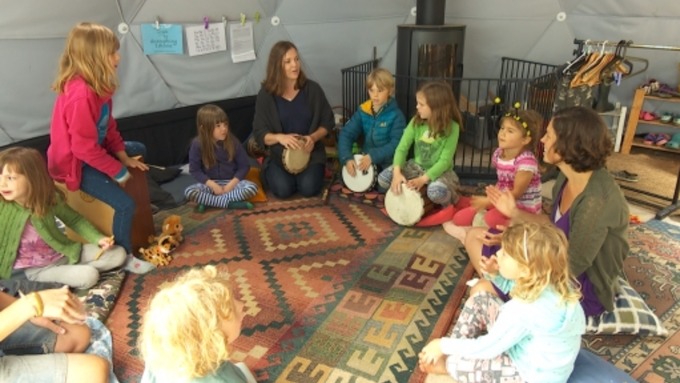
children playing
The Green House Education Project is not a school according to the people who run it. Credit: ITV News

There are mentors for the children for guidance and the project prizes itself on having nature as the children’s first classroom; the mentors say this creates curiosity and inspires learning.

One parent says she has seen a difference in her child’s behaviour since attending to the Green House Education Project.

I’ve just noticed that she has come to life again. She has re-discovered her joy for learning. When I pick her up now she wants to talk about her day rather than when I used to pick her up she used to just say nothing, «I’ve done nothing.»

– Sarah Thomas, Parent

children singing
Credit: ITV News

The teaching methods here are not in line with the traditional education model and ITV News understands Ofsted is now investigating the project. Though its Directors say they welcome conversations with the education watchdog.

We are very happy to talk to Oftsed, we welcome that, we’d love to know if there are any grey areas, which Ofsted have said that there are grey areas. We’d love to have a conversation with them, we’d love to talk about what do they require from us. We’re very proud of what we’ve created and we’re really happy for them to see children happy and loving learning and I think they probably have the same passion at their core.

– Cindy Adams, Director of The Green House Education Project

children playing
Credit: ITV News

While it might be non-traditional, it appears popular. There is a waiting list to get one of the 24 places at the project and parents have been prepared to moved cities to access the education they think their child needs.

Source:

http://www.itv.com/news/westcountry/2017-07-03/ofsted-to-investigate-alternative-education-project-near-bath/

Comparte este contenido:

China Online Education industry expected to grow to 241.6 million in 2021

China/ July 4, 2017/Source: http://www.marketwatch.com

China’s online education industry has expanded at a rate of around 20% in recent years, with the market worth of RMB150.7 billion in 2016, a year-on-year growth of 23%.

Meanwhile, user scale also increased rapidly, reaching 89.27 million in the same period, a 21.9% rise from a year ago.

Propelled by favorable policies and capital inflows, the Chinese online education market and user scale will maintain a rapid growth rate, hitting an estimated RMB421.6 billion and 241.6 million in 2021, respectively.

Despite a high concentration of online education in PC, mobile-client has the advantage of enabling users to maximize fragmented time to learn, while PC cannot allow users to study in any place and at any time.

It is expected the Chinese K12 online education market will grow at a pace of over 30% over the next five years, reaching RMB82.31 billion in 2021.

Due to environmental protection and supply-side reform in the coal industry, the output of coal-based activated carbon will decline, while that of wood-based and coconut shell-based activated carbons will rise steadily.

Online education industry in China was characterized by and showed the trends as follows in 2016:

1. Steady growth in market size and user scale
China’s online education industry has expanded at a rate of around 20% in recent years, with the market worth of RMB150.7 billion in 2016, a year-on-year growth of 23%. Meanwhile, user scale also increased rapidly, reaching 89.27 million in the same period, a 21.9% rise from a year ago.

Propelled by favorable policies and capital inflows, the Chinese online education market and user scale will maintain a rapid growth rate, hitting an estimated RMB421.6 billion and 241.6 million in 2021, respectively.

2. Industry development driven by capital injection
More governmental spending on education, accelerated revision of the laws on private education and supporting policies, and introduction of relevant policies create broad space for the development of online education in China and attract the attention of capital market. In 2016, there were a total of 140 domestic online education investment programs with aggregate amount of more than RMB14.886 billion, including 32 ones each worth of over RMB100 million.

3. Shift from PC to Mobile Client
Despite a high concentration of online education in PC, mobile-client has the advantage of enabling users to maximize fragmented time to learn, while PC cannot allow users to study in any place and at any time. Meanwhile, 95.1% of Chinese internet users are mobile netizens, meaning that people’s living habits are growingly based on mobile client, which provides a foundation for mobile online education. Hence, driven by changes in user demand and living habits, domestic online education is shifting from PC to mobile client.

4. Huge development potential of K12 online education market
As the younger generation (post-80s and 90s) become parents, they have higher requirements on education for children and spend more on education; as the two-child policy is implemented, the number of children in K12-education age group will increase steadily and market demand will further expand. It is expected the Chinese K12 online education market will grow at a pace of over 30% over the next five years, reaching RMB82.31 billion in 2021.

In addition, among 32 programs each with a total amount of more than RMB100 million in online education industry in China in 2016, 15 ones involved K12 online education, making up 46.7%. The flow of capital clearly shows the development potential of K12 online education market.

China Online Education Industry Report, 2016-2021 highlights the following:
Education industry in China (spending on education, various kinds of schools and students, private education);
Online education in China (development course, environment, status quo, market size, user scale, financing, and development trends);
Online education market segments in China (enterprise E-learning, online higher curricula education, online vocational education, K12 online education, and online language education).

Source:

http://www.marketwatch.com/story/china-online-education-industry-expected-to-grow-to-2416-million-in-2021-2017-07-03

Comparte este contenido:

Nigeria: Education. Sen. Uba Wants Intervention, Renovates School

Nigeria/July 4, 2017/Source: http://independent.ng

Senator Andy Uba has expressed displeasure over what he termed infrastructural decays in schools stressing that there was need for urgent intervention especially in Anambra state.

The lawmaker made the observation while on a routine visit to Girls High School Uga in Aguata Local Government Area, one of the schools he renovated a few months ago to enhance academic activities in the state.

Uba, a governorship aspirant of the All Progressives Congress (APC) stressed that the situation of things in many schools in the state was so bad that it was no longer conducive for learning.

The Senator who represents Anambra South Senatorial district said that the standard of education in the state had also declined to a pitiable level adding that such was unacceptable.

He insisted that investment in education should be a priority project of any good government.

“The infrastructure in many of our schools in Anambra is dilapidated, classrooms are not fit for learning and the hostels are not conducive for students to rest.

“Indeed no serious academic work can go on in this kind of condition, which is why the level of education is dwindling fast.

“We must intervene; education should be a priority project of any good government. This level of decay must not be allowed to continue,“ he said.

The senator who was saddened on seeing the hostel blocks of the girls’ school also promised to renovate it so that it would be conducive for the students.

He said that it was pitiable that “our children would be allowed to live in this kind of environment”.

The students and teachers of the schools expressed gratitude to the governor aspirant for his kind gesture.

They said that his intervention in renovating the classroom block had indeed repositioned the school adding that his pledge to renovate the dilapidated hostel was a very cheering news.

One of the elated students said that they would no longer be suffering from leaking roofs in the hostel.

Source:

Education: Sen. Uba Wants Intervention, Renovates School

Comparte este contenido:
Page 3689 of 6193
1 3.687 3.688 3.689 3.690 3.691 6.193