Siria/13 de Marzo de 2017/El Mundo
Bomba, bala, mortero, francotirador, fusil… son las primeras palabras que aprenden en inglés los niños que estudian en los colegios sirios bajo control del autodenominado Estado Islámico. También suman, restan y multiplican utilizando, en lugar de manzanas y peras, imágenes de lanzagranadas o coches bomba. [En los libros de Historia, junto a las banderas negras y un fusil Kalashnikov, los pequeños pueden ver cómo España se cuela en sus aulas representada por una carabela de Colón y un molino de El Quijote]. Algunos colegios han sido rebautizados con nombres de terroristas mártires. Y la Física y la Química están fuera del itinerario educativo por ser materias contrarias al islam…
Así es la educación del terror diseñada por el Ministerio de Educación creado por los seguidores del Al Bagdadi. Crónica tiene acceso a sus libros de texto y a todo el plan del califato para adoctrinar a sus hijos en el islam más excluyente. Entre sus 70 escuelas, el Daesh distingue incluso centros públicos, que son gratuitos, y concertados. Aunque su afán educativo trasciende las propias aulas. En las calles, los responsables de mantener el rigor de su ideario terrorista son los miembros de un gabinete creado ex profeso para ello: el de Prédica y Mezquitas, que desarrolla desde «cursos de arrepentimiento» hasta clases de jurisprudencia islámica con una larga lista de sanciones para quienes contravengan sus normas.
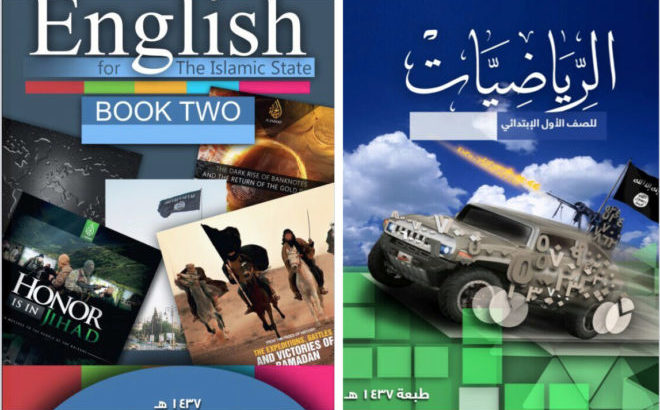
El Ministerio de Educación que han puesto en marcha contempla la asignatura de inglés, sí, pero con sus propios libros de texto: dos manuales editados por el Califato titulados Inglés para el Estado Islámico. Y no es el único material escolar que ha editado el Daesh para educar a sus niños y lavar sus cerebros. Todos los libros infantiles están plagados de armas. Hasta las matemáticas sirven para adoctrinar a los más pequeños en las 70 escuelas que controlan en Siria. La apariencia de los libros es moderna y atractiva. Pero sus contenidos resultan impactantes. Como un ejercicio para practicar la multiplicación, que consiste en señalar con una flecha el resultado correcto entre varias opciones para la operación «5×3». En la página no sólo hay números o dibujos infantiles: lo que los niños unen realmente con su lapicero son un lanzagranadas RPG y un vehículo militar iraquí. Otro ejercicio se llama «Ayuda al francotirador»: «Su rifle tiene 24 disparos y ante usted se encuentran siete objetivos de la coalición de cruzados. ¿Cuántos tiros recibirían de forma uniforme cada uno de los enemigos cruzados?». Otro: «Si tiene tres pistolas en frente y dispones de nuve balas, ¿cuántos disparos podrás realizar?».
La portada del libro ya advierte de lo que va a venir: la imagen de un blindado equipado con una metralleta que dispara números. Así aprenden a calcular.
Materiales como estos son obligatorios en la escuela pública de Al Yaqeen, en Abu Kamal, en la región de Deir ez-Zor, a 144 kilómetros al sur de la ciudad de Deir ez-Zor, en la misma frontera entre Siria e Iraq. En sus pupitres se sientan 300 alumnos, a cargo de nueve profesores que por 120 euros al mes siguen estrictamente el programa y los libros de texto elegidos los terroristas. Los padres no pagan nada por la educación de sus hijos; ni siquiera por el material escolar. En los últimos tres años, desde que los más de 200.000 habitantes de la localidad están bajo el control de los hombres de Al Bagdadi, el terror se ha instalado en Deir ez-Zor, pero las escuelas nunca han dejado de funcionar ni han dejado de ser públicas. La educación siempre ha sido una obsesión para el Estado Islámico.
Así que han diseñado su propio plan. Que incluye la asignatura de Historia, en la que encontramos una referencia a España. En la ilustración de portada del libro de Primaria aparece un típico molino manchego, como los de El Quijote, y una carabela de Colón, mezclados con un skyline estadounidense y una mezquita. Podría ser, éste sí, uno de los libros que todas las mañanas mete en su mochila cualquier niño español. Salvo por la bandera negra del Califato y un kalashnikov coronan la imagen.
Los pequeños del ISIS también estudian obligatoriamente Ciencias Sociales, que aprenden en inglés. El foco es la familia tradicional. En la lección 1 de este manual los niños repasan cuáles son los miembros de la familia a través de una fotografía que parece sacada de un álbum casero: sólo que si bien el abuelo, el padre y el tío son reconocibles, las mujeres -la abuela, Khadeeja, de 56 años; la madre, Hafsa, de 42; la tía Maryam, de 22 años, y la hermana Sara, de 15- no pueden distinguirse entre sí. Aparecen las cinco juntas, tapadas por un velo integral negro que cubre su cabeza y su cuerpo completamente. Cada milímetro de su piel.
Hasta aquí las ciencias. El Califato ha eliminado la Física y la Química de su plan escolar: las considera «contrarias a la enseñanza islámica», argumentan los seguidores de Al Bagdadi.
Las clases de caligrafía y gramática árabe, de sharía (enseñanza religiosa) y de educación física completan el currículum escolar planificado para ganar las mentes y los corazones de los habitantes más jóvenes del Estado Islámico.
El Ministerio de Educación del Califato, responsable del profesorado y de los programas académicos de la organización terrorista, fue una de las primeras instituciones que entró a funcionar tras la proclamación del IS y trabaja de forma coordinada con el denominado Ministerio de Prédica y Mezquitas, dedicado a difundir la ideología de la organización a través de programas educativos y de propaganda.
El proyecto educativo del Daesh echó a andar a principios de 2014 en la ciudad siria de Al Raqa. Uno de los primeros pasos fue la segregación de sexos: a partir de entonces todas las escuelas serían diferentes para hombres y para mujeres. Tras la proclamación del llamado Califato, los terroristas cerraron colegios -todos los que aplicaban el sistema educativo sirio anterior y los centros privados, lo que causó desplazamientos masivos de estudiantes y profesores- e implantaron su doctrina. Los cambios afectaron incluso a los nombres de los colegios. Ocurrió en la ciudad siria de Al Bukamal. Los terroristas rebautizaron centros como la escuela-mezquita Al-Rahman, que pasó a llamarse al-Sheikh Faris al-Zahrani, en honor a un terrorista ejecutado por Arabia Saudí en enero de 2016.
Hoy abren sus puertas en Siria alrededor de 70 escuelas con el sistema educativo del Daesh. Y aunque toda la enseñanza es pública, existen dos tipos de colegios: públicos y concertados. Los primeros son gratuitos y dependen directamente del Ministerio de Educación del Califato. En ellos el absentismo escolar es muy elevado por el temor de los habitantes a ser atacados por bombardeos de la Coalición. De hecho, en zonas como Al Raqa y Deir ez-Zor los yihadistas están utilizando las escuelas como cuarteles y no dudan en explosionarlas si se encuentran en riesgo de caer en manos del enemigo. Por eso resulta muy difícil obtener una relación exacta del número de alumnos sometidos a las enseñanzas extremistas.
Las escuelas concertadas, por su parte, fueron instauradas por maestros que siguen residiendo en zonas bajo control del Daesh y que poseen un permiso especial del Ministerio de Educación para impartir el currículum de los terroristas. Los padres pagan cerca de 10 dólares al mes por que sus hijos asistan a estas clases que son hoy la opción preferida para las familias sirias que habitan en las regiones tomadas por el régimen. Aunque algunos padres recurren también a unos colegios clandestinos donde los chicos puedan adquirir conocimientos científico-técnicos proscritos, como Física y Química, o aprender otras materias que el Daesh ha prohibido.
En Al Raqa existe además un colegio especial. Es la Escuela de los Cachorros de al-Furqan, creada recientemente para los hijos de los combatientes extranjeros. A sus aulas, a diferencia del resto, acuden niños de ambos sexos; eso sí, en distinto horario, de mañana y tarde. También es especial porque, además de recibir educación académica, sus alumnos reciben entrenamiento militar, incluido el manejo de armas largas y cortas. En la Escuela de los Cachorros, que depende directamente de la máxima autoridad en la capital siria del Califato, trabajan unos 20 empleados, hombres y mujeres. Aunque el temor a los ataques aéreos hace que su ubicación cambie con frecuencia.
Cursos de arrepentimiento
Cuando el califato implantó su sistema educativo los maestros se convirtieron en una pieza fundamental de su ejército ideológico: se vieron forzados a someterse a los llamados «cursos de arrepentimiento, para retractarse de la «infidelidad» en la que habían incurrido en el pasado al haber firmado su compromiso con los sistemas docentes sirios anteriores. Pero la estrategia de educación del grupo terrorista se extiende más allá del control de las aulas. Y quien lleva la batuta es el Gabinete de Prédica y Mezquitas.
Los soldados de este gabinete son los shariiyin (expertos en jurisprudencia islámica), una suerte de funcionarios de la administración regional que, presentes en todas las provincias, operan en las llamadas Oficinas de Prédica y Mezquitas, ubicadas generalmente en los propios templos. Sus instrumentos: sermones (jutbas) recitados los viernes en las mezquitas y que ellos mismos redactan y coordinan; cursos monográficos sobre el islam y de jurisprudencia islámica o sharía; concursos para niños y adolescentes con motivación religiosa, como los de recitación y memorización del Corán… Y los folletos y carteles propagandísticos que, expuestos en las zonas de afluencia o en los accesos a las mezquitas, explican cómo debe uno comportarse e incluso cómo debe cortarse la barba.
El arrepentimiento
Los cursos de adoctrinamiento que más asfixian a la población son los conocidos como de «arrepentimiento» (en árabe tauba o istitaba). Una verdadera pesadilla para muchos. Durante unos 45 días, los alumnos asisten a clase en un austero internado llamado Centro de Enseñanza para el Arrepentimiento. Un lugar desconocido, a menudo una gran mezquita o un edificio con suficiente capacidad, donde duermen, comen y aprenden todos aquellos que pueden suponer una amenaza para el Califato. No sólo disidentes, reclusos o miembros de otros grupos que abandonaron las armas en su día y no se han sumado al IS. También jueces, periodistas, abogados… cualquiera que haya cobrado o cobre del régimen.
Lo primero que recibe un cursillista del «arrepentimiento» son unos utensilios básicos para el aseo y para pernoctar, y una tarjeta con su nombre, número, curso y fecha de inicio. A partir de ese momento el alumno cobrará un dólar al día -más o menos al salario actual de un combatiente soltero del Daesh- y estará bajo la protección del califa.
En su primer interrogatorio, los jefes de la sharía le preguntarán: ¿participaba en las manifestaciones contra el Régimen?, ¿luchaba con las facciones contrarias al Daesh?, ¿pretende jurar fidelidad al grupo…?
El interno recibe a continuación un mensaje aparentemente conciliador. Los responsables del curso le invitan a olvidar las torturas que, en su caso, han podido padecer en las cárceles del IS, argumentando que eran fruto de la mente perturbada de los temidos Amniyin, miembros del aparato de seguridad, que «no representan al verdadero Daesh». «En todas las organizaciones se cometen errores», añaden. El verdadero Daesh es una «organización islámica» -nada más- cuya finalidad es restaurar el Califato y luchar contra los chiíes.
Fidelidad o castigo
Y así pasan los días. Con oraciones al alba, sesiones de formación sobre el Corán y la sharía, el estudio, actividades de limpieza…. Los alumnos, en pequeños grupos, ven vídeos con combates del Daesh contra el Gobierno iraquí (generalmente se evitan imágenes de la lucha contra grupos islamistas). La comida es limitada y el trato al interno es brusco, con frecuentes reproches por supuesta falta de rendimiento y acusaciones de cobardía o ineptitud. Aunque para los estándares sirios actuales, los alumnos reciben un trato digno si respetan las normas. En caso de incumplirlas, se les castiga con la prolongación de los días de internado.
Al acabar en el Centro de Enseñanza para el Arrepentimiento, los graduados tienen dos opciones: regresar a sus hogares o jurar fidelidad al grupo terrorista. A los primeros el Régimen les proporciona un salvoconducto para que se desplacen a sus residencias, con medidas de restricción de movimientos y comparecencia en las sedes del Daesh.
Los segundos, los convencidos, quedan a disposición de los terroristas como miembros de pleno derecho. Su destino habitual serán los frentes más castigados, con alta probabilidad de morir en combate. Son los menos.
Pese a que el Califato invierte mucho esfuerzo y dinero en este internado, los resultados reales de estos cursos son pequeños. Los convocados suelen asistir a las sesiones para evitar represalias sobre ellos o sus familias, pero no por convicción. Sólo una minoría modifica su ideología, jura fidelidad o se une a la lucha armada. Aunque también hay quienes, sin jurar fidelidad al IS, sí sienten fuertes convicciones religiosas y cierta afinidad ideológica con el Daesh. A ellos el proceso de «arrepentimiento» les llega a generar fuertes dudas y la «autoridad moral» de los profesores les causa una impresión positiva.
Al acabar, el graduado recibe una tarjeta acreditativa con su nombre, su foto y el sello del Daesh. En un vehículo cerrado lo conducen fuera de la instalación.
¿Y las mujeres? Apenas existen en el sistema educativo de Al Badgadi. Rara vez se convocan cursos de sharía para ellas. El Daesh entiende que deben ser los tutores, padres o esposos los que se responsabilicen de enseñar a las personas que de ellos dependen. Así, dentro y fuera de las aulas, la maquinaria sigue funcionando.
Fuente: http://www.elmundo.es/cronica/2017/03/10/58b9ac8b22601d0b0e8b45ce.html




 Users Today : 2
 Total Users : 35492279
 Views Today : 3
 Total views : 3610834