Page 783 of 6193
1 781 782 783 784 785 6.193

España: ACAE alerta de la intesificación del acoso escolar en los ‘grupos burbuja’

ACAE alerta de la intesificación del acoso escolar en los ‘grupos burbuja’

El Ayuntamiento de Logroño, a instancias de ACAE Rioja, iluminará este sábado la Fuente Murrieta y la Muralla del Revellín con tonos azules para visibilizar la lucha contra el acoso escolar.

La asociación, constituida en 2015, recuerda que este curso los centros escolares se han organizado formando grupos burbuja para prevenir los contagios por coronavirus, lo que propicia que «las relaciones se centran en los mismos niños durante todo el horario escolar».

«Muchos se han sentido a gusto y se ha generado una convivencia única, potenciada por el buen hacer de muchos docentes y los propios alumnos», explica ACAE, matizando que «el que ha sido elegido para ser diana de un acoso escolar ha sufrido si cabe más intensamente el aislamiento y hostigación propia de esta lacra, sintiéndose desprotegido y sin posibilidad de buscar otras relaciones con compañeros ajenos a su propia aula».

«Muchos niños han manifestado la separación de sus mejores amigos, haciéndose el recreo una auténtica pesadilla. Y lo más triste y que nos han manifestado no sentirse escuchados por los adultos, que se supone son su máxima protección», denuncia la asociación.

Fuente de la Información: https://nuevecuatrouno.com/2021/04/27/acoso-escolar-coronavirus-grupos-burbuja-acae-rioja/

Comparte este contenido:

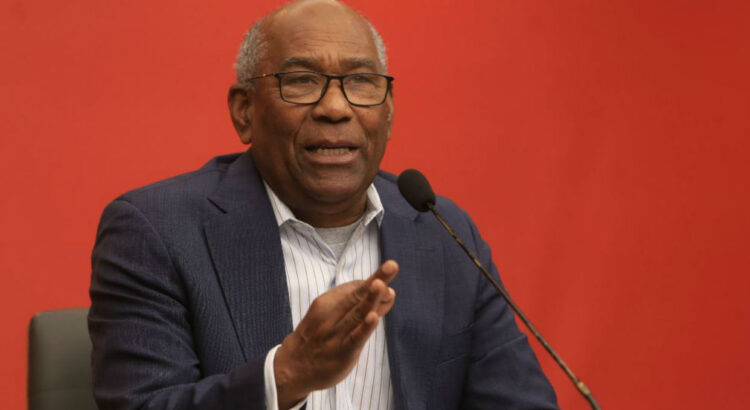
Venezuela: Falleció Aristóbulo Istúriz, ministro de Educación

Falleció Aristóbulo Istúriz, ministro de Educación

La información fue confirmada por la vicepresidenta Ejecutiva de la República, Delcy Rodríguez, quien describió a Istúriz como un «combatiente de esta Patria a la que dedicó su vida». Y añadió: «Lo acompañó hasta último momento su sonrisa esperanzadora»

Caracas.- La noche de este martes 27 de abril se tuvo conocimiento sobre la muerte del ministro para la Educación, Aristóbulo Istúriz, información que fue confirmada por la vicepresidenta Ejecutiva, Delcy Rodríguez, en su cuenta de Twitter.

«Con profundo pesar lamentamos informar la partida de nuestro Profe, Aristóbulo Isturiz, combatiente de esta Patria a la que dedicó su vida. Lo acompañó hasta último momento su sonrisa esperanzadora. Nuestras condolencias a su esposa, hijos, amigos. El profe vivirá en nosotros», trinó la alta funcionaria.
Con profundo pesar lamentamos informar la partida de nuestro Profe, Aristóbulo Isturiz, combatiente de esta Patria a la que dedicó su vida. Lo acompañó hasta último momento su sonrisa esperanzadora. Nuestras condolencias a su esposa, hijos, amigos. El profe vivirá en nosotros

Imagen

Por su parte, el primer vicepresidente del Partido Socialista Unido de Venezuela (PSUV), Diosdado Cabello, lamentó «la triste noticia de la partida de un grande»

Diodado Cabello

Desde lo más profundo de mi sentir de hermano, lamento la triste noticia de la partida de un grande, de nuestro hermano Aristóbulo, un revolucionario y un gran ser humanos, a sus familiares y amigos nuestra palabra de pesar. Honor y Gloria querido hermano mayor.

«Desde lo más profundo de mi sentir de hermano, lamento la triste noticia de la partida de un grande, de nuestro hermano Aristóbulo, un revolucionario y un gran ser humanos, a sus familiares y amigos nuestra palabra de pesar. Honor y Gloria querido hermano mayor», publicó el dirigente socialista.
Fuente de la Información: https://www.eluniversal.com/politica/95820/fallecio-aristobulo-isturiz-ministro-de-educacion
Comparte este contenido:

España: El Centro de Estudios Penitenciarios permitirá desestacionalizar la demanda turística

El Centro de Estudios Penitenciarios permitirá desestacionalizar la demanda turística

7/4/2021 · Las Noticias

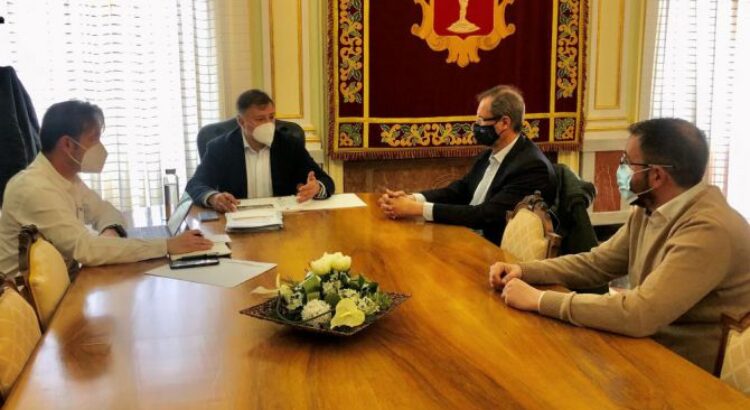
El alcalde de Cuenca, Darío Dolz, y el concejal de Turismo, Miguel Ángel Valero, han mantenido una reunión para explicar el proyecto del Centro Nacional de Estudios Penitenciarias a las asociaciones profesionales de Hostelería y Turismo con el fin de trasladar lo que supondrá para estos sectores la decisión del Gobierno de España de que esta infraestructura se vaya a ubicar en la ciudad.

Concretamente, han estado presentes el presidente de la Agrupación Provincial de Hostelería y Turismo de Cuenca, José Manuel Abascal, y el técnico de Hostelería de CEOE Cepyme Cuenca, Diego López.

Este Centro, que supondrá la creación de unos 100 puestos de trabajo, se dedicará a la formación de todo el funcionariado de Prisiones, tanto la formación continua de los aproximadamente 24.000 funcionarios que hay actualmente como el aprendizaje y capacitación de las nuevas promociones, que se estima están conformadas por en torno a 1.000 personas cada una de ellas.

Esto implicará la desestacionalización de la demanda puesto que “todos estas personas vendrán en unos tiempos muy diferentes a los del turista que tradicionalmente nos visita”, ha explicado Dolz, señalando que estarán durante la semana -fuera del fin de semana- y durante todo el año.

Fuente de la Información: https://www.lasnoticiasdecuenca.es/cuenca/centro-estudios-penitenciarios-permitira-desestacionalizacion-demanda-turistica-54696

Comparte este contenido:

España: Las universidades vigilarán que no se formen aglomeraciones en las pruebas de Selectividad

Las universidades vigilarán que no se formen aglomeraciones en las pruebas de Selectividad

La comisión de salud pública aprobará esta tarde las medidas de prevención de contagio de las pruebas de acceso a la universidad

Barcelona, Catalunya

EP

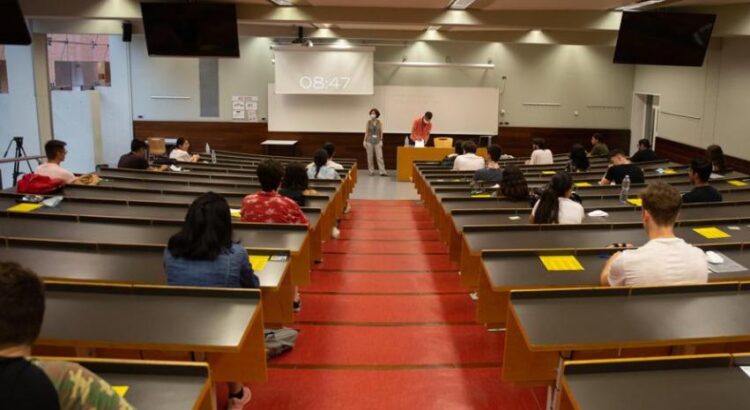
La comisión de salud pública aprobará hoy las medidas recomendadas en la celebración de las pruebas de acceso a la selectividad (PAU), también denominadas EBaU, convocadas por las autonomías para el mes de junio. Según el documento, al que ha tenido acceso La Vanguardia, estas recomendaciones de prevención y control de la infección se basan en el escenario actual de la epidemia por SARS-CoV-2 y en la última información disponible.

Las conocidas como ventilación, distancias, mascarillas e higiene de manos, que también se especifican, se suman al objetivo de evitar la formación de grupos. El documento indica que con la evidencia científica acumulada, se considera que SARS-CoV-2 puede transmitirse de persona a persona por diferentes vías, “siendo la principal mediante el contacto y la inhalación de aerosoles respiratorios o partículas de mayor tamaño, emitidos por una persona infectada, con las vías respiratorias superiores e inferiores de una persona susceptible”.

Añade que “el riesgo de propagación aumenta a mayor interacción de las personas y mayor tiempo de duración de la misma”. Y que se ha demostrado que hay “mayor transmisión en distancias cortas”, en espacios cerrados y concurridos, cuando no hay una buena ventilación y sin las adecuadas medidas de prevención

Acceso al recinto y exteriores del aula

Así, las autoridades sanitarias recomiendan la presencia de personal que se encargue de “distribuir y regular la cantidad de personas que acuden al examen, evitando aglomeraciones en los accesos, así como en el interior” y observar el uso adecuado de la mascarilla, que en ningún caso debe tener válvula. Asimismo, la entrada al edificio debe ser en fila y manteniendo la distancia física de 1,5 metros entre los estudiantes.

Solo podrán entrar al centro de examen las personas de administración y servicios del centro, examinadores/as, alumnado y acompañantes de personas que puedan precisar asistencia.

Este son varios puntos que aparece en el documento como medidas específicas para los días que se realizan la prueba y que regulan el acceso al recinto y los exteriores, el acceso a las aulas, en el interior del aula y la salida del aula y del recinto.

También se aconseja señalizar los circuitos indicando el sentido de circulación y la distancia física interpersonal y establecer un flujo de entrada y otro de salida, a fin de evitar la doble circulación de personas. El acceso a las aulas deberá ser escalonado.

Preferentemente, los estudiantes harán uso de las escaleras y se guardará el aforo establecido en los ascensores si tienen que utilizarlo.

Acceso al aula

El aula estará ventilada desde al menos 15 minutos antes de que empiece a ocuparse, procurando que se mantenga una “ventilación natural cruzada” de manera permanente, a ser posible, abriendo ventanas y puertas. Si ello no es posible, “se usará ventilación mecánica”.

Al entrar, tanto el alumnado como el profesorado o personal debe realizar higiene de manos con solución hidroalcohólica.

Para la identificación del alumnado, se recomienda hacerlo en el interior del aula “manteniendo siempre la distancia, para evitar aglomeraciones a la entrada”. En caso de que sea necesario hacerlo en la parte exterior, se recomienda escalonar el acceso.

También debe evitarse en la medida de lo posible “solicitar la retirada de la mascarilla para la verificación de identidad”. En el caso de que exista intercambio de documentación, se debe disponer de hidromel.

En el interior del aula

El uso de la mascarilla y la distancia interpersonal de 1,5 metros sigue vigente también en el interior del aula. Y los profesores deberán vigilar que se cumpla.

En el caso del alumnado con necesidad específica de apoyo educativo, que necesite adaptaciones como acompañantes de apoyo, medios materiales o ayudas técnicas, estas se llevarán a cabo teniendo en cuenta las medidas de prevención.

Si se precisa realizar una consulta, “el alumno levantará la mano y el docente se acercará para resolverla, “durante el mínimo tiempo indispensable y regulando el tono de voz de modo que no sea muy fuerte”.

Se debe evitar compartir materiales de uso personal y en el caso de material de uso común extremar las medidas de prevención y limpieza o desinfección tras cada uso.

Además se controlará el acceso a los aseos, que se realizará garantizando el cumplimento del aforo.

Finalización de la evaluación y salida del aula

Una vez terminada la evaluación, el alumnado deberá abandonar el aula inmediatamente.

Cuando falten 5 minutos para finalizar el tiempo de la evaluación, se recomienda indicar que el alumnado que se encuentra en el interior espere en su lugar, y al término del tiempo indicar una salida progresiva y ordenada, desde la primera fila y manteniendo la distancia física.

Se comunicará al alumnado que tras finalizar el examen abandone el centro, siguiendo la señalización y flujos dispuestos y no se quede formando grupos en zonas comunes exteriores.

Siempre que sea posible, y sobre todo cuando hay exámenes consecutivos, se debe establecer puntos de salida y acceso diferenciados.

Fuente de la Información: https://www.lavanguardia.com/vida/20210427/7367633/universidades-vigilaran-formen-aglomeraciones-pruebas-selectividad.html

Comparte este contenido:

Myanmar Women: ‘Our Place Is In The Revolution’

Myanmar Women: ‘Our Place Is In The Revolution’

Every day at sunrise, Daisy* and her sisters set out to spend several hours in the heat cleaning debris from the previous day’s protests off the streets of Yangon, Myanmar’s largest city.

Protests have erupted around the country since the military seized control of the government after arresting democratic leader, Aung San Suu Kyi, on 1 February, and declared a year-long state of emergency.

According to the Assistance Association for Political Prisoners (AAPP), a non-profit rights organisation formed by former political prisoners from Myanmar and based in Thailand, 715 civilian protesters have been killed and more than 3,000 people have been charged, arrested or sentenced to prison for taking part in protests. 27 March marked the deadliest day of the anti-coup protests so far, with more than 100 deaths in a single day.

Daisy, a 29-year-old elementary school teacher, has been out of work since the first week of February, because schools have been closed as a result of the protests, but is the sole earner and carer for her two younger sisters, aged 15 and 13. Despite this, she spends a portion of whatever money she has left to help feed hungry protesters.

The military makes use of dalans – local people who are forced to spy on their neighbours and, in particular, to target women living alone whose homes are easy targets for looting and harassment. As a result, Daisy and her sisters have been forced to move home three times and are now in hiding with relatives.

“The military are preying on vulnerable women, breaking in and raiding where we live to seize our belongings and lock us up for no reason,” Daisy says. But despite having little financial security, Daisy continues to help with the protests. “As women, we are the most at risk under the military but however large or small, our place is in the revolution.”

Outrageous Displays Of ‘Profanity’

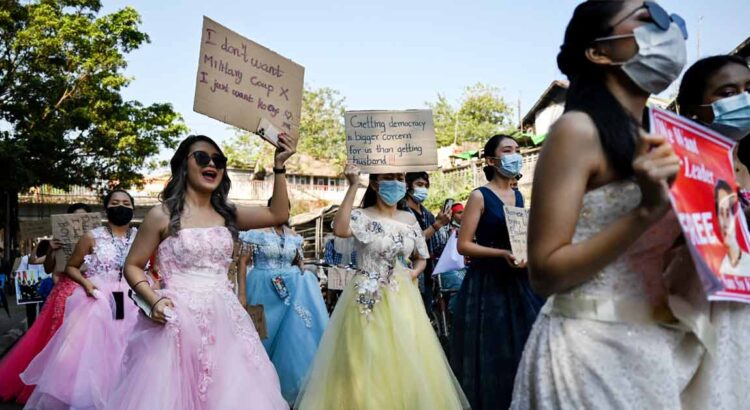
Across Myanmar, women protesters have lined the streets with vibrant traditional women’s clothing and undergarments in the hope of challenging a long-held taboo around women’s clothing. “Htaimein – Burmese for sarongs and intimate women’s wear – are perceived as ‘unclean’ in traditional Buddhist belief and thus considered inferior in Burmese society,” explains 25-year-old Su, an activist and university student who does not wish to give her full name for fear of reprisals. Su is originally from Dadaye, a town in the Ayeyarwady region of southwest Myanmar.

“Coming into contact or walking under these is believed to bring bad luck, reducing one’s hpone – masculine superiority – in Buddhist belief.”

She says hanging up sarongs has been an effective deterrent to keep the military from attacking the protesters as their staunch beliefs will not allow them go anywhere near the orchestrated clothing lines.

Women are also using their sarongs to create flags and hats for men to parade alongside banners that read “our victory, our htaimein” to celebrate wielding a degrading superstition about women as a successful defence strategy.

In a similar vein, women have been hanging sanitary towels drenched in red paint to emulate blood over photos of the military general, Min Aung Llaing. “For a society where men, including Min Llaing, detest the idea of menstruation, smearing his face with what he finds the dirtiest is unimaginably humiliating,” Su explains. “Sarongs and sanitary napkins are symbolic of the women in Myanmar and how they are regarded as inferior to men in society.”

By weaponizing these displays of “profanity”, women say they are reclaiming their status against the same patriarchal attitudes that perceive them as lesser in society.

Civil Disobedience As A Means Of Resistance

The Women’s League of Burma, an organisation which seeks to increase women’s participation in public life in Myanmar (which was formerly called Burma), estimates that 60 percent of those protesting are women, while the AAPP says women make up almost 40 percent of those arrested.

The Civil Disobedience Movement (CDM) has brought the country’s public services, including healthcare, schools and banks, to a halt. It is also behind efforts to deprive the military of its income by boycotting military-owned services and products such as tobacco, alcohol, coffee and oil, and refusing to pay government taxes.

Chit*, a 26-year-old doctor-in-training from Yangon, has been part of a group of female medical volunteers tending to the wounded during the protests. She believes providing medical care to protesters is a duty for all doctors. She says she has heard of one female doctor who was shot by the military while trying to aid a patient. “As women, we are expected to stay in ‘safe’ areas of the protests but we know our place is wherever help is needed.”

Female lawyers and bankers have formed an informal group to offer legal and financial advice to civilians, especially those trying to flee the country. “We want to offer our services to those in general need of legal routes or financial advice. We know the public have been put in a compromising position given a pandemic then a coup so free verbal consultations, advice, and going through documents with them is an extension of our efforts against the military,” explains Min Thwaw, a private lawyer practising in the capital, Naypyidaw.

“Many white-collar workers have lost their jobs and those females workers continue to be threatened by authority figures but the military need us [the workers] more than we need them. Without us, the banking system will collapse soon and economic crisis will remain irreversible – a price we are willing to pay to cripple the military,” she adds.

Economic uncertainty caused by the military takeover is likely to have a negative effect on the country’s US$6 billion garment and footwear industry. As a result, thousands of garment workers, predominantly young women, have taken part in demonstrations, urging the multinational companies they work for to denounce the coup and protect workers from being fired or even killed for protesting.

While some Western brands have remained silent over the military takeover in Myanmar, the Benetton Group, H&M, Primark and Bestseller all suspended new orders from factories there until further notice, following pressure from within and outside Myanmar. Despite this, trade unions in Myanmar stress companies are not doing enough and are demanding more “concrete action” like documenting and addressing human rights abuses with their respective governments and committing to partial payments of orders.

Many garment workers have left their family homes for the safety of other family members in order to participate in the strikes. They include 27-year-old Jasmine (who did not wish to give her full name) and five of her colleagues. They live together in a 250-square-foot flat in Yangon, surviving on food donations from the wider community as well as community money handouts – funds raised by local and international supporters of the CDM to finance the movement from afar – a portion of which they need to send back to their home villages to support their families as well.

These young women march defiantly together in large human chains with arms interlocked. Jasmine says this is an effective tactic adopted by garment workers who are protesting to ensure the police do not separate them from each other. “They yank protesters away to break the chain then abuse those they capture in jail or publicly.”

On 18 February, about 1,000 garment workers producing clothes for Primark were reportedly locked in GY Sen Apparel Company’s factory for taking part in the protests by supervisors who sympathised with the military.

Upon breaking free after several hours, many of them were fired. Jasmine also says that she and her colleagues have been intimidated with verbal abuse by factory owners, who confront the women physically, they say, and who have been trying to fire them for protesting. For now, Jasmine still has her job, although many of her colleagues have been laid off.

“These are the challenges we are faced with on top of a coup; borderline starvation and no pay. We need the companies we work for to denounce these heinous acts, recognise what we are going through and protect us,” she says. Since the women live together, they have been easy targets for the military and factory owners.

During the day, the workers liaise with activists to gather information about locals collaborating with the military by providing details about people’s whereabouts and public gatherings. This way, they can find out about potential morning break-ins into workers’ homes and abductions by the military and police carrying out military orders. As the evening sets in, workers quietly gather in one house to make plans for the next day’s protests.

The military blacks out the internet every night from 1:00 am to 9:00 am and has banned all social media to stop protesters from informing each other about arrests or possible military targets. It is meticulously tracking telecommunications. It also imposes a strict overnight curfew and deploys soldiers with orders to shoot on sight anyone who breaks it.

Jasmine and her friends have heard frightening rumours about people being shot or abducted if they are found to be breaking curfew. The women, therefore, move carefully on foot from one house to another in the dead of night to relay crucial information regarding potential break-ins, abductions and to make plans for protests.

“We cannot afford to risk brushing off anything heard through the grapevine as hearsay. Nobody is here to protect us but ourselves,” says Jasmine. – Al Jazeera

*Names changed to protect identities.

Fuente de la Información:  https://theaseanpost.com/article/myanmar-women-our-place-revolution
Comparte este contenido:

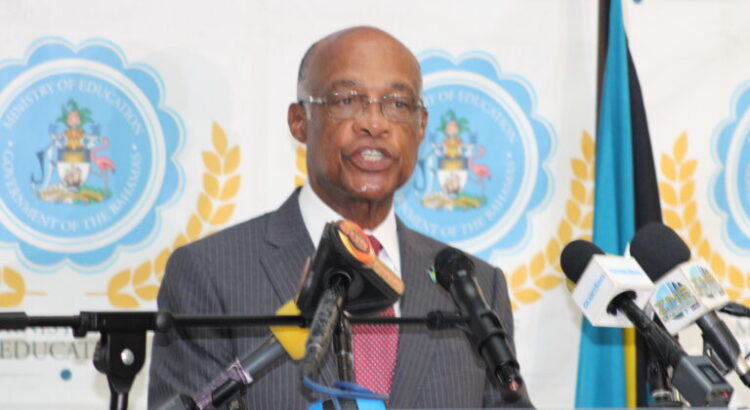
Bahamas – “WE DID IT”: Ministry of Education and partners achieve goal to put devices in hands of every public school student

“WE DID IT”: Ministry of Education and partners achieve goal to put devices in hands of every public school student

NASSAU, BAHAMAS — The Ministry of Education (MOE) expressed gratitude to public/private partners who participated in a national initiative for the provision of devices and data plans for public school students.

In September 2020, with an initial contribution of $60,000, Leno Corporate Services Limited launched a campaign in conjunction with the MOE, to put a learning device in the hands of students who were in need of a laptop or computer.

Since then, numerous businesses, service clubs, individuals and other entities have contributed to the drive, resulting in more than $500,000 in donations and financial contributions.

At a ceremony to mark the final presentation of tablets through the Leno Learning Link partnership on Friday, Minister of Education Jeffrey Lloyd thanked Founder and CEO of Leno Sean K Longley for his vision and generosity in helping the ministry and country put a device in the hands of every public school student who needed one.

He also recognized the partners, corporate sponsors, individual donors, organizations and NGOs who contributed.

He expressed appreciation to those who have enabled the MOE to make this “indispensable” tool a part of the current toolkit in education in The Bahamas.

Lorraine Armbrister, permanent secretary, underscored that although the campaign was ending, the door is not closed for donations.

Director of Education Marcellus Taylor said in great measure, Longley’s leadership, altruism and support of education in the time of crisis has helped to bring out the best in the Bahamian society.

“So many entities have stepped up to help in this endeavor to ensure that our students get what they need in order to continue their education,” he said.

Representatives of some of the campaign sponsors attended the event.

Fuente de la Información: https://ewnews.com/we-did-it-ministry-of-education-and-partners-achieve-goal-to-put-devices-in-hands-of-every-public-school-student


Comparte este contenido:

Unión Europea: European Union Moves to Regulate Artificial Intelligence

European Union Moves to Regulate Artificial Intelligence

The European Union’s executive branch on Wednesday announced proposals designed to regulate the use of artificial intelligence (AI), banning its use in practices such as surveillance and facial scanning that threaten personal rights.

At a news briefing in Brussels, European Commission Executive Vice President and Tech Commissioner Margrethe Vestager noted the benefits of AI in the medical field, agriculture and engineering.

“I think those examples illustrate very well what we want AI in Europe to be: a force for progress,» she said.

The proposed regulations address the human and societal risks associated with specific uses of AI, such as mass surveillance and biometric identification in public places.

The draft EU regulations include rules for other uses of artificial intelligence in some risky categories such as choosing schools, jobs or loan applicants, while banning it outright in cases such as «social scoring» or systems used to manipulate human behavior.

The proposals are the bloc’s latest move to maintain its role as the world’s standard-bearer for technology regulation, putting it ahead of the world’s two big tech superpowers, the U.S. and China.

EU Commissioner for Internal Market Thierry Breton told reporters that Europe would become the first continent to provide guidelines over the use of artificial intelligence.

The commission is continuing to work out details of the proposals and how they will be enacted with EU member governments and the European Parliament before coming into force.

Fuente de la Información: https://www.voanews.com/europe/european-union-moves-regulate-artificial-intelligence


Comparte este contenido:
Page 783 of 6193
1 781 782 783 784 785 6.193