Mundo/30-04-2021/Autor(a) y Fuente: www.worldbank.org
Todos los niños deberían poder leer a los 10 años. La lectura es una puerta de entrada para el aprendizaje a medida que el niño progresa en la escuela y, a la inversa, la incapacidad para leer cierra la puerta de golpe. Más allá de esto, cuando los niños no pueden leer, generalmente es una clara indicación de que los sistemas escolares no están bien organizados para ayudar a los niños a aprender en otras áreas como matemáticas, ciencias y humanidades. Y aunque es posible aprender más tarde en la vida con suficiente esfuerzo, los niños que no leen a los 10 años, o como muy tarde, al final de la escuela primaria, generalmente no logran dominar la lectura más adelante en su carrera escolar.
Una educación de calidad para todos los niños es fundamental para el éxito de los Objetivos de Desarrollo Sostenible (ODS), un conjunto de objetivos globales para reducir el hambre y la pobreza y mejorar los niveles de vida en todo el mundo para 2030. Los malos resultados en la educación, y en particular la capacidad de leer a nivel de grado – es la vanguardia de una crisis de aprendizaje que amenaza los esfuerzos de los países para construir capital humano y lograr la agenda de los ODS.
Sin embargo, en los últimos años ha quedado claro que muchos niños de todo el mundo no están aprendiendo a leer con soltura. Aunque la mayoría de los niños están en la escuela, una gran proporción no está adquiriendo las habilidades fundamentales. Además, 260 millones de niños ni siquiera están escolarizados. Sin un aprendizaje fundamental, los estudiantes a menudo no prosperan más tarde en la escuela o cuando se unen a la fuerza laboral. No adquieren el capital humano que necesitan para impulsar sus carreras y economías una vez que dejan la escuela, o las habilidades que los ayudarán a convertirse en ciudadanos comprometidos y a formar familias prósperas y saludables. Como uno de los principales contribuyentes a los déficits de capital humano, la crisis del aprendizaje socava el crecimiento sostenible y la reducción de la pobreza.
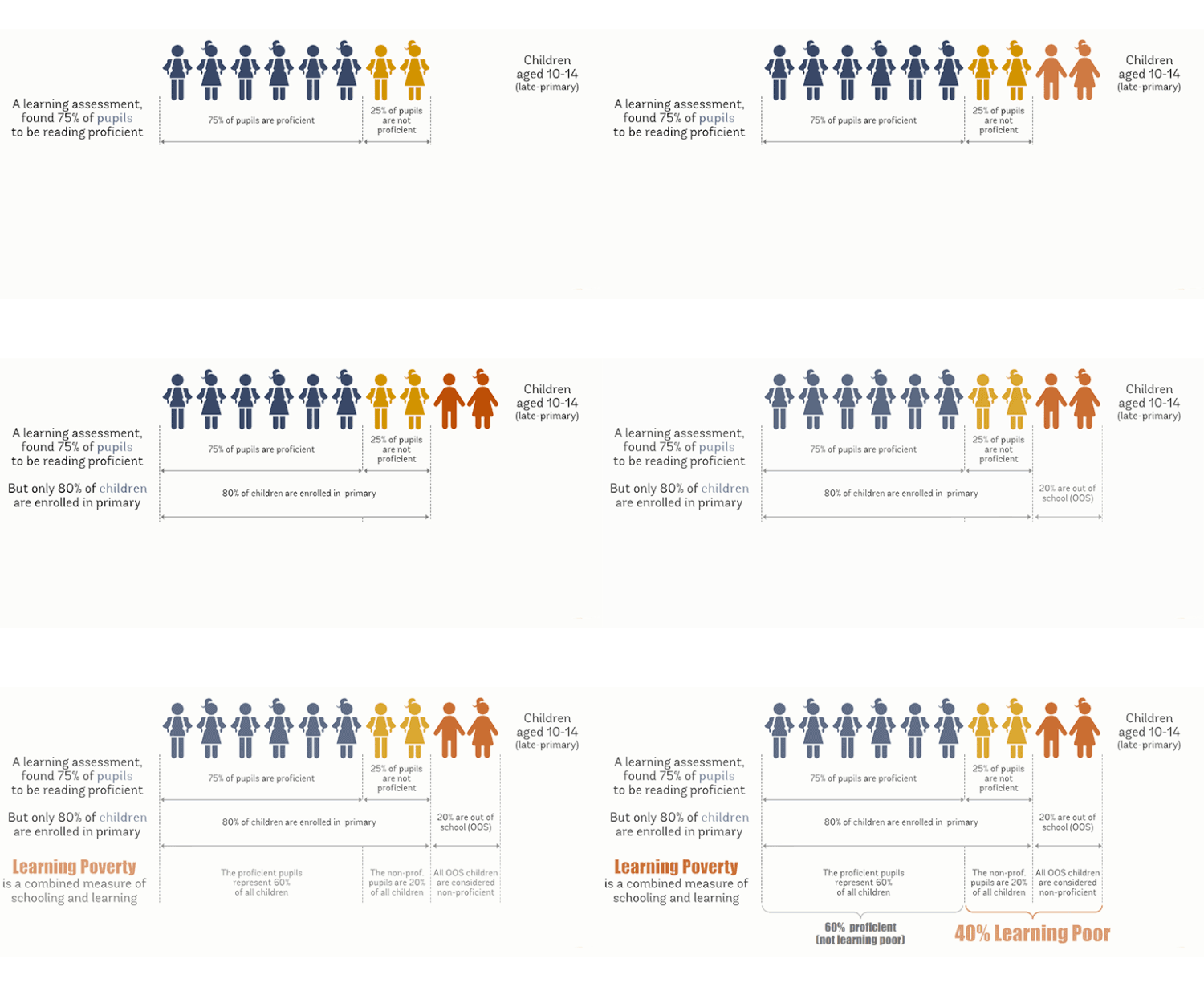
Para resaltar esta crisis, estamos introduciendo el concepto de Pobreza de Aprendizaje y una medida de acompañamiento construida conjuntamente por el Banco Mundial y el Instituto de Estadística de la UNESCO. Pobreza de aprendizaje significa no poder leer y comprender un texto simple a los 10 años. Este indicador reúne indicadores de escolaridad y aprendizaje: comienza con la proporción de niños que no han alcanzado la competencia mínima en lectura (medida en las escuelas) y se ajusta por la proporción de niños que no asisten a la escuela (y se supone que no saben leer con soltura).
Utilizando una base de datos desarrollada conjuntamente por el Banco Mundial y el Instituto de Estadística de la UNESCO, hemos determinado que el 53 por ciento de los niños en países de ingresos bajos y medianos no pueden leer y entender una historia simple al final de la escuela primaria. En los países pobres, el nivel llega al 80 por ciento. Niveles tan altos de analfabetismo son una señal de alerta temprana de que el ODS 4 para la educación y todos los objetivos mundiales relacionados están en peligro.
El progreso en la reducción de la pobreza en el aprendizaje es demasiado lento para cumplir con las aspiraciones de los ODS: al ritmo actual de mejora, en 2030 aproximadamente el 43% de los niños seguirá aprendiendo mal. Incluso si los países reducen su pobreza de aprendizaje al ritmo más rápido que hemos visto hasta ahora en este siglo, el objetivo de ponerle fin no se alcanzará para 2030.
Existe una necesidad urgente de un compromiso de toda la sociedad para invertir más y mejor en las personas. Si los niños no saben leer, todas las metas de los ODS relacionados con la educación están en peligro. Eliminar la pobreza de aprendizaje es tan importante como eliminar la pobreza monetaria extrema, el retraso en el crecimiento o el hambre. Para lograrlo en el futuro previsible se requiere un progreso a escala mucho más rápido de lo que hemos visto hasta ahora.
El indicador de pobreza de aprendizaje se centra en la lectura por tres razones:
- La competencia lectora es una medida de aprendizaje fácil de entender
- La lectura es la puerta de entrada del estudiante al aprendizaje en otras áreas.
- La competencia lectora puede servir como un indicador del aprendizaje fundamental en otras materias.
El indicador de pobreza de aprendizaje nos permite ilustrar el progreso hacia el objetivo más amplio del ODS 4 de garantizar una educación de calidad inclusiva y equitativa para todos. Destaca en particular el progreso hacia el ODS 4.1.1 (b), que especifica que todos los niños al final de la primaria alcanzan al menos un nivel mínimo de competencia en lectura.
Metodología
El indicador combina la proporción de niños en edad de primaria que no asisten a la escuela y que tienen dificultades de escolarización (SD) y la proporción de alumnos por debajo de un nivel mínimo de competencia en lectura, que tienen dificultades de aprendizaje (LD) . Al combinar la escolarización y el aprendizaje, el indicador pone de relieve tanto «más escolaridad», que por sí misma cumple una variedad de funciones críticas, como «un mejor aprendizaje», que es importante para garantizar que el tiempo que se pasa en la escuela se traduzca en la adquisición de habilidades y capacidades.
Cómo se define la pobreza de aprendizaje
El indicador de pobreza de aprendizaje se calcula de la siguiente manera:
LP = SD + [(1-SD) x LD]
LP = Pobreza de aprendizaje
LD = Privación de aprendizaje , definida como la proporción de niños al final de la primaria que leen por debajo del nivel mínimo de competencia, según lo define la Alianza Global para Monitorear el Aprendizaje (GAML) en el contexto del monitoreo de ODS 4.1.1
DE = Privación escolar , definida como la proporción de niños en edad de primaria que no asisten a la escuela. Se supone que todos los niños que no asisten a la escuela están por debajo del nivel mínimo de competencia en lectura.
La pobreza del aprendizaje se puede mejorar de dos maneras: (i) reduciendo la privación del aprendizaje a medida que los países elevan los niveles de competencia de los niños por debajo del umbral mínimo de competencia, o (ii) reduciendo la privación escolar a medida que los países amplían la cobertura, trayendo a los niños fuera de la escuela a el sistema.
Si bien la privación escolar se puede observar directamente dependiendo de si el niño está matriculado o no en la escuela, la privación del aprendizaje no se puede observar directamente y se mide a través de evaluaciones estandarizadas utilizando la definición del ODS 4 de nivel mínimo de competencia, donde la competencia lectora se define como:
Tres conceptos complementarios: nivel de pobreza de aprendizaje, brecha y severidad
El nivel de pobreza de aprendizaje (o tasa de recuento) que se muestra arriba, es decir, la proporción de niños de 10 años que no están en la escuela (con privación de escolaridad) o están por debajo del nivel mínimo de competencia (con privación de aprendizaje), tiene limitaciones. No captura el déficit de aprendizaje promedio entre los niños por debajo del nivel mínimo de competencia. Por lo tanto, incluimos la brecha de pobreza de aprendizaje , que mide la distancia promedio de un niño con privación de aprendizaje hasta el nivel mínimo de competencia e indica el aumento promedio en el aprendizaje requerido para eliminar la pobreza de aprendizaje.
Sin embargo, la medida de la brecha no puede distinguir entre un aumento en la brecha de aprendizaje impulsado por estudiantes cerca del umbral y uno impulsado por aquellos en la parte inferior de la distribución del aprendizaje. La severidad de la pobreza en el aprendizaje captura la desigualdad de aprendizaje entre la población con bajos niveles de aprendizaje y es la brecha al cuadrado en relación con la competencia mínima al cuadrado.
Los conceptos de brecha de pobreza en el aprendizaje y severidad de la pobreza en el aprendizaje son importantes para comprender completamente el acceso de los niños al aprendizaje. Es posible que países con el mismo nivel de pobreza de aprendizaje tengan diferentes brechas de pobreza de aprendizaje, o países con las mismas brechas de pobreza de aprendizaje tengan diferente gravedad de la pobreza de aprendizaje, con implicaciones para las políticas utilizadas para abordar la pobreza de aprendizaje.
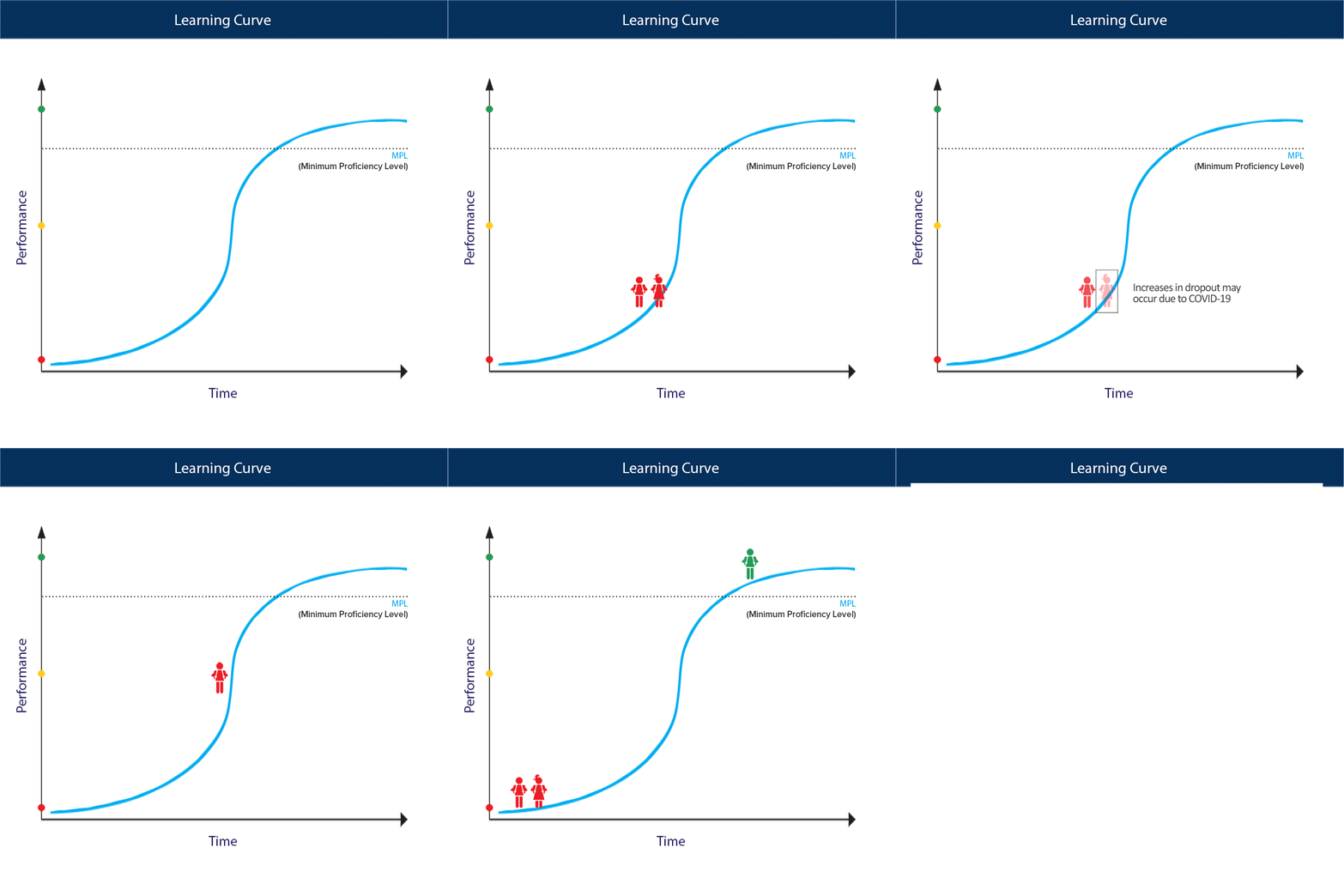
Por ejemplo, donde dos países tienen el mismo nivel de pobreza de aprendizaje, pero uno tiene una brecha de pobreza de aprendizaje más alta , este último necesitaría un mayor esfuerzo para llevar a los niños por encima del nivel mínimo de competencia. Al mismo tiempo, donde dos países tienen la misma brecha de pobreza de aprendizaje , pero uno tiene una mayor gravedad de la pobreza de aprendizaje , este último necesitaría adoptar estrategias que aborden la distribución desigual del aprendizaje entre aquellos que se encuentran por debajo del umbral mínimo de competencia. Además, a medida que anticipamos pérdidas de aprendizaje debido a la pandemia, o la proporción cada vez mayor de niños que aprenden mal, podemos examinar las desigualdades cada vez mayores con los cálculos de la brecha y la gravedad.
Detalles del cálculo
La implementación de este indicador y la producción de estimaciones globales se basan en:
- Ventana de notificación de 9 años, un intervalo de ± 4 alrededor de un año de referencia. En la primera publicación de la pobreza de aprendizaje, el año de referencia se estableció en 2015, lo que implica que se podrían incluir datos de 2011-2019. En la práctica, los datos más recientes fueron de 2017.
- Evaluaciones de aprendizaje con un umbral de competencia mínimo comparado por la Alianza Global para Monitorear el Aprendizaje (GAML), que ocurrió dentro de la ventana de informes. Si un país tiene varias evaluaciones de aprendizaje elegibles, se aplica la siguiente jerarquía: lectura PIRLS> ciencia TIMSS> evaluaciones regionales> evaluaciones nacionales. Entre dos rondas de las mismas evaluaciones, se prefiere la más cercana al año de referencia.
- La participación escolar se deriva de la tasa neta ajustada de matriculación (ANER) para las escuelas primarias y la UIS la calcula utilizando registros administrativos. La matrícula neta ajustada es una medida tanto del «stock» como del «flujo» y tiene en cuenta las distorsiones basadas en la edad y el grado, ya que es el porcentaje de niños en edad de asistir a la escuela primaria matriculados en la educación primaria o secundaria, en contraposición a la matrícula bruta que es la proporción de niños de cualquier edad que están matriculados en la escuela primaria, o la matrícula neta que es la proporción de niños en edad de asistir a la escuela primaria que están matriculados en la escuela primaria. Utilizamos el mismo año de participación escolar como evaluación de aprendizaje preferida para cada país.
- Las agregaciones para cada región comprenden la pobreza de aprendizaje promedio de los países con datos disponibles, ponderada por su población de 10 a 14 años de edad. Para obtener una estimación global, ponderamos las agregaciones regionales por la población de 10 a 14 años independientemente de la disponibilidad de datos. Esto equivale a imputar los datos del país que faltan utilizando valores regionales.
Nota: Si bien la edad de referencia para la pobreza en el aprendizaje es la edad de 10 años, las evaluaciones del aprendizaje se toman en base a grados específicos y no a la edad. Para incorporar evaluaciones administradas en diferentes grados, elegimos para cada país el grado entre 4 y 6 cuando se dispusiera de datos relevantes y confiables.
Datos
Puede descargar los datos sobre la pobreza en el aprendizaje directamente desde Development Data Hub . La base de datos contiene indicadores agrupados y desglosados por género para el porcentaje de niños en situación de pobreza de aprendizaje, el porcentaje de niños en edad escolar primaria que no asisten a la escuela y el porcentaje de niños por debajo del nivel mínimo de competencia en lectura al final de la primaria.
También puede acceder a los datos de pobreza de aprendizaje directamente a través de EdStats .
Para cargar los datos de Pobreza de aprendizaje directamente en Stata , puede usar este código:
// Instale el comando escrito por el usuario si no lo tiene captura qué wbopendataif _rc == 111 ssc install wbopendata // Consulta el indicador de pobreza de aprendizaje de la API del Banco Mundial wbopendata, indicador (SE.LPV.PRIM) último largo claro
Para cargar los datos de Pobreza de aprendizaje directamente en Python , puede usar este código:
# Cargar el packageimport wbgapi como wb # Consultar el valor no vacío más reciente (parámetro mrnev) df = wb.data.DataFrame (‘SE.LPV.PRIM’, db = 12, mrnev = 1, columnas = ‘tiempo’, numericTimeKeys = True)
Hallazgos actuales
Aprendizaje mapa de pobreza
El siguiente mapa es una instantánea de la pobreza en el aprendizaje en todo el mundo. También puede ver el indicador para mujeres y hombres. Puede editar este mapa directamente en DataBank .
¿Cómo varía la pobreza del aprendizaje según el género?
Utilizando todas las evaluaciones disponibles entre países (así como los datos de inscripción desglosados por género del UIS), hemos calculado las tasas de pobreza de aprendizaje específicas por género. Dada la disponibilidad de datos, solo hemos podido calcular esta desagregación para 92 países. El acceso a los microdatos en algunos países, particularmente en el sur de Asia, ha sido un desafío importante para calcular los resultados desglosados por género.
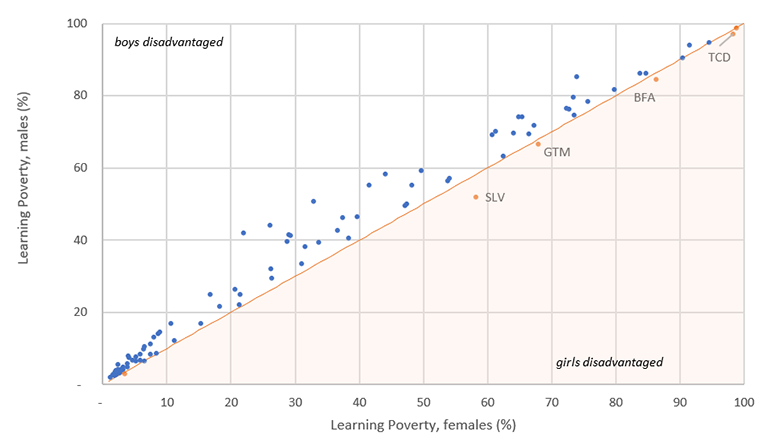
Brecha de género de la pobreza en el aprendizaje, por país
A pesar de las barreras que enfrentan las niñas en algunas áreas de la educación, en prácticamente todos los países de los que tenemos datos, las niñas tienen tasas más bajas de pobreza de aprendizaje que los niños.
Replica nuestros resultados en GitHub
Nuestros procesos están documentados en el repositorio de LearningPoverty Github, que también incluye instrucciones sobre cómo replicar nuestros números. Puede encontrar información sobre la selección de fuentes de datos, cálculos y agregaciones aquí .
Próxima actualización
La reciente publicación de los nuevos resultados de la evaluación del aprendizaje (TIMSS 2019, SEA-PLM 2019 y PASEC 2019) exige una actualización del indicador de pobreza de aprendizaje. Se planea una actualización pública de las estimaciones regionales y globales para septiembre de 2021 , para incluir los próximos resultados LLECE 2019.
Se anticipan cambios significativos en algunas estimaciones de países debido al reemplazo de las evaluaciones de aprendizaje nacionales por evaluaciones internacionales. La estimación inicial de la pobreza de aprendizaje fue del 52,7 por ciento en los países de ingresos bajos y medianos, anclada en 2015. Se utilizaron datos de 62 países, que cubrían el 80 por ciento de la población objetivo. En septiembre de 2021, planeamos publicar una actualización corporativa de estos números globales. Utilizar 2017 como año de referencia implica aceptar evaluaciones a partir de 2013, incluyendo las recientemente publicadas TIMSS, SEA-PLM, PASEC de 2019 y el próximo LLECE 2019. Con los nuevos datos, la cobertura del indicador aumentará a 66 países y 81 por ciento. de la población objetivo. La nueva actualización también permitirá comparaciones temporales en los casos en que los países tengan resultados de la misma evaluación en la última ronda.
Fuente e Imagen: https://www.worldbank.org/en/topic/education/brief/what-is-learning-poverty








 Users Today : 135
 Total Users : 35522998
 Views Today : 164
 Total views : 3736169