Panamá se suma a los países que dejan de reconocer a Guaidó
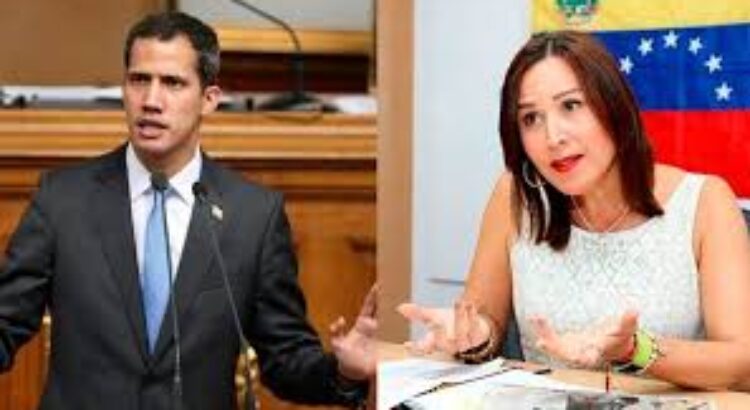
Gobierno de Panamá retiró credenciales a Fabiola Zavarce, representante de Guaidó
El gobierno de Panamá informó mediante un comunicado que desde el 8 de enero del 2021 le retiró las credenciales y le solicitaron la devolución de los mismos a Fabiola Zavarce, quien ejercía ante ellos funciones como representante del político venezolano Juan Guaidó.
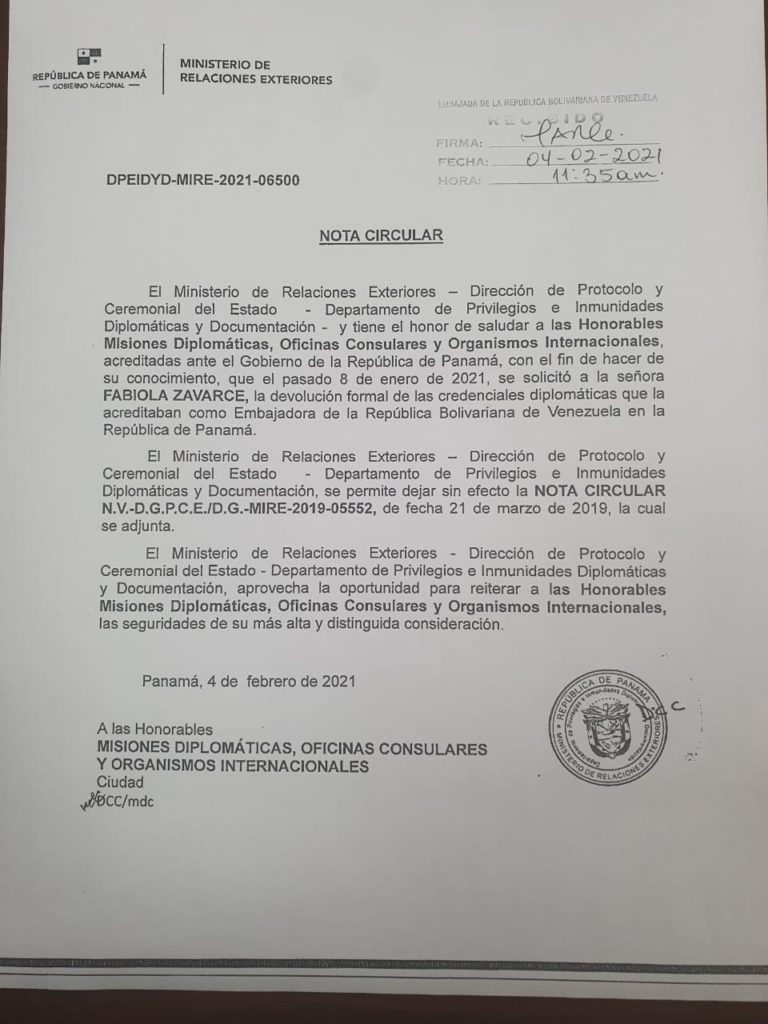
Sin embargo, hasta el momento Zavarce no entrega las credenciales, ni le informa de ésto a la comunidad venezolana en Panamá, por lo que en el texto reseña que dejan sin efecto la NOTA CIRCULAR N.V.D.G.P.C.E/D.G.-MIRE-2019-05552, de fecha 21 de marzo de 2019.
“El ministerio de Relaciones Exteriores Dirección de Protocolo y Ceremonial del Estado, Departamento de Privilegios e Inmunidades Diplomaticas y Documentación tiene el honor de saludar a las honorables Misiones diplomáticas, Oficinas Consulares y Organismos Internacionales, acreditadas ante el Gobierno de Panama, con el fin de hacer de su conocimiento que el pasado 8 de enero de 2021, se le solicitó a la señora Fabiola Zavarce, la devolución formal de las credenciales diplomáticas que la acreditaban como Embajadora de la República Bolivariana de Venezuela en la República de Panamá”, reseñaron en el comunicado.
Patricia Poleo
@PattyPoleo
Gobierno de Panamá le retiró -desde el 8 de enero del 2021- las credenciales a Fabiola Zavarce, la representante de @jguaido pero hasta ahora Zavarce ni entrega las credenciales, ni le informa de ésto a la comunidad venezolana en Panamá.
Comunicado de la Cancillería de Panamá
Fuente de la Información: https://www.nodal.am/2021/02/panama-se-suma-a-los-paises-que-dejan-de-reconocer-a-guaido/
América Latina y el Caribe tendrá crecimiento positivo en 2021, pero no alcanzará para recuperar los niveles de actividad económica pre-pandemia
En su Balance Preliminar de las Economías de la región, la CEPAL prevé una contracción promedio de -7,7% para 2020 -la mayor en 120 años- y un rebote de 3,7% en 2021.
La región de América Latina y el Caribe marcará una contracción de -7,7% en 2020, pero tendrá una tasa de crecimiento positiva de 3,7% en 2021, debido principalmente a un rebote estadístico que, sin embargo, no alcanzará para recuperar los niveles de actividad económica pre-pandemia del coronavirus (en 2019), indicó hoy la CEPAL en un nuevo informe.
Según el documento de la Comisión Económica para América Latina y el Caribe (CEPAL), en un contexto de contracción global, América Latina y el Caribe es la región más golpeada del mundo en desarrollo por la crisis derivada del COVID-19. En la década previa a la pandemia la región mostraba una trayectoria de bajo crecimiento y en 2020 enfrenta una combinación de choques negativos de oferta y demanda sin precedentes, lo que se traduce en la peor crisis económica de los últimos 120 años.
Si bien los importantes esfuerzos fiscales y monetarios realizados por los países han permitido mitigar los efectos de la crisis, las consecuencias económicas y sociales de la pandemia han sido exacerbadas por los problemas estructurales que la región arrastra históricamente. Para el año 2021 se espera una tasa de crecimiento del PIB positiva que refleja fundamentalmente un rebote estadístico, pero la recuperación del nivel de producto interno bruto (PIB) pre crisis será lenta y se alcanzaría recién hacia el año 2024.
“La dinámica del crecimiento en 2021 está sujeta a una alta incertidumbre relacionada con el riesgo de rebrotes de la pandemia, de la agilidad para producir y distribuir las vacunas y de la capacidad para mantener los estímulos fiscales y monetarios para apoyar la demanda agregada y a los sectores productivos. Avanzar en un crecimiento sostenible e inclusivo requiere de una transformación productiva hacia sectores ambientalmente sostenibles, que favorezcan la generación de empleo y la innovación tecnológica”, señaló Alicia Bárcena.
Las debilidades y brechas estructurales históricas de la región, su limitado espacio fiscal, la desigualdad, la escasa cobertura y acceso a la protección social, la elevada informalidad laboral, la heterogeneidad productiva y la baja productividad son centrales para entender el alcance de los efectos de la pandemia en las economías de la región, sus dificultades para implementar políticas que mitiguen estos efectos y los desafíos a la hora de emprender una reactivación económica sostenible e inclusiva.
Antes de la pandemia la región ya mostraba un bajo crecimiento económico: en promedio un 0,3% en el sexenio 2014-2019, y específicamente en 2019 una tasa de 0,1%. Con la llegada de la pandemia, se sumaron a ese bajo crecimiento económico los choques externos negativos y la necesidad de implementar políticas de confinamiento, distanciamiento físico y cierre de actividades productivas, lo que hizo que la emergencia sanitaria se materializara en la peor crisis económica, social y productiva que ha vivido la región. La contracción de la actividad económica ha venido acompañada de un aumento significativo de la tasa de desocupación, que se prevé en torno al 10,7% en 2020, una profunda caída de la participación laboral y un incremento considerable de la pobreza y la desigualdad.
De acuerdo con las proyecciones entregadas por el organismo de las Naciones Unidas, América del Sur se contraería -7,3% en 2020 y crecería 3,7% en 2021; América Central caería -6,5% en el presente período y se expandiría 3,8% el próximo año; mientras que El Caribe anotaría una contracción de -7,9% en 2020 y un crecimiento de 4,2% en 2021.
El documento de la CEPAL enfatiza que para evitar que la región persista en su dinámica de bajo crecimiento se requiere de políticas fiscales y monetarias expansivas junto con políticas ambientales e industriales, que permitan las transformaciones estructurales que la región necesita y promuevan un desarrollo sostenible.
Plantea la necesidad de priorizar el gasto para la reactivación y transformación económica y social mediante el fomento de la inversión intensiva en empleo y ambientalmente sostenible en sectores estratégicos; extender el ingreso básico a personas en situación de pobreza; otorgar financiamiento a micro, pequeñas y medianas empresas (MIPYMES); entregar incentivos al desarrollo productivo, revolución digital para la sostenibilidad y tecnologías limpias; y universalizar los sistemas de protección social.
Se argumenta que más allá de los esfuerzos nacionales, la reactivación y la transformación económica de la región requerirán de financiamiento y cooperación internacional. En este ámbito, enfatiza la necesidad de utilizar instrumentos como la emisión y reasignación de los Derechos Especiales de Giro (DEGs) del Fondo Monetario Internacional para fortalecer las reservas de los países de la región y los acuerdos regionales; incluir a los países de renta media vulnerables en la iniciativa de moratoria de deuda del G-20 (DSSI, por sus siglas en inglés) y además poner en práctica el canje de deuda por adaptación al cambio climático en el caso del Caribe junto con la creación de un fondo de resiliencia; y capitalizar las instituciones de crédito multilaterales, regionales y nacionales.
Fuente de la Información: https://www.cepal.org/es/comunicados/america-latina-caribe-tendra-crecimiento-positivo-2021-pero-alcanzara-recuperar-niveles
Panamá: El movimiento social marca la cancha sobre diálogo CSS
Elementos para un verdadero Diálogo sobre la CSS
Un verdadero diálogo sobre los problemas y soluciones de la CSS supone basarse en los siguientes criterios:
Deben determinarse los sectores a participar:
El Coordinador y/o Facilitador debe definirse democráticamente entre los participantes y por consenso; que todos estén de acuerdo: Sector Informal y pobladores, Trabajadores organizados, Trabajadores dela Salud y gremios médicos, Trabajadores de la CSS, Jubilados y pensionados, Grupos magisteriales, Empleados Públicos, empresarios, pequeños empresarios, Mujeres, Juventud, Campesinos, Pueblos Originarios, Universidades.
Decisiones deben ser por consenso. No por mayoría o por una fracción “x” de los participantes. Todos deben estar de acuerdo.
Mantener el carácter público y solidario de la CSS; no a la privatización.
No a las medidas paramétricas (aumento de la edad de jubilación, aumento de cuota, densidad)
No a la privatización de los fondos.
Plan para mejorar los rendimientos de inversión de los fondos de la CSS.
No al fraccionamiento y debilitamiento de la CSS por el interés del sector privado de asumir el control de la institución.
Fortalecimiento de la Autonomía de la CSS.
Combate frontal a la corrupción, evasión y retención de cuotas por parte de empresarios y contra el negociado de medicamentos, insumos y equipos.
Plan para recuperación de cuotas retenidas y robadas. Si esto no se hace el Estado debe reponer dichos fondos a la CSS.
Aplicación de sanciones ejemplares para evasores y corruptos.
Jubilaciones especiales para sectores que por el desgaste físico y afectaciones de salud producto de las condicione de trabajo, les es difícil alcanzar las cuotas necesarias para jubilarse, y ahora más por la pandemia (muerte y enfermedades), las secuelas del virus y contratos de trabajo suspendido que les despojó de cuotas fundamentales.
Aporte especial del Estado a la CSS.
Política de generación de empleo permanente y salario justo.
Promoción de sectores generadores de empleo
Entrega de los estados financieros debidamente auditados y con información real y precisa.
Revisión de los parámetros actuariales
No a un nuevo impuesto.
El futuro de la CSS y la propuesta que surja de un verdadero diálogo debe someterse a referéndum
Fuente de la Información: https://kaosenlared.net/panama-el-movimiento-social-marca-la-cancha-sobre-dialogo-css/
Tens of Thousands in Myanmar Protest Military Coup
Tens of thousands of people took to the streets across Myanmar for a second day Sunday to protest last week’s military coup and call for the release of elected leader Aung San Suu Kyi.
Demonstrations that began in different parts of Yangon converged on Sule Pagoda, the center of city. Large crowds were reported in other cities as well on Sunday, including Mandalay.
“The military coup is a violation of our democracy and human rights. It also insults the will of the people. That’s why we are against the military coup,” one of the protest leaders, Aung San Hmaine, told VOA’s Burmese service. “It’s important to honor the election result. That’s why we have come here, staging protests.”
Large crowds were reported in other cities as well on Sunday.
As protests grew a day earlier on Saturday, Myanmar authorities had cut internet service but the service appeared to have been restored by Sunday.
Many of the protesters chanted “Long live Mother Suu,” a reference to deposed Suu Kyi, and, “We don’t want military dictatorship.” Other protesters raised a three-finger salute, a sign of resistance against tyranny in the “Hunger Games” movies.
The military takeover in Myanmar began last Monday with the detention of Suu Kyi, who was the country’s de facto leader, and other senior government officials. Suu Kyi remains under house arrest at her official residence in Naypyitaw, according to party spokesman Kyi Toe.
Suu Kyi faces charges of illegally importing and using six unregistered walkie-talkie radios found in a search of her home in the capital of Naypyitaw.
The Myanmar military that seized power said its state of emergency, set to last one year, was necessary because the government had not acted on claims of voter fraud in November elections that were overwhelmingly won by Suu Kyi’s National League for Democracy party.
On Friday, nearly 300 members of Suu Kyi’s deposed ruling party proclaimed themselves to be the only lawful representatives of the country’s citizenry and called for global recognition as the stewards of the country’s government.
The military coup has been condemned by U.S. President Joe Biden and other world leaders, who called for the elected government to be restored to power.
The U.N. Security Council, which often struggles to reach consensus, issued a united statement Thursday expressing “deep concern” at the declaration of the state of emergency imposed by the military. The 15-members, which include Myanmar’s patron, China, also called for the release of Aung San Suu Kyi, President Win Myint and others who have been detained.
Myanmar, also known as Burma, has long struggled between civilian and military rule, but until the coup had been enjoying a hopeful transition to democracy.
A woman offers a face mask to a police officer during a protest against the military coup near the Sule Pagoda in Yangon, Myanmar, Feb. 7, 2021. (VOA Burmese Service)
A British colony until 1948, the country was ruled by military-backed dictators from 1962 until 2010.
An uprising in 1988 pushed for an election in 1990, which the NLD won in a landslide. But the elected members of Parliament were imprisoned, and the dictatorship continued.
Suu Kyi, the daughter of Myanmar’s assassinated independence hero, Gen. Aung San, emerged as a leader in the pro-democracy rallies and in the NLD. She was awarded the Nobel Peace Prize in 1991 while under house arrest.
In 2010, Senior Gen. Than Shwe announced the country would be handed over to civilian leaders, who included retired generals. They freed political prisoners, including the lawmakers from the NLD, and Suu Kyi, who was elected in a 2012 by-election and later became the state counsellor of Myanmar.
While popular among Myanmar’s Buddhist majority, Suu Kyi, 75, has seen her international reputation decline over her government’s treatment of the country’s mostly Muslim Rohingya minority.
In 2017, an army crackdown against the Rohingya, sparked by deadly attacks on police stations in Rakhine State, led hundreds of thousands of them to flee to neighboring Bangladesh, where they remain.
The International Criminal Court is investigating Myanmar for crimes against humanity.
Fuente de la Información: https://www.voanews.com/east-asia-pacific/tens-thousands-myanmar-protest-military-coup
A/R: Four children rescued from suspected kidnapper
Residents at Esumeja in the Bekwai Municipality of the Ashanti Region have captured a suspected kidnapper.
They rescued four children.
The victims, two girls and two boys aged between 2 and 6 years old were kidnapped last week.
One of the victims escaped from a cemetery deep inside the sacred Asantemanso Forest where the victims had been held hostage for days, according to the police.
Police together with some other residents conducted a search in the forest during which a young man was seen running away when he saw the search party. He was chased and arrested by the team.
The victims identified the suspect to the police.
The 23-year-old suspect, Michael Adomako admitted taking the victims to the forest.
A search conducted at the scene revealed some charms with feathers and some bloodstains.
The suspected kidnapper has since been remanded by a court at Bekwai.
He is expected to reappear on Tuesday, 9 February 2021 as police continue investigations.
The victims have returned to their families.
Fuente de la Información: https://www.modernghana.com/news/1060043/ar-four-children-rescued-from-suspected-kidnappe.html
“Mother is the name for God in the lips and hearts of little children”.
That is a popular quote by William Makepeace Thackeray typically used to describe mothers. Basically, it highlights the significant role of a mother who is everything to her offspring.
But what happens when a mother, father, or both parents, or guardians – who are supposed to protect, and love their children – bring harm to those under their care?
In 2016, a five-year-old Singaporean boy was subjected to all kinds of horrifying abuse, including being confined in a cage meant for the family’s pet. He was also pinched with pliers on his thighs and buttocks, hit with objects such as a broom and hanger – and was scalded with hot water. These acts were inflicted by his own parents from July 2016 until his death on 23 October of the same year.
The couple was sentenced to 27 years’ jail time by the country’s High Court in 2020.
Over the weekend, Malaysians were shocked by the news of the death of a seven-year-old boy who was allegedly abused and drowned in a water tub in his house in the state of Melaka.
“At about 4pm yesterday, Melaka Tengah District IPD Operations Room received a call from a man informing that his son had drowned at his house in Taman Krubong Jayam,” said Mohd Sukri Kaman, Chief of the Melaka Contingent Police Headquarters (IPD) Criminal Investigation Department.
«Checks at the scene found the seven-year-old male victim had bruises and injuries on several parts of his body,» he explained to local media.
The mother and stepfather of the victim, both in their 30s, have been detained for further investigation. Local media reports stated that the former had a history of psychiatric treatment back in 2019.
The tragedy comes months after the boy was surrendered to his birth mother by his foster family who had taken care of him for over six years.
“I regret it, I should have protected him but because I understood his mother’s situation as she might really miss him, I was willing to let him return to them. But I did not expect that a boy that was so loved, would be gone in a blink of an eye, just like that,” said the heartbroken adoptive mother, Norlida Abu Hassan.
The case is still under investigation and local police said that it is too early to declare if it is a case of abuse. At the time of writing, police are still waiting for the full lab report to determine the cause of death.
Child Maltreatment
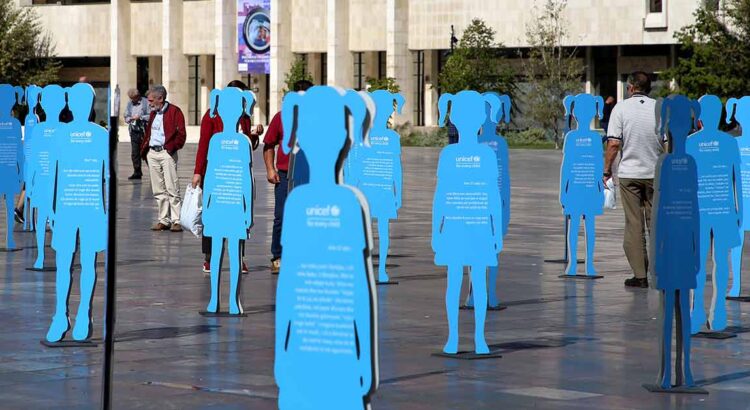
According to the World Health Organization (WHO), nearly three in four children, aged two to four years old regularly suffer from physical and/or psychological violence at the hands of their parents or caregivers.
Child maltreatment is the abuse and neglect that occurs to children under 18 years of age. It includes all types of ill-treatment – emotional, physical, sexual abuse, neglect, negligence, and commercial or other exploitation. Neglect is said to be the number one form of child abuse.
As said in the aforementioned cases, child abuse can lead to death. In cases where it does not, consequences of child maltreatment last a lifetime, including impaired lifelong physical and mental health, and the social and occupational outcomes which can slow a country’s economic and social development, stated the WHO.
Source: 2018 Child Maltreatment Report
In 2000, the WHO estimated that there were 57,000 deaths attributed to homicide among children under 15 years of age. Later, in a 2014 United Nations (UN) report on global child abuse based on data from 190 countries, it was found that in 2012, another 95,000 children and teenagers were murdered.
The health agency notes that there are more than 40,000 homicides of children under 18 every year – some of which are likely linked to maltreatment. However, it said that a significant portion of deaths due to child maltreatment are often incorrectly attributed to accidents like falls, burns, and drowning.
The Global Report on Children 2018 cited another UN report which revealed that in 58 countries, 17 percent of children face severe physical punishments. It was also found that three out of every 10 adults consider such punishment as a necessary element in raising a child.
Since COVID-19 lockdowns were imposed around the world – and people are urged to stay home due to virus fears, cases of domestic abuse rose, unabated in rich and poor countries alike. It was reported that France saw a 30 percent jump in family violence surge within the first two weeks of its shutdown last year, while Singapore reported a 22 percent surge in the first month of its circuit breaker in April.
“A child who is abused is more likely to abuse others as an adult so that violence is passed down from one generation to the next,” said the WHO.
“It is therefore critical to break this cycle of violence, and in so doing create positive multi-generational impacts.”
Fuente de la Información: https://theaseanpost.com/article/child-abuse-battered-till-death
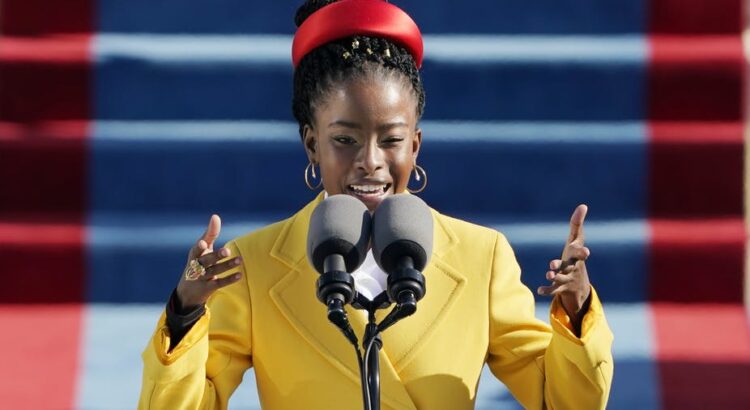
Amanda Gorman’s poetry shows why spoken word belongs in school
Editor’s note: Not long after Amanda Gorman recited one of her poems at the inauguration of President Joe Biden on Jan. 20, three of her forthcoming books skyrocketed to three of the top four spots on Amazon. She was also selected to recite an original poem for Super Bowl LV. Here, three scholars of poetry explain why the writings of the 22-year-old Gorman – who became the country’s national youth poet laureate at age 17 – and her rise to fame represent a prime opportunity for educators to use spoken word poetry as a lively way to engage students.
Wendy R. Williams, assistant professor of English at Arizona State University
During my research studying a diverse group of spoken word poets in Arizona, I learned that adolescents improved their writing skills, academic performance, confidence and social skills through writing and performing spoken word poetry. The poets used this medium to heal, advocate for change and imagine new futures.
I noticed that these brave young writers often delivered stunning lines, such as, “If I sit long enough in a dark room will I develop like film?” They used poetry to talk back to those who wronged them. And they used this medium to speak out about injustice. As one adolescent poet in the study wrote, “We live in a first-world country, yet inner-city kids still go hungry.”
Fuente de la Información: https://theconversation.com/amanda-gormans-poetry-shows-why-spoken-word-belongs-in-school-153838
OtrasVocesenEducacion.org existe gracias al esfuerzo voluntario e independiente de un pequeño grupo de docentes que decidimos soñar con un espacio abierto de intercambio y debate.
¡Ayúdanos a mantener abiertas las puertas de esta aula!







 Users Today : 69
 Total Users : 35497739
 Views Today : 83
 Total views : 3617376