Page 429 of 621
1 427 428 429 430 431 621

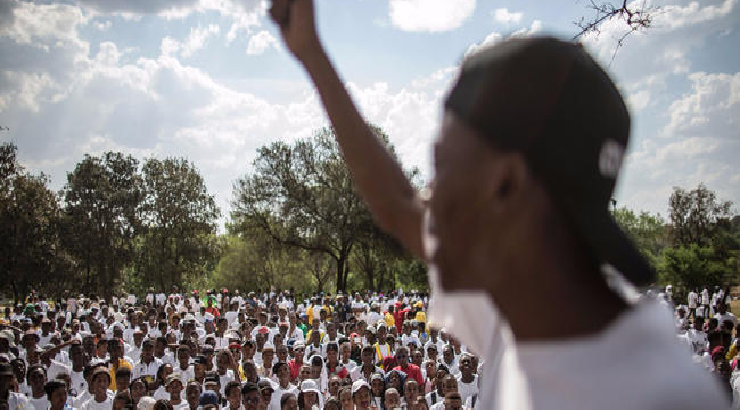
África: Classes at the University of the Witwatersrand are to resume on Monday‚ the university’s senior executive team said in a statement on Sunday.

This follows weeks of violent protests by students demanding free education which saw classes being disrupted and cancelled. The protests saw a number of students‚ including student leader Busisiwe Seabe‚ arrested. No serious injuries were reported.

“The Council of the University of the Witwatersrand agreed that the University will reopen on Monday‚ 10 October 2016‚ to ensure the continuation of the learning‚ teaching‚ research and administrative activities of the University‚ and the successful completion of each individual student’s academic year‚” it said.

It said this was for the benefit of all students – undergraduate and postgraduate‚ local and international‚ full-time and part-time and all staff – academic‚ professional‚ administrative and international.

“We are committed to completing the 2016 academic programme and to ensuring that examinations are written. Senate has approved a revised calendar for 2016‚ as well as developed contingency plans to ensure that examinations are written‚” the executive added.

It said it was clear that everyone in the university community had the same goal – to work as a community to realise the goal of free‚ quality higher education.

“We firmly believe that this can be done at the same time as finishing the academic year. No student should see a year’s worth of work come to naught‚ along with the financial sacrifices that they‚ and their families have had to make.

“We believe that this campaign has been strengthened by a collective commitment from the entire University community to seek meaningful and speedy ways to make university education accessible‚ but it is also clear that the majority of the University community and society at large desperately want to save the academic programme of the University. Our approach is to do both.

“We call on all students‚ parents‚ staff and stakeholders to join us in this approach‚ to ensure that everyone has a chance to write‚ to pass‚ to create space for the next year of university intakes while at the same time giving equal priority to the broader political issues of funding and transformation‚” the Wits executive said.

It added however that while the university would reopen‚ it was obliged to put in place certain conditions.

These include that while students will be allowed to protest‚ they will only be able to do so in specific areas and large groups of people engaged in protest action will not be allowed to gather outside the designated areas.

The university said it was also completely opposed to the intimidation of staff or students or the disruption of academic activities.

“As such‚ any person/s intimidating students to leave a classroom or building‚ or disrupting any University activity‚ may be suspended‚” it warned. Violent protests would also not be brooked. “As such‚ anyone carrying rocks‚ stones‚ weapons or any other items that can be used to destroy property or inflict harm‚ will immediately be disarmed‚ and may be suspended. Any person using items to deliberately conceal their identity‚ may be suspended.”

Rigorous control of access to the university‚ including comprehensive and sporadic checks of all vehicles‚ including buses‚ would be implemented‚ it said‚ adding that all staff and students would be required to carry their access cards with them‚ as was the norm.

“All persons arrested by the police may immediately be suspended.

“All suspensions will immediately be processed for finalisation through disciplinary hearings‚” the executive added.

Fuente:

http://www.timeslive.co.za/local/2016/10/09/Wits-classes-to-resume-on-Monday

Fuente Imagen:

https://lh3.googleusercontent.com/yYreEa_K9u1btI-1rn1InYBrj6vS5A1t91jJE_UdGjNeFXT7WiWN0FCQqXPnMOAouz5yqQ=s85
 

Comparte este contenido:

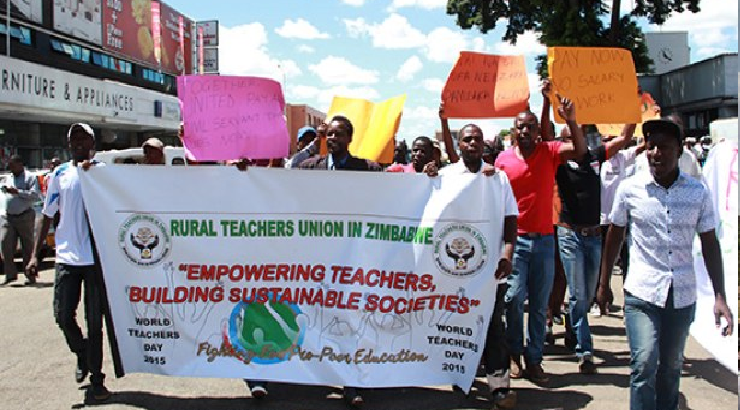
Zimbabwean Teachers in South Africa to Be Licensed

Zimbabue/10 de Octubre de 2016/Allafrica

Resumen: Los gobiernos de Zimbabwe y Sudáfrica están trabajando en medidas para hacer frente a los maestros en paro,  y al mismo tiempo hacer frente a la brecha de las necesidades de la «nación del arco iris».  Se espera que el proceso de ver a los maestros de Zimbabwe en Sudáfrica siendo registrados y autorizados.

The Zimbabwean and South African governments are working on measures to deal with unemployed but qualified teachers in Zimbabwe while at the same time addressing the needs gap in the «Rainbow Nation».

The process is expected to see Zimbabwean teachers in South African being registered and licensed.

The move comes against the backdrop of an unquantifiable number of qualified Zimbabwean teachers working in South Africa. Some of the teachers are not in the education sector and those in the education sector are employed mostly in private schools, where authorities cannot easily monitor their conditions of service.

Addressing a Press conference, flanked by South Africa’s Basic Education Minister Angelina Motshekga, after a two-day conference on identifying possible areas of cooperation, Primary and Secondary Education Minister Dr Lazaraus Dokora said issues of human resources, research, curriculum implementation and assessment are earmarked for collaboration.

 «The way we have discussed this issue is to say that, when our teachers proceed to work in South Africa, we want to know where they are, how they are being deployed and we also safeguard their interests,» said Minister Dokora.

Dr Dokora said the collaboration was meant to find a common ground with South Africa for the benefit of not only the two countries but also the teachers themselves. Minister Dokora said both countries also need to cooperate on curriculum implementation and assessment to modernise the two in line with the demands of the 20th century.

He also said that other areas included educational conferences to keep learning from each other and arts festivals.

Minister Motshekga said South Africa had always held Zimbabwe’s education system in high esteem and therefore had a lot to learn for her northern neighbour.

She said one area her government was keen to learn from Zimbabwe was the area of public examinations from which, she said the country was way ahead compared to South Africa.

«Historically, South Africa looks forward to the education system of Zimbabwe and thus we never hesitated to take up your invitation to this meeting to see how best we can collaborate,» she said.

Minister Motshekga said a series of meetings will follow the engagement with her Zimbabwean counterpart to start operationalising other areas that do not necessarily require a Memorandum of Understanding.

Both ministers, however, said they were looking forward to have an MOU in place before the end of the year.

Fuente: http://allafrica.com/stories/201609261299.html

Comparte este contenido:

South African universities say academic year is in peril

Suth African/03 de Octubre de 2016/Los Ángeles Time

Resumen: Suth African  se encuentra bajo guardias de seguridad una de las principales universidades de ese continente. La policía disparan balas de goma a los estudiantes. Vicerrectores advierten que los estudiantes podrían no ser capaces de terminar el año académico si la controversia nacional sobre la financiación de la educación superior no se resuelve pronto.

Suth African protesters lob rocks at security guards at one of the continent’s leading universities. Police fire rubber bullets at students on another campus. Vice chancellors warn that students might not be able to finish the academic year if a national dispute over financing higher education is not resolved soon.

Twenty-two years after the end of white minority rule, grievances over economic inequities are fueling unrest that has forced the closure of some of South Africa’s most prominent universities, which are struggling to cover costs. Opinion has splintered among students, faculty, parents and the government, which acknowledges funding shortfalls but accuses a radical minority of bringing campuses to a standstill.

One target of protesters’ condemnation is Adam Habib, vice chancellor of the University of the Witwatersrand in Johannesburg, also known as Wits. Habib, in turn, has suggested it is ironic that Wits, whose student population is mostly black, could unravel because of protesters who say they are committed to “decolonization.”

He tweeted: “The tragedy of our moment.”

The protests are smaller than widely popular demonstrations in 2015 that forced the government to suspend university fee increases this year. Demonstrations picked up again after the government said universities can increase fees by up to 8% next year, although it will pay about $180 million to cover the costs of poor students in 2017.

Wits and the University of Cape Town hope to resume the academic program on Monday. Some students vehemently oppose that plan.

Once a student demand for free education is met, “we are willing to go back to class. I mean, we are here because we want to study and get degrees,” said Mzwanele Ntshwanti, a student leader at Wits who wore a jacket with an emblem of the Student Representative Council.

“We’ve managed to disrupt the system because that’s the only language that they understand,” he said Friday.

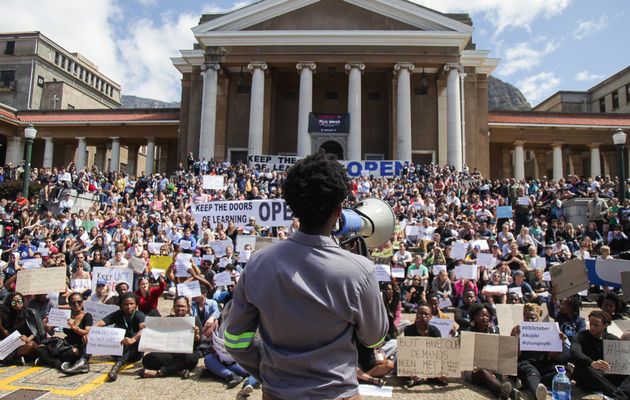
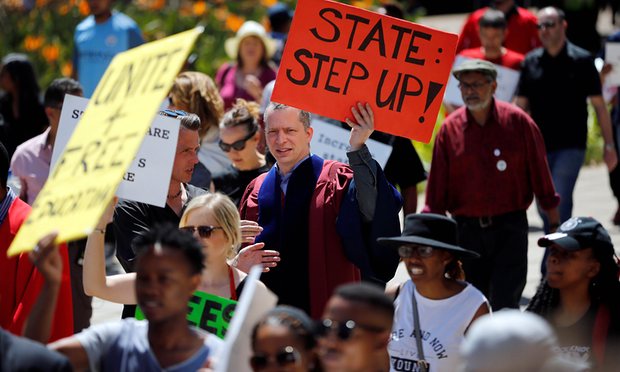
Ntshwanti was standing outside the Great Hall, a temple-like building whose tall columns evoke Western academic traditions that irk some South African students who demand a curriculum more focused on African affairs. As he spoke, about 100 members of the Wits teaching staff, many in red and black academic robes, rallied on the Great Hall steps to demand more state funding and an end to violence.

“No cops on campus!” read a placard. About 10 police vehicles were stationed on a nearby campus road and in a parking lot beside the Origins Center, a university museum that explores human evolution.

On Sept. 20, protesters at Wits threw stones at private security guards, smashing glass at the Great Hall entrance. Some guards picked up projectiles and threw them back, contributing to an image of a prestigious center of learning as a chaotic battleground. In a separate incident, the government blamed student activists for the death of a university worker who was hospitalized after being affected by a fire extinguisher sprayed by protesters.

Wits is charging between $2,200 and $4,200 for tuition for a first-year undergraduate in 2016. In addition, there are book, travel and lodging costs. The government says it will pay tuition for students from households with up to $43,700 in annual income, a measure expected to benefit about 80% of undergraduates.

On Wednesday, police fired rubber bullets and arrested 11 students during a protest for free education at Rhodes University in the city of Grahamstown. That prompted the vice chancellor, Sizwe Mabizela, to say students should not become “collateral damage” in the dispute over costs.

Vice Chancellor Max Price of the University of Cape Town on Friday met 200 protesters who oppose the university’s reopening on Monday. Separately, about 2,000 students and staff members, some holding books, held a silent rally urging the resumption of classes, Price said on the university’s website.

“There’s a lot of uncertainty. There are a lot of different political positions and views on campus,” said Mehita Iqani, an associate professor of media studies at Wits.

There are also expectations of more violence. Wits Vuvuzela, a university newspaper, advises students on how to respond to stun grenades, rubber bullets and tear gas in a section titled: “What to expect from the police and how to stay safe.”

Around the corner from the Great Hall at Wits is a piece of graffiti with instructions. It starts: “How to make a petrol bomb: a guide for students.”

Fuente: http://www.latimes.com/world/la-fg-south-africa-universities-20161001-snap-story.html

Comparte este contenido:

Maestro refugiado y voluntario da un paso para llenar los vacíos en la educación del campamento

Por: ACNUR

Alnur Burtel puede ser un hombre mayor ahora, pero aún recuerda cómo lo inspiraron sus profesores de la universidad a vivir una buena vida y estudiar mucho para tener un futuro mejor.

Ahora, en el campamento de refugiados en Etiopía, en el que vive desde 2011, el hombre de 71 años busca ser una guía similar para los jóvenes sudaneses que también están allí. Es un lugar donde la inspiración y la motivación pueden ser un bien escaso.

“La educación es un instrumento para la vida y el desarrollo”, dice Burtel, desde su Centro de Lenguaje en el campamento en Sherkole, Etiopía. Él construyó el pequeño centro educativo de una habitación, y enseña inglés y cívica a refugiados adolescentes y adultos jóvenes que no han tenido educación o capacitación vocal apropiadas.

“La educación es un instrumento para la vida y el desarrollo”.

“Los refugiados jóvenes están desperdiciando sus vidas, sin hacer nada”, añadió. “Es momento de terminar con este problema. Estas personas jóvenes con el futuro de nuestros países”.

En Sudán, Burtel enseñaba inglés en una secundaria local y en la Universidad de Omdurman. “Pensé, alimentemos sus mentes. Si tengo éxito cambiando la vida de solo una persona, eso ya hará una diferencia”.

ACNUR, la Agencia de la ONU para los Refugiados, ayuda con la administración del campamento Sherkole, donde vive Burtel junto con más de 11.200 personas, en su mayoría refugiados de Sudán, hace su mejor esfuerzo para brindar tanta educación como le es posible, pero los recursos escasean. El llamamiento del ACNUR para Etiopía solo ha recibido 35% de los fondos, con un faltante de $181 millones de dólares, significando que la educación queda atrás de prioridades como brindarle a los refugiados albergue, alimento, y atención médica.

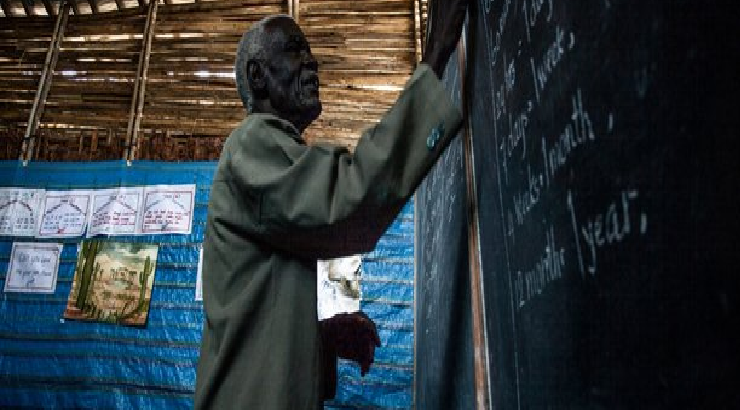
Alnur Burtel frente a la clase donde enseña a jóvenes refugiados. © ACNUR/Diana Diaz

Es aquí donde voluntarios comprometidos como Burtel son cruciales para llenar estos vacíos. Él y otros dos refugiados voluntarios enseñan inglés y cívica, transparencia, ley y lo que a Burdel le gusta llamar “coexistencia pacífica” a 130 estudiantes. El ACNUR y la agencia del Gobierno de Etiopía para los refugiados, les han dado dos pizarras y tizas.

Burtel es de Kauda, una ciudad en las montañas Nuba en la región Kordofan en Sudán, donde el conflicto se volvió a desencadenar entre los rebeldes y fuerzas gubernamentales en 2011. El día que él y su esposa huyeron, en junio de 2011, fue “el día que las personas de Nuban fueron asesinadas en masa”, recuerda, con lágrimas en sus ojos. Sus dos tíos fueron asesinados y su hogar fue destruido.

 “Dejé todo atrás, excepto mi conocimiento”, dice Burtel. “Tengo el sueño de desarrollar servicios educativos para jóvenes. Los aliento a que aprendan los unos de los otros. Eso les ayuda a aumentar su autoestima. Tengo muchos estudiantes brillantes que solo necesitan un poco de confianza”.

“Tengo muchos estudiantes brillantes que solo necesitan un poco de confianza”.

El Centro de Aprendizaje tan solo ha estado abierto desde enero de 2016, pero los estudiantes de Burtel ya reconocen el impacto de sus lecciones y se sienten comprometidos para aprender más.

“Antes no entendía completamente la importancia del estudio”, dice Emoel Yakub, refugiado sudanés de 27 años. “Con Alnur no solo estoy aprendiendo a hablar inglés, ahora entiendo por qué tenemos que respetarnos. Estamos mejorando y somos más responsables para poder tener oportunidades de un mejor futuro”.

Yakub y otros graduados del Centro de Estudio Light ahora usan lo que Burtel les enseñó, y ellos mismos están enseñando inglés a niños refugiados en el campamento.

Sirak Sileshi, asociado de protección en Sherkole, elogia a Burtel por añadir estas valiosas lecciones al curriculum básico de idioma.

Alnur Burtel enseña en una clase de bambú, la que él llamó «Centre de idioma Luz, donde los jóvenes refugiados tienen acceso a aprendizaje de idiomas y educación cívia. © ACNUR/Diana Diaz

“Alnur inspira a los refugiados a perseguir sus sueños a través de la educación, mientras que les devuelve el sentido de normalidad a sus vidas”, dice Sileshi. “Debido a las limitantes de presupuesto, el ACNUR y nuestros socios no siempre pueden ofrecer educación secundaria o de idioma para los refugiados. Nosotros dependemos de voluntarios como Alnur para que los jóvenes puedan desarrollar al máximo su potencial, para recuperar sus esperanzas en la vida y preparase para soluciones duraderas en la búsqueda de vidas productivas”.

Los cinco hijos adultos de Burtel, de edades entre los 21 y los 35 años, estudiaron en Kenia gracias a programas de becas. Ellos están preparados para desarrollarse en carreras como enseñanza, enfermería y trabajo para el desarrollo.

Los jóvenes refugiados representan cerca de un 15% de la población en Sherkole y a menudo están en riesgo de violencia y de involucrarse en mecanismos de sobrevivencia peligrosos. Alnur espera poder alentar a una generación completa de jóvenes en el campamento a desarrollar las habilidades para encontrar trabajos cuando vuelvan a sus hogares.

“Espero que los jóvenes puedan transmitir los mensajes de tolerancia para que la paz acoja nuestros turbulentos países”, dice. “La educación no es solo una solución, pero es el inicio de la juventud para contribuir con sus comunidades”.

Fuente: http://www.acnur.org/noticias/noticia/maestro-refugiado-y-voluntario-da-un-paso-para-llenar-los-vacios-en-la-educacion-del-campamento/

Comparte este contenido:

Uganda: Don’t Criminalise Students’ Innovations

Uganda/10 de Octubre de 2016/Allafrica

Resumen: El Makerere EV Kiira, el bus Kayoola con energía solar y el tractor polivalente del MV Mulimi, son algunas de las novedades que la Universidad de Makerere ha creado. Estos proyectos han contado con el apoyo y la aprobación o del gobierno. Por eso que es bastante sorprendente que la policía ha calificado como un criminal a Samuel Mugarura, un estudiante universitario, afirmando que puede hacer bombas gases lacrimógenos y humo.

The Makerere EV Kiira, the solar-powered bus Kayoola, and the multi-purpose tractor the MV Mulimi, are some of the innovations that Makerere University has come up with. These projects have received the government’s support and or approval.

For example, under the Presidential Initiative for Science and Technology, students and teachers at Makerere University launched the EV Kiira in 2011 and later, the government, through Uganda Development Corporation Limited, took on 96 per cent share holding of the Kiira EV car investment.

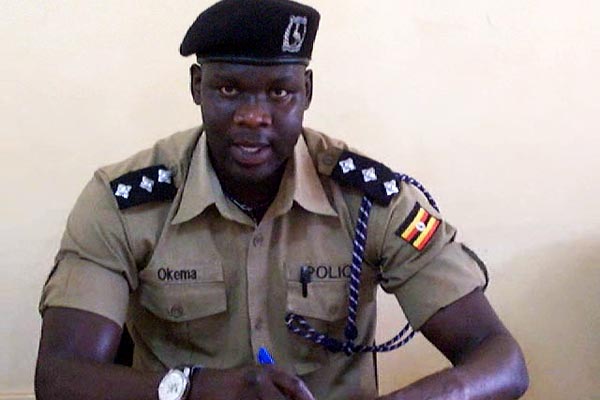
The plan is that hopefully, these projects will take off and we will manufacture vehicles that we can use in the country. That is why it is rather shocking that the police have branded Samuel Mugarura, a university student who claims he can make tear-gas and smoke bombs, a criminal.

Mugarura came to the limelight a few weeks ago when he demonstrated his ability and desire to make tear-gas that is not detrimental to people’s health.

The third year student of Chemistry and Botany at Makerere University was happy to reveal to the press his innovations and even called upon the government to support him. But for unclear reasons, the police believe he is a threat.

Of course, innovations in such elements will always be taken with caution. Unlike things such as cars or maka-pads which should be sold to the public, tear-gas and ammunition of any sort should ideally stay with the government.

Therefore, the government has a right and even an obligation to be interested in Mugarura’s innovations.

However, hounding him and labelling him a criminal does not help. Instead of suffocating this, the police should scrutinise it.

The President has continuously talked about putting more effort on science subjects. The idea is to get people to create and innovate more as well as be technologically up-to-date in this fast advancing world.

Therefore, when anyone comes up with what they believe are helpful innovations and are happy to share them with the government, they should be given due attention and their work checked to see if it can amount to something useful.

Suffocating these works will instead discourage others interested in coming up with various innovations.

The government can start by getting Mugarura to pitch his project to the Presidential Initiative for Science and Technology. This initiative was started purposely to enhance the development of science and research in the country and seeks to advance scientific research through better funding and organisation. That would be a better place to start.

Fuente: http://allafrica.com/stories/201610040020.html

Comparte este contenido:

África: Free tertiary education needs funding from public sources

África/Sudáfrica/Octubre de 2016/Autor: Ernest Mabuza/Fuente: Times Live

RESUMEN: La educación terciaria libre no sería realmente libre porque una importante financiación tendría que provenir de fuentes públicas. Sin embargo, Sudáfrica se enfrentó a una serie de retos para hacer realidad este sueño, en comparación con los países que no cobran ninguna tasa de matrícula, según ha encontrado un informe de KPMG sobre los desafíos económicos para acceder a la educación terciaria y proporcionar educación gratuita en Sudáfrica. El estudio, titulado «La economía de la #FeesMustFall» miró a Brasil, Dinamarca, Estonia, Finlandia, Francia, Alemania, Malta, México, Noruega, Eslovaquia, Eslovenia, Suecia y Turquía. El PIB de Sudáfrica nivel per cápita en términos de dólares americanos ($ 5.844) – es un indicador de la riqueza relativa de los ciudadanos de un país – es sólo una quinta parte del promedio del grupo ($ 30.805) y el más bajo entre los países que proporcionan  educación terciaria gratis.

Free tertiary education would not really be free because significant funding would need to come from public sources.

However‚ South Africa faced a number of challenges to realise this dream when compared to countries which do not charge any tuition fees‚ or only charged administration fees‚ a report by KPMG on the economic challenges to accessing tertiary education and providing tuition-free education in South Africa has found.

The study‚ titled “The economics of #FeesMustFall” looked at Brazil‚ Denmark‚ Estonia‚ Finland‚ France‚ Germany‚ Malta‚ Mexico‚ Norway‚ Slovakia‚ Slovenia‚ Sweden and Turkey.

“South Africa’s GDP per capita level in US dollar terms ($5‚844) – an indicator of the relative wealth of a country’s citizens – is only a fifth of the group’s average ($30‚805) and the lowest amongst the countries which provide free tertiary education.”

Countries which do not charge tuition such as Denmark (GDP per capita $52‚214) Finland ($42‚807) and Norway ($72‚441) had a higher GDP per capita than South Africa.

“At the same time‚ South Africa’s top personal income tax rate (41%) is already on par with the group average (41.2%)‚ suggesting that higher personal tax rates to fund free tertiary education might not be feasible.

“At the same time‚ South Africa is struggling with higher levels of inequality‚ poverty and unemployment than the other countries in the group.”

The comparison found that countries such as Denmark (6.6%)‚ Brazil (6.8%)‚ Mexico (5.1%)‚ Sweden (8%) had a lower unemployment rate compared to South Africa at 25.1%.

The study also found that government expenditure on education as a percentage of total government expenditure (19.1%) was high in South Africa compared to the other countries (13.8%).

It found that a relatively high share (12.2%) of government money spent on education was channelled to tertiary education‚ though this serviced a relatively low number of students given that South Africa’s tertiary enrolment rate (19.2%) was significantly below the group average (63.6%).

“This raises questions over the quality of the tertiary education system and the efficiency of expenditure.”

All is not lost‚ however.

KPMG said in the 2015/2016 fiscal year‚ South Africa trained around 15‚000 artisans but also attracted thousands of similarly qualified workers from abroad as a result of the continued lack of artisan skills.

KMPG said this emphasised the opportunity of using artisan and vocational training initiatives as an alternative form of higher education.

KPMG said a complimentary aspect to formal tertiary education was to invest in on-the-job training initiatives.

South Africa ranked 19th globally regarding the quality‚ availability and uptake of on-the-job training programmes.

“To place this into context‚ South Africa ranks higher than tuition-free countries such as Brazil‚ Malta‚ Mexico‚ Slovenia‚ Slovakia and Turkey in its on-the-job training ranking.

“South Africa’s strong ranking points to the private sector being directly involved in augmenting the training provided by the tertiary sector.”

The study said for tertiary institutions‚ a key question was how to increase funding outside the sphere of state financing and tuition fees.

It said options included encouraging private sector to share funding costs; using technology to improve access and getting communities involved to reduce indirect costs like transport and accommodation.

Fuente: http://www.timeslive.co.za/local/2016/10/08/Free-tertiary-education-needs-funding-from-public-sources-KPMG

Comparte este contenido:

Sudáfrica: Student leaders vow to continue tuition fee protests

África/Sudáfrica/Octubre de 2016/Autor: Jason Burke/Fuente: The Guardian

RESUMEN: Los líderes estudiantiles en Sudáfrica se han comprometido a continuar con las protestas en contra de los derechos de matrícula ya que el país se prepara para más violencia en los campus. Las universidades suspendieron las clases esta semana después de que las manifestaciones se tornaron violentas, con granadas de aturdimiento, policías que disparaban balas de goma y gases lacrimógenos a los estudiantes que arrojaban piedras. Las protestas se produjeron después el gobierno de Jacob Zuma quien dijo que no podía permitirse el lujo de  educación gratuita para todos, sin embargo seguiría prestando asistencia en los costos universitarios para los estudiantes más pobres. La Universidad de Witwatersrand (Wits) en Johannesburgo tenía la esperanza de volver a abrir el lunes después de que  la policía se enfrentó a principios de esta semana con los manifestantes estudiantiles en el campus.

Student leaders in South Africa have pledged to continue protests against tuition fees as the country braces for further campus violence.

Universities suspended classes this week after demonstrations turned violent, with police firing stun grenades, rubber bullets and teargas at stone-throwing students.

The protests came after Jacob Zuma’s government said it could not afford free education for all, though it would continue providing assistance for university costs for the poorest students.

The University of the Witwatersrand (Wits) in Johannesburg had hoped to reopen on Monday after police clashed earlier this week with student demonstrators on the campus. Classes are now unlikely to resume.

An extraordinary general assembly at the 120-year old-university, called in the hope of reaching agreement, was cancelled on Friday because “no consensus” existed, as well as for security reasons.
Analysis South Africa’s student protests have lessons for all universities
The uprising has specific roots in apartheid and colonialism. But issues of race, identity, fees and unemployment are provoking unrest across the world
Read more

Leaders of the student protesters said on Friday they had hoped to convince the university authorities to back their campaign to force the government to increase subsidies to further education, and had no choice but to continue the campaign. “We wanted to get the university to join us. But if we stop now it means we go back to classes having won nothing,” said Thalo Mokoena, of the Student Representative Council.

Protests have hit more than half of South Africa’s universities in recent weeks. Though most have been peaceful, there have been frequent clashes with security guards and police. Several buildings were set alight at the University of Cape Town while at the University of KwaZulu-Natal last month a library was burned.

Last year a campaign to force the government to bring down the cost of university education led to a freeze in the level of fees. This year the ministry of education has said individual universities could impose a rise of up to 8%, slightly more than the rate of annual inflation in South Africa.

Universities say they cannot make further concessions as last year’s fee freeze has put their finances under great strain. Undergraduate tuition fees at Wits, which is one of South Africa’s most expensive universities, are as high as 60,000 rand (£3,500) a year depending on the course. Accommodation, textbooks and transport are also expensive.

Such costs make further education beyond the means of many black students, who are around four times less likely to go to university than their white counterparts. Even fewer graduate.

“It’s normal for maybe a third to drop out, just because they can’t afford it. We paid our fees. But what about those who can’t?” said Tshikhudo Milalo, 21, an engineering student from Limpopo province.

Universities have become the focus of anger about broader inequalities that endure in South Africa more than two decades after the end of apartheid. South Africa remains one of the most unequal societies in the world, with new research showing 10% of the population owning at least 90–95% of all assets.

“The aftermath of apartheid has not been sufficiently dealt with. You are allowed to go around but economic marginalisation hasn’t changed much and opportunity certainly isn’t equal. It’s no way as bad as it was but there are parallels with back then,” said Mokoena, 22.
Advertisement

Commentators described the protests as “the moment of rupture, the noisy (if inevitable) breach of the South African democratic project,” comparing them to the 1968 student movements in France, or the Vietnam protests in the US.

At a meeting at Wits on Friday, student leaders pledged to continue what they called a “generational struggle” for justice. The movement, which observers say is less organised than last year’s, has highlighted a fundamental difference between young “born frees” who cannot remember life under the repressive racist apartheid system, which collapsed in the early 1990s, and their parents. “Our parents don’t understand … but they have been brainwashed,” said Rose, a 19-year-old student who did not want to give her full name for fear of repercussions from university authorities.

The row has also exposed a growing gap between young activists of the ruling African National Congress, and the elected officials of the party, famous for its role in the struggle to overthrow apartheid.

Gwede Mantashe, ANC secretary general, recently said he would shut the universities to teach protesters a lesson. “I’m not the minister of education [but] if I was, my first reaction would be to close [the universities]. For 16 months. And open them after six months, and close the residences for six months. After a year, people will know higher education will be important for their future,” he told reporters last month.

Other government officials have said education subsidies should not come at the expense of other sectors such as health and housing.

Many students do not support the protests, and very few support violence. A controversial SMS poll of students at Wits last week found that 77% of students who responded wanted the university to reopen.

Fuente: https://www.theguardian.com/world/2016/oct/07/south-africa-tuition-fee-protests-student-leaders-universities


Comparte este contenido:
Page 429 of 621
1 427 428 429 430 431 621