Una nueva herramienta revela el efecto de los sesgos individuales y de la información social en la “sabiduría de los grupos”
La inteligencia colectiva funciona y afecta a nuestra vida y comportamientos a muchos niveles, pero está condicionada por factores como el sesgo individual y la información social, según una nueva herramienta matemática creada por investigadores norteamericanos. El hallazgo puede ayudar a entender mejor los patrones que subyacen a la “sabiduría de las multitudes”.
En el año 1907, el estadista Sir Francis Galton, de 85 años, acudió a una Feria de Ganado en Plymouth, al sudeste de Inglaterra. En ella se celebraba un concurso que consistía en adivinar cuánto pesaba un buey. Unas 800 personas habían participado, y a Galton se le ocurrió ir apuntando las apuestas de todas ellas. Cuando calculó la media, el resultado fue sorprendentemente cercano a la realidad: era de 1.197 libras. El peso real del buey, de 1.198 libras.
Por tanto, aunque las conjeturas individuales variaban enormemente, la media total resultó ser sorprendentemente precisa. Cuando Galton publicó sus resultados, introdujo en la sociedad la teoría de la inteligencia colectiva, también conocida como «sabiduría de los grupos».
Desde entonces, se ha seguido profundizando en este concepto. Por ejemplo, en 2004 lo trató el periodista norteamericano James Surowiecki en un libro (Cien mejor que uno), en el que se presentaban numerosos casos estudiados en distintos campos del saber, principalmente economía y psicología, que demostraban que las decisiones colectivas son a menudo mejores que las que podrían haber sido tomadas por un solo individuo.
El efecto de la información social
¿Qué condiciona esta inteligencia colectiva? Para tratar de averiguar este punto, recientemente, un investigador de la Universidad de Harvard llamado, Albert Kao y su colaborador del Santa Fe Institute(EEUU), Andrew Berdhal, han examinado los efectos en el resultado final de las estimaciones comunes de factores como el sesgo individual o el intercambio de información con otros. Lo han hecho con una novedosa herramienta matemática.
En la investigación participaron más de 800 voluntarios a los que se les pidió que adivinaran el número de chicles que había en un frasco. Esta cantidad variaba en diversos órdenes de magnitud de 54 a más de 27.000, informa el Santa Fe Institute en un comunicado. Además, a los participantes se les ofrecieron detalles falsos sobre las suposiciones de otras personas, y se les permitió cambiar su estimación a la luz de esa información.
Kao y Berdhal descubrieron así varias cosas interesantes. En primer lugar, que aunque las estimaciones variaban considerablemente, eran muy predecibles: la gente tendía a señalar números más pequeños que el valor real y a asignar una cantidad mayor a tarros más grandes.
En segundo lugar, se constató que la información social juega un papel en la sabiduría colectiva. Sobre todo, influían en las estimaciones de los participantes aquellas que eran más altas que las propias. Conjeturas inferiores en cantidad a las de cada individuo eran desechadas con mayor frecuencia.
Según los investigadores, sus hallazgos ayudan a entender mejor ciertos patrones que subyacen a la sabiduría de las multitudes.
Las mujeres como garantía
Otro aspecto de la inteligencia colectiva que ha sido analizado estos últimos años es el de su funcionamiento en el trabajo en equipo.En 2010, un estudio del Instituto Tecnológico de Massachussets (MIT) de Estados Unidos, demostró que el rendimiento de la inteligencia colectiva en un grupo de trabajo depende de la “sensibilidad social” de los miembros del equipo, entendida como tal la capacidad de ser flexibles en la asignación de ocupaciones y de hacer partícipes a todos los miembros en la resolución de desafíos.
En la investigación se reveló, por otra parte, que la presencia de mujeres en los grupos resulta fundamental para que se dé un rendimiento colectivo óptimo: la tendencia a cooperar eficientemente está relacionada con el número de mujeres presentes en cada equipo de trabajo, porque estas normalmente muestran una mayor sensibilidad social.
En este este estudio, la inteligencia colectiva fue calculada con medidas normalmente aplicadas a la inteligencia individual mensurable. Asimismo, los científicos equiparon a los participantes con dispositivos electrónicos portátiles que registraron los patrones de conversación de los grupos.
El análisis de todos los datos reveló que el grado de inteligencia colectiva de los equipos de trabajo supuso entre un 30 y un 40% de diferencia en la capacidad de rendimiento de éstos.
Jugadores de fútbol versus moléculas
Otro aspecto sorprendente que se ha analizado de la inteligencia colectiva es su espontaneidad en el caso de los movimientos coordinados de grupos humanos para un fin común, como ganar un partido de fútbol. Esta cuestión la han estudiado hace poco en la Universidad de Connecticut (UCONN, EEUU).
Más concretamente, los científicos analizaron en términos de la física la coordinación espontánea e inteligente de movimientos de los jugadores de fútbol de un equipo. Desde esta perspectiva, esta inteligencia colectiva responde a la necesidad de promover una reducción del gasto de energía del sistema (en este caso, el equipo), esto es, para aprovechar al máximo el rendimiento.
Curiosamente, esta propensión a la reducción de energía se da en sistemas no vivos (¿serán inteligentes?) Por ejemplo, cuando pequeñas moléculas de una sustancia llamada benzoquinona flotan en la superficie de un charco de agua tienden a agruparse, incluso si inicialmente se han esparcido de manera aleatoria por su superficie. Las moléculas funcionan de este modo por la misma razón que los futbolistas en el campo: para reducir el gasto energético.
Tipos y estudio
Este último estudio estaría enmarcado en la inteligencia colectiva de coordinación del comportamiento. En el libro de James Surowiecki antes mencionado, se señalaba que este tipo de sabiduría común puede afectar –más allá del fútbol- a otros aspectos de nuestra vida, como el tráfico o el flujo de asistencia a restaurantes populares.
La investigación sobre el trabajo en equipo, entraría en el tipo de inteligencia colectiva “de cooperación”, también definida por Surowiecki, que consiste en la formación de redes sociales para fines específicos.
Pero en realidad los campos y niveles desde los que se puede analizar y tipificar la inteligencia colectiva son muchos. Desde la sociología hasta las ciencias de la computación, y desde las sociedades humanas hasta las bacterias, las plantas o los insectos (no debemos olvidar que los trabajos del entomólogo William Morton Wheeler, nacido en 1865, estarían entre las bases del concepto, pues en ellos se constató cómo los individuos independientes pueden llegar a funcionar casi como un solo organismo).
En resumidas cuentas, parece que la inteligencia humana individual sí marca una diferencia con respecto a los individuos de otras especies, pero que nuestra inteligencia colectiva responde a patrones compartidos con otros organismos, e incluso con sistemas no vivos, como las moléculas. De nuevo la ciencia nos da una lección de humildad.
As a sociologist and legal scholar, I struggle to explain the boundaries of free speech to undergraduates. Despite the 1st Amendment—I tell my students—local, state, and federal laws limit all kinds of speech. We regulate advertising, obscenity, slander, libel, and inciting lawless action to name just a few. My students nod along until we get to racist and sexist speech. Some can’t grasp why, if we restrict so many forms of speech, we don’t also restrict hate speech. Why, for example, did the Supreme Court on Monday rule that the trademark office cannot reject “disparaging” applications—like a request from an Oregon band to trademark “the Slants” as in Asian “slant eyes.”
The typical answer is that judges must balance benefits and harms. If judges are asked to compare the harm of restricting speech – a cherished core constitutional value – to the harm of hurt feelings, judges will rightly choose to protect free expression. But perhaps it’s nonsense to characterize the nature of the harm as nothing more than an emotional scratch; that’s a reflection of the deep inequalities in our society, and one that demonstrates a profound misunderstanding of how hate speech affects its targets.
Legally, we tell members of traditionally disadvantaged groups that they must live with hate speech except under very limited circumstances. The KKK can parade down Main Street. People can’t falsely yell fire in a theater but can yell the N-word at a person of color. College women are told that a crowd of frat boys chanting “no means yes and yes means anal” is something they must tolerate in the name of (someone else’s) freedom.
Consider also the protections afforded to soldiers’ families in the case of Westboro Baptist anti-gay demonstrations. When the Supreme Court in 2011 upheld that church’s right to stage offensive protetsts at veterans’ funerals, Congress passed the Honoring America’s Veterans’ Act, which prohibits any protests 300 to 500 feet around such funerals. (The statute made no mention of protecting LGBTQ funeral attendees from hate speech, just soldiers’ families).
So soldiers’ families, shoppers and workers are protected from troubling speech. People of color, women walking down public streets or just living in their dorm on a college campus are not. The only way to justify this disparity is to argue that commuters asked for money on the way to work experience a tangible harm, while women catcalled and worse on the way to work do not — as if being the target of a request for change is worse than being racially disparaged by a stranger.
In fact, empirical data suggest that frequent verbal harassment can lead to various negative consequences. Racist hate speech has been linked to cigarette smoking, high blood pressure, anxiety, depression and post-traumatic stress disorder, and requires complex coping strategies. Exposure to racial slurs also diminishes academic performance. Women subjected to sexualized speech may develop a phenomenon of “self-objectification,” which is associated with eating disorders.
These negative physical and mental health outcomes — which embody the historical roots of race and gender oppression — mean that hate speech is not “just speech.” Hate speech is doing something. It results in tangible harms that are serious in and of themselves and that collectively amount to the harm of subordination. The harm of perpetuating discrimination. The harm of creating inequality.
Many readers will find this line of thinking repellent. They will insist that protecting hate speech is consistent with and even central to our founding principles. They will argue that regulating hate speech would amount to a serious break from our tradition. They will trivialize the harms that social science research undeniably associates with being the target of hate speech, and call people seeking recognition of these affronts “snowflakes.”
But these free-speech absolutists must at least acknowledge two facts. First, the right to speak already is far from absolute. Second, they are asking disadvantaged members of our society to shoulder a heavy burden with serious consequences. Because we are “free” to be hateful, members of traditionally marginalized groups suffer.
The Trump administration is set to roll back the Obama-era policies promoting diversity in universities, known as affirmative action, US media report.
US Attorney General Jeff Sessions revoked 24 guidance documents on Tuesday, many involving race in schools and affirmative action recommendations.
It comes as Harvard University faces a discrimination lawsuit alleging it limits admissions for Asian-Americans.
In 2016, the US Supreme Court had ruled in favour of affirmative action.
Supreme Court Justice Anthony Kennedy, who wrote the 2016 opinion, announced his retirement from the top US court last month.
His departure gives President Donald Trump a chance to appoint a justice who more closely matches the administration’s views on taking race into account in college admissions.
The Trump administration is expected to tell schools not to consider race in the admissions process, discontinuing the policy former President Barack Obama adopted to promote more diversity at colleges and high schools.
What does rescinding the policy mean?
Academic affirmative action – known as positive action in the UK- which involves favouring minorities during the admissions process in order to promote campus diversity, has long proved controversial in the US.
The lawsuit against Harvard currently filed by the Students for Fair Admissions alleges that the college holds Asian-American applicants to an unfairly high admissions standard.
The Justice Department is also currently investigating Harvard over racial discrimination allegations.
In April, it called for the public disclosure of the Ivy League college’s admissions practices.
Harvard argues it «does not discriminate against applicants from any group, including Asian-Americans».
Image copyrightREUTERSImage captionThe US attorney general revoked several affirmative action guidances
Under President Barack Obama, the Departments of Justice and Education issued guidelines for universities to promote diversity on campuses.
«Learning environments comprised of students from diverse backgrounds provide an enhanced educational experience for individual students,» the guidance reads.
«By choosing to create this kind of rich academic environment, educational institutions help students sharpen their critical thinking and analytical skills.»
The guidance features ways to encourage diversity, including granting admission preferences to students from certain schools based on demographics and considering a student’s race «among other factors in its admissions procedures».
The Obama-era policy replaced the Bush-era view that discouraged affirmative action.
The Bush-era guidance had been removed from the government website during the Obama administration, but it has since reappeared.
Education Secretary Betsy DeVos told the Associated Press she would not debate or discuss the matter of race and college admissions.
«I think this has been a question before the courts and the courts have opined,» Ms DeVos said.
Image copyrightREUTERSImage captionHarvard University has one of the lowest admissions rates, accepting less than 6% of applicants
What is affirmative action in US colleges?
Affirmative action, or the idea that disadvantaged groups should receive preferential treatment, first appeared in President John F Kennedy’s 1961 executive order on federal contractor hiring.
It took shape during the height of the civil rights movement, when President Lyndon Johnson signed a similar executive order in 1965 requiring government contractors to take steps to hire more minorities.
Colleges and universities began using those same guidelines in their admissions process, but affirmative action soon prompted intense debate in the decades following, with several cases appearing before the US Supreme Court.
The high court has outlawed using racial quotas, but has allowed colleges and universities to continue considering race in admitting students.
Critics rail against it as «reverse discrimination», but proponents contend it is necessary to ensure diversity in education and employment.
North America/United States/03.07.18/Source: www.theguardian.com.
In Pennsylvania, organizers go door-to-door to make a personal case for educators as a court decision threatens union funding
Gunshots ring out from the nearby hunting range across the railroad tracks in Westmoreland City, Pennsylvania, but Jason Davis is not easily deterred.
“You never know what’s going to happen when you knock on someone’s door,” says Davis as we get out of his car to start walking the hills of this blue-collar, Trump-supporting community in the foothills of the mountains of south-western Pennsylvania.
Davis is going door-to-door to rally support for a teacher’s union after a historic supreme court decision – Janus vs AFSCME – that threatens its funding and that of all other US public sector unions.
Following last Wednesday’s ruling, non-union members will no longer have to pay “fair share” fees to be represented by unions in collective bargaining negotiations. The move could cost unions millions and lead some union members to make the decision to stop paying their dues.
For Davis, this is vital work. Over the past 15 years, the Republican-leaning school district where Davis teaches has seen the number of teachers reduced through attrition and layoffs from 320 to 270 today. He sees unions as the best way to fight back against those cuts.
While anti-union organizations have launched a broad effort to get public sector union members to stop paying dues, unions like Davis’s are going into high gear to not only retain their members, but to build on public support for teachers felt in the wake of this year’s teachers’ strikes.
As we trudge up a large hill, Davis and I meet Tim McKinney, a 24-year-old factory worker at the local General Carbide plant, who is living with his parents while working part-time. Davis starts off by introducing himself as a local teacher in the Penn Trafford school district; his kids attend McKinney’s alma mater, Norwin high school. Davis asks McKinney how he feels about education funding and they immediately start talking about the underfunding of the local high school band.
McKinney had played in the band, which is nationally ranked. But after he graduated in 2012, the then governor, Republican Tom Corbett, cut more than $1bn from the state’s education funds, and the school started instituting fees for kids who wanted to play. Now, Norwin high school parents like Davis pay $620 a year for each of their kids to play in the band.
“The band was so important to me. It taught me discipline,” says McKinney as we stand on the front porch of his parent’s house.
Davis and McKinney begin to discuss how statewide funding cuts have devastated education and how the current Democratic governor, Tom Wolf, is fighting the narrowly Republican-controlled Pennsylvania state legislature to increase funding. Davis quickly wins over McKinney as a convert to the teachers’ union cause.
“Funding education is important. We gotta support our teachers,” says McKinney as we leave his doorstep.
Davis, who canvasses the area regularly, says that conversations force people who never think about education funding to consider why unionized teachers like himself are seeking more funding.
“I just reminded him of the greatest moments of his life,” says Davis. “Now, he is going to have a conversation with his parents about what we talked about and they are probably going to talk to two or three people, which means that I helped facilitate not one conversation, but multiple conversations about education.”
A few doors down, we encounter a woman wearing a shirt depicting Joe Paterno, the controversial hero and legendary Penn State football coach. She appears a little nervous to talk to Davis. She starts to complain about how local property taxes are too high and at the same time, the school seems to be letting staff go and the quality of teaching is going down.
Davis explains to her that local property taxes have gone up as state funding of education has gone down. Davis talks for a few brief minutes, but as the reception seems less warm than at the previous home, he doesn’t stick around.
Even though the conversation isn’t quite what Davis expected, he still sees it as a victory in the fight to humanize teachers’ unions.
“For too long, we have been vilified and the only way to stop that is to put a human face on it,” says Davis. “If we want to exist, we have to sell ourselves as unions about why are we valuable. This is intensive, but it does make a difference and it will help.”
Davis and his colleagues have their work cut out for them. The Janus case was backed by some of the richest rightwing activists in the US, including the Koch brothers. As the Guardian revealed earlier this year, those groups have been planning an all-out assault on public sector unions following the Janus decision. They too will be going door-to-door and buying ads to encourage union members to rip up their membership cards and drop out now that they no longer have to pay “fair share” fees.
“In the wake of Janus, that one-on-one direct form of communication is extremely important,” says Annie Briscoe, a union organizer with the Pennsylvania State Education Association. “The ability to connect with one another is something that unions have unfortunately struggled with in recent decades. So, from an organizing standpoint, it’s very much back to basics with the canvassing effort to talk to members of the community about the nuts and bolts of public schools and why education funding works.”
Source of the notice: https://www.theguardian.com/us-news/2018/jul/01/teachers-unions-supreme-court-janus-ruling
Written in 2006 and published by the teacher-led Rethinking Schools organization, The Line Between Uscontinues to be an excellent resource for teachers who address border issues in the classroom.
Beginning with a personal narrative, author Bill Bigelow provides us with a teacher-friendly book to assist students in understanding complex issues related to immigration and globalization. He offers teachers concrete strategies, lesson ideas, and resources that force students to engage in critical debate and to reconceptualize the unnecessary ‘us’ and ‘them’ dichotomy.
Unlike many teacher-oriented texts, the author chronicles his successes and failures as a teacher who strives to challenge learners’ preexisting beliefs about Mexico, the border, and immigration.
Although I am not a teacher of social studies, as a language teacher and teacher educator, I can easily identify the strengths of this particular book. Since students often hold preconceived notions about other cultures, peoples, and nations, it is my opinion that this book can be used effectively in the social studies classroom to promote empathy and social action, and to encourage an ongoing, critical dialogue.
Further, teachers in other content areas, such as foreign languages, will be able to incorporate several of these firsthand accounts and other resources to provide students with a glimpse into how other peoples live, the challenges they face, and the variety of reasons that they choose (or are forced) to come to the United States.
Teacher-friendly
First and foremost, the author allows all readers to visualize how the lesson unfolds in its entirety. Lesson examples begin with a hook, often in the form of questions intended to identify students’ background knowledge and beliefs. These opening sets are then followed by detailed step-by-step procedures to guide the teacher from beginning to end. All accompanying materials such as role play cards, external readings (political speeches, poems, personal narratives), and others are included as well.
Strategies Independent of Content Area
As an experienced teacher, I was most impressed with the numerous strategies to motivate and engage students. The author included opportunities for collaborative learning, problem solving, and debate. Among the ideas that stand out from the text are the following:
Tea Party — The tea party event is used to introduce students to a variety of historical and imaginative (yet historically appropriate) characters. At the party students receive a character card, and they become the character in order to answer classmates’ questions about a variety of issues.
Role Play — One of the role plays in this text allows students to consider four policy proposals: Proposition 187, the Extension of the Wall Between Mexico and the United States, the Legalization of Immigration from Mexico, and the Abolishment of NAFTA. Students are provided with resources to assist them in considering the implications of each policy with regard to the government, its citizens, the economy, and the environment.
Interior Monologue — The interior monologue requires learners to write from another’s perspective from the first person. Through this activity, students assume the role of another which may foster empathy and a greater understanding of the issues that impact that particular literary or historical figure.
Us and Them
Bigelow includes a variety of tasks that require students to think outside of the box. Through these activities, students begin to recognize the interconnectedness of all beings and to “regard themselves as part of a broader human family” (p. 84). They also begin to understand how politics contribute to several pervasive problems such as poverty, a widening gap between the haves and the have-nots, strict immigration laws, and environmental issues.
Most important, the lessons in The Line Between Us provide students with a more nuanced perspective, one built on a crucial balance between historical inquiry and personal anecdotes. It is perhaps this fundamental component that facilitates the connection of such complex issues to students’ unique lives.
Kelly Moser is an Assistant Professor in the Department of Curriculum, Instruction, and Special Education at Mississippi State University. Kelly coordinates the undergraduate foreign language education program, which prepares prospective teachers of Spanish, French, and German. She teaches courses related to foreign language methodology, secondary education, curriculum development, and technology integration. Her research focuses on foreign language teacher preparation and certification, using literature to promote empathy and technology in the world language classroom.
North America/United States/02.07.18/By Bernie Marcus/Source: thehill.com.
Could merging the Labor and Education departments, as the Trump administration proposes, help make the U.S. education system more responsive to the 21st century needs of the labor market?
Students hope so. While the economy is booming, and the class of 2018 has it better off than its millennial predecessors, the entrepreneurship rate is still sputtering. Combining Labor and Education could help influence colleges to add broad entrepreneurship requirements, which are needed for all students in today’s economy where creative destruction is seemingly upending every profession.
According to Census Bureau data, the start-up rate is still hovering near its Great Recession low. The share of young companies less than a year old has declined by almost half in the last generation. And the Kauffman Foundation’s Startup Activity Index is still below its pre-recession level. Given that start-ups drive productivity and innovation, their disappearance has broader implications than just reduced entrepreneurial opportunity.
There are many reasons for the low start-up rate. For one, health-care premiums on the individual market doubled between 2013 and 2017, according to the Department of Health and Human Services. These high costs tip the scales for would-be entrepreneurs in favor of keeping their day jobs with relatively inexpensive health insurance.
But perhaps the biggest reason for the low start-up rate is the country’s higher-education system, which has not modernized along with the economy. Roughly one-quarter of the 1.9 million bachelor degrees awarded in 2016 were in the fields of humanities, psychology, communications or languages — majors where students generally graduate without any entrepreneurial instruction at all.
Just as students majoring in business and STEM (science, tech, engineering and math), are required to take liberal arts courses because these ideally teach critical thinking skills, students majoring in liberal arts should be required to take entrepreneurship courses. Entrepreneurship can bring solutions to scale, and can especially help liberal arts graduates who have few, if any, hard skills.
Liberal arts programs would also better prepare students for the 21st century economy by incorporating principles of entrepreneurship into the general curriculum. In practice this could mean history classes that highlight how comparative advantage and trade made the West rich; geography classes that explain how micro-lending contributes to indigenous wealth creation in Africa; sociology classes that showcase how economic opportunity is the best way to alleviate poverty; philosophy classes that teach the morality of capitalism.
It’s not only college curricula that have weighed on startup rates but also college cost. According to the Department of Education, the cost of attending a four-year college has risen by 64 percent over the past 20 years, adjusted for inflation. As a result, Americans now shoulder $1.5 trillion in student loan debt — an average of more than $30,000 per borrower. Carrying this much debt makes it difficult to take the entrepreneurial plunge, given that it usually means going into more debt. Colleges that more efficiently teach entrepreneurial skills valued by the job market play an important role in helping to bring down these costs.
All this isn’t to say there’s no entrepreneurial movement on campuses. A Kauffman Foundation report finds entrepreneurial programs have more than quadrupled since 1975. The re-examination of the Department of Education priorities as a result of a merger with the Department of Labor could help build on this momentum to make entrepreneurship a core part of the college experience.
All students should be equipped with the thinking to start the next Etsy, Main Street diner or The Home Depot. Only when entrepreneurship is a core pillar of the educational system will students be able to take full advantage of the modern economy, reverse the dwindling startup rate, and — more importantly — renew the American dream.
Source of the notice: http://thehill.com/opinion/education/395011-fixing-education-is-key-to-improving-job-creation
United States / July 1, 2018 / Author: Katrina Schwartz / Source: KQED
Teaching grade-level content to students who have just arrived in the United States and whose English skills are limited is a difficult task. High school-level content specialists especially have little training on how to integrate language acquisition into their content. Often teachers deal with that by either dumbing down the curriculum to make it linguistically simpler or alternating between lessons focused on language and those about content.
Teachers in San Francisco were looking for better ways to teach their newcomer students the English skills they need, without losing a focus on the complex content all students should be learning. To do that, they looked to adopt some of the strategies of the Writing Is Thinking Through Inquiry(WITsi) work being done in New York City with the general education population.
Nell Scharff Panero developed the WITsi strategies and has been working with New York Renewal schools to implement them. As she watched teachers having some success, she realized the same strategies could be powerful for English learners. She has been working with language specialists to adapt the strategies for that population.
“Teachers are so responsive to this work,” said Amy Gottesfeld, a supervisor in San Francisco’s Multilingual Pathways Department. “They’re finding it hugely helpful and successful in terms of giving them concrete ways to integrate language into their content.”
San Francisco Unified School District is starting small, bringing together sheltered pathway teacher cohorts from seven high schools around the district. Together they look closely at student writing, share lesson ideas, and try to deepen their own understanding of the English Language and how to teach it through content.
“Given these strategies that support language, that support writing, without having to sacrifice the focus on content has felt liberating to people,” Gottesfeld said.
The program is intentionally set up around cohorts at each school so that teachers can collaboratively build the WITsi strategies into every class, regardless of content area. One activity asks students to write sentences using “but, because and so” correctly. These small conjunctions are powerful language markers that students often use incorrectly.
But when the science teacher is using “but, because, so” sentence routines to help students understand relationships in an ecosystem, while in the next room the history teacher is using the same structures to help students identify the effects of colonialism, it reinforces writing and thinking for students. And, it means students are getting explicit language development help throughout the school day, not only during their legally required English Language Development time.
“I was like, oh, this is what I’ve been missing,” said Anne Ryan, a history teacher in the sheltered language pathway for newcomers at Thurgood Marshall High School in San Francisco. She first learned about some of the strategies through an exchange with the Internationals Network for Public Schools in New York, whose teachers have become standouts in developing language alongside content. She was trying to use some tips she picked up at a conference on her own when SFUSD announced the current pilot. She jumped at the chance for more formal training on the strategies.
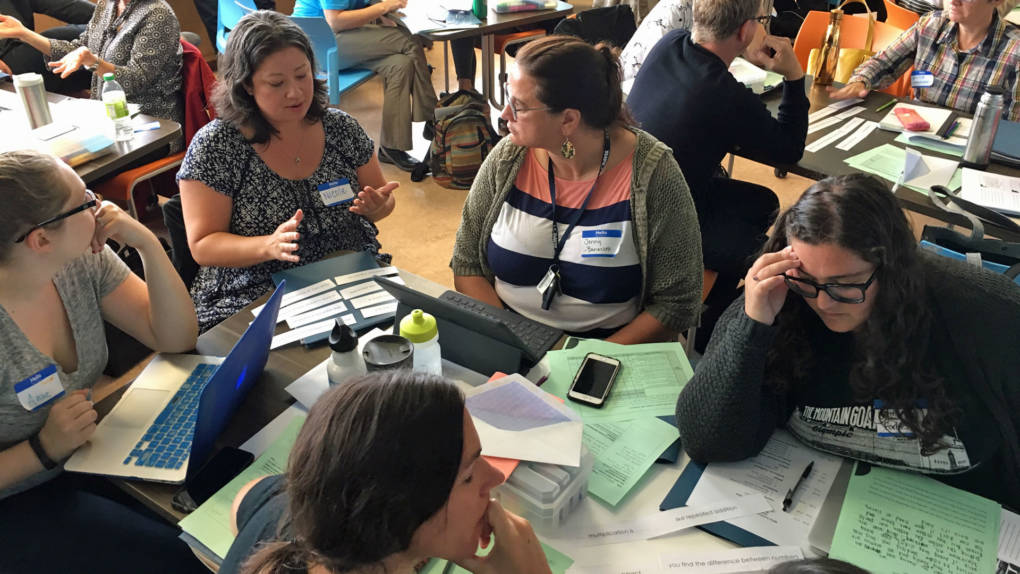
Teachers in Thurgood Marshall High School’s sheltered language pathway collaborate during a professional development training about how to teach thinking through writing. (Courtesy Amy Gottesfeld/SFUSD)
“I think that non-English Language Development and English teachers, a lot of us still have nervousness around how to really develop English and writing skills in our classroom,” Ryan said. “But it really is our responsibility as well. I think doing the WITsi has made that responsibility feel lighter and feel effective.”
Bringing instruction down to the level of the sentence forces the teacher to carefully identify the most important information she wants her students to learn that day, and build sentence-level activities around the main content goal. This practice often leads to more effective instruction, in addition to helping students build their language skills.
WITsi work in New York City Renewal schools with the general education population has uncovered similar sentence-level misunderstandings in high school student writing. In those cases, it’s often hard for high school teachers to accept that they have to go back and teach the basic building blocks of good sentence writing, then paragraphs, and finally essays. They feel that their students should already have those skills.
But with newcomer students, teachers are hungry for anything that will help them make their curriculum more accessible to students who don’t have language skills yet, but desperately need them. All of these strategies should be used in conjunction with the most important content of the day. The idea is to marry the linguistics with subject mattercontent at every step to make the language relevant, while helping students learn the content.
SEVEN BASIC WRITING STRATEGIES
1. Sentence boundaries: These activities are designed to help students understand what a sentence is and what it is not.
In the process, teachers can identify the parts of a sentence: noun, verb, object, but more than the grammar, these activities use content to discuss what makes a sentence. How can one tell if something is a fragment, or a run-on? Activities include matching different parts of a sentence to either make a complete sentence or repair a fragment. Or, teachers might ask students to sort sentences into fragments, complete sentences and run-ons.
“But again all the sorting that you’re doing is around the content that you’re studying,” Gottesfeld said. So, if the lesson focus is Alexander Hamilton, all the sorting and matching is related to his historical contributions. The dual approach is the most important part of all these strategies.
2. Recognizing different sentence types like statements, questions, exclamations or commands.
This includes helping students look for clues — does the sentence start with a question word, for example? While it may seem simple to a native speaker, expressing the content using various types of sentences can dramatically change meaning, an important concept for students to understand. Also, focusing explicitly on questioning helps empower English learners as question askers throughout the curriculum and in other learning settings.
3. Working with the coordinating conjunctions “but, because and so” to help students elaborate on their sentences.
Many students, even ones who speak English, don’t have a firm grip on the differences these words signal. “But, because, so” activities might start off with matching sentence stems to sentence ends based on the conjunction, and gradually become more difficult, ending with giving a student the three bases and having them complete the sentence.
This is often a favorite with teachers and students because it begins to open the door to more analytical thinking. Knowing how to use these conjunctions is not only a language rule, it indicates the student’s ability to think comparatively, to explain, to make connections.
4. Subordinating conjunctions
Subordinating conjunctions are an important way English speakers vary sentences structure and express complicated relationships between things. They’re also tricky for non-native English speakers, and deserve explicit introduction. Words that signal time and position are powerful expressions of analytical thinking. When teachers introduce subordinating conjunctions within a content lesson, it gives students more ways to express complex ideas and improves sentence fluency.
5. Sentence combining
Activities in this sequence include giving students two sentences and asking them to use a variety of techniques to combine them into one. Scaffolds might include giving students a word bank or conjunctions to choose from, while the most complex version might ask students to write a sentence with an independent and dependent clause on Alexander Hamilton that uses a conjunction. A core goal of these activities is to use relevant content to help students reduce redundancy in their writing by combining sentences. It’s also an opportunity to work on syntax within the context of content objectives. Students are motivated by the desire to be understood.
6. Appositives
Appositives are a language structure that allows the writer to rename a noun. This is another explicit language structure that makes student writing more interesting, specific and nuanced. But rather than making it a disconnected grammar lesson, teachers can use activities about their content that incorporate appositive practice.
Many English learners also struggle to follow the chain of references in texts with unknown words, so explicitly teaching about appositives can help with reading comprehension as well.
7. Sentence expansion with descriptors
In these activities students ask students to expand on a simple, unelaborated sentence by asking them to answer a series of questions aimed at teasing out details. A typical simple sentence might be, “Alexander Hamilton helped establish it.” The teacher then writes questions to identify the information that would elaborate this sentence: What did he establish? Why did he establish it? How did he do it? Who helped him? Once students have identified all these details, they rewrite or “expand” the unelaborated sentence into a much improved one that includes those details. This guided process helps model the way English sentences are constructed and is a precursor to revision.
“The ‘Writing as thinking’ presents somewhat of a sequence to introducing these strategies and approaches,” Gottesfeld said. “That feels new and clearly makes sense” to many teachers in the sheltered language pathways.
And when students have these clear sentence-level building blocks, practice them regularly, and understand the way they function to express ideas, teachers can use them in the most complex process of all: parallel revision.
“We know that revision is critical for the writing process to support students in developing good writing,” Gottesfeld said. Parallel revision is a more structured way to help students revise their writing. Teachers might write “elaborate” next to a thought in a student’s paragraph and suggest the student think about the “but, because, so” strategy to carry out that elaboration. This practice can also make peer revision more useful, grounding the discussion in specific strategies the kids know well through prior practice.
“It puts the kid in a position where they have to think about language that they know and try to apply it,” said Joanna Yip, a former teacher in the Internationals Network who helped design the materials and activities SFUSD teachers are using. “It is an absolutely necessary component for kids who are learning the language.” Through parallel revision students begin to truly appropriate the language and transfer the piecemeal sentence-level work into paragraphs and even essays.
Yip said this systematic approach to language construction that WITsi offers is fairly new to many English language teachers, especially ones who see themselves foremost as content specialists and secondarily as teachers of English. Rather than chunking out the steps of writing a paragraph and asking students to follow instructions, parallel revision requires students themselves to do the thinking about which strategy responds to the teacher’s feedback.
Yip said a lot of English language teachers are well versed in using language frames, sentence starters, vocabulary work and scaffolding larger pieces of writing. They regularly use the cycle Pauline Gibbons champions, in which teachersbuild up background knowledge jointly as a class before asking students to do it on their own. “That’s all good and necessary,” Yip said, “but the one missing piece to those approaches tends to be there isn’t explicit instruction on how to build sentences.”
And keeping these strategies tightly tied to the content makes the language lessons useful to students. Too often when teachers try to focus on the nuts and bolts of language, they end up delivering a disconnected lesson on grammar that students don’t transfer to the writing they do in each content area.
“If they have opportunities to do this kind of work that is appropriate for their phase of language development, then over time they will gain that momentum as students,” Yip said. “When they feel supported in doing it, it’s a rigorous task, but a task they can manage.” She said it’s unreasonable to ask a student who has been in the country for three months to write an essay. And without carefully scaffolding writing strategies, that student may never get to the essay writing level.
A TEAM EFFORT
Evelyn Sulem is just finishing up her second year of teaching high school history. She said teaching in the sheltered language pathway isn’t a highly coveted position, so it often falls to newer teachers. But she enjoys watching the incredible progress her students make and plans to continue teaching newcomer students, especially now that she feels she has a few more tools and a supportive group of colleagues.
“I have definitely seen a massive progress in the level of English and in the level of content knowledge,” Sulem said about using the WITsi strategies. She meets with colleagues from other content specialties who also teach newcomers once a week. They share strategies and try to sync up their curriculum to reinforce vocabulary, concepts and language structures.
“We try to bring forth the vocabulary in all the disciplines,” Sulem said. Through this intensive WITsi work, she has also become more aware of the different English levels in her classroom. She is now carefully building more scaffolds into her lessons, using WITsi strategy variants to support her students to understand the history content. For example, students might complete the activities in their home language, or discuss the content with a partner in their home language before trying to use their English to write down thoughts..
“We teach history in a workshop style,” Sulem said. The social studies department at Lincoln wants to build students into critical thinkers who can analyze history. They try not to lecture from the front of the room, and have de=emphasized memorization. That’s even more important when students don’t understand the lecture anyway. “We don’t give any lectures, but we engage students with simple text which has history content,” Sulem said.
Sulem is grateful the WITsi work has given her more tools to reach her newcomer English learners, but she admits the work is very difficult. Many of her students arrived in the U.S. with interrupted educations, and their writing skills in a home language aren’t strong either.
“It makes me think about my own teaching practice in a different way,” Sulem said. “Students need visuals and need to be informed about the same theme in three different ways: speaking, writing and visually.”
And because she teaches a few sections of general education students, Sulem is applying tactics that work with her newcomers to all her classes. She thinks teaching English learners has made her a more creative teacher, helping her to guide kids to an analytical understanding of history using multimodal forms of learning. And when she can see a student is struggling to express a complex idea in their writing, she’s got more linguistic supports to help them get there.
*This piece has been edited to reflect that the WITsi strategies build on ideas originally developed by Judith Hochman.
OtrasVocesenEducacion.org existe gracias al esfuerzo voluntario e independiente de un pequeño grupo de docentes que decidimos soñar con un espacio abierto de intercambio y debate.
¡Ayúdanos a mantener abiertas las puertas de esta aula!










 Users Today : 88
 Total Users : 35491975
 Views Today : 406
 Total views : 3607625