Page 150 of 400
1 148 149 150 151 152 400

EEUU: Students inspire hope for bright future

By Brandon Butler/ duboiscountyherald.com/ 23-05-2018

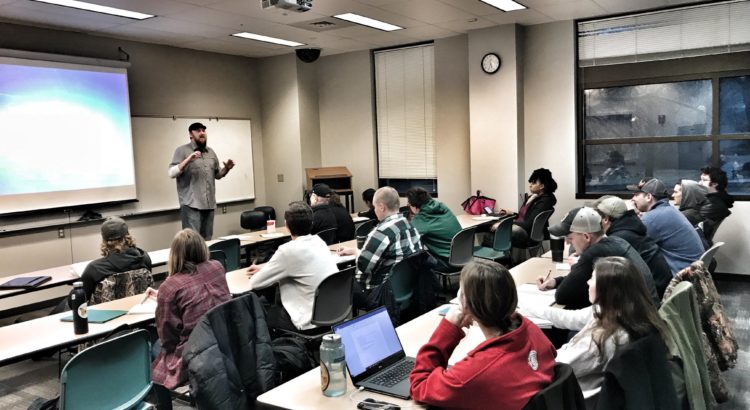
My first semester as an adjunct instructor ended last week. I taught a class I created called Communications in Natural Resources. It was an experience I’ll treasure forever. Over the course of 15 weeks, I came to realize if my students are a reflection of their generation, the future of our natural world is good hands.

I spend a lot of time talking and writing about topics relating to the outdoors, specifically fish and wildlife. Most of the time, I am not an expert on the subject. While I may know a little about a lot of things, it’s people who know a lot about one thing who communicators like me use as sources for stories. Unfortunately, too often, the expert sources are poor communicators. They possess incredible knowledge. Yet struggle to deliver what they know to the general public in a way that makes it relevant to the masses.

As a member of a Natural Resources Advisory Council, I have come to know and respect some of the challenges of higher education leadership. During a meeting last year, I was asked if I saw any opportunity to improve the curriculum. I suggested we do a better job of teaching these brilliant young minds how to tell their stories. I was empowered to create a curriculum and teach it.

To begin with, I examined beliefs I feel justified the need for this class. Number one being; no matter what your job is, communication is important. And the more prepared you are to offer input on the efforts of your work the more likely you are to build support for what it is you do and care about. Also, as far as personal advancement, if you become known as someone who can both complete the work and communicate the outcomes, you are much more valuable to the business, agency or organization you’re part of. Who would remember the revolutionary work of Aldo Leopold had he not written a “Sand County Almanac?”

I broke the course down into lessons about different communication platforms and had guest lecturers discuss their expertise. We covered magazine writing, letters to the editor and opinion pieces in newspapers, television and radio interviews, social media, websites, photography, public speaking and more.

Communication is critical in conservation, and not all citizens gather information in the same ways. Agencies have to communicate across the many different platforms from which the public consumes information. Through out the semester, guest speakers emphasized the importance of communications in all natural resource professions, the students listened and learned.

One great guest lecturer was my buddy Nathan McLeod who hosts a morning radio show. McLeod talked about how much he values natural resources and enjoys sharing messages of conservation with his listeners, but finds guests often struggle with the rapid fire pace of a radio interview. He wants guests on his show to talk conservation, but needs them to be fun and personable, and to talk in a way most people can relate to.

“Leave the rocket science at home,” McLeod said. “Give them the elevator speech. Quickly explain to listeners why this important and why they should care. Tell them how it impacts them personally.”

At the end of the class, students were paired into four groups with the assignment of building and implementing a communications plan around a natural resources topic of concern. The four topics they selected and worked on were: Open New State Parks, Reintroductions of Wildlife Species, Wildflowers in Urban Settings and The Effects of Climate Change on Wildlife. You can see the minds of tomorrow have their priorities.

I hope my students gained a better understanding of how important it is to communicate scientific knowledge in a way most citizens can understand. Our natural world faces incredible challenges requiring the support of the public to address and fix. Once these students are in professional roles, if I did my job, they will try a little harder to share their expertise.

See you down the trail…

*Fuente: https://duboiscountyherald.com/b/column-students-inspire-hope-for-bright-future

Comparte este contenido:

EEUU: Michigan’s floundering education system has left its children far behind

EEUU/May 22, 2018/Source: http://www.mlive.com

There’s no way around it: Michigan’s education system is floundering.

From early literacy to middle-school math, Michigan students are not keeping up with their peers in top-performing states.

Big changes are needed if Michigan wants to turn itself around, experts say.

«Michigan, if it thinks the status quo is going to be fine, we’ll have a race to the bottom, and we’re almost there right now,» said Grand Valley State University President Thomas Haas, who chaired Gov. Rick Snyder’s 21st Century Education Commission, a panel that developed recommendations to improve Michigan’s education system.

Perhaps no issue is more important for Michigan’s future: In a global economy, a well-educated workforce is critical – and an area where Michigan lags behind.

It starts with reaching and educating Michigan school children even earlier than kindergarten. That means providing more families with affordable access to high-quality early childhood education and funding K-12 schools based on student need, experts say.

It also means ensuring all children have access to top-notch teachers and boosting the number of residents with college degrees or certificates in areas such as the skilled trades.

The relatively low numbers of college graduates and people with post-secondary training mean good jobs here can go begging. The state’s fast-growing occupations are those that require post-secondary training. In 2016, 2 percent of Michigan adults with a bachelor’s degree were unemployed compared to 7 percent of those with only a high school diploma.

Low rates of educational attainment means stagnating wages and tax bases that stifle economic growth. It means Michigan is less competitive in recruiting new employers.  A major reason Detroit wasn’t a finalist in the new Amazon Headquarters was that the region didn’t have the talent pool needed for the jobs.

It hurts individuals. It hurts entire communities.

«It’s really about our vitality in every aspect for the future in our state,» said Amber Arellano, executive director of The Education Trust-Midwest, a nonpartisan education policy and research group. «It’s whether you want to stay here and raise your kids.»

In a series that began in April, MLive is taking a hard look at Michigan’s biggest challenges – our economy, education system and infrastructure – from the historical importance, to how we got where we are today, to possible solutions.

We’ll use the series to frame our discussion with candidates as we head into the 2018 midterm elections and choose Michigan’s newest leaders.

This month, we’re taking a deep dive into Michigan’s educational pipeline.

K-12 schools

Michigan students are below the national average in federal test scores, in graduating high school in four years and in college enrollment.

* Michigan ranked 36th in fourth-grade reading proficiency in the most round of the National Assessment of Educational Progress tests.

* About 80 percent of Michigan’s Class of 2017 graduated high school in four years compared to a national average of 84 percent.

*Not quite 32 percent of Michigan adults age 25 to 34 have a bachelor’s degree compared to 35 percent in that age group nationwide.

And that’s after Michigan has spent the past two decades rolling out various strategies to improve Michigan’s schools.

Use regions/landmarks to skip ahead to chart and navigate between data series.

Michigan has opened the door to school choice and charter schools. Rigorous high school graduation requirements have been implemented. High-stakes testing has been adopted. Teacher tenure laws have been reformed. And a now-defunct state-reform district was created.

Some of those efforts, such as high academic standards, are important and should stay in place, experts say. But overall, they have not pushed the needle in student achievement.

What’s needed, education leaders say, is transformational change.

That includes an overhaul of the school-funding formula, according to the School Finance Research Collaborative, a coalition of educators, nonprofits and philanthropic groups.

Michigan isn’t providing adequate funding for K-12 education, and policymakers must take into greater account the needs of each child, the collaborative said in a January 2018 report.

About half of Michigan students qualify for the subsidized lunch program, and there’s a huge academic achievement gap between those children and students from middle-class and affluent families.

Closing that gap requires more support services: more tutoring and specialized instruction, more after-school programs, more summer school. Michigan’s funding formula needs to reflect those costs, the collaborative says.

Another big issue: Getting more experienced, high-quality teachers in Michigan’s most troubled school districts.

Right now, Michigan’s best teachers tend to gravitate to more affluent districts where the pay tends to be much better and the public support is much greater.

But that shortchanges students in high-poverty communities most in need of skilled, experienced teachers.

Birth to age 5

Another recommendation of the governor’s commission: give more families access to high-quality, early childhood education.

That means offering all 4-year-olds access to state-funded preschool, and helping more families pay for quality childcare for children ages birth to three, educators and advocacy groups say.  Currently, slightly less than half of Michigan 3- and 4-year-olds attend a pre-K program, according to Census data.

«People can’t afford or don’t have access to quality child care in their communities,» said Matt Gillard, president and CEO of Michigan’s Children, which advocates for services for low-income families. «This is a huge challenge right now.»

Research shows that 90 percent of brain development occurs in the first five years of life, which means birth-to-5 services offer the best bang for the buck for improving academic outcomes.

Higher education

Investments are crucial in higher education, too.

By 2020, about two-thirds of jobs are expected to require training beyond high school, whether that be a college degree or an associate degree or certificate in areas such as advanced manufacturing or information technology.

Yet Michigan lags in the number of college graduates and people with post-secondary training. About 28 percent of Michigan adults age 25 and older have a bachelor’s degree, compared to a national average of 31 percent.

Boosting Michigan’s number is key if the state wants to lure employers to the state and ensure that residents have the skills needed to land good, high-paying jobs, said Lou Glazer, president of Michigan Future Inc., a nonprofit organization focused on improving the state’s economy.

«The choice is increase college attainment or permanently be one of the poorer states in the country,» Glazer said. «That’s the stakes.»

Over the course of the next several months, MLive will explore issues of economy, education and infrastructure, and what Michigan leaders need to do to create a better future. We’d love to hear from you, about your struggles and your wins, as you navigate Michigan’s economic landscape. We want to use your voice and your questions to frame the conversation with candidates as we head into midterm elections. Have a story to share, send us an email to michiganbeyond@mlive.com

Source:

http://www.mlive.com/news/index.ssf/2018/05/michigan_beyond_education.html


Comparte este contenido:

How to Plan and Implement Continuous Improvement In Schools

USA / May 20, 2018 / Author: Katrina Schwartz / Source: KQED News

In the classroom, good teachers constantly test small changes to class activities, routines, and workflow. They observe how students interact with the material, identify where they trip up and adjust as they go. This on-the-fly problem solving is so common in classrooms many teachers don’t realize they’re even doing it, and the expertise they are gathering is rarely taken into account when schools or districts try to solve larger, systematic problems.

In  education research, researchers come up with ideas they think will improve teaching and then set up laboratory experiments or classroom trials to test that idea. If the trial goes well enough that idea gets put on a list of research-approved practices. While research-informed practices are important, this process can often mean that the interventions are unrealistic or disconnected from the hectic reality of many classrooms, and are rarely used. But what if teachers themselves were the research engine — the spark of continued improvement?


The Carnegie Foundation is trying to bridge that gap in identifying techniques that work and «create a much more democratic process in which teachers are involved in identifying and solving problems of practice that matter to them,” said Dr. Manuelito Biag, an associate in network improvement science at the foundation. Biag previously worked on developing research-practitioner partnerships for Stanford’s Graduate School of Education.

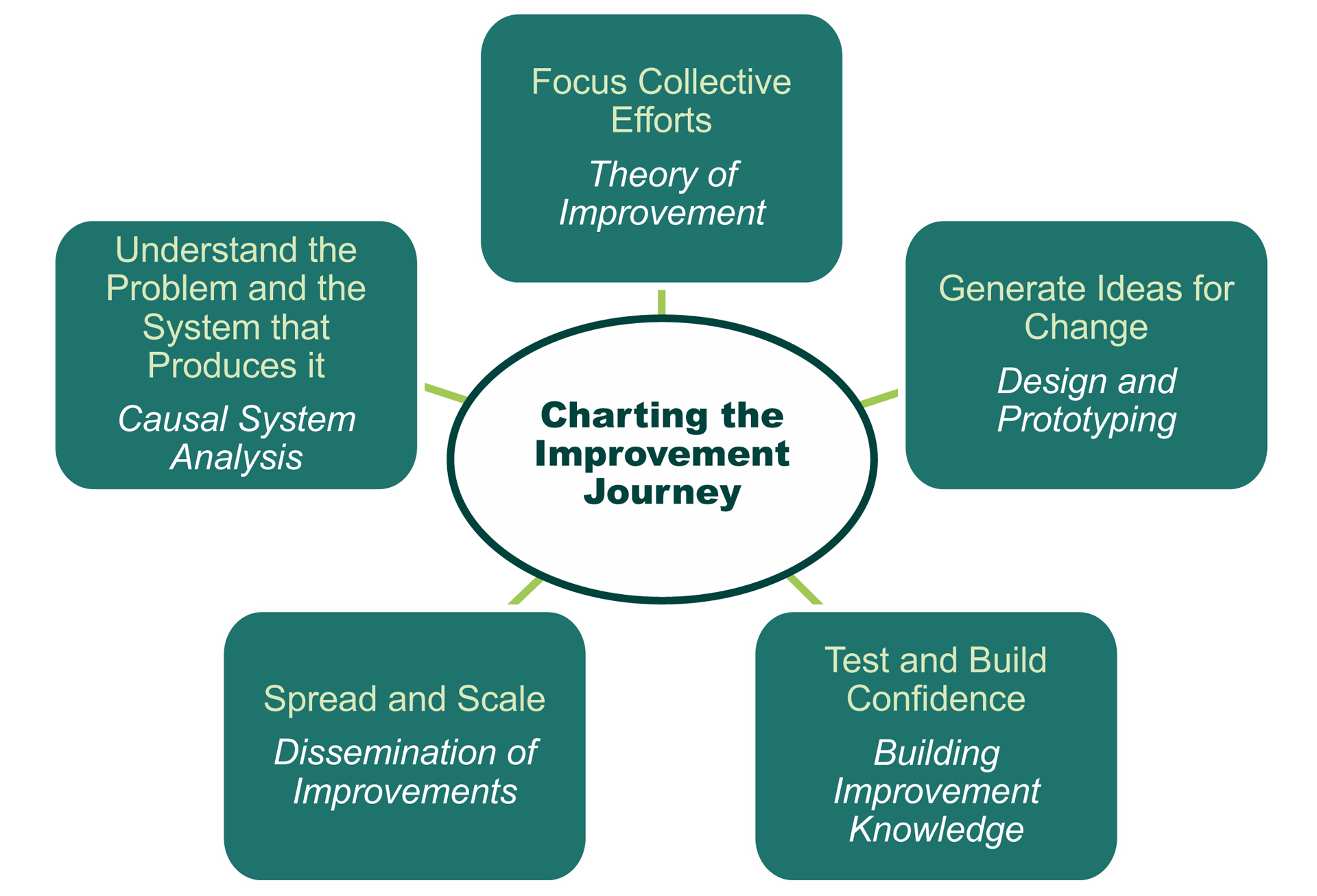
For the past several years, under the leadership of Dr. Tony Bryk, Carnegie is trying to apply a structured inquiry process to problems in education, building the capacity of teachers, principals and district administrators to continuously improve. This type of improvement science started in manufacturing and has been used to successfully change human-based systems like healthcare.

The basic tenets of the process involve understanding the problem, defining a manageable goal, identifying the drivers that could help reach that goal, and then testing small ideas to change those drivers. When done in a network, this cycle of improvement is expedited as various participants test different change ideas and share their findings with the group. Through a constant interplay of these elements a few change ideas will rise to the top and can be scaled across a system.

UNDERSTANDING THE PROBLEM

Many of the biggest problems of practice have been around a long time and aren’t easy to solve. Too often when trying to improve something leaders jump to solutions before properly examining the problem. Understanding the problem requires valuing many types of knowledge. It means doing empathy interviews with participants in the system including teachers, staff, parents, and students. It involves bringing the best research literature to bear on the problem. And sometimes representing the processes involved in the problem can illuminate areas that are breaking down.

Biag said this stage is crucial and shouldn’t be rushed. He’s seen improvement projects that require up to a year of study to fully understand the problem, its root causes and the levers of change available to leaders. Often an improvement network will know it’s time to move on when participants feel saturated — they aren’t turning up any new perspectives or information.

“Sometimes it’s good to stop doing the research and try something,” Biag said. Implementing some change ideas often helps inform the problem and may even necessitate that the team revisit and revise the problem statement.

Courtesy of Carnegie Foundation

DEFINE THE GOALS AND FOCUS COLLECTIVE EFFORT

Once the group has a “good enough” understanding of the problem it’s crucial that they write a clear, succinct aim statement. It should be specific, measurable and focus on a challenging problem, but it should be doable.

The crucial question, Biag said, is “What’s within your span of control and what’s not? So when you act on this problem you aren’t wasting your time on the things that aren’t in your control.”

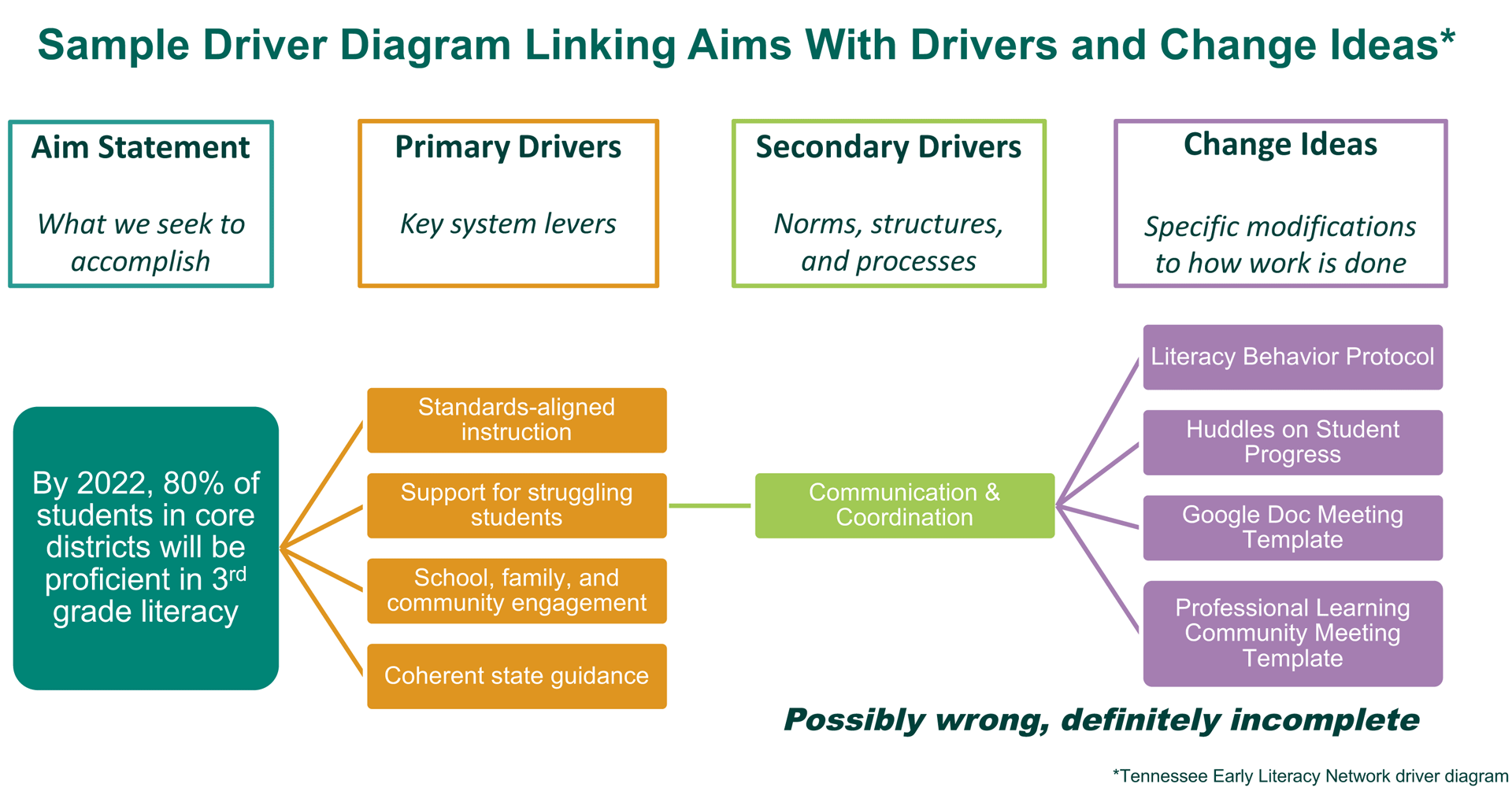
He often sees people define the problem too broadly. If the problem is an achievement gap between student populations, a group might say the root problem is inequality or poverty. Those things may contribute to the problem, but they aren’t within the control of teachers or principals or even districts to solve. A more manageable aim statement might be: “By June 2020 we’re going to increase from 45% to 90% the number of male students enrolling in credit bearing math courses at community colleges.”

“It has to be motivating enough for people to continue working on it for several months,” Biag said about the reach goal. But it must be specific and concrete enough that the group can see if change ideas are helping progress towards the goal.

“While an aim statement can look deceptively simple, you need to build trust and get on the same page with everyone in your network to even agree on where to focus your efforts,” Biag said. The network itself is important because it accelerates the pace of learning about potential solutions.

Once the aim is clear, the group brainstorms three to five primary drivers of the problem. These are the things the group believes provide the most leverage to meet the goal, and that are within the span of control. It’s crucial to only have a few of these, not twenty, because the network must work on all of them in tandem. Staying focused allows for more progress.

After identifying the most important drivers, network participants brainstorm change ideas that might affect those drivers. “The word change is very specific to improvement science,” Biag said. “It means an actual change in how you do work.” In other words, the focus is on the process and results in action. Change ideas are not things like “more money” or “more staff.” “It’s an actual change of a process or the introduction of a new process,” Biag said.

TEST AND BUILD EVIDENCE

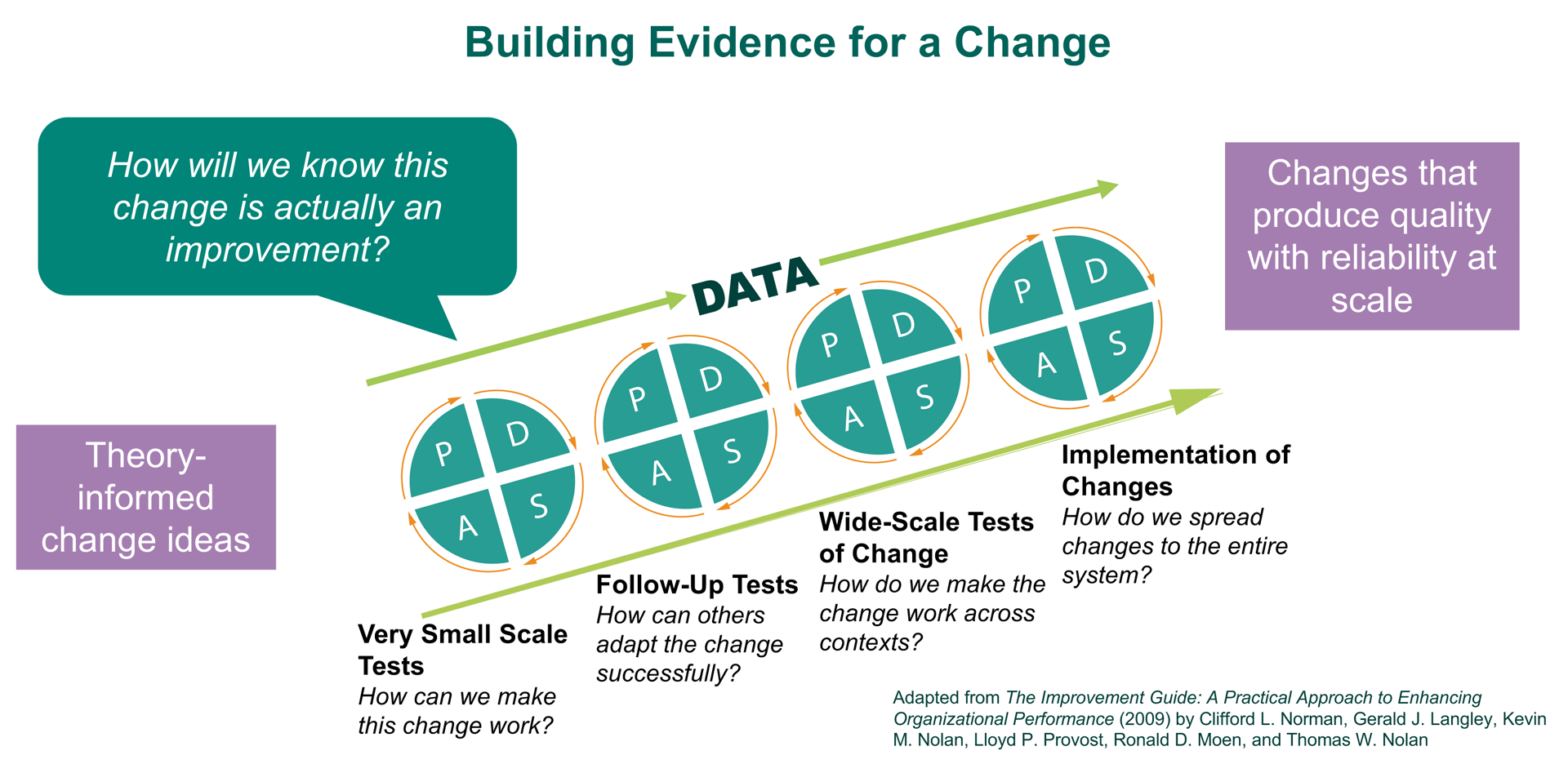
Once the group has a good understanding of the problem, its root causes, what drives it and some ideas that will directly affect those drivers, it’s time to start testing them. Carnegie uses a “Plan, Do, Study, Act” (PDSA) cycle for testing ideas. The changes should be fairly small and the tester collects data along the way. It doesn’t have to be complicated data, just something to help analyze and track whether the change is moving the needle.

Courtesy of Carnegie Foundation

“Most schools and districts plan plan plan, then do, and then they never study,” Biag said. He advocates that planning include a prediction because participants are more likely to compare a new strategy with the expected effect. If the change idea didn’t function as expected there’s a lot to learn there.

Many of the best change ideas come from looking at what Carnegie calls “positive deviants” — the bright spots in a network. For example, if a network sets the aim of improving college readiness for English language learner students, when leaders are assembling their knowledge base they should talk to teachers who seem to be achieving better than average results with that population. Those teachers are “positive deviants” and networks should try to learn from the ways their practices differ from colleagues.

For example, High Tech High Charter Network leaders identified that they wanted to increase the number of African American and Latino males applying to four-year colleges. When they looked at drivers, they realized school attendance was lower for this group and hypothesized that the way teachers communicated with parents might be part of the issue. To try to eliminate variation in parent-teacher communication they tested a change theory that involved using a set of protocols for interacting with families.

They went through several iterations of the protocols, but when they hit on one that seemed to work they spread it throughout their network of schools. Now, when teachers meet with parents around achievement or discipline they all try to make it positive, share data about the student, and co-construct an action plan with the parent, among other things.

The key thing about working in a network is that different people can be trying different change ideas and sharing their data. “The idea is that you’re not all working on all the same things at the same time,” Biag said. “So you leverage the network, and the power of the network, to increase change ideas.”

Some ideas won’t work and will be abandoned. Others might seem promising, but more data is needed, so others in the network might try them too. Over time the change ideas that seem to really impact the drivers rise to the top.

“As you’re testing and building evidence you’re going to find ideas that work and then you can talk about spreading those ideas,” Biag said.

Courtesy of Carnegie Foundation

SPREAD AND SCALE

Even with the best ideas implementation can be hard. Biag said leaders need to weigh several factors when thinking about how to spread an idea that seems to work. How costly will it be to implement? What are the consequences of failure? How reluctant are the people involved? How confident is the leader in the change idea?

For example, if the change is a parent meeting protocol and the leader doesn’t think it’s a great idea and that the cost of failure will be high, perhaps she only tests it on her sister first. But, if teachers are ready for the change and there’s nothing to lose, then maybe the idea can scale up more quickly. This is where knowing one’s own system and culture becomes important.

It’s also worth thinking about who within the system needs to be on board for the plan to go well. Those folks can be powerful advocates if convinced that the change idea is a good one. “The best people are those who were pretty skeptical in the beginning and you were able to change them,” Biag said.

Another strategy is to roll out the idea with those eager to try it and then demonstrate success to those who are more fearful. It’s also necessary to be humble and willing to go back and test new ideas if the ones that seemed to work in the smaller group don’t work when scaled. Perhaps the aim statement needs to change, or maybe the drivers aren’t actually the most impactful.

“Our theory is possibly wrong and definitely incomplete; that’s kind of a Carnegie saying,” Biag said. He doesn’t want anyone to think this process is linear, rather it’s a cycle. And when people get comfortable with the cycle they build it into everything they do naturally. The biggest strength of continuous improvement is that it offers a path for systemic change, a way to build the capacity within the system, rather than building whole new systems.

“What we’re trying to do is implement these tools and ways of thinking to empower people to engage in this work,” Biag said. And that means having a bias towards action.

“You have to start before you feel ready. Your understanding of the problem will change over time and when you act on that problem the problem will change and so your understanding of that problem will change,” Biag said.

People learn how to think about continuous improvement through the process of doing it. They get better at narrowing in on motivating, but achievable aim statements. They learn to include more voices in the information gathering stage. The “Plan, Do, Study, Act” cycles become second nature, and analyzing data gets less scary.

Perhaps one of the best parts of continuous improvement is that it helps empower those within a system to see themselves as the drivers of change. The ideas come from practice as does the data. And while data is often associated with accountability requirements, this improvement process offers practitioners the opportunity to think about and evaluate data that are important to their practice.

In this process, the data is only worthwhile if it shines light on whether the change is working. And when data is used this way, it’s easier for educators to be transparent about what they’re seeing. Improvement is not about judgement, it’s a constant, normal aspect of professional life.

“You have to have a lot of humility to come to the realization that you don’t have the answers, and that you’re going to learn your way into this,” Biag said. “You’ve got to think about this as a learning journey. If you really had the answers to this problem we wouldn’t be talking about it.”

To see measurable progress on some of the most intransigent problems in education requires a systematic focus on improving in every aspect of the system. It’s not enough for one teacher to be amazing, or one school to outshine the others around it. All kids deserve an incredible education; and that can only happen by building on the strengths already found in the system.

Source:

https://www.kqed.org/mindshift/51115/how-to-plan-and-implement-continuous-improvement-in-schools

Comparte este contenido:

Al menos 10 muertos en un tiroteo en una escuela de Texas

Estados Unidos/19 de Mayo de 2018/El País

La policía detiene al atacante y encuentra artefactos explosivos dentro y fuera de la escuela. Hay 10 heridos

La sinrazón de la violencia armada volvió a sacudir este viernes Estados Unidos. Un menor de edad abrió fuego en una escuela de secundaria en Santa Fe, una localidad a las afueras de Houston (Texas). Mató a al menos 10 personas e hirió a otras 10. La policía detuvo al tirador, Dimitrios Pagourtzis, de 17 años. Empuñó un revólver y una escopeta que eran de su padre y habían sido compradas legalmente. Las autoridades encontraron explosivos en los alrededores del colegio y en la casa y vehículo del asaltante. La policía también arrestó a un sospechoso.

El presidente estadounidense, Donald Trump, habló de un “ataque horrible” y lamentó que estas matanzas “han estado ocurriendo por demasiado tiempo” en el país. El republicano, cercano a la industria armamentística y que hasta hace poco rechazaba endurecer los controles, prometió tomar medidas para “proteger a nuestros estudiantes y asegurar nuestras escuelas”. Texas es uno de los Estados con leyes más laxas en la compraventa de armas. Su gobernador, el republicano Gregg Abbot, también abogó por “garantizar que esta tragedia nunca se repita”.

El nuevo baño de sangre es el más grave desde que en febrero un estudiante, equipado con un rifle militar, mató a 17 personas en una escuela secundaria en Parkland (Florida). La masacre desató una ola de indignación en EE UU y el mayor debate nacional sobre las armas de fuego de los últimos años. Impulsados por la repulsa de los estudiantes de Parkland, cientos de miles de personas se manifestaron en marzo en grandes ciudades reclamando endurecer la compraventa de fusiles. Su lema era muy claro: “Nunca más”. Ese objetivo no se ha cumplido.

Dimitrios Pagourtzis, en su ficha policial
Dimitrios Pagourtzis, en su ficha policial AP
El de Texas es el tiroteo número 22 en colegios de EE UU en lo que va de año, según el recuento de la organización Gun Violence Archive. Considerando que han transcurrido 20 semanas, equivale a más de uno por semana. La violencia armada convierte a EE UU en una anomalía en el mundo desarrollado. Cada día mueren alrededor de 93 personas por disparos en el país. Hay casi el mismo número de armas privadas que ciudadanos en un país de 325 millones de habitantes y que ampara el derecho a portar armas.

El drama se desató a las 7:45 (hora local) cuando el joven empezó a abrir fuego poco antes de que empezaran las clases en el Santa Fe High School. Dos policías de la escuela respondieron a los disparos. Una alumna explicó a una televisión local que el atacante entró en su clase de arte y empezó a descerrajar tiros. Vio a una compañera de clase con la pierna ensangrentada. “Creíamos al principio que era un simulacro de incendio pero el profesor dijo: ‘Empezad a correr’”, afirmó. Muchos huyeron hasta resguardarse en un comercio enfrente de la escuela. Otros corrieron mucho más lejos.

Las escenas de desolación se repitieron. Adolescentes llorando desconsolados a las puertas de un colegio. Padres desesperados que no saben si sus hijos están vivos. Las escenas se vivieron en Santa Fe, un municipio de 12.000 habitantes en Texas. Pero evocaron demasiadas otras. El de este viernes es el peor tiroteo en Texas desde que en noviembre un hombre mató a 26 personas en una iglesia en Sutherland Springs, una localidad cercana a San Antonio.

We grieve for the terrible loss of life, and send our support and love to everyone affected by this horrible attack in Texas. To the students, families, teachers and personnel at Santa Fe High School – we are with you in this tragic hour, and we will be with you forever…
El clamor de los alumnos de Parkland propició que el Congreso de Florida, uno de los Estados conservadores más cercanos a la industria armamentística, aumentara de 18 a 21 años la edad mínima para comprar un rifle militar. Florida también dio luz verde a que un grupo de profesores, tras superar un entrenamiento especial, pueda ir armado en las aulas. Asociaciones educativas han censurado esa medida al advertir de que convertirá las escuelas en espacios bunkerizados y las hará mucho más peligrosas.

El armar a los profesores fue la principal propuesta de Trump tras el tiroteo en Parkland. Inicialmente, abogó por elevar también la edad mínima de compra, rompiendo con el consenso conservador, pero luego dio marcha atrás. De momento el Congreso, de mayoría republicana, solo ha adoptado tímidos retoques a la legislación de las armas. Es la misma pasividad que ha ido ocurriendo matanza tras matanza en los últimos años.

UNA DE LAS LEYES DE ARMAS MÁS PERMISIVAS

Texas es uno de los pocos Estados en que puedes llevar un arma a la universidad. También puedes portar una en los estacionamientos de los colegios. Y no se verifican los antecedentes en la compraventa entre particulares. Esto y una serie de facilidades, hace que Texas tenga una de las leyes de armas más permisivas de Estados Unidos y sea uno de los Estados con la peor calificación en el control de armamento, según la organización estadounidense Gifford Law Center. Hay que tener al menos 18 años para comprar un rifle y 21 para una pistola.

Sin embargo, el endurecimiento de la compraventa de pistolas y rifles no fue uno de los asuntos relevantes en los debates de los candidatos en las primarias demócratas y republicanas en marzo.

Después de la matanza de Florida, la escuela de Santa Fe reforzó sus protocolos de seguridad. Una de las supervivientes de Parkland y rostros del movimiento, Emma González, reaccionó al tiroteo: “No os merecéis esto. Merecéis paz durante toda vuestra vida y no solo después de que se ponga sobre vosotros una lápida que lo diga. Os merecéis más que ‘pensamientos y oraciones'», escribió en Twitter.

Fuente: https://elpais.com/internacional/2018/05/18/actualidad/1526651074_163338.html

Comparte este contenido:

En EEUU, Texas: Maestra acusada de promover “agenda gay” demanda por discriminación

Las autoridades escolares en Texas negaron categóricamente las acusaciones y culpan a la profesora

AméricadelNorte/EEUU/NOTICIAS YA

Una maestra de Texas que fue despedida por “promover una agenda homosexual” en sus salones de clase ahora demanda al distrito escolar por discriminación.

Se trata de Stacy Bailey, quien se encuentra bajo licencia administrativa pagada desde septiembre tras quejas de los padres de familia. De acuerdo con USA Today, la docente considera que el distrito escolar independiente de Mansfield la está castigando por ser lesbiana.

Stacy Bailey quiere que Mansfield admita que lo que hicieron es incorrecto”, refirió Jason Smith, su abogado, durante una conferencia de prensa este martes en Dallas.

Los padres de familia se habrían quejado de Bailey, quien alguna vez fue nombrada “maestra del año” enTexas, después de que se presentara ante sus nuevos alumnos de la escuela primaria Charlotte Anderson con una serie de fotografías de su familia y amigos.

Entre las imágenes que vieron los estudiantes de la institución de Arlington se encontraba una foto de la maestra con su entonces prometida y ahora esposa, Julie Vásquez.

“No podemos creerlo, estamos en shock y heridas profundamente”, expresó Vásquez, quien asegura que su pareja no solo está luchando por sus propios derechos, sino que busca sentar un precedente y proteger a otros empleados LGBT de la discriminación directamente en las reglas de la escuela.

“Fue tratada de forma diferente que las personas heterosexuales que muestran a sus parejas”, consideró por su parte el abogado.

La demanda asegura que la maestra fue suspendida tras mencionar a un artista masculino que tenía unapareja del mismo sexo.

Las autoridades escolares niegan categóricamente las acusaciones y dijeron estar confiados en que la demanda no tiene mérito.

“La señora Bailey ha sido maestra de Mansfield por espacio de una década. Durante su tiempo con el distrito, nunca había surgido un problema con sus preferencias sexuales abiertas hasta este año. Eso fue cuando sus acciones en el salón de clases cambiaron, lo que motivó a sus estudiantes a mostrar preocupación a sus padres”, dice el comunicado.

Durante una reunión celebrada el mes pasado, padres de familia, maestros, estudiantes y miembros de la comunidad con diferentes posturas discutieron el caso.

El distrito escolar resolvió renovar el contrato de la maestra, quien a pesar de ello no ha podido volver  a las aulas. Las autoridades también le ofrecieron transferirla a una escuela secundaria, pero ella y su abogado consideran que esta acción envía un mensaje equivocado.

“(Dice) que los gays y lesbianas no pueden enseñar a alumnos de primaria, por eso está mal”, finalizó Smit

Comparte este contenido:

Estados Unidos: La fundación de Bill Gates aportó 44 millones en educación

América del norte/Estados Unidos/17 Mayo 2018/Fuente: El nuevo día

La ayuda del filántropo dio forma a los nuevos planes estatales requeridos por una ley del 2015

El filántropo multimillonario Bill Gates vio una oportunidad para su fundación en una nueva ley federal de educación en Estados Unidos que tiene amplias repercusiones en las aulas del país.

Su organización sin fines de lucro, Bill and Melinda Gates Foundation,ha dado 44 millones de dólares a diversos grupos en los últimos dos años para ayudar a dar forma a los nuevos planes estatales de educación requeridos por la ley del 2015, de acuerdo con un análisis de The Associated Press. Los gastos pagaron por estudios alineados con los intereses de la fundación, llevaron a buena cobertura de prensa e incluso tuvieron un papel en la redacción de la nueva estructura educacional en un estado.

Las subvenciones ilustran cuán estratégico e involucrado puede ser el fundador de Microsoft en la promoción de su agenda de reforma de la educación, ejerciendo calladamente influencia nacional en la forma en que operan las aulas. La cuidadosa red de influencia de Gates es a menudo invisible, pero permite a su fundación impulsar la conversación en respaldo a su visión sobre cómo reformar los atribulados sistemas escolares en Estados Unidos.

Críticos dice que se trata de interferencia por una fundación con vastos recursos y riqueza. La Gates Foundation dice que simplemente trata de navegar un cambio “tectónico” de responsabilidad para la educación, del gobierno federal a más control local.

«Para 50 estados con diversas capacidades y preparación, fue una oportunidad y una preocupación de que los estados y socios en esos estados necesitan respaldo”, Allan Golston, presidente de los trabajos en Estados Unidos de la Gates Foundation.

La fundación se gastó unos 44 millones de dólares centrados en la ley federal del 2015 llamada Todo Estudiante Exitoso. La ley da a los estados flexibilidad para crear su propia estructura de educación, y los estados reciben fondos federales para cumplir con sus propias reglas.

La ley requiere estándares académicos, lo que significa que la espina dorsal de la mayoría de los sistemas educacionales estatales es el programa llamado Common Core, un símbolo para muchos críticos de lo que llamaron años de extralimitación federal en educción durante los años de Obama. Gates fue influyente en el respaldo a los estándares académicos del Common Core y ahora hace lo mismo en momentos en que los estados tratan de determinar la mejor forma de implementar sus políticas educacionales bajo la ley de 2015.

Y es así como funciona la mayor entidad filantrópica: financiando desde trabajos para políticas hasta amplios estudios y análisis, además de grupos nacionales de activismo, líderes comunitarios y cobertura de prensa.

Algunos críticos del Common Core dicen que no estaban al tanto del interés de la fundación Gates en la ley de educación ni los millones de dólares que continúa invirtiendo en respaldo a los estándares. “Lo están haciendo calladamente porque no quieren que el público en general sepa que siguen interfiriendo en la política de educación”, dijo Carol Burris, de la Network for Public Education.

Comparte este contenido:

Think Tank: States Aren’t Teaching Consent in Sex Ed

By: usnews.com/16-05-2018

Not all require teachers to mention ‘healthy relationships,’ ‘sexual assault’ or ‘consent’ in class.

The Center for American Progress recently released an analysis of what it called «the current state of sex education standards» across the U.S., focusing on discussions of consent and healthy relationships in those teaching standards. Analysts at the think tank considered state laws in 24 states and Washington, D.C., that require sex education in public schools and found that not all states address those topics in their sex education standards.

According to the review, just 10 states and Washington, D.C., reference «healthy relationships,» «sexual assault» or «consent» in their sex education programs.

Rhode Island, West Virginia and Washington, D.C., mandate detailed state standards that «address aspects of sexual health and clearly categorize topic areas» by age, according to the analysis. Hawaii, Maine, Maryland, North Carolina and Vermont don’t spell out these requirements, but they have revamped state standards to address consent or health relationships.

Moreover, the review found that California, New Jersey and Oregon have comprehensive sex education standards, requiring teachers to discuss healthy relationships as part of sex education. Each state, CAP says, requires educators to use medically correct materials, as well as incorporate lessons on healthy relationships or consent. California, New Jersey and Oregon also boast teen pregnancy rates 3, 4 and 11 percent lower than the national average, respectively. 

The majority of the states analyzed – Delaware, Georgia, Iowa, Kentucky, Minnesota,Mississippi, Nevada, New Mexico, North Dakota, Ohio, South Carolina and Utah – reportedly provide teachers with little guidance on which subjects should be covered in sex education curriculums. Those teachings cover pregnancy prevention and preventing sexually transmitted diseases, but don’t address the development of healthy relationships and don’t divide standards by age, according to the review.

Still, the think tank reports that a number of reforms are building momentum in state legislatures across the country.

*Fuente: https://www.usnews.com/news/best-states/articles/2018-05-15/cap-states-arent-teaching-consent-healthy-relationships-in-sex-education

Comparte este contenido:
Page 150 of 400
1 148 149 150 151 152 400