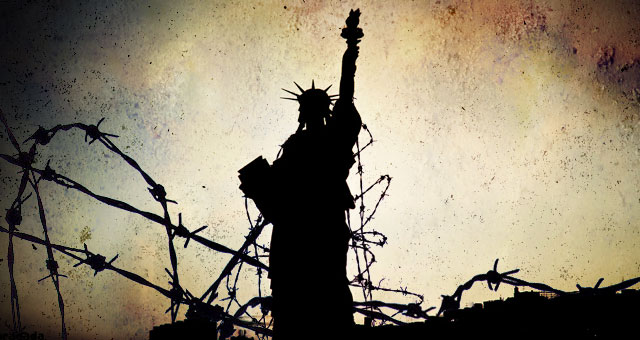
By Henry Giroux
For the last 40 years, the United States has pursued a ruthless form of neoliberalism that has stripped economic activity from ethical considerations and social costs. One consequence has been the emergence of a culture of cruelty in which the financial elite produce inhuman policies that treat the most vulnerable with contempt, relegating them to zones of social abandonment and forcing them to inhabit a society increasingly indifferent to human suffering. Under the Trump administration, the repressive state and market apparatuses that produced a culture of cruelty in the 19th century have returned with a vengeance, producing new levels of harsh aggression and extreme violence in US society. A culture of cruelty has become the mood of our times — a spectral lack of compassion that hovers over the ruins of democracy.
While there is much talk about the United States tipping over into authoritarianism under the Trump administration, there are few analyses that examine how a culture of cruelty has accompanied this political transition, and the role that culture plays in legitimating a massive degree of powerlessness and human suffering. The culture of cruelty has a long tradition in this country, mostly inhabiting a ghostly presence that is often denied or downplayed in historical accounts. What is new since the 1980s — and especially evident under Donald Trump’s presidency — is that the culture of cruelty has taken on a sharper edge as it has moved to the center of political power, adopting an unapologetic embrace of nativism, xenophobia and white nationalist ideology, as well as an in-your-face form of racist demagoguery. Evidence of such cruelty has long been visible in earlier calls by Republicans to force poor children who get free school lunches to work for their meals. Such policies are particularly cruel at a time when nearly «half of all children live near close to the poverty line.» Other instances include moving people from welfare to workfare without offering training programs or child care, and the cutting of children’s food stamp benefits for 16 million children in 2014. Another recent example of this culture of cruelty was Rep. Steve King (R-Iowa) tweeting his support for Geert Wilders, a notorious white supremacist and Islamophobic Dutch politician.
Focusing on a culture of cruelty as one register of authoritarianism allows us to more deeply understand how bodies and minds are violated and human lives destroyed. It helps us to acknowledge that violence is not an abstraction, but is visceral and, as Brad Evans observes, «should never be studied in an objective and unimpassioned way. It points to a politics of the visceral that cannot be divorced from our ethical and political concerns.» For instance, it highlights how Trump’s proposed budget cuts would reduce funding for programs that provide education, legal assistance and training for thousands of workers in high-hazard industries. As Judy Conti, a federal advocacy coordinator [at the National Employment Law Project] points out, these cuts would result in «more illness, injury and death on the job.»
Rather than provide a display of moral outrage, interrogating a culture of cruelty offers critics a political and moral lens for thinking through the convergence of power, politics and everyday life. It also offers the promise of unveiling the way in which a nation demoralizes itself by adopting the position that it has no duty to provide safety nets for its citizens or care for their well-being, especially in a time of misfortune. Politically, it highlights how structures of domination bear down on individual bodies, needs, emotions and self-esteem, and how such constraints function to keep people in a state of existential crisis, if not outright despair. Ethically the concept makes visible how unjust a society has become. It helps us think through how life and death converge in ways that fundamentally transform how we understand and imagine the act of living — if not simply surviving — in a society that has lost its moral bearing and sense of social responsibility. Within the last 40 years, a harsh market fundamentalism has deregulated financial capital, imposed misery and humiliation on the poor through welfare cuts, and ushered in a new style of authoritarianism that preys upon and punishes the most vulnerable Americans.
The culture of cruelty has become a primary register of the loss of democracy in the United States. The disintegration of democratic commitments offers a perverse index of a country governed by the rich, big corporations and rapacious banks through a consolidating regime of punishment. It also reinforces the workings of a corporate-driven culture whose airwaves are filled with hate, endless spectacles of violence and an ongoing media assault on young people, the poor, Muslims and undocumented immigrants. Vast numbers of individuals are now considered disposable and are relegated to zones of social and moral abandonment. In the current climate, violence seeps into everyday life while engulfing a carceral system that embraces the death penalty and produces conditions of incarceration that house many prisoners in solitary confinement — a practice medical professionals consider one of the worse forms of torture.
In addition, Americans live in a distinctive historical moment in which the most vital safety nets, social provisions, welfare policies and health care reforms are being undermined or are under threat of elimination by right-wing ideologues in the Trump administration. For instance, Trump’s 2017 budgetary proposals, many of which were drafted by the hyperconservative Heritage Foundation, will create a degree of imposed hardship and misery that defies any sense of human decency and moral responsibility.
Public policy analyst Robert Reich argues that «the theme that unites all of Trump’s [budget] initiatives so far is their unnecessary cruelty.» Reich writes:
His new budget comes down especially hard on the poor — imposing unprecedented cuts in low-income housing, job training, food assistance, legal services, help to distressed rural communities, nutrition for new mothers and their infants, funds to keep poor families warm, even «meals on wheels.» These cuts come at a time when more American families are in poverty than ever before, including 1 in 5 children. Why is Trump doing this? To pay for the biggest hike in military spending since the 1980s. Yet the U.S. already spends more on its military than the next 7 biggest military budgets put together. His plan to repeal and «replace» the Affordable Care Act will cause 14 million Americans to lose their health insurance next year, and 24 million by 2026. Why is Trump doing this? To bestow $600 billion in tax breaks over the decade to wealthy Americans. This windfall comes at a time when the rich have accumulated more wealth than at any time in the nation’s history.
This is a demolition budget that would inflict unprecedented cruelty, misery and hardship on millions of citizens and residents. Trump’s populist rhetoric collapses under the weight of his efforts to make life even worse for the rural poor, who would have $2.6 billion cut from infrastructure investments largely used for water and sewage improvements as well as federal funds used to provide assistance so they can heat their homes. Roughly $6 billion would be cut from a housing budget that benefits 4.5 million low-income households. Other programs on the cutting block include funds to support Habitat for Humanity, the homeless, energy assistance to the poor, legal aid and a number of antipoverty programs. Trump’s mode of governance is no longer modeled on «The Apprentice.» It now takes its cues from «The Walking Dead.»
If Congress embraces Trump’s proposal, poor students would be budgeted out of access to higher education as a result of a $3.9 billion cut from the federal Pell grant program, which provides tuition assistance for low-income students entering college. Federal funds for public schools would be redistributed to privately run charter schools, while vouchers would be available for religious schools. Medical research would suffer and people would die because of the proposed $6 billion cut to the National Institutes of Health.
Trump has also called for the elimination of the National Endowment for the Arts, the National Endowment for the Humanities, the Corporation for Public Broadcasting and the Institute of Museum and Library Services, making clear that his contempt for education, science and the arts is part of an aggressive project to eliminate those institutions and public spheres that extend the capacity of people to be imaginative, think critically and be well-informed.
The $54 billion that Trump seeks to remove from the budgets of 19 agencies designed to help the poor, students, public education, academic research and the arts would instead be used to increase the military budget and build a wall along the Mexican border. The culture of cruelty is on full display here as millions would suffer for the lack of loans, federal aid and basic resources. The winners would be the Departments of Defense, Homeland Security, the private prison industry and the institutions and personnel needed to expand the police state. What Trump has provided in this budget proposal is a blueprint for eliminating the remnants of the welfare state while transforming American society into a «war-obsessed, survival-of-the fittest dystopia.»
The United States is now on a war footing and has launched a war against undocumented immigrants, Muslims, people of color, young people, the elderly, public education, science, democracy and the planet itself, to say nothing of the provocations unfolding on the world stage. The moral obscenity and reactionary politics that inform Trump’s budget were summed up by Bernie Sanders: «At a time of massive income and wealth inequality, when 43 million Americans are living in poverty and half of older Americans have no retirement savings, we should not slash programs that senior citizens, children and working people rely on in order to provide a massive increase in spending to the military industrial complex. Trump’s priorities are exactly the opposite of where we should be heading as a nation.»
As more and more people find themselves living in a society in which the quality of life is measured through market-based metrics, such as cost-benefit analyses, it becomes difficult for the public to acknowledge or even understand the cost in human misery and everyday hardship that an increasing number of people have to endure.
A culture of cruelty highlights both how systemic injustices are lived and experienced, and how iniquitous relations of power turn the «American dream» into a dystopian nightmare in which millions of individuals and families are struggling to merely survive. This society has robbed them of a decent life, dignity and hope. I want to pose the crucial question of what a culture of cruelty looks like under a neofascist regime, and in doing so, highlight what I believe are some of its most crucial elements, all of which must be recognized if they are to be open to both criticism and resistance.
First, language is emptied of any sense of ethics and responsibility and begins to operate in the service of violence. This becomes evident as social provisions are cut for programs that help poor people, elderly people, impoverished children and people living with disabilities. This is also evident in the Trump administration’s call to scale back Medicaid and affordable, quality health insurance for millions of Americans.
Second, a survival-of-the-fittest discourse provides a breeding ground for the production of hypermasculine behaviors and hypercompetitiveness, both of which function to create a predatory culture that replaces compassion, sharing and a concern for the other. Under such circumstances, unbridled individualism and competition work to weaken democracy.
Third, references to truth and real consequences are dismissed, and facts give way to «alternative realities» where the distinction between informed assertions and falsehoods disappears. This politics of fabrication is on full display as the Trump administration narrates itself and its relationship to others and the larger world through a fog of misrepresentations and willful ignorance. Even worse, the act of state-sanctioned lying is coupled with the assertion that any critical media outlets and journalists who attempt to hold power accountable are producing «fake news.» Official lying is part of the administration’s infrastructure: The more authority figures lie the less they have to be taken seriously.
Fourth, in a culture of cruelty, the discourse of disposability extends to an increasing number of groups that are considered superfluous, redundant, excess or dangerous. In this discourse, some lives are valued and others are not. In the current moment, undocumented immigrants, Muslim refugees and Black people are targeted as potential criminals, terrorists or racial «others» who threaten the notion of a white Christian nation. Underlying the discourse of disposability is the reemerging prominence of overt white supremacy, as evidenced by an administration that has appointed white nationalists to the highest levers of power in the government and has issued a racist appeal to «law and order.» The ongoing rise of hate crimes should be no surprise in a society that has been unabashedly subjected by Trump and his cohorts to the language of hate, anti-Semitism, sexism and racism. Cultures of cruelty slip easily into both the discourse of racial cleansing and the politics of disposability.
Fifth, ignorance becomes glamorized, enforced through the use of the language of emotion, humiliation and eventually through the machinery of government deception. For example, Donald Trump once stated that he loved «uneducated people.» This did not indicate, of course, a commitment to serve people without a college education — a group that will be particularly disadvantaged under his administration. Instead, it signaled a deep-seated anti-intellectualism and a fear of critical thought itself, as well as the institutions that promote it. Limiting the public’s knowledge now becomes a precondition for cruelty.
Sixth, any form of dependency in the interest of justice and care for the «other» is viewed as a form of weakness, and becomes the object of scorn and disdain. In a culture of cruelty, it is crucial to replace shared values and bonds of trust with the bonds of fear. For the caste of warriors that make up the Trump administration, politics embraces what might be called neoliberalism on steroids, one in which the bonds of solidarity rooted in compassion and underlying the welfare state are assumed to weaken national character by draining resources away from national security and placing too large a tax burden on the rich. In this logic, solidarity equates with dependency, a weak moral character, and is dismissed as anaemic, unreliable and a poor substitute for living in a society that celebrates untrammeled competition, individual responsibility and an all-embracing individualism.
Seventh, cruelty thrives on the language of borders and walls. It replaces the discourse of bridges, generosity and compassion with a politics of divisiveness, alienation, inadequacy and fear. Trump’s call for building a wall on the Mexican border, his endless disparaging of individuals and groups on the basis of their gender, race, religion and ethnicity, and his view of a world composed of the deadly binary of «friends» and «enemies» echo the culture of a past that lost its ethical and political moorings and ended up combining the metrics of efficiency with the building of concentration camps.
Eighth, all cultures of cruelty view violence as a sacred means for addressing social problems and mediating relationships; hence, the criminalization of homelessness, poverty, mental illness, drug addiction, surviving domestic violence, reproductive choice and more. The centrality of oppressive violence in the United States is not new, of course; it is entrenched in the country’s origins. Under Trump this violence has been embraced, openly and without apology, as an organizing principle of society. This acceleration of the reality and spectacle of violence under the Trump administration is evident, in part, in his call for increasing an already-inflated military budget by $54 billion. It is also evident in his efforts to create multiple zones of social abandonment and social death for the most vulnerable in society.
Ninth, cultures of cruelty despise democracy and work incessantly to make the word disappear from officially mandated state language. One example of this took place when Trump opted not to utter the word democracy in either his inaugural address or in his first speech to Congress. Trump’s hatred of democracy and the formative cultures that sustain it was on full display when he and his top aides referred to the critical media as the enemy of the American people and as an «opposition party.» A free press is fundamental to a society that takes seriously the idea that no democracy can exist without informed citizens. Trump has turned this rule on its head, displaying a disdain not only for a press willing to pursue the truth and hold politicians and corporations accountable, but also for those public spheres and institutions that make such a press possible. Under these circumstances, it is important to remember Hannah Arendt’s warning: «What makes it possible for a totalitarian or any other dictatorship to rule is that people are not informed … and a people that no longer can believe anything cannot make up its mind. It is deprived not only of its capacity to act but also its capacity to think and to judge.»
Tenth, all fascist regimes disparage, dismantle and destroy institutions, such as public and higher education and other public spheres where people can learn how to think critically and act responsibly. Evidence of an act of war against public spheres that are critical, self-reflective and concerned with the social good is visible in the appointment of billionaires, generals and ideological fundamentalists to cabinet positions running public agencies that many of them have vowed to destroy. What does it mean when an individual, such as Betsy DeVos, is picked to head the Department of Education even though she has worked endlessly in the past to destroy public education? How else to explain Trump appointing Scott Pruitt to head the Environmental Protection Agency, even though he does not believe that climate change is affected by human-produced carbon dioxide emissions and has spent most of his career actively opposing the authority of the EPA? At stake here is more than a culture of incompetency. This is a willful assault on public goods and the common good.
Eleventh, cultures of cruelty thrive when shared fears replace shared responsibilities. Under such conditions, an ever-expanding number of people are reduced to the status of a potential «terrorist» or «criminal,» watched constantly, and humiliated under the watchful eye of a surveillance state that inhabits practically every public and private space.
Twelfth, cultures of cruelty dispose of all vestiges of the welfare state, forcing millions to fend for themselves. Loneliness, powerlessness and uncertainty — fueled by the collapse of the public into the private — create the conditions for viewing those who receive much needed social provisions as cheaters, moochers or much worse. Under the Republican Party extremists in power, the welfare state is the enemy of the free market and is viewed as a drain on the coffers of the rich. There are no public rights in this discourse, only entitlements for the privileged, and rhetoric that promotes the moral superiority and unimpeachable character of the wealthy. The viciousness of these attacks is driven by the absolute idolatry of power of wealth, strength and unaccountable military might.
Thirteenth, massive inequalities in power, wealth and income mean time will become a burden for most Americans, who will be struggling merely to make ends meet and survive. Cruelty thrives in a society in which there seem to be only individual problems, as opposed to socially-produced problems, and it is hard to do the work of uniting against socially-produced problems under oppressive time constraints. Under such circumstances, solidarity is difficult to practice, which makes it easier for the ruling elite to use their power to engage in the relentless process of asset-stripping and the stripping of human dignity. Authoritarian regimes feed off the loyalty of those who benefit from the concentration of wealth, power and income as well as those who live in stultifying ignorance of their own oppression. Under global capitalism, the ultrarich are celebrated as the new heroes of late modernity, while their wealth and power are showcased as a measure of their innate skills, knowledge and superiority. Such spectacles function to infantilize both the general public and politics itself.
Fourteenth, under the Trump administration, the exercise of cruelty is emboldened through the stultifying vocabulary of ultranationalism, militarism and American exceptionalism that will be used to fuel further wars abroad and at home. Militarism and exceptionalism constitute the petri dish for a kind of punishment creep, in which «law and order» becomes code for the continued rise of the punishing state and the expansion of the prison-industrial complex. It also serves to legitimate a war culture that surrounds the world with military bases and promotes «democracy» through a war machine. It turns already-oppressive local police departments into SWAT teams and impoverished cities into war zones. In such a culture of cruelty, language is emptied of any meaning, freedom evaporates, human misery proliferates, and the distinction between the truth and lies disappears and the governance collapses into a sordid species of lawlessness, emboldening random acts of vigilantism and violence.
Fifteenth, mainstream media outlets are now a subsidiary of corporate control. Almost all of the dominant cultural apparatuses extending from print, audio and screen cultures are controlled by a handful of corporations. The concentration of the mainstream media in few hands constitutes a disimagination machine that wages a pedagogical war on almost any critical notion of politics that seeks to produce the conditions needed to enable more people to think and act critically. The overriding purpose of the corporate-controlled media is to drive audiences to advertisers, increase ratings and profits, legitimate the toxic spectacles and values of casino capitalism, and reproduce a toxic pedagogical fog that depoliticizes and infantilizes. Lost here are those public spaces in which the civic and radical imagination enables individuals to identify the larger historical, social, political and economic forces that bear down on their lives. The rules of commerce now dictate the meaning of what it means to be educated. Yet, spaces that promote a social imaginary and civic literacy are fundamental to a democracy if the young and old alike are to develop the knowledge, skills and values central to democratic forms of education, engagement and agency.
Underlying this form of neoliberal authoritarianism and its attendant culture of cruelty is a powerfully oppressive ideology that insists that the only unit of agency that matters is the isolated individual. Hence, mutual trust and shared visions of equality, freedom and justice give way to fears and self-blame reinforced by the neoliberal notion that individuals are solely responsible for their political, economic and social misfortunes. Consequently, a hardening of the culture is buttressed by the force of state-sanctioned cultural apparatuses that enshrine privatization in the discourse of self-reliance, unchecked self-interest, untrammeled individualism and deep distrust of anything remotely called the common good. Once again, freedom of choice becomes code for defining responsibility solely as an individual task, reinforced by a shameful appeal to character.
Many liberal critics and progressives argue that choice absent constraints feeds the rise of Ayn Rand’s ideology of rabid individualism and unchecked greed. But they are only partly right. What they miss in this neofascist moment is that the systemic cruelty and moral irresponsibility at the heart of neoliberalism make Ayn Rand’s vicious framework look tame. Rand’s world has been surpassed by a ruling class of financial elites that embody not the old-style greed of Gordon Gekko in the film Wall Street, but the inhumane and destructive avarice of Patrick Bateman in American Psycho. The notion that saving money by reducing the taxes of the rich justifies eliminating health care for 24 million people is just one example of how this culture of cruelty and hardening of the culture will play out.
Under the Trump administration, a growing element of scorn is developing toward the increasing number of human beings caught in the web of oppression, marginalization, misfortune, suffering and deprivation. This scorn is fueled by a right-wing spin machine that endlessly spews out a toxic rhetoric in which all Muslims are defined as «jihadists;» the homeless are cast as «lazy» rather than as victims of oppressive structures, failed institutions and misfortune; Black people are cast as «criminals» and subjected en masse to the destructive criminal punishment system; and the public sphere is portrayed as largely for white people.
The culture of hardness and cruelty is not new to American society, but the current administration aims to deploy it in ways that sap the strength of social relations, moral compassion and collective action, offering in their place a mode of governance that promotes a pageant of suffering and violence. There will, no doubt, be an acceleration of acts of violence under the Trump administration, and the conditions for eliminating this new stage of state violence will mean not only understanding the roots of neofascism in the United States, but also eliminating the economic, political and cultural forces that have produced it. Addressing those forces means more than getting rid of Trump. We must eliminate a more pervasive irrationality in which democracy is equated with unbridled capitalism — a system driven almost exclusively by financial interests and beholden to two political parties that are hardwired to produce and reproduce neoliberal violence.
http://www.truth-out.org/opinion/item/39925-the-culture-of-cruelty-in-trump-s-america




 Users Today : 40
 Total Users : 35490852
 Views Today : 44
 Total views : 3604267