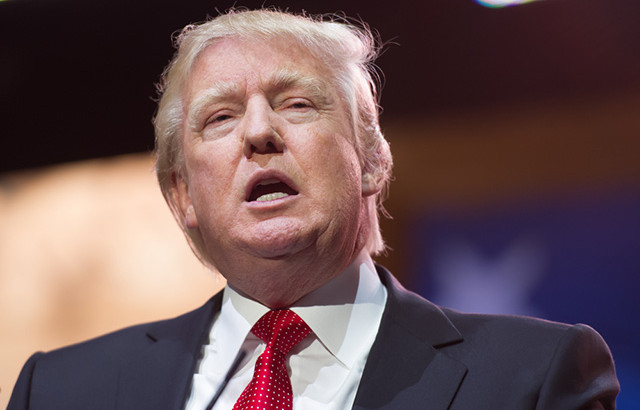
The lynch-mob mentality that permeates Donald Trump’s campaign rallies was made visible once again this month at a rally in Fayetteville, North Carolina, when Rakeem Jones, a 26-year-old Black protester, was sucker punched by a white Trump supporter. A video of the incident documents how, after Jones was punched, the audience cheered and the police threw Jones to the ground and handcuffed him. John McGraw, the man who admitted on camera that he had punched Jones, was later arrested. When asked why he did it, McGraw, 78, not only admitted to having committed the assault, but said he «liked it, clocking the hell out of that big mouth,» whom he said he thought might be a member of ISIS. He then added, «Yes, he deserved it. We don’t know who he is, but we know he’s not acting like an American … the next time we see him, we might have to kill him.»
For more original Truthout election coverage, check out our election section, «Beyond the Sound Bites: Election 2016.»
Of course, this incident was not out of the ordinary. Trump supporters have a consistent history of attacking those protesting Trump’s policies. When an activist named Mercutio Southall Jr. started shouting «Black Lives Matter!» at a Trump rally in Birmingham, Alabama, on November 21, 2015, some Trump supporters punched and choked him. Dara Lind observes that the Southall Jr. attack «isn’t an isolated incident. Trump supporters have gotten physical with protesters at several other events throughout his candidacy. A protester was dragged out of a Trump rally in Miami. A Trump supporter ripped up a protester’s sign. A Trump bodyguard was filmed sucker-punching a protester outside Trump Tower in early September. And at a rally in DC, photographers captured a Trump supporter pulling a protester’s hair.» Meanwhile, last week, after a March 11 rally was cancelled in Chicago, a number of skirmishes and fistfights broke out between Trump supporters and protesters. Many commentators noted that the rally offered a signpost of the escalating violence that has taken place at Trump’s rallies.
At their core, Trump’s politics and appeal are built around violence.
Trump has repeatedly indicated his support for such actions by saying he «would like to punch a protester in the face» and labeling protesters as «bad Americans.» He also incited this violence through his response to the November incident that occurred in Alabama, when Trump supporters punched and choked Southall Jr., who started shouting «Black Lives Matter!» as Trump started to speak. When asked about the incident, Trump responded in a Fox News interview with the remark: «Maybe he should have been roughed up.»
Such comments make clear that at their core, Trump’s politics and appeal are built around violence. Trump’s encouragement of violence can be seen very starkly in his decision to look into paying for McGraw’s legal fees. In defense of such actions,Trump told «Meet the Press» that McGraw «obviously loves his country,» and that he might «have gotten carried away.» Meanwhile, some Trump supporters havereportedly expressed interest in forming a makeshift militia called the Lion’s Guard to oppose «far-left agitators.»
To read more articles by Henry A. Giroux and other authors in the Public Intellectual Project, click here.
One would think that these incidents would be enough to convince liberals that Trump’s popularity is deeply tied to his open advocacy of racist violence, but a disconcerting number of liberal commentators have sought to downplay Trump’s racist and fascist tendencies.
Liberal Apologists for Trump
Some conservatives, such as Wall Street Journal columnist Peggy Noonan, predictably downplay the racist and fascist undertones of Trump’s candidacy, arguing that Trump is simply a symptom of massive disillusionment among Americans who are exhibiting a profound disdain, if not hatred, for the political and economic mainstream elites. Disappointingly, however, this argument is also often bolstered by liberals who go too far in their efforts to prove that criticism of Trump’s bigotry and racism cannot fully account for Trump’s political appeal.
For instance, historian Thomas Frank (also a former Wall Street Journal columnist)observes that Trump actually embraces a number of left-leaning liberal positionsthat make him popular with working-class white people with lower education levels. He cites Trump’s criticism of free trade agreements, his call for competitive bidding with the drug industry, his critique of the military-industrial complex and its wasteful spending, and his condemnation of companies that displace American workers by closing factories in the United States and opening them in much poorer countries such as Mexico in order to save on labor costs.
Trump’s appeal to fear, aggression and violence makes people more vulnerable to authoritarianism.
Purveyors of this view present the working class as a noble representative of a legitimate populist backlash against neoliberalism and appear to deem irrelevant the question of whether or not this backlash embraces an American form of fascism. Frank, however, has a long history of ignoring cultural issues, ideologies and values that do not simply mimic the economic system. As Ellen Willis has pointed out in her brilliant critique of Frank’s work, Frank makes the mistake of imagining popular and media culture, or what I call the educative nature of culture and politics, as simply «a pure reflection of the corporate class that produces it.» Hence, the racism, ultra-nationalism, bigotry, religious fundamentalism and other anti-democratic factors get downplayed in Frank’s analysis of Trump’s rise to power.
Journalist John Judis, a senior writer at The National Journal, extends this argument by comparing Trump with Bernie Sanders, claiming that they are both populists and outsiders while suggesting that Trump occupies a legitimate outsider status. Judis argues that Trump raises a number of criticisms regarding domestic policies for which he should be taken seriously by the American people and not simply dismissed as a racist, clown or pompous showman. In a piece for Vox, he writes:
Sanders and Trump differ dramatically on many issues — from immigration to climate change — but both are critical of how wealthy donors and lobbyists dominate the political process, and both favor some form of campaign finance reform. Both decry corporations moving overseas for cheap wages and to avoid American taxes. Both reject trade treaties that favor multinational corporations over workers. And both want government more, rather than less, involved in the economy…. Both men are foes of what they describe as their party’s establishment. And both campaigns are also fundamentally about rejecting the way economic policy has been talked about in American presidential politics for decades.
Some liberals such as scholar and blogger Arthur Goldhammer go so far as to suggest that Trump’s appeal is largely an extension of the «cult of celebrity» and his attentiveness to «a very rational and reasonable set of business practices» and to the anger of a disregarded element of the working class. Goldhammer asserts without irony that Trump «is not an authoritarian but a celebrity,» as if one cancels out the other. While celebrity culture confers authority in a society utterly devoted to consumerism, it also represents less a mode of false identification than a manufactured spectacle that cheapens serious and thoughtful discourse, and puts into play a focus on lifestyles and personalities. This has given rise to mainstream media that devalue politics, treat politicians as celebrities, refuse to give politicians a serious hearing and are unwilling to raise tough questions. This occurs because the media assume that celebrities are incapable of answering difficult questions and that the public is more concerned about their personalities than anything else.
Celebrity culture is not simply a mode of entertainment; it is a form of public pedagogy central to creating a formative culture that views thinking as a nuisance at best or dangerous at worse. Treated seriously, celebrity culture provides the architectural framing for an authoritarian culture by celebrating a deadening form of self-interest, narcissism and civic illiteracy. As the historian of Germany Fritz Sternhas argued, the dark side of celebrity culture can be understood by the fact that it gave rise to Trump and represents the merger of financial power and a culture of thoughtlessness.
Roger Berkowitz, the director of the Hannah Arendt Center, takes Goldhammer’s argument further and claims that Trump is a celebrity who knows how to work the «art of the deal» (a reference to the title of Trump’s well-known neoliberal manifesto). That is, he suggests that Trump’s appeal rests on his role as a celebrity with real business acumen and substance. In particular, Berkowitz argues that Trump’s appeal is due, in part, to his image as a smart and successful businessman who gets things done. Berkowitz goes into overdrive in his claim that Trump is not Hitler, as if that means he is not a demagogue unique to the American context.
The authoritarian tendencies of Trump’s followers cannot be explained through economic analyses alone.
Without irony, Berkowitz goes so far as to write that «it is important to recognize that Trump’s focus on illegal immigrants, protectionism, the wall on the Mexican border, and the terrorist danger posed by Muslims transcends race.» I am assuming Berkowitz means that Trump’s racist ideology, policies and rhetoric can be separated from the hateful policies for which he argues (such as torture, which is a war crime) and the violence he legitimates at his rallies. Indeed, Berkowitz implies that these policies and practices derive not from a fundamentally racist and xenophobic orientation but rather are rooted in Trump’s sound understanding of economic issues related to his business practices.
The sound business practices that Berkowitz finds admirable have a name: neoliberal capitalism. This neoliberal capitalist system has produced an untold degree of human misery, political corruption and inequality throughout the world. It has given us a social and political formation that promotes militarization, attacks the welfare state, aligns itself slavishly with corporate power and corrupts politics. Moreover this system seeks to justify the disproportionate police violence directed toward Black communities by referring to Black people as «criminals» and «thugs.» Proponents of this political and economic system may not constitute a fascist party in the strict sense of the word, but they certainly embrace toxic elements of a new style of American authoritarianism.
In declaring that Trump isn’t being racist and in claiming that the difference between Trump and Sanders is one of attitude and not policy, Berkowitz reveals the extent to which his eagerness to defend neoliberal capitalism requires him to overlook Trump’s racism. Berkowitz even goes so far as to downplay the differences between Trump and Sanders on racism by arguing that they have both «pushed the limits of racial propriety.» This statement whitewashes Trump’s overt racism and appears to suggest that both candidates share similar ideological positions toward people of color and inhabit the same racist landscape, truly a claim that borders on the absurd and represents an intellectual deceit in its claims to legitimate a false equivalency. Of course, if Berkowitz had used the word «racism» instead of «racial propriety,» the latter claim would not make sense given Sanders’ long history of fighting racial injustices.
I strongly doubt that Trump’s call to ban Muslims from entering the United States, his call to expel 11 million undocumented immigrants, his appeal to white nationalism, his intention to kill terrorists and their families as well, or his support for state-sponsored torture, among other egregious policy practices, constitute simply different attitudes between him and Bernie Sanders.
Trump attempts to generate intolerance out of misfortune while Sanders goes to the political, economic and social roots of the problems that cause it. Trump promotes an intense culture of fear that cannot be excused by appealing to his alleged good business practices or for that matter to his criticism of some of the Republican Party’s more regressive domestic and foreign policy endeavors. On the contrary, Trump’s appeal to fear, aggression and violence makes people, especially those who have been politically victimized, more vulnerable to authoritarianism.
The Downplaying of Trump’s Racism
Berkowitz’s argument is more than apologetic; it is a species of postracial discourse that became commonplace during the Obama years. It is also disingenuous and nonsensical. It is hard to make up such apologetic reasoning at a time in which racist invective and actions are more visible than ever: Police brutality against Black people is widespread; racist comments against Obama proliferate without apology; Black congregants are killed while praying in their church; white supremacists target immigrants, Muslims and Planned Parenthood with repeated acts of violence; and all the while the racially coded prison system is bursting at its seams. We also live at a time when a dangerous resurgence of racism, Islamophobia and anti-immigrant sentiment is on the rise. Against the reality of a society immersed if not saturated in racial violence, Berkowitz’s postracial and market-drenched discourse mimics a naive form of liberalism, if not a species of right-wing ideology too afraid to name itself, and too unwilling to address Trump’s authoritarian and myopic drive for power.
Trump echoes a fascist script that has been updated to address the fears and anxieties of people who feel betrayed by mainstream politics.
Critical race theorist David Theo Goldberg is right in arguing that this line of argument is a form of «postraciality [that] heightens the mode of racial dismissal» and «renders opaque the structures making possible and silently perpetuating racially ordered power and privilege» (see Goldberg’s book Are We All Postracial Yet?). Trump’s followers cannot be defined simply by an anger that is associated with oppressive economic institutions, policies and structures. They are also defined by an anti-democratic politics that embraces the long legacy of racialized human trafficking and enslavement, a hatred of immigrants and an embrace of the ethos of privatization.
The positions that many liberals such as Thomas Frank, Arthur Goldhammer and Roger Berkowitz have taken on Trump often sound like apologies for Trump’s reactionary utterances. Moreover, they tend to downplay his toxic racism, nativism, class bullying, demagogic policies and chilling embrace of violence. In focusing on Trump’s populism alone, these analyses ignore David Neiwert’s insight that Trump’s updated neo-fascist rhetoric is «designed to demonize an entire class of people by reducing them to objects fit only for elimination.»
What is disturbing about accounts that celebrate, however cautiously, Trump’s more liberal tendencies is that, in the words of sociologist Pierre Bourdieu, «they give racist contempt the impeccable alibi of ethical and secular legitimacy.» This type of restricted discourse runs the risk of absolving the Republican Party and Trump and his followers of some of their most vile, right-wing, nativist legacies. These liberal cover-ups do more than underplay Trump’s fascist tendencies; they also overlook a moment in which political authoritarianism is on the rise and in which the very fate of humanity and the planet are at risk. As Los Angeles Times reporters Don Lee and Kurtis Lee observe:
If Donald Trump were president, [he would end abortion rights, repeal Obamacare,] put U.S. ground troops in Iraq to fight Islamic extremists, rescind President Obama’s executive orders that protect millions of immigrants from deportation, eliminate American citizenship for U.S.-born children whose parents are in the country illegally and «police» but not necessarily revoke the nuclear pact with Iran. Trump wants to deport all immigrants in the U.S. illegally — an estimated 11 million people — but says he wouldn’t break up families because their families would be deported too. «We’re going to keep the families together … but they have to go,» he said in a wide-ranging interview on NBC’s «Meet the Press.» «We have to make a whole new set of standards. And when people come in, they have to come in legally.» Deportees who qualify could return, he said. Trump would end Obama’s Deferred Action for Childhood Arrivals program, which allows young people brought to the country illegally as children to work and attend college without facing deportation.
Trump’s toxic racism and discourse has been leading to violence for some time. According to an August 2015 article in Rolling Stone by Matt Taibbi, when two brothers from South Boston urinated on and severely beat with a metallic pipe a Latino man, «one of the brothers reportedly told police that ‘Donald Trump was right, all of these illegals need to be deported.'»
Taibbi adds:
When reporters confronted Trump, he hadn’t yet heard about the incident. At first, he said, «That would be a shame.» But right after, he went on: «I will say, the people that are following me are very passionate. They love this country. They want this country to be great again. But they are very passionate. I will say that.»
Trump later modified his response, one that both appeared to condone and legitimate the violence done in his name, but the fact remains that he is disseminating hate and creating the conditions for dangerous ideas to mobilize real-life violence in a society seething with a toxic disdain for immigrants. In what can only be interpreted as an openly racist justification for such violence — reminiscent of similar attacks against Jews in Nazi Germany — Trump’s initial response truly reflects the degree to which right-wing extremism has become an acceptable register of US politics.
The authoritarian tendencies of Trump’s followers cannot be explained through economic analyses alone. Denying the importance of racism, xenophobia, corporate-driven public pedagogies and a culture shaped by the financial elite greatly ignores modes of domination that go far beyond economic discontents and are produced and legitimated daily in mainstream cultural apparatuses. As Ellen Willis has pointed out, domination is not simply structural — it takes shape through beliefs, persuasion, rhetoric and the pedagogical dimensions of politics. What Trump has tapped into is not simply economic resentment but also decades of a formative culture that is as divisive as it is anti-democratic. Violence is ubiquitous in US society and has become normalized, furthering a politics of anxiety, uncertainty and bigotry.
Trump has taken advantage of a proliferating culture of fear to create what Susan Sontag has described as a mimicry of fascinating fascism that trades in a carnival of violence and hatred. This spectacle furthers a politics of nihilism and brings many Americans closer to the abyss of proto-fascism. Under such circumstances, it is fair to argue that many of Trump’s supporters have embraced the core elements of totalitarian politics. In this instance, politics has become a staged event, a spectacle that both normalizes violence and makes it a source of pleasure.
Trump echoes a fascist script that has been updated to address the fears and anxieties of people who feel betrayed by mainstream politics and channel their anger toward immigrants, Black people and anyone they deem un-American. Given the way in which racism mixes with the growing fear and anger over economic precariousness of working-class white people in this country, is it any wonder, that Trump presents himself as the strong leader, the mythic strongman offering redemption, revenge and a revitalized white Christian United States? Trump is not only the new face of proto-fascism, but also the logical end result of neoliberal capitalism’s numerous assaults on democracy itself.
May not be reprinted without permission .
Publicado originalmente en http://www.truth-out.org/news/item/35240-why-are-liberal-commentators-acting-as-apologists-for-trump-s-racism




 Users Today : 10
 Total Users : 35491032
 Views Today : 11
 Total views : 3604539