Page 696 of 1671
1 694 695 696 697 698 1.671

México: Salud, Educación y Bienestar

México/ 22 de mayo de 2018/Fueente: http://www.aztecanoticias.com.mx

UNICEF DESTACA AVANCES EN DERECHOS DE LA NIÑEZ EN MÉXICO

Durante el Informe Anual 2017 de Unicef, en el auditorio principal del Museo de Memoria y Tolerancia, Skoog señaló que esta organización cumplirá 64 años en México.

México, 9 de mayo.- El representante del Fondo de las Naciones Unidas para la infancia (Unicef) en México, Christian Skoog, destacó que el país ha logrado diversos avances para garantizar los derechos de la niñez, pero aún existen rezagos que deben atenderse.

Hay 39.2 millones de niños, niñas y adolescentes, de los cuales 80 por ciento no alcanza los conocimientos requeridos de su nivel educativo; 20 por ciento entre cero y cinco años no obtiene un desarrollo adecuado, y 33.2 por ciento entre seis y 11 años presenta obesidad y sobrepeso, dijo.

Durante el Informe Anual 2017 de Unicef, en el auditorio principal del Museo de Memoria y Tolerancia, Skoog señaló que esta organización cumplirá 64 años en México.

Entre los mayores desafíos, consideró, están 12 millones de niñas y niños de entre cero y cinco años de edad, que  tienen el menor nivel de desarrollo humano; así como rezagos en términos de aprendizaje, “ya que ocho de cada 10 estudiantes no alcanzan los conocimientos requeridos de su nivel educativo”.

Entre los avances, resaltó que el trabajo coordinado de Unicef y diversas organizaciones de civiles ha logrado definir a los 18 años como la edad mínima para contraer matrimonio, “y solo faltan cuatro estados para quitar las excepciones”.

También se contribuyó al plan nacional para poner fin a la violencia contra la niñez, a través de un proceso participativo con diversos sectores de la sociedad.

Christian Skoog expresó que entre los mayores pendientes se requiere evitar que los niños migrantes sean detenidos, difundir las procuradurías de protección de la niñez y dotarlas de presupuesto; así como mejorar la logística para atender las áreas afectadas por emergencias.

“La visión de Unicef es un mundo en el que nuestro trabajo ya no sea necesario; un mundo en el que cada niño esté sano, seguro, educado, atendido y protegido”, externó.

Detalló que en 2017, Unicef recibió recursos por 280 millones 629 mil 550 pesos provenientes de recaudación local e internacional, de los cuales 39 por ciento fueron para emergencias.

El funcionario aclaró que “75 por ciento de los recursos que ejerce Unicef en el país son recaudados localmente, pero de los 108 millones de pesos que logramos recaudar para las emergencias en septiembre, la gran mayoría, 80 por ciento provinieron de fuera, lo cual muestra la solidaridad del mundo con los niños y niñas mexicanos”.

A su vez, la oficial nacional de Educación de Unicef, Paola Gómez, recalcó que entre los mayores compromisos de la organización en 2017 tuvo el de mantener acercamientos con dependencias como la Secretaría de Educación Pública (SEP), para garantizar los estudios a los niños, pese a los daños causados por el sismo de septiembre en sus escuelas.

En tanto, Ricardo Bucio Mujica, secretario Ejecutivo del Sistema Nacional de Protección Integral de Niñas, niños y adolescentes recordó que la organización internacional no solo ha invitado a las autoridades, sino a la sociedad a “remontar el marcador a favor de los niños y las niñas”, para fortalecer la responsabilidad del Estado mexicano con este sector, a fin de mantener una mayor visibilidad en todos los ámbitos.

Fuente de la Noticia:

http://www.aztecanoticias.com.mx/unicef-destaca-avances-en-derechos-de-la-ninez-en-mexico/3282654

Comparte este contenido:

La escuela mexicana; realidad y futuro para el mundo actual (Primera parte)

Por: Alberto Salvador Ortíz Sánchez*

Para nadie en el sector educativo mexicano son extraños los conceptos de liderazgo y gestión educativa como una parte central de la organización escolar y la autonomía de trabajo que indica la directriz normativa de la Secretaria de Educación Pública aplicable a las escuelas públicas básicas de nuestro país.

Entrar a este asunto es por demás complejo y delicado, más aún  en los tiempos políticos actuales donde está por renovarse la presidencia de la República y donde las voces que no están de acuerdo con una u otra posición política suelen ser acalladas, tachadas o tildadas de “populistas” o “vendidas al sistema”.

Más allá de las dudas razonables expuestas tanto por una parte importante del magisterio nacional disidente como de especialistas educativos y teóricos de reconocido prestigio sobre la actual política educativa que se dicta en México, cabe hacer espacio para una reflexión propositiva que se enfoque esencialmente en el logro de los aprendizajes de nuestros alumnos puesto que es la realidad a la que el sistema educativo se enfrenta desde tiempos inmemoriales y que de no tomarse en serio desde luego seguirá siendo el talón de Aquiles de una nación en pleno desarrollo como es la nuestra, donde no solo la escuela debe formar para alcanzar un grado de preparación formal, sino también dar herramientas y conocimientos para insertarse en la vida diaria con todo lo que ello implica.

El denominado Nuevo Modelo Educativo, próximo a entrar en vigor en un par de meses, múltiplemente vapuleado y puesto en duda tanto en su planteamiento como en sus efectos concretos, ofrece desde luego para quien lo desee, una oportunidad de poner en práctica una concepción diferente de ver a la escuela, los alumnos y en general a todos aquellos involucrados en la jornada diaria de cualquier institución. En ese sentido, es una manera inmediata de romper los estados de comodidad adquiridos por tantas y tantas figuras y autoridades educativas.

La primera autoridad en una institución educativa es el director o directora. De su mano, visión, trabajo y compromiso, dependerá en buena medida parte del éxito o fracaso de él mismo y su equipo docente para que los alumnos logren el máximo logro de los aprendizajes. Pero no solo es el directivo y los docentes bajo su cargo, sino también el apoyo y compromiso de los padres de familia y la comunidad.

De acuerdo con el Acuerdo 02/05/16 donde se establecen los lineamientos para la constitución, organización y funcionamiento de los Consejos de Participación Social en la Educación, para llevar con orden la administración y gestión de un centro educativo, haciendo ejercicio de los conceptos de gestión y participación social, se requiere un perfil directivo que reúna al menos algunas de las siguientes características o atributos (habilidades, destrezas, actitudes e intenciones y conocimientos), para efecto de ser un instrumento efectivo de la gestión de la participación social en cualquier centro educativo, no solamente en ciertos ámbitos o regiones.

Habilidades: capacidad de diálogo, escucha activa, observación en varios planos, negociación.

Destrezas: cortar, pegar, dibujar, almacenar, jardinería, plomería, conocimiento de materiales y técnicas para construcción, uso y dominio de papelería de oficina y herramientas del medio donde esté la escuela.

Actitudes e intenciones: progreso, movilización, logro de los aprendizajes, mejora material y social de la comunidad.

Conocimientos: normativos, técnico pedagógicos, técnico legales, en materia de protección civil, derechos humanos, contabilidad y rendición de cuentas.

Esto, porque se requiere que un directivo sea de tal modo activo, dinámico y líder social, que por ese ejemplo de trabajo sea motivo de transformación de una realidad que ahí está y que no podrá cambiar a menos que todos los involucrados en ella participen. Si bien la participación social es un motor muy fuerte para la reforma educativa, este no tendrá efectos suficientes y fuertes en una comunidad escolar que no esté comprometida con la transformación y el cambio real y trascendental.

Hay que partir de varias consideraciones para atender el concepto de autonomía, desde la concepción teórica hasta su modalidad práctica. Desde la visión de investigadores como Joaquín Garín y Lucia Rivera, se considera a la autonomía como el margen mínimo que debe empatar organización con normatividad. Jurídicamente, el derecho humano a la educación tiene un margen y finalidad suprema constitucional que es el máximo logro de los aprendizajes; a su vez, la autonomía de gestión es la capacidad de los centros educativos para tomar decisiones propias que vayan en beneficio de la comunidad educativa.

Luego entonces, una escuela, que se considere auténticamente autónoma (dentro de la normativa educativa vigente) debe tener la capacidad de tomar esas decisiones siempre y cuando tenga un mínimo de orden y organización tal, donde no solo se multipliquen indicaciones de manera vertical, sino donde todos los integrantes puedan opinar, organizar, delegar, retomar, ejecutar, evaluar y reconsiderar aquellas acciones que como colectivo de profesionales toman para beneficio de sus centros de trabajo.

En este marco mínimo de orientación y organización, el equipo SATE de cada zona escolar (concebido a partir de la implementación de la reforma educativa de 2013) se erige como una herramienta de apoyo y seguimiento a la autonomía de las instituciones educativas a su cargo a través de la atención de dos esferas fundamentales del trabajo de los colectivos docentes: una, la del estado que guardan aquellas condiciones que permitan a los docentes tomar decisiones colegiadamente (en el caso de nuestro país, las condiciones mínimas para tomar decisiones colegiadamente se erigen desde los rasgos de la normalidad mínima) y dos, apoyar, verificar, orientar, retomar, rescatar, retroalimentar (en el marco constitucional del servicio educativo vigente) que aquellas decisiones tomadas sean cumplidas, honradas o seguidas por quienes las promovieron y se comprometieron a llevarlas a cabo.

Fuente del Artículo:

La escuela mexicana; realidad y futuro para el mundo actual (Primera parte)

Comparte este contenido:

No a la violencia infantil en la educación: Unicef

México/ 22 de mayo de 2018/Fuente: https://www.unotv.com

En México, así como en el resto del continente Americano, la violencia hacia los niños durante la impartición de educación es una constante, situación que debe ser frenada, exhorta la Unicef.

La directora del Fondo de Naciones Unidas para la Infancia para América Latina y El CaribeMarita Perceval, indicó que apenas 10 países de la región cuentan con legislaciones que prohíben de manera contundente el castigo físico entre niños y adolescentes, algunos son: Argentina, Bolivia, Brasil, Costa Rica y Venezuela.

Perceval comentó que se tiene la creencia errónea de que un tirón de cabello y un jalón de orejas sirven para corregir algunas de las conductas de los menores de edad; sin embargo, puntualizó en que existe evidencia científica que no avala dichas acciones.

Señaló que con base en un estudio del organismo internacional, en 17 países de la región los niños expuestos a castigos corporales severos tienen 2.4 menos de posibilidades de un desarrollo adecuado; además, para quienes viven en condiciones de disciplina violenta, el riesgo de mostrar comportamientos agresivos aumenta en 1.6 veces.

Precisó que 2 de cada 3 infantes menores de cinco años de edad son regularmente sometidos a disciplina violenta, no solo en sus hogares, sino que en algunas escuelas aún cuentan con este tipo de métodos.

Finalmente, la directora de la Unicef advirtió que estos castigos llegan a provocar que algunos niños dejen de hablar, o bien a responder a cualquier tipo de estímulos al ser víctimas de castigos físicos severos.

Fuente de la Noticia:

https://www.unotv.com/noticias/portal/internacional/detalle/no-a-la-violencia-infantil-en-la-educacion-unicef-687720/

Comparte este contenido:

Mensaje y destinatario

Por: Carlos Ornelas

En contraste con campañas presidenciales anteriores, el tema de la educación enciende debates. Se discute más que nada la Reforma Educativa, si sigue, si se abroga o se modifica; que está bien, pero que hay cambiar la evaluación; que hay que seguir con ella, a pesar de la oposición de la Coordinadora Nacional de Trabajadores de la Educación, nos dicen.

Parece obvio que los candidatos persiguen el voto de los docentes. La mayor parte de sus mensajes se dirige a ellos, escasos a los padres de familia y a la sociedad. No obstante, a pesar del tono de campaña, aquí y allá afloran planteamientos que indican las aristas de por dónde podrá ir la política educativa en el siguiente gobierno. Indicar, en este contexto enrevesado, no quiere decir que se discuta a fondo la pedagogía, los fines de la educación o la mejor educación posible para el futuro. La puja política se destina a ganar votos.

Me pregunto a qué se deberá que la mayoría de las ofertas de los candidatos en el campo educativo se dirija a los maestros, que son pocos, en comparación con el número de votantes que pueden arrojar los paterfamilias. ¿Por qué tanta atención al Sindicato Nacional de Trabajadores de la Educación y a la CNTE y poca a otros actores?

He escuchado o leído tres conjeturas que no se excluyen entre sí. La primera: El gremio está organizado y como tal, representa una fuerza política considerable. No sólo es el número de votos, es la participación en los grupos de “a pie”, en visitas casa por casa, representantes de casillas, observadores electorales y, además, los maestros pueden convencer a sus familiares cercanos de votar por uno u otro candidato.

No obstante, el SNTE ya no es la maquinaria corporativa formidable que hizo historia electoral en el régimen de la Revolución Mexicana. No es la organización que seguía la consigna del gobierno, no es ya más un todo orgánico y bajo un control riguroso. El SNTE es una confederación de grupos con intereses más diversos cada vez.

La segunda presunción, quizá más sofisticada, reza que, al dirigirse a los maestros, los candidatos envían mensajes a toda la sociedad para mostrar su interés por la educación. Al poner esmero en los actores más importantes del sistema escolar, revelan —aunque de manera subliminal— que les concierne un asunto que atañe a la nación.

Tal vez, pero, al poner a los docentes en el centro, también indican que seguirán en la mira de la política educativa —ya como víctimas, ya como villanos— y la sociedad y los niños en segundo plano. Esto lo intuyen los activistas de las organizaciones de la sociedad civil y por eso convocaron los aspirantes a la Presidencia a que firmaran un pacto (10 por la educación) para mejorar al sistema en su conjunto y no nada más colocar el acento en el magisterio.

La tercera tesis se enfoca a la plaza pública. No importa tanto lo que digan los candidatos sobre otros asuntos: El aprendizaje, la violencia escolar o bullying, el currículum, la pedagogía o los libros de texto, la prensa y los medios destacan los puntos sobre los maestros. Por ejemplo, las notas del 9 de enero en los periódicos nacionales reportaron poco de los puntos del Foro 10 por la educación, que no tengan relación directa con los maestros. Es más, la nota principal la dio Andrés Manuel López Obrador con su ausencia.

Quizá ésta explique algo de lo que le interesa a los medios —y el medio es el mensaje, diría McLuhan—, pero es insuficiente para entender por qué otros temas no “pegan” tanto y si se habla de los maestros sí.

Mi respuesta es más sencilla. La Reforma Educativa y la evaluación docente, aunque no los hayan finiquitado, debilitaron santuarios del SNTE y la CNTE; hubo cambios, unos de fondo, otros de superficie, pero tuvieron consecuencias. Allí está la cuestión.

Fuente del Artículo:

Mensaje y destinatario

Comparte este contenido:

EEUU: Michigan’s floundering education system has left its children far behind

EEUU/May 22, 2018/Source: http://www.mlive.com

There’s no way around it: Michigan’s education system is floundering.

From early literacy to middle-school math, Michigan students are not keeping up with their peers in top-performing states.

Big changes are needed if Michigan wants to turn itself around, experts say.

«Michigan, if it thinks the status quo is going to be fine, we’ll have a race to the bottom, and we’re almost there right now,» said Grand Valley State University President Thomas Haas, who chaired Gov. Rick Snyder’s 21st Century Education Commission, a panel that developed recommendations to improve Michigan’s education system.

Perhaps no issue is more important for Michigan’s future: In a global economy, a well-educated workforce is critical – and an area where Michigan lags behind.

It starts with reaching and educating Michigan school children even earlier than kindergarten. That means providing more families with affordable access to high-quality early childhood education and funding K-12 schools based on student need, experts say.

It also means ensuring all children have access to top-notch teachers and boosting the number of residents with college degrees or certificates in areas such as the skilled trades.

The relatively low numbers of college graduates and people with post-secondary training mean good jobs here can go begging. The state’s fast-growing occupations are those that require post-secondary training. In 2016, 2 percent of Michigan adults with a bachelor’s degree were unemployed compared to 7 percent of those with only a high school diploma.

Low rates of educational attainment means stagnating wages and tax bases that stifle economic growth. It means Michigan is less competitive in recruiting new employers.  A major reason Detroit wasn’t a finalist in the new Amazon Headquarters was that the region didn’t have the talent pool needed for the jobs.

It hurts individuals. It hurts entire communities.

«It’s really about our vitality in every aspect for the future in our state,» said Amber Arellano, executive director of The Education Trust-Midwest, a nonpartisan education policy and research group. «It’s whether you want to stay here and raise your kids.»

In a series that began in April, MLive is taking a hard look at Michigan’s biggest challenges – our economy, education system and infrastructure – from the historical importance, to how we got where we are today, to possible solutions.

We’ll use the series to frame our discussion with candidates as we head into the 2018 midterm elections and choose Michigan’s newest leaders.

This month, we’re taking a deep dive into Michigan’s educational pipeline.

K-12 schools

Michigan students are below the national average in federal test scores, in graduating high school in four years and in college enrollment.

* Michigan ranked 36th in fourth-grade reading proficiency in the most round of the National Assessment of Educational Progress tests.

* About 80 percent of Michigan’s Class of 2017 graduated high school in four years compared to a national average of 84 percent.

*Not quite 32 percent of Michigan adults age 25 to 34 have a bachelor’s degree compared to 35 percent in that age group nationwide.

And that’s after Michigan has spent the past two decades rolling out various strategies to improve Michigan’s schools.

Use regions/landmarks to skip ahead to chart and navigate between data series.

Michigan has opened the door to school choice and charter schools. Rigorous high school graduation requirements have been implemented. High-stakes testing has been adopted. Teacher tenure laws have been reformed. And a now-defunct state-reform district was created.

Some of those efforts, such as high academic standards, are important and should stay in place, experts say. But overall, they have not pushed the needle in student achievement.

What’s needed, education leaders say, is transformational change.

That includes an overhaul of the school-funding formula, according to the School Finance Research Collaborative, a coalition of educators, nonprofits and philanthropic groups.

Michigan isn’t providing adequate funding for K-12 education, and policymakers must take into greater account the needs of each child, the collaborative said in a January 2018 report.

About half of Michigan students qualify for the subsidized lunch program, and there’s a huge academic achievement gap between those children and students from middle-class and affluent families.

Closing that gap requires more support services: more tutoring and specialized instruction, more after-school programs, more summer school. Michigan’s funding formula needs to reflect those costs, the collaborative says.

Another big issue: Getting more experienced, high-quality teachers in Michigan’s most troubled school districts.

Right now, Michigan’s best teachers tend to gravitate to more affluent districts where the pay tends to be much better and the public support is much greater.

But that shortchanges students in high-poverty communities most in need of skilled, experienced teachers.

Birth to age 5

Another recommendation of the governor’s commission: give more families access to high-quality, early childhood education.

That means offering all 4-year-olds access to state-funded preschool, and helping more families pay for quality childcare for children ages birth to three, educators and advocacy groups say.  Currently, slightly less than half of Michigan 3- and 4-year-olds attend a pre-K program, according to Census data.

«People can’t afford or don’t have access to quality child care in their communities,» said Matt Gillard, president and CEO of Michigan’s Children, which advocates for services for low-income families. «This is a huge challenge right now.»

Research shows that 90 percent of brain development occurs in the first five years of life, which means birth-to-5 services offer the best bang for the buck for improving academic outcomes.

Higher education

Investments are crucial in higher education, too.

By 2020, about two-thirds of jobs are expected to require training beyond high school, whether that be a college degree or an associate degree or certificate in areas such as advanced manufacturing or information technology.

Yet Michigan lags in the number of college graduates and people with post-secondary training. About 28 percent of Michigan adults age 25 and older have a bachelor’s degree, compared to a national average of 31 percent.

Boosting Michigan’s number is key if the state wants to lure employers to the state and ensure that residents have the skills needed to land good, high-paying jobs, said Lou Glazer, president of Michigan Future Inc., a nonprofit organization focused on improving the state’s economy.

«The choice is increase college attainment or permanently be one of the poorer states in the country,» Glazer said. «That’s the stakes.»

Over the course of the next several months, MLive will explore issues of economy, education and infrastructure, and what Michigan leaders need to do to create a better future. We’d love to hear from you, about your struggles and your wins, as you navigate Michigan’s economic landscape. We want to use your voice and your questions to frame the conversation with candidates as we head into midterm elections. Have a story to share, send us an email to michiganbeyond@mlive.com

Source:

http://www.mlive.com/news/index.ssf/2018/05/michigan_beyond_education.html

 

Comparte este contenido:

Maestros en México, entre los peores pagados del mundo

México / 20 de mayo de 2018 / Autor: Gerardo Cano / Fuente: LaNetaNoticias

El estudio de la OCDE revela que los maestros mexicanos tienen salarios muy por debajo de la media

Este 15 de mayo se conmemora el Día del Maestro, fecha en la que se reconoce el trabajo que realizan los docentes en todos los niveles de educación a nivel nacional.

El origen de este día en nuestro país se dio hace un siglo cuando el Congreso de la Unión oficializó esta fecha a nivel nacional como reconocimiento a los profesores.

Sin embargo, millones de maestros en México no pueden celebrar el día como ellos quisieran, pues sus salarios son equivalentes a los de un trabajador de industria con prestaciones básicas.

Por si fuera poco, de acuerdo con cifras de la Organización para la Cooperación y el Desarrollo Económicos (OCDE), el salario inicial para un maestro de escuela sin experiencia en México es de aproximadamente 18 mil dólares al año (alrededor de 156 mil pesos), poco más de 13 mil pesos al mes. Por el otro lado, la percepción máxima para un profesor en México es de 37 mil dólares (425 mil pesos).

Estos datos de la OCDE revelan que México ocupa el séptimo peor lugar en salarios de maestros a nivel global, sólo superado por Grecia, Turquía, Zambia, Honk Kong y Polonia. El país con el peor salario en el mundo lo tiene Eslovaquia, con un monto de 19 mil dólares para un profesor con más de quince años de experiencia.

Por su parte, el Instituto Nacional de Estadística, Geografía e Informática (Inegi) reveló que el 54 por ciento de los profesores mexicanos laboran en promedio 28 horas a la semana; el 38 por ciento trabaja de 35 a 48 horas semanales y sólo un tres por ciento más de 48 horas.

Con la llegada de la reforma educativa, la Secretaría de Educación Pública modificó los estatutos de los profesores y eliminó acciones como la herencia de la planta laboral, pues por varias décadas maestros le dejaban el puesto a sus hijos y así sucesivamente eliminando la posibilidad de que nuevos profesores se hicieran de un espacio.

Fuente de la Noticia:

Maestros en México, entre los peores pagados del mundo

Comparte este contenido:

How to Plan and Implement Continuous Improvement In Schools

USA / May 20, 2018 / Author: Katrina Schwartz / Source: KQED News

In the classroom, good teachers constantly test small changes to class activities, routines, and workflow. They observe how students interact with the material, identify where they trip up and adjust as they go. This on-the-fly problem solving is so common in classrooms many teachers don’t realize they’re even doing it, and the expertise they are gathering is rarely taken into account when schools or districts try to solve larger, systematic problems.

In  education research, researchers come up with ideas they think will improve teaching and then set up laboratory experiments or classroom trials to test that idea. If the trial goes well enough that idea gets put on a list of research-approved practices. While research-informed practices are important, this process can often mean that the interventions are unrealistic or disconnected from the hectic reality of many classrooms, and are rarely used. But what if teachers themselves were the research engine — the spark of continued improvement?


The Carnegie Foundation is trying to bridge that gap in identifying techniques that work and «create a much more democratic process in which teachers are involved in identifying and solving problems of practice that matter to them,” said Dr. Manuelito Biag, an associate in network improvement science at the foundation. Biag previously worked on developing research-practitioner partnerships for Stanford’s Graduate School of Education.

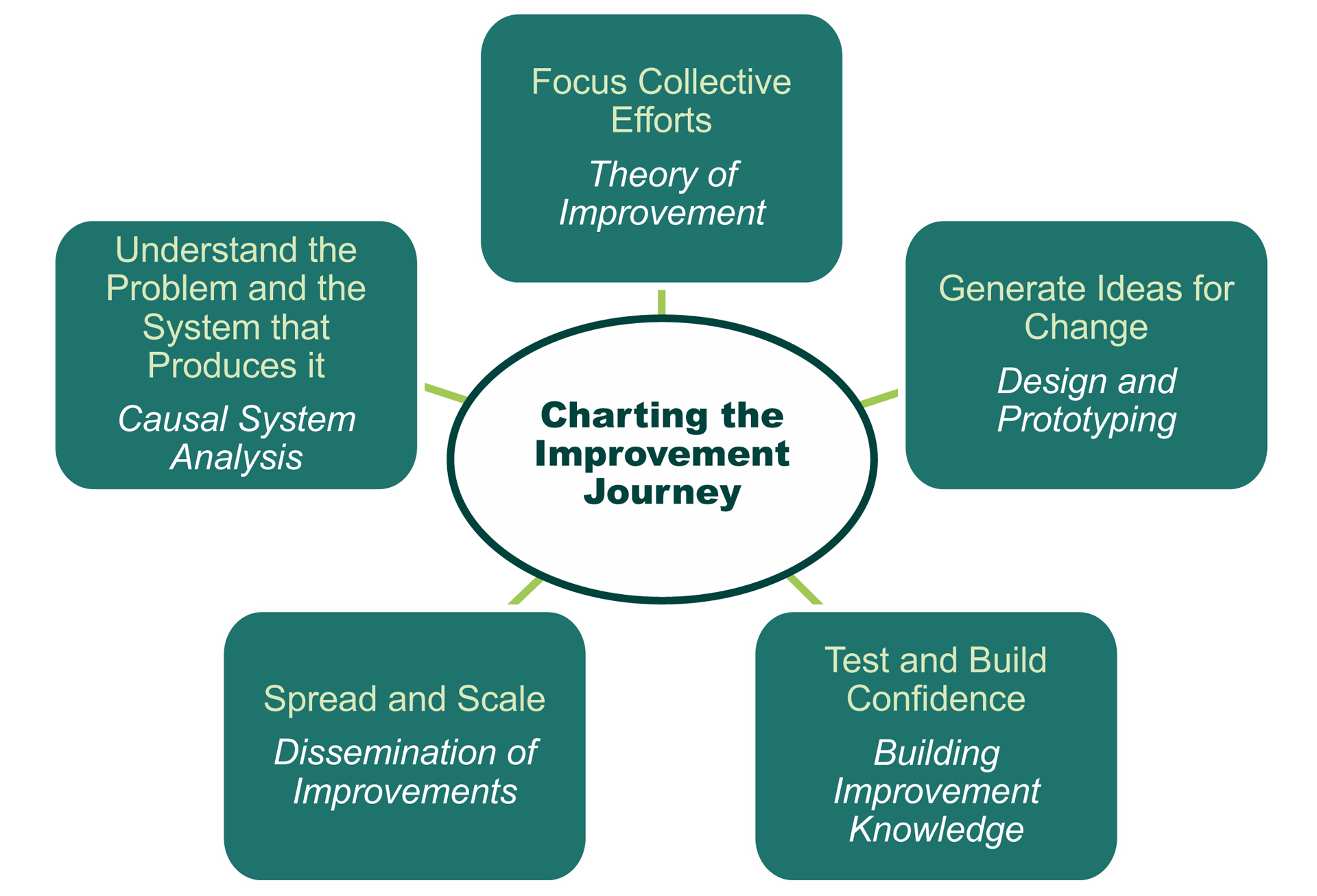
For the past several years, under the leadership of Dr. Tony Bryk, Carnegie is trying to apply a structured inquiry process to problems in education, building the capacity of teachers, principals and district administrators to continuously improve. This type of improvement science started in manufacturing and has been used to successfully change human-based systems like healthcare.

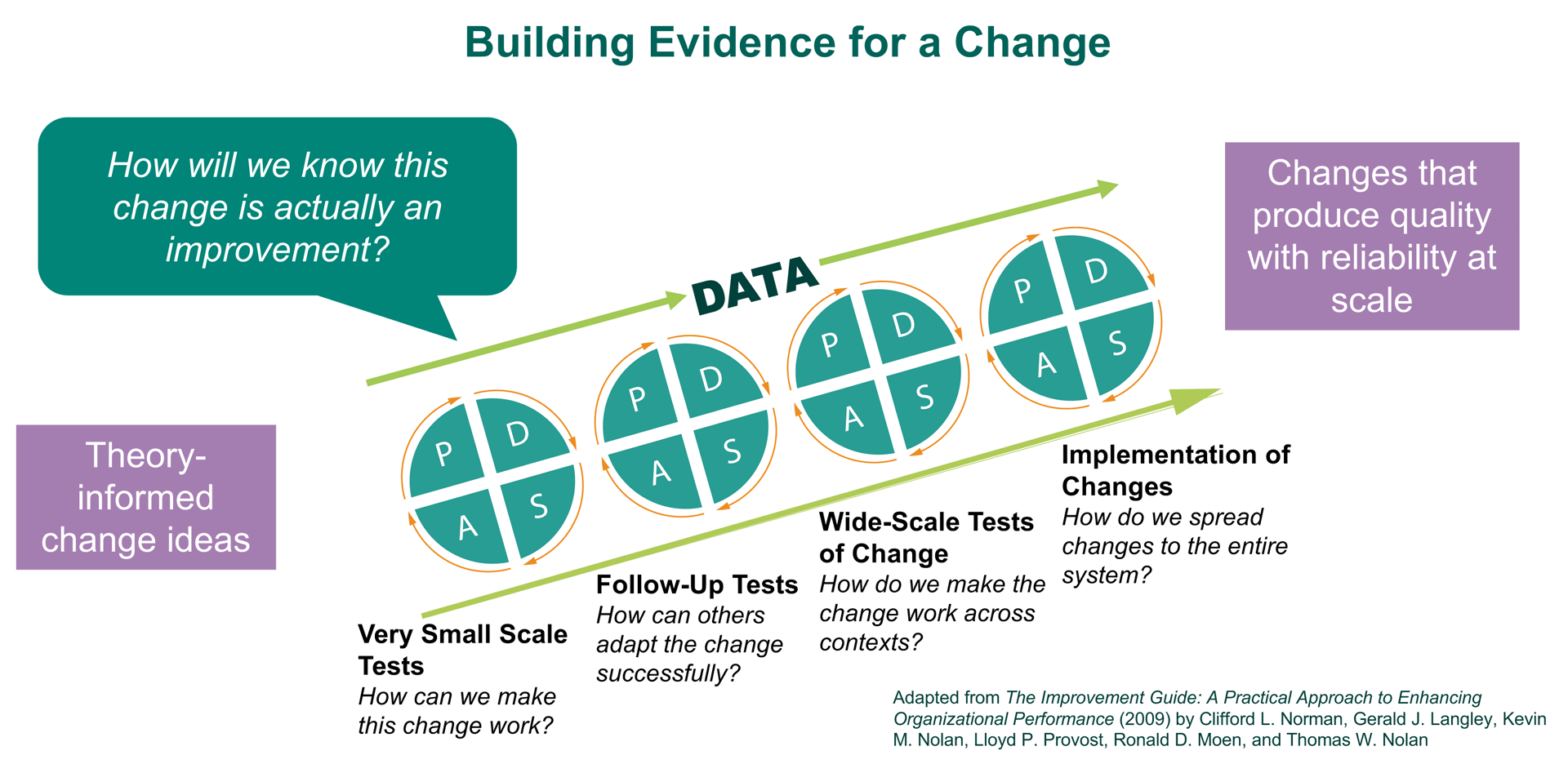
The basic tenets of the process involve understanding the problem, defining a manageable goal, identifying the drivers that could help reach that goal, and then testing small ideas to change those drivers. When done in a network, this cycle of improvement is expedited as various participants test different change ideas and share their findings with the group. Through a constant interplay of these elements a few change ideas will rise to the top and can be scaled across a system.

UNDERSTANDING THE PROBLEM

Many of the biggest problems of practice have been around a long time and aren’t easy to solve. Too often when trying to improve something leaders jump to solutions before properly examining the problem. Understanding the problem requires valuing many types of knowledge. It means doing empathy interviews with participants in the system including teachers, staff, parents, and students. It involves bringing the best research literature to bear on the problem. And sometimes representing the processes involved in the problem can illuminate areas that are breaking down.

Biag said this stage is crucial and shouldn’t be rushed. He’s seen improvement projects that require up to a year of study to fully understand the problem, its root causes and the levers of change available to leaders. Often an improvement network will know it’s time to move on when participants feel saturated — they aren’t turning up any new perspectives or information.

“Sometimes it’s good to stop doing the research and try something,” Biag said. Implementing some change ideas often helps inform the problem and may even necessitate that the team revisit and revise the problem statement.

Courtesy of Carnegie Foundation

DEFINE THE GOALS AND FOCUS COLLECTIVE EFFORT

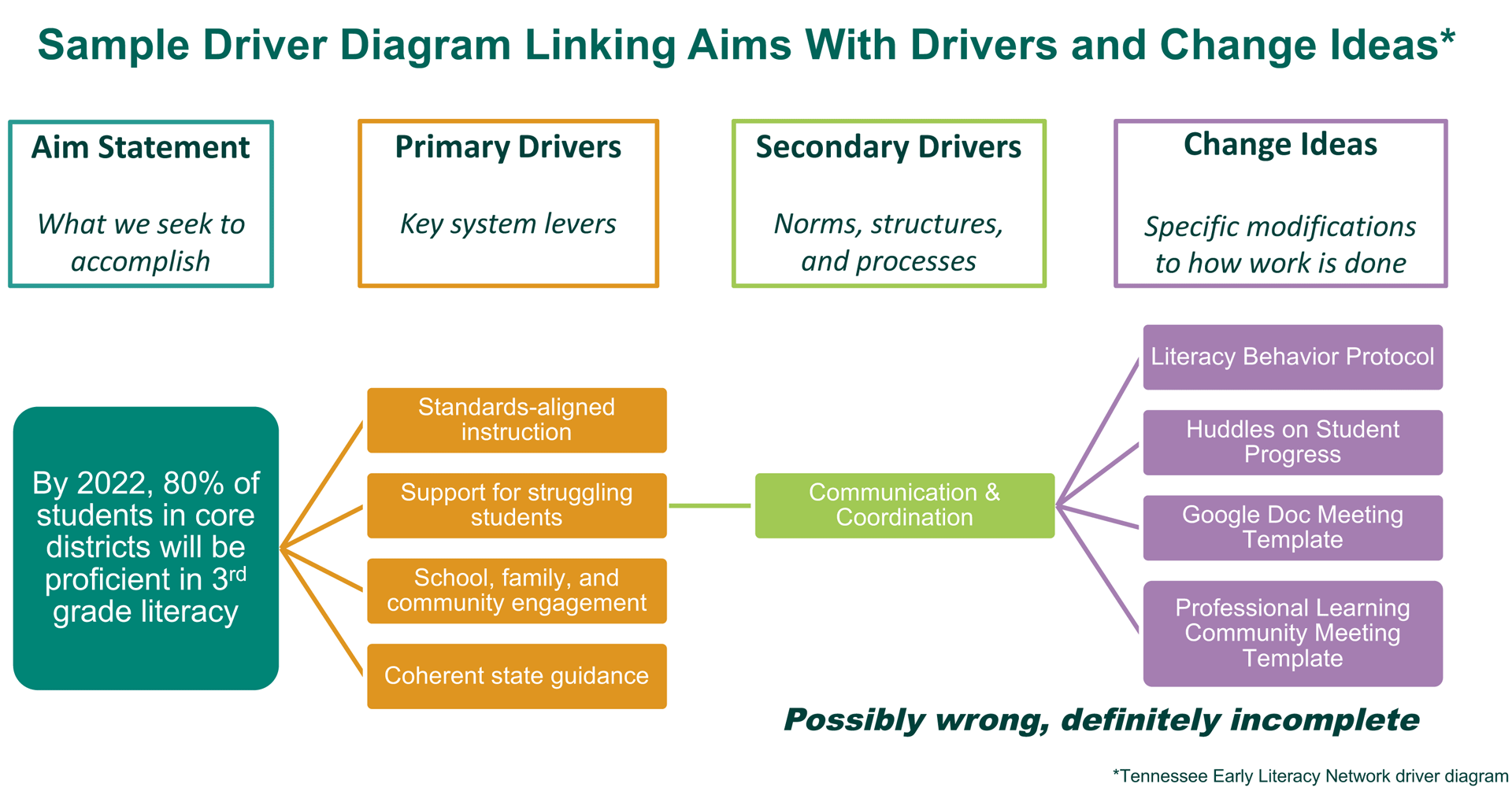
Once the group has a “good enough” understanding of the problem it’s crucial that they write a clear, succinct aim statement. It should be specific, measurable and focus on a challenging problem, but it should be doable.

The crucial question, Biag said, is “What’s within your span of control and what’s not? So when you act on this problem you aren’t wasting your time on the things that aren’t in your control.”

He often sees people define the problem too broadly. If the problem is an achievement gap between student populations, a group might say the root problem is inequality or poverty. Those things may contribute to the problem, but they aren’t within the control of teachers or principals or even districts to solve. A more manageable aim statement might be: “By June 2020 we’re going to increase from 45% to 90% the number of male students enrolling in credit bearing math courses at community colleges.”

“It has to be motivating enough for people to continue working on it for several months,” Biag said about the reach goal. But it must be specific and concrete enough that the group can see if change ideas are helping progress towards the goal.

“While an aim statement can look deceptively simple, you need to build trust and get on the same page with everyone in your network to even agree on where to focus your efforts,” Biag said. The network itself is important because it accelerates the pace of learning about potential solutions.

Once the aim is clear, the group brainstorms three to five primary drivers of the problem. These are the things the group believes provide the most leverage to meet the goal, and that are within the span of control. It’s crucial to only have a few of these, not twenty, because the network must work on all of them in tandem. Staying focused allows for more progress.

After identifying the most important drivers, network participants brainstorm change ideas that might affect those drivers. “The word change is very specific to improvement science,” Biag said. “It means an actual change in how you do work.” In other words, the focus is on the process and results in action. Change ideas are not things like “more money” or “more staff.” “It’s an actual change of a process or the introduction of a new process,” Biag said.

TEST AND BUILD EVIDENCE

Once the group has a good understanding of the problem, its root causes, what drives it and some ideas that will directly affect those drivers, it’s time to start testing them. Carnegie uses a “Plan, Do, Study, Act” (PDSA) cycle for testing ideas. The changes should be fairly small and the tester collects data along the way. It doesn’t have to be complicated data, just something to help analyze and track whether the change is moving the needle.

Courtesy of Carnegie Foundation

“Most schools and districts plan plan plan, then do, and then they never study,” Biag said. He advocates that planning include a prediction because participants are more likely to compare a new strategy with the expected effect. If the change idea didn’t function as expected there’s a lot to learn there.

Many of the best change ideas come from looking at what Carnegie calls “positive deviants” — the bright spots in a network. For example, if a network sets the aim of improving college readiness for English language learner students, when leaders are assembling their knowledge base they should talk to teachers who seem to be achieving better than average results with that population. Those teachers are “positive deviants” and networks should try to learn from the ways their practices differ from colleagues.

For example, High Tech High Charter Network leaders identified that they wanted to increase the number of African American and Latino males applying to four-year colleges. When they looked at drivers, they realized school attendance was lower for this group and hypothesized that the way teachers communicated with parents might be part of the issue. To try to eliminate variation in parent-teacher communication they tested a change theory that involved using a set of protocols for interacting with families.

They went through several iterations of the protocols, but when they hit on one that seemed to work they spread it throughout their network of schools. Now, when teachers meet with parents around achievement or discipline they all try to make it positive, share data about the student, and co-construct an action plan with the parent, among other things.

The key thing about working in a network is that different people can be trying different change ideas and sharing their data. “The idea is that you’re not all working on all the same things at the same time,” Biag said. “So you leverage the network, and the power of the network, to increase change ideas.”

Some ideas won’t work and will be abandoned. Others might seem promising, but more data is needed, so others in the network might try them too. Over time the change ideas that seem to really impact the drivers rise to the top.

“As you’re testing and building evidence you’re going to find ideas that work and then you can talk about spreading those ideas,” Biag said.

Courtesy of Carnegie Foundation

SPREAD AND SCALE

Even with the best ideas implementation can be hard. Biag said leaders need to weigh several factors when thinking about how to spread an idea that seems to work. How costly will it be to implement? What are the consequences of failure? How reluctant are the people involved? How confident is the leader in the change idea?

For example, if the change is a parent meeting protocol and the leader doesn’t think it’s a great idea and that the cost of failure will be high, perhaps she only tests it on her sister first. But, if teachers are ready for the change and there’s nothing to lose, then maybe the idea can scale up more quickly. This is where knowing one’s own system and culture becomes important.

It’s also worth thinking about who within the system needs to be on board for the plan to go well. Those folks can be powerful advocates if convinced that the change idea is a good one. “The best people are those who were pretty skeptical in the beginning and you were able to change them,” Biag said.

Another strategy is to roll out the idea with those eager to try it and then demonstrate success to those who are more fearful. It’s also necessary to be humble and willing to go back and test new ideas if the ones that seemed to work in the smaller group don’t work when scaled. Perhaps the aim statement needs to change, or maybe the drivers aren’t actually the most impactful.

“Our theory is possibly wrong and definitely incomplete; that’s kind of a Carnegie saying,” Biag said. He doesn’t want anyone to think this process is linear, rather it’s a cycle. And when people get comfortable with the cycle they build it into everything they do naturally. The biggest strength of continuous improvement is that it offers a path for systemic change, a way to build the capacity within the system, rather than building whole new systems.

“What we’re trying to do is implement these tools and ways of thinking to empower people to engage in this work,” Biag said. And that means having a bias towards action.

“You have to start before you feel ready. Your understanding of the problem will change over time and when you act on that problem the problem will change and so your understanding of that problem will change,” Biag said.

People learn how to think about continuous improvement through the process of doing it. They get better at narrowing in on motivating, but achievable aim statements. They learn to include more voices in the information gathering stage. The “Plan, Do, Study, Act” cycles become second nature, and analyzing data gets less scary.

Perhaps one of the best parts of continuous improvement is that it helps empower those within a system to see themselves as the drivers of change. The ideas come from practice as does the data. And while data is often associated with accountability requirements, this improvement process offers practitioners the opportunity to think about and evaluate data that are important to their practice.

In this process, the data is only worthwhile if it shines light on whether the change is working. And when data is used this way, it’s easier for educators to be transparent about what they’re seeing. Improvement is not about judgement, it’s a constant, normal aspect of professional life.

“You have to have a lot of humility to come to the realization that you don’t have the answers, and that you’re going to learn your way into this,” Biag said. “You’ve got to think about this as a learning journey. If you really had the answers to this problem we wouldn’t be talking about it.”

To see measurable progress on some of the most intransigent problems in education requires a systematic focus on improving in every aspect of the system. It’s not enough for one teacher to be amazing, or one school to outshine the others around it. All kids deserve an incredible education; and that can only happen by building on the strengths already found in the system.

Source:

https://www.kqed.org/mindshift/51115/how-to-plan-and-implement-continuous-improvement-in-schools

Comparte este contenido:
Page 696 of 1671
1 694 695 696 697 698 1.671