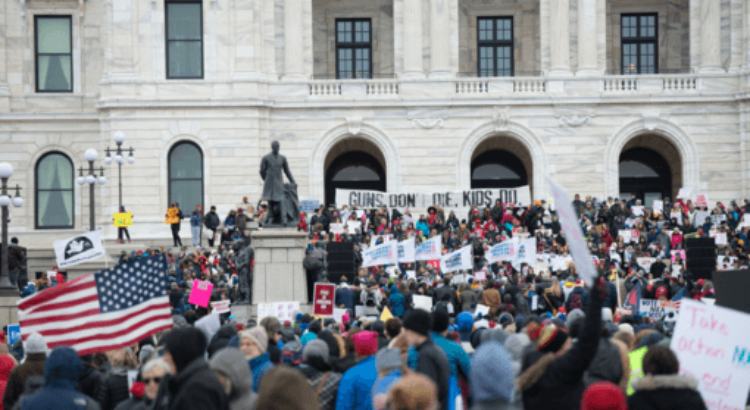
Under the regime of Donald Trump, the role of education in producing the formative cultures in and out of schools necessary to support critical thinking, civic courage, and critically engaged citizens appears to be disappearing. Words that speak to the truth and hold power accountable are in retreat as lies become normalized and the relationship between the truth and the citizen is treated either with disdain or simply ignored. The democratization of information has given way to the democratization of disinformation as disimagination machines proliferate and corporate controlled cultural apparatuses colonize the media and political landscapes. One consequence is that historical memory is not only vanishing in a culture of immediacy, sensationalism, and “fake news,” it is also being rewritten in school textbooks so as to eliminate dangerous memories and align the past with narratives that reinforce anti-democratic ideologies and social relations.[1] In the current historical moment, memory has no place in the dark cave of civic depravity—a space where freedom is abandoned in an educational ecosystem where nothing is true, and the basis for criticizing power collapses under the spectacle of presidential bomb throwing-like tweets, endless spectacles of diversion, and high-level stretches of newspeak illiteracy.
At a time when political extremists and war mongers have moved from the margins of politics to the center of power, a culture of fear and cruelty becomes the essence of politics reinforced by the denigration and erasure of any viable notion of morality and personal and social responsibility. As notions of social justice and political visions fall prey to draconian notions of unchecked self-interest, greed is elevated to a national virtue, and the ethical imagination withers along with the public spheres that make it possible. In the age of “fake news” everything that matters disappears, and institutions that were meant to address crucial social issues and problems begin to vanish. Notions of honesty, honor, respect, and compassion are increasingly policed and those who advocate them are either muzzled or punished. How else to explain the collective silence of Vichy-like Republicans supporting Trump’s reign of horror and the cravenly actions of the mainstream media, which refuses to engage critically a society that has fallen into the abyss of fascism?
This flight from the ideal and promise of a substantive democracy is especially dangerous at a time in which a broad-based notion of authoritarian education has become central to politics, particularly in a digital age in which there is an overabundance of information and a proliferation of educational platforms from schools to the social media. In the age of Trump, education has lost its alleged role in cultivating an informed, critical citizenry capable of participating in and shaping a democratic society. Lost also is an educational vision that takes people beyond the world of common sense, functions as a form of provocation, teaches them to be creative, exposes individuals to a variety of great traditions, and creates the pedagogical conditions for individuals to expand the range of human possibilities. Under the influence of corporate power and a growing authoritarianism in the United States, education in multiple informal and formal platforms operates increasingly in the service of lies, racism, unadulterated market values, and a full-fledged assault on critical consciousness and public values. Under such circumstances, democracy is cast as the enemy of freedom, and politics turns dark.
These anti-democratic tendencies are evident in the ways in which neoliberalism since the 1980s has reshaped formal education at all levels into a site for training, inundating market values, and imposing commercial relations as a template for governing all of social life. Every idea, value, social relationship, institution, and form of knowledge runs the risk of being economized, turned into either a commodity, brand, or source of profits, or all of the latter. Increasingly aligned with market forces, public and higher education are mostly primed for teaching business principles and corporate values, while university administrators are prized as CEOs or bureaucrats in an audit culture.[2] In addition, students are viewed as clients and customers while faculty are treated like service workers. Public education is especially under assault with the appointment of Betsy DeVos as the Secretary of Education. DeVos hates all things public and believes that beyond privatizing public education, her role is to “advance God’s Kingdom” through the school system.[3]
Under the Trump administration, the role of education as a medium of culture is reduced to a tool of management, conformity, and repression. Operating through a conservative social media and right-wing radio and television platforms, education under Trump has become a powerful weapon to produce and distribute hate, bigotry, and reactionary policies. Moreover, it has become a commanding tool to legitimate a range of right-wing policies that constitute an assault on the environment, transgender people in the military, and undocumented immigrants, among others. It has also become a bullhorn for spreading conspiracy theories including the ridiculous and caustic claim by a number of right wing pundits that the student leaders and survivors of the Parkland mass shooting are either “crisis actors,” bankrolled by George Soros, or pawns of left-wing gun control advocates.[4]
Operating in the service of a strictly instrumental rationality that erodes the boundaries between economic power and politics, enables a culture of racial exclusion, and furthers a politics of repression, education in a range of formal and informal sites is used to empty politics of any substance. With regards to higher education, students are not only inundated with the competitive, privatized, and market-driven values of neoliberalism, they are also punished by those values in the form of exorbitant tuition rates, crippling astronomical debt owed to banks and other financial institutions, and lack of meaningful employment.[5]
At the level of public education, too many students especially those marginalized by class and race are subject to disciplinary measures and oppressive forms of pedagogy that kill the imagination and increasingly criminalize student behavior. Solidarity, critical thought, and shared values are the enemy of Trump’s notion of education and pedagogy, which serves largely to disdain public values while canceling out a democratic future for too many young people. All of these forces are exacerbated in the wider society through a notion of popular education that accelerates a modern day pandemic of fear, anxiety, anger, and despair.
What is often lost on the part of the left and progressives is that the educational force of the wider culture functions through a range of what the sociologist C. Wright Mills termed cultural apparatuses, which extend from the mainstream and conservative media to digital and online platforms that largely operate in the service of a commodified and authoritarian political media sphere that has become what Mort Rosenblum calls a “cesspool of misleading babble.”[6] Trump has managed to shape the cultural landscape in ways that have unleashed a poisonous public pedagogy of sensationalism, easy consumption, bigotry, fear, militarism, and distraction. For instance, insightful and critical reporting is dismissed as “fake news,” while corporate profiteers accelerate a culture of instant gratification and feed off spectacles of violence.
Against this backdrop of civic illiteracy lies Trump’s 2018 budget, which adds $80 billion to the military’s bloated machinery of death. All the while, Trump fills the Twitter world with an ongoing bombast of emotional drivel. Simultaneously, he appoints cabinet and other high ranking officials whose chief role is to dismantle those institutions central to a democracy: “its schools, courts, civil liberties, environment, natural wealth, and underlying morality.”[7] Former chief strategist Steve Bannon makes visible and boasts about Trump’s racist politics as he travels the globe proclaiming to his fascist friends that they should not be troubled if called a racist. In fact, he announced to a gathering of the National Front party in 2018 at their annual congress in France, “Let them call you racists. Let them call you xenophobes. Let them call you nativists. Wear it as a badge of honor.”[8]
Squandering America’s moral authority, whatever is left, comes easy for Trump given his well publicised celebration of state violence and his endorsement of the use of torture. The latter provides a context for his nomination of Gina Haspel as the head of the CIA. Haspel once headed a secret “black site” prison in Thailand where Abd al-Rahim al-Nashiri was water boarded three times.[9] Haspel “also participated in the controversial decision to destroy evidence of interrogation sessions in which detainees were subjected to waterboarding.”[10] Another egregious example of Trump’s militaristic and morally vacuous mind set can be seen in his appointment of John Bolton as Trump’s National Security Advisor, whom Juan Cole has called a “war criminal.”[11] Bolton is a jingoistic hawk and warmonger of the first order and resembles a mix between Brig. General Jack D. Ripper, the trigger-happy war loving character out of the film, Dr. Strangeloveand the psychopathic, Patrick Bateman, the main character in American Psycho. Trump’s facile appointment of militarists, war criminals, and his ruthless “law and order” policies point to both a rhetoric and set of practices that provide the ideological and political foundation for acts of domestic terrorism.
Domestic terrorism, defined in part as acts designed by the state “intimidate or coerce a civilian population”[12] now operates unapologetically at the highest levels of power as Trump rails against undocumented immigrants, advises police officers to rough up people they are arresting, and relentlessly cultivates “fear and contempt among … white citizens against immigrants, indigenous people and people of color, who are placed on the other side of ‘the law’.”[13] In addition, Trump undermines the rule of law by attacking the courts and other legal institutions if they don’t pander to his policies. Moreover, his implementation of his “law and order” agenda is highly selective, depending upon who is the perpetrator of the alleged crime, or who is considered a friend or enemy. If it is “illegals” or anyone in his target audience of “criminals,” they should be roughed up by the police but if it is a friend such as Rob Porter, a former White House senior aide charged with abuse by both of his ex-wives, such accusations are simply dismissed by Trump.
Trump has ushered in a world of political and educational tyranny, misery, and oppression with his endless impetuous outbursts, insults, misrepresentations, corruption, and hucksterism. His emotional outbursts and unchecked narcissism provide the levers that promote a pedagogy in the service of mass illiteracy, ethical bankruptcy, and political conformity. As the liar-in-chief, Trump collapses the distinction between facts and fiction and in doing so undermines the necessity for institutions that promote shared beliefs in facts, truth, and moral integrity, while valuing the common good above the facilitation of narrow private interests. Without some allegiance to evidence-based arguments, informed judgements, and reason, politics and the public spheres that support it begin to disappear. Moreover, morality and the ethical imagination wither as it becomes more and more difficult within Trump’s universe of “alternative facts” to distinguish right from wrong, good from evil, and compassion from cruelty.
Americans live in Kafkaesque times—a time in which the fight for justice has given way at the highest levels of government to the legitimation of injustice. How else to explain Trump’s claim that there are “very fine people on both sides” when referring to the deadly violence perpetrated in Charlottesville, Virginia by white nationalists, neo-Nazis, and members of the Klu Klux Klan and those protesting such hatred.[14] While the latter is another example of Trump’s muddled politics of diversion, it is also testimony to Pierre Bourdieu’s insistence that “the most important forms of domination are not only economic but also intellectual and pedagogical and lie on the side of belief and persuasion.”[15] In this instance, the pedagogical call to think, inspire, and energize has been replaced by a discourse and pedagogical practices designed to misdirect rage, empty meaning of any substance, deaden the ethical imagination, and encourage the collective fog of unchecked nihilism, white nationalism, and a depoliticizing privatism.
Trump’s pedagogy is largely fashioned through his use of Twitter, his support by conservative media such as Fox News and the Sinclair Broadcast Group, the aggressive support by tribal social media, and extreme talk radio, all of which function as thinly veiled propaganda and disimagination machines. Trump’s unrelenting pedagogical shocks to the body politics and civic culture have done more than lower the bar of civic discourse and the rules of governing, they have normalized the unimaginable. Conservative commentator Andrew Sullivan captures the damage in the following commentary in which he asserts that Trump:
[is] a cult leader of a movement that has taken over a political party [whose] twisted, compulsive insecurity requires him to use his office to attack, delegitimize and weaken every democratic institution that may occasionally operate outside his own delusional narcissism. He cannot help this. His tweets are a function of spasms, not plots. But the wreckage after only one year is extraordinary. The F.B.I. is now widely discredited; the C.I.A. is held in contempt; judges, according to the president, are driven by prejudice and partisanship (when they disagree with him); the media produce fake news; Congress is useless (including both Republicans and Democrats); alliances are essentially rip-offs; the State Department — along with the whole idea of a neutral Civil Service — is unnecessary. And the possibility of reasoned deliberation at the heart of democratic life has been obliterated by the white-hot racial and cultural hatreds that Trump was able to exploit to get elected and that he constantly fuels.[16]
Following Arendt’s insight into the dynamics of totalitarianism, education both within and outside of institutionalized schooling has the capacity to become a tool not only to instill authoritarian convictions but also to destroy the ability of the populace to form any convictions that are on the side of justice, freedom, and thoughtfulness. I think it is fair to argue that the nightmarish vision of an impending American-style authoritarianism is no longer a product of dystopian fiction—found in the work of George Orwell, Aldous Huxley, Margaret Atwood, Ray Bradbury, and others. Under the regime of Donald Trump, the language of “Newspeak” has been normalized, functions through multiple platforms, and has morphed into a giant disimagination machinery of propaganda, violence, bigotry, hatred, and war. The latter is clearly visible in Trump’s language and politics which in its various forms has a high threshold for disappearance and zones of terminal exclusion, especially for Muslims, undocumented immigrants, and African-Americans.
As a form of pedagogical regulation, intelligence is considered a liability and Trump’s White House works hard to eliminate expressions of discontent, resistance, and popular democratic struggles. Trump’s criminogenic machinery of power is on full display in the educational landscape of the wider culture. New unapologetic forms of racist discrimination, unbridled commodification undermine the democratic mission of both formal and informal educational institutions and apparatuses in an age of increasing tyranny. Against the force of a highly militarized mode of casino capitalism in which violence and a resurgence of white supremacy are at the center of power, education as the practice of freedom is losing its ability to resist the authoritarian machinery of social death now shaping American society. The modern loss of faith in the merging of education and democracy needs to be reclaimed, but that will only happen if the long legacy of struggle over education is once again brought to life as part of a more comprehensive understanding of education being central to politics itself. Such a task is particularly urgent as the United States descends into the abyss of authoritarianism under the regime of Donald Trump.
What forces have allowed education to be undermined as a democratic public sphere, capable of producing the formative culture and critical citizens that could have prevented such a catastrophe from happening in an alleged democracy? In the more general sense, education is now viewed either as a form of mass entertainment or as a form of training, aligned to market values. As a market driven pedagogical practice, it is wedded to a technocratic rationality dominated by the imperatives of commercial exchange. As education becomes central to politics itself, it removes democratic values and a compassion for the other from the ideology, policies, and institutions that now control American society. At its worst, particularly regarding public education, it is reduced to an instrument of the carceral state used to warehouse young people considered suspect and disposable who become fodder for the school-to-prison pipeline. What happens to a public that retreats into private silos and becomes indifferent to the use of language in the service of a panicked rage that stokes anger but not about issues that matter? What happens to a social order when it treats millions of illegal immigrants as disposable, potential terrorists, and criminals? What happens to a country when the presiding principles of a society are violence and ignorance? What happens is that democracy withers and dies, both as an ideal and as a reality?
In the present moment, it becomes particularly urgent for educators and concerned citizens all over the world to protect and enlarge the formative cultures and public spheres that make democracy possible. The attack on the truth, honesty, and the ethical imagination, makes it all the more imperative for educators to think dangerously, especially in societies that appear increasingly amnesiac—that is, countries where forms of historical, political, and moral forgetting are not only willfully practiced but celebrated. All of which becomes all the more threatening at a time when a country such as the United States has tipped over into a mode of authoritarianism that views critical thought as both a liability and a threat.
Given the crisis of education, agency, and memory that haunts the current historical conjuncture, educators need a new language for addressing the changing contexts and issues facing a world in which there is an unprecedented convergence of resources–financial, cultural, political, economic, scientific, military, and technological– increasingly used to exercise powerful and diverse forms of control and domination. Such a language needs to be self-reflective and directive without being dogmatic and needs to recognize that pedagogy is always political because it is connected to the acquisition of agency. In this instance, making the pedagogical more political means being vigilant about “that very moment in which identities are being produced and groups are being constituted, or objects are being created.”[17]
At the same time it means educators, cultural workers, young people, and the wider public need to be attentive to those practices in which critical modes of agency and particular identities are being denied. At the heart of such a challenge is the need to ask what the role is of both formal education and the wider functions of education in a democracy? What pedagogical, political, and ethical responsibilities should educators and other cultural workers take on at a time when there is an increasing abandonment of egalitarian and democratic impulses? How can educational and pedagogical practices be connected to the resurrection of historical memory, new modes of solidarity, a resurgence of the radical imagination, and broad-based struggles for an insurrectional democracy? The question regarding what role education should play in democracy becomes all the more urgent at a time when the dark forces of authoritarianism are on the march all across the globe.
Vaclav Havel once argued that politics followed culture. That is, politics is inextricably connected to how individual and social consciousness are shaped, experiences are narrated, and investments organized so as speak convincingly to people’s needs, anxieties, and hopes. The mix of power, culture, and everyday life imposes new demands on those of us willing to make education and pedagogy central to politics itself if we want to breathe life and hope into a future that refuses the authoritarian impulses of the present. One productive sign of the times is that women, scientists, and young people are marching and organizing against the impending violence and fascism of the Trump administration. Many individuals and groups are beginning to wage a brave fight against oppressive neoliberal modes of governance. Prison abolitionists are making their voices heard, and new groups are mobilizing to fight the rise of white nationalism, militarism, and the threat of a nuclear war. Young people are reinventing new forms of collective resistance against gun violence. What all of these groups recognize is that to be voiceless is to be powerless. They are striking, organizing, and protesting to make their voices heard, refusing to allow their grievances to go unheard and ignored by the financial elite.
A new militancy can be seen in educators such as the striking teachers in West Virginia who have demonstrated the power of the wildcat strike as a mode of organized collective struggle against a criminogenic corporate based ideologies, pedagogies or repression, and ruthless labor practices.[18] What is crucial about this strike and its success is that it was not waged simply to improve paltry salaries and abominable labor conditions, but to also make clear that public schools are not for sale and that they represent one of the most crucial public spheres in a democracy.
But the most promising act of resistance on the horizon in the level and scope of protest against gun violence being mobilized by young people since the Parkland massacre. Not only have they exposed the toxic violence produced by the NRA but also the cowardice of those politicians, such as Senator Marco Rubio, who sell their conscience and dignity for blood money by putting profits from gun sales ahead of children’s lives. Gun deaths among children are rising in the United States as evident by the fact that “3,128 children and teens were killed with a gun 1n 2016, enough to fill 156 classrooms of 20 children.”[19]Yet it is young people, rather than adults, who are arousing the conscience of the nation with their demonstrations, interviews, and March for Our Lives demonstrations, in which is hundreds of thousands of students protested throughout the United States and in 800 cities around the world, all of which was designed to end “the plague of gun violence.”[20]
State and corporate sanctioned violence comes in many forms and hopefully the issues raised by the students marching against gun violence across the United Sates will begin to expand the public’s political horizons by addressing how violence functions as a mode of domestic terrorism in a range of sites. Among others, these include: schools modeled after prisons; streets and poor cities treated as war zones by many police departments; airports that have become centers of repressive surveillance practices against immigrants; shopping centers that exclude poor minorities; debtor prisons designed to punish the impoverished; detention centers for young people whose range of behaviors is being increasingly criminalized; a carceral state that has used the prison as containing centers for racial minorities, and in a range of deadly policies that have turned civil society into a breeding ground for everyday and organized violence.
The retreat to nationalism, state sanctioned racism, the expansion of the military-industrial complex, and accelerating police violence and the growth of the carceral state, particularly with respect to the war on undocumented immigrants constitute a short list of issues to be addressed by a broad based movement of collective resistance. Hopefully, such issues will be eventually in the crosshairs of the protesters being mobilized by young people who refuse put up with the reign of domestic terrorism and gun violence at work in their schools and enabled by the Trump administration.
At a time when people’s lives are more precarious, hope for a better society seems to be in short supply. The Parkland youth protesters have put new energy into creating a new vision of hope, or what Ronald Aronson, calls “social hope.” That is, a belief in the ability to act collectively to make a better world and act “not blindly but with a sense of possibility.”[21] They have seized upon a vision of social justice rooted in the belief that they can not only challenge oppression but also can change the fundamental nature of an oppressive social order. Education for them becomes a way of translating personal issues into larger systemic concerns, changing the way people see things, and investing a variety of modes of communication in order to use elements of belief and persuasion as appropriate weapons of struggle. They are talking back, writing, marching, and thinking outside of the boundaries of the deadening political horizons preached by established politicians and the mainstream media. They are also using the new digital technologies and the social media in order to educate a nation about the necessity of collective struggle and a shared militancy based on the need to both change public consciousness and to inspire people to act. What these young people have made clear is that education is central to such a struggle and that it provides the foundation for turning momentary protests into broad-based movements, which cannot come fast enough in the age of Trump with its fascist investment in legitimized and organized violence.
Notes.
[1] For one example among many, see Emma Brown, “Texas officials: Schools should teach that slavery was ‘side issue’ to Civil War,” The Washington Post (July 5, 2012). Online: https://www.washingtonpost.com/local/education/150-years-later-schools-are-still-a-battlefield-for-interpreting-civil-war/2015/07/05/e8fbd57e-2001-11e5-bf41-c23f5d3face1_story.html?utm_term=.207f36cf4609; Of course, Howard Zinn, in his A People’s History of the United States made clear that history was being written from the point of view of the dominant classes, leaving out much of what came to be called history from the bottom up. I believe the problem is more severe today than when Zinn published his book.
[2] Benjamin Ginsberg, The Fall of the Faculty (New York: Oxford University Press, 2011).
[3] Jon Sharman, “Education secretary Betsy DeVos wants to ‘advance God’s kingdom’ through US school system,” The Independent (February 8, 2017). Online: https://www.independent.co.uk/news/world/americas/betsy-devos-us-education-secretary-advance-gods-kingdom-donald-trump-pick-confirmed-senate-hearing-a7568641.html
[4] Tina Nguyen, “‘Give me a Break’: How the far right is Smearing School-Shooting Survivors,” Vanity Fair (February 21, 2018). Online: https://www.vanityfair.com/news/2018/02/how-the-far-right-is-smearing-parkland-school-shooting-survivors
[5] Creston Davis, “The Time of the Intellectual-Activists Has Come,” Truthout (November 4, 2017). Online: http://www.truth-out.org/opinion/item/42472-the-time-of-the-intellectual-activists-has-come
[6] Mort Rosenblum, “The Loon Ranger; All the fits that are news to print,” Reader Supported News (March 16, 2018). Online: https://www.amazon.com/Fascism-Today-What-How-End/dp/1849352941/ref=sr_1_1?s=books&ie=UTF8&qid=1521399237&sr=1-1&keywords=fascism+today+what+it+is+and+how+to+end+it+by+shane+burley
[7] Ibid, Mort Rosenblum.
[8] Daniel Politi, “Bannon: Let Them Call You Racist…Wear it as a Badge of Honor,” Slate (March 10, 2018). Online: https://slate.com/news-and-politics/2018/03/steve-bannon-let-them-call-you-racist-wear-it-as-a-badge-of-honor.html
[9] David Smith, “Torture allegations dog Gina Haspel as she is poised to be first female CIA head,” The Guardian (March 16, 2018). Online: https://www.theguardian.com/us-news/2018/mar/16/gina-haspel-cia-torture-allegations
[10] Sarah Childress and Priyanka Boghani, “Trump’s New CIA Director Nominee Helped Cover Up Torture,” PBS: Frontline (March 13, 2018). Online: https://www.pbs.org/wgbh/frontline/article/trumps-new-cia-director-nominee-helped-cover-up-torture/
[11] Juan Cole, “Let’s Call Bolton What He Is: A War Criminal with Terrorist Ties, Not Just ‘Hawkish’.” Common Dreams (March 23, 2018). Online: https://www.commondreams.org/views/2018/03/23/lets-call-bolton-what-he-war-criminal-terrorist-ties-not-just-hawkish
[12] See, US Federal code at https://www.law.cornell.edu/uscode/text/18/2331
[13] Chris Hayes, “What ‘Law and Order” Means to Trump,” New York Times (March 17, 2018). Online: https://www.nytimes.com/2018/03/17/opinion/sunday/chris-hayes-trump-law-order.html
[14] Rosie Gray, “Trump Defends White-Nationalist Protesters: ‘Some Very Fine People on Both Sides’,” The Atlantic (August 15, 2017). Online: https://www.theatlantic.com/politics/archive/2017/08/trump-defends-white-nationalist-protesters-some-very-fine-people-on-both-sides/537012/
[15] Pierre Bourdieu and Gunter Grass, “The ‘Progressive’ Restoration: A Franco-German Dialogue,” New Left Review 14 (March-April, 2002), P. 2
[16] Andrew Sullivan, “Can Donald Trump Be Impeached?” New York Times (March 12, 2018). Online: https://www.nytimes.com/2018/03/12/books/review/impeachment-cass-sunstein-can-it-happen-here.html
[17] Gary Olson and Lynn Worsham, “Staging the Politics of Difference: Homi Bhabha’s Critical Literacy,” Journal of Advanced Composition (1999), pp. 3-35.
[18] Benjamin Wallace-Wells, “The New Old Politics of the West Virginia Teachers’ Strike,” The New Yorker (March 2, 2018). Online: https://www.newyorker.com/news/news-desk/the-new-old-politics-of-the-west-virginia-teachers-strike
[19] Marian Wright Edelman, “Marching for Our Children’s Lives and Nation’s Soul,” Child Watch Column: Children’s Defense Fund (March 23, 2018). Online: http://www.childrensdefense.org/newsroom/child-watch-columns/child-watch-documents/MarchingForOurChildrensLives.html
[20] Jake Johnson, “Ahead of ‘March for Our Lives,’ Student Manifesto Outlines Steps to Eradicate ‘Plague of Gun Violence’,”Common Dreams (March 23, 2018). Online: https://www.commondreams.org/news/2018/03/23/ahead-march-our-lives-student-manifesto-outlines-steps-eradicate-plague-gun-violence
[21] Ronald Aronson, We, Reviving Social Hope (Chicago: University of Chicago Press, 2017), p. 33.
Source:
Education as a Weapon of Struggle: Rethinking the Parkland Uprising in the Age of Mass Violence







 Users Today : 14
 Total Users : 35460815
 Views Today : 27
 Total views : 3420057