Page 792 of 1685
1 790 791 792 793 794 1.685

Challenging Trump’s Language of Fascism

By: Henry Giroux

George Orwell warns us in his dystopian novel 1984 that authoritarianism begins with language. Words now operate as «Newspeak,» in which language is twisted in order to deceive, seduce and undermine the ability of people to think critically and freely. As authoritarianism gains in strength, the formative cultures that give rise to dissent become more embattled along with the public spaces and institutions that make conscious critical thought possible.

Words that speak to the truth, reveal injustices and provide informed critical analysis begin to disappear, making it all the more difficult, if not dangerous, to hold dominant power accountable. Notions of virtue, honor, respect and compassion are policed, and those who advocate them are punished.

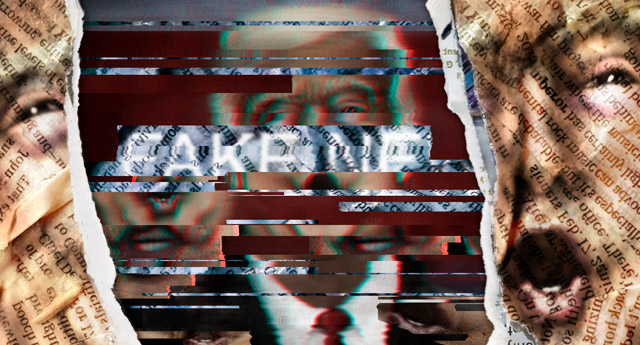
I think it is fair to argue that Orwell’s nightmare vision of the future is no longer fiction. Under the regime of Donald Trump, the Ministry of Truth has become the Ministry of «Fake News,» and the language of «Newspeak» has multiple platforms and has morphed into a giant disimagination machinery of propaganda, violence, bigotry, hatred and war.

With the advent of the Trump presidency, language is undergoing a shift in the United States: It now treats dissent, critical media and scientific evidence as a species of «fake news.» The administration also views the critical media as the «enemy of the American people.» In fact, Trump has repeated this view of the press so often that almost a third of Americans believe it and support government-imposed restrictions on the media, according to a Poynter survey. Language has become unmoored from critical reason, informed debate and the weight of scientific evidence, and is now being reconfigured within new relations of power tied to pageantry, political theater and a deep-seated anti-intellectualism, increasingly shaped by the widespread banality of celebrity culture, the celebration of ignorance over intelligence, a culture of rancid consumerism, and a corporate-controlled media that revels in commodification, spectacles of violence, the spirit of unchecked self-interest and a «survival of the fittest» ethos.

Under such circumstances, language has been emptied of substantive meaning and functions increasingly to lull large swaths of the American public into acquiescence, if not a willingness to accommodate and support a rancid «populism» and galloping authoritarianism. The language of civic literacy and democracy has given way to the language of saviors, decline, bigotry and hatred. One consequence is that matters of moral and political responsibility disappear, injustices proliferate and language functions as a tool of state repression. The Ministry of «Fake News» works incessantly to set limits on what is thinkable, claiming that reason, standards of evidence, consistency and logic no longer serve the truth, because the latter are crooked ideological devices used by enemies of the state. «Thought crimes» are now labeled as «fake news.»

The notion of truth is viewed by this president as a corrupt tool used by the critical media to question his dismissal of legal checks on his power — particularly his attacks on judges, courts, and any other governing institutions that will not promise him complete and unchecked loyalty. For Trump, intimidation takes the place of unquestioned loyalty when he does not get his way, revealing a view of the presidency that is more about winning than about governing. One consequence is myriad practices in which Trump gleefully humiliates and punishes his critics, willfully engages in shameful acts of self-promotion and unapologetically enriches his financial coffers.

David Axelrod, a former senior advisor to President Obama, is right in stating:

And while every president is irritated by the limitations of democracy on them, they all grudgingly accept it. [Trump] has not. He has waged a war on the institutions of democracy from the beginning, and I think in a very corrosive way.

New York Times writer Peter Baker adds to this charge by arguing that Trump — buoyed by an infatuation with absolute power and an admiration for authoritarians — uses language and the power of the presidency as a potent weapon in his attacks on the First Amendment, the courts and responsible governing. Trump’s admiration for a number of dictators is well known. What is often underplayed is his inclination to mimic their language and polices. For instance, Trump’s call for «law and order,» his encouraging police officers to be more violent with «thugs,» and his adoration of all things militaristic echoes the ideology and language of Philippine President and strongman Rodrigo Duterte, who has called for mass murder and boasted about «killing criminals with his own hand.»

Fascism starts with words. Trump’s use of language and his manipulative use of the media as political theater echo earlier periods of propaganda, censorship and repression.

At the same time, it would be irresponsible to suggest that the current expression of authoritarianism in US politics began with Trump, or that the context for his rise to power represents a distinctive moment in American history. As Howard Zinn points out in A People’s History of the United States, the US was born out of acts of genocide, nativism and the ongoing violence of white supremacy. Moreover, the US has a long history of demagogues, extending from Huey Long and Joe McCarthy to George Wallace and Newt Gingrich. Authoritarianism runs deep in American history, and Trump is simply the end point of these anti-democratic practices.

With the rise of casino capitalism, a «winner-take-all» ethos has made the United States a mean-spirited and iniquitous nation that has turned its back on the poor, underserved, and those considered racially and ethnically disposable. It is worth noting that in the last 40 years, we have witnessed an increasing dictatorship of finance capital and an increasing concentration of power and ownership regarding the rise and workings of the new media and mainstream cultural apparatuses. These powerful digital and traditional pedagogical apparatuses of the 21st century have turned people into consumers, and citizenship into a neoliberal obsession with self-interest and an empty notion of freedom. The ecosystem of visual and print representations has taken on an unprecedented influence, given the merging of power and culture as a dominant political and pedagogical force. This cultural apparatus has become so powerful, in fact, that it is difficult to dispute the central role it played in the election of Donald Trump to the presidency. Analyzing the forces behind the election of Trump, Steven Levitsky and Daniel Ziblatt provide a cogent commentary on the political and pedagogical power of an old and updated media landscape. They write:

Undoubtedly, Trump’s celebrity status played a role. But equally important was the changed media landscape…. By one estimate, the Twitter accounts of MSNBC, CNN, CBS, and NBC — four outlets that no one could accuse of pro-Trump leanings — mentioned Trump twice as often as Hillary Clinton. According to another study, Trump enjoyed up to $2 billion in free media coverage during the primary season. Trump didn’t need traditional Republican power brokers. The gatekeepers of the invisible primary weren’t merely invisible; by 2016, they were gone entirely.

What is crucial to remember here, as Ruth Ben-Ghiat notes, is that fascism starts with words. Trump’s use of language and his manipulative use of the media as political theater echo earlier periods of propaganda, censorship and repression. Commenting on the Trump administration’s barring the Centers for Disease Control to use certain words, Ben-Ghiat writes:

The strongman knows that it starts with words…. That’s why those who study authoritarian regimes or have had the misfortune to live under one may find something deeply familiar about the Trump administration’s decision to bar officials at the Centers for Disease Control (CDC) from using certain words («vulnerable,» «entitlement,» «diversity,» «transgender,» «fetus,» «evidence-based» and «science-based»). The administration’s refusal to give any rationale for the order, and the pressure it places on CDC employees, have a political meaning that transcends its specific content and context…. The decision as a whole links to a larger history of how language is used as a tool of state repression. Authoritarians have always used language policies to bring state power and their cults of personality to bear on everyday life. Such policies affect not merely what we can say and write at work and in public, but also [attempt] to change the way we think about ourselves and about others. The weaker our sentiments of solidarity and humanity become — or the stronger our impulse to compromise them under pressure — the easier it is for authoritarians to find partners to carry out their repressive policies.

Under fascist regimes, the language of brutality and culture of cruelty was normalized through the proliferation of the strident metaphors of war, battle, expulsion, racial purity and demonization. As German historians such as Richard J. Evans and Victor Klemperer have made clear, dictators such as Hitler did more than corrupt the language of a civilized society, they also banned words. Soon afterwards, they banned books and the critical intellectuals who wrote them. They then imprisoned those individuals who challenged Nazi ideology and the state’s systemic violations of civil rights. The endpoint was an all-embracing discourse of disposability, the emergence of concentration camps, and genocide fueled by a politics of racial purity and social cleansing. Echoes of the formative stages of such actions are with us once again. They provide just one of the historical signposts of an American-style neo-fascism that appears to be engulfing the United States, after simmering in the dark for years.

Under such circumstances, it is crucial to interrogate, as the first line of resistance, how this level of systemic linguistic derangement and corruption shapes everyday life. It is essential to start with language, because it is the first place tyrants begin to promote their ideologies, hatred, and systemic politics of disposability and erasure. Trump is not unlike many of the dictators he admires. What they all share as strongmen is the use of language in the service of violence and repression, as well as a fear of language as a symbol of identity, critique, solidarity and collective struggle. None of them believe that the truth is essential to a responsible mode of governance, and all of them support the notion that lying on the side of power is fundamental to the process of governing, however undemocratic such a political dynamic may be.

In a throwback to the language of fascism, he has repeatedly positioned himself as the only one who can save the masses.

Lying has a long legacy in American politics and is a hallmark of authoritarian regimes. Victor Klemperer in his classic book, The Language of the Third Reich, reminds us that Hitler had a «deep fear of the thinking man and [a] hatred of the intellect.» Trump is not only a serial liar, but he also displays a deep contempt for critical thinking and has boasted about how he loves the uneducated. Not only have mainstream sources such as The Washington Post and The New York Times published endless examples of Trump’s lies, they have noted that even in the aftermath of such exposure, he continues to be completely indifferent to being exposed as a serial liar.

In a 30-minute interview with The New York Times on December 28, 2017, The Washington Post reported that Trump made «false, misleading or dubious claims … at a rate of one every 75 seconds.» Trump’s language attempts to infantilize, seduce and depoliticize the public through a stream of tweets, interviews and public pronouncements that disregard facts and the truth. Trump’s more serious aim is to derail the architectural foundations of truth and evidence in order to construct a false reality and alternative political universe in which there are only competing fictions with the emotional appeal of shock theater.

More than any other president, he has normalized the notion that the meaning of words no longer matters, nor do traditional sources of facts and evidence. In doing so, he has undermined the relationship between engaged citizenship and the truth, and has relegated matters of debate and critical assessment to a spectacle of bombast, threats, intimidation and sheer fakery. This is the language of dictators, one that makes it difficult to name injustices, define politics as something more than rule by the powerful, and make and justify real equitable rules, shared relations of power, and a strong democratic politics.

But the language of fascism does more that normalize falsehoods and ignorance. It also promotes a larger culture of short-term attention spans, immediacy and sensationalism. At the same time, it makes fear and anxiety the normalized currency of exchange and communication. Masha Gessen is right in arguing that Trump’s lies are different than ordinary lies and are more like «power lies.» In this case, these are lies designed less «to convince the audience of something than to demonstrate the power of the speaker.» In short, Trump’s prodigious tweets are not just about the pathology of endless fabrications, they also function to reinforce a pedagogy of infantilism, designed to animate his base in a glut of shock while reinforcing a culture of war, fear, divisiveness and greed in ways that often disempower his critics.

Memories inconvenient to authoritarian rule are now demolished, so the future can be shaped so as to become indifferent to the crimes of the past.

How else to explain Trump’s desire to attract scorn from his critics and praise from his base through a never-ending production of tweets and electronic shocks reminiscent of the tantrums of a petulant 10-year-old? The examples just keep coming and appear to get more bizarre as time goes on. Peter Baker and Michael Tackett sum up a number of bizarre and reckless tweets that Trump produced to inaugurate the New Year. They write:

President Trump again raised the prospect of nuclear war with North Korea, boasting in strikingly playground terms on Tuesday night that he commands a «much bigger» and «more powerful» arsenal of devastating weapons than the outlier government in Asia. «Will someone from his depleted and food starved regime please inform [North Korean Leader Kim Jong Un] that I too have a Nuclear Button, but it is a much bigger & more powerful one than his, and my Button works!» It came on a day when Mr. Trump, back in Washington from his Florida holiday break, effectively opened his new year with a barrage of provocative tweets on a host of issues. He called for an aide to Hillary Clinton to be thrown in jail, threatened to cut off aid to Pakistan and the Palestinians, assailed Democrats over immigration, claimed credit for the fact that no one died in a jet plane crash last year and announced that he would announce his own award next Monday for the most dishonest and corrupt news media.

Trump appropriates crassness as a weapon. In a throwback to the language of fascism, he has repeatedly positioned himself as the only one who can save the masses, reproducing the tired script of the savior model endemic to authoritarianism. In 2016 at the Republican National Convention, Trump stated without irony that he alone would save a nation in crisis, captured in his insistence that, «I am your voice, I alone can fix it. I will restore law and order.» Trump’s latter emphasis on restoring the authoritarian value of law and order has overtones of creating a new racial regime of governance, one that mimics what the historian Cedric J. Robinson once called the «rewhitening of America.» Such racially charged language points to the growing presence of a police state in the US and its endpoint in a fascist state where large segments of the population are rendered disposable, incarcerated or left to fend on their own in the midst of massive degrees of inequality. There is more at work here than an oversized, if not delusional ego. Trump’s authoritarianism is also fueled by braggadocio and misdirected rage. There is also a language that undermines the bonds of solidarity, abolishes institutions meant to protect the vulnerable, and a full-fledged assault on the environment.

Trump’s language does more than produce a litany of falsehoods, fears and poisonous attacks on those considered disposable; it works hard to prevent people from having an internal dialogue with themselves and others.

In addition, Trump’s ceaseless use of superlatives models a language that encloses itself in a circle of certainty while taking on religious overtones. Not only do such words pollute the space of credibility, they also wage war on historical memory, humility and the belief that alternative worlds are possible. For Trump and his followers, there is a recognizable threat to their power in the political and moral imperative to learn from a dark version of the past, so as to not repeat or update the dark authoritarianism of the 1930s. Trump is the master of manufactured illiteracy, and his public relations machine aggressively engages in a boundless theater of self-promotion and distractions — both of which are designed to whitewash any version of the past that might expose the close alignment between Trump’s language and policies and the dark elements of a fascist past.

Trump revels in an unchecked mode of self-congratulation bolstered by a limited vocabulary filled with words like «historic,» «best,» «the greatest,» «tremendous» and «beautiful.» As Wesley Pruden observes:

Nothing is ever merely «good,» or «fortunate.» No appointment is merely «outstanding.» Everything is «fantastic,» or «terrific,» and every man or woman he appoints to a government position, even if just two shades above mediocre, is «tremendous.» The Donald never met a superlative he didn’t like, himself as the ultimate superlative most of all.

Trump’s relentless exaggerations suggest more than hyperbole or the self-indulgent use of language. This is true even when he claims he «knows more about ISIS than the generals,» «knows more about renewables than any human being on Earth,» or that nobody knows the US system of government better than he does. There is also a resonance with the rhetoric of fascism. As the historian Richard J. Evans writes in The Third Reich in Power:

The German language became a language of superlatives, so that everything the regime did became the best and the greatest, its achievements unprecedented, unique, historic, and incomparable…. The language used about Hitler, Klemperer noted was shot through and through with religious metaphors; people ‘believed in him,’ he was the redeemer, the savior, the instrument of Providence, his spirit lived in and through the German nation….Nazi institutions domesticated themselves [through the use of a language] that became an unthinking part of everyday life.

Under the Trump regime, memories inconvenient to authoritarian rule are now demolished in the domesticated language of superlatives, so the future can be shaped so as to become indifferent to the crimes of the past. For instance, he has talked about the Civil War as if historians have not asked why it took place, while at the same time ignoring the role of slavery in its birth. During a Black History Month event, he talked about the great abolitionist and former slave Frederick Douglass as if he were still alive. Trump’s ignorance of the past finds its counterpart in his celebration of a history that has enshrined racism, tweeted neo-Nazi messages, and embraced the «blood and soil» of white supremacy.

How else to explain the legacy of white racism and fascism historically inscribed in his signature slogan «Make America Great Again» and his use of the anti-Semitic phrase «America First,» long associated with Nazi sympathizers during World War II? How else to explain his support for bringing white supremacists such as Steve Bannon (now resigned) and Jeff Sessions, both with a long history of racist comments and actions, into the highest levels of governmental power? Or his retweeting of an anti-Islamic video originally posted by Britain First, a far-right extremist group — an action that was condemned by British Prime Minister Theresa May?

It gets worse: Trump created a false equivalence between white supremacist neo-Nazi demonstrators and those who opposed them in Charlottesville, Virginia. In doing so, he argued that there were «very fine people on both sides,» as if fine people march with protesters carrying Nazi flags shouting, «We will not be replaced by Jews.» Trump appears to be unable to differentiate «between people who think like Nazis and people who try to stop them from spewing their hate.»

If fascism is to be defeated, there is a need to make education central to politics.

But there is more than ignorance at work in Trump’s lengthy history of racist comments. Trump’s sympathy for white nationalism and white supremacy offers a clear explanation for his unbroken use of racist language about Mexican immigrants, Muslims, Syrian refugees and Haitians. It also points to Trump’s use of language as part of a larger political and pedagogical project to «mobilize hatred,» legitimate the discourse of intimidation and encourage the American public «to unlearn feelings of care and empathy that lead us to help and feel solidarity with others,» as Ben-Ghiat writes.

Trump’s nativism and ignorance works in the United States because it not only caters to what the historian Brian Klass refers to as «the tens of millions of Americans who have authoritarian or fascist leanings,» it also enables what he calls Trump’s attempt at  «mainstreaming fascism.» He writes:

Like other despots throughout history, Trump scapegoats minorities and demonizes politically unpopular groups. Trump is racist. He uses his own racism in the service of a divide-and-rule strategy, which is one way that unpopular leaders and dictators maintain power. If you aren’t delivering for the people and you’re not doing what you said you were going to do, then you need to blame somebody else. Trump has a lot of people to blame.

Trump’s language, especially his endorsement of torture and contempt for international norms, normalizes the unthinkable, and points to a return to a past that evokes what Ariel Dorfman has called «memories of terror … parades of hate and aggression by the Ku Klux Klan in the United States and Adolf Hitler’s Freikorps in Germany…. executions, torture, imprisonment, persecution, exile, and, yes, book burnings, too.» Dorfman sees in the Trump era echoes of policies carried out under the dictator Pinochet in Chile. He writes:

Indeed, many of the policies instituted and attitudes displayed in post-coup Chile would prove models for the Trump era: extreme nationalism, an absolute reverence for law and order, the savage deregulation of business and industry, callousness regarding worker safety, the opening of state lands to unfettered resource extraction and exploitation, the proliferation of charter schools, and the militarization of society. To all this must be added one more crucial trait: a raging anti-intellectualism and hatred of «elites» that, in the case of Chile in 1973, led to the burning of books like ours.

The language of fascism revels in forms of theater that mobilize fear, hatred and violence. Sasha Abramsky is on target in claiming that Trump’s words amount to more than empty slogans. Instead, his language comes «with consequences, and they legitimize bigotries and hatreds long harbored by many but, for the most part, kept under wraps by the broader society. They give the imprimatur of a major political party to criminal violence.» Surely, the increase in hate crimes during Trump’s first year of his presidency testifies to the truth of Abramsky’s argument.

The history of fascism teaches us that language operates in the service of violence, desperation, and troubling landscapes of hatred, and carries the potential for inhabiting the darkest moments of history. It erodes our humanity, and makes too many people numb and silent in the face of ideologies and practices that are hideous acts of ethical atrocity. By undermining the concepts of truth and credibility, fascist-oriented language disables the ideological and political vocabularies necessary for a diverse society to embrace shared hopes, responsibilities and democratic values.

There is no democracy without informed citizens and no justice without a language critical of injustice.

Trump’s language — like that of older fascist regimes — mutilates contemporary politics, empathy, and serious moral and political criticism, and makes it more difficult to criticize dominant relations of power. Trump’s language does more than produce a litany of falsehoods, fears and poisonous attacks on those considered disposable; it works hard to prevent people from having an internal dialogue with themselves and others, relegating self-reflection, critical thinking, and the ability to question and judge to a scorned practice.

Trump’s fascistic language also fuels the rhetoric of war, toxic masculinity, white supremacy, anti-intellectualism and racism. What was once an anxious discourse about what Harvey Kaye calls the «possible triumph in America of a fascist-tinged authoritarian regime over liberal democracy» is no longer a matter of speculation, but a reality.

Any resistance to the new stage of American authoritarianism has to begin by analyzing its language, the stories it fabricates, the policies it produces, and the cultural, economic and political institutions that make it possible. Questions have to be raised about how right-wing educational and cultural apparatuses function both politically and pedagogically to shape notions of identity, desire, values, and emotional investments in the discourses of casino capitalism, white supremacy and a culture of cruelty. Trump’s language both shapes and embodies policies that have powerful consequences on people’s lives, and such effects must be made visible, tallied up, and used to uncover oppressive forms of power that often hide in the shadows. Rather than treat Trump’s lies and fear-mongering as merely an expression of the thoughts of a petulant and dangerous demagogue, it is crucial to analyze their historical roots, the institutions that reproduce and legitimate them, the pundits who promote them, and the effects they have on the texture of everyday life.

Trump’s language is not his alone. It is the language of a nascent fascism that has been brewing in the US for some time. It is a language that is comfortable viewing the world as a combat zone, a world that exists to be plundered. It is a view of those deemed different as a threat to be feared, if not eliminated. Frank Rich is correct in insisting that Trump is the blunt instrument of a populist authoritarian movement whose aim is «the systemic erosion of political, ethical, and social norms» central to a substantive democracy. And Trump’s major weapon is a toxic language that functions as a form of «cultural vandalism» that promotes hate, embraces the machinery of the carceral state, makes white supremacy a central tenant of governance, and produces unthinkable degrees of inequality in wealth and power.

Trump’s language has a history that must be acknowledged, made known for the suffering it produces, and challenged with an alternative critical and hope-producing narrative. Such a language must be willing to make power visible, uncover the truth, contest falsehoods, and create a formative and critical culture that can nurture and sustain collective resistance to the diverse modes of oppression that characterize the times that have overtaken the United States, and increasingly many other countries. Progressives need a language that both embraces the political potential of diverse forms racial, gender and sexual identity, and the forms of «oppression, exclusion, and marginalization» they make visible while simultaneously working to unify such movements into a broader social formation and political party willing to challenge the core values and institutional structures of the American-style fascism. No form of oppression, however hideous, can be overlooked. And with that critical gaze must emerge a critical language, a new narrative and a different story about what a socialist democracy will look like in the United States.

At the same time, there is a need to strengthen and expand the reach and power of established public spheres as sites of critical learning. There is also a need to encourage artists, intellectuals, academics and other cultural workers to talk, educate, make oppression visible, and challenge the normalizing discourses of casino capitalism, white supremacy and fascism. There is no room here for a language shaped by political purity or a limited to politics of outrage. A truly democratic vision has a broader and more capacious overview and project of struggle and transformation.

Language is not simply an instrument of fear, violence and intimidation; it is also a vehicle for critique, civic courage, resistance, and engaged and informed agency. We live at a time when the language of democracy has been pillaged, stripped of its promises and hopes. If fascism is to be defeated, there is a need to make education central to politics. In part this can be done with a language that exposes and unravels falsehoods, systems of oppression and corrupt relations of power while making clear that an alternative future is possible. A critical language can guide us in our thinking about the relationship between older elements of fascism and how such practices are emerging in new forms. The search and use of such a language can also reinforce and accelerate the need for young people to continue creating alternative public spaces in which critical dialogue, exchange and a new understanding of politics in its totality can emerge. Focusing on language as a strategic element of political struggle is not only about meaning, critique and the search for the truth, it is also about power, both in terms of understanding how it works and using it as part of ongoing struggles that merge the language of critique and possibility, theory and action.

Without a faith in intelligence, critical education and the power to resist, humanity will be powerless to challenge the threat that fascism and right-wing populism pose to the world. All forms of fascism aim at destroying standards of truth, empathy, informed reason and the institutions that make them possible. The current struggle against a nascent fascism in the United States is not only a struggle over economic structures or the commanding heights of corporate power. It is also a struggle over visions, ideas, consciousness and the power to shift the culture itself.

Progressives need to formulate a new language, alternative cultural spheres and fresh narratives about freedom, the power of collective struggle, empathy, solidarity and the promise of a real socialist democracy. We need a new vision that refuses to equate capitalism and democracy, normalize greed and excessive competition, and accept self-interest as the highest form of motivation. We need a language, vision and understanding of power to enable the conditions in which education is linked to social change and the capacity to promote human agency through the registers of cooperation, compassion, care, love, equality and a respect for difference.

Any struggle for a radical democratic socialist order will not take place if «the lessons from our dark past [cannot] be learned and transformed into constructive resolutions» and solutions for struggling for and creating a post-capitalist society. Ariel Dorfman’s ode to the struggle over language and its relationship to the power of the imagination, collective resistance and hope offers a fitting reminder of what needs to be done. He writes:

We must trust that the intelligence that has allowed humanity to stave off death, make medical and engineering breakthroughs, reach the stars, build wondrous temples, and write complex tales will save us again. We must nurse the conviction that we can use the gentle graces of science and reason to prove that the truth cannot be vanquished so easily. To those who would repudiate intelligence, we must say: you will not conquer and we will find a way to convince.

In the end, there is no democracy without informed citizens and no justice without a language critical of injustice.

Source:

http://www.truth-out.org/news/item/43159-challenging-trumps-language-of-fascism

Comparte este contenido:

Canadá: Liberals still keeping lid on student standardized test results

Canadá/Enero de 2018/Autor: Robert Jones/Fuente: CBC

Resumen: Los resultados de las pruebas académicas estandarizadas para los escolares de New Brunswick, que han estado en secreto desde el otoño sin ninguna explicación, finalmente podrían publicarse esta semana.
«Los detalles se están finalizando y los resultados se publicarán más adelante (en la) semana», escribió Kelly Cormier, vocera del Departamento de Educación, en un correo electrónico a CBC News.

Standardized academic test results for New Brunswick schoolchildren, which have been under wraps since the fall with no explanation, could finally be released this week.

«Details are being finalized and the results should be posted later (in the) week,» Kelly Cormier, a spokesperson with the Department of Education, wrote in an email to CBC News.

Last year New Brunswick students in Grade 2, 4, 6, 10 and 12 took a variety of standardized tests to measure proficiency in various subjects, including math, science, reading and language skills.

Results of the tests were promised last fall but with one exception have been held back.

Test results help expose weaknesses in the school system and also track whether the education being delivered to children is improving or worsening over time.

Calls for progress in targets

In 2016 New Brunswick adopted a 10-year education plan to drive  progress in the school system. In the plan, testing students and publicly reporting on the results is a central element.

«The plan establishes clear expectations on standards and performance, with outcome measures that will be tracked and reported,» Premier Brian Gallant wrote in the document’s introduction.

The education plan calls for progress toward academic targets to be published annually but after embarrassingly poor assessment results were released in the fall of 2016, information appeared to dry up in 2017.

Of 12 assessments done on New Brunswick anglophone students in five grades last year, the results of only one has been released so far. The department refused a CBC request last month to view the rest.

«The results are not currently available but we will advise you when they are,» Cormier said at the time.

Grade 2 results miss target

Last November the province did release 2017 reading assessment results from Grade 2 students in the anglophone system.

Test scores showed 75.7 per cent of students scored appropriate or above for reading proficiency in 2017.

Although it was the second-worst score recorded on the assessment in the last 10 years and well below the target of 90 per cent, it was still a modest improvement from 2016 and government quickly cited it as an example of progress.

«Thanks to the efforts of our government, the literacy level of New Brunswick students is improving,» said Liberal MLA Bernard LeBlanc during member statements in the legislature in November about the lone release of the single Grade 2 test.

2016 results ‘disappointing’

More concerning in 2016, however, were Grade 6 results and so far the 2017 version of those and other assessments, remain secret.

In 2016, there were 5,006 Grade 6 students who took a math assessment and 3,995 of them failed to achieve an «appropriate» or better score, which involves answering at least 64 per cent of math questions correctly.

It was a failure rate eight times higher than targets the province had set for math achievement in that grade.

Grade 6 results in science were nearly as bad, and reading results, although somewhat better, were also poor. The number of Grade 6 students falling short of «appropriate» in reading proficiency was 2,303, nearly five times higher than the provincial target.

After disappointing test results in 2016, Education Minister Brian Kenny suggested the province had nowhere to go but up. (CBC)

Education Minister Brian Kenny acknowledged the 2016 results were disappointing but predicted they would begin to improve quickly.

«These results here are not good, there’s no doubt,» he said in October 2016. «But there’s lots of optimism with our new 10-year education program. «I do believe we’ve identified some issues that are there in the province with regards to our results. We have no where to go but up.»

But whether results did improve in 2017 remains a mystery.

In preparing parents for testing in 2017, the province pledged the results would be transparent and available publicly «in the fall of 2017» but that mostly failed to happen.

Results that have not been released so far include math, science and reading assessments of grades 4 and 6 students and science and math assessments of students in Grade 10. Those exams were all written between May 8 and June 9 last year.

Also missing are Grade 6, 10 and 12 assessments of students French second language oral proficiency.

Fuente: http://www.cbc.ca/news/canada/new-brunswick/department-education-liberal-standardized-assessments-1.4487568

Comparte este contenido:

Estados Unidos: The key to honoring King is equality in education

Estados Unidos/Enero de 2018/Fuente: The Kansas City  Star

Resumen:  Al celebrar el aniversario del cumpleaños del reverendo Martin Luther King Jr., también debemos reconocer otro aniversario importante, este año: el asesinato del gran líder de los derechos civiles hace 50 años, el 4 de abril de 1968, en Lorena Motel en Memphis, Tenn.

El asesinato de King fue el evento más aleccionador y desastroso de su época para los afroamericanos en todo el país. Más de 100 ciudades en todo Estados Unidos explotaron en disturbios cuando los afroamericanos expresaron abiertamente su indignación y su dolor por el asesinato de King.

Habiendo visitado recientemente el Museo Nacional de Derechos Civiles en el Motel Lorraine, donde están en marcha los reconocimientos del aniversario del asesinato de King, recuerdo el impacto duradero de la vida y la muerte de King en nuestra comunidad y el país, así como la importancia de revitalizar su sueño.

As we celebrate the anniversary of the Rev. Martin Luther King Jr.’s birthday, we must also acknowledge another important anniversary, this year — the assassination of the great civil rights leader 50 years ago, on April 4, 1968, at the Lorraine Motel in Memphis, Tenn.

King’s assassination was the most sobering and disastrous event of its time for African Americans nationwide. More than 100 cities across the United States exploded in riots as African Americans openly expressed their outrage and grief over the slaying of King.

Having recently visited the National Civil Rights Museum at the Lorraine Motel, where acknowledgments of the anniversary of King’s assassination are underway, I am reminded of the lasting impact of King’s life and death on our community and the country as well as the importance of revitalizing his dream.

As I reflect on King, his leadership and his work, I know he would be deeply saddened by the state of affairs in this country today. He fought for equality for the black community and for greater opportunity for those living in poverty. Today, we see civil rights laws being undone, segregation once again well entrenched and education in rapid decline. Our country, our community and our children are traumatized by the division, the inequity and the violence in today’s America.

Perhaps we have become numb to the recurring shootings of unarmed black men in our streets, to the stories of increasing poverty and violence against women and children.

Perhaps we feel too discouraged to demand change today. Despite the efforts of King and other civil rights leaders more than 50 years ago, we are facing a 21st century Jim Crow with the school-to-prison pipeline, reminding us that the need for future prison beds is based on the current number of students who are not reading at grade level by third grade.

Perhaps we feel powerless when we read reports like “The State of Teacher Diversity in American Education,” which tells us that more than 60 years after the Supreme Court Brown vs. Topeka Board of Education decision in 1954, which ended legal segregation, efforts to get more teachers of color in schools has been abysmal.

Perhaps we are bewildered to learn that from 1987 to 2012, the minority share of American teachers increased from 12 percent of the total to 17 percent, while in the same 25-year period, the minority share of the American student population mushroomed so that children of color now account for more than half of all public school students.

There is one more disturbing bit of information from the report: Teachers of color are concentrated in urban schools serving high poverty, minority communities.

While all of this is true, we who watched King, studied him and honor him must revive, reactivate and resurrect the civil rights leader’s dream!

That is why the National Association for Multicultural Education will commemorate both the Rev. Martin Luther King Jr. and the movement with NAME’s 28th annual international convention in Memphis this year. The NAME conference theme will be “How Many More ’Til We Rise Up? Multicultural Education, a Radical Response of Love, Life and Dr. King’s Dream.”

Multicultural education was born out of the struggles of the civil rights movement in the 1960s. With leaders like King, the movement brought change to the United States and the rest of the world. As we work to resurrect King’s dream we must challenge policies that seek to roll back civil rights gains.

We must call for radically informed education that meets the needs of an emerging majority-minority nation and empowers marginalized, traditionally underserved groups. We must challenge racism, sexism, homophobia, anti-Semitism, Islamophobia, xenophobia, bigotry, all forms of oppression and neoliberal efforts that seek to make unjust practices mainstream.

In these difficult times, the best way to honor King’s legacy is to take action that disrupts injustice and inequities in education because education is the key to a successful future for our youth.

The National Association for Multicultural Education reminds us that “injustice anywhere is a threat to justice everywhere and, now more than ever, multicultural education must be at the forefront in reviving King’s dream.”

This should be everyone’s aim, especially considering recent reports that show students of color suffer a disproportionate percentage of suspensions, expulsions and placement in special education classes. It should also be no surprise that efforts to destroy the foundation of education for minority students will result in fewer entering college, fewer completing their degrees and being hired in good paying careers.

The association must address these and other equity and social justice concerns at its Memphis conference including King’s push to end poverty. The minimum wage reached its inflation-adjusted historic high in 1968, the year King was assassinated. While the minimum wage is now $7.25 per hour, at least one report says that using the 1968 benchmark, the minimum wage today should be $21.16 an hour.

King fought for and won the Voting Rights Act, yet legislatively that law has been defanged, and many states now make it restrictive for people of color to cast ballots.

Yes, it is time to revive, revitalize, resurrect King’s dream for all Americans. It’s well past time for people to act. The U.S. cannot afford to wait any longer.

Education has to lead the way, but we, as individuals must act, as well. Where to start? Read, inform and educate yourselves.

Start with something from our history, like “The Mis-Education of the Negro” by Carter G. Woodson, and then something new, like “Our Fathers: Making Black Men” by Lewis Diuguid.

Then act. Do something to make the world around you better. Volunteer at a school or library, read to neighborhood kids, become a mentor. These things matter.

Fuente: http://www.kansascity.com/news/local/article194718539.html

Comparte este contenido:

México: Integraron estructuras del SNTE Joven Hidalgo

México/Enero de 2018/Autores: Pedro Ángeles y Francisco Hernández/Fuente: El Sol de Hidalgo

Luis Enrique Morales Acosta, secretario general del Comité Ejecutivo de la sección 15 del SNTE, y Alejandro Villarreal Aldaz, representante del CEN del SNTE, encabezaron la toma de protesta a las Estructuras Regionales de SNTE Joven Hidalgo.

“Una de las grandes fortalezas de la organización sindical está basada en los jóvenes, por eso la dirigencia nacional del SNTE ha creado en todo el país las estructuras de jóvenes”, refirió Morales Acosta.
El futuro de esta organización sindical, dijo, está en sus manos, porque serán ustedes los que con el tiempo estarán dirigiendo los destinos de nuestro sindicato.

“Lo más importante es cumplir cabalmente con la tarea que se nos han encomendado, no olvidemos que nuestra razón de ser es la escuela pública, el legado más importante en nuestro país, por lo cual podemos tener posibilidades de igualdad social”, sostuvo.

De ahí, mencionó, viene la certeza laboral, depende de nuestro trabajo; en la medida que sigamos teniendo escuela pública seguiremos teniendo certeza laboral los trabajadores de la educación.
En su momento, ustedes cubrirán estos espacios, es el tiempo de los jóvenes, es momento de que asuman su compromiso, su liderazgo, que canalicen su energía a una buena causa.

Hacemos un llamado a la unidad del SNTE, pues es el único bastión de defensa que seguimos teniendo los trabajadores de la educación, porque nuestra labor trasciende más allá de ser maestro.

La otra responsabilidad que no debemos pasar de vista es la defensa de los derechos laborales, asistenciales, económicos y profesionales de los agremiados a este maravilloso sindicado nacional de trabajadores de la educación.
“En Hidalgo hemos dado muestras de fortaleza”, indicó. “Gracias a la unidad salimos adelante”.

Asisten a los eventos que sean convocados, con su presencia fortalecen cada una de las actividades que realizamos”, mencionó.

Seguiremos trabajando de la mano de nuestro presidente, el maestro Juan Díaz, quién ha señalado que “a nadie que cumpla dejaremos en el camino”. En su intervención, Alejandro Villarreal Aldaz, coordinador nacional del proyecto SNTE joven, destacó el trabajo que realizan las nuevas generaciones de los trabajadores de la educación de la sección 15.

Fuente: https://www.elsoldehidalgo.com.mx/local/integraron-estructuras-del-snte-joven-hidalgo


Comparte este contenido:

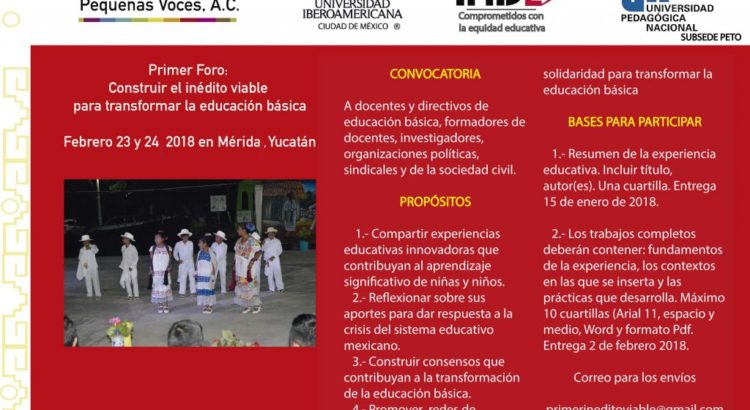
México: Convocatoria al Primer Foro: Construir el inédito viable para transformar la educación básica

México/15 de Enero de 2018/Educación Futura

“Crear, Crecer y Cuidar” es una experiencia educativa que desde 2014 se construye como una alternativa empeñada en transformar la educación básica y en constituirse en un movimiento que aliente la construcción de lo que Freire ha llamado el inédito viable, en tanto esperanza de transformación de las condiciones sociales de existencia.

Por ello, y con el propósito de contribuir a reflexionar en torno a propuestas alternativas de educación básica que llevan a cabo docentes en nuestro país, el Instituto de Investigación para el Desarrollo de la Educación de la Universidad Iberoamericana Ciudad de México, La Universidad Pedagógica Nacional, Unidad 31-A, Subsede Peto y Mejen T´aano´ob. Pequeñas Voces, A.C., emiten la presente CONVOCATORIA.

A docentes y directivos de educación básica, formadores de docentes, investigadores, organizaciones políticas, sindicales y de la sociedad civil, convencidos de la necesidad de transformar la educación básica en México, al: Primer foro. Transformar la educación básica. Construyendo el inédito viable. Que se llevará a cabo en Mérida, Yucatán, el viernes 23 y sábado 24 de febrero de 2018

Propósitos:

  1. Compartir experiencias educativas innovadoras que contribuyen al aprendizaje significativo de los niñxs.
  2. Reflexionar sobre sus aportes para dar respuesta a la crisis del sistema educativo mexicano.
  3. Construir consensos que contribuyan a la transformación de la educación básica.
  4. Promover el establecimiento de redes de solidaridad para transformar la educación básica.

Requisitos:

  • Una cuartilla con el resumen de la experiencia educativa que deberá incluir título, autor(es) y referencia.
  • Enviarlo al correo primerineditoviable@gmail.com, a partir de la presente Convocatoria y hasta el 15 de enero de 2018.

Los trabajos completos deberán contener: los fundamentos de la experiencia (horizonte de sentido); los contextos en las que está inserta y las prácticas que desarrolla (el qué y el cómo de los que se hace y con quiénes).

Máximo de 10 cuartillas, Arial 11, espacio y medio, en Word y formato pdf.

Fecha máxima 2 de febrero de 2018.

Fuente: http://www.educacionfutura.org/convocatoria-al-primer-foro-construir-el-inedito-viable-para-transformar-la-educacion-basica/

Comparte este contenido:

Estados Unidos: El mundo condena racismo de Trump hacia África y Latinoamérica

Estados Unidos/15 de Enero de 2018/Tele Sur

Las declaraciones emitidas por Trump en una reunión realizada el pasado jueves fueron publicadas por medios internacionales en las que expresaba: «¿Por qué estamos recibiendo a toda esta gente de países de mierda?».
Los insultos racistas y discriminatorios del presidente de Estados Unidos (EE.UU.), Donald Trump, contra América Latina y África han dado la vuelta al mundo. Su frase “por qué recibimos a gente de países de mierda” ha generado rechazo y condena internacional.

Este viernes la Organización de Naciones Unidas (ONU), la Unión Africana, Haití y El Salvador criticaron con dureza los comentarios discriminatorios de Trump, que hacían referencia a inmigrantes de las dos naciones caribeñas y de países africanos, residentes en EE.UU.

Haití

El embajador de Haití en EE.UU., Paul G. Altidor, también condenó los insultos de la Casa Blanca a sus ciudadanos. “Sentimos que estas afirmaciones, si fueron hechas, reflejan un desconocimiento o una falta de educación del presidente sobre Haití y su gente”, expresó.

El principal periódico del país caribeño calificó las palabras de Trump de “racistas y vergonzosas”.

El Salvador

El Salvador también declaró su disgusto con las «lamentables expresiones» de Trump. En un comunicado, el Ministerio de Relaciones Exteriores señaló que envió una nota de protesta al  Gobierno de EE.UU. y que demanda respeto a la dignidad de su noble y valiente pueblo.

«Algunas reacciones del presidente Trump, donde acepta implícitamente el uso de términos duros en menoscabo de la dignidad de El Salvador y de otros países; expresa su rotundo rechazo a este tipo de afirmaciones», agrega la nota.

La Unión Africana

La Unión Africana, la organización multilateral más importante del continente, también rechazó los exabruptos de Trump.

“Estamos alarmados por las afirmaciones del presidente de EE.UU. al referirse a inmigrantes africanos y otros con tales despectivos, teniendo en cuenta la realidad histórica de cómo llegaron muchos africanos a EE.UU. durante el comercio de esclavos; esto va en contra de cualquier actitud y comportamiento aceptable”, expresó la portavoz, Ebba Kalondo.

La Organización de las Naciones Unidas (ONU) calificó de racista el polémico comentario del presidente Donald Trump, sobre inmigrantes de Haití y países de África, al referirse a ellos como “países de mierda”.

“Esto no es sólo una historia sobre lenguaje vulgar, se trata de abrir la puerta al peor lado de la humanidad, de validar y fomentar el racismo y la xenofobia”, declaró el portavoz de la Oficina del Alto Comisionado de Naciones Unidas para los Derechos Humanos (Acnudh), Rupert Colville.

Ver imagen en Twitter

Fuente: https://www.telesurtv.net/news/El-mundo-condena-racismo-de-Trump-hacia-Africa-y-Latinoamerica-20180112-0045.html

Comparte este contenido:

Feminismo radical, ideología de género y el Papa Francisco

Por: Religión Digital

«El humo generado por críticos de la ‘ideología de género’ impide ver el sentido cristiano de la gracia».

Suena siniestro leer que tras la ideología de género se encuentra el marxismo cultural y el feminismo radical, amén de otros agentes, empeñados en acabar con la familia tradicional y el mundo occidental tal como lo conocemos.

¿En relación a qué es «radical» el feminismo así calificado? Según sus críticos es «radical» en relación al feminismo moderado o tradicionalde las primeras feministas, las cuales fueron buenas chicas que portaron el estandarte de la liberación femenina con justas reivindicaciones sociales como un salario digno o acceso a profesiones consideradas exclusivamente de hombres. Un feminismo al cual nada se puede objetar, sino todo lo contrario.

Pero a finales de los años sesenta surge en Estados Unidos un grupo de feministas radicales que empieza a desmarcarse de lo que hasta ese momento había sido el movimiento feminista reivindicativo en todo el mundo, dando lugar al feminismo agresivo contra el hombre y toda su cultura patriarcal, cuyo germen debe buscarse en la nueva izquierda surgida después de mayo del 68. «El corpus de esta ideología totalitaria incluye el sexo libre, el aborto, y la desaparición del matrimonio, la familia y la religión por ser instituciones opresoras».

A juzgar por lo extremado de las afirmaciones de algunas de sus representados es fácil satanizar el feminismo radical, sin pararse a pensar en sus causas y razones reivindicativas, tras las que se esconden muchas experiencias de dolor, como la de, por ejemplo, la escritora estadounidense y activista Andrea Dworkin, cuya vida es todo un rosario de abusos.

Para empezar, abusos por parte de su padre, abusos de su primer marido. A los 18 años fue arrestada durante una protesta contra la guerra del Vietnam y estuvo en la cárcel de mujeres del Village, donde sufrió abusos de dos médicos. Todos estos factores dominaron sus batallas subsiguientes contra toda forma de violencia contra la mujer.

Tras licenciarse en Literatura en 1968 por el Bennington College, dedicó todas sus fuerzas a la lucha feminista. Básicamente, fueron batallas contra la pornografía, la pedofilia, la violencia contra la mujer y la conducta sexual del hombre como referente de la desigualdad imperante, ahondando en la utilización del sexo por el hombre como vehículo del poder patriarcal. En 1999, a los 53 años, fue drogada y violada en un hotel de París, un suceso que le hizo un daño enorme, agravado, además, porque hubo quien no creyó su historia.

Es evidente que muchas mujeres no han llegado al feminismo radical por pura teoría ni por promover caprichosamente una ideología de género, sino sencillamente como consecuencia de su propia experiencia de vejación y dolor. Se entiende perfectamente que sea una mujer, monja y teóloga católica, Ivone Gebara, la que pueda escribir una teodicea teológica hasta aquí no tratada por ningún teólogo o filósofo masculino, me refiero a El rostro oculto del mal. Una teología desde la experiencia de las mujeres (Trotta, Madrid, 2002).

Ciertamente, la experiencia de violencia sexual o machista no justifica necesariamente las posiciones extremas o radicales, pero ayuda a comprenderlasy obliga a buscar otras perspectivas y hermenéuticas más comprensivas, según el principio cristiano destacado por San Ignacio, de que antes de condenar la posición contraria, hay que intentar salvarla. Así es como se es fiel a aquel que dijo, «no he venido a condenar al mundo, sino a salvarlo» (Jn 12, 47).

Cuando cada día somos testigos del abuso de la mujer, que en estos últimos meses ha tenido por protagonista a la industria del espectáculo de Hollywood, pero que es una realidad cotidiana que muchas niñas -y niños- llevan sufriendo desde la más tierna infancia en el seno mismo de su familia. Es triste comprobar que la violencia contra la mujer está presente en tanto en ámbitos privados como públicos; en el hogar y en trabajo; en la economía canalla de la prostitución, la pornografía y la trata de blancas; en la violencia física directa; en los feminicidios, que muchas veces quedan impunes.

Los que señalan los años 60 como génesis de la ideología de género, deben recordar que aquellos fueron marcados no solo por el movimiento feminista radical, sino también por protestas internacionales contra la guerra en Vietnam y contra la aceptación y hasta el apoyo de brutales dictaduras en Latinoamérica. Parte de aquella juventud se radicalizó al no ver posibilidades de eliminar esta violencia institucional. Protestaba por igual contra la violencia política y todo tipo de violencias, entre ellas la violencia de género.

Dicho esto, hay que aclarar que este tipo feminismo radical de los años 60-70 ya apenas si existe, excepto en Estados Unidos, donde siempre ha contado con grandes representantes, cuyo pensamiento fluctuó entre lo radical y lo moderado. Hoy muchas feministas abogan más por la cooperación que por la confrontación. En la actualidad, se puede decir con María Blanco, que «nadie tiene el monopolio de lo que piensan las mujeres, ni del feminismo auténtico, ni de la feminidad» (Afrodita desenmascarada. Una defensa del feminismo liberal, Deusto Ediciones, Barcelona, 2017).

Cathy Young, escribiendo a mediados del 2016 para The Washington Post, afirmaba que casi nadie niega la realidad histórica de la dominación masculina, pero la solución al problema, que ha creado un gran fractura en nuestra cultura, pasa no sólo por la guerra entre sexos. «Para formar parte de la curación, el feminismo debe incluir a los hombres, no sólo como aliados sino como socios, con una misma voz y una misma humanidad».

Después de una década complicada, la Conferencia Episcopal Española reconocía que el tiempo transcurrido desde la publicación Directorio de la Pastoral Familiar en España (2003), donde los obispos llamaban la atención sobre las nuevas circunstancias en las que se desarrollaba la vida familiar, y la presencia en la legislación española de presupuestos que devaluaban el matrimonio, en la actualidad «permite advertir que, desde entonces, no son pocos los motivos para la esperanza. Junto a otros factores se advierte, cada vez más extendida en amplios sectores de la sociedad, la valoración positiva del bien de la vida y de la familia; abundan los testimonios de entrega y santidad de muchos matrimonios y se constata el papel fundamental que están suponiendo las familias para el sostenimiento de tantas personas, y de la sociedad misma, en estos tiempos de crisis».

Los múltiples desafíos al concepto cristiano de la sexualidad y la familia están ahí, pero para responder a esta problemática, amplia y compleja, a la Iglesia no le queda otra vía que volver a reflexionar las viejas creencias a la luz de las nuevas realidades. Su labor es la búsqueda de la paz y el bien en cada nuevo contexto y en cada nuevo momento de la historia, sanar el egoísmo visceral que nos lleva a preferir siempre nuestros intereses en detrimento de los demás.

El ser humano, debido a lo arraigado de su pecado, ha construido una sociedad injusta y discriminadora, donde las esclavitudes antiguas da lugar a nuevos tipos de esclavitud, donde en última instancia todo se reduzca a mantener la diferencia entre los de arriba y los de abajo, entre la élite y la no-élite; entre los nuestros y los otros.

«Establecemos», como dice Ivone Gebara, «colores y etnias superiores unas a otras, sexos superiores a otros, orientaciones sexuales más normales que otras. Y quien está del lado del poder y de la normalidad no duda en mantener relaciones excluyentes y culpabilizar a ‘los diferentes’ por muchos males del mundo».

La Iglesia no es inmune a estos combates históricos entre la igualdad y la desigualdad, lo que en la Biblia se describe como «acepción de personas», intolerable para el creyente. La Iglesia tiene miedo de las feministas radicales y la feministas tienen miedo de la Iglesia. «Las feministas», escribía Alicia Miyares, «sabemos que los valores, tanto morales como políticos, de la igualdad y la libertad son falazmente cuestionados por discursos religiosos que pretenden interrumpir de continuo la marcha de la humanidad hacia modelos de democracia más perfectos».

Los últimos papas, comenzando por Juan Pablo II, pasando por Benedicto XVI y llegando a Francisco, se han pronunciado inequívocamente contra la «ideología de género»; esto no se puede negar.

En la exhortación apostólica postsinodal Amoris laetitia sobre el amor a la familia, publicada en marzo de 2016, el Papa Francisco advierte: «Otro desafío surge de diversas formas de una ideología, genéricamente llamada gender, que niega la diferencia y la reciprocidad natural de hombre y de mujer. Esta presenta una sociedad sin diferencias de sexo, y vacía el fundamento antropológico de la familia. Esta ideología lleva a proyectos educativos y directrices legislativas que promueven una identidad personal y una intimidad afectiva radicalmente desvinculadas de la diversidad biológica entre hombre y mujer. La identidad humana viene determinada por una opción individualista, que también cambia con el tiempo» (n. 86). Con ello no hace sino defender la enseñanza sustentada en la Escritura y la Tradición sobre las relaciones hombre-mujer y el matrimonio.

Pero, téngase en cuenta una nota importante. Para Francisco, denunciar la ideología de género no implica negar ayuda o compañía a los homosexuales; no cierra los ojos a la urgencia de una teología pastoral adecuada, sensible y atenta a la realidad.

En la habitual conferencia de prensa que concede en el retorno de sus viajes internacionales, específicamente en el vuelo de Azerbaiyán a Roma, el Papa señaló que «las personas se deben acompañar como las acompaña Jesús. Cuando una persona que tiene esta condición llega hasta Jesús, Jesús no le dirá seguramente vete porque eres homosexual. No. Lo que yo he dicho, es esa maldad que hoy se hace en el adoctrinamiento de la teoría del género».

«Antes que nada, yo he acompañado en mi vida como sacerdote, obispo y también como Papa, he acompañado personas con tendencia homosexual y también con prácticas homosexuales. He acompañado, los he acercado al Señor, algunos no podían, pero yo he acompañado y nunca he abandonado a nadie, esto que quede claro».

Anteriormente, el 26 junio 2016, Francisco se había atrevido a decir que la Iglesia católica debería disculparse con las personas gays por la forma en que las ha tratado. Fue durante el vuelo de regreso al Vaticano tras su visita a Armenia. El Papa hizo estas declaraciones cuando le preguntaron si estaba de acuerdo con los comentarios del cardenal alemán Reinhard Marx, quien dijo que la Iglesia debía disculparse con los homosexuales por haberlos «marginado».

Francisco respondió literalmente: «Creo que la Iglesia no sólo debe pedir disculpas a una persona homosexual que ofendió, sino que hay que pedir perdón a los pobres, a las mujeres que han sido explotadas, a los niños obligados a trabajar, pedir perdón por haber bendecido tantas armas».

Por si fuera poco, el 3 de octubre de 2016, de nuevo a bordo de un avión, de regreso de su viaje a Georgia y Azerbaiyán, Francisco aseguró que Jesús no abandonaría a un homosexual o un transexual. Fue en respuesta a la pregunta sobre qué opinaba de las personas transexuales, de aquellas con disfunciones hormonales o aquellas que cambiaban de sexo porque no aceptaban su cuerpo de hombre o mujer. «Cuando una persona con esta condición llega delante de Jesús, nunca le dirá vete porque eres homosexual», dijo y agregó: «A las personas hay que acompañarlas cómo hace Jesús siempre».

A la luz de estas declaraciones «en vuelo», no es de extrañar que el Papa Francisco haya sido reconocido por la comunidad gay como el papa más «clemente» de los últimos años. El escritor colombiano Giuseppe Caputo, aunque no cree que es para echar las campanas al vuelo, reconoce que «ha habido un cambio, dentro del estrecho margen de cambio que un discurso de derecha como el católico puede tener: el suyo es un gesto sutil, muy sutil, pero ha demostrado ser simbólico y, sobre todo, beneficioso. Definitivamente no es lo mismo que una institución con tanto poder de influencia hable de hogueras y penalización a que pida abiertamente que los gays no sean marginados. Que la extrema derecha rechace las declaraciones de Francisco, evidencia que ha habido un giro: las personas homosexuales, señores creyentes, no pueden ser discriminadas ni tratadas con violencia, lo pide el Papa».

Esta es lo diferencia de la crítica papal de la «ideología de género» de la crítica de los que la instrumentalizan para sus intereses particulares, principalmente políticos. En todos los países latinoamericanos, con nula educación política en general, muchos políticos debeladores de la «ideología de género» la utilizan interesadamentecomo un instrumento muy importante para ganarse la voluntad que pueblo, siempre dispuesto a defender la moral tradicional y sus creencias religiosas, al tiempo que también, cómo no, excitan los prejuicios, odios y fobias populares, con el fin de conseguir su voto, o al menos, el rechazo de aquellos partidos zurdos señalados como defensores de la subversiva «ideología de género».

Muchos pastores, principalmente de las iglesias evangélicas fundamentalistas, pentecostales y carismáticas, se suman a con tal fervor a este discurso que arrastran tras de sí a toda su congregación, llegando a traspasar el límite del rechazo a la homosexualidad por causas doctrinales, para caer en el odio más visceral al que es tildado de abominable y digno de la pena de muerte, según la ley de Moisés. Imagino que aderezado con amor por la salvación del alma.

En estos casos, la «ideología de género» se convierte en una nube de humo que no solo oculta los problemas del pueblo de carácter social y económico, y desvía la atención del subdesarrollo y la corrupción política, sino lo que es mucho más grave, oculta por completo el mensaje evangélico de gracia y misericordia.

El humo generado por muchos críticos de la «ideología de género» impide ver el sentido cristiano de la gracia y la reconciliación. En lugar de ser portadores de esperanza, se convierten en mensajeros de odio y miedo. Han pisado el umbral de la gracia, sí, pero se han quedado en la antesala de ley; pertenecen más en la escuela del Juan Bautista tronante que del apacible Jesús de Nazaret.

Para Amelia Valcárcel, desde su posición de observadora, estos predicadores evangélicos pentecostistas son más veterotestamentarios que neotestamentarios; son capaces de sacar enseñanzas de los versículos más abstrusos del Antiguo Testamento, por el que tienen especial predilección. Los Evangelios se escuchan poco, pero Josué, Jueces, Esdras, Reyes, o Ezequiel son citados de continuo.

Lamentablemente, los rigoristas e integristas, «convierten la defensa de la moral, de la vida y familia en una ideología e ideologización que les lleva a despreocuparse o legitimar, al mismo tiempo, otros males e injusticias sociales-globales. Como son el hambre y la pobreza, la precariedad (explotación) laboral, el trabajo basura e indecente y el paro, la pena de muerte, las guerras, armas e industria militar, las violencias y destrucción ecológica.

«Es la parcialización e ideologización de la fe y la moral que cae en la moralina burguesa e individualista, obsesionada por las cuestiones personales como la familia o la sexualidad. Sin enmarcarlas y responsabilizarse por las otras cuestiones sociales y éticas, que o bien no les preocupan o quieren justificar dichas injusticias sociales. Para ser una moral coherente, hay que defender la vida en todas sus fases, dimensiones y aspectos, desde el inicio con la concepción-fecundación, durante toda la existencia humana con el bien común, la dignidad y derechos de las personas hasta el final de la misma».

En la Carta a los obispos de la Iglesia católica sobre la atención pastoral a las personas homosexuales, publicada en 1986 durante el papado de Juan Pablo II y que estuvo a cargo del cardenal Joseph Ratzinger, entonces prefecto de la Congregación para la Doctrina de la Fe, se afirma con rotundidad que los actos homosexuales son «intrínsecamente desordenados» y que en ningún caso pueden recibir aprobación -enseñanza que recogía la anterior declaración sobre la «Persona humana» y la ética sexual, del 29 de diciembre de 1975-, sin embargo en dicha carta el cardenal Ratzinger, advierte con no menos énfasis, que «es de deplorar con firmeza que las personas homosexuales hayan sido y sean todavía objeto de expresiones malévolas y de acciones violentas. Tales comportamientos merecen la condena de los pastores de la Iglesia, dondequiera que se verifiquen» (n. 10).

Importante nota pastoral que muchos parecen ignorar. Lo grave es que aquí no están en juego ciertas doctrinas o ideas, sino las personas, las mismas que estamos llamados a servir con amor y diligencia.

Fuente: http://www.periodistadigital.com/religion/opinion/2018/01/13/religion-iglesia-opinion-feminismo-radical-ideologia-de-genero-papa-francisco.shtml

Comparte este contenido:
Page 792 of 1685
1 790 791 792 793 794 1.685