Page 847 of 1684
1 845 846 847 848 849 1.684

Interview 1: Blueprint for a Progressive US: A Dialogue With Noam Chomsky and Robert Pollin

Interview/By C.J. Polychroniou, Truthout

This is the first part of a wide-ranging interview with world-renowned public intellectuals Noam Chomsky and Robert Pollin. The next installment will appear on October 24.

Not long after taking office, it became evident that Donald Trump had engaged in fraudulent populism during his campaign. His promise to «Make America Great Again» has been exposed as a lie, as the Trump administration has been busy extending US military power, exacerbating inequality, reverting to the old era of unregulated banking practices, pushing for more fuel fossil drilling and stripping environmental regulations.

In the Trump era, what would an authentically populist, progressive political agenda look like? What would a progressive US look like with regard to jobs, the environment, finance capital and the standard of living? What would it look like in terms of education and health care, justice and equality? In an exclusive interview with C.J. Polychroniou for Truthout, world-renowned public intellectuals Noam Chomsky and Robert Pollin tackle these issues. Noam Chomsky is professor emeritus of linguistics at MIT and laureate professor in the department of linguistics at the University of Arizona. Robert Pollin is distinguished professor of economics and co-director of the Political Economy Research Institute at the University of Massachusetts at Amherst. Their views lay the foundation for a visionary — yet eminently realistic — progressive social and economic order for the United States.

C.J. Polychroniou: Noam, the rise of Donald Trump has unleashed a rather unprecedented wave of social resistance in the US. Do you think the conditions are ripe for a mass progressive/socialist movement in this country that can begin to reframe the major policy issues affecting the majority of people, and perhaps even challenge and potentially change the fundamental structures of the US political economy?

Noam Chomsky: There is indeed a wave of social resistance, more significant than in the recent past — though I’d hesitate about calling it «unprecedented.» Nevertheless, we cannot overlook the fact that in the domain of policy formation and implementation, the right is ascendant, in fact some of its harshest and most destructive elements [are rising].

Nor should we overlook a crucial fact that has been evident for some time: The figure in charge, though often ridiculed, has succeeded brilliantly in his goal of occupying media and public attention while mobilizing a very loyal popular base — and one with sinister features, sometimes smacking of totalitarianism, including adoration of The Leader. That goes beyond the core of loyal Trump supporters…. [A majority of Republicans] favor shutting down or at least fining the press if it presents «biased» or «false news» — terms that mean information rejected by The Leader, so we learn from polls showing that by overwhelming margins, Republicans not only believe Trump far more than the hated mainstream media, but even far more than their own media organ, the extreme right Fox news. And half of Republicans would back postponing the 2020 election if Trump calls for it.

It is also worth bearing in mind that among a significant part of his worshipful base, Trump is regarded as a «wavering moderate» who cannot be fully trusted to hold fast to the true faith of fierce White Christian identity politics. A recent illustration is the primary victory of the incredible Roy Moore in Alabama despite Trump’s opposition. («Mr. President, I love you but you are wrong,» as the banners read). The victory of this Bible-thumping fanatic has led senior party strategists to [conclude] «that the conservative base now loathes its leaders in Washington the same way it detested President Barack Obama» — referring to leaders who are already so far right that one needs a powerful telescope to locate them at the outer fringe of any tolerable political spectrum.

The potential power of the ultra-right attack on the far right is [illustrated] by the fact that Moore spent about $200,000, in contrast to his Trump-backed opponent, the merely far-right Luther Strange, who received more than $10 million from the national GOP and other far-right sources. The ultra-right is spearheaded by Steve Bannon, one of the most dangerous figures in the shiver-inducing array that has come to the fore in recent years. It has the huge financial support of the Mercer family, along with ample media outreach through Breitbart news, talk radio and the rest of the toxic bubble in which loyalists trap themselves.

While Trump keeps the spotlight on himself, the «respectable» Republican establishment chips away at government programs that benefit the general population.

In the most powerful state in history, the current Republican Party is ominous enough. What is not far on the horizon is even more menacing.

Much has been said about how Trump has pulled the cork out of the bottle and legitimized neo-Nazism, rabid white supremacy, misogyny and other pathologies that had been festering beneath the surface. But it goes much beyond even that.

I do not want to suggest that adoration of the Dear Leader is something new in American politics, or confined to the vulgar masses. The veneration of Reagan that has been diligently fostered has some of the same character, in intellectual circles as well. Thus, in publications of the conservative Hoover Institution at Stanford University, we learn that Reagan’s «spirit seems to stride the country, watching us like a warm and friendly ghost.» Lucky us, protected from harm by a demi-god.

Whether by design, or simply inertia, the Republican wrecking ball has been following a two-level strategy. Trump keeps the spotlight on himself with one act after another, assuming (correctly) that yesterday’s antics will be swept aside by today’s. And at the same time, often beneath the radar, the «respectable» Republican establishment chips away at government programs that might be of benefit to the general population, but not to their constituency of extreme wealth and corporate power. They are systematically pursuing what Financial Times economic correspondent Martin Wolf calls «pluto-populism,» a doctrine that imposes «policies that benefit plutocrats, justified by populist rhetoric.» An amalgam that has registered unpleasant successes in the past as well.

Meanwhile, the Democrats and centrist media help out by focusing their energy and attention on whether someone in the Trump team talked to Russians, or [whether] the Russians tried to influence our «pristine» elections — though at most in a way that is undetectable in comparison with the impact of campaign funding, let alone other inducements that are the prerogative of extreme wealth and corporate power and are hardly without impact.

The Russian saboteurs of democracy seem to be everywhere. There was great anxiety about Russian intervention in the recent German elections, perhaps contributing to the frightening surge of support for the right-wing nationalist, if not neo-fascist, «Alternative for Germany» [AfD]. AfD did indeed have outside help, it turns out, but not from the insidious Putin. «The Russian meddling that German state security had been anticipating apparently never materialized,» according to Bloomberg News. «Instead, the foreign influence came from America.» More specifically, from Harris Media, whose clients include Marine Le Pen’s National Front in France, Benjamin Netanyahu in Israel, and our own Donald Trump. With the valuable assistance of the Berlin office of Facebook, which created a population model and provided the needed data, Harris’s experts micro-targeted Germans in categories deemed susceptible to AfD’s message — with some success, it appears. The firm is now planning to move on to coming European races, it has announced.

Nevertheless, all is not bleak by any means. The most spectacular feature of the 2016 elections was not the election of a billionaire who spent almost as much as his lavishly-funded opponent and enjoyed fervent media backing. Far more striking was the remarkable success of the Sanders campaign, breaking with over a century of mostly bought elections. The campaign relied on small contributions and had no media support, to put it mildly. Though lacking any of the trappings that yield electoral success in our semi-plutocracy, Sanders probably would have won the Democratic Party nomination, perhaps the presidency, if it hadn’t been for the machinations of party managers. His popularity undimmed, he is now a leading voice for progressive measures and is amassing considerable support for his moderate social democratic proposals, reminiscent of the New Deal — proposals that would not have surprised President Eisenhower, but are considered practically revolutionary today as both parties have shifted well to the right [with] Republicans virtually off the spectrum of normal parliamentary politics.

Offshoots of the Sanders campaign are doing valuable work on many issues, including electoral politics at the local and state level, which had been pretty much abandoned to the Republican right, particularly during the Obama years, to very harmful effect. There is also extensive and effective mobilization against racist and white supremacist pathologies, often spearheaded by the dynamic Black Lives Matter movement. Defying Trumpian and general Republican denialism, a powerful popular environmental movement is working hard to address the existential crisis of global warming. These, along with significant efforts on other fronts, face very difficult barriers, which can and must be overcome.

Bob, it is clear by now that Trump has no plan for creating new jobs, and even his reckless stance toward the environment will have no effect on the creation of new jobs. What would a progressive policy for job creation look like that will also take into account concerns about the environment and climate change?

Robert Pollin: A centerpiece for any kind of progressive social and economic program needs to be full employment with decent wages and working conditions. The reasons are straightforward, starting with money. Does someone in your family have a job and, if so, how much does it pay? For the overwhelming majority of the world’s population, how one answers these two questions determines, more than anything else, what one’s living standard will be. But beyond just money, your job is also crucial for establishing your sense of security and self-worth, your health and safety, your ability to raise a family, and your chances to participate in the life of your community.

Building a green economy in the US generates roughly three times more jobs per dollar than maintaining our fossil fuel dependency.

How do we get to full employment, and how do we stay there? For any economy, there are two basic factors determining how many jobs are available at any given time. The first is the overall level of activity — with GDP as a rough, if inadequate measure of overall activity — and the second is what share of GDP goes to hiring people into jobs. In terms of our current situation, after the Great Recession hit in full in 2008, US GDP has grown at an anemic average rate of 1.3 percent per year, as opposed to the historic average rate from 1950 until 2007 of 3.3 percent. If the economy had grown over the past decade at something even approaching the historic average rate, the economy would have produced more than enough jobs to employ all 13 million people who are currently either unemployed or underemployed by the official government statistics, plus the nearly 9 million people who have dropped out of the labor force since 2007.

In terms of focusing on activities where job creation is strong, let’s consider two important sets of economic sectors. First, spending $1 million on education will generate a total of about 26 jobs within the US economy, more than double the 11 jobs that would be created by spending the same $1 million on the US military. Similarly, spending $1 million on investments in renewable energy and energy efficiency will create over 16 jobs within the US, while spending the same $1 million on our existing fossil fuel infrastructure will generate about 5.3 jobs — i.e. building a green economy in the US generates roughly three times more jobs per dollar than maintaining our fossil fuel dependency. So full employment policies should focus on accelerating economic growth and on changing our priorities for growth — as two critical examples, to expand educational opportunities across the board and to build a green economy, while contracting both the military and the fossil fuel economy.

A full employment program also obviously needs to focus on the conditions of work, starting with wages. The most straightforward measure of what neoliberal capitalism has meant for the US working class is that the average wage for non-supervisory workers in 2016 was about 4 percent lower than in 1973. This is while average labor productivity — the amount each worker produces over the course of a year — has more than doubled over this same 43-year period. All of the gains from productivity doubling under neoliberalism have therefore been pocketed by either supervisory workers, or even more so, by business owners and corporate shareholders seeing their profits rise. The only solution here is to fight to increase worker bargaining power. We need stronger unions and worker protections, including a $15 federal minimum wage. Such initiatives need to be combined with policies to expand the overall number of job opportunities out there. A fundamental premise of neoliberalism from day one has been to dismantle labor protections. We are seeing an especially aggressive variant of this approach today under the so-called «centrist» policies of the new French President Emmanuel Macron.

What about climate change and jobs? A view that has long been touted, most vociferously by Trump over the last two years, is that policies to protect the environment and to fight climate change are bad for jobs and therefore need to be junked. But this claim is simply false. In fact, as the evidence I have cited above shows, building a green economy is good for jobs overall, much better than maintaining our existing fossil-fuel based energy infrastructure, which also happens to be the single most significant force driving the planet toward ecological disaster.

It is true that building a green economy will not be good for everyone’s jobs. Notably, people working in the fossil fuel industry will face major job losses. The communities in which these jobs are concentrated will also face significant losses. But the solution here is straightforward: Just Transition policies for the workers, families and communities who will be hurt as the coal, oil and natural gas industries necessarily contract to zero over roughly the next 30 years. Working with Jeannette Wicks-Lim, Heidi Garrett-Peltier and Brian Callaci at [the Political Economy Research Institute], and in conjunction with labor, environmental and community groups in both the states of New York and Washington, we have developed what I think are quite reasonable and workable Just Transition programs. They include solid pension protections, re-employment guarantees, as well as retraining and relocation support for individual workers, and community-support initiatives for impacted communities.

The single most important factor that makes all such initiatives workable is that the total number of affected workers is relatively small. For example, in the whole United States today, there are a total of about 65,000 people employed directly in the coal industry. This represents less than 0.05 percent of the 147 million people employed in the US. Considered within the context of the overall US economy, it would only require a minimum level of commitment to provide a just transition to these workers as well as their families and communities.

Finally, I think it is important to address one of the major positions on climate stabilization that has been advanced in recent years on the left, which is to oppose economic growth altogether, or to support «de-growth.» The concerns of de-growth proponents — that economic growth under neoliberal capitalism is both grossly unjust and ecologically unsustainable — are real. But de-growth is not a viable solution. Consider a very simple example — that under a de-growth program, global GDP contracts by 10 percent. This level of GDP contraction would be five times larger than what occurred at the lowest point of the 2007-09 Great Recession, when the unemployment rate more than doubled in the United States. But even still, this 10 percent contraction in global GDP would have the effect, on its own, of reducing carbon dioxide (CO2) emissions by precisely 10 percent. At a minimum, we would still need to cut emissions by another 30 percent within 15 years, and another 80 percent within 30 years to have even a fighting chance of stabilizing the climate. As such, the only viable climate stabilization program is to invest massively in clean renewable and high energy efficiency systems so that clean energy completely supplants our existing fossil-fuel dependent system within the next 30 years, and to enact comparable transformations in agricultural production processes.

The «masters of the universe» have made a huge comeback since the last financial crisis, and while Trump’s big-capital-friendly policies are going to make the rich get richer, they could also spark the next financial crisis. So, Bob, what type of progressive policies can and should be enforced to contain the destructive tendencies of finance capital?

Pollin: The classic book Manias, Panics, and Crashes by the late MIT economist Charles Kindleberger makes clear that, throughout the history of capitalism, unregulated financial markets have persistently produced instability and crises. The only deviation from this long-term pattern occurred in the first 30 years after World War II, roughly from 1946-1975. The reason US and global financial markets were much more stable over this 30-year period is that the markets were heavily regulated then, through the Glass-Steagall regulatory system in the US, and the Bretton Woods system globally. These regulatory systems were enacted only in response to the disastrous Great Depression of the 1930s, which began with the 1929 Wall Street crash and which then brought global capitalism to its knees.

Of course, the big Wall Street players always hated being regulated and fought persistently, first to evade the regulations and then to dismantle them. They were largely successful through the 1980s and 1990s. But the full, official demise of the 1930s regulatory system came only in 1999, under the Democratic President Bill Clinton. At the time, virtually all leading mainstream economists — including liberals, such as Larry Summers, who was Treasury Secretary when Glass-Steagall was repealed — argued that financial regulations were an unnecessary vestige of the bygone 1930s. All kinds of fancy papers were written «demonstrating» that the big players on Wall Street are very smart people who know what’s best for themselves and everyone else — and therefore, didn’t need government regulators telling them what they could or could not do. It then took less than eight years for hyper-speculation on Wall Street to once again bring global capitalism to its knees. The only thing that saved capitalism in 2008-09 from a repeat of the 1930s Great Depression was the unprecedented government interventions to prop up the system, and the equally massive bail out of Wall Street.

An effective regulatory system today would be one guided by a few basic premises that can be applied flexibly but also universally.

By 2010, the US Congress and President Obama enacted a new set of financial regulations, the Dodd-Frank system. Overall, Dodd-Frank amount to a fairly weak set of measures aiming to dampen hyper-speculation on Wall Street. A large part of the problem is that Dodd-Frank included many opportunities for Wall Street players to delay enactment of laws they didn’t like and for clever lawyers to figure out ways to evade the ones on the books. That said, the Trump administration, led on economic policy matters by two former Goldman Sachs executives, is committed to dismantling Dodd-Frank altogether, and allowing Wall Street to once again operate free of any significant regulatory constraints. I have little doubt that, free of regulations, the already ongoing trend of rising speculation — with, for example, the stock market already at a historic high — will once again accelerate.

What is needed to build something like a financial system that is both stable and supports a full-employment, ecologically sustainable growth framework? A major problem over time with the old Glass-Steagall system was that there were large differences in the degree to which, for example, commercial banks, investment banks, stock brokerages, insurance companies and mortgage lenders were regulated, thereby inviting clever financial engineers to invent ways to exploit these differences. An effective regulatory system today should therefore be guided by a few basic premises that can be applied flexibly but also universally. The regulations need to apply across the board, regardless of whether you call your business a bank, an insurance company, a hedge fund, a private equity fund, a vulture fund, or some other term that most of us haven’t yet heard about.

One measure for promoting both stability and fairness across financial market segments is a small sales tax on all financial transactions — what has come to be known as a Robin Hood Tax. This tax would raise the costs of short-term speculative trading and therefore discourage speculation. At the same time, the tax will not discourage «patient» investors who intend to hold their assets for longer time periods, since, unlike the speculators, they will be trading infrequently. A bill called the Inclusive Prosperity Act was first introduced into the House of Representatives by Rep. Keith Ellison in 2012 and then in the Senate by Bernie Sanders in 2015, [and] is exactly the type of measure that is needed here.

Another important initiative would be to implement what are called asset-based reserve requirements. These are regulations that require financial institutions to maintain a supply of cash as a reserve fund in proportion to the other, riskier assets they hold in their portfolios. Such requirements can serve both to discourage financial market investors from holding an excessive amount of risky assets, and as a cash cushion for the investors to draw upon when market downturns occur.

This policy instrument can also be used to push financial institutions to channel credit to projects that advance social welfare, for example, promoting investments in renewable energy and energy efficiency. The policy could stipulate that, say, at least 5 percent of banks’ loan portfolios should be channeled to into clean-energy investments. If the banks fail to reach this 5 percent quota of loans for clean energy, they would then be required to hold this same amount of their total assets in cash.

Finally, both in the US and throughout the world, there needs to be a growing presence of public development banks. These banks would make loans based on social welfare criteria — including advancing a full-employment, climate-stabilization agenda — as opposed to scouring the globe for the largest profit opportunities regardless of social costs…. Public development banks have always played a central role in supporting the successful economic development paths in the East Asian economies.

Editor’s note: This interview has been lightly edited for length and clarity.

C.J. POLYCHRONIOU

C.J. Polychroniou is a political economist/political scientist who has taught and worked in universities and research centers in Europe and the United States. His main research interests are in European economic integration, globalization, the political economy of the United States and the deconstruction of neoliberalism’s politico-economic project. He is a regular contributor to Truthout as well as a member of Truthout’s Public Intellectual Project. He has published several books and his articles have appeared in a variety of journals, magazines, newspapers and popular news websites. Many of his publications have been translated into several foreign languages, including Croatian, French, Greek, Italian, Portuguese, Spanish and Turkish. He is the author of Optimism Over Despair: Noam Chomsky On Capitalism, Empire, and Social Change, an anthology of interviews with Chomsky originally published at Truthout and collected by Haymarket Books.

Source:

http://www.truth-out.org/opinion/item/42284-blueprint-for-a-progressive-us-a-dialogue-with-noam-chomsky-and-robert-pollin


Comparte este contenido:

EEUU: School board needs to act on special education

EEUU/November 07, 2017/By: 

I was upset and sad when I read The Frederick News-Post’s article about the parents, teachers, and others blowing the whistle on Frederick County Public Schools’ special education department.

The dozens of people who spoke out aren’t outliers or disgruntled complainers. Their stories show a pattern. Special education advocates have been trying to call attention to that pattern for years. The system seems to have ignored or dismissed them.

If we believe special education parents and teachers (and I do), FCPS managers are skirting and possibly breaking state and federal special education laws through what they do and what they fail to do. That would also violate our ethical and moral obligations to children who need special education services. And that would also mean that hardworking teachers are being pressured to act as unwilling accomplices — all at the expense of children, families and taxpayers.

 If the allegations in the article are true, FCPS is mismanaging our county’s special education services. System-wide problems require system-wide solutions. Here’s what I think we should do as a start.

First, the Board of Education should set up a safe way for people to come forward so we can really understand the scope of the problems we face. Whistleblowers clearly fear school system retaliation. We need to know why. It’s time to listen to parents and teachers.

Second, the Board of Education should undertake an independent audit of FCPS’ special education department. How many of the county’s 4,000 Individual Education Plans are legal and valid? How many special education students are receiving services as legally required? How many teachers are being asked by FCPS to provide more daily hours of special education services than there are hours in the day? If there isn’t a systemic problem, then a full and publicly transparent audit will show that.

We need to thank the parents and teachers who are speaking out for special education students and families. The best way to do that is to act.

Source:

https://www.fredericknewspost.com/opinion/letter_to_editor/school-board-needs-to-act-on-special-education/article_9aa10033-ec80-5de4-93ca-5130c564bd89.html

Comparte este contenido:

Aurelio Nuño refrenda compromiso de México con la educación

México/06 noviembre 2017/Fuente: Megalopolis

Aseveró que “México cree profundamente en la fuerza de la educación; México aspira, a través de la educación, a ser una gran potencia en el Siglo XXI”.

El titular de la Secretaría de Educación Pública (SEP), Aurelio Nuño, refrendó el compromiso de México con la educación, como máxima prioridad, y con los valores de la Organización de Naciones Unidas para la Educación, la Ciencia y la Cultura (UNESCO).

En un discurso solemne ante la 39 conferencia general de la UNESCO, que se celebra en París, aseveró que “México cree profundamente en la fuerza de la educación; México aspira, a través de la educación, a ser una gran potencia en el Siglo XXI”.

“Pero para ello necesitamos trabajar juntos, hoy más que nunca debemos redoblar esfuerzos para que esta institución, la UNESCO, continúe con su labor histórica”, dijo respecto a la organización, que se encuentra en crisis, tras el reciente anuncio de Estados Unidos de que saldrá por desacuerdos.

Asimismo, comentó que “frente a la división y los muros debemos refrendar los valores de libertad, igualdad, solidaridad, tolerancia y cooperación internacional que nos unen a todos nosotros”.

“Frente a la ignorancia la respuesta es más educación, por eso, hoy ratifico la voluntad de México de seguir contribuyendo a la noble misión de esta gran institución, construir a través de la educación, la cultura, la ciencia y la innovación, la paz en la mente de los hombres y de las mujeres”, subrayó.

El funcionario federal estimó que “hoy que la humanidad y el planeta enfrentan graves amenazas como el populismo, el aislacionismo y el cambio climático” la visión de la UNESCO “está más vigente que nunca”.

Pese a ello, “en este momento en el que es tan importante trabajar juntos hay quienes han optado por caminar solos”, prosiguió el secretario de Educación sin nombrar a ninguna nación en concreto.

“Por ello, México reitera su compromiso inquebrantable con los valores fundacionales de la UNESCO y refrenda su permanencia en esta gran organización”, subrayó Nuño Mayer.

El secretario de Educación también realizó un balance de los logros y retos de México en materia educativa al recalcar que en el país “no hay prioridad más grande que la educación”.

En ese sentido, comentó que “en el Siglo XX nuestro país logró adoptar uno de los sistemas educativos más grandes del mundo con una amplia cobertura en todos los niveles”.

“Pero en el Siglo XXI el acceso a la educación ya no es suficiente, el gran reto de hoy es la calidad. El reto en la educación en el Siglo XXI es construir ciudadanos capaces de adaptarse a un mundo en cambio constante”, subrayó.

“El objetivo es formar ciudadanos críticos, pero responsables, solidarios, que sepan convivir en sociedad y en libertad; preparar a los niños y a los jóvenes para adaptarse a los retos del Siglo XXI y ser capaces de competir, pero también de competir exitosamente”, manifestó.

Agregó que el gobierno mexicano trabaja en la formación inicial de los docentes con un plan para que en los próximos 20 años sean maestros bilingües y trilingües, e invirtiendo en equipamiento e infraestructura escolar.

Fuente: https://megalopolismx.com/noticia/29846/aurelio-nuno-refrenda-compromiso-de-mexico-con-la-educacion

Comparte este contenido:

6 de las más extrañas teorías científicas olvidadas de la historia

Por: BBC Mundo

Hipótesis acerca de experimentos terroríficos para determinar la mejor manera de sobrevivir a climas helados, creencias erróneas, como la predicción del tiempo con animales muertos, telepatía, morfina para manzanas y otras extravagancias se han tratado de comprobar a lo largo de los últimos 500 años.

Probablemente no sorprenda saber que esas teorías no superaron los criterios establecidos por el rigor científico, pese a la convicción y los argumentos de quienes las defendían.

BBC Mundo te presenta algunas de las hipótesis «científicas» más extrañas de la historia.

1. Hadas darwinistas

En 1913, el clérigo inglés Charles Webster Leadbeater (1854 y 1934) publicó un libro llamado «El lado secreto de las cosas», con el que trató de crear un nuevo árbol evolutivo… para hadas.

«Cuando eran parte del mundo vegetal, estos seres fantásticos dependían de grama, avena y trigo para vivir. Posteriormente, en el mundo animal, se alimentaban con hormigas y abejas. Actualmente están en el estadio de minúsculos espíritus de la naturaleza», afirmaba Leadbeater.

Y una vez que llegaban a ese punto, observarlas era muy agradable. Según el clérigo, las razas tenían distintos colores, lo que diferenciaba las tribus, así como las plumas de las especies de pájaros no eran iguales.

Pero como las hadas no existen, Leadbeater no pudo probar su teoría.

Marcha de soldados naziDerechos de autor de la imagenGETTY IMAGES
Image captionLos médicos nazis realizaron experimentos terribles.

2. Medicina nazi

El doctor Sigmund Rascher realizó algunos de los experimentos más horribles durante la era nazi en el campo de concentración de Dachau, en el sur de Alemania.

Uno de los que realizaba con más frecuencia tenía que ver con el frío extremo. Quería saber cuál era la mejor manera de tratar a los pilotos que habían tenido que escapar de su avión en paracaídas en el mar del Norte. Estas pruebas también le servían para simular las condiciones climáticas con las que tenían que lidiar los soldados alemanes en el frente de guerra.

Así que en invierno obligaba a los prisioneros a pararse en el exterior durante 14 horas o los forzaba a meterse en un tanque de agua helada. Cuando perdían la conciencia trataba de revivirlos con baños de agua caliente.

Sin embargo, Heinrich Himmler, uno de los oficiales nazi de más alto rango, tenía una teoría distinta. Aseguraba que las esposas de los pescadores del mar del Norte revivían a sus maridos, cuando en un accidente terminaban en el mar, con el calor corporal.

Para comprobar la hipótesis de Himmler, mujeres gitanas fueron enviadas a Dachau a solicitud de Rascher. El médico las obligó a desnudarse y a acostarse con las víctimas de hipotermia.

Concluyeron que lo más efectivo eran los baños de agua caliente.

SalarDerechos de autor de la imagenGETTY IMAGES
Image captionUn homeópata estadounidense estaba convencido de que la sal era el secreto de la vida.

3. La sal milagrosa

El homeópata estadounidense Charles Wentworth Littlefield aseguraba haber descubierto el secreto de la vida.

Cuando atendía a pacientes que habían sufrido alguna cortadura, oraba para curarlos.

Un día tomo una muestra de sales orgánicas que ayudan a que la sangre se coagule y empezó a rezar pensando en un pollo.

Cuando analizó la muestra bajo un microscopio, se sorprendió al ver que la formación de los cristales de la sal era igualita al pollo en el que había estado pensando.

Asumiendo que tenía poderes telepáticos, Littlefield publicó un libro en el que aseguraba que al fijar sus pensamientos en pequeños montones de sal había logrado reproducir con los cristales la silueta del Tío Sam (la característica ilustración de un hombre vestido con los colores de la bandera de Estados Unidos que se usaba para reclutar soldados).

Según el homeópata, las sales también se transformaban en animales minúsculos como cangrejos y peces. Incluso en humanos de tamaño miniatura.

La mayoría de las especies no estaban vivas, a excepción de una raza microscópica de pulpos que, según Littlefield, eran el origen de la vida en la Tierra.

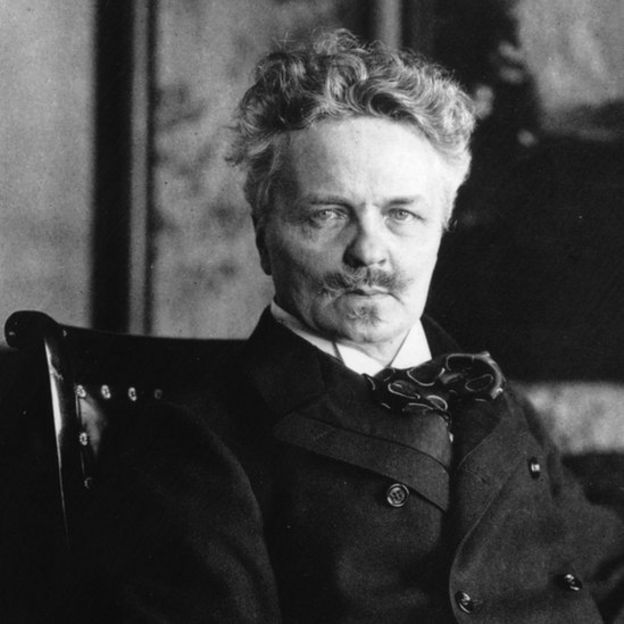
August StrindbergDerechos de autor de la imagenHULTON ARCHIVE / GETTY
Image captionEl novelista sueco August Strindberg se creía científico.

4. Las manzanas también tienen sentimientos

Contrario a lo que él creía, el novelista sueco August Strindberg, quien vivió entre 1849 y 1912, no era un científico.

Según una de sus teorías, las plantas tenían un sistema nervioso. Para comprobarlo se llevaba jeringas a sus caminatas matutinas y le inyectaba morfina a las plantas con las que se tropezaba para determinar si exhibían los efectos del consumo de drogas.

Un día, un policía lo descubrió introduciéndole la aguja a una manzana y lo arrestó. Fue puesto en libertad cuando explicó el experimento que estaba realizando. El funcionario se dio cuenta de que Strindberg era un excéntrico inofensivo y no un siniestro envenenador de frutas.

ManzanasDerechos de autor de la imagenGETTY IMAGES
Image caption¿Manzanas con morfina?

5. ¡Hola homúnculo!

El homúnculo era una especie de humano artificial minúsculo que los alquimistas «cultivaban» en laboratorios.

Sin duda, la historia más famosa de esta creación es la de Paracelsus, un médico suizo-alemán que vivió entre 1493 y 1541.

También era químico, astrólogo, místico, alcohólico y alquimista. En su libro, «De Rerum Natura», el autor se refiere al tema de la siguiente manera:

«Hay que dejar que el esperma de un hombre se pudra en un vaso sellado por 40 días. Cuando haya transcurrido este período de tiempo, será algo así como un hombre, pero transparente y sin cuerpo. Si se le cuida y alimenta con sangre humana durante 40 semanas… se convertirá en un infante».

Paracelsus, de hecho, afirmaba haber creado un homúnculo de 30 centímetros siguiendo las indicaciones descritas con anterioridad.

VeletaDerechos de autor de la imagenGETTY IMAGES
Image captionA falta de una veleta… un pájaro muerto.

6. La vida de los pájaros

La obra maestra del filósofo inglés Thomas Browne, quien vivió en el siglo XVII, fue «Pseudodoxia Epidemica», un libro publicado en 1646.

Era un catálogo inmenso de creencias erróneas que tenía la población y que incluía los extraños experimentos que Browne había realizado para probarlas o refutarlas.

Uno de los «errores vulgares» que el filósofo investigó fue la idea de que guindar de una cuerda a un pájaro martín pescador muerto lo convertía en una precisa veleta para determinar la dirección del viento.

Así que Browne consiguió uno de esos ejemplares y lo guindó, comprobando que se movía de manera aleatoria. Hizo lo mismo con otro pájaro que puso al lado del primero. Ambos animales empezaron a moverse en distintas direcciones.

Fue así como el inglés verificó que los martín pescador no tienen habilidades para predecir la dirección del viento.

 Fuente: http://www.bbc.com/mundo/noticias-41860997


Comparte este contenido:

La tecnología ha creado más trabajos de los que ha destruido, según 140 años de datos

Por: Mamela Fiallo

Desde que se inventó de la máquina para tejer, hubo resistencia por el temor a causar desempleo. Casi medio milenio atrás, la Reina Isabel I de Inglaterra le negó una patente al inventor por temor a dejar sin trabajo a los tejedores manuales. Siglos después, a principios del siglo XIX, con el auge de la Revolución Industrial, pero sobre todo por la escasez y carestía causada por la costosa guerra contra Napoleón, el temor se agravó, obreros del mismo rubro empezaron a destruir máquinas y prender fuego a fábricas. Y el miedo no ha terminado.

Por ello, economistas de la consultora Deloitte compararon estadísticas del censo en el Reino Unido desde 1871 hasta la actualidad  para hacer un estudio comparativo sobre cómo la maquinaria y la tecnología han influido sobre el empleo. Descubrieron que la máquina suplantó la fuerza física, dejando más tiempo libre y como tal creando más empleo en áreas vinculadas a la salud, bienestar y estética.

Según el informe:

En 1871, 6,6 % de los censados en Inglaterra y Gales se clasificaron como trabajadores agrícolas. Hoy en día el 0.2 % de la población desempeña esas tareas; es decir una caída prominente.

“La tendencia dominante es la contracción de empleo en la agricultura y la manufactura, que se ve más que compensada por el rápido crecimiento en los sectores de atención, creatividad, tecnología y servicios empresariales”.

“Las máquinas asumirán tareas más repetitivas y laboriosas, pero no parecen estar más cerca de eliminar la necesidad de mano de obra humana que en cualquier momento en los últimos 150 años”.

Adicionalmente, indica que en algunos sectores, incluidos la medicina, la educación y los servicios profesionales, la tecnología ha aumentado la productividad y el empleo ha aumentado al mismo tiempo, dice el informe.

De acuerdo al análisis de la Oficina de Estadísticas Nacionales, en el Reino Unido, entre 1992 y 2014, el número de trabajadores en el sector de la salud aumentó de 29,743 a 300,201. Es decir, aumento 909 % en los últimos 20 años.

También en ese mismo lapso de tiempo, el número de asistentes de apoyo educativo aumentó  580 %. Mientras que el empleo en sectores vinculados al bienestar, vivienda y trabajos comunitarios incrementaron 183 %. Asimismo, en ese periodo, creció la cantidad de cuidadores a domicilio 168 %.

En cambio, los sectores donde ha disminuido la mano de obra son:

79 % de caída en tejedores y tejedores de 24,009  a  4,961
57 % de caída en mecanógrafos
50 % de caída en las secretarias de la compañía

Es decir, aquellos que han sido reemplazados por procesos de automatización.

El ejemplo más notorio de este fenómeno es cómo la máquina para lavar ropa existe hace décadas en una versión apta para el hogar y reemplazó a una industria casi por completo. Tomando en cuenta que anteriormente se lavaba manualmente en el río, representó un cambio revolucionario.

El informe describe la existencia de este artefacto en el hogar como “una colisión de tecnologías, plomería dentro del hogar, electricidad y la lavadora automática asequible casi ha suplantado totalmente a las grandes lavanderías y el pesado trabajo de lavado manual”.

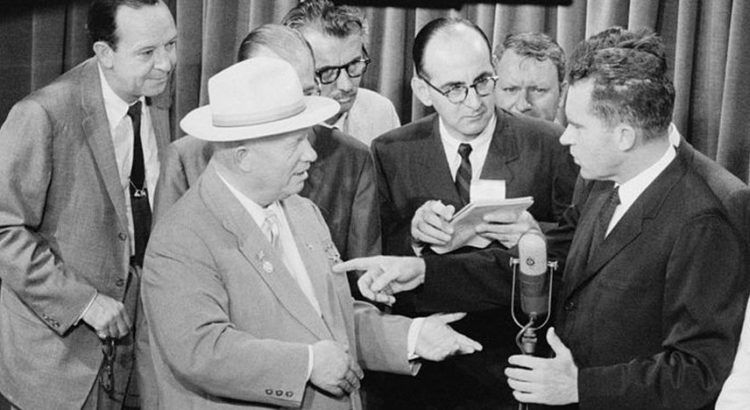
Sobre este suceso histórico existe un intercambio político. En 1959 los Gobiernos de los EE. UU. y la Unión Soviética pactaron un acuerdo para mejorar el diálogo y el intercambio entre ambas naciones. En Moscú se llevó a cabo lo que se conoce como “el debate de cocina“. El Gobierno de los EE. UU. expuso el prototipo de la casa de un ciudadano promedio. En su interior albergaba la “la línea blanca” de electrodomésticos que incluía una máquina para lavar ropa y otra para lavar los platos, dos cosas impensables en la unión de naciones socialistas. Al líder de la Unión de Repúblicas Socialistas Soviéticas, Khrushev, le pareció innecesario. A modo de burla, preguntó si había una máquina “para meter la comida a la boca y empujarla hacia abajo”.

No obstante, ese invento que hoy damos por sentado como algo cotidiano aligeró horas de carga laboral de labores domésticas; que fue a su vez uno de los tantos facilitadores de la inserción laboral masiva de mujeres en el mercado. Pues, las máquinas se encargaban de las tareas del hogar.

A su vez, por medio del uso de máquinas, la fuerza física siguió quedando relegada como parámetro de utilidad laboral. Esto sumó a la igualdad entre los sexos, dando mayor amplitud a los trabajos. Indica el estudio que: “El fácil acceso a la información y el ritmo acelerado de la comunicación han revolucionado la mayoría de las industrias basadas en el conocimiento”.

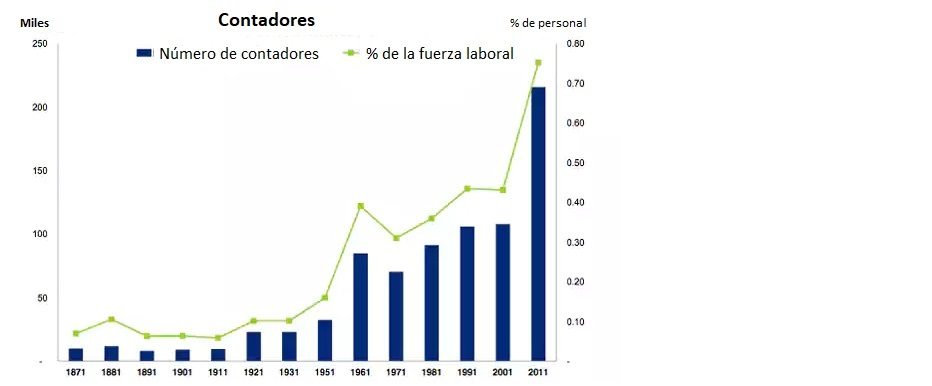
La maquinaria suplanta el trabajo forzado y aumenta la necesidad de trabajo intelectual, como contaduría. (Gráfico traducido)

Por ejemplo, el censo de 1871 registra que hubo 9,832 contadores en Inglaterra y Gales, y que se ha multiplicado por veinte en los últimos 140 años hasta 215,678.

Trabajos como estos también implican mayor ganancia que aquellos que pueden ser reemplazados con máquinas. Mayores ingresos implica mayor dinero para para gastar en el ocio. Esto crea nuevos empleos para suplir la nueva demanda.

Por ejemplo, en el rubro estético, el trabajo sigue en aumento. Mientras en 1871, había un peluquero o peluquero por cada 1.793 ciudadanos de Inglaterra y Gales; hoy hay uno por cada 287 personas. Es decir que aumentó casi 800 %.

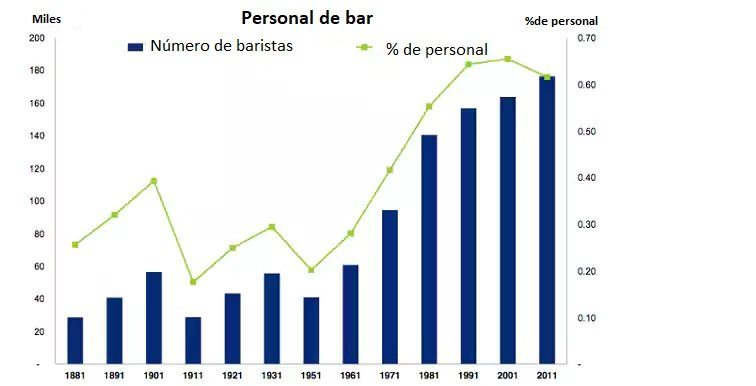
El empleo en los bares ha aumentado 400 %. (Gráfico traducido)

Este mismo aumento de gasto en ocio, sugiere el estudio que podría ser uno de los motivos por los cuales han surgido más bares.

“A pesar del declive del pub tradicional, los datos del censo muestran que la cantidad de personas empleadas en bares se multiplicó por cuatro entre 1951 y 2011”, dice el informe.

En retrospectiva, el informe indica cómo la tecnología ha facilitado el acceso a servicios no solo por abaratar los costos por medio de la automatización sino cómo tenemos a nuestro alcance productos que nos ahorran suficiente tiempo para poder hacer no solo lo que debemos sino lo que queremos. Indica, por ejemplo, que en los últimos 25 años el precio de los automóviles en el Reino Unido se ha reducido a la mitad.

Adicionalmente, plantea un interrogante ético, si los trabajos que se han perdido han sido realmente lamentables, pues ante su suplantación ha permitido que seres humanos no sean quienes carguen el peso que puede levantar una máquina sino que ahora se pueden dedicar a tareas que exigen mayor creatividad e ingenio. Al punto que un automóvil podría conducirse solo, aunque esto enfade a muchos taxistas.

Fuente: https://es.panampost.com/mamela-fiallo/2017/11/03/tecnologia-ha-creado-mas-trabajos/

Comparte este contenido:

África: ‘Harambee Youth Meeting’: ¡todos a una!

África/06 de Noviembre de 2017/Opusdei.es

Estudiantes de Polonia, Italia y Estados Unidos se reunieron en Roma para poner en marcha el grupo solidario «Harambee Youth» y compartir experiencias de voluntariado.

Harambee es el nombre de la asociación internacional que surgió con ocasión de la canonización de Josemaría Escrivá, y que, desde hace 15 años, trabaja para sostener realidades y organizaciones africanas activas en áreas de salud, educación y formación.

Recientemente, estudiantes de Polonia, Italia y Estados Unidos se reunieron en Roma para lanzar «Harambee Youth», el grupo que dentro de la asociación internacional promoverá el voluntariado entre los jóvenes.

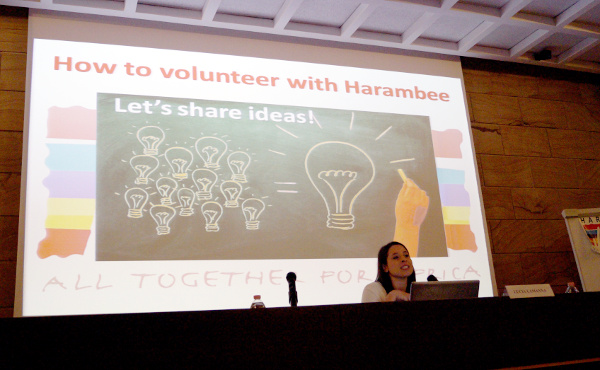
En este primer Harambee Youth Meeting, jóvenes voluntarios pudieron compartir experiencias y buscar soluciones creativas frente a las necesidades con las que se enfrentan sus coetáneos en algunas ciudades de África.

Jacek e Wojciech con otros participantes.Jacek e Wojciech con otros participantes.
«África no te deja indiferente. Es imposible estar allí y olvidarlo. África te marca». Son palabras de Jacek Pytel, médico y Coordinador de Harambee Polonia, quien acudió al encuentro romano con estudiantes de la Universidad de Medicina de Poznan. Desde el 2013 viajan cada año a las ciudades de Muthale y Mutomo (Kenia) para trabajar en colaboración con profesionales del lugar.

HAY QUE PENSAR CARA AL FUTURO, ¿QUÉ QUEREMOS CONSEGUIR DE AQUÍ A UNOS AÑOS? Y LUCHAR POR ELLO

Wojciech Sierocki, estudiante de Medicina, compartió su experiencia: «Empezamos a colaborar en Kenia con deseos de ayudar y, también, de aprender mucho. No hay que desanimarse cuando el trabajo no funciona al principio. Hay que pensar cara al futuro, ¿qué queremos conseguir de aquí a unos años? Y luchar por ello».

Orge Huja Duba, estudiante de Finanzas en la Universidad de Strathmore(Kenia), que también participó del evento, compartió su historia: «Mis padres nacieron en una comunidad nómada con muy pocos recursos económicos. En los años 60 llegaron al norte de África los misioneros del Instituto Consolata y, al comprobar la pobreza del país, decidieron invertir en educación. Construyeron un colegio con ayudas económicas provenientes, fundamentalmente, de Italia. Fueron casa por casa buscando niños que pudieran beneficiarse de este nuevo colegio. Es así como mis padres comenzaron a formarse. Ahora pienso que si mi padre no hubiese estudiado, seguramente yo no estaría hoy aquí».

A través de su testimonio, Orge explicó que educar a una persona es educar a toda una generación. La transmisión de conocimientos es fundamental, ya que la educación de una sola persona tiene un fuerte efecto expansivo; de ella se beneficia toda su familia, y esta educación se expande de generación en generación. Participar en alguno de estos proyectos es como sembrar una semilla y dejar que ésta arraigue y crezca por muchos años.

LOS JÓVENES QUE PARTICIPARON EN ESTE ENCUENTRO ESTUVIERON DE ACUERDO EN QUE LOS VIAJES A ÁFRICA NO SON LA ÚNICA MANERA DE PARTICIPAR EN LOS PROYECTOS DE HARAMBEE

Los jóvenes que participaron en este encuentro estuvieron de acuerdo en que los viajes a África no son la única manera de participar en los proyectos de Harambee. Así, por ejemplo, en Italia se llevan a cabo nuevas formas de voluntariado con inmigrantes, actividades de sensibilización en las redes sociales que se refieren a África como el continente del futuro y campañas de recogida de fondos.

Para concluir, Lucia de Smaele, representante de FOCSIV (Federazione degli Organismi Cristiani Servizio Internazionale Volontario), animó a los presentes a involucrarse más en proyectos sociales: «Servir significa que el centro no somos nosotros mismos, sino los demás. El centro de nuestros proyectos es el servicio, no nuestras ideas o necesidades. Hacer voluntariado es una oportunidad de conocer nuestras capacidades y de sacar lo mejor de nosotros mismos».

Fuente: http://opusdei.es/es-es/article/harambee-youth-meeting-2017/

Comparte este contenido:

La genética desmiente que el color de la piel determina una raza

Por: Tendencias 21

El color blanco de la piel viene de África y la pigmentación es una adaptación al entorno.

Una investigación ha descubierto que la piel blanca tiene un origen africano y que el color de la piel responde a una adaptación al entorno. La genética refuta así la noción de raza basada en la biología y establece que la mayoría de las variaciones genéticas asociadas al color de la piel aparecieron hace más de 300.000 años, algunas incluso hace un millón de años. La versión más antigua de estas variantes genéticas es la de una piel blanca.

Investigadores de la Universidad de Pensilvania han identificado los genes implicados en las diferentes tonalidades del color de la piel de 1.600 africanos y descubierto que la variabilidad genética asociada a una piel blanca o negra están presentes tanto en África como en otras poblaciones del mundo, lo que significa que la piel blanca tiene un origen africano y que la genética refuta la noción de raza.

Se entiende como raza cada uno de los cuatro grandes grupos étnicos en que se suele dividir la especie humana teniendo en cuenta ciertas características físicas distintivas, como el color de la piel, que se transmiten por herencia de generación en generación. Esta noción queda cuestionada con los resultados de la nueva investigación.

Todos los grupos humanos (las cuatro razas existentes son blanca o caucásica, negra o negroide, amarilla  o mongoloide y cobriza) manifiestan una amplia gama de colores de la piel. Hasta ahora se sabía poco de los genes vinculados a la pigmentación de la piel, salvo en el caso de las poblaciones europeas. Sin embargo, en África no todos los habitantes tienen el mismo color de piel y el origen genético que explica esta diversidad ha sido el objeto de esta investigación.

Para lograrlo, los investigadores usaron un medidor de color para establecer la reflectancia (capacidad de un cuerpo de reflejar la luz) de la piel de más de 2.000 africanos de poblaciones étnica y genéticamente diversas, tomando una muestra la parte interna de sus brazos, donde la exposición al sol es mínima.

Las mediciones se utilizan para inferir los niveles de melanina en la piel. La melanina es el pigmento oscuro que se encuentra en algunas células del cuerpo de los mamíferos y que produce la coloración de la piel, el pelo y los ojos. A través de estas mediciones, los investigadores determinaron que la piel más oscura correspondía a una población del África Occidental y la más clara a un grupo de cazadores-recolectores (bosquimanos) del África Austral.

Cuatro variantes genéticas

Además, los investigadores obtuvieron información genética de casi 1.600 africanos, examinando más de 4 millones de polimorfismos de un solo nucleótido en el genoma, lugares donde el código de ADN puede diferir en una «letra». A partir de este conjunto de datos, los investigadores pudieron hacer un estudio de asociación genómico y encontró cuatro áreas clave del genoma donde la variación se correlacionaba estrechamente con las diferencias de color de la piel.

La primera zona se encuentra en torno al gen denominado SLC24A5, que posee una variante conocida por desempeñar un papel importante en la claridad de la piel de las poblaciones europeas y del sur de Asia.

Una variante genética es un gen que es esencialmente igual que otro,  pero que posee diferencias debidas a mutaciones. En este caso, la variante del SLC24A5 apareció hace más de 30.000 años y se encuentra en las poblaciones etíopes y de Tanzania que tienen ancestros en el sur de Asia y en el Medio Oriente. Se cree que esta variante fue importada de esas regiones africanas.

Una segunda zona del genoma identificada por los investigadores contiene el gen MFSD12, asociado también a la pigmentación de la piel. Los investigadores descubrieron que mutaciones relacionadas con este gen, asociadas a una pigmentación oscura, son frecuentes en las poblaciones subsaharianas, pero no en los bosquimanos de piel más clara.

Estas variantes están presentes asimismo en poblaciones indias, de Australia y Malasia que tienen también una piel oscura y se han encontrado ahora en África. Los investigadores consideran que esos grupos humanos heredaron esos genes de poblaciones llegadas de África.

En los bosquimanos, las variantes genéticas han sido más frecuentes y muestran los mismos genes vinculados al color de la piel, de los ojos y de los cabellos que se encuentran en las poblaciones europeas.

Variaciones de hasta 1 millón de años

En este estudio, la mayoría de las variaciones genéticas asociadas a una piel blanca o negra han aparecido hace más de 300.000 años. Algunas incluso aparecieron hace un millón de años, mucho antes de la aparición del hombre moderno. Y un detalle: la versión más antigua de estas variantes genéticas es la de una piel clara.

Sarah Tishkoff, una de las investigadoras, explica en un comunicado que es lógico que el color de la piel en los ancestros de los humanos modernos haya podido ser relativamente blanca y que es probable que cuando perdimos los pelos que cubrían nuestro cuerpo, y salimos de los bosques para ir a la sabana, necesitáramos una piel más curtida.

En consecuencia, puede que el color de la piel esté relacionado con una adaptación al entorno, por lo que no puede decirse que exista una raza africana. “Nosotros demostramos que el color de la piel es muy variable en el continente africano y que todavía está evolucionando. Además, en la mayor parte de los casos, las variantes genéticas asociadas a la piel blanca han aparecido en África”.

Es decir, el estudio refuta categóricamente la noción de raza y demuestra una diversidad pigmentaria en el mismo seno de las diversas poblaciones africanas, donde las variantes genéticas responsables de una piel blanca aparecieron por primera vez.

Aunque el término raza es utilizado para hacer definir grupos con características hereditarias comunes, muchos científicos evolucionistas y sociales opinan que a la definición común de raza, o a cualquier definición de raza relativa a los humanos, le falta rigor y validez taxonómica. Argumentan que son imprecisas y arbitrarias, y que las razas observadas varían según la cultura examinada.

El nuevo estudio reafirma además lo que apuntan otros avances de la genética, según los cuales las diferencias genéticas entre grupos son biológicamente insignificantes,​ en el sentido de que existen variaciones genéticas en el interior de los grupos denominados razas y de que los rasgos raciales se solapan sin fronteras diferenciadas.

Referencia

Loci associated with skin pigmentation identified in African populations. Science, 12 Oct 2017:eaan8433. DOI: 10.1126/science.aan8433
Fuente: http://www.tendencias21.net/La-genetica-desmiente-que-el-color-de-la-piel-determina-una-raza_a44219.html
Comparte este contenido:
Page 847 of 1684
1 845 846 847 848 849 1.684