Page 998 of 2471
1 996 997 998 999 1.000 2.471

Technological innovations have improved quality of education

By: Louis Fourie.


History has proven that education is one of the most powerful tools to drive positive social, economical and technological change, and, therefore, create a more prosperous future for a country.

In South Africa many approaches to enhance the educational experience and quality have been tried in the past, but none of them were dramatically successful in improving the results of students, giving them greater access to post-school studies or enhance their employability.

There is a constant drive for educational policy change at national level, yet the attempts generally seem to be perennially futile. We have tried the appointment of more teachers, pedagogical methodologies that did not work elsewhere, and instructional designs that are outdated in the Fourth Industrial Era.

Perhaps the answer (partly) lies in technology. In our endeavours to increase the access and quality of education in South Africa, the Internet of Educational Things (IoET) may provide the much needed support. Historically, technological innovations and enhancements have improved the quality of and access to education all over the world.

In particular the Internet has had a profound impact on teaching and learning. Due to the many free online resources such as Massive Open Online Courses from leading institutions such as Harvard and MIT it is possible to take a class at home.

High school learners can access the rich sources of the Khan Academy and digital encyclopedias. Almost any skill or theory can be learned via YouTube and TED.

It is possible to find an online tutor for a child in any subject for a reasonable amount and children can even (illicitly) outsource their mathematics homework and other assignments to an unknown person on the Web.

But the Fourth Industrial Revolution (4IR) has not left education untouched. The Internet of Things (IoT), one of the building blocks of the 4IR, is an important innovation to create smart learning environments in schools and universities.

The IoT can improve the education system and can also add value to the face-to-face teaching environment and to structured learning.

The IoT makes it possible for schools to implement an unparalleled number of systems and methods that could enhance the abilities of students. It also revolutionises classroom dynamics, from primary school to university education.

The IoT, with its inherent connection of numerous devices and people to the Internet, will significantly transform our learning processes, as is evident from recent research that confirmed the educational potential at lower grade levels of the IoET devices.

Dr Jim Ang and his team from Kent University in the UK investigated how IoET technology could be effectively designed and used to support education in primary schools in rural Northern Thailand.

They developed a bespoke IoET platform called “Observation Learning System” (Obsy) that made the learning process more “real, local and fun”.

The toy-like Obsy device was based on the inexpensive Raspberry Pi mini computer and had several ports to which the learners could connect environmental sensors to measure ambient light and temperature. The recorded data was then transferred wirelessly to the tablets of the children. The Obsy was specifically designed to look like a toy to rouse the curiosity of the children and to minimise any possible technology anxiety or distrust.

At the back-end the system consisted of an IoET platform, which processed the context of learning activities, how the experiments have been carried out, as well as the results, allowing for improvements.

The children had to undertake three science-based learning activities with the aim of improving their understanding of certain science processes while simultaneously learning to work in teams.

They had to study the growth of mould in different conditions; learn about the factors that influence the growth of mushrooms; and determine how much light can pass through different objects by taking photos or videos, monitoring temperature changes, and measuring the amount of light with the Obsy device.

All the information that was wirelessly transmitted to their tablets, visualised in the form of graphs to assist the learners in making comparisons of the results and also in understanding how different conditions can lead to different results.

The device not only encouraged observation, but also invited students to share their results with the rest of their classmates.

From the research in Thailand, the researchers were able to demonstrate that the children using the IoET device had a significant higher learning engagement and obtained better scores than a control class that undertook the same experiments without the use of the Obsy device.

The current growth in the IoT has the potential to cause a move towards a new class of ubiquitous learning applications that rely on inexpensive sensors, edge devices, IoT middleware, and web-based protocols like HTTP to enable innovative ubiquitous and personalised learning designs in language and social sciences learning, science and technology learning, and domain independent learning.

Through the confluence of physical objects with the digital world, IoT allows the development of new hybrid systems. One solution is the powerful combination between Virtual Reality (VR) and IoT that was researched by Mohamed Fahim and others in Morocco.

IoT makes physical objects part of the virtual and digital environment, while VR makes digital environments seem realistic. Due to the increase in learners and shortage of physical resources in Morocco, the researchers resorted to VR and the IoT to create a credible virtual learning space where the learners could perform practical activities like in the real world – in this case the measurement of ultrasonic velocity in the air.

Thirty students were randomly divided into an experimental and a control group. A post-test revealed that the experimental group using the learning system based on IoT and VR were significantly better than the control group who only had a theoretical course.

Fourteen learners in the experimental group averaged 93.3percent, while the control group averaged between 46.7 and 53.3percent in the test.

The study indeed indicated that IoT and VR could widen the possibility for innovations in the teaching and learning, especially by creating a virtual environment where the learner is an active participant that can “learn by doing”, through the interaction with the 3D virtual objects.

An educational environment based on VR and IoT can further solve the problem of the equipment/product insufficiency often experienced by institutions. Such an environment can provide learners with a rich, interactive learning experience where they can perform tasks safely; participate in learning situations that require repetition; and participate in learning situations that are too expensive to implement in the real world.

It is evident that IoET technology in the classroom can bring major educational benefits. It can significantly improve learning outcomes and participation and allows learners to grasp more complex concepts.

Given the high percentage of children and students with smart phones in South Africa, the smart phones with their various sensors could easily be integrated into the learning activities of schools.

Learners live in a world where digital devices constitute a vital part of their daily lives.

It is time that the educational system harnesses this proficiency of students in the use of modern tools in order to stimulate their appetite for learning and their understanding of complex concepts.

Educational institutions can benefit greatly by using IoT in their regular educational activities. Perhaps the biggest problem is not the readiness of the students, but the readiness of the teachers.

Source of the article: https://www.iol.co.za/business-report/opinion/opinion-technological-innovations-have-improved-quality-of-education-26220202

Comparte este contenido:

La digitalización, un reto para la educación en Colombia

Hoy en día son cada vez más los sectores empresariales que están re-enfocando sus esfuerzos en la inmersión de sus unidades de negocio a todo lo que tiene que ver con la era digital. Por esta razón, existe un reto en Colombia por implementar en el modelo educativo el desarrollo de una asignatura pendiente, la digitilización; se habla de habilidades eficientes en matemáticas, comprensión de lectura y programación.

En el mundo ya ha es notorio el papel de la cultura digital y sus exigencias, tendencia que encamina a las sociedades a su modernización, en este caso particular en los entornos empresariales en los que la conectividad, análisis de datos y tecnologías, entre otras como la inteligencia artificial, son determinantes.

Por lo anterior, el reto es alinear la educación al punto de proyectar a los profesionales del mañanadesde su formación específica para afrontar lo que llaman la industria 4.0. Esto es además un llamado a ir de la mano con la economía digital.

En el caso de Colombia, no es un secreto que es una de las naciones que necesitan contemplar alternativas que adapten el modelo educativo a la tecnología de vanguardia y su cultura. Según la Organización Niñez Ya56 de cada 100 estudiantes no terminan la secundaria, un dato demoledor que llama a la academia a optimizar y trabajar más por ofrecer educación competente y llamativa.

«Los padres de familia y las entidades educativas deben entender dos competencias fundamentales. Uno, que los niños adquieran un carácter que les haga tener confianza en un futuro cambiante y eso pasa por fomentar su capacidad de aprender. Y dos, que una buena formación matemática va a ser muy importante porque es la base de la ciencia y de la tecnología, que son los motores del progreso. La situación ideal es que los niños con un carácter flexible y resiliente, tengan conocimientos matemáticos y visión humanista sólida«, explica Javier Arroyo, cofundador de Smartick, una plataforma de enseñanza de matemáticas bajo inteligencia artificial.

Y es que la matemática así como la comprensión lectora son claves para potenciar el carácter, esfuerzo y razonamiento lógico (en el caso de la matemática), y el desarrollo de la memoria, interpretación y argumentación (en el caso de la lectura).

«Los niños y sus familias deben saber que las matemáticas son el lenguaje de la ciencia y de la tecnología. Los profesores deberían ser capaces de abrirles a los niños las puertas a la belleza de las matemáticas, como un idioma que explica el mundo que nos rodea», añade Arroyo.

En Colombia, un país en el que las personas leen en promedio 3 libros al año, es importante no solo aumentar ese indicador sino enfocar la manera de leer para que la compresión se pueda perfeccionar y así lo procesos educativos y su exigencia.

Ahora bien, otro enfoque no menor es el de la programación, sector del conocimiento que está teniendo una alta demanda en todo el mundo. En esta nueva era es importante entender el lenguaje de Internet y las herramientas computarizadas, por lo se debe generar la necesidad de que a edades tempranas los niños estén familiarizados con sus conceptos y terminología, para así entender el pensamiento lógico de las tecnologías.

«Los niños de la actualidad tendrán que elegir entre ser espectadores de lo que otros crean, o ser ellos los que están en el campo de juego creando el futuro (…) necesitamos que a muchos les guste la programación y se familiaricen con ella desde pequeños (…) en unos años los estudiantes que manejen esas habilidades tendrán mejores ideas para su vida, podrán elegir mejor su profesión y posteriormente revolucionar el mundo, sin haberse sentido frustrados por la academia»

Fuente del artículo: https://www.rcnradio.com/estilo-de-vida/educacion/la-digitalizacion-un-reto-para-la-educacion-en-colombia

Comparte este contenido:

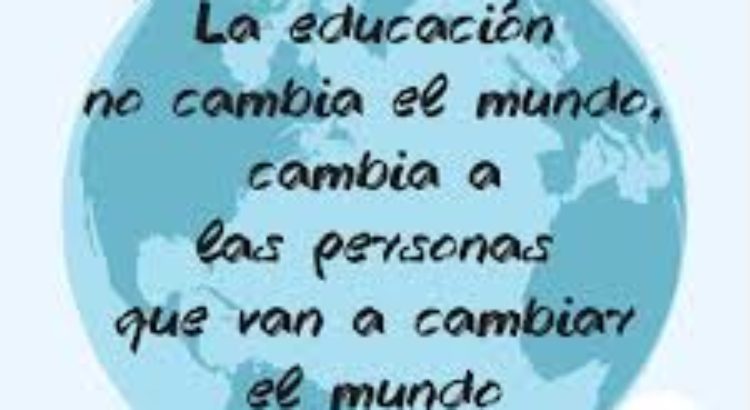
“La educación no cambia el mundo, cambia a las personas que van a cambiar el mundo”

Por: Ángel Pérez. 

La educación en esencia ayuda a formar buenos seres humanos y estos deberían contribuir a cambiar al mundo, sin violencia, con el conocimiento. El sueño y la esperanza de un mundo mejor es esencial en quien educa.

La semana pasada, celebramos el día del maestro en Colombia, por fortuna, aún desde el presidente para abajo se destaca la labor de los maestros en su día. Sin embargo, el reconocimiento social y profesional a los maestros y a su difícil labor debería ser mayor, no solo en el mes de mayo. En parte las celebraciones se justifican si estas tienen el propósito de valorizar y de llenar de respetabilidad la profesión del maestro, del educador, en la sociedad. La escuela no es una guardería, es un centro de conocimientos, donde se desarrollan capacidades para pensar de manera crítica, comunicar y convivir; esta labor demanda a los docentes grandes retos en formación, manejo de emociones y sensibilidad humana.

Para los docentes de la educación básica y media en Colombia existen retos adicionales. Por ejemplo, conozco muchos docentes que tienen miedo, no saben cómo enfrentar los odios de la sociedad colombiana. Preguntémonos: en un país dividido, donde los adultos no somos ejemplo de tolerancia y de lenguajes asertivos, ¿cómo le pedimos a los docentes razonar, comunicar y reflexionar con sus estudiantes y padres de familia en torno a la convivencia, la democracia, la participación y la paz?. El profesor Michael Sandel sostiene que “vivimos en una época muy polarizada donde hay muy poca base para una política del bien común, la gente solo escucha opiniones que refuerzan lo que ya creen”.

Máxime si el maestro debe utilizar el conocimiento de manera crítica para: caracterizar el entorno en el que vive el estudiante, promover la paz contra la violencia, buscar justicia social contra la discriminación, exigir legalidad contra la corrupción, entre otras contradicciones. El magisterio en Colombia conoce que por pensar y opinar en los últimos años han sido asesinados más de 1.100 docentes y otros han sido amenazados u obligados a desplazarse de un día para otro, bajo pena de muerte.

Julián de Zubiría sostiene que: “Para comprender la complejidad del trabajo de un profesor, les pido invitar mañana a 40 niños. Luego, deben jugar, evaluarlos, descubrir talentos y debilidades, hablar con padres y enseñarles a pensar, convivir y resolver conflictos; y hacerlo todos los días”.

De acuerdo con De Zubiría, este proceso en condiciones normales es complejo, pero propongo agregar circunstancias que hoy son corrientes en el trabajo de un maestro en la educación pública: aulas con niños desplazados colombianos y/o venezolanos; maestros que deben recibir niños en cualquier época del año, porque sus padres viven en arriendo y obligan a sus hijos a ir de colegio en colegio, cada vez que se trasladan de vivienda o trabajo; y aulas con uno o más niños que sufren de algún tipo de discapacidad. Así mismo, a los maestros les pedimos que en el aula integren a los niños, que no discriminen a ninguno y que los amen, que les enseñen a trabajar en grupo, que busquen su felicidad y que se preocupen por aquellos que no aprenden al mismo ritmo de los demás.

Agreguemos, los retos que tiene un buen docente en términos de preparar su trabajo en aula, para lograr los propósitos de su curso o área del conocimiento en la que realiza su labor. Menciono algunos: contar con un proyecto pedagógico, desarrollar un currículo y un proceso didáctico innovativo, además de un sistema de evaluación para valorar y mejorar los procesos de aprendizaje de sus estudiantes.

El trabajo de un buen docente se puede complicar aún más, si incluimos discusiones como las que plantea Habermas sobre la acción comunicativa, que es una herramienta esencial al trabajo de los docentes, él sostiene que  «en la praxis comunicativa cotidiana han de imbricarse interpretaciones cognitivas, esperanzas morales, expresiones y valoraciones. Los procesos de entendimiento del mundo vital precisan de una tradición cultural en toda la amplitud de su horizonte y no solamente de las bendiciones de la ciencia y de la técnica”.

Es justo reconocer que en Colombia existen cientos de ejemplos de docentes que piensan, preparan y actúan en función de sus estudiantes, del aprendizaje de ellos y enfrentan con éxito entornos adversos a la educación. Maestros que logran consolidar y compartir en el aula una visión diferente a la condición de vida de sus estudiantes, ellos son ejemplo y logran incidir para cambiar, para que sus estudiantes sean buenos seres humanos.

En este contexto, sigue vigente la reflexión y el razonamiento crítico que nos propone Freire, sobre el rol de los maestros, de concebir una educación que forme seres humanos para cambiar el mundo. A pesar de que el mundo se inclina a las verdades absolutas, a quienes destruyen el medio ambiente e incentivan al odio y a la guerra. Los maestros están al lado de los estudiantes, en muchos casos, son ellos quienes más disfrutan de sus triunfos y a la vez a quienes más les duelen sus fracasos. El mundo seguirá cambiando mientras existan maestros que desarrollen capacidades en sus estudiantes, que les permitan estudiar y conocer su entorno, pensar de manera crítica y actuar para ser mejores seres humanos y para proteger la tierra. Gran honor ser maestro, enorme responsabilidad.

Fuente del artículo: https://www.dinero.com/opinion/columnistas/articulo/la-educacion-no-cambia-el-mundo-cambia-a-las-personas-que-van-a-cambiar-el-mundo-por-angel-perez/272192

Comparte este contenido:

Fathers are necessary in the lives of children and their education

By: David Plazas. 


The absence of fathers in the home life of a child is bringing disaster to every fabric of our state and nation.

As Chair of the Tennessee General Assembly House Sub and Full Education Committees since 2013, I have spent many thousands of hours studying and looking for ways to best educate and challenge the children in our State.

The latest figures show that our 89.1% high school graduation rate is the highest in our state history.  Even with that positive statistic, still fewer than half of these graduates are ready to move into higher education or the workforce without remediation in English and/or Math.

Another startling statistic: Only 37% of our students in third grade are reading on grade level. This is a critical and very disturbing statistic: “if you cannot read you cannot learn!”

That means grades 4-12 and beyond will be difficult for these students. The inability to perform in School results in drop out, truancy and little or no skills to compete in todays workforce.

Funding has improved for education, but our outcomes are still low

So, what is the answer? Many say, “just add more money and we will improve.”  But time has proven that, even though money is a factor, it is not the solution.

In 2010, Tennessee was the recipient of $500 million “Race to the Top” dollars from the Federal Government.

Tennessee put that money in many excellent programs but still we struggle, as the 37% third grade reading statistic indicates.

Also, Tennessee has been on an education reform movement for the past 10 years.  We have added $1.5 billion new dollars to our state education budget and over $570 million new dollars to teacher compensation since 2013.

Tennessee Public Schools K-12 Education Budget for 2019-2020 School year is $6.6 billion dollars. Because of our reform and our funding, Tennessee has the title as the “fastest improving state in education” in the nation.  But there is a critical piece of the equation that is missing – a piece of the equation that money and the best teachers cannot remedy.

Why dads matter in the lives of their kids

It is now time that we address with seriousness why so many of our children are coming to school without the foundation to learn.  In 2007, I authored a book titled:  “May I Call You Dad? Why Fathers are needed in the Home.”

We must realize that fathers are necessary in the lives of children, and that their absence in the home life of a child is bringing disaster to every fabric of our state and nation.

In 2017, 43.6% of children in Tennessee were born to single mothers.  It is a fact that more poverty exists in single parent homes. Last year 1,000 new children were admitted to Tennessee Department of Children Services because of drugs and other addictions.

Domestic and sexual abuse in the home has risen so drastically that we now spend millions of dollars addressing the issue known as “Adverse Childhood Experiences or ACE.”

This is the new study on how a child’s brain is prevented from developing properly because of the constant trauma in their home. With enough ACE experiences from birth to age 5, the neuron connections in brain development are so damaged that the act of learning and simple behavior development is challenged.

We are now spending billions of dollars trying to do in school what the home is failing to do for children.

“Communities in School Programs» provide wrap around services for school age children, RTI or Response to Intervention Programs, mandated by the state but without adequate funding, attempts to put a second teacher’s aide in the classroom to help with children falling behind.

Our local school districts are trying to fill the funding gap but the demand is greater than funds available.

A few staggering statistics we should know are:

  • 63% of all youth suicides are from fatherless homes.
  • 85% of all youth in prison are from fatherless homes.
  • 71% of all high school dropouts are from fatherless homes.

Positive factors related to education include:

  • Children with fathers are less likely to repeat a grade in school.
  • Children with fathers are morel likely to get A’s in school.
  • Children with fathers are more likely to enjoy school and engage in school  activities.

The question is asked: “Have we lost a generation and now must find a way to change moving forward?”  I refuse to accept such a pessimistic attitude.

This is why we are looking for programs and budgeting state dollars to fill the gap where the home is failing. We must challenge and teach every teen and young adult that bringing another life into the world carries with it the responsibility of building a safe and loving fortress (Home) around that child.

It is the role of the father to be the provider, protector, guide, role model, listener, stabilizer and hope giver for the future of a child.  Let us resolve to renew this commitment to our children on this Father’s Day.

Source of the article: https://www.tennessean.com/story/opinion/2019/06/15/fathers-children-tennessee-education/1431197001/

Comparte este contenido:

New education policy misses a critical chance to address inequalities in system

By: Anjela Taneja. 


The draft National Education Policy (NEPTodas las entradas), 2019, is full of provisions that many in the education sector have been desperate to see for decades. The conferring of the Right to Education to children under six and above 14, doubling of the overall financial allocation to education and strengthening the teaching profession bring cheer. However, many of the policy’s omissions and contradictions, combined with the previous track record of central and state governments in implementing existing education policies, diminish this hope.

The omissions: While the policy talks about the need to bring “unrepresented groups» into school and focus on educationally lagging “special education zones», it misses a critical opportunity of addressing inequalities within the education system. It misses to provide solutions to close the gap of access to quality education between India’s rich and poor children. It proposes to remove the expectations that all schools meet common minimum infrastructure and facility standards, and that primary schools be within a stipulated distance from children’s homes.

India’s schools already vary across the scale—from single room structures without water and sanitation, to technology-enabled international schools. Not specifying a common minimum standard below which schools cannot fall, creates conditions where quality of facilities in some schools will only sink lower, widening this gap.

This is even more of an issue since it proposes a roll back of existing mechanisms of enforcement of private schools making parents “de-facto regulators» of private schools. Parents, and particularly poor and neo-literate parents, cannot hold the onus of ensuring that much more powerful and resourced schools comply with quality, safety and equity norms.

India should have moved towards a national system of education that shapes India’s next generation and enforce standards of quality across the country.

The contradictions: While the policy places considerable emphasis on the strengthening of “school complexes» (clusters of schools sharing joint resources) and decentralized mechanisms for supporting teachers, their everyday management appears to have been tasked to the head teacher of the secondary school in the cluster.

Furthermore, no separate funding appears to have been earmarked for this. This is false economy, since this is a full time activity and needs to be staffed and resourced accordingly.

Lessons from non-implementation of past policies: The policy’s implementation is predicated on the assumption that the education budget would be almost doubled in the next 10 years through consistent decade-long action by both the centre and states. However, the revenue is decentralized to the states and it is unclear what would be done to ensure that resources needed will be allotted. The sheer scale of changes expected, the rapid timeline, the absence of a strong mechanism for handholding states on this journey and the probable inadequate budget raises questions on the full implementation of this policy. India’s history is littered with ambitious education policies that have not been fully implemented. The National Education Policy risks following this tradition, unless the government addresses the reasons behind the past policy-practice implementation gap and makes conscious efforts to carry all of India on the same road towards improvement in education.

Source of the article: https://www.livemint.com/opinion/online-views/new-education-policy-misses-a-critical-chance-to-address-inequalities-in-system-1560282262183.html

Comparte este contenido:

Looking to history can shape Utah’s education future

By: Lynn Stoddard.

During the last week of May of this year, 30,250 students graduated from 78 Utah public high schools for an average of 388 students per graduating class. In 1945, I graduated from Ogden High School in a graduating class of approximately 400 students. During the 74 years since my graduation has anything changed in our system of public education?

Except for one big thing, nearly everything has stayed the same. All six of my grandchildren who graduated this year were required to abide by the same school system and curriculum that I did 74 years ago — the one that was installed in 1892 by a “Committee of Ten” scholars. This committee recommended eight years of elementary school followed by four years of high school and a “call to teach English, mathematics, and history or civics to every student every academic year in high school. The recommendations also formed the basis of the practice of teaching chemistry, and physics, respectively, in ascending high school academic years.”

My six graduating grandchildren each attended a different high school and were all subject to the same graduation requirements: 24 credits in English, mathematics, science, social studies, arts and computer, health and physical education and five electives.

What’s wrong with this picture? The “Committee of Ten” inaugurated a system of education to standardize students with a predetermined outline of subject matter courses. Each of my graduating grandchildren achieved what was required of them and has a diploma to show it. They were all exposed to the same knowledge and skills as the other 30,244 Utah graduates.

The one huge difference between education as it was 74 years ago and today is not really a difference at all, but a window to a revolution: computers and electronic communication have shined a spotlight on human differences. Back in my day, we obtained our information about the required curriculum from books and teacher lectures. Now, with the worldwide internet, television and hand-held interactive devices, we have suddenly found new ways to learn and discovered that it is impossible to standardize students in knowledge and skills.

Technology now offers a bridge to unlimited student learning and accomplishment. The present required curriculum allows for only a small percentage to become extraordinary, “sterling” scholars. On the other hand, using computers to access the whole world of events and information makes it possible for every student to attain phenomenal knowledge and accomplishment. Each student will now be able to prove that he or she can become a genius in some area of knowledge.

What needs to be done to have this utopia of education become a reality? Before the federal government imposed subject matter standardization on the system, some schools were starting to use human standards rather than subject standards to help learners grow as powerful individuals. Teachers and parents united to help students grow in human powers such as inquiry, interaction, imagination, initiative, identity, intuition and integrity.

Comment on this story

By using this approach, hundreds of students in several schools discovered their genius and reason to exist as important contributors to society. With “identity” as a top priority, teachers united with parents to help students magnify their unique talents and strengths. Teachers and parents were starting to learn how to find and develop student-oriented curriculum based on the important questions and needs of students. They were starting to learn how to develop a much better student-oriented education.

We now have a choice: go back and get on the right path or continue on the subject-dominated, assembly-line path of student standardization.

Source of the article: https://www.deseretnews.com/article/900075359/guest-opinion-looking-to-history-can-shape-utahs-education-future.html

Comparte este contenido:

Audacia para nuestra educación

Por: Jorge Izusqui. 

El Consejo Nacional de Educación debe elaborar un nuevo proyecto educativo nacional al 2036. Los distinguidos miembros de este cónclave, encargados de dicha labor, están trabajando en su diseño y tendrán que enfrentar varios retos que no son de fácil solución, pero el principal, considero, es redactar un plan lo suficientemente ambicioso como para marcar el camino a seguir para salir del estancamiento en que está nuestro sistema educativo.

Diseñar un plan al 2036 implica reconocer que la escuela, como está diseñada, no va más y que es necesario que el sistema educativo se adapte a los grandes cambios tecnológicos; no podemos tener estudiantes que vivan en el siglo XXI fuera de la escuela, pero que estén en esta como en el siglo XIX. Las metodologías de hoy no van más y debemos imaginar una escuela sin las ataduras como currículos, horarios fijos, evaluaciones memorísticas, etc.

El proyecto debe contemplar una escuela libre, en cuyo centro esté el estudiante y no los intereses políticos, partidarios o gremiales; y debe basarse en una simple pregunta: ¿esto o aquello es lo mejor para el estudiante? Se debe construir un proyecto de escuela libre que forme ciudadanos globales comprometidos con sus comunidades, preparados para enfrentar retos del futuro, la incertidumbre, la tecnología y que sean capaces de aprender y desaprender a lo largo de sus vidas.

El reto de plasmar en un documento la idea de escuela libre y traducirla a políticas públicas no es fácil, pero con audacia se puede lograr, con mucha audacia que, espero, los distinguidos consejeros pongan sobre la mesa porque no podemos seguir teniendo nuestras escuelas con sistemas anacrónicos que, como está demostrado, no rinden resultado.

Fuente del artículo: https://peru21.pe/opinion/audacia-nuestra-educacion-484396

Comparte este contenido:
Page 998 of 2471
1 996 997 998 999 1.000 2.471