Page 805 of 2546
1 803 804 805 806 807 2.546

Neoliberal Savagery and the Assault on Higher Education as a Democratic Public Sphere


By Henry A. Giroux

Across the globe, a new historical conjuncture is emerging in which attacks on higher education as a democratic institution and on dissident public voices in general – whether journalists, whistleblowers, or academics – are intensifying with alarming consequences for both higher education and the formative public spheres that make democracy possible. Hyper-capitalism or market fundamentalism has put higher education in its cross hairs and the result has been the ongoing transformation of higher education into an adjunct of the very rich and powerful corporate interests. Marina Warner has rightly called these assaults on higher education, “the new brutalism in academia.”[i] It may be worse than she suggests. In fact, the right-wing defense of the neoliberal dismantling of the university as a site of critical inquiry is more brazen and arrogant than anything we have seen in the past. What we are witnessing is an attack on universities not because they are failing, but because they are public. This is not just an attack on political liberty but also an attack on dissent, critical education, and any public institution that might exercise a democratizing influence on the nation. In this case the autonomy of institutions such as higher education, particularly public institutions are threatened as much by state politics as by corporate interests. How else to explain in neoliberal societies such as the U.S., U.K. and India the massive defunding of public institutions of higher education, the raising of tuition for students, and the closing of areas of study that do not translate immediately into profits for the corporate sector?

The hidden notion of politics that fuels this market-driven ideology is on display in a more Western-style form of neoliberalism in which the autonomy of democratizing institutions is under assault not only by the state but also by the rich, bankers, hedge fund managers, and the corporate elite. In this case, corporate sovereignty has replaced traditional state modes of governance that once supported higher education as a public good. That is, it is now mostly powerful corporate elites who despise the common good and who as the South African Nobel Prize winner in literature, JM Coetzee, points out “reconceive of themselves as managers of national economies” who want to turn universities into training schools equipping young people with the skills required by a modern economy.”[ii] Viewed as a private investment rather than a public good, universities are now construed as spaces where students are valued as human capital, courses are defined by consumer demand, and governance is based on the Walmart model of labour relations. For Coetzee, this attack on higher education, which is not only ideological but also increasingly relies on the repressive, militaristic arm of the punishing state, is a response to the democratization of the university that reached a highpoint in the 1960s all across the globe. In the last twenty years, the assault on the university as a center of critique, but also on intellectuals, student protesters, and the critical formative cultures that provide the foundation for a substantive democracy has only intensified.[iii]

Coetzee’s defense of education provides an important referent for those of us who believe that the university is nothing if it is not a public trust and social good; that is, a critical institution infused with the promise of cultivating intellectual insight, the civic imagination, inquisitiveness, risk-taking, social responsibility, and the struggle for justice. Rather than defining the mission of the university by mimicking the logic of the market in terms of ideology, governance, and policy, the questions that should be asked at this crucial time in American history might raise the following issues: how might the mission of the university be understood with respect to safeguarding the interests of young people at a time of violence and war, the rise of a rampant anti-intellectualism, the emerging specter of authoritarianism, and the threat of nuclear and ecological devastation? What might it mean to define the university as a public good and democratic public sphere rather than as an institution that has aligned itself with market values and is more attentive to market fluctuations and investors than educating students to be critically engaged citizens? Or, as Zygmunt Bauman and Leonidas Donskis write: “how will we form the next generation of … intellectuals and politicians if young people will never have an opportunity to experience what a non-vulgar, non-pragmatic, non-instrumentalized university is like?”[iv] As public spheres – once enlivened by broad engagements with common concerns – are being transformed into “spectacular spaces of consumption”,[v] financial looting, the flight from mutual obligations and social responsibilities has intensified and resulted in not only a devaluing of public life and the common good, but also a crisis in the radical imagination, especially in terms of the meaning and value of politics itself.[vi]

What I am suggesting is that the crisis of higher education is about much more than a crisis of funding, an assault on dissent, and a remaking of higher education as another institution designed to serve the increasing financialization of neoliberal driven societies; it is also about a crisis of memory, agency, and the political. As major newspapers all over the country shut down and the media becomes more concentrated in the hands of fewer mega corporations, higher education becomes one of the few sites left where the ideas, attitudes, values, and goals can be taught that enable students to question authority, rethink the nature of their relationship with others in terms of democratic rather than commercial values, and take seriously the impending challenges of developing a global democracy.

The apostles of predatory capitalism are well aware that no democracy can survive without an informed citizenry, and they implement a range of policies to make sure that higher education will no longer fulfill such a noble civic task. This is evident in the business models imposed on governing structures, defining students as customers, reducing faculty to Wal-Mart workers, imposing punishing accounting models on educators, and expanding the ranks of the managerial class at the expense of the power of faculty.

As politics is removed from its political, moral, and ethical registers – stripped down to a machine of social and political death for whom the cultivation of the imagination is a hindrance, commerce is the heartbeat of social relations, and the only mode of governance that matters is one that rules Wall Street. Time and space have been privatized, commodified, and stripped of human compassion under the reign of neoliberalism. We live in the age of a new brutalism marked not simply by an indifference to multiple social problems, but also defined by a kind of mad delight in the spectacle and exercise of violence and what the famed film director, Ken Loach, has called “conscious cruelty.”[vii] America is marked by a brutalism that is perfectly consistent with a new kind of barbaric power, one that puts millions of people in prison, subjects an entire generation to a form of indentured citizenship, and strips people of the material and symbolic resources they need to exercise their capacity to live with dignity and justice.

For those of us who believe that education is more than an extension of the business world and the new brutalism, it is crucial that educators, artists, workers, labour unions, and other cultural workers address a number of issues that connect the university to the larger society while stressing the educative nature of politics as part of a broader effort to create a critical culture, institutions, and a collective movement that supports the connection between critique and action and redefines agency in the service of the practice of freedom and justice. Let me mention just a few. 

First, educators can address the relationship between the attack on the social state and the transformation of higher education into an adjunct corporate power. As Stefan Collini has argued, under the regime of neoliberalism, the “social self” has been transformed into the “disembedded individual,” just as the notion of the university as a public good is now repudiated by the privatizing and atomistic values at the heart of a hyper-market driven society.[viii] Clearly, in any democratic society, education should be viewed as a right, not an entitlement. This suggests a reordering of state and federal priorities to make that happen. Much needed revenue can be raised by putting into play even a limited number of  reform policies in which, for instance, the rich and corporations would be forced to pay a fair share of their taxes, a tax would be placed on trade transactions, and tax loopholes for the wealthy would be eliminated. It is well known that the low tax rate given to corporations is a major scandal. For instance, the Bank of America paid no taxes in 2010 and “got $1.9 billion tax refund from the IRS, even though it made $4.4 billion in profits.”[ix]

In addition, academics can join with students, public school teachers, unions, and others to bring attention to wasteful military spending that if eliminated could provide the funds for a free public higher education for every qualified young person in the country. While there is growing public concern over rising tuition rates along with the crushing debt students are incurring, there is little public outrage from academics over the billions of dollars squandered on a massive and wasteful military budget and arms industry. As Michael Lerner has pointed out, democracy needs a Marshall Plan in which funding is sufficient to make all levels of education free, while also providing enough social support to eliminate poverty, hunger, inadequate health care, and the destruction of the environment. There is nothing utopian about the demand to redirect money away from the military, the powerful corporations, and the upper 1 percent. 

Second, addressing these tasks demands a sustained critique of the transformation of a market economy into a market society along with a clear analysis of the damage it has caused both at home and abroad. Power, particularly the power of the largest corporations, has become more unaccountable and “the subtlety of illegitimate power makes it hard to identify.”[x] Disposability has become the new measure of a savage form of casino capitalism in which the only value that matters is exchange value. Compassion, social responsibility, and justice are relegated to the dustbin of an older modernity that now is viewed as either quaint or a grim reminder of a socialist past. This suggests, as Angela Davis, Michelle Alexander, and others have argued, that there is a need for academics and young people to become part of a broader social movement aimed at dismantling the repressive institutions that make up the punishing state. The most egregious example of this is the prison-industrial complex, which drains billions of dollars in funds to put people in jail when such funds could be used for expanding public and higher education.We live in a country in which the police have become militarized, armed with weapons from the battlefields of Iraq and Afghanistan.[xi] The United States prison system locks up more people than any other country in the world, and the vast majority of them are people of color.[xii] Moreover, public schools are increasingly modeled after prisons and are implementing policies in which children are arrested for throwing peanuts at a school bus or violating a dress code.[xiii] The punishing state is a dire threat to both public and higher education and democracy itself. The American public does not need more prisons; it needs more schools, free health services, and a living wage for all workers.  

Third, academics, artists, journalists, and other young people need to connect the rise of subaltern, part-time labour – or what we might call the Walmart model of wealth and labour relations – in both the university and the larger society to the massive inequality in wealth and income that now corrupts every aspect of American politics and society. No democracy can survive the kind of inequality in which “the 400 richest people…have as much wealth as 154 million Americans combined, that’s 50 percent of the entire country [while] the top economic 1 percent of the U.S. population now has a record 40 percent of all wealth and more wealth than 90 percent of the population combined.”[xiv] Senator Bernie Sanders provides a statistical map of the massive inequality at work in the United States. In a speech to the U.S. Senate, he states:

Today, Madam President, the top 1% owns 38% of the financial wealth of America, 38%. And I wonder how many Americans know how much the bottom 60% own. They want people to think about it. Top 1% own 38% of the wealth. What do the bottom 60% own? The answer is all of 2.3%. Top 1% owns 38% of the financial wealth. The bottom 60% owns 2.3%. Madam President, there is one family in this country, the Walton family, the owners of Wal-Mart, who are now worth as a family $148 billion. That is more wealth than the bottom 40% of American society. One family owns more wealth than the bottom 40% of American society…That’s distribution of wealth. That’s what we own. In terms of income, what we made last year, the latest information that we have in terms of distribution of income is that from 2009-2012, 95% of all new income earned in this country went to the top 1%. Have you all got that? 95% of all new income went to the top 1%, which tells us that when we talk about economic growth, which is 2%, 3%, 4%, whatever it is, that really doesn’t mean all that much because almost all of the new income generated in that growth has gone to the very, very, very wealthiest people in this country.[xv]

Democracy in the United States, and many other countries, has been hijacked by a free-floating class of ultra-rich and corporate powerbrokers and transformed into an oligarchy “where power is effectively wielded by a small number of individuals.”[xvi] At least, this is the conclusion of a recent Princeton University study, and it may be much too moderate in its conclusions. 

Fourth, academics need to fight for the rights of students to get a free education, for them to be given a formidable and critical education not dominated by corporate values, and to have a say in the shaping of their education and what it means to expand and deepen the practice of freedom and democracy. In many countries such as Germany, France, Denmark, Cuba, and Brazil, post-secondary education is free because these countries view education not as a private right but as a public good. Yet, in some of the most advanced countries in the world such as the United States and Canada, young people, especially from low income groups have been excluded from getting a higher education and, in part, this is because they are left out of the social contract and the discourse of democracy. They are the new disposables who lack jobs, a decent education, hope, and any semblance of a life better than the one their parents inherited. They are a reminder of how finance capital has abandoned any viable vision of a better future for young people. Youth have become a liability in the world of high finance, a world that refuses to view them as an important social investment. 

Fifth, there is a need to oppose the ongoing shift in power relations between faculty and the managerial class. Too many faculty are now removed from the governing structure of higher education and as a result have been abandoned to the misery of impoverished wages, excessive classes, no health care, and few, if any, social benefits. As political scientist Benjamin Ginsburg points out, administrators and their staff now outnumber full time faculty producing two-thirds of the increase in higher education costs in the past 20 years. This is shameful and is not merely an education issue but a deeply political matter, one that must address how neoliberal ideology and policy has imposed on higher education an anti-democratic governing structure. 

Sixth, it is important to stress once again that education must be viewed not simply as a practice endemic to schooling but goes on throughout society through a range of cultural apparatuses extending from the mainstream media to various aspects of screen culture. Education is at the center of politics because it is crucial to how agency is formed, how people view themselves and their relations to others. Educators and other cultural workers must acknowledge that domination is as much ideological as it is economic and structural. This means taking on the challenge of embracing the symbolic and ideological dimensions of struggle as part of the struggle against oppression and domination. Educators need to launch pedagogical campaigns aimed at dismantling the common sense logic of neoliberalism: people are only consumers, government is the enemy, the market should govern all of social life, social bonds are a pathology, self-interest is the highest virtue, and last but not least the market should govern itself. University faculty must join together and find ways to press the claims for economic and social justice and do so in a discourse that is aimed at multiple audiences and is both rigorous and accessible. Universities need to defend not only the idea of the university as a democratic public sphere but also faculty as public intellectuals capable and willing to question authority, hold power accountable, and be critical of existing affairs.

Finally, seventh, the fight to transform higher education cannot be waged strictly inside the walls of such institutions by faculty and students alone. As radical social movements more recently in Spain, Portugal, and India have made clear, there is a need for new social and political formations among faculty, unions, young people, cultural workers, and most importantly social movements, all of which need to be organized in part for the defense of public goods and what might be called the promise and ideals of a radical democracy. Any struggle against the anti-democratic forces that are mobilizing once again all over the world must recognize that power is not global and politics is local. A financial elite operates now in the flow and international spaces of capital and have no allegiances to nation-states and can impose their financial will on these states as we have seen recently in some European countries. Resistance must address this new power formation and think and organize across national boundaries. Resistance on a global level is no longer an option, it is a necessity.

Neoliberal societies now live in the shadow of the authoritarian corporate state, but the future is still open. The time has come to develop a political language in which civic values and social responsibility – and the institutions, tactics, and long-term commitments that support them – become central to invigorating and fortifying a new era of civic engagement, a renewed sense of social agency, and an impassioned international social movement with the vision, organization, and set of strategies capable of challenging the neoliberal nightmare that now haunts the globe and empties out the meaning of politics and democracy.

Photo: Google Images


[i] Marina Warner, “Dairy,” The London Review of Books 36:17, September 11, 2014.

[ii]JM Coetzee, “JM Coetzee: Universities head for extinction” Mail & Guardian, November 1, 2013.

[iii] Ibid.

[iv] Zygmunt Bauman and Leonidas Donskis, Moral Blindness: The Loss of Sensitivity in Liquid Modernity, (Cambridge, UK: Polity Press, 2013), p. 139.

[v] Steven Miles, Social Theory in the Real World (Thousand Oaks, Sage, 2001), p. 116.

[vi] Joshua Kurlantzick, Democracy in Retreat (New Haven: Yale University Press, 2013).

[vii] Fran Blandy, “Loach film on shame of poverty in Britain moves Cannes to tears,” Yahoo News, May 13, 2016.

[viii] These two terms are taken from Stefan Collini, “Response to Book Review Symposium: Stefan Collini, What are Universities For,” Sociology 1-2 (February 5, 2014).

[ix] Michael Snyder, “You won’t believe who is getting away with paying zero taxes while the middle class gets hammered,” InfoWars.com, February 19, 2013.

[x] Susan George, “State of Corporations: The Rise of Illegitimate Power and the Threat to Democracy,” in Transnational Institute and Occupy.com. State of Power 2014: Exposing the Davos Class (February 2014).

[xi] Radley Balko, Rise of the Warrior Cop: The Militarization of America’s Police Forces (New York: Public Affairs, 2013), and Jill Nelson, ed. Police Brutality (New York: Norton, 2000).

[xii] Michelle Alexander, The New Jim Crow (New York: The New Press, 2010).

[xiii] Henry A. Giroux, Youth in a Suspect Society (New York: Palgrave, 2012).

 [xiv] David DeGraw, “Meet the Global Financial Elites Controlling $46 Trillion in Wealth,”Alternet, August 11, 2011.

[xv] Sen. Bernie Sanders, “A Threat to American Democracy,” RSN, April 1 , 2014

[xvi] Tom McKay, “Princeton Concludes What Kind of Government America Really Has, and It’s Not a Democracy,” Popular Resistance, April 16, 2014.


Bio:
Henry A. Giroux
 is University Professor for Scholarship in the Public Interest at McMaster University in Hamilton, Ontario. His many books include Theory and Resistance in Education(1983), Critical Theory and Educational Practice (1983), Teachers as Intellectuals: Toward a Critical Pedagogy of Learning (1988), Border Crossings: Cultural Workers and the Politics of Education (1992),Living Dangerously: Multiculturalism and the Politics of Culture (1993), Pedagogy and the Politics of Hope Theory, Culture, and Schooling (1997), Impure Acts: The Practical Politics of Cultural Studies(2000), Public Spaces/Private Lives: Democracy Beyond 9/11 (2003), Take Back Higher Education: Race, Youth, and the Crisis of Democracy in the Post Civil Rights Era (co-authored with Susan Searls Giroux, 2004), The Terror of Neoliberalism: Authoritarianism and the Eclipse of Democracy(2004), The University in Chains: Confronting the Military-Industrial-Academic Complex (2007),Youth in a Suspect Society: Democracy or Disposability? (2009), America’s Education Deficit and the War on Youth (2013), and America’s Addiction to Terrorism (2016).

Comparte este contenido:

Libro: Jóvenes y soberanía

Jóvenes y soberanía
Hegemonía, discursos y trayectorias hacia la emancipación

Josefina Bolis [Autora]
…………………………………………………………………………
ISBN: 978-950-34-1187-2
EdicionesEPC
Argentina – Buenos Aires
Marzo de 2016

Jóvenes y soberanía contiene un conjunto de problematizaciones epistemológicas para indagar cómo se transforma y subvierte el sentido en la sociedad, cómo se unifica simbólicamente la comunidad y cómo se constituyen los sujetos políticos. La soberanía, como poder de decisión o como demanda, ha sido desde América Latina una proclama emancipatoria. Los jóvenes ‒con sus reclamos de ciudadanía‒ recorren esas trayectorias que los proyectan de sujeciones tutelares a posiciones de sujeto soberanas.
Para descargar el libro, haga click aquí:
Descargar .pdf
Fuente de la reseña:
http://www.clacso.org.ar/libreria-latinoamericana-cm/libro_detalle.php?id_libro=1289&pageNum_rs_libros=0&totalRows_rs_libros=1296
Comparte este contenido:

El camino de la Universidad Latinoamericana hacia la certificación de saberes y de competencias

Eva Elena Monagas (*)

“…poco se avanzó en la redefinición y en la puesta en marcha de iniciativas de reforma académica, curricular, de paradigmas pedagógicos y de formación integral, o en la oferta universitaria, con todo y que se ha valorado y discutido ampliamente su enorme importancia”.

Axel Didriksson (2008)

Una gran cantidad de iniciativas a nivel mundial promueven el desarrollo de modelos, prototipos y proyectos que pueden ser desarrollados por personas, independientemente de si ellas pertenecen al sistema educativo o del nivel en que se encuentren, solo con el fin de vincular los talentos a la solución de problemas y proyectarlos en la sociedad; sin embargo, el sistema educativo tradicional presta poca atención al aprendizaje a lo largo de la vida, al no formal, al informal y a la motivación natural que lleva al hombre al conocimiento. En este contexto, aún las sociedades se concentran en el aprendizaje formal en instituciones educativas lo que conduce al desconocimiento de algunos sujetos y la subutilización del talento encubierto en la sociedad, por tanto ¿Deben quedarse las instituciones educativas de espalda al conocimiento adquirido? ¿Cuál debe ser el recorrido para el reconocimiento del saber o de un conjunto de saberes? ¿Cuáles son los desafíos que tiene la gestión educativa para certificar saberes y competencias?

En este punto se hace necesario aclarar los conceptos de saber, competencias y certificación.

De acuerdo con Foucault (2006), los saberes son las manifestaciones homogéneas y masivas existentes como corriente de pensamiento o mentalidad colectiva, y solo es requerido para la imaginación del sujeto. Foucault también lo llama “creencia común” ya que es aceptado sin demostración, por lo cual no es una ciencia, porque la ciencia debe mostrar unas reglas de práctica discursiva, conceptos, objetos y series teóricas que lo delimitan, le dan estructura y rigidez. La gran diferencia que Foucault presenta con la ciencia, es que el saber es libre, no cuenta con restricciones, delimitaciones teóricas ni sistemas de relaciones, ya que proviene de lo que ha sido vivido o de la experiencia, donde el individuo en la comunicación del saber a otros, deja claro que existe una conexión entre el saber y la expresión lingüística ya que la forma en que estas corrientes de pensamiento se ponen de manifiesto es fundamentalmente a través de la palabra.

A diferencia de Foucault, Bunge (2002) no le da tantas libertades al saber, y establece compatibilidad con la ciencia, al señalar que el saber tiene características estructurales (materialistas, dinamicista, emergentista, sistemista, cientificista y es exacta). Coincide con Foucault en que queda inserto en el sistema social manifestando que no se aprende sin sociedad porque el prójimo, incluidas las instituciones, estimula o inhibe el saber. Tanto Foucault como Bunge, en principio, ofreceen dos interpretaciones: una es que las personas en sociedad pueden alcanzar el saber y la otra es que las instituciones de educación, entre ellas las universidades, están llamadas a la estimulación, promoción y diseño de estrategias para alcanzar y reconocer el saber.

Por su parte, Celis de Soto (2006) le impone movilidad al saber indicando que no está confinado a un lugar o espacio predeterminado, puede ser adquirido en un lugar, trasladado de un lugar a otro y puede ser enriquecido en función de las aplicaciones, y coincidiendo con Foucault, puede articular el presente y el pasado. Se puede deducir que la importancia del saber está en las oportunidades que brinda a las personas para enfrentar y resolver problemas en cualquier lugar y momento a través del aprendizaje obtenido por la interacción con el mundo, el descubrimiento y por las posibilidades de crear nuevas visiones articulando el pasado con el presente. Así, en este caso, su certificación promueve su existencia, la legitima y legaliza, y las instituciones de educación son las llamadas a desarrollar esos procesos.

La definición de competencia ha sido tratada en diversos estudios realizados por instituciones nacionales y multinacionales, así como por filósofos, en tal sentido, Durant y Naveda (2012) presentan una guía de todos los aportes. Tobón (2006) define la competencia como un conjunto de actuaciones integrales en distintos escenarios, integrando el saber ser (compromiso, normas, valores, actitudes, creencias), el saber conocer (teorías, conceptos, argumentaciones, principios, leyes, hechos) y el saber hacer (formas de construir conocimiento, habilidades, métodos, procedimientos) para identificar, analizar y resolver problemas del contexto. El mismo Tobón (2007) amplía su definición para establecerla como unos procesos complejos de desempeño con idoneidad en determinados contextos, integrando diferentes saberes (saber ser, saber hacer, saber conocer y saber convivir), para realizar actividades y/o resolver problemas con sentido de reto, motivación, flexibilidad, creatividad, comprensión y emprendimiento, dentro de una perspectiva de procesamiento metacognitivo, mejoramiento continuo y compromiso ético, con la meta de contribuir al desarrollo personal, la construcción y afianzamiento del tejido social, la búsqueda continua del desarrollo económico-empresarial sostenible, y el cuidado y protección del ambiente y de las especies vivas.

Como el término competencia también ha sido abordado por instituciones multinacionales, donde se identifican a la Organización de las Naciones Unidas para la Educación, la Ciencia y la Cultura (UNESCO), la Organización para la Cooperación y Desarrollo Económico (OCDE), la Unión Europea (UE), el Centro Interuniversitario de Desarrollo en América Latina y el Caribe (CINDA-ALC) y el Centro Interamericano para el Desarrollo del Conocimiento en la Formación Profesional (CINTERFOR), a continuación se indica un breve resumen de los aportes e implicaciones.

La Organización para la Cooperación y Desarrollo Económico (OCDE) establece la competencia como habilidad para enfrentar demandas complejas administrando recursos psicosociales en un contexto. El mismo organismo involucra la competencia con el desarrollo sostenible y la cohesión social constituyéndola en una característica social. Igualmente, la UNESCO también agrega fines a la competencia y establece que es la capacidad desarrollada por el ser humano, para impactar en el contexto de realidades socioculturales, sociopolíticas e históricas y propiciar la igualdad y la justicia.

La UNESCO (2006), con el fin de democratizar la educación promueve la educación para todos a lo largo de la vida y establece las directrices para la certificación de saberes y competencias. La Unión Europea con el “Proyecto Tuning” introduce la clasificación de competencias genéricas y específicas en programas educativos. El CINDA promueve cambios profundos en la acción docente para el desarrollo de procesos educativos centrados en competencias. El CINTERFOR, adscrito a la Organización Internacional del Trabajo (OIT), promueve la conformación de comunidades de aprendizaje, gestión del conocimiento, lleva a cabo e integra las experiencias en certificación de saberes y competencias laborales en Latinoamérica.

  Como se observa, el término competencia involucra al saber e integra a varios saberes en un conjunto que permite definir que un individuo alcanza una condición idónea para hacer algo de valor en la sociedad en la que convive y por esto se muestra como de gran importancia para la educación. Ahora bien, emprender la certificación de competencias involucra reconocer la existencia de un conjunto de saberes que “legitima y legaliza” que hubo aprendizaje en un individuo que le permite hacer algo.

El reconocimiento, validación y acreditación (RVA) de los resultados del aprendizaje es una práctica, promovida por la UNESCO (2012) que “hace visible y valora toda la amplia gama de competencias (conocimientos, habilidades y actitudes) que las personas han obtenido en diversos contextos, mediante distintos medios y en diferentes etapas de su vida”.

La certificación es el procedimiento mediante el cual un organismo o institución autorizada, da garantía por escrito, mediante un reconocimiento (certificados, diplomas o títulos) u otorga equivalencias, unidades de crédito o excepciones, o emite documentos tales como portafolios de competencias para indicar que una persona está conforme a los requisitos especificados basándose en la evaluación de los resultados o competencias del aprendizaje según diferentes propósitos y métodos. La certificación comprende los siguientes elementos: un conjunto de las actividades implementadas en el marco de un proceso para evaluar la conformidad de acuerdo a requisitos especificados; un certificador que es el Organismo/Institución que procede a la certificación y asume la responsabilidad de los resultados del proceso; un beneficiario de la certificación es una persona natural al que un organismo de certificación otorga el certificado; y la certificación que se materializa en un documento emitido conforme a las reglas del sistema de certificación.

Pero reconocer el aprendizaje de un individuo, sin haber guiado el proceso de enseñanza, involucra la evaluación de la puesta en marcha de procesos cognitivos no supervisados que determinan que un individuo alcanzó la competencia, es decir, evaluar si el individuo alcanzó un nivel satisfactorio de conocimientos y habilidades, así como la capacidad para aplicarlas demostrando valores y actitudes como motivación, creatividad, compromiso ético para el desarrollo de la sociedad deseada. Los procesos cognitivos, según García, Garrido y Rodríguez (1998), son los garantes de la consistencia de la conducta humana ya que definen la personalidad, ocurren a través de la atención, la percepción, la memoria, y con ellos se puede procesar, analizar, interpretar, almacenar y recuperar la información.

Este parece ser un punto de intimidación de las instituciones educativas. A pesar de las directrices propuestas por los organismos multinacionales y de la importancia para la equidad, la inclusión en el acceso a las oportunidades de aprendizaje y para el avance académico, conocer la forma en que se dan los procesos cognitivos en ambientes de aprendizajes distintos al aula, o distintos del aprendizaje tradicional, y cómo hacer su evaluación, lo cual requiere el compromiso de las instituciones de educación a implementar novedosos modelos educativos o modelos emergentes, puede intimidar al más experimentado sistema pedagógico por lo cual es poco implementado o promovido por las instituciones de educación superior.

Sin embargo, otros problemas acompañan la certificación de saberes; Molis (2003) indica que ante la crisis de las universidades tradicionales para adaptarse a las demandas sociales, a la precariedad del conocimiento cultural y científico en Latinoamérica, nuevas universidades con finalidad de lucro son consecuentes para responder a esta crisis, que junto al cortoplacismo del mercado y un debilitado financiamiento universitario, alimentan a “compradores de diplomas” confundiendo la educación universitaria con la educación postsecundaria.

Entonces, los desafíos que se plantean para las instituciones universitarias para emprender el camino de la certificación de saberes son:

  • Ser suficientemente ágiles como para identificar los talentos encubiertos en sus sociedades y desarrollar nuevas ofertas que permitan la inclusión de ellos a las oportunidades de aprendizaje y al avance académico.
  • Tener la flexibilidad para implementar nuevos modelos educativos o modelos emergentes que permitan el reconocimiento y acreditación del aprendizaje de un individuo, sin haber guiado el proceso de enseñanza.
  • Tener la capacidad para estructurar procesos de certificación de saberes y competencias, suficientemente sólidos, respetables y transparentes, para otorgar equivalencias, unidades de crédito, o para emitir documentos como portafolios de competencias que puedan dar avance académico a los excluidos, y además, que puedan ser sometidos a revisiones periódicas que demuestren que no se han comprometido los valores institucionales.
  • Contar con los recursos necesarios y la formación docente (evaluadores) para indicar que una persona está conforme a los requisitos especificados basándose en la evaluación de los resultados o competencias del aprendizaje según diferentes propósitos y métodos.

  En instituciones tradicionalistas este camino puede ser accidentado, pero ¿Pueden las instituciones educativas continuar de espaldas a reconocer diversas formas de aprendizaje? La situación es que cuando la universidad da la espalda a los procesos de certificación, manifiesta abiertamente que no quiere reconocer el saber y rechaza la oportunidad de dirigir la generación y aplicación del conocimiento (científico, tecnológico y humanístico) desde nuevas perspectivas en momentos donde, de acuerdo a López (2003), el rol de la educación y del conocimiento en la formación del ciudadano requiere atender demandas de un mundo globalizado donde una fuerza de trabajo más preparada es lo que consolida las empresas competitivas en el mercado mundial, por lo que los procesos educativos son responsables de “incorporar en una mayor orientación hacia la personalización de los procesos de aprendizaje, hacia la construcción de la capacidad de construir aprendizajes, de construir valores, de construir la propia identidad” (p.43).

Finalmente, emprender el camino hacia la certificación de saberes y de competencias como proyecto nacional implica que se ha determinado la necesidad de satisfacer una demanda social para lo cual el Estado diseña y gestiona la política pública. En este caso, respecto a las políticas de certificación Hernández (2002) advierte, entre otras cosas, que en Latinoamérica se están abordando sobre el espacio de la certificación en vez de proyectar el aprendizaje para sacarlo “de lo privado, de lo individual, de lo invisible”. Es decir, el talento encubierto sigue quedando encubierto porque los procesos de certificación no se enfocan a acompañar y motivar a las personas en los aprendizajes sino en el certificado, mientras que estas políticas deben orientarse a consolidar sistemas de certificación sólidos, abiertos, plurales, participativos que promuevan e incentiven el aprendizaje diversificado, articulado, democrático y justo. En todo caso, investigaciones y nuevos conocimientos se están generando respecto a los procesos de certificación mientras gran parte de las universidades se mantienes de espaldas a estos procesos.

Los innovadores modelos pedagógicos o modelos emergentes que habría de implementar la universidad parecen quedar como tarea pendiente. De acuerdo a Tünnermann (2008), discutir los alcances de la satisfacción a su comunidad humana por parte de las instituciones de educación universitaria y las expectativas de éstas de generar cambio y progreso en sus sociedades, así como su contribución a la construcción de sociedades de conocimiento y al impulso del desarrollo sostenible en el contexto nacional e internacional aún permanece en discusión en universidades de América Latina.

El Centro Interamericano para el Desarrollo del Conocimiento en la Formación Profesional (CINTERFOR) señala que el camino de la certificación de saberes y competencias ya empezó su recorrido en veintiocho países en Latinoamérica. Muchos actores están involucrados, tales como, Ministerios de Trabajo, Ministerios de Educación, Instituciones Nacionales de Formación, organizaciones sectoriales de la industria, centros de formación y empresas, pero muy pocas universidades.

Solo queda responder ¿Hasta cuándo la universidad latinoamericana permanecerá ajena a asumir el rol activo que les corresponde?

Referencias bibliográficas.

Bunge, M. (2002). Ser, saber, hacer. Editorial Paidós Mexicana, S.A. y Facultad de Filosofía y Letras Universidad Autónoma de México. DF, México.

Celis de Soto, F (2006). Experiencias innovadoras de la UPEL en formación docente. Ponencia presentada en el Encuentro de Universidades del Convenio Andrés Bello. Bogotá, Colombia, 2006. Disponible en: http://150.187.142.20/info-general/eventos/Pregrado/Archivos/ExperienInnovaUPELFormaDocent.pdf. [Consulta: 2016, abril 21].

Didriksson, A. (2008). Capítulo IX. Educación superior y sociedad del conocimiento en América Latina y el Caribe, desde la perspectiva de la Conferencia Mundial de la Unesco. En C. Tünnermann (Ed.), La educación superior en América Latina y el Caribe: diez años después de la Conferencia Mundial de 1998 (pp. 399-458). IESALC, UNESCO. Cali, Colombia.

Durant, M. y Naveda, O. (2012). Transformación curricular por competencias en la educación universitaria bajo el enfoque ecosistémico formativo. Fundacelac UC. Valencia, Venezuela.

Foucault, M. (2006). La arqueología del saber. Vigésimo segunda edición en español. Siglo XXI, S.A de C.V. D.F., México.

García, J., Garrido, M., Rodríguez, L. (1998). Personalidad, procesos cognitivos y psicoterapia. Un enfoque constructivista. Madrid, España.

Hernández, D. (2002). Políticas de certificación en América Latina. Boletín Cinterfor: Boletín Técnico Interamericano de Formación Profesional, (152), 31-50.

López, F. (2003). El impacto de la globalización y las políticas educativas en los sistemas de educación superior de América Latina y el Caribe. En M. Mollis (Ed.), Las Universidades en América Latina (pp. 38-58). Consejo Latinoamericano de Ciencias Sociales CLACSO. Buenos Aires, Argentina.

Mollis, M. (2003). Las Universidades en América Latina. Consejo Latinoamericano de Ciencias Sociales CLACSO. Buenos Aires, Argentina.

Tobón, S. (2006). Las competencias en la educación superior. Políticas de calidad. Bogotá: ECOE.

Tobón, S. (2007). El enfoque complejo de las competencias y el diseño curricular por ciclos propedéuticos. Acción Pedagógica, 16(1): p. 14 – 28.

Tünnermann, C. (2008). La educación superior en América Latina y el Caribe: diez años después de la Conferencia Mundial de 1998. IESALC, UNESCO. Cali, Colombia.

UNESCO (2006). La educación encierra un tesoro. Disponible en: http://www.unesco.org/education/pdf/DELORS_S.PDF [Fecha de la consulta: 05/05/2016].

UNESCO (2012). Directrices de la Unesco para el reconocimiento, validación y acreditación de los resultados del aprendizaje no formal e informal. Disponible en: http://unesdoc.unesco.org/images/0021/002163/216360s.pdf [Fecha de la consulta: 05/05/2016].

UNESCO (2015). Informe de la Unesco sobre la ciencia. Disponible en: http://unesdoc.unesco.org/images/0023/002354/235407s.pdf [Fecha de la consulta: 16/07/2016].

(*) Eva Elena Monagas

contacto: evamonagas@gmail.com

La autora forma parte del  Doctorado Latinoamericano en Educación Políticas Públicas y Profesión Docente.

El presente es un artículo inedito, publicado con el consentimiento de la autora.


Fuente de la imagen: http://www.libertadyprogresonline.org/wp-content/uploads/2012/01/Internet-la-Mente-y-el-Cerebro-Libertad-y-Progreso.jpg

Comparte este contenido:

España: El Gobierno valenciano obliga a un instituto a readmitir a una chica con hiyab

Europa/España/20 Septiembre 2016/Fuente: ccaa/Autor: IGNACIO ZAFRA

 Un centro público de Valencia le impedía asistir con el pañuelo en aplicación de una normativa interna

Takwa Rejeb, la alumna española que no podía entrar en su instituto de Valencia desde hacía una semana al negarse a quitarse el pañuelo islámico, podrá volver al centro. El Gobierno valenciano ha anunciado este lunes que «ha garantizado el derecho a la educación» de la estudiante, de 22 años, que podrá llevar la prenda, conocida como hiyab y que ella considera parte de su identidad religiosa, en su mismo instituto.

«He recibido la noticia con una felicidad total», ha afirmado Takwa a este periódico. «Da mucha alegría ver que conseguimos pequeños cambios con los que al final llegará el gran cambio. El hecho de que cada persona pueda ser como quiera sin verse coaccionada», ha añadido la joven, matriculada en un grado superior de Turismo de Formación Profesional.

El instituto público Benlliure le había denegado el acceso ante su negativa a quitarse el pañuelo. El motivo alegado era que el régimen interno del instituto, aprobado por el claustro, prohíbe entrar en las aulas con la cabeza cubierta. Aunque la norma se aprobó en 2009 pensando en gorras y bragas, la dirección había aplicado el mismo criterio al hiyab.

El centro negó que la medida tuviera una finalidad discriminatoria. Y la justificó en la búsqueda de la «homogeneidad» y en motivos de «salud», recordando que durante la fase de educación obligatoria los alumnos tienen entre sus asignaturas Educación Física.

Takwa, que se ha enterado de que puede volver a clase con pañuelo a través de los medios de comunicación, ha asegurado que su intención es volver a las aulas «con naturalidad, como un día normal». Y ha insistido en que se encuentra «feliz». «Esto supone un pequeño avance para que todos podamos ser como somos, sin ser coaccionados por la mirada de otros y sin tener que acoplarnos a lo que haga la mayoría».

La joven nació en España. Sus padres huyeron de Túnez y se exiliaron en Valencia por motivos políticos.

El asunto fue denunciado el viernes pasado por el abogado de SOS Racismo Francisco Solans. La vicepresidenta del Gobierno valenciano, Mónica Oltra, expresó el mismo día su desacuerdo con el veto a la alumna. El departamento de Educación, dirigido por Vicent Marzà, que como Oltra pertenece a Compromís, socio de los socialistas en el Ejecutivo autonómico, ha adelantado que elaborará una normativa común sobre las prendas de vestir en el sistema educativo.

La finalidad de la nueva regulación en la comunidad autónoma será «garantizar el derecho a la educación del alumnado»; «son necesarias todo tipo de herramientas para fomentar la convivencia y la diversidad cultural en los centros educativos valencianos», ha indicado la consejería.

El departamento ha adoptado la decisión sobre el caso de Takwa tras abordar la situación «con los diferentes agentes educativos y sociales implicados en la cuestión», ha señalado en un comunicado. La consejería ha creado en cada centro la figura de un coordinador «de igualdad y convivencia con el objetivo de trabajar de primera mano diferentes situaciones relacionadas con esta temática».

El tipo de actuación del Gobierno valenciano es infrecuente. Hace unos años, otra alumna fue vetada por el mismo motivo en un instituto de Pozuelo de Alarcón (Madrid), pero la Administración autonómica evitó intervenir. El Tribunal Superior de Justicia de Madrid dio, además, la razón al centro.

El veto a Takwa salió a la luz por la denuncia formulada por SOS Racismo, pero no es un caso excepcional. Solo en el instituto Benlliure de Valencia, desde que aprobó su normativa interna hace siete años, a otras tres jóvenes se les prohibió ir a clase con el pañuelo. Una de ellas aceptó quitárselo y otras dos abandonaron el instituto.

Cada centro ha tenido autonomía para regular el uso de prendas de vestir, algo que ahora cambiará en la Comunidad Valenciana. La Consejería de Educación ha informado también de que va a organizar «una jornada de reflexión sobre los nuevos retos y contextos sociales para tratar la diversidad cultural en las aulas y cómo garantizar las buenas prácticas interculturales en los centros educativos».

Fuente de la noticia:

http://ccaa.elpais.com/ccaa/2016/09/19/valencia/1474289825_103412.html

Fuente de la imagen:

http://ccaa.elpais.com/ccaa/2016/09/16/valencia/1474014928_157421.html?rel=mas

Comparte este contenido:

Learning in Cultures of Social Interaction

Harry Daniels

Department of Education. University of Oxford (United Kingdom)

El aprendizaje en culturas de interacción social


Resumen

Este artículo aborda las formas en que las culturas de las instituciones y los patrones de interacción social ejercen un efecto formativo en el qué y cómo del aprendizaje. El modo en que se regulan las relaciones sociales de las instituciones tienen consecuencias cognitivas y afectivas para aquellos que viven y trabajan dentro de las mismas. El actual estado del arte en las ciencias sociales se esfuerza por proporcionar una conexión teórica entre formas específicas, o modalidades, de regulación institucional y de la consciencia. Los intentos que se han llevado a cabo para hacerlo tienden a la incapacidad de generar análisis y descripciones de formaciones institucionales que sean predictivos de consecuencias para los individuos. Al mismo tiempo, la política social tiende a no comprometerse con las consecuencias personales de las diferentes formas de regulación institucional. Se discutirá un enfoque con el fin de establecer conexiones entre los principios de la regulación de las instituciones, las prácticas discursivas y de la formación de la consciencia. Este enfoque se basa en el trabajo del sociólogo británico, Basil Bernstein y el teórico social ruso Lev Vygotsky.

Palabras clave: Vygotsky; Bernstein; instituciones; aprendizaje; cultura.


Abstract

This paper is concerned with the ways in which the cultures of institutions and the patterns of social interaction within them exert a formative effect on the what and how of learning. The way in which the social relations of institutions are regulated has cognitive and affective consequences for those who live and work inside them. The current state of the art in the social sciences struggles to provide a theoretical connection between specific forms, or modalities, of institutional regulation and consciousness. Attempts which have been made to do so tend not to be capable of generating analyses and descriptions of institutional formations that are predictive of consequences for individuals. At the same time social policy tends not to engage with the personal consequences of different forms of institutional regulation. I will discuss an approach to making connections between the principles of regulation in institutions, discursive practices and the shaping of consciousness. This approach is based on the work of the British sociologist, Basil Bernstein, and the Russian social theorist, Lev Vygotsky.

Keywords: Vygotsky; Bernstein; institutions; learning; culture.

Introduction

This paper is concerned with the ways in which the cultures of institutions and the patterns of social interaction within them exert a formative effect on the what and how of learning. This is part of a more general argument to which I subscribe. This is that we need a social science that articulates the formative effects of a much broader conception of the social than that which inheres in much of the slew of research which emanates from the writings of Vygotsky and his colleagues. The boundaries which shape researcher’s horizons often serve to severely constrain the research imagination. Sociologists have sought to theorise relationships between forms of social relation in institutional settings and forms of talk. Sociocultural psychologists have done much to understand the relationship between thinking and speech in a range of social settings with relatively little analysis and description of the institutional arrangements that are in place in those settings. At present there is a weak connection between these theoretical traditions.

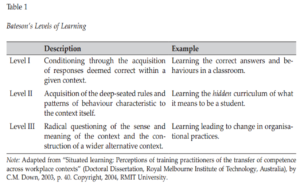
An important point of departure is with the understanding of learning itself. The Russian word, used by Vygotsky and his colleagues, obuchenie is often translated as instruction. The cultural baggage of a transmission based pedagogy is easily associated with obuchenie in its guise as instruction. Davydov’s (1995) translator suggests that teaching or teaching-learning is more appropriate as the translation of obuchenie in that it refers to all the actions of the teacher in engendering cognitive development and growth. In the plethora of approaches to the analysis of teaching and learning, whether they be situated or distributed, or espousing an internalisation, participation or transformational model, there has been relatively few attempts to forge the elusive connection between macrostructures of power and control and micro processes of the formation of pedagogic consciousness (see Daniels, 2001, 2008, for details). There also appears to be an assumption in many accounts of learning that it may be described and analysed as a homogenous phenomenon. In his original formulation of expansive learning, Engeström (1987) draws on Bateson’s formulation, in 1972, of levels of learning. Down (2003) provides a summary of Bateson’s levels as shown in Table 1.

Engeström (1987) draws attention to Learning III. He argues that this form of learning involves the reformulation of problems and the creation of new tools for engaging with these problems. This ongoing production of new problem solving tools enables subjects to transform “the entire activity system”, and potentially create, or transform and expand, the objects of the activity (pp. 158-159).

tabla-1


Expansive learning involves the creation of new knowledge and new practices for a newly emerging activity; that is, learning embedded in and constitutive of qualitative transformation of the entire activity system. Such a transformation may be triggered by the introduction of a new technology or set of regulations, but it is not reducible to it. All three types of learning may take place within expansive learning, but these gain a different meaning, motive and perspective as parts of the expansive process. A full cycle of expansive transformation may be understood as a collective journey through the zone of proximal development of the activity (Engeström, 1999a).

Whatever the type or form of learning that is taking place there is a need to understand its emergence in relation to the circumstances in which it is taking place. My argument is that the way forward is to be found in an exploration of the dialectical relation between theoretical and empirical work which draws on the strengths of the legacies of sociological and psychological sources to provide a theoretical model which is capable of descriptions at levels of delicacy which may be tailored to the needs of specific research questions. The development of the theoretical model along with the language of description it generates will hopefully open the way for new avenues of research in which different pedagogic practices are designed and evaluated in such a way that the explicit and tacit features of processes of the mutual shaping of person and context may be examined (Daniels, 2010). This will enable significant contributions to be made to the possibilities for studying fields or networks of interconnected practice (such as those of the home, school and community) with their partially shared and often contested objects. Alongside this enhancement of the outward reach of the theory must be increased capacity and agility in tackling inward issues of subjectivity, personal sense, emotion, identity, and moral commitment. In the past these two directions have tended to remain the incompatible research objects of different disciplines with an emphasis on collective activity systems, organizations and history on the one hand and subjects, actions and situations on the other hand (Engeström & Sannino, 2010).

Here I will consider the institutional level of social formation. I will outline an approach to the study of learning which examines the way in which societal needs and priorities and/or curriculum formations are recontextualised within institutions such as schools or universities. This approach seeks to understand, analyse and describe the structural relations of power and control within institutions and deploy a language of description to the discursive formations to which the structural formations give rise. I argue that the practices of interaction, which particular institutions seek to maintain, differentially deflect and direct the attention, gaze and patterns of interaction of socially positioned participants.

Institutions and the Social Formation of Mind

The way in which the social relations of institutions are regulated has cognitive and affective consequences for those who live and work inside them. The current state of the art in the social sciences struggles to provide a theoretical connection between specific forms, or modalities, of institutional regulation and consciousness. Attempts which have been made to do so tend not to be capable of generating analyses and descriptions of institutional formations that are predictive of consequences for individuals. At the same time social policy tends not to engage with the personal consequences of different forms of institutional regulation. I will discuss an approach to making connections between the principles of regulation in institutions, discursive practices and the shaping of consciousness. This approach is based on the work of the British sociologist, Basil Bernstein, and the Russian social theorist, Lev Vygotsky.

From a sociological point of view Bernstein (1996, p. 93) outlined the challenge as follows:

The substantive issue of . . . [this] theory is to explicate the process whereby a given distribution of power and principles of control are translated into specialised principles of communication differentially, and often unequally, distributed to social groups/classes. And how such a differential/unequal distribution of forms of communication, initially (but not necessarily terminally) shapes the formation of consciousness of members of these groups/classes in such a way as to relay both opposition and change.

The following assertion from Vygotsky (1960/1981, p. 163) recasts the issue in more psychological terms but with the same underlying intent and commitment:

Any function in the child’s cultural [i.e. higher] development appears twice, or on two planes. First it appears on the social plane, and then on the psychological plane. First it appears between people as an inter-psychological category, and then within the child as an intra-psychological category.

I argue that, taken together, the Vygotskian and Bernsteinian social theory has the potential to make a significant contribution to the development of a theory of the social formation of mind in specific pedagogic modalities.

A sociological focus on the rules which shape the social formation of discursive practice may be brought to bear on those aspects of psychology which argue that cultural artefacts, such as pedagogic discourse, both explicitly and implicitly, mediate human thought and action. Sociocultural theorists argue that individual agency has been significantly under acknowledged in Bernstein’s sociology of pedagogy (Werstch, 1998a). Vygotsky’s work provides a compatible account that places an emphasis on individual agency through its attention to the notion of mediation. Sociologists complain that post-Vygotskian psychology is particularly weak in addressing relations between local, interactional contexts of activity and mediation, where meaning is produced and wider structures of the division of labour and institutional organisation act to specify social positions and their differentiated orientation to activities and cultural artefacts (Fitz, 2007).

Vygotsky’s Sociogenetic Approach

Vygotsky provided a rich and tantalising set of suggestions that have been taken up and transformed by social theorists as they attempt to construct accounts of the formation of mind which to varying degrees acknowledge social, cultural and historical influences. There is also no doubt that Vygotsky straddled a number of disciplinary boundaries. Davydov (1995) went as far to suggest that he was involved in “a creative reworking of the theory of behaviourism, gestalt psychology, functional and descriptive psychology, genetic psychology, the French school of sociology, and Freudianism” (p. 15).

Recent developments in post Vygotskian theory have witnessed considerable advances in the understanding of the ways in which human action shapes and is shaped by the contexts in which it takes place. They have given rise to a significant amount of empirical research within and across a wide range of fields in which social science methodologies and methods are applied in the development of research-based knowledge in policy making and practice in academic, commercial and industrial settings. His is not a legacy of determinism and denial of agency, rather he provides a theoretical framework which rests on the concept of mediation. These developments have explored different aspects of Vygotsky’s legacy at different moments.

It is clear that many disciplines contributed to the formation of Vygotsky’s ideas. For example, Van der Veer (1996) argues that Humboldt with reference to linguistic mediation and Marx with reference to tool-use and social and cultural progress influenced Vygotsky’s concept of culture. He suggested that the limitations in this aspect of Vygotsky’s work are with respect to non-linguistically mediated aspects of culture and the difficulty in explaining innovation by individuals. Vygotsky’s writing on the way in which psychological tools and signs act in the mediation of social factors does not engage with a theoretical account of the appropriation and/or production of psychological tools within specific forms of activity within or across institutions. Just as the development of Vygotsky’s work fails to provide an adequate account of social praxis, so much sociological theory is unable to provide descriptions of micro level processes, except by projecting macro level concepts on to the micro level unmediated by intervening concepts though which the micro can be both uniquely described and related to the macro level.

Bernstein’s Sociology of Pedagogy

Amongst sociologists of cultural transmission, Bernstein (2000) provides the sociology of this social experience which is most compatible with, but absent from, Vygotskian psychology. His theoretical contribution was directed towards the question as to how institutional relations of power and control translate into principles of communication and how these differentially regulate forms of consciousness. It was through Luria’s attempts to disseminate his former colleague’s work that Bernstein first became acquainted with Vygotsky’s writing.

I first came across Vygotsky in the late 1950s through a translation by Luria of a section of Thought and Speech published in Psychiatry 2 1939. It is difficult to convey the sense of excitement, of thrill, of revelation this paper aroused: literally a new universe opened (Bernstein, 1993, p. 23).

This paper along with a seminal series of lectures given by Luria at the Tavistock Institute in London sparked an intense interest in the Russian Cultural Historical tradition and went on to exert a profound influence on post war developments in English in Education, the introduction of education for young people with severe and profound learning difficulties, and theories and practices designed to facilitate development and learning in socially disadvantaged groups in the United Kingdom. In November 1964 Bernstein wrote a letter to Vygotsky’s widow outlining her late husband’s influence on his developing thesis.

As you may know, many of us working in the area of speech (from the perspective of psychology as well as from the perspective of sociology) think that we owe a debt to the Russian school, especially to works based on Vygotsky’s tradition. I should say that in many respects, many of us are still trying to comprehend what he said (Bernstein, 1964, p. 1).

In a commentary on the 1971 publication of “The Psychology of Art’”, Ivanov identifies Bernstein’s influence on the dissemination of Vygotsky’s ideas in the west, despite somewhat inaccurate claims about publication and disciplinary identity.

It was Vygotsky’s (Vygotsky, 1930-1934/1978) non-dualist cultural historical conception of mind claims that intermental (social) experience shapes intramental (psychological) development that continued to influence Bernstein’s thinking. This was understood as a mediated process in which culturally produced artefacts (such as forms of talk, representations in the form of ideas and beliefs, signs and symbols) shape and are shaped by human engagement with the world (Daniels, 2008; Vygotsky, 1982/1987).

Durkheim influenced both Vygotsky and Bernstein (Atkinson, 1985). On the one hand Durkheim’s notion of collective representation allowed for the social interpretation of human cognition, on the other it failed to resolve the issue as to how the collective representation is interpreted by the individual. This is the domain so appropriately filled by the later writings of Vygotsky.

Although Vygotsky (1930-1934/1978, 1982/1987) discussed the general importance of language and schooling for psychological functioning, he failed to provide an analytical framework to analyse and describe the real social systems in which these activities occur. The analysis of the structure and function of semiotic psychological tools in specific activity contexts is not explored. The challenge is to address the demands created by this absence.

Bernstein (1996) outlined a model for understanding the construction of pedagogic discourse. In this context pedagogic discourse is a source of psychological tools or cultural artefacts. “The basic idea was to view this [pedagogic] discourse as arising out of the action of (…) a group of specialised agents operating in specialised setting in terms of the interests, often competing interests, of this setting” (p. 113).

In Engeström’s (1996) work within activity theory, which to some considerable extent has a Vygotskian root, the production of the outcome of activity is discussed but not the production and structure of cultural artefacts such as discourse. The production of discourse is not analysed in terms of the context of its production, that is the rules, community and division of labour, which regulate the activity in which subjects are positioned. It is therefore important that the discourse is seen within the culture and structures of schooling where differences in pedagogic practices, in the structuring of interactions and relationships, and the generation of different criteria of competence, will shape the ways in which children are perceived and actions are argued and justified. This is the agenda which Hasan (2005) has pursued in an approach that draws on Halliday, Vygotsky and Bernstein.

The application of Vygotsky by many social scientists (e.g. linguists, psychologists and sociologists) has been limited to relatively small scale interactional contexts often within schooling or some form of educational setting. The descriptions and the form of analysis are in some sense specific to these contexts.

In his work on schooling, Bernstein (2000) argues that pedagogic discourse is constructed by a recontextualising principle which selectively appropriates, relocates, refocuses and relates other discourses to constitute its own order. He argues that in order to understand pedagogic discourse as a social and historical construction attention must be directed to the regulation of its structure, the social relations of its production and the various modes of its recontextualising as a practice. For him symbolic tools are never neutral; intrinsic to their construction are social classifications, stratifications, distributions and modes of recontextualizing.

The language that Bernstein (2000) has developed allows researchers to take measures of institutional modality. That is to describe and position the discursive, organizational and interactional practice of the institution. His model is one that is designed to relate macro-institutional forms to micro-interactional levels and the underlying rules of communicative competence. He focuses on two levels: a structural level and an interactional level. The structural level is analysed in terms of the social division of labour it creates (e.g. the degree of specialisation, and thus strength of boundary between professional groupings) and the interactional with the form of social relation it creates (e.g. the degree of control that a manager may exert over a team member’s work plan). The social division is analysed in terms of the strength of the boundary of its divisions; that is, with respect to the degree of specialisation (e.g. how strong is the boundary between professions such as teaching and social work or one school curriculum subject and another). Bernstein (1996) refined the discussion of his distinction between instructional and regulative discourse. The former refers to the transmission of skills and their relation to each other, and the latter refers to the principles of social order, relation and identity. Regulative discourse communicates the school’s (or any institution’s) public moral practice, values beliefs and attitudes, principles of conduct, character and manner. Pedagogic discourse is modelled as one discourse created by the embedding of instructional and regulative discourse. Bernstein provides an account of cultural transmission which is avowedly sociological in its conception. In turn the psychological account that has developed in the wake of Vygotsky’s writing offers a model of aspects of the social formation of mind which is underdeveloped in Bernstein’s work.

Mediation

Discourse may mediate human action in different ways. There is visible (Bernstein, 2000) or explicit (Wertsch, 2007) mediation in which the deliberate incorporation of signs into human action is seen as a means of reorganising that action. This contrasts with invisible or implicit mediation that involves signs, especially natural language, whose primary function is in communications which are part of a pre-existing, independent stream of communicative action that becomes integrated with other forms of goaldirected behaviour (Wertsch, 2007). Invisible semiotic mediation occurs in discourse embedded in everyday ordinary activities of a social subject’s life.

As Hasan (2001, p. 8) argues, Bernstein further nuances this claim:

What Bernstein referred to as the ‘invisible’ component of communication (see Bernstein 1990: 17, figure 3.1 and discussion). The code theory relates this component to the subject’s social positioning. If we grant that “ideology is constituted through and in such positioning” (Bernstein 1990: 13), then we grant that subjects’ stance to their universe is being invoked: different orders of relevance inhere in different experiences of positioning and being positioned. This is where the nature of what one wants to say, not its absolute specifics, may be traced. Of course, linguists are right that speakers can say what they want to say, but an important question is: what is the range of meanings they freely and voluntarily mean, and why do they prioritize those meanings when the possibilities of making meanings from the point of view of the system of language are infinite? Why do they want to say what they do say? The regularities in discourse have roots that run much deeper than linguistics has cared to fathom.

This argument is strengthened through its reference to a theoretical account which provides greater descriptive and analytical purchase on the principles of regulation of the social figured world, the possibilities for social position and the voice of participants.

These challenges of studying implicit or invisible mediation have been approached from a variety of theoretical perspectives. Holland, Lachiotte, Skinner, & Cain (1998) have studied the development of identities and agency specific to historically situated, socially enacted, culturally constructed worlds in a way that may contribute to the development of an understanding of the situatedness of the development of social capital. This approach to a theory of identity in practice is grounded in the notion of a figured world in which positions are taken up constructed and resisted. The Bakhtinian concept of the space of authoring is deployed to capture an understanding of the mutual shaping of figured worlds and identities in social practice. They refer to Bourdieu (as cited in Holland et al., 1998) in their attempt to show how social position becomes disposition. They argue for the development of social position into a positional identity into disposition and the formation of what Bourdieu refers to as habitus. Bernstein is critical of habitus arguing that the internal structure of a particular habitus, the mode of its specific acquisition, which gives it its specificity, is not described. For him habitus is known by its output not its input (Bernstein, 2000).

Wertsch (1998) turned to Bakhtin’s theory of speech genres rather than habitus. A similar conceptual problem emerges with this body of work. Whilst Bakhtin’s views concerning speech genres are ‘rhetorically attractive and impressive, the approach lacks … both a developed conceptual syntax and an adequate language of description. Terms and units at both these levels in Bakhtin’s writings (1978, 1986/1986) require clarification; further, the principles that underlie the calibration of the elements of context with the generic shape of the text are underdeveloped, as is the general schema for the description of contexts for interaction (Hasan, 2005). Bernstein acknowledges the importance of Foucault’s analysis of power, knowledge and discourse as he attempts to theorise the discursive positioning of the subject. He complains that it lacks a theory of transmission, its agencies and its social base.

Identity and Agency

Hasan brings Bernstein’s concept of social positioning to the fore in her discussion of social identity. Bernstein (1990, p. 13) used this concept to refer to “the establishing of a specific relation to other subjects and to the creating of specific relationships within subjects”. He forged a link between social positioning and psychological attributes. This is the process through which Bernstein talks of the shaping of the possibilities for consciousness. The dialectical relation between discourse and subject makes it possible to think of pedagogic discourse as a semiotic means that regulates or traces the generation of subjects’ positions in discourse. We can understand the potency of pedagogic discourse in selectively producing subjects and their identities in a temporal and spatial dimension (Diaz, 2001). As Hasan (2005) argues, within the Bernsteinian thesis there exists an ineluctable relation between one’s social positioning, one’s mental dispositions and one’s relation to the distribution of labour in society. Here the emphasis on discourse is theorised not only in terms of the shaping of cognitive functions but also, as it were invisibly, in its influence on “dispositions, identities and practices”(Bernstein, 1990, p. 33).

Within Engeström’s approach to Cultural Historical Activity Theory (1999a) the subject is often discussed in terms of individuals, groups or perspectives/views. I would argue that the way in which subjects are positioned with respect to one another within an activity carries with it implications for engagement with tools and objects. It may also carry implications for the ways in which rules, the community and the division of labour regulate actions, including learning, of individuals and groups.

Holland et al. (1998) have studied the development of identities and agency specific to historically situated, socially enacted, culturally constructed worlds. They draw on Bakhtin and Vygotsky to develop a theory of identity as constantly forming and in which the person is understood as a composite “of many, often contradictory, selfunderstandings and identities (…) [which are distributed across] the material and social environment and (…) [are rarely] durable” (p. 8). Holland et al. (1998) draw on Leont’ev in the development of the concept of socially organized and reproduced figured worlds which shape and are shaped by participants and in which social position establishes possibilities for engagement. They also argue that figured worlds:

Distribute “us” not only by relating actors to landscapes of action (as personae) and spreading our senses of self across many different fields of activity, but also by giving the landscape human voice and tone (…). Cultural worlds are populated by familiar social types and even identifiable persons, not simply differentiated by some abstract division of labor. The identities we gain within figured worlds are thus specifically historical developments, grown through continued participation in the positions defined by the social organization of those world’s activity [emphasis added] (Holland et al. 1998, p. 41).

This approach to a theory of identity in practice is grounded in the notion of a figured world in which positions are taken up constructed and resisted. They argue for the development of social position into a positional identity into disposition and the formation of what Bourdieu refers to as habitus. It is here that I feel that this argument could be strengthened through reference to a theoretical account which provides greater descriptive and analytical purchase on the principles of regulation of the social figured world, the possibilities for social position and the voice of participants.

Engeström (1999b), who has tended to concentrate on the structural aspects of CHAT, offers the suggestion that the division of labour in an activity creates different positions for the participants and that the participants carry their own diverse histories with them into the activity. This echoes the earlier assertion from Leont’ev:

Activity is the minimal meaningful context for understanding individual actions… In all its varied forms, the activity of the human individual is a system set within a system of social relations… The activity of individual people thus depends on their social position [emphasis added], the conditions that fall to their lot, and an accumulation of idiosyncratic, individual factors. Human activity is not a relation between a person and a society that confronts him…in a society a person does not simply find external conditions to which he must adapt his activity, but, rather, these very social conditions bear within themselves the motives and goals of his activity, its means and modes. (Leont’ev, 1978, p. 10).

In activity the possibilities for the use of artefacts depend on the social position occupied by an individual. Sociologists and sociolinguists have produced empirical verification of this suggestion (Bernstein, 2000; Hasan, 2001; Hasan & Cloran, 1990). My suggestion is that the notion of subject within activity theory requires expansion and clarification. In many studies the term subject perspective is used which arguably infers subject position but does little to illuminate the formative processes that gave rise to this perspective.

Holland et al. (1998) also argue that multiple identities are developed within figured worlds and that these are “historical developments, grown through continued participation in the positions defined by the social organization of those worlds’ activity” (p. 41). This body of work represents a significant development in our understanding of the concept of the subject in activity theory.

Conclusion

The language that Bernstein has developed allows researchers to develop measures of school modality. That is, to describe and position the discursive, organizational and interactional practice of the institution. He also noted the need for the extension of this work in his discussion of the importance of Vygotsky’s work for research in education.

“His theoretical perspective also makes demands for a new methodology, for the development of languages of description which will facilitate a multilevel understanding of pedagogic discourse, the varieties of its practice and contexts of its realization and production” (Bernstein, 1993, p. 23).

This approach to modelling the structural relations of power and control in institutional settings taken together with a theory of cultural–historical artefacts that invisibly or implicitly mediate the relations of participants in practices forms a powerful alliance. It carries with it the possibility of rethinking notions of agency and reconceptualising subject position in terms of the relations between possibilities afforded within the division of labour and the rules that constrain possibility and direct and deflect the attention of participants.

It accounts for the ways in which the practices of a community, such as school and the family are structured by their institutional context and that social structures impact on the interactions between the participants and the cultural tools. Thus, it is not just a matter of the structuring of interactions between the participants and other cultural tools; rather it is that the institutional structures themselves are cultural products that serve as mediators in their own right. In this sense, they are the message, that is a fundamental factor of education. As Hasan (2001) argues, when we talk, we enter the flow of communication in a stream of both history and the future. There is therefore a need to analyze and codify the mediational structures as they deflect and direct the attention of participants and as they are shaped through interactions which they also shape. In this sense, combining the intellectual legacies of Bernstein and Vygotsky permits the development of cultural historical analysis of the invisible or implicit mediational properties of institutional structures which themselves are transformed through the actions of those whose interactions are influenced by them. This move would serve to both expand the gaze of post Vygotskian theory and at the same time bring sociologies of cultural transmission into a framework in which institutional structures are analyzed as historical products which themselves are subject to dynamic transformation and change as people act within and on them.

References

Atkinson, P. (1985). Language, structure, and reproduction: An introduction to the sociology of Basil Bernstein. London, UK: Methuen.

Bakhtin, M.M. (1978). The problem of the text (An essay in the philosophical analysis). Soviet Studies in Literature, 14(1), 3-33. doi: 10.2753/RSL1061-1975140163

Bakhtin, M.M. (1986). The problem of speech genres (V.W. McGee, Trans.). In C. Emerson & M. Holquist (Eds.), Speech genres and other late essays (Series 8, pp. 60-102). Austin, Texas: University of Texas Press. (Reprinted from Éstetika slogesnovo tvorchestva, pp. 192-198, by M.M. Bakhtin, Ed., 1986, Moscow, Russia: Iskusstvo).

Bernstein, B. (1964, November, 27). Letter to Vygotsky’s Widow, Mimeo.

Bernstein, B. (1990). The structuring of pedagogic discourse: class, codes and control (Vol. 4). London, UK: Routledge.

Bernstein, B. (1993). Foreword. In H. Daniels (Ed.), Charting the Agenda: educational activity after Vygotsky (pp. 13-23). London, UK: Routledge.

Bernstein, B. (1996). Pedagogy symbolic control and identity: Theory, research, criticism. London, UK: Falmer Press.

Bernstein, B. (2000). Pedagogy symbolic control and identity: Theory, research, criticism (Rev. ed.). London: Falmer Press.

Daniels, H. (2001). Vygotsky and Pedagogy. London, UK: Routledge.

Daniels, H. (2006). Analysing institutional effects in activity theory: First steps in the development of a language of description. Outlines: Critical Social Studies, 8(2), 43-58. Retrieved from http://ojs.statsbiblioteket.dk/index.php/outlines/article/view/2091

Daniels, H. (2008). Vygotsky and research. London, UK: Routledge

Daniels, H. (2010). The mutual shaping of human action and institutional settings: a study of the transformation of children’s services and professional work. The British Journal of Sociology of Education, 31(4), 377-393. doi: 10.1080/01425692.2010.484916

Davydov, V.V. (1995). The influence of L. S. Vygotsky on education theory, research, and practice. Educational Researcher, 24(3), 12-21. doi: 10.3102/0013189X024003012

Diaz, M (2001). The importance of Basil Bernstein. In S. Power, P. Aggleton, J. Brannen, A. Brown, L. Chisholm, L., & J. Mace (Eds.), A tribute to Basil Bernstein 1924-2000 (pp. 114-116). London, UK: Institute of Education, University of London.

Down, CM. (2003). Situated learning: Perceptions of training practitioners of the transfer of competence across workplace contexts (Doctoral dissertation, Royal Melbourne Institute of Technology, Australia). Retrieved from https://researchbank.rmit.edu.au/eserv/ rmit:6311/Down_PartA.pdf

Engeström, Y. (1987). Learning by expanding: An activity-theoretical approach to developmental research. Helsinki, Finland: Orienta-Konsultit Oy Publisher.

Engeström, Y. (1996). Development as breaking away and opening up: A challenge to Vygotsky and Piaget. Swiss Journal of Psychology, 55(2), 126–132. Retrieved from http://lchc.ucsd.edu/mca/Paper/Engestrom/Engestrom.html

Engeström, Y. (1999a). Activity theory and individual and social transformation. In Y. Engeström, R. Miettinen, & R.-L. Punamäki (Eds.), Perspectives on activity theory (pp. 19-38). Cambridge, UK: Cambridge University Press.

Engeström, Y. (1999b). Innovative learning in work teams: Analyzing the cycles of knowledge creation in practice. In Y. Engeström, R. Miettinen, & R.-L. Punamäki (Eds.), Perspectives on activity theory (pp. 377-404). Cambridge, UK: Cambridge University Press.

Engeström, Y. & Sannino, A. (2010). Studies of expansive learning: Foundations, findings and future challenges. Educational Research Review, 5(1), 1-24. doi:10.1016/j. edurev.2009.12.002.

Fitz, J. (2007). [Review of the book Knowledge, power and educational reform, applying the sociology of Basil Bernstein, by R. Moore, M. Arnot, J. Beck, & H. Daniels]. British Journal of Sociology of Education, 28(2), 273-279. Retrieved from http://www.jstor. org/stable/30036202

Hasan, R. (2001). Understanding talk: Directions from Bernstein’s sociology. International Journal of Social Research Methodology, 4(1), 5-9. doi: 10.1080/13645570010028549

Hasan, R. (2005). Semiotic mediation, language and society: Three exotripic theories – Vygotsky, Halliday and Bernstein. In J. Webster (Ed.), Language, society and consciousness: Ruqaiya Hasan (Vol. 1, pp. 55-80). London, UK: Equinox.

Hasan, R. & Cloran, C. (1990). A sociolinguistic study of everyday talk between mothers and children. In M.A.K. Halliday, J. Gibbons, & H. Nicholas (Eds.), Learning keeping and using language (Vol. 1, pp. 104-131). Amsterdam, Netherlands: John Benjamins.

Holland, D., Lachiotte, L., Skinner, D., & Cain, C. (1998). Identity and agency in cultural worlds. Cambridge, Massachusets, USA.: Harvard University Press. Ivanov, V.V. (1971). Commentary. In L.S. Vigotsky (Ed.), The psychology of art (pp. 265- 295). Cambridge, Massachusetts. USA: MIT Press.

Leont’ev, A. N. (1978) Activity, consciousness and personality. Englewood Cliffs, New Jersey, USA: Prentice Hall.

Van der Veer, R. (1996). The concept of culture in Vygotsky’s thinking. Culture Psychology, 2(3), 247-263. doi: 10.1177/1354067X9600200302

Vygotsky, L.S. (1978) Mind in society: The development of higher psychological processes (M. Cole, V. John-Steiner, S. Scribner, & E. Souberman, Trans.). Cambridge, Massachusets, USA: Harvard University Press. (Reprinted from Разум в обществе, by L.S. Vygotsky, Ed., [ca. 1930-1934], Russia).

Vygotsky, L.S. (1981). The genesis of higher mental functions (J.V. Wertsch, Trans.). In J.V. Wertsch (Ed.), The concept of activity in soviet psychology (pp. 144-188). Armonk: M E Sharp. (Reprinted from Razvitie vysshikh psikhicheskikh funktsii, by L.S. Vigotsky, L.S., Ed., 1960, Moscow, Russia).

Vygotsky, L.S. (1987). Thinking and speech (N. Minick, Trans.). In R.W. Rieber, A.S. Carton, & N. Minick (Eds.), The collected works of L.S. Vygotsky: Problems of general psychology (Vol. 1). New York, USA: Plenum Press. (Reprinted from Sobranie sochinenii, by L.S. Vygotsky, Ed., 1982, Moscow, Russia: Aksenov).

Wertsch, J.V. (1998). [Review of the book Pedagogy, symbolic control and identity: Theory, research, critique, by B. Bernstein]. Language in Society, 27(2), 257-259. doi: 10.1017/ S0047404500019904

Wertsch, J.V. (2007). Mediation. In H. Daniels, M. Cole, & J.V. Wertsch (Eds.), The Cambridge Companion to Vygotsky (pp. 178-193). New York, USA: Cambridge University Press.

Fuente del Artículo:

http://revistas.um.es/rie/article/view/252801/195001

Comparte este contenido:

South Africa: UKZN SRC – We Were Clear We Do Not Want Any Fee Increase

África/Suráfrica/20 de Septiembre de 2016/Allafrica

Resumen: La Universidad de KwaZulu – Natal Howard Colegio consejo representante de los estudiantes ( SRC ) dice que el aumento de la tarifa propuesta por el ministro de Educación Superior Blade Nzimande el lunes era exactamente lo que han estado protestando en contra.

——————————————————————-

The University of KwaZulu-Natal Howard College student representative council (SRC) says the fee increase proposed by Higher Education Minister Blade Nzimande on Monday was exactly what they have been protesting against.

«From the beginning of our protests we were clear that we do not want any increment increase. The issues of fees increment it is our main issue,» SRC deputy president Sunshine Myende said.

Myende however added that the student council would still have to determine how the increase, capped at 8%, would affect UKZN students.

She said that while there were currently no planned protests, the council meeting would «determine various factors around the increase».

«Our council meeting is [scheduled for] today. Council must speak on fee increments. Everything will be determined by the council meeting.

«We want free education. And we want it… to be this year or never.»

Myende was critical of government saying the fee increase announcement should have been made earlier in the year.

Student initiatives

According to Myende, at the beginning of the year, students resolved to undertake various initiatives to raise funds for those who could not afford fees.

«We have been asking people to donate and we have been selling various items.»

Nzimande announced on Monday that universities in the country can increase fees for 2017, but they must not exceed 8%.

He said to ensure that such inflation-linked fee adjustments of the 2015 fee baseline are affordable to financially needy students, government has committed to finding the resources to support all students.

He said they would assist households with an income of up to R600 000 per annum with subsidy funding to cover the gap between the 2015 fee and adjusted 2017 fee at the relevant institutions.

«This will be done for fee increments up to 8%,» he said.

This will in effect mean that all NSFAS qualifying students, as well as the so-called «missing middle»- that is, students whose families earn above the NSFAS threshold but who are unable to support their children to access higher education – will experience no fee increase in 2017.

Fuente de la Noticia: 
http://allafrica.com/stories/201609191159.html
Comparte este contenido:

Honduras: L800 de aumento recibirán 65 mil maestros

Centro América/Honduras/20 Septiembre 2016/Fuente: La tribuna

Los maestros hondureños comenzarán a recibir un incremento salarial de 800 lempiras a partir de este, confirmó el ministro del Educación, Marlon Escoto.

El incentivo laboral beneficiará alrededor de 65 mil maestros del sistema público tanto del sector primario como de media, agregó el funcionario.

La iniciativa fue promovida por el Presidente Juan Orlando Hernández en recompensa de los docentes en los últimos dos años al cumplir con 200 días de clases, disminuir los índices de analfabetismo y una mejora en otros indicadores educativos.

Escoto también recordó que a partir del próximo año, los mentores recibirán mil lempiras más de aumento, para un total de 1,800 lempiras en la presente gestión gubernamental, después de casi diez años de tener congelados los salarios.

La Secretaría de Educación comenzará a acreditar el aumento a partir del 20 de septiembre en cada una de las cuentas individuales de los profesores, subrayó Escoto.

Fuente de la Noticia:

http://www.latribuna.hn/2016/09/18/l800-aumento-recibiran-65-mil-maestros/

Comparte este contenido:
Page 805 of 2546
1 803 804 805 806 807 2.546