Page 268 of 359
1 266 267 268 269 270 359

Cash Transfer Programs Succeed for Zambia’s Poor, Offer Lessons for Battling African Poverty, AIR Finds

Fuente AIR / 8 de junio de 2016

Programs designed to alleviate hunger and increase food supply through cash transfers to some of Zambia’s poorest families achieved those goals and more, final evaluations conducted by the American Institutes for Research (AIR) revealed.

Overall, researchers found that a cash-transfer program geared toward families with at least one young child had effects that amounted to a net benefit of 1.5 kwacha—Zambia’s currency—for each kwacha transferred. A second program for households with fewer able-bodied people to farm had effects that amounted to a net benefit of 1.68 kwacha for each kwacha transferred.

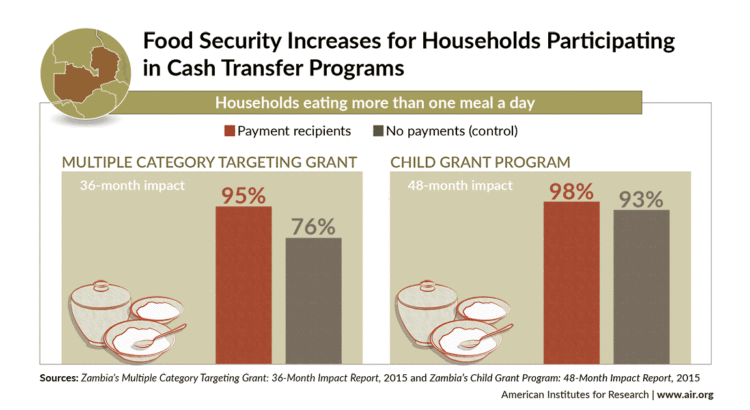
Besides eating more meals and building more reliable food reserves, families used the money to improve their housing, buy additional necessities for their children, acquire more livestock and reduce debt.

The studies, commissioned by UNICEF, are likely to be closely watched as African nations increasingly embrace cash transfers to combat the continent’s cycle of poverty. South Africa’s program is the largest, with roughly 16.1 million people—about a third of its population—receiving some kind of social grant.

Notably, the two Zambian programs were unconditional—providing small, consistent sums of money with no strings attached on how they were spent. The programs bucked general criticisms that cash transfers spark dependency. Rather, the discretionary approach empowered families, who used the grants to improve their living standards in ways that made sense given their individual circumstances. At no point during the multiyear grants did alcohol consumption increase. Nor was there any impact on fertility, according to the evaluations.

“The unconditional approach worked,” said Stanfield Michelo, director of social welfare at Zambia’s Ministry of Community Development and Social Welfare. “And because it did, the region is making positive strides. Without a doubt, the changes would not have been possible without AIR’s rigorous evaluations.”
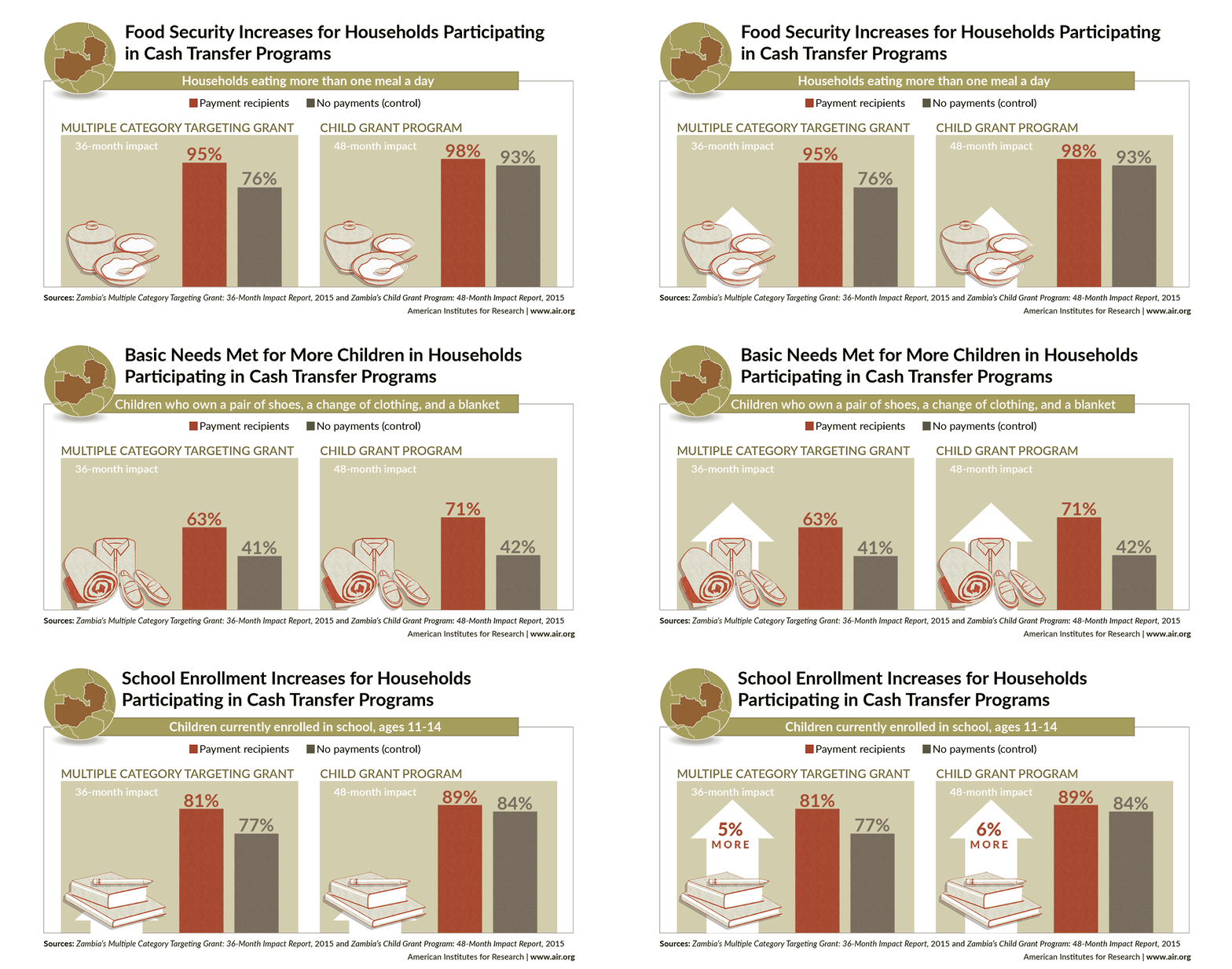
Animated infographic: Zambia cash transfer results

The evaluation of the Child Grant cash-transfer program (CGP) lasted four years, and the evaluation of the Multiple Category Targeting Grant (MCTG) lasted three years. Begun in 2010 in three of Zambia’s poorest districts, the CGP was open to all households with at least one child under age 4. Half were randomly assigned to receive cash transfers of 60 kwacha ($12) a month, and half to a control group that did not receive funds. The MCTG was aimed at poor households with fewer able-bodied people to farm, due largely to a “missing generation” of parents in their 30s and 40s and disproportionally high numbers of adolescents and orphans cared for by widows and grandparents. As with the CGP, half the MCTG participants received the equivalent of $12 a month and half were in a control group that didn’t.

The studies were notable not only for their duration, but also for their use of randomization and control groups to tease out the program’s true effects.

“Few evaluations of cash transfer programs can make such strong causal claims with as much certainty as these two evaluations,” said David Seidenfeld, AIR’s senior director of international research and evaluation and lead study author. “The design of the study, which extended over several years, allowed us to see that the beneficiaries do not grow complacent over time, but instead find ways to grow the value of the transfer beyond benefits related to food security and consumption.”

Although the studies revealed persistent successes, they also offered future researchers and policymakers an idea of cash transfers’ limitations. The studies did not show consistent successes in education or child nutrition, possibly due to large-scale infrastructure issues—namely, the supply of social services, access to clean water, and a lack of health care and education facilities.

Among the studies’ principal lessons, researchers found that the degree of positive impact depended largely on the participants’ characteristics. For example, the multiple-category grants had large impacts on schooling because participating households had more school-age children. Overall, school enrollment jumps of 8 percent for children ages 11–14 and 11 percent for children 15–17 were attributed to the program, and these age groups are at the greatest risk of dropping out in Zambia, according to the report. By contrast, four years into the program, the child grants had no enrollment or attendance impacts for children in three groups: ages 4–7, 8–10 and 15–17.

“Another lesson is that the unconditional nature of the grants gave participants the flexibility to use the money to combat principal life challenges,” said UNICEF Zambia Representative Hamid El-Bashir Ibrahim. “For example, the CGP significantly affected many indicators commonly associated with resiliency—the ability to manage and withstand shocks. Households with transfers significantly improved housing quality and tools, livestock procurement, and opportunities to diversify income-generating activities so they could better withstand emergencies.”

“The overall results demonstrate unequivocally that common perceptions about cash transfers—that they are handouts and cause dependency, or lead to alcohol and tobacco consumption, or increases in pregnancy—are not true in Zambia,” Seidenfeld said. “Quite the contrary. Due to the unconditional nature of the grants, households had the flexibility needed to meet their most pressing challenges head on.”

The final reports on the Child Grant cash transfer program and the Multiple Category Transfer Grant program can be found on AIR’s website. The site also features a video of David Seidenfeld discussing lessons learned from the multiyear studies.

About AIR
Established in 1946, with headquarters in Washington, D.C., the American Institutes for Research (AIR) is a nonpartisan, not-for-profit organization that conducts behavioral and social science research and delivers technical assistance both domestically and internationally in the areas of health, education and workforce productivity. For more information, visit www.air.org.

###

Comparte este contenido:

Reino Unido: Education in the media

Fuente: dfemedia.blog.gov.uk / 8 de junio de 2016

Education in the media: 8 June 2016

Today’s news review includes a stories about A level take-up across the country, evidence heard by the Women and Equalities Select Committee on incidents of alleged sexual harassment in schools and an Ofsted letter on East Midlands school performance.

A level take-up

On Wednesday, 8 June, the New Schools Network published new analysis looking at areas of the country that have the lowest numbers of young people studying A levels, claiming there is a deep-seated problem in ensuring that young people in poorer areas are able to take A levels.

The New Schools Network’s analysis is inaccurate as it only takes into account those young people that studied within their own borough and fails to acknowledge those students that travel to a different area to study, therefore creating an unrealistic picture of the areas they say have a low take-up. The figures suggest that 48 16-to-18 year olds in 2015 which lived in Knowsley studied A levels, when in fact the actual figure is 654.

BBC Online is the only outlet to cover the story using the figures to highlight the regional differences in the proportion of pupils studying A levels.

A Department for Education spokesperson said:

These figures are completely misleading – they do not reflect those young people who study A levels in a neighbouring borough, the actual levels of participation are far higher because many will choose to study in other areas. The primary reason the uptake of A levels differs from area to area is because demand varies across the country. Where there is demand, provision is always available.


We want to see high quality A level provision across the country so that all children have access to a good education. Our ambitious reforms are driving up standards and spreading educational excellence everywhere – a key part of this is ensuring post-16 providers have the resources they need to ensure young people can reach their full potential, and leave well prepared for life in modern Britain with the skills that employers value.

Sexual harassment

On Tuesday, 7 June, the Women and Equalities Select Committee held an evidence session as part of its ongoing inquiry into sexual harassment in schools. During the session, calls were made by a number of experts for children as young as four to be taught about sexism, harassment and sexual abuse.

The Guardian covers the story today focusing on the comments made regarding children as young as four being taught about sexism and harassment, while the Sun and Daily Mail look at calls to make sex education compulsory and for four-year-olds to be taught about this issue to stop children being abused.

A Government spokesperson said:

We welcome this inquiry, and are playing a full part in it. We know that teachers and schools are already doing excellent work on this issue, but no young person should be made to feel unsafe or suffer harassment in any circumstance. Schools are safe places and fortunately crime in schools is very rare but sexual assault of any kind is an offence and must always be reported to the police.


Sex and relationship education is already compulsory in all maintained secondary schools and we expect academies and free schools to teach it as part of the curriculum. We are also working with leading headteachers and practitioners to look at how to raise the quality of PSHE teaching, which includes sex and relationship education.

East Midlands school performance

The Guardian ran a story today based on a letter from Ofsted’s regional director to East Midlands MPs, local authorities, multi-academy trusts and dioceses to highlight the poor performance of the region.

We have made clear that we want to ensure all pupils are receiving a good education and have announced a series of ambitious reforms in our recent White Paper to tackle underperformance and drive up standards.

Education Secretary Nicky Morgan said:

Every child deserves a great education and that’s why our White Paper has spreading educational excellence everywhere at its heart.


The East Midlands has improved drastically since our reforms began and there are now 119,000 more pupils in good or outstanding schools than in 2010 – an increase greater than the English average. This is a testament to the hard work of teachers across the region in implementing our reforms.


But some parts of the country are not yet good enough. That is why, in common with other areas of underperformance, we are working with groups like Teach First to place great teachers where they are needed most, returning power back to the profession through our White Paper reforms and introducing schemes like the National Teaching Service which will develop even more brilliant leaders.

Find out more about our White Paper reforms.

Comparte este contenido:

Inglaterrra: Teaching assistants could take industrial action

Fuente: tes.com / 8 de junio de 2016

GMB union to consult on a campaign against the ‘dismantling’ of terms and conditions

Teaching assistants in England are to be consulted by the GMB union over a campaign of action in a row about terms and conditions – a move that raises the prospect of coordinated industrial action by teachers and other staff.

The annual conference of the GMB in Bournemouth agreed to support efforts to retain «hard-fought» terms and conditions of school staff, including a campaign of industrial action if necessary.

The NUT teaching union is balloting its members over strike action against threats from academisation, deregulation of pay and funding cuts.

‘We will not stand by’

The GMB union said schools continued to be privatised, leading to the threat of cuts to the terms and conditions of staff. It is campaigning against schools being turned into academies.

An agreed motion read: «We will not stand by and let this Tory agenda dismantle our members’ terms and conditions brick by brick, class by class, where schools will be left with no alternative but to compete against one another.»

Enlace original: https://www.tes.com/news/school-news/breaking-news/teaching-assistants-could-take-industrial-action


Comparte este contenido:

EEUU: Federal Data Show Unequal Access to Challenging Math and Science Courses

Fuente: edweek / 8 de junio de 2016

New federal civil rights data released Tuesday show that black and Latino high school students are being shortchanged in their access to high-level math and science courses that could prepare them for college.

An early preview of the latest U.S. Department of Education’s Civil Rights Data Collection, based on the 2013-14 school year, lays out sharp racial and ethnic disparities in access to challenging high school courses:

Calculus offered in:

  • 33 percent of high schools with high black and Latino enrollment
  • 56 percent of high schools with low black and Latino enrollment

Physics offered in:

  • 48 percent of high schools with high black and Latino enrollment
  • 67 percent of high schools with low black and Latino enrollment

Chemistry offered in:

  • 65 percent of high schools with high black and Latino enrollment
  • 78 percent of high schools with low black and Latino enrollment.

Algebra 2 offered in:

  • 71 percent of high schools with high black and Latino enrollment
  • 84 percent of high schools with low black and Latino enrollment.

Particular inequities emerge when looking at course access by race and ethnicity. But there are many neighborhoods where those courses aren’t available to anyone, the civil rights data show.Only 48 percent of the country’s high schools offer calculus, 60 percent offer physics, 72 offer chemistry, and 78 percent offer Algebra 2.

The numbers are among the first batch to emerge from the Civil Rights Data Collection, which is conducted every two years. The federal education department’s Office for Civil Rights released a 13-page preview of a small slice of the information it uncovers in mandatory surveys of a huge swath of the U.S. K-12 system: 99 percent of schools and districts, representing 50 million students.

For more from EdWeek on what this early batch of data found, see this story by Evie Blad and this post by Sarah Sparks. In addition to the findings on college readiness, today’s data covers school discipline, the use of restraint and seclusion, early learning, chronic absenteeism, teachers and staffing, and education in justice facilities.

Many more results of the survey, which is intended to gauge how well schools and districts are providing equal opportunity to education as required by federal law, will be released this summer. Much of it will update previous releases, such as the ones we brought you in 2014 (which included the question of access to high-level courses). But there will be new elements covered this time, too, such as student access to distance education, credit-recovery and dual enrollment programs.

Today’s data also shows patterns in Advanced Placement enrollment by race, ethnicity, disability, and native language. For instance: English-learners represent 5 percent of the students in schools that offer AP courses, but only 2 percent of those actually enrolled in one or more of AP courses, the federal data show.

Black and Latino students are 38 percent of the students in schools offering AP, but only 29 percent of those enrolled. Students with disabilities under the Individuals with Disabilities Education Act represent 11 percent of the students in schools offering AP, but less than 2 percent of those taking such a class.

The federal data also showed that students who are multiracial, black, Latino, Native American, Native Alaskan, or Native Hawaiian, are more likely than students of other racial or ethnic descent to be held back a grade in high school. Students with disabilities and English-learners are also held back disproportionately.

Get High School & Beyond posts delivered to your inbox as soon as they’re published. Sign up here. Also, for news and analysis of issues that shape adolescents’ preparation for work and higher education.

Comparte este contenido:

Universities should ask whether their academics work too much

Fuente: Times Higher Education / 8 de junio de 2016

Scholars say they feel overwhelmed by demands, but there is scandalously little evidence on whether long hours make any sense for knowledge workers, finds David Matthews

Since I started reporting on research last summer, I’ve been surprised by how evidence-lite major bits of science policy seem to be.

For example, last November, I analysed the new Francis Crick Institute in London, a £700 million biomedical “superlab”. Its radically flat organisational structure and high levels of scientific freedom are based not on reams of experimental data on researcher productivity, but (at least in part) on the personal experiences of the chief executive, Sir Paul Nurse, in leading other institutions.

Read more: The Francis Crick Institute: science and serendipity 

Of course this isn’t to say the Crick won’t be a huge success, or that Sir Paul’s experiences aren’t useful guides. But, as I was told by Julia Lane, a professor of practice at New York University’s Center for Urban Science and Progress, “one of the things that gives one pause is that scientists don’t apply the scientific method to their own activities”.

This quote came to mind as I was writing an analysis that asks: how many hours a week should an academic work? It’s clear that faculty, particularly in the US, are putting in hours well above average (one recent study suggested 61 a week, including 10 on the weekend). Some are working even longer, as suggested by a recent blog that argued “you do not need to work 80 hours a week to succeed in academia”.

The research on optimum working hours is pretty patchy, particularly for knowledge workers (and if readers know of any relevant papers, please let me know). But there was nothing I could find that suggests someone toiling 80 hours a week can be as productive as a colleague doing half that, and plenty of research showing long hours leads to accidents and illness (see the conclusion of this paper).

Most gobsmacking of all was an ethnographic study of 100-hour-a-week Wall Street bankers by Alexandra Michel, a former Goldman Sachs employee herself, and now a professor at theUniversity of Pennsylvania.

Some of the quotes from bankers struggling to overcome the physical limits of their bodies in a never-ending work culture could have come straight from Patrick Bateman. Others are much more tragic.

‘‘I totally believe in mind over matter. There are no such things as physical needs. Tell me one physical need and I can tell you a culture in which they have controlled it,” one banker told Michel.

‘‘I fell on my way to a meeting. The leg changed color and I had pain but I chose not to think about it until after the meeting,” explained another. Her leg was broken in two places.

By year six, the latter banker had developed multiple new allergies, suffered from joint and back pain, heart problems and ovarian cancer, and had numerous unshakable colds and flu. Work forced her to miss the funeral of a beloved grandfather. ‘‘I feel like the creative juices are just gone,” she said. But she was still socialised by the bank’s culture: ‘‘I work hard because this work is who I am.’’

Academics can’t be blamed for overwork any more than can these bankers. Many surely feel trapped in a culture that lionises hyper-long hours, with anything else seen as a lack of commitment (Michel told me working at the weekend is seen as a “badge of honour” for faculty.)

Instead, it should be up to universities as employers to measure how long their faculty are working, and test whether there is any basis for them to work 50, let alone 80, hours a week.

You wouldn’t expect a Wall Street bank to do this. But the academy is supposed to adhere to higher standards of evidence. Understanding whether the nine-to-five (which is, after all, a hangover from the Fordist era of manufacturing) makes any economic or social sense in a knowledge economy strikes me as one of the most pressing research questions of our time.

Comparte este contenido:

España: CCOO exige una reforma de la normativa de formación dual en España

Fuente CCOO / 8 de junio de 2016

«Es urgente reformar la normativa que regula la formación dual, más aún en el contexto de precariedad en el empleo y concentración de la oferta en pocos sectores. Si las prácticas deben servir a la mejora de la cualificación de los jóvenes hay que garantizar su calidad, así como una retribución justa para los aprendices», asegura Javier López, secretario confederal de Formación de CCOO.

Las Organizaciones empresariales y sindicales de los 27 países de la Unión Europea, representadas por BUSINESSEUROPE (Confederación Europea de Gran Empresa), CEEP (Confederación Europea de Empresas de Servicios), UEAPME (Confederación Europea de Pequeñas y Medianas Empresas) y CES (Confederación Europea de Sindicatos), han pactado solicitar a Comisión Europea el establecimiento de un diálogo tripartito destinado a alcanzar un acuerdo sobre un marco de calidad para la Formación Profesional que se desarrolla en la empresa.

En la reunión celebrada los días 26 y 27 de mayo en Bruselas, la Confederación Europea de Sindicatos presentó las conclusiones de su análisis de la situación de los aprendices en la Unión Europea y fijó veinte criterios de calidad para las prácticas en la Formación Profesional. Los representantes empresariales, por su parte, presentaron los resultados de un estudio sobre los costes y beneficios para las empresas de cooperar en la formación de aprendices.

A pesar de la diversidad de enfoques y realidades nacionales de la Unión, los agentes sociales han acordado unas bases mínimas para garantizar que el aprendizaje en la empresa resulte beneficioso para ambas partes, jóvenes en formación y empresas. En el acuerdo se señala la necesidad de que los sistemas de formación dual se desarrollen contando con la participación de los agentes sociales, porque aquellos países que tienen sistemas de formación dual consolidados, como Alemania, Dinamarca o Austria, cuentan también con un marco institucional participativo.

En el acuerdo se afirma la necesidad de contar con una regulación clara a nivel nacional, que establezca derechos y obligaciones de los jóvenes en formación y de las empresas, desde el punto de vista de las condiciones laborales y de la formación, incluyendo un pago o salario y protección social para los aprendices.

El acuerdo considera también que las prácticas en las empresas son un instrumento de aprendizaje, por tanto no pueden sustituir puestos de trabajo estructurales, y deben permitir a los jóvenes adquirir una cualificación reconocida. Lo anterior exige que profesores y tutores, tanto del centro de formación como de la empresa, cuenten con conocimientos actualizados.

Y se dice que jóvenes y empresas deben tener claros sus derechos y obligaciones, ya sea a través de un acuerdo formal o un contrato que, además de establecer garantías respecto a la calidad de la formación y la protección social durante el periodo de aprendizaje, debe incluir un pago o compensación, de acuerdo con lo establecido en los convenios colectivos o en el marco normativo nacional.

Según Gema Torres, representante de CCOO en el Comité de Educación de la Confederación Europea de Sindicatos, “para que todo esto sea posible se requiere un marco regulador claro a nivel nacional, que es precisamente lo que no tenemos en nuestro país, donde la formación profesional dual, ‘desregulada’ en un real decreto de 2012, permite que los jóvenes se encuentren con condiciones de formación y laborales muy distintas, en función del programa de formación o la administración responsable del mismo”.

Para CCOO, en España es urgente reformar la normativa que regula la formación dual, más aún en el contexto de precariedad en el empleo y concentración de la oferta en pocos sectores. Si las prácticas deben servir a la mejora de la cualificación de los jóvenes hay que garantizar su calidad, así como una retribución justa para los aprendices.

Javier López, Secretario de Formación de CCOO, concluye que “es imprescindible un marco regulador como el que pretende la Declaración europea, que garantice la calidad del aprendizaje en la empresa, pero junto a esto hay que generar empleo y trabajo de calidad para que los y las jóvenes tengan oportunidades reales de encontrar después un buen trabajo. Sin un empuje decidido por un modelo productivo sostenible, la formación dual y las prácticas en empresa serán otra vía añadida a la precarización laboral y a la devaluación del trabajo”.

Comparte este contenido:

Global Partnership: Good teachers are essential to achieve quality education

Fuente: globalpartnership.org / 8 de junio de 2016

Teachers are the essential link to delivering a quality education to all children. To achieve the goal of universal education, the world needs more, better trained and better supported teachers.

Teachers have the single biggest impact on children learning (John Hattie, Visible Learning).

The availability of well-trained, motivated and supported teachers, nurturing and stable learning environments and adequate learning materials are among the factors that lead to effective teaching and positive learning outcomes.

While student-teacher ratios have improved – mostly in richer countries – in recent years, many countries continue to have an average of 40 or more students per teacher, inadequate teacher training, and limited teaching resources.

Comparte este contenido:
Page 268 of 359
1 266 267 268 269 270 359