Page 232 of 342
1 230 231 232 233 234 342

EEUU: Chicagoans Not Amused at Gov. Rauner’s Comment Comparing Schools to ‘Prisons’

Fuente: edweek.org  /8 de junio de 2016

Bruce Rauner said on Monday that some Chicago Public Schools resembled «crumbling prisons.» And people in Chicago were not amused.

The school district called on Rauner to apologize. Mayor Rahm Emanuel accused Rauner of auditioning to be the running mate of presumptive Republican presidential nominee, Donald Trump.

And CPS parents, teachers, principals, and others took to social media to blast the governor over his language. With the hashtag #NotAPrison, they rebutted the governor’s claims.

Link original: http://blogs.edweek.org/edweek/District_Dossier/2016/06/chicagoans_not_amused_by_gov_r.html?cmp=soc-edit-tw


Comparte este contenido:

México: Marcha magisterio del Senado a Segob

Fuente: La Capital  / 8 de Junio de 2016

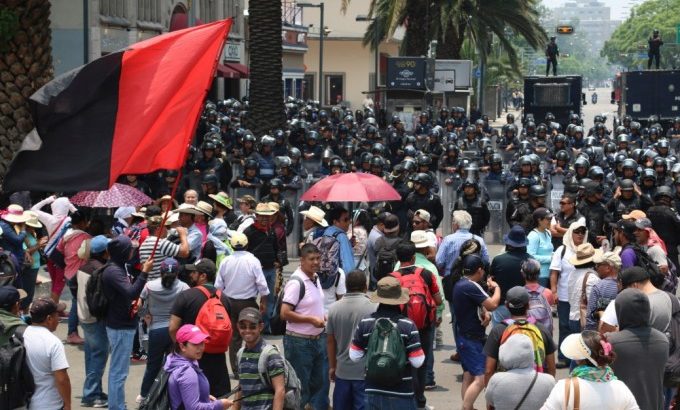
Luego de que una comitiva de maestros entró al Senado para entregar el pliego petitorio, inició la movilización de la Coordinadora Nacional de la Educación (CNTE) del Senado de la República hacia la Secretaría de Gobernación (Segob).

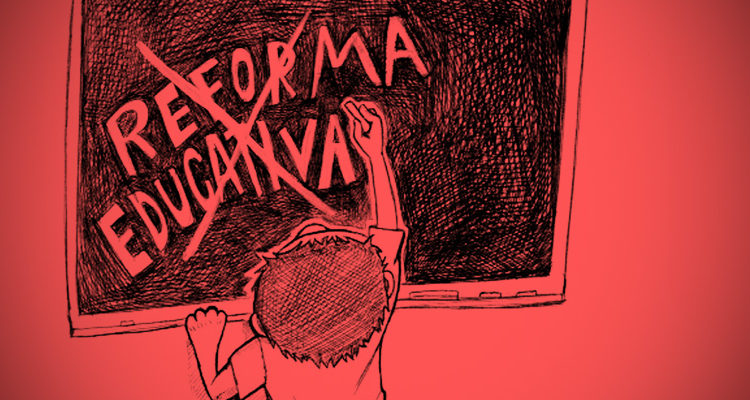
El contingente, integrado por las Secciones 18 de Michoacán, 14 de Guerrero, 7 de Chiapas, 9 y 10 de la Ciudad de México y 22 de Oaxaca, caminan sobre Paseo de la Reforma para manifestar su descontento por la Reforma Educativa.

Antes de iniciar la marcha, padres de los 43 normalistas de Ayotzinapa se unieron al contingente para confirmar su apoyo a la lucha del magisterio, así como pedir al pueblo alzar la voz y acabar con el mal gobierno de Enrique Peña Nieto.

Previamente había marchado sobre la misma vía para arribar al Senado de la República.

Sin embargo, elementos de Seguridad Pública bloqueron el paso de los manifestantes en Reforma, rumbo a Chapultepec, en las inmediaciones del Senado.

Según reportes, los contingentes se organizaron por secciones para iniciar la marcha, yendo a la vanguardia los maestros de la Sección 18 provenientes de Michoacán; posteriormente se colocaron los maestros de la Sección 7 de Chiapas, Sección 14 de Guerrero y Sección 22 de Oaxaca.

Además de la movilización, los manifestantes alistan un mitin frente a la Torre del Caballito, donde se concentra el mayor número de manifestantes, los cuales arriban principalmente del estado de Chiapas.

EN DIRECTO en : Llega contingente Chiapas CNTE a Reforma https://www.periscope.tv/w/aicN1zEwMzI2MjQxfDFsRHhMcVBFUkVMS23oso7epSWtyO7t4h7MGd3q5ypYqoaGbqtwHq1yA_vNxA== http://fb.me/6vriraULj 

Photo published for Coordinadora1DMX @Coordinadora1DM

Coordinadora1DMX @Coordinadora1DM

Llega contingente Chiapas CNTE a Reforma

é CNTE bloqueo permanente en Reforma

Maestros de la Coordinadora Nacional de Trabajadores de la Educación bloquearon Paseo de la Reforma. Los contingentes de maestros provenientes de Michoacán, Estado de México, Oaxaca y Chiapas, principalmente, se reunieron el cruce de Reforma y Bucareli lo que impidió el libre paso de los automovilistas.

Granaderos mantuvieron la vigilancia de los manifestantes e impidieron su paso hacia otros puntos del Centro Histórico de CDMX.

Los miembros del magisterio disidente realizarán una conferencia de prensa en el antimonumento a los 43 normalistas desaparecidos de Ayotzinapa. El lugar está resguardado por elementos del cuerpo de granaderos de la Secretaría de Seguridad Pública capitalina, asimismo lo sobrevuela un helicóptero la corporación.

Ambos sentidos de la Paseo de la Reforma, entre avenida Bucareli y avenida Juárez, fueron cerrados.

Vigilan granaderos marcha de la CNTE

Maestros de la Coordinadora Nacional de Trabajadores de la Educación que mantienen plantón en La Ciudadela, se reunirán con la caravana que proviene de Michoacán, Guerrero, Chiapas y Oaxaca para reforzar las movilizaciones en La Capital, en contra de la reforman educativa.

Ante la marcha anunciada para este miércoles, policías de la Secretaría de Seguridad Pública capitalina, vigilan ya Paseo de la Reforma a la altura de la Torre del Caballito.

También hay vallas de policías en los accesos al Zócalo capitailno y al Monumento a la Revolución, donde está instalada la réplica de la Capilla Sixtina. Además de los granaderos que bloquean los accesos por 5 de mayo, Tacuba, Madero y Eje Central.

“Hoy vamos a concentrarnos en Reforma y a las 12:00  estamos concentrándonos” en el cruce de Reforma y Bucareli”, dijo por la mañana el secretario General de la CNTE en Guerrero, Ramos Reyes.

Permiten avance de la CNTE por Calzada Zaragoza 

Después de unos 40 minutos de negociación, se permitió el paso a la caravana de profesores disidentes que ingresó a la Ciudad de México por la carretera México-Puebla, previamente detenida por granaderos a la altura del Metro Acatitla, en avenida Ignacio Zaragoza.

Los elementos policiacos retiraron de carriles centrales, vehículos y motocicletas oficiales.

Alrededor del mediodía, los representantes de los maestros de la sección 22 de la Coordinadora Nacional de Trabajadores de la Educación (CNTE) y de la sección 7 de esa agrupación en Chiapas, José Antonio y Marisol Rodríguez, respectivamente, dialogaron con los elementos policíacos.

Dirigentes de la CNTE habían solicitado a los gobiernos federal y local para que permita el paso de los contingentes.

En tanto, se prevé que en pocos minutos arribe la caravana de docentes del estado de Michoacán que avanza ya hacia el cruce de Paseo de la Reforma y Bucareli, donde comienzan a concentrarse decenas de educadores.

Hace cinco días, la marcha convocada por la CNTE en La Capital pretendía llegar al Aeropuerto de la Ciudad de México, pero policías capitalinos obstruyeron su paso y «encapsularon» a los manifestantes en Reforma.


Con información de Milenio y La Jornada 


Comparte este contenido:

México: Reforma educativa en 3 años no ha formulado programas que impliquen cambios de fondo en la enseñanza: experto

Fuente: revoluciontrespuntocero / 8 de junio de 2016

César Navarro Gallegos, profesor e investigador del Instituto José María Luis Mora, declaró que la reforma educativa ha privilegiado la fase jurídica, administrativa y de sanción peor no ha hecho ningún solo aporte a la educación en el país.

Detalló que después de tres años de la aprobación de la reforma y las modificaciones a los artículos tercero y 73 constitucionales, la Secretaría de Educación Pública (SEP) no ha formulado ni planes, ni programas o contenidos que implique un cambio de fondo en la enseñanza y formación básica en México, ya que lo que menos ha interesado en este proceso es la infancia y adolescencia.

Navarro opinó en la mesa de análisis de la reforma educativa frente a los maestros que se encuentran en lucha y plantón en La Ciudadela, que la negación por parte de Aurelio Nuño de entablar un diálogo con la Coordinadora Nacional de Trabajadores de la Educación (CNTE), no permitirá que se aplique la reforma porque lo que se pretende es un diálogo sin diálogo.

Tras concluir la mesa de análisis los maestros se dirigieron a la Bolsa Mexicana de Valores, donde exigieron que los empresarios se involucren en la problemática por la que atraviesa la educación.

Anunciaron que el día de hoy llegarán trabajadores de la educación de Chiapas,Michoacán, Guerrero, Oaxaca, Tlaxcala, Puebla e Hidalgo que acudirán a la movilización que se prevé a mediodía; agregaron que monitorearan la llegada de los profesores a la Ciudad de México en caso que se intente impedir otra vez el acceso a la capital con el fin de obstaculizar los derechos de libre tránsito y expresión.

Enlace original: http://revoluciontrespuntocero.com/reforma-educativa-en-3-anos-no-ha-formulado-programas-que-impliquen-cambios-de-fondo-en-la-ensenanza-experto/


Comparte este contenido:

Reino Unido: Education in the media

Fuente: dfemedia.blog.gov.uk / 8 de junio de 2016

Education in the media: 8 June 2016

Today’s news review includes a stories about A level take-up across the country, evidence heard by the Women and Equalities Select Committee on incidents of alleged sexual harassment in schools and an Ofsted letter on East Midlands school performance.

A level take-up

On Wednesday, 8 June, the New Schools Network published new analysis looking at areas of the country that have the lowest numbers of young people studying A levels, claiming there is a deep-seated problem in ensuring that young people in poorer areas are able to take A levels.

The New Schools Network’s analysis is inaccurate as it only takes into account those young people that studied within their own borough and fails to acknowledge those students that travel to a different area to study, therefore creating an unrealistic picture of the areas they say have a low take-up. The figures suggest that 48 16-to-18 year olds in 2015 which lived in Knowsley studied A levels, when in fact the actual figure is 654.

BBC Online is the only outlet to cover the story using the figures to highlight the regional differences in the proportion of pupils studying A levels.

A Department for Education spokesperson said:

These figures are completely misleading – they do not reflect those young people who study A levels in a neighbouring borough, the actual levels of participation are far higher because many will choose to study in other areas. The primary reason the uptake of A levels differs from area to area is because demand varies across the country. Where there is demand, provision is always available.


We want to see high quality A level provision across the country so that all children have access to a good education. Our ambitious reforms are driving up standards and spreading educational excellence everywhere – a key part of this is ensuring post-16 providers have the resources they need to ensure young people can reach their full potential, and leave well prepared for life in modern Britain with the skills that employers value.

Sexual harassment

On Tuesday, 7 June, the Women and Equalities Select Committee held an evidence session as part of its ongoing inquiry into sexual harassment in schools. During the session, calls were made by a number of experts for children as young as four to be taught about sexism, harassment and sexual abuse.

The Guardian covers the story today focusing on the comments made regarding children as young as four being taught about sexism and harassment, while the Sun and Daily Mail look at calls to make sex education compulsory and for four-year-olds to be taught about this issue to stop children being abused.

A Government spokesperson said:

We welcome this inquiry, and are playing a full part in it. We know that teachers and schools are already doing excellent work on this issue, but no young person should be made to feel unsafe or suffer harassment in any circumstance. Schools are safe places and fortunately crime in schools is very rare but sexual assault of any kind is an offence and must always be reported to the police.


Sex and relationship education is already compulsory in all maintained secondary schools and we expect academies and free schools to teach it as part of the curriculum. We are also working with leading headteachers and practitioners to look at how to raise the quality of PSHE teaching, which includes sex and relationship education.

East Midlands school performance

The Guardian ran a story today based on a letter from Ofsted’s regional director to East Midlands MPs, local authorities, multi-academy trusts and dioceses to highlight the poor performance of the region.

We have made clear that we want to ensure all pupils are receiving a good education and have announced a series of ambitious reforms in our recent White Paper to tackle underperformance and drive up standards.

Education Secretary Nicky Morgan said:

Every child deserves a great education and that’s why our White Paper has spreading educational excellence everywhere at its heart.


The East Midlands has improved drastically since our reforms began and there are now 119,000 more pupils in good or outstanding schools than in 2010 – an increase greater than the English average. This is a testament to the hard work of teachers across the region in implementing our reforms.


But some parts of the country are not yet good enough. That is why, in common with other areas of underperformance, we are working with groups like Teach First to place great teachers where they are needed most, returning power back to the profession through our White Paper reforms and introducing schemes like the National Teaching Service which will develop even more brilliant leaders.

Find out more about our White Paper reforms.

Comparte este contenido:

End child labour in supply chains – It’s everyone’s business!

Fuente:  OIT / 8 de junio de 2016

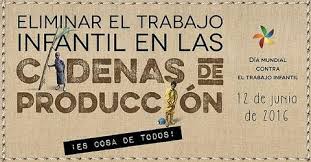
This year, the focus for World Day Against Child Labour – marked on 12 June – is on child labour and supply chains. With 168 million children still in child labour, all supply chains, from agriculture to manufacturing, services to construction, run the risk that child labour may be present.

Child labour has no place in well-functioning and well regulated markets, or in any supply chain. The message that we must act now to stop child labour once and for all has been affirmed by the Sustainable Development Goals. Acting together, it is within our means to make the future of work a future without child labour.»

Guy Ryder, ILO Director-General

This year, the focus for World Day Against Child Labour  – marked on 12 June – is on child labour and supply chains. With 168 million children still in child labour, all supply chains, from agriculture to manufacturing, services to construction, run the risk that child labour may be present.

“Child labour has no place in well-functioning and well regulated markets, or in any supply chain. The message that we must act now to stop child labour once and for all has been affirmed by the Sustainable Development Goals. Acting together, it is within our means to make the future of work a future without child labour,” said ILO Director-General Guy Ryder.

To support businesses in their actions to remove child labour from their supply chains, the ILO and the International Organisation of Employers (IOE) have jointly created the Child Labour Guidance Tool , a resource for companies to increase their knowledge and ability to conduct business in line with international labour standards on child labour.

The tool draws on the long experience of the ILO’s International Programme on the Elimination of Child Labour (ILO-IPEC) in collaborating with employers to combat child labour in supply chains and incorporates contributions from the a wide variety of companies including Coca-Cola Company, AngloGold Ashanti, Vale, Japan Tobacco and Sterling Manufacturing.

In addition, the ILO provides peer-to-peer best practice and knowledge sharing through the Child Labour Platform , which aims to identify the obstacles to the implementation of the ILO Conventions on child labour in supply chains, develop practical ways of overcoming these obstacles, and catalyse collective action.

Examples of good practise case studies of addressing child labour in supply chains are available here .

“With globalization, supply chains have become increasingly complex, involving workers, small producers, and enterprises around the world. Ending child labour in this context is everyone’s.business,” said Beate Andrees, Chief of the ILO’s Fundamental Principles and Rights at Work Branch.

World Day Events

The ILO is organizing a series of events on the occasion both in Geneva and throughout the world.

Geneva

A high-level event to mark the World Day will be held on 8 June 2016 in the Human Rights Council room of the Palais des Nations from 13:30 to 15:00. This event will take place during the 105th Session of the International Labour Conference .

The panel discussion will start at 2:00 p.m. and the panellists include:

  • Guy Ryder: Director-General, International Labour Organization
  • MaryAnn Mihychuk: Minister of Employment, Workforce Development and Labour, Canada
  • Jacqueline Mugo: Executive Director, Federation of Kenya Employers and Secretary General of Business Africa
  • Philip J. Jennings: General-Secretary, UNI Global Union.
  • Katharine Stewart: Director, Ethical Trade and Sustainability Division, Primark
  • Andrews Tagoe: Head of Program, Rural Workers, General Agricultural Workers Union of Ghana and Anglophone African Coordinator for the Global March Against Child Labour,
  • Vicky Bowman: Director, Myanmar Centre for Responsible Business

The panel discussion will be moderated by Nomia Iqbal from the BBC.

The Minister of Labour, Employment and Social Security of Argentina, Jorge Triaca, will make an announcement about the next Global Conference on Child Labour.

The panel discussion will be preceded by a musical performance by the “Choeur pour l’abolition du travail des enfants”, a group of artists and media professionals that joined together in 2013 to sensitize the public on the worst forms of child labour. The Group led by:

Guy Valery Constant NEZA, includes: Akissi Delphine LOUKOU (aka Akissi Delta), Ami Sarah BAMBA, Valley Ahou Manuella ETTE (aka Nuella), Odia Sidimé, Général Sead, Alain Amani GOLY (aka. Spyrow), Diarra Adama Dujiminika Koné (aka Jimmy James), Arthur Oswald Koya (aka Thura), Prisca Melaine Koffi (aka Prisk), and Dali Eva Christelle Kouko.

Their song “Mon enfant” is available on YouTube .

UN Geneva correspondents as well as ILC-accredited journalists are welcome to attend the event.

Globally

Over 30 events will be taking place around the world in support of the 2016 World Day Against Child Labour, including In New York hosted by UNICEF and in Rome hosted by FAO.

Musical concerts will also be performed around the world as part of the Music Against Child Labour Initiative  (MACLI).

Media

Interviews by print, web or broadcast media can be scheduled in advance via the ILO Department of Communication: newsroom@ilo.org , +4122/799-7912.

Social media

Please support an end to child labour with the hashtag #childlabour

ILO’s Facebook: https://www.facebook.com/ILO.ORG/  
ILO’s Twitter: https://twitter.com/ilo  

Comparte este contenido:

Inglaterrra: Teaching assistants could take industrial action

Fuente: tes.com / 8 de junio de 2016

GMB union to consult on a campaign against the ‘dismantling’ of terms and conditions

Teaching assistants in England are to be consulted by the GMB union over a campaign of action in a row about terms and conditions – a move that raises the prospect of coordinated industrial action by teachers and other staff.

The annual conference of the GMB in Bournemouth agreed to support efforts to retain «hard-fought» terms and conditions of school staff, including a campaign of industrial action if necessary.

The NUT teaching union is balloting its members over strike action against threats from academisation, deregulation of pay and funding cuts.

‘We will not stand by’

The GMB union said schools continued to be privatised, leading to the threat of cuts to the terms and conditions of staff. It is campaigning against schools being turned into academies.

An agreed motion read: «We will not stand by and let this Tory agenda dismantle our members’ terms and conditions brick by brick, class by class, where schools will be left with no alternative but to compete against one another.»

Enlace original: https://www.tes.com/news/school-news/breaking-news/teaching-assistants-could-take-industrial-action


Comparte este contenido:

EEUU: Federal Data Show Unequal Access to Challenging Math and Science Courses

Fuente: edweek / 8 de junio de 2016

New federal civil rights data released Tuesday show that black and Latino high school students are being shortchanged in their access to high-level math and science courses that could prepare them for college.

An early preview of the latest U.S. Department of Education’s Civil Rights Data Collection, based on the 2013-14 school year, lays out sharp racial and ethnic disparities in access to challenging high school courses:

Calculus offered in:

  • 33 percent of high schools with high black and Latino enrollment
  • 56 percent of high schools with low black and Latino enrollment

Physics offered in:

  • 48 percent of high schools with high black and Latino enrollment
  • 67 percent of high schools with low black and Latino enrollment

Chemistry offered in:

  • 65 percent of high schools with high black and Latino enrollment
  • 78 percent of high schools with low black and Latino enrollment.

Algebra 2 offered in:

  • 71 percent of high schools with high black and Latino enrollment
  • 84 percent of high schools with low black and Latino enrollment.

Particular inequities emerge when looking at course access by race and ethnicity. But there are many neighborhoods where those courses aren’t available to anyone, the civil rights data show.Only 48 percent of the country’s high schools offer calculus, 60 percent offer physics, 72 offer chemistry, and 78 percent offer Algebra 2.

The numbers are among the first batch to emerge from the Civil Rights Data Collection, which is conducted every two years. The federal education department’s Office for Civil Rights released a 13-page preview of a small slice of the information it uncovers in mandatory surveys of a huge swath of the U.S. K-12 system: 99 percent of schools and districts, representing 50 million students.

For more from EdWeek on what this early batch of data found, see this story by Evie Blad and this post by Sarah Sparks. In addition to the findings on college readiness, today’s data covers school discipline, the use of restraint and seclusion, early learning, chronic absenteeism, teachers and staffing, and education in justice facilities.

Many more results of the survey, which is intended to gauge how well schools and districts are providing equal opportunity to education as required by federal law, will be released this summer. Much of it will update previous releases, such as the ones we brought you in 2014 (which included the question of access to high-level courses). But there will be new elements covered this time, too, such as student access to distance education, credit-recovery and dual enrollment programs.

Today’s data also shows patterns in Advanced Placement enrollment by race, ethnicity, disability, and native language. For instance: English-learners represent 5 percent of the students in schools that offer AP courses, but only 2 percent of those actually enrolled in one or more of AP courses, the federal data show.

Black and Latino students are 38 percent of the students in schools offering AP, but only 29 percent of those enrolled. Students with disabilities under the Individuals with Disabilities Education Act represent 11 percent of the students in schools offering AP, but less than 2 percent of those taking such a class.

The federal data also showed that students who are multiracial, black, Latino, Native American, Native Alaskan, or Native Hawaiian, are more likely than students of other racial or ethnic descent to be held back a grade in high school. Students with disabilities and English-learners are also held back disproportionately.

Get High School & Beyond posts delivered to your inbox as soon as they’re published. Sign up here. Also, for news and analysis of issues that shape adolescents’ preparation for work and higher education.

Comparte este contenido:
Page 232 of 342
1 230 231 232 233 234 342