Page 2033 of 6178
1 2.031 2.032 2.033 2.034 2.035 6.178

Una tarde con Judith Butler

Por: Piedepagina/17-04-2019

Referente del pensamiento de género, la filósofa norteamericana visitó Buenos Aires. Para su conferencia se anotaron 15 mil personas y produjo furores. La periodista Cecilia González escribió este texto sobre el encuentro para la Revista digital La Agenda. Lo reproducimos con permiso del medio de de la autora

Es bajita, delgada y tiene el cabello corto, entrecano y peinado al medio. No usa maquillaje, ni aros ni bisutería alguna. Como único accesorio, un pañuelo verde cuelga amarrado a su maletín.

Judith Butler, la filósofa estadounidense de 63 años convertida a fuerza de libros, pensamiento y teorías en faro del firmamento feminista, entra a uno de los salones de la Universidad Tres de Febrero vestida con pantalón, camisa y zapatillas negras. El único toque discordante son sus medias verdes, ese color resignificado el año pasado en Argentina como emblema de la lucha por la legalización del aborto y que ya se ha expandido por América Latina.

“Voy a hablar en inglés, pero entiendo español”, dice la catedrática de la Universidad de California, en Berkeley, a la docena de periodistas que fuimos invitadas por la Untref para charlar con ella. Y lo dice con una sonrisa y una voz suave que mantendrá durante toda la tarde.

La mayoría de las periodistas partimos a la cita con Butler en una combi desde La Biela, el conservador y tradicional bar porteño en donde los mozos tuvieron que tomar un curso sobre género después de discriminar a una pareja de lesbianas por besarse en público. En el camino hacia la sede de la Untref en General San Martín, algunas confesamos la dificultad de asimilar las tesis desarrolladas por Butler en sus libros sobre género, cuerpos, lenguaje, teoría performativa, identidad o hegemonía. En sus ponencias o entrevistas, en cambio, la claridad de su discurso permite entender por qué es una referente del feminismo que, al estilo de una estrella pop, convoca a masas. Aquí, el equivalente es la creciente popularidad de Rita Segato. Lo comprobamos enseguida. Al llegar a la Untref, cientos de personas, la mayoría jóvenes veinteañeros, forman varias cuadras de fila desde hace horas para poder entrar al microestadio en el que Butler dialogará con activistas del colectivo Ni Una Menos después de su encuentro con las periodistas.

Ya en el salón, mientras esperamos a la filósofa y tomamos café y galletas, llega Claudia Piñeiro, la escritora que abrazó el activismo y hoy es una de las voces más potentes del feminismo argentino. Pola Oloixarac, frecuente crítica de algunos feminismos, presume el diseño de su libro Mona. La activista trans Marlene Wayer prefiere salir a hablar con los estudiantes que esperan por Butler. Las Ni Una Menos se identifican con sus remeras rosas. La tarde es alterada por la noticia del hallazgo de la nieta 129 que ha sido recuperada por Abuelas de Plaza de Mayo.

Entonces llega Butler. En un español entrecortado, celebra “el lindo día” regalado por el otoño porteño. Con nosotras sentadas en semi círculo y ella rodeada de fotógrafos y el salón cada vez más lleno de fans, la filósofa responde preguntas durante una hora, café en mano, con la ayuda de una traductora a la que felicita a cada rato por la manera en que interpreta sus palabras. “No soy binaria”, dice la impulsora de la teoría queer, recordando lo alejada que está de cualquier estereotipo, en particular los de género porque son meras construcciones sociales impuestas. También explica que el aborto es un derecho que pone en cuestionamiento quién tiene poder sobre el cuerpo de una mujer: “es porque el cuerpo de las mujeres es del Estado, de la Iglesia, o de la Iglesia dentro del Estado. Son amigos muy cercanos”.

Le pregunto por el MeToo mexicano, el movimiento que en las últimas semanas copó las redes sociales con denuncias anónimas y masivas de abusos y acoso contra mujeres. Periodistas, escritores, músicos, académicos y activistas fueron escrachados con nombre y apellido. Unos reconocieron sus “errores” y se disculparon. Otros fueron echados de su trabajo. Pero un famoso músico, Armando Vega Gil, decidió suicidarse después de ser acusado de abuso contra una menor de 13 años. El movimiento feminista impulsor de las denuncias entró en crisis.

–Es muy complicado –reconoce Butler–. MeToo es un movimiento muy importante porque ha ayudado a visibilizar los abusos sexuales, la violencia, la discriminación, eso tiene que ser expuesto, pero las feministas nos tenemos que plantear si buscamos justicia, porque desconfiamos y a veces dejamos aparte el sistema legal. Muchas veces se habla de cancelar a otra persona. ¿Qué buscamos: denunciar el acto o arruinarle la vida a otra persona? Decidir que la vida de alguien no merece respeto ya no es justicia. Las mujeres negras de Estados Unidos desarrollaron el concepto de “justicia restauradora” porque piensan que no está bien que los hombres negros terminen en la cárcel en donde van a terminar siendo oprimidos. Eso no ayudaría en nada. Hay que condenar los actos de abuso y no a la persona, porque si no, nos estaríamos convirtiendo en jueces y verdugos.

La conferencia termina y Butler es rodeada por pedidos de autógrafos y fotografías. Luego se reúne a solas con Marta Dillon, Verónica Gago y Cecilia Palmeiro, las activistas del Ni Una Menos con las que, un rato más tarde, compartirá un diálogo público en el microestadio de la Untref, en un evento al que se inscribieron 15 mil personas. Sólo caben 1400.

Una de ellas es Antonia Firpo, una joven de 19 años que estudia simultáneamente Relaciones Internacionales y Filosofía. Viene a pesar de que disiente con Butler. “Fui a varias charlas sobre su pensamiento y hay cosas que no comparto, pero la posibilidad de escucharla me parece muy piola para mi formación, para pensar desde otros ámbitos. Yo comparto un poco más de ideas con el feminismo radical que con la teoría queer, pero no puedo perder esta oportunidad”, explica.

A su lado, Lucila Druetta, estudiante de Sicología de 19 años, sí se confiesa fan de la filósofa: “me cuestan muchísimo sus libros, desarrolla pensamientos complejos, pero quizá escuchándola en vivo me ayude a entenderla mejor”.

La marea que colma el microestadio no es sólo femenina. Javier Marino, de 24 años y estudiante de Relaciones Comerciales Internacionales, cuenta que hace poco leyó “Deshacer el género” y se dio cuenta de la falta de información que hay en los medios e incluso en las universidades para abordar el tema “en medio de una coyuntura social urgente protagonizada por los feminismos, es necesario formarnos mucho más y mejor para crecer social y políticamente”.

Apenas entra Butler, una ovación masiva le da la bienvenida. Aníbal Jozami, rector de la Untref, la recibe con un discurso que amplía el sentido político del acto. “En una época en que se ataca a la universidad pública, a pesar de las trabas que estamos viviendo, vamos a seguir haciendo estos proyectos porque el feminismo es el nombre de la justicia social”, dice. “¡Fuera, fuera, fuera Macri, fuera!”, le responde una multitud a coro.

Durante dos horas, la activista advierte que los paradigmas del feminismo no son siempre los mismos, invita a convivir con la fragmentación del movimiento, a no tener miedo del conflicto, a entender que el enemigo común de los feminismos es el régimen patriarcal, capitalista y homofóbico, a subrayar lo colectivo por encima de la experiencia individual. Y sentencia: “los feminismos trans excluyentes no son feminismos”. El público no se cansa de aplaudirla.

El nombre de la filósofa se convierte en la segunda tendencia de Twitter Argentina este martes por la noche. Es el “Butlerpalloza”, como lo bautizan algunos usuarios. Otros aportan datos a un “Butler para principiantes”. Miles siguen la transmisión por streaming.

Ella reconoce que está cansada. Que ya es tarde. A punto de despedirse, anuncia que está escribiendo un libro para niños y que, cuando lo termine, le enviará una copia al presidente de Brasil, Jair Bolsonaro, famoso, entre muchas otras cosas, por su asumida homofobia. Las Ni Una Menos arengan y el público responde a modo de despedida: “Y ahora que estamos juntas / y ahora que sí nos ven / abajo el patriarcado / que va a caer que va a caer / arriba el feminismo / que va a vencer que va a vencer”.

Butler no canta pero sí aplaude a sus compañeras de mesa, sonríe de frente al público a modo de agradecimiento. Y se va.

*Fuente: https://piedepagina.mx/una-tarde-con-judith-butler/

Comparte este contenido:

Paraguay: Cerca de 40 mil estudiantes no van clases por crisis educativa

Redacción:  La Nación/17-04-2019

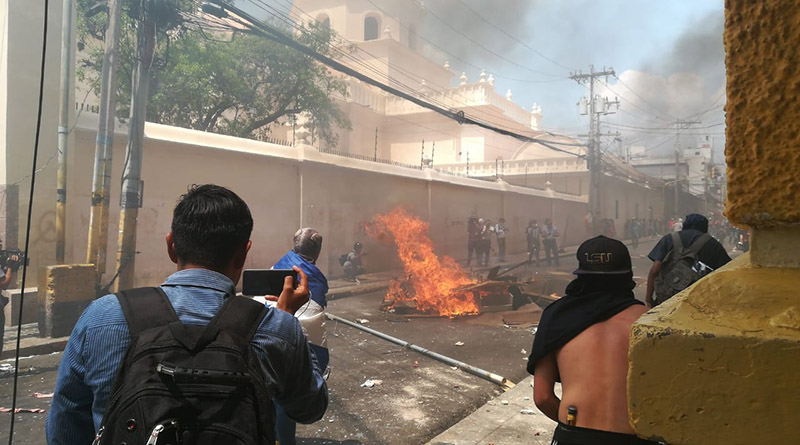
La coordinadora ejecutiva de la Federación Nacional de Estudiantes Secundarios (Fenaes), Tamara Cabello, manifestó este martes que unos 40 mil estudiantes estudiantes están sin clases como consecuencia de la falta de docentes, agravando la crisis en la educación.

“Los estudiantes se están movilizando, incluso mucho antes de que convoquemos a la asamblea. Aproximadamente 40.000 estudiantes están sin clases por la falta de docentes”, manifestó la dirigente estudiantil, en comunicación con la 970 AM.

Sostuvo que las autoridades del Ministerio de Educación y Ciencias (MEC) plantean adelantar los concursos para tratar de solucionar la problemática, pero que los estudiantes no pueden seguir esperando que finalice el proceso y ante esta situación quieren una solución inmediata.

Para el senador Juan Darío Monges, la Cámara de Senadores podría interpelar al ministro de Educación en caso que no se solucione el conflicto. Varias bancadas en la Cámara Alta estarían a favor de interpelar a Petta en caso que siga la crisis por la falta de docentes y otras falencias.

Actualmente cerca de 40 mil estudiantes se encuentran a la deriva por la falta de docentes. Esto ante la jubilación masiva de los educadores y la falta de previsión del MEC. Los jóvenes plantean que los profesionales sean contratados de forma interina para destrabar el conflicto pero hasta el momento no tienen respuesta.

“Queremos saber por qué antes no trataron de solucionar esta situación. Pocas veces vimos e interactuamos con el ministro”, agregó la coordinadora. Los estudiantes anuncian que seguirán tomando colegios hasta tanto haya una solución.

El ministro de Educación es criticado por el propio sector oficialista por no “recibir” a la gente y por varias falencias en su gestión. A esto se suma la falta de docentes en varias instituciones educativas y la “improvisación” en el sistema. Gremios de docentes emplazaron a Petta para destrabar el conflicto.

Fuente: https://www.lanacion.com.py/pais/2019/04/02/cerca-de-40-mil-estudiantes-no-dan-clases-por-crisis-educativa/

Comparte este contenido:

Zygmunt Bauman: “El diálogo real no es hablar con gente que piensa lo mismo que tú”

Por: Daniel R. Esparza. 

El sociólogo y filósofo polaco denuncia que las redes sociales no son una comunidad sino apenas un sustituto

Bauman, nacido en Poznam en 1925, tuvo que emigrar con su familia a la entonces Unión Soviética cuando apenas era un niño, huyendo de la persecución nazi. Nuevamente, en 1968, tuvo que huir del que entonces era su país, escapando de la purga antisemita que siguió al conflicto árabe-israelí. Se radicó temporalmente en Tel Aviv, para luego terminar en Inglaterra, donde hizo carrera en la Universidad de Leeds. En una entrevista relativamente reciente (de enero de este año) con Ricardo De Querol para Babelia, en El País, explica cómo las redes sociales, si bien han cambiado en buena medida la manera las formas tradicionales del activismo social, no son sino un sustituto de la formación de auténticas comunidades.

Ricardo De Querol inicia su pregunta a propósito de las redes sociales citando al propio Bauman, quien señala que el activismo online es “activismo de sofá”, y que la Internet las más de las veces sólo nos “adormece con entretenimiento barato”.  De Querol pregunta, así, si las redes sociales no son, parafraseando a Marx, el nuevo “opio del pueblo”. Bauman no duda en responder que la identidad, como las comunidades, no son algo que se deba crear, sino algo que “se tiene o no se tiene”.

“Lo que las redes sociales pueden crear” –señala el sociólogo- “es un sustituto. La diferencia entre la comunidad y la red es que tú perteneces a la comunidad pero la red te pertenece a ti. Puedes añadir amigos y puedes borrarlos, controlas a la gente con la que te relacionas. La gente se siente un poco mejor porque la soledad es la gran amenaza en estos tiempos de individualización. Pero en las redes es tan fácil añadir amigos o borrarlos que no necesitas habilidades sociales”.

Estas habilidades, señala Bauman en su entrevista con De Querol, se desarrollan en el contacto cotidiano humano directo, en espacios compartidos, sean públicos o privados: en la calle, en los espacios de trabajo, en los que es necesaria una interacción “razonable” con la gente; esto es, en interacciones que exigen de diálogo, negociación y de apertura.

A propósito de ello, Bauman no duda en evocar el hecho de que el Papa Francisco concedió su primera entrevista después de haber sido electo como Sumo Pontífice a un periodista abierta y militantemente ateo, Eugenio Scalfari. “Fue una señal”, señala Bauman: “el diálogo real no es hablar con gente que piensa lo mismo que tú”.

Fuente de la reseña: https://es.aleteia.org/2016/09/07/zygmunt-bauman-el-dialogo-real-no-es-hablar-con-gente-que-piensa-lo-mismo-que-tu/
Comparte este contenido:

School Climate Strikes: Tens of Thousands of Children Skip Class in Third National Action

Europa/ Reino Unido/ 17.04.2019/ Source: rightsinfo.org.

Schoolchildren are on strike for the third time today, with tens of thousands of young people expected to skip class and join one of more than 70 protests happening up and down the country – but campaigners and parents are concerned that some teenagers have been issued with harsh punishments for walking out.

Charities and parents report some local education authorities levying fines on the parents of children who participated in the first and second strikes, while some schools have put protesters in detention. Worryingly, it seems that children at state comprehensives are being penalised disproportionately, while private school pupils are often allowed to strike.

An estimated 50,000 school children took part in strikes in March in more than 150 towns and cities, building on a 15,000 turnout in February. Around the world, more than one million young people took part in a coordinated international action on the same day.

Teenage organisers say today’s #YouthStrike4Climate demonstrations will be bigger and bolder than previous strikes, with more children taking part than ever before and sizeable events planned in most major towns and cities including London, Sheffield, Leeds, Manchester and Brighton.

Image credit: Charlotte England

The group has also officially come out in support of a Green New Deal for the UK – an idea recently popularised in the United States by the Sunrise Movement and outspoken supporter Alexandria Ocasio-Cortez.

Anna Taylor, co-founder of the UK Student Climate Network (UKSCN) said strikers were sending a clear message to politicians that urgent action must be taken on climate change.

“Our futures, the health of our environment and the lives of those around the world already suffering the devastation of the climate crisis are not up for debate,” she said. “We need you to act to protect people and planet, at the same time as creating a better world for everyone. That’s why we’re calling for a Green New Deal in the UK to do just that. We want good and well paid green jobs, a healthy planet and a future to look forward to!”

Young people are also demanding the government declares a state of climate emergency and communicates the severity of the ecological crisis to the general public. Additionally, campaigners want the education system reformed to address climate change as a priority, alongside including youth voices in policy-making and lowering the voting age to 16.

Protests so far have been chaotic and sweary, with children taking aim at Theresa May and the Tories. Last month a handful of students were arrested for blockading Westminster Bridge using similar tactics to direct action group Extinction Rebellion. In general, however, the protests have remained peaceful and been tolerated by the police who often appear reluctant to take action against under 18s. The biggest opposition, it seems, is coming from schools and local education authorities.

Image credit: Charlotte England

The Right To Protest

Campaigners say reports that some parents have been fined for allowing their children to skip school could amount to a breach of their human rights. According to human rights think tank Child Rights International Network (CRIN), some students have been threatened with or given after-school detention for taking part in local strikes, while others have been marked as truant or even suspended.  “These restrictions and penalties are not only unwise,” the group said, “they also interfere with the rights guaranteed to everyone under the age of 18 under the UN Convention on the Rights of the Child (CRC).”

The group continued:

“Under-18s have the same right to free expression as anybody else, a right to seek, receive and impart information and ideas of all kinds. They also have the right to freedom of association and to freedom of peaceful assembly. These rights unquestionably include the right of young students to speak out and protest about climate change, the burden of which will fall most heavily on those who are the youngest among us today.”

The CRC also states that the education of children should include helping them to develop a respect for human rights and fundamental freedoms, in order to prepare them to live responsible lives in a free society. CRIN point out that a school that respects this would support the strikers, arguing “it is a short-sighted school that excludes these lessons from its curriculum by punishing students who engage with their society and its government.”

Image credit: Charlotte England

The CRC has itself applauded students for taking part in the protests, with a UN committee describing the strikes as “desperately needed in today’s political climate of lassitude and decision paralysis”.

Another concerning issue with the punishments levied on some protesters is that parents, teachers and activists are reporting that students at state comprehensives seem to be facing harsher sanctions than students at private schools, who are generally allowed to strike if they have high enough attendance and good grades. This exacerbates a notable problem with children from upper-middle-class backgrounds finding it easier to engage with the strikes.

Jake Woodier, of the UK Youth Climate Coalition (UKYCC), a group of 18-29-year-olds that has been supporting the strikes from the onset, agreed that “kids who come from better off backgrounds or go to more prestigious schools probably do find it easier to engage”. He said that although he believes organisers are working to address this, schools are making it harder for them to do so.

Woodier said he’s heard a couple of reports of state school kids in London being given, or at least threatened with, serious punishments for striking. A teacher at a secondary school, who did not want to be identified, confirmed that this was the case in the London comprehensive school where he worked.

Woodier cited fines, which better off parents are more able to afford even if they are applied to everyone equally, as a particular problem. It’s essential, Woodier said, for the movement is to be representative and harsh sanctions are damaging efforts to include everyone. “If this movement is to be successful it can’t just fall into the trap of age-old environmentalism,” he said, “where it’s primarily been the domain of fairly wealthy middle-class white people”.

According to a report in online magazine the Ecologist last month, some parents have already sought legal advice regarding the fines, with a human rights barrister agreeing the right to protest must not be restricted to those who can afford it.

Woodier echoed this. “Children have the right to go and protest and it shouldn’t just be available to those that can afford to pay,“ he said.

Comparte este contenido:

‘Education and action needed to combat Islamophobia’

Asia/ Turquia/ 17.04.2019/ Source: www.aa.com.tr.

Describing Islamophobia a “very very dangerous threat” not only to Muslims but to all of humanity, a group of scholars on Sunday insisted that Muslims need to educate themselves to fight this growing problem.

At the end of the third day of the Islamophobia international conference hosted by the Centre for Islam and Global Affairs (CIGA) at Istanbul Sabahattin Zaim University, the scholars said that the Muslim community also needs to look within and rectify mistakes.

Elsadig Elsheikh from the University of California said: “There is a need for intervention at multiple levels, including society, education, public policy, and how we tell our story.”

“We need to decolonize ourselves, and there is a need for a lot of work within ourselves and our societies,” he said.

The scholars said that Muslims need to engage with the systems «but with open eyes.”

«We need to display a robust Muslim identity,» said James Carr of the University of Limerick, Ireland.

Luwei Rose Luqui from Hong Kong University said that Muslims in China need to communicate and tell their stories with others in the country.

They should “not just complain and victimize but talk and communicate with people who are not familiar with your situation,” Luqui said about Muslims in China.

Correcting injustice

Khadijah Elshayyal, a researcher working among Muslims in Britain, said that the community needs to rectify mistakes among themselves.

“We have to support and amplify each other’s voices, however, there are injustices and racism [in Muslim community] and that needs to be corrected,” she asserted.

Moreover, she added, Muslims need to extend solidarity with others as well.

Asking scholars to translate their words into action, Shireen Rasheed from the U.S.’ Long Island University said Muslims must also build coalition with other communities.

Varsha Basheer from India said the Muslim community requires structural changes from within.

“Muslims need political power to dismantle the structures of inequality,” Basheer said, referring to India.

“We need power other than the intellect,” she added.

Talip Kucukcan from Istanbul’s Marmara University said a legal framework against Islamophobia is needed. “Otherwise whatever work we do, it will melt down,” he said.

Kucukcan, a former parliamentarian, added: “Politicians need to be involved in raising the issue of Islamophobia.”

The Organization of Islamic Cooperation (OIC) has 57 members, he said, and “this issue need to be raised and nation-states need to be engaged.”

Governments using Islamophobia

Anne Norton from the University of Pennsylvania said people need to protected from “the power of the state,” explaining: “People need to be saved from torture, hunger, separation from their families, and deprivation.”

Sami A. Al-Arian, the Centre for Islam and Global Affairs’s director, said the importance of the conference goes beyond academic interest.

“This conference tried to analyze all different aspects of Islamophobia, specifically the geopolitics and epistemological roots of Islamophobia that are affecting not only the Muslim world at large but Muslim minorities in the U.S., Europe, India and China,” he said.

He added: “We have some governments in the region, in the Muslim world, who are helping Islamophobes and empowering practitioners of Islamophobia in order to fight their own citizens and movements because they are trying to keep their privileges and autocratic regimes.”

He said: “Understanding Islamophobia at every level is important and needs to be confronted at all levels.”

“It is a very very dangerous threat just not to Muslims only but to all of humanity, and we need to educate and then act to confront Islamophobia,” he stressed.

Source of the notice: https://www.aa.com.tr/en/education/education-and-action-needed-to-combat-islamophobia-/1452159

Comparte este contenido:

China ensue education destination for Pakistani students

Asia/ China/ 20.04.2019/ Source: www.technologytimes.pk.


China’s Ministry of Education released the proclamation that China has become the top education destination for international students. A total of 492,185 international students from 196 countries and regions studied in China.

According to a report, South Korea ranked first with 50,600 students and Pakistan ranked third with 28,023 students, followed by Thailand with 28,608 and the United States with 20,996 students.

The number of Pakistani students has risen in China mainly because of a chain of privileged policies offered by the Chinese government after the launch of China Pakistan Economic Corridor (CPEC), a channel project of Belt and Road Initiative.

Pakistani budding aspirants are studying Chinese language, engineering, medical, computer science and various other fields in china. Currently, 6,156 Pakistani students are studying in Ph.D., 3,600 in Masters, 11,100 in Bachelors and 3,000 in Short Term Exchange Programs across China.

Pakistani students take part in cultural activities organized by different universities across China. Pakistani students represent the country by setting up booths with traditional Pakistani stuff that depicting different social and cultural activities and historical places in Pakistan.

Source of the notice: https://www.technologytimes.pk/china-education-destination-pakistani/

Comparte este contenido:

Special-needs children lose out on £1.2bn of support, says union

Europa/ United Kindow/ 16.04.2019/ Source: www.theguardian.com.


Children in England with special educational needs and disabilities (Send) have lost out on £1.2bn worth of services because government funding has failed to keep pace with soaring demand for additional support over the past four years, according to an analysis.

The number of children and young people with an education, health and care plan, a legal document detailing a child’s entitlement to support for special needs, has risen from 240,000 to 320,000 since 2015 – an increase of 33% – according to research by the National Education Union (NEU).

Yet central government funding paid into the “high-needs block” of councils’ education budgets to cover Send provision has only increased by 7% over the same period, from £5.6bn to £6bn in today’s prices, the NEU says, resulting in “massive” funding shortfalls in nine out of 10 local authorities.

As a result, families have endured increasing waiting times for Send assessments and cuts to specialist provision and support staff. In response, families have turned to tribunals to fight councils for their children’s rights to additional provision and are winning in the vast majority of cases.

A number of parents have also taken local authorities to the high court over Send funding decisions, and in June the government will find itself in court when its Send funding policy will be examined in a landmark judicial review.

The crisis in Send provision will be discussed during the NEU’s annual conference, which opens in Liverpool on Monday. Kevin Courtney, the union’s joint general secretary, said: “The funding shortfall for Send provision comes against the backdrop of the swingeing cuts to local authority budgets imposed by the Westminster government over the last nine years, which have left many councils on the brink.”

Courtney said that between 2010 and 2020, councils will have lost almost 60p out of every £1 the government once provided for Send services. “This is an appalling way to be addressing the education of some of our most vulnerable children and young people and is causing untold misery and worry for thousands of families.”

One of the key reasons for increased demand, and cost, is the extension of education, health and care plan provision to include young people with additional needs aged 19-25. Campaigners also highlight the drift of Send pupils away from mainstream schools to more expensive special school settings, accusing some of failing to be inclusive, either because of funding or accountability pressures.

Angela Rayner, the shadow education secretary, said: “Education is a right, not a privilege, and these cuts mean that in one of the richest countries in the world children with special educational needs are not receiving the support they need.”

Nadhim Zahawi, the minister for children and families, said it was wrong to imply that funding had been cut and that the government had increased spending on high needs from £5bn in 2013 to £6.3bn this year.

“We recognise the challenges facing local authorities and in December provided an extra £250m up to 2020 to help them manage high-needs cost pressures. We have also provided councils with an extra £100m funding to create more Send places in mainstream schools, colleges and special schools.”

Source of the notice: https://www.theguardian.com/education/2019/apr/15/special-needs-children-lose-out-on-12bn-of-support-says-union
Comparte este contenido:
Page 2033 of 6178
1 2.031 2.032 2.033 2.034 2.035 6.178