Page 2701 of 6195
1 2.699 2.700 2.701 2.702 2.703 6.195

Paraguay: 6 de cada 10 niños no terminan la secundaria

América del Sur/Paraguay/Fuente: Paraguay

‘Preguntale a tu candidato’, la campaña de UNICEF para garantizar las políticas públicas para la educación, reveló datos alarmantes en Paraguay.

La educación paraguaya sigue presentado datos verdaderamente alarmantes, ya que un 80 por ciento de los jóvenes del país no logran acceder a un plan educativo, ya sea por los escasos recursos con los que cuenta o por la falta de infraestructuras educativas en las zonas en las que viven. De la misma forma, 6 de cada 10 niños no terminan los estudios secundarios.

Estos datos fueron expuestos en el marco de la campaña ‘Preguntale a tu candidato’, que fue realizada por el Fondo de las Naciones Unidas para la Infancia (UNICEF), en donde también se trataron proyectos de políticas públicas, con respecto a la educación de nuestro país.
Esta misma campaña fue realizada en Perú y en Uruguay, donde los resultados fueron fructíferos. Los panelistas que participaron de este debate y seminario fueron algunos exministros de educación de ambos países.
El ministro de Educación de nuestro país, Raúl Anguilera, que también estuvo presente en la plenaria, indicó que la solución más rápida a esta situación en tener un mayor presupuesto dirigido exclusivamente a los proyectos educativos.
TODOS LOS DETALLES EN EL VIDEO:

Fuente: http://www.paraguay.com/nacionales/6-de-cada-10-ninos-no-terminan-la-secundaria-175678

Comparte este contenido:

Arranca la III Edición de los premios “Innovación Educativa en MOOCs 2018”

Por: rrhhdigital.com/ 28-03-2018

Miríadax, primera plataforma iberoamericana de MOOCs (cursos on line, abiertos y masivos) en español y portugués, impulsada por Telefónica Educación Digital, convoca la III edición de los premios“Innovación Educativa en MOOCs 2018” con el objetivo de reconocer y fomentar la difusión del conocimiento en abierto, así como impulsar la transformación digital en el ámbito universitario. Dicho premio cuenta colaboración de la SEGIB, Secretaría General Iberoamericana.

Podrán participar todos aquellos docentes o equipos docentes de cualquier universidad o institución, que ya estén adheridas a Miríadax, y que presenten cursos nuevos (primera convocatoria) obteniendo especial reconocimiento aquellos que emitan certificados de acreditación académica de la institución y que finalicen antes del 28 de septiembre de 2018.El plazo de presentación de candidaturas finaliza el 7 de mayo de 2018.

La dotación de los premios asciende a 18.000 euros distribuidos entre las cuatro categorías que se han determinado: un primer premio, de 10.000 €, un accésit, de 4.000 €, dos menciones especiales de 1.500 € y cuatro reconocimientos de 250 €.

El jurado, compuesto por destacadas figuras del ámbito universitario, fallarán los premios el 19 de noviembre y pondrán especial énfasis en valorar la originalidad y capacidad de la propuesta para transmitir con rigor y claridad los contenidos; la utilización práctica de los materiales de apoyo a los contenidos multimedia; su accesibilidad; la dinamización de los foros; el número de participantes; la acreditación académica del curso, y la temática recibiendo especial puntuación aquellos MOOCs relacionados con la enseñanza de Idiomas, Desarrollo Local Sostenible, Smart Cities, Educación Digital, Empleo, Hostelería, Aeronáutica, Logística, Agroindustria, Salud, Audiovisual y Tecnología.

Nuevo servicio para el sector corporativo: el Espacio Empresas

Apostar por la cultura del aprendizaje continuo es una de las premisas que nos impone la revolución digital, los cambios cada vez son más rápidos y el conocimiento es un factor de competitividad para las empresas y las personas.

Por este motivo, desde Miríadaxse ha querido dar un paso más y abrir su foco al sector corporativo, ofreciendo la posibilidad de contar con su propio espacio dentro de la plataforma. Además de acceder al amplio catálogo de contenidos, más de 700 MOOCs de 100 universidades, a través de este espacio podrán disponer de servicios de administración y monitorización como invitar a nuevos usuarios, asignarles cursos disponibles, generar reportes de seguimiento individualizado, e incluso incentivar la finalización de la formación a través de descuentos en los Certificados de Superación como evidencia de los conocimientos adquiridos.

*Fuente: http://www.rrhhdigital.com/secciones/formacion/129929/Arranca-la-III-Edicion-de-los-premios-%E2%80%9CInnovacion-Educativa-enMOOCs-2018%E2%80%9D

Comparte este contenido:

EEUU: Apple’s Plans To Win Back The U.S. Education Market May Be Too Little Too Late

Por: forbes.com/Susan Adams/28-03-2018

At an hour-long event staged in a Chicago public high school auditorium this morning, Apple said it would introduce lower-priced devices and initiatives aimed at regaining market share at America’s schools.

The company will offer a new 9.7-inch iPad that will be compatible with its Pencil drawing stylus, which previously only worked on the higher-priced iPad Pro. Last year Apple dropped the price it charges schools for the low-priced tablet to $299, a reduction of $30 from the consumer price. Today Apple also announced that Logitech, a Swiss company that makes computer accessories, will introduce a $49 drawing stylus that can substitute for Apple’s $99 Pencil.

Since 2012, Apple has lost its grip on the educational hardware market for students in kindergarten through 12th grade. According to a report by U.K.-based Futuresource Consulting, which sells its market research studies to Apple and other tech firms, in 2012 Apple sold 52% of all mobile computing products to K-12 schools in the U.S. But last year Apple had only 15% of that market. Chromebooks made by Samsung, Acer, and other manufacturers are now the dominant players, with 58% of the market last year. Windows machines trailed in second place at 22%.

Courtesy: Futuresource

Apple’s share of the education hardware market has shrunk since 2012.

Future source doesn’t break out the value of the K-12 education hardware market but its research shows that school spending on all information technology products, including hardware, software, information technology services and assessments totaled $18 billion in 2017.

Why has Apple’s popularity taken such a hit? Four reasons: Its devices have cost more than twice as much as competitors’, its batteries didn’t last as long, iPads lack the keyboards viewed by teachers as essential to writing instruction, and Apple’s computing environment does not live mainly in the cloud. By contrast, students working on cloud-based Chromebooks can use any machine to get access to their work and administrators can easily implement systemwide changes from a dashboard on a single computer. And Chromebooks sell for as little as $149.

At the Chicago event today, Apple announced several new education apps. It is introducing a tool called Schoolwork, which will make it possible for teachers to give digital handouts to students, including notes, PDFs, and web links. One of Schoolwork’s selling points is privacy. Only teachers will be able to see students’ data. But Google also promises privacy for student information and it’s not clear whether Apple’s system is more secure. Schoolwork will launch in June. Apple is also updating its Pages word processing app, which will allow teachers and students to make books together using handwritten notes, photos, videos and drawings using pre-made templates.

*Fuente: https://www.forbes.com/sites/susanadams/2018/03/27/apples-plans-to-win-back-the-u-s-education-market-may-be-too-little-too-late/

Comparte este contenido:

Nicaragua: Canitel sobre redes sociales: “se necesita una alfabetización digital”

Centro América/Nicaragua/Fuente: Confidencial

Expertos coinciden en que se debe debatir el bueno uso del Internet

Canitel sobre redes sociales: “se necesita una alfabetización digital”

ProtestaRedes

“Más que regular el Internet lo que se debe es hacer leyes para proteger a los usuarios”, asegura especialista en seguridad digital

El escándalo que afecta a Facebook, por el uso de datos privados de sus usuarios por parte de la empresa Cambridge Analytica, para influir en campañas electorales, en particular en la que acabó con la victoria electoral de Donald Trump en Estados Unidos, ha generado alarma mundial. Y en Nicaragua, la noticia llega cuando se debate la propuesta oficial de regular las redes sociales con el argumento de “proteger a la familia”.

Para el presidente de la Cámara Nicaragüense de Internet y Telecomunicaciones (Canitel), Hjalmar Ayestas, lo más importante es que exista una “alfabetización digital” para que los usuarios nicaragüenses den un buen uso al Internet.

“Hay dos alternativas: la primera es preparar a las personas sobre el uso de Internet, que sepan que es lo bueno y lo malo, porque cuando se creó el Internet no vino con un manual de cómo utilizarlo y hay que preparar a las personas para que sepan sacarle el jugo a esta herramienta. La otra opción es permitir primero una fórmula de autorregulación”, precisó Ayestas durante su participación en el programa televisivo Esta Noche.

La vicepresidenta Rosario Murillo convocó a un “debate nacional”, que la Comisión de la Familia dirige a puerta cerrada en la Asamblea Nacional. El objetivo, afirman, es “actualizar” leyes penales para “proteger a la niñez y a la familia”.

Sin embargo, los expertos aseguran que lo primordial es que los usuarios sepan utilizar las herramientas digitales.

“En el caso de Nicaragua el debate se está enfocando en los valores, pero no hay un debate sobre cómo estas redes sociales están usando nuestros datos y no es solo Facebook si no todas las demás plataformas. El debate se está manejando más en lo moral que en las aplicaciones técnicas”, comentó Rodrigo Peñalba, experto en marketing digital.

No se puede censurar Internet

Ayestas indicó que desde Canitel la prioridad es buscar “la accesibilidad de todos los nicaragüenses al Internet” porque “ahí está la mayor biblioteca del mundo que existe”.

En ese sentido, insistió que la prioridad debe ser la educación digital desde los colegios y las universidades porque “ponerle cortapisas” al acceso a Internet podría más bien “afectar la accesibilidad que puedan tener las personas”.

Por su parte, el experto en seguridad informática, Norman García, expresó que el Internet hoy en día es primordial para la vida de las personas y se debe trabajar para que le puedan sacar el mejor provecho a esta herramienta.

Mencionó que en algunos países de América Latina se está creando un marco jurídico para proteger a los usuarios del Internet, con leyes de protección de datos y de ciberseguridad porque la solución “no es regular” el Internet.

Fuente: https://confidencial.com.ni/se-necesita-una-alfabetizacion-digital/

Comparte este contenido:

Thompson hosts northernmost March For Our Lives event in Canada

Por: thompsoncitizen.net/Kyle Darbyson-Thompson Citizen/28-03-2018

While the crowd size didn’t compare to the hundreds of thousands who converged on Washington, D.C., Thompson’s March For Our Lives event still managed to attract a small but dedicated group of participants.

Just like the other 845 sibling marchers that took place throughout the globe March 24, this local walk, which began at R.D. Parker Collegiate, was designed to stand in solidarity with victims of gun violence in the United States.

Given that this was the northernmost March For Our Lives event to take place in Canada, the three-kilometre loop around Thompson Drive and Cree Road was littered with ice and snow.

Thankfully, the over 50 students, parents, teachers and volunteers who showed up for this event all dressed appropriately for the weather and completed the route without any traffic-related incidents.

Of course, this worldwide movement against gun violence in the U.S. largely kicked off in the wake of the Marjory Stoneman Douglas High School shooting in Parkland, Florida on Feb. 14, which left 17 dead.

Much like the how the Stoneman Douglas students spearheaded the central rally in the American capital, a local high school group from RDPC was responsible for organizing the only March For Our Lives event to take place in Manitoba.

Even though this group, Students Offering Support (SOS), normally focus their mental health awareness campaigns on their own school, on Saturday they shone a light on the struggles of students south of the border.

“The students in the U.S. are exhausted, and they do not want one more child to be shot at school,” said SOS member Hayley Jenkins just before the start of Saturday’s march.

“They do not one more teacher to make the choice to jump in front of a firing assault rifle to save the lives of students … they are taking charge and we are supporting them because we must stop letting this become the normal.”

While some have been quick to dismiss a movement that is largely lead by teenagers, SOS member Rishwan Dherdi reminded everybody at the March 24 rally that this campaign has already managed to garner some results.

Not only did the Florida State Senate recently raise the legal age to buy a firearm from 18 to 21, but they’ve also banned the sale or possession of bump stocks, attachments that allow a semi-automatic rifle to fire at a quicker rate.

Fellow SOS member Lala Rukh also mentioned that these students who are marching in the U.S. will be able to transform all this rhetoric into votes in a very short time.

“Those students, who will be 18 as of November of this year, are registering right now to be able to vote for the mid-term election and select their members of Congress,” said Rukh. ”These students are also reminding President Trump and his government that they will be the ones selecting the new [president] in 2020 in the new election.”

After finishing the march on Saturday, School District of Mystery Lake trustee Leslie Tucker echoed her comments from a March 13 school board meeting by saying that she was immensely proud of the youth activism on display here in Thompson and around the world.

In fact, Tucker said that the last time she witnessed student-led activism on this scale was during the South African Anti-Apartheid Movement.

“I remember being much younger, because that was a long time ago, and just fighting and fighting and fighting and eventually it changed,” she said. “So that’s what we do here. It might not change overnight for Americans with respect to gun control, but the pressure has to be put on.”

*Fuente: http://www.thompsoncitizen.net/news/thompson/thompson-hosts-northernmost-march-for-our-lives-event-in-canada-1.23214050
Comparte este contenido:

New Study: Less Expensive Competency-Based Education Programs Just As Good As Traditional Programs

Por: Forbes.com/Tom Lindsay/28-03-2018

College students and their parents find it increasingly difficult to cope with tuition hyperinflation and historically high student-loan debt. Over the last 30 years, the average tuition for a U.S. bachelor’s degree at a traditional four-year college increased more than 15 times faster than the average household income in the United States. Students who borrow graduate with an average of $27,000 in student loans. Student loan defaults slow economic growth by limiting access to credit, stifling entrepreneurship, and reducing long-term buying power.

In an effort to address this crisis, we at the Texas Public Policy Foundation commissioned Goldman Insights (Joseph Goldman, Phoebe Long, and Lillian Leone) to study of the possibilities of an alternative to traditional higher education—competency-based education (CBE). Under CBE, students earn their degrees by demonstrating their skills and knowledge in required subjects through a series of assessments. As with traditional education, they take tests and write papers; unlike traditional education, CBE degrees do not focus on “seat time” or credit hours. Rather, CBE degrees aim to certify that all its graduates are competent in their fields at or beyond a specific standard. Competency-based bachelor’s degree programs offer an alternative for nontraditional students who may not have the time or resources to complete a four-year program yet still desire a rigorous, meaningful education.

In order to develop a robust understanding of different fields within CBE, we analyzed graduates of three different competency-based programs in teaching, nursing, and organizational leadership.

What we found bodes well for students, especially those from lower-income backgrounds.

 The first paper published from the Competency-Based Education: Graduate Outcomes Study (CBE GO, I) is titled, “Career and Financial Outcomes of Graduates of Competency-based Higher Education Programs.” In it, we surveyed graduates from two leading competency-based courses of study, the Associate Degree in Nursing (ADN) from an anonymous university (Institution X) and the Bachelor of Arts degree from the Teachers College at Western Governors University (WGU). We measured the career and financial outcomes of these graduates with those from other comparable traditional nursing and teaching programs. In addition, we interviewed graduates of South Texas College’s (STC) CBE degree in Organizational Leadership to gauge their experiences and career outcomes.

The findings of the first part of our CBE study suggest that CBE degree programs such as the Associate Degree of Nursing at Institution X and the BA degree at WGU’s Teachers College may be financially more attainable for students from a lower socio-economic background, thus opening the door for more Americans to pursue registered nurse (RN) and teaching credentials.

With regard to the CBE program in nursing (Associate Degree of Nursing), Institution X graduates were assessed using a modified version of the Work Readiness Scale, developed by Arlene Walker of Deakin University. They were also asked grit-related questions developed by Dr. Angela Duckworth as a part of her Short Grit Scale. Institution X graduates scored significantly higher in all areas, including social intelligence, organizational acumen, work competence, personal management, grit, and work readiness overall. Non-Institution X graduates surveyed who borrowed money accumulated 2.3 times more debt during their nursing education than Institution X graduates.

Interestingly, although fewer graduates from Institution X received financial assistance toward their tuition, more graduated debt-free than non-Institution X graduates.

*Fuente: https://www.forbes.com/sites/tomlindsay/2018/03/27/new-study-less-expensive-competency-based-education-programs-just-as-good-as-traditional-programs/#50a8c557674d

Comparte este contenido:

UNICEF: Children’s education latest victim of Yemen conflict

Por: news.un.org/ 28-03-2018

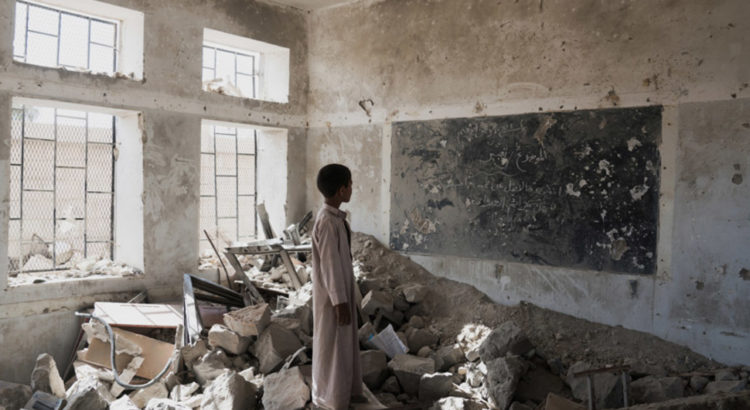
Yemen’s education system has been devastated by the country’s brutal conflict, the United Nations Children’s Fund (UNICEF) said on Tuesday, reporting that at least half a million children have dropped out of school since the 2015 escalation of the war.

“An entire generation of children in Yemen faces a bleak future because of limited or no access to education,” said Meritxell Relaño, UNICEF Representative in Yemen. “Even those who remain in school are not getting the quality education they need.”

According to “If Not In School,” the total number of out-of-school children now stands at 2 million, and almost three quarters of public school teachers have not been paid their salaries in over a year, putting the education of an additional 4.5 million children at grave risk.

An entire generation of children in Yemen faces a bleak future because of limited or no access to education.

More than 2,500 schools are out of use, with two thirds damaged by attacks, 27 per cent closed and 7 per cent used for military purposes or as shelters for displaced people.

Children risk being killed on their way to school. Fearing for their children’s safety, many parents choose to keep their children at home.

The lack of access to education has pushed children and families to dangerous alternatives, including early marriage, child labour and recruitment into the fighting.

UNICEF appeals to the warring parties, those who have influence on them, government authorities and donors to put an end to the war, pay teachers, protect children’s education unconditionally, and increase funding for education.

On 26 March 2015, a coalition of countries led by Saudi Arabia intervened militarily at the request of President Abd Rabbuh Mansour Hadi to secure the return of the Government to Sana’a, which had been seized by Houthi militias and allied units of the armed forces when the conflict initially erupted in 2014.

Three years on, the fighting is still raging and the ensuing humanitarian crisis has only deepened in a country that was already one of the region’s poorest.

The UN, through its envoy, has been engaged in helping Yemenis to find a peaceful solution.  UN agencies and partners are also on the ground to deliver life-saving aid.

Learn more about the findings of If Not In School here.

*Fuente: https://news.un.org/en/story/2018/03/1006051

Comparte este contenido:
Page 2701 of 6195
1 2.699 2.700 2.701 2.702 2.703 6.195