Page 3144 of 6179
1 3.142 3.143 3.144 3.145 3.146 6.179

EEUU: CEOs say county budget should focus on transportation, education

EEUU/October 31, 2017/Source: http://www.miamiherald.com

This week’s question to the Miami Herald CEO Roundtable: In your opinion, what areas should commissioners focus on as they iron out the 2018 county budget?

==========

The commissioners should focus on providing the necessary services to meet the needs of the county, while being fiscally responsible to minimize or avoid a tax increase altogether. A tax increase will burden every homeowner in the county and impact the local economy. This requires that some tough decisions be made regarding spending for the greater good of the county residents.

Miami must decide if it wants to be a global center, or a provincial town. Public transportation is key to that, and needs to be supported. And, as South Florida’s premier provider of therapy to special needs children, I would be remiss without stressing we cannot forget those who rely on the government for help.

Maria Arizmendi, behavior analyst and president, Progressive Behavioral Science

Allocating funds and developing a comprehensive plan to significantly improve the county’s infrastructure, affordable housing and education should be top priorities. It is always easier to address our short-term, immediate needs. However, we should be working on a 25-year plan and budget to make us a more sustainable community. We need a long-term vision to secure a stronger and healthier city for our children and grandchildren in terms of infrastructure, education, social services and land planning. Today, let’s start envisioning the plan for Miami 2050 and strive each year to make our city greater, not just for ourselves, but for the generations to come.

Noah Breakstone, founder and managing partner, BTI Partners

==========

Transportation, transportation and transportation! The No. 1 complaint I hear about local government is the apparent inability to adequately address the increasingly dire state of transportation here in South Florida. A large part of the downtown Miami workforce relies on the Metrorail system to get to work. The system is not working. It now sometimes takes as much as 1 1/2  to 2 hours each way on Metrorail to get to and from downtown Miami from affordable suburbs due to breakdowns, crowded trains and inadequate scheduling. The Miami downtown business community cannot survive and prosper without the large workforce that commutes from affordable suburbs using Metrorail. There is no other viable form of transportation for a large part of the downtown Miami workforce that lives in these suburbs. For those who live closer to downtown Miami and drive to work, commute times are also dramatically increasing. Substantially greater resources should be committed on an urgent basis for modern systems to coordinate traffic signals and improve traffic flows.

Bowman Brown, partner and chairman of the Executive Committee and the Financial Services Practice Group of Shutts & Bowen

==========

K-12 education! Our schools should have enough money and resources to prepare our students for the real world. Our training in school really shapes the kind of business professional we will be in the future. Businesses need employees that can, at a minimum, communicate effectively! Without enough funds and resources going to education, we will all be impacted.

Patricia Elizee, managing partner, Elizee Law Firm

==========

Education, hands down. I’ll keep beating this drum because our students deserve a higher quality education and more opportunities. Create a strong foundation and you can build anything. This is not only a moral issue. If we allow our community’s future workforce to wither, our community will wither, too.

Richard Fain, chairman and CEO, Royal Caribbean Cruises Ltd.

==========

Theirs is a difficult job as they plan for present needs and future requirements. Infrastructure and environmental issues need to be addressed. Also, they must ensure an updated disaster plan is developed.

Jeffrey Freimark, president and CEO, Miami Jewish Health

==========

In light of the recently concluded TRIM and budget hearings in Miami-Dade, it’s clear that a strong transportation system and a robust pool of available housing — at all economic levels — are two things the county must have in order to be considered a competitive candidate for new business. Amazon, for example, recently announced plans to establish its second headquarters in North America, bringing with it 50,000 high-paying jobs, thousands of construction and operational positions, and billions of dollars in additional investment to the surrounding communities. Direct access to mass transit and a range of housing options are at the top of the company’s requirement list.

James Haj, president and CEO, The Children’s Trust of Miami-Dade County

==========

Three areas high on my list are transportation and transportation infrastructure, economic and business development, and the county’s emergency management plan. It’s important to review the emergency management plan within a budget context to ensure it addresses what we learned from Hurricane Irma, what Houston learned from Hurricane Harvey, and what the first responders and citizens of Puerto Rico are, unfortunately, learning following Hurricane Maria.

Bob Hohenstein, president and CEO, Miami-Dade County Youth Fair and Exposition

==========

Commissioners should focus on building a resilient community, improving our infrastructure and methods of communication to allow for energy and water resiliency as we continue to deal with these environmental disturbances. As a community, we should look to new development to grow our property taxes and start allocating more funds towards infrastructure improvements and rethinking the planning of our neighborhoods.

David Martin, president and co-founder, Terra

==========

I spent several days assisting relief efforts after Hurricane Irma — handing out ice and supplies to those in need. I was surprised and saddened by the poor living conditions at many of the housing communities in places like the West Grove, Overtown, Allapattah and Liberty City. We need more code enforcement at privately owned properties, as well as capital improvements at county-owned housing communities. It’s up to our elected officials to ensure that our residents are living in adequate conditions that don’t pose a health risk.

Aabad Melwani, president, Rickenbacker Marina, and managing principal, Marina PARC

==========

I have to admit I have not been monitoring the Miami-Dade County budget discussions because I reside in Broward County. However, I was glad to see that there was some focus on early childhood education. Research shows that a high quality early childhood education has a lifetime of benefits including narrowing, or even eliminating, achievement gaps.

Avis Proctor, vice president of academic affairs and president, North Campus at Broward College

==========

Affordable housing needs to be the top priority for commissioners in 2018. Miami has been one of the hardest-hit cities in the nation by the current affordable housing crisis. Low-income individuals, families and seniors are not the only ones to suffer — we all take a hit. A shortage of affordable and workforce housing poses a tremendous obstacle to our continued ascension into a preeminent world city. It limits our ability to attract major businesses to the area that can create well-paying jobs. It eats into our budget for goods and services that help keep our local economy vibrant. The economic impact is quite extensive, so the 2018 budget needs to focus on much greater allocation of available resources to affordable and workforce housing.

Source:

http://www.miamiherald.com/news/business/biz-monday/article180742331.html

Comparte este contenido:

Malaysia: Free education not practical’

Malaysia/October 31, 2017/Source: http://www.theborneopost.com

Higher Education Minister Datuk Seri Idris Jusoh yesterday urged the public not to be influenced by the opposition’s promises of introducing free education in the country as this was not practical and difficult to implement.

He said the opposition had always been trumpeting on offering free education and they should have  implemented it in Selangor through the state-owned Universiti Selangor (Unisel).

“I challenge them to implement free education at Unisel first, they did implement it before but it failed and the National Higher Education Fund Corporation (PTPTN) had to step in,” he told reporters after the launch of Big Data Lab and opening of a new building at Universiti Teknologi Mara (UiTM) Kota Bharu campus here yesterday.

Idris said the fees charged to students here were not high and were among the lowest in Asia.

“This is because over 90 per cent of current academic fees charged by public universities has been subsidised by the government, “ he said.

He said the government was also helping students by providing various loan facilities such as loans from PTPTN, scholarships or sponsorship from various agencies including the Public Service Department.

In the 2018 budget presented by Prime Minister Datuk Seri Najib Tun Razak last Friday, RM2.2 billion scholarship allocation was announced to boost higher education. — Bernama

Source:

‘Free education not practical’

Comparte este contenido:

Nigeria: Government To Stop Free Secondary School Education

Nigeria/October 31, 2017/Source: http://www.informationng.com

Indications emerged on Sunday that the Ondo State government is set to discontinue free education at the Secondary Schools level across the state.
The decision was contained in a communique issued by the over 2,000 stakeholders who converged on the International Culture and Events Center (DOME), Akure, for a two-day education summit in the state.
Governor Oluwarotimi Akeredolu, who declared the event opened last Thursday, had assured the participants of the summit that the government will enforce any decision taken at the end of the summit.
He urged participants to deliberate in line with the current economic realities and sustainability. According to the communique which was handed to reporters by the summit’s media and publicity chairman, Kunle Adebayo, stakeholders at the summit resolved that “Government should fund education at the Primary school level while parents should be responsible for the education of their children at the Secondary and Tertiary levels”.
The summit also resolved that automatic promotions should be cancelled in the Secondary Schools, stressing that the joint SSS 2 examination must be reintroduced to present qualified students for the Senior Certificate Examination.
The communique read in part, “That the issue of Education funding is too important to be left in the hands of Government alone if we must achieve functionality in education. It must be the business of all stakeholders.
 
“That there should be a review of chargeable fees in State’s tertiary institutions in line with the needs of each school and current economic realities.
 
“That the issue of return of schools to their original owners requires further engagement amongst stakeholders in order to arrive at amicable and workable solution.
 
“That State Government; International Development Patners; Non Govermental Organisations;and spirited individuals should collaborate in the training and retraining of teachers; school Administators/Education Managers in order to update their knowledge on contemporary issues on education “.
The summit also resolved that renovation and reconstruction of dilapidated school structures must not be left in the hands of government alone.
It recommended that Philanthropists, Old Students Association, PTA and Corporate Organizations should also intervene in such projects.
“That Mega schools in the State should be put into more functional,optimal and better use by government to address the current state of underutilization of some of them
 
“That Examination Ethics and Disciplinary Committee should be strengthened in the Ministry and schools to checkmate incidences of examination malpractice.
 
“That a measurable parameter should be designed for the promotion of teachers while Teachers Biometric Attendance device should be designed to monitor their class attendance and enhance productivity.
 
“That the Ministry should reinvigorate co-curricular activities in schools while craft work and school gardens should be revived in all schools ” the communique read.

Source: Tori

Source:

Government To Stop Free Secondary School Education

Comparte este contenido:

Ghana: World Bank warns of ‘learning crisis’ in global education

Ghana/October 31, 2017/By Iddi Yire/Source: http://www.ghananewsagency.org

Millions of young students in low and middle-income countries face the prospect of lost opportunity and lower wages in later life because their primary and secondary schools are failing to educate them to succeed in life.

Warning of ‘a learning crisis’ in global education, a new Bank report said schooling without learning was not just a wasted development opportunity, but also a great injustice to children and young people worldwide.

The World Development Report 2018: ‘Learning to Realise Education’s Promise’, which was made available to the Ghana News Agency, argues that without learning, education will fail to deliver on its promise to eliminate extreme poverty and create shared opportunity and prosperity for all.

It said even after several years in school, millions of children cannot read, write or do basic math and the learning crisis was widening social gaps instead of narrowing them.

It said young students who were already disadvantaged by poverty, conflict, gender or disability reach young adulthood without even the most basic life skills. “This learning crisis is a moral and economic crisis,” World Bank Group President Jim Yong Kim said.

“When delivered well, education promises young people employment, better earnings, good health, and a life without poverty. For communities, education spurs innovation, strengthens institutions, and fosters social cohesion. But these benefits depend on learning, and schooling without learning is a wasted opportunity. More than that, it’s a great injustice: the children whom societies fail the most are the ones who are most in need of a good education to succeed in life.”

The report recommended concrete policy steps to help developing countries resolve this dire learning crisis in the areas of stronger learning assessments, using evidence of what works and what doesn’t to guide education decision-making; and mobilise a strong social movement to push for education changes that champion ‘learning for all.’

According to the report, when third grade students in Kenya, Tanzania, and Uganda were asked recently to read a sentence such as “The name of the dog is Puppy” in English or Kiswahili, three-quarters did not understand what it said.

It said in rural India, nearly three-quarters of students in grade three could not solve a two-digit subtraction such as “46 – 17”—and by grade five, half still could not do so.

It said although the skills of Brazilian 15-year-olds had improved, at their current rate of improvement they would not reach the rich-country average score in maths for 75 years; adding that in reading, it would take 263 years.

It said these statistics do not account for 260 million children who, for reasons of conflict, discrimination, disability, and other obstacles, were not enrolled in primary or secondary school.

It said while not all developing countries suffer from such extreme learning gaps, many fall far short of levels they aspire to.

It noted that leading international assessments on literacy and numeracy show that the average student in poor countries performs worse than 95 per cent of the students in high-income countries—meaning such a student would be singled out for remedial attention in a class in those countries.

It said many high-performing students in middle-income countries, young men and women who achieve in the top quarter of their group would rank in the bottom quarter in a wealthier country.

The report, written by a team directed by World Bank Lead Economists, Deon Filmer and Halsey Rogers, identifies what drives these learning shortfalls, not only the ways in which teaching and learning breaks down in too many schools, but also the deeper political forces that cause these problems to persist.

The report noted that when countries and their leaders make “learning for all” a national priority, education standards can improve dramatically.

It cited that, from a war-torn country with very low literacy rates in the 1950s, South Korea achieved universal enrollment by 1995 in high-quality education through secondary school, its young people performed at the highest levels on international learning assessments.

It said Vietnam’s 2012 results from an Organisation for Economic Co-operation and Development (OECD) test for high school students in maths, science, and reading called the Programme for International Student Assessment (PISA), showed that its 15-year-olds performed at the same level as those in Germany—even though Vietnam is a much poorer country.

“The only way to make progress is to ‘find truth from facts.’ If we let them, the facts about education reveal a painful truth. For too many children, schooling does not mean learning,” said World Bank Chief Economist, Paul Romer.

Relying on evidence and advice gathered during extensive consultations in 20 countries, with governments, development and research organisations, CSOs, and the private sector.

The report offers three policy recommendations: firstly, it calls for assess learning, so it could become a measurable goal; secondly, it recommends making schools work for all children and thirdly mobilising everyone who had a stake in learning.

“Developing countries are far from where they should be on learning. Many do not invest enough financial resources and most need to invest more efficiently. But it is not only a matter of money; countries need to also invest in the capacity of the people and institutions tasked with educating our children,” said Jaime Saavedra, World Bank’s Senior Director for Education.

Source:

http://www.ghananewsagency.org/education/world-bank-warns-of-learning-crisis-in-global-education-124220

Comparte este contenido:

Una nueva ley desata la polémica en Dinamarca: los profesores podrán revisar los portátiles de los alumnos

Dinamarca/30 octubre 2017/Fuente: Las Provincias

Les permitirá inspeccionar el contenido de los dispositivos, como el historial de búsqueda o el registro. Las críticas no se han hecho esperar debido a la «poca claridad» de los límites.

La evolución de la tecnología ha llegado a las aulas, y cada vez es más común encontrar alumnos que utilizan portátiles o tablets en el colegio. Sin embargo, la presencia de los dispositivos tecnológicos en las salas de clase también ha traído consigo el debate sobre si se cubre una necesidad real o simplemente se proporciona a los alumnos más facilidad a la hora de hacer trampas.

La polémica esta servida y ha saltado a la palestra con una nueva ley danesa, todavía en fase de borrador, por la cual los profesores podrían revisar los portátiles de los alumnos. Según publica el diario danés ‘DR.dk‘, el texto establece que la escuela debe poder acceder a información de los estudiantes almacenada sus dispositivos, como el historial de búsqueda y los archivos de registro, o consultar su actividad en redes sociales o Internet. Las protestas en Dinamarca no se han hecho esperar, pues los críticos denuncian que el borrador no deja claro cuáles son los límites.

«Ceder o hacer frente a las consecuencias»

Aunque el texto especifica que los colegios no podrán obligar a los alumnos a entregar los dispositivos para que sean revisados, y que es el propio alumno el que deberá dar su consentimiento, si contempla posibles reacciones ante la negativa del estudiante. Si se niegan podrán ser sancionados o castigados: sus ordenadores podrán ser confiscados durante 24 horas e incluso podrían llegar a ser expulsados de la escuela. Este es el principal argumento de los detractores, que aseguran que se obliga a los alumnos a «ceder o enfrentarse a las consecuencias», sobre todo para aquellas familias que no puedan permitirse proporcionar un ordenador para estudiar y otro para uso privado.

Los alumnos y el derecho a la privacidad

El debate sobre qué información deberían poder revisar los profesores y qué información es privada está sobre la mesa. Como recoge ‘The Next Web‘, algunas voces del país como Jens Philip Yazdani, presidente de la Danish High School Association, ya han afirmado que «los estudiantes tienen derecho a la privacidad».

Fuente: http://www.lasprovincias.es/sociedad/educacion/nueva-desata-polemica-20171023163046-nt.html

Comparte este contenido:

Panamá: Buscan calificar la educación

Panamá/30 octubre 2017/Fuente: Día a Día

El año escolar va acabar, y las evaluaciones a los estudiantes y programas del Ministerio de Educación Meduca se siguen dando con miras, según las autoridades, a mejorar la calidad educativa.

Ayer culminó la primera fase de la Prueba Nacional Censal y Muestral a niños de 3° y 6°, lo que, de acuerdo con la ministra Marcela Paredes, son importantes para conocer el dominio de los temas de los niños en las escuelas.

También se inició el proceso de evaluación de Panamá Bilingüe con pruebas que serán aplicadas a los estudiantes de tercer grado, de las 216 escuelas que forman parte de él.

Eneida Araúz, asesora de Panamá Bilingüe, comentó que están haciendo la evaluación en tercer grado porque son los que han estado en el programa por tres años.

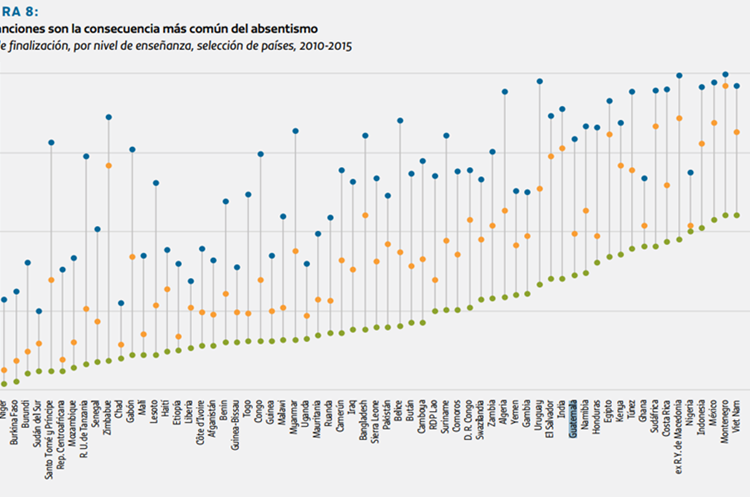
Mientras, el Informe de Seguimiento de la Educación en el Mundo, de Unesco, apeló que los gobiernos tienen la responsabilidad de garantizar una educación, pero que los padres y estudiantes deben poner de su parte.

La directora general de la Unesco, Irina Bokova, sugiere que los bajos resultados en las pruebas podrían ser por la falta de una buena estructura física, a menudo con desventajas socioeconómicas.

En el 2015 Panamá salió mal posicionado en el Tercer Estudio Regional Comparativo y Explicativo, en español, ingles y matemáticas.

Fuente: http://www.diaadia.com.pa/el-pais/buscan-calificar-la-educacion-327141

Comparte este contenido:

México tiene nueva estrategia educativa bilingüe: Nuño

México/30 octubre 2017/Fuente: El Siglo de Torreón

El secretario de Educación, Aurelio Nuño, indicó que en un plazo de 20 años se contará con escuelas bilingües en México.

“Estamos trabajando para caminar hacia la calidad educativa. Se han preparado los nuevos planes de educación, libros de texto y hay una nueva estrategia de inglés para que todo el sistema de educación de nuestro país sea bilingüe”, dijo en entrevista Aurelio Nuño durante su visita a Saltillo.

El funcionario estatal indicó que el proceso que implementará en dos década. Como primera etapa esta el capacitar a los maestros.

“Las escuelas Normales deberán ser bilingües. Y a partir de ello todos serán bilingües”, indicó Aurelio Nuño.

Asimismo indico que esto será un gran avance en la educación. “Con la educación es como se va a transformar México”, añadió.

Fuente: https://www.elsiglodetorreon.com.mx/noticia/1399048.mexico-tiene-nueva-estrategia-educativa-bilingue-nuno.html

Comparte este contenido:
Page 3144 of 6179
1 3.142 3.143 3.144 3.145 3.146 6.179