Page 3661 of 6195
1 3.659 3.660 3.661 3.662 3.663 6.195

FAO and the Ministry of Education support school garden initiative for better nutrition in Sri Lanka

Sri Lanka/July 11, 2017/By Abdul Mujeeb/Source: http://www.elankanews.com

The Food and Agricultural Organization of the United Nations (FAO) together with the Ministry of Education hosted a ceremony on Tuesday, 4 July 2017 at Wijerama Maha Vidyalaya in Udahamulla, Nugegoda to highlight the importance of school gardens for child nutrition and life skills. The event took place in the context of the project on “Scaling up Nutrition through a Multi-Sector Approach”, jointly implemented by FAO and the World Food Programme (WFP) in collaboration with the Government of Sri Lanka.
 
Through this project, more than 6000 schools have been inspired to create their own organic and healthy garden within the school grounds. To support each school develops their own garden, FAO together with the Ministry of Education has facilitated a series of training workshops in all nine provinces, training 377 education officers.
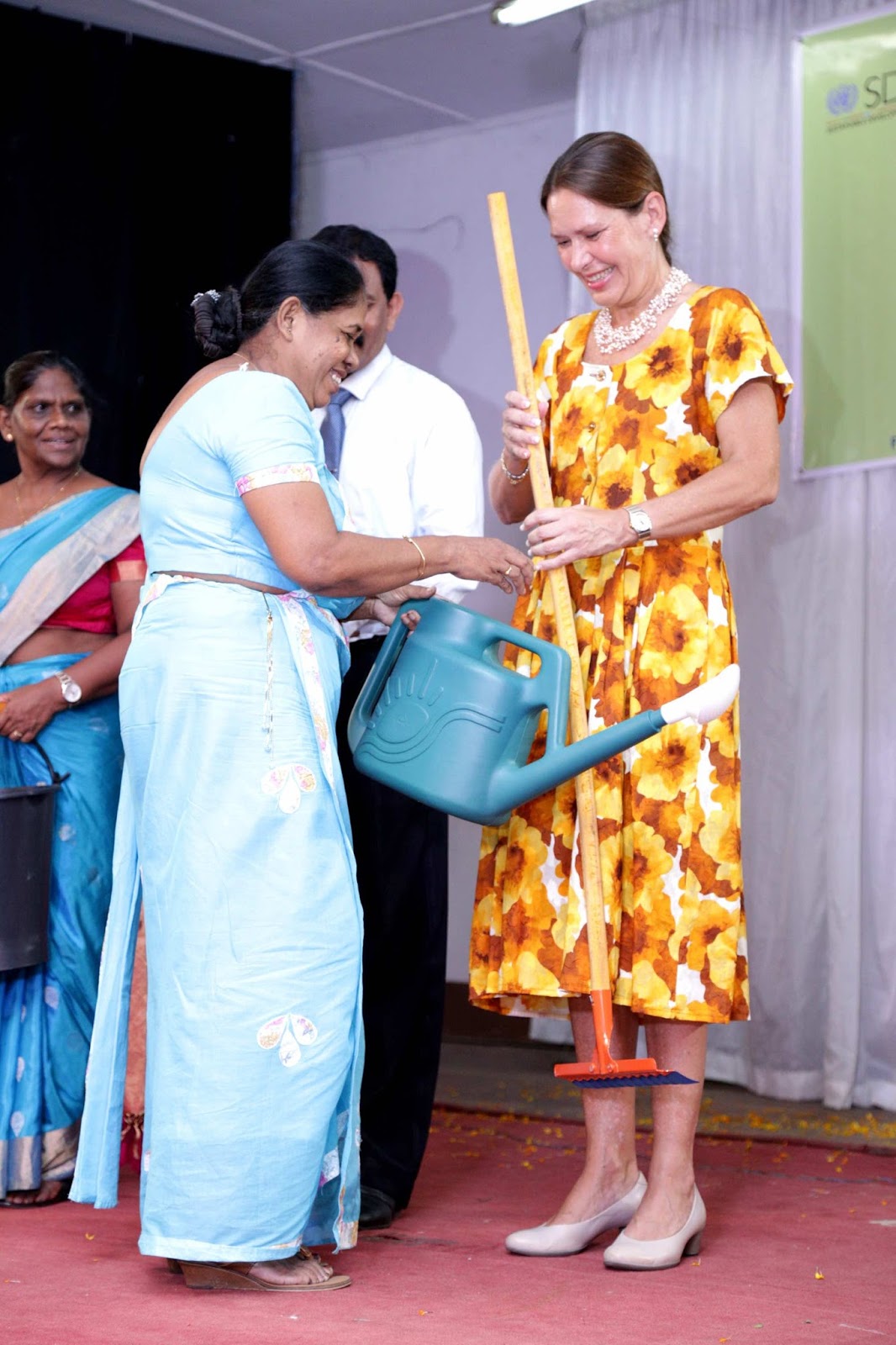
 
Nina Brandstrup, FAO Representative for Sri Lanka and Maldives presents gardening equipment to principals of 22 schools in the Sri Jayawardenapura Education zone at the school garden ceremony.
Nina Brandstrup, FAO Representative for Sri Lanka and
Maldives presents gardening equipment to principals
of 22 schools in the Sri Jayawardenapura Education
zone at the school garden ceremony.
At these comprehensive two-day workshops, education specialists have learned the different aspects of establishing and managing school gardens, from selecting a location and deciding the type of beds to create, to identifying the best tools and equipment. They have also learned about fertilizing, pruning and pest control by utilizing plant extracts and modern technologies. The education specialists have acquired the skills to impart this knowledge to the school community within each province. They have been provided a guideline and manuals which teachers, parents, and children can use in establishing the school garden. As the project includes knowledge about child nutrition, health, and education, it encourages the children to directly apply what they learn in their school gardens and replicates the same healthy habits at home. FAO has distributed gardening tools and resources to participating schools across the island to support the project’s sustainability.
 
A manual available in both Sinhala and Tamil has been crucial to the success of the initiative and has reached over 300,000 children across the island. In many parts of the country that continue to struggle with food insecurity and undernutrition, this initiative has supported children to take responsibility for their diets and share their learnings with their families and the wider community.
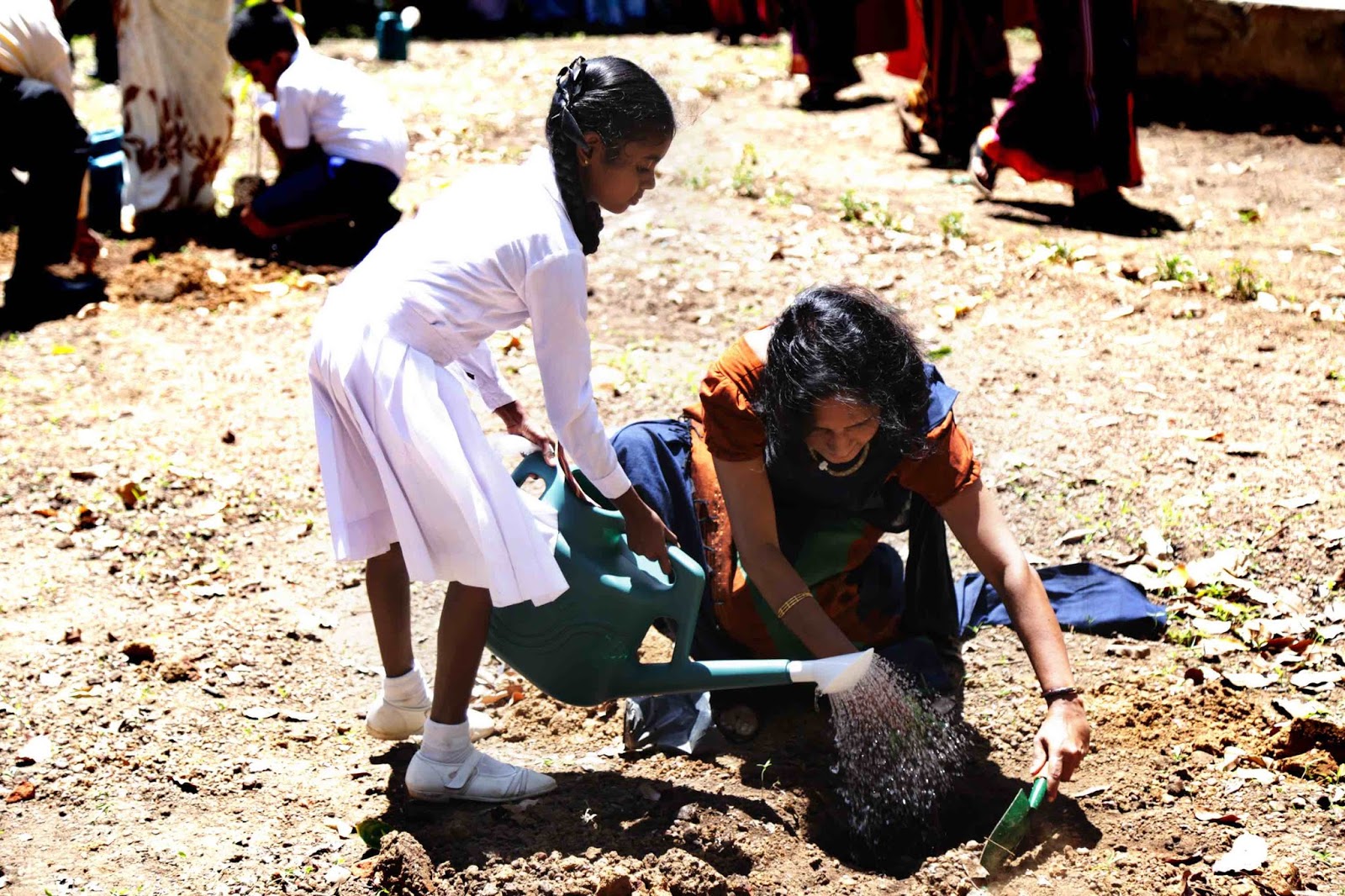
 
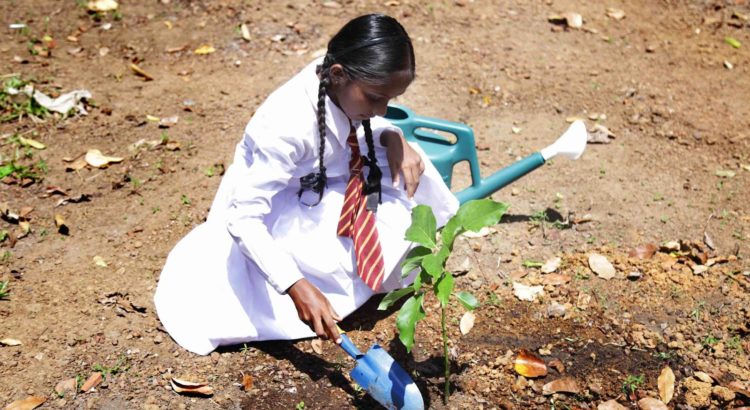
Priyanthi Chandrasekera, Project Manager-Scaling up Nutrition through a Multi-Sector Approach, FAO plants a tree with a student of Wijerama Maha Vidyalaya.
Priyanthi Chandrasekera, Project Manager-
Scaling up Nutrition through a Multi-Sector Approach,
FAO plants a tree with a student of Wijerama Maha Vidyalaya.
Speaking at the event, the FAO Representative Nina Brandstrup highlighted school gardens as a key tool in teaching children the value of nutritious organic food and the importance of sustainable lifestyles. “School gardens can be used as a classroom by reconnecting children with the outdoors and the source of their food,” she said. “These gardens teach children about the importance of a balanced diet and nutrition while opening their eyes to new agriculture concepts. The gardens are also encouraging the children to increase their consumption of fruits and vegetables; no one can resist eating what they grew with their own hands!”
The Honorary Consul of Spain, Priyadarshini Jayawardena encouraged the promotion of school gardens to keep children safe and healthy while nurturing future generations to ensure a healthier and better tomorrow. “Gardens are of utmost importance to the development of the country. Well-nourished children are healthier and learn better, have improved opportunities for growth and contribute positively to society,” she said.
 
Commenting on the programme, Mr. Jayantha Wickramanayake, Director of National Schools said: “This project jointly implemented by the FAO and the Ministry of Education is a good solution to tackle health problems and the lack of awareness about the environment among school children. This programme really takes education beyond the classroom, guiding students to form a relationship with nature. I encourage all principals, teachers, and students to replicate this model in their schools. I have no doubt that this will help to create a healthier generation of youth and contribute towards minimizing the risk of natural disasters in the country with more awareness.”
 
Brenda Barton, Representative and Country Director of World Food Programme (WFP) highlighted that the school garden initiative ties in with the efforts of WFP to treat undernutrition in Sri Lanka. WFP distributes specialized fortified nutritious food to pregnant and nursing women and children aged between 6 months and 5 years and provides technical support to the Ministry of Health to enhance the impact of Thriposha – a nutritious and locally fortified blended food. “Our aim is to support behavioral changes through enhanced nutrition education and information on safe and nutritious foods, dietary diversity, nutrient deficiencies and their root causes,” she said. WFP also supports the Ministry of Health to conduct national nutrition surveys for pregnant and lactating women and for schoolchildren, to promote the linkage of health, nutrition, and food security as a national development priority.
 
The event concluded with the distribution of gardening tools to 22 school principals from the Sri Jayawardenapura Education zone of the Western Province, and the planting of a fruit tree followed by a visit to the school garden by guests and the school community.
 
School gardens are one aspect of the Scaling up Nutrition through a Multi-Sector Approach project, jointly implemented by FAO and WFP in collaboration with the Government of Sri Lanka. The project is part of the United Nations Sustainable Development Goals Fund, an international multi-agency and multi-donor development mechanism created in 2014 by The United Nation Development Programme (UNDP) funded through the Government of Spain. 
Source:
http://www.elankanews.com/2017/07/fao-and-ministry-of-education-support.html

Comparte este contenido:

China Distance Education Hldgs : CDEL Announces Strategic Investment in Beijing Ruida

China/July 11, 2017/Source: http://www.4-traders.com

China Distance Education Holdings Limited (NYSE: DL) (‘CDEL’, or the ‘Company’), a leading provider of online education and value-added services for professionals and corporate clients in China, today announced that it signed a definitive agreement to acquire 40% equity interest in Beijing Ruida Chengtai Education Technology Co., Ltd. (‘Beijing Ruida’), a leading provider of exam preparation services for participants in China’s national judicial examination, for a total consideration of RMB192 million ($28.3 million), subject to adjustments under certain pre-agreed conditions. In addition, CDEL has the right, at its option, to further increase its equity interest in Beijing Ruida up to 60% before April 2019 under certain pre-agreed conditions. The acquisition of 40% equity interest in Beijing Ruida is an all-cash transaction, and is expected to close in the fourth quarter of fiscal 2017.

Mr. Zhengdong Zhu, Chairman and CEO of CDEL, said, ‘Our investment in Beijing Ruida is ideally aligned with our strategy to build industry-leading comprehensive lifelong education verticals. With this investment we immediately strengthen our legal education vertical by adding a prominent national judicial exam preparation provider to our portfolio of education services.’ Mr. Zhu added, ‘Beijing Ruida has enjoyed impressive growth since being launched last year due to its highly acclaimed instructors, best-of-breed educational content, and innovative new media marketing strategy. We welcome the Beijing Ruida team to the CDEL platform.’

Mr. Fengke Liu, Founder and Chairman of Beijing Ruida, said, ‘We are delighted to have CDEL as our strategic investor. CDEL and Beijing Ruida share the common goal of providing high-quality education services to help professionals advance in their careers. We believe our focus on delivering high-quality educational content and services for participants in China’s national judicial examination will further complement CDEL’s broad array of industry-leading exam preparation services.’

Safe Harbor Statement

This announcement contains forward-looking statements within the meaning of Section 27A of the Securities Act of 1933, as amended, and Section 21E of the Securities Exchange Act of 1934, as amended, and as defined in the U.S. Private Securities Litigation Reform Act of 1995. Forward-looking statements are not historical facts, but instead are predictions about future events. Future events are inherently uncertain, and our forward-looking statements may turn out to be incorrect. The Company may not realize the anticipated benefits of the investment in Beijing Ruida. The forward-looking statements in this press release speak only as of the date on which they are made, and we assume no obligation to update any forward-looking statements except as required by law.

About Beijing Ruida

Founded in 2016, Beijing Ruida was established by eight highly acclaimed instructors in China’s legal education industry. Beijing Ruida provides exam preparation services and products, including proprietary books and reference materials, for participants in China’s national judicial examination. Beijing Ruida delivers services and products at six campuses in China (Beijing, Shanghai, Nanjing, Hangzhou, Guangzhou, and Shenzhen) as well as through its online platform and a nationwide network of education partners.

About China Distance Education Holdings Limited

China Distance Education Holdings Limited is a leading provider of online education and value-added services for professionals and corporate clients in China. The courses offered by the Company through its websites are designed to help professionals seeking to obtain and maintain professional licenses and to enhance their job skills through our professional development courses in China in the areas of accounting, healthcare, engineering & construction, and other industries. The Company also offers professional education courses for participants in the national judicial examination, online test preparation courses for self-taught learners pursuing higher education diplomas or degrees, test preparation courses for university students intending to take the nationwide graduate school entrance exam, practical accounting training courses for college students and working professionals, as well as online language courses and third-party developed online courses. In addition, the Company provides business services to corporate clients, including but not limited to tax advisory and accounting outsourcing services. For further information, please visit http://ir.cdeledu.com

Source:

http://www.4-traders.com/CHINA-DISTANCE-EDUCATION-3860988/news/China-Distance-Education-Hldgs-CDEL-Announces-Strategic-Investment-in-Beijing-Ruida-24725738/


Comparte este contenido:

Sexuality education for Kenya’s youth: When the evidence is on the wall, but politics gets in the way

Kenya/July 11, 2017/By: Diana Warira* /Source: https://www.standardmedia.co.ke

The need to provide sexuality education for Kenya’s youth has been the subject of discussion in Kenya’s development circles for decades. Whether sexuality education has a critical role in improving the sexual and reproductive health outcomes of youth, or not, is no longer the debate. Why? One may ask. Well, research evidence already shows that sexuality education reduces risky sexual behaviour among youth. This means that when youth are well-informed about their sexuality, then the likelihood of engaging in risky sexual behaviour reduces. Those who are abstaining from sex continue abstaining, and those who are already having sex practice safer sex. This means that sexuality education has potential to reduce teenage pregnancy, unsafe abortions, and HIV infections among other negative sexual and reproductive health outcomes in Kenya.

However, despite the strong evidence supporting the need for sexuality education for Kenya’s youth, the momentum the government had gained over recent years towards incorporating sexuality education in the formal education curriculum seems to have waned, drastically. To quote one development practitioner, the ‘matter was shelved.’

We have an enabling policy environment, right?

More puzzling is the fact that the government has a policy outlining the need for sexuality education for Kenya’s youth, adolescents to be precise. The Ministry of Health’s National Adolescent Sexual and Reproductive Health (ASRH) Policy of 2015 outlines contributing to increased access to ASRH information and age-appropriate comprehensive sexuality education (AACSE) as one of the policy objectives. The Policy goes on to outline that it shall “Strengthen ASRH information and AACSE programmes for out-of-school and in-school adolescents.”

Further, in order to ensure the policy recommendations are implemented, the Policy stresses the use of a multi-sectoral approach cutting across various ministries and state agencies. Top on the list of ministries to be involved in the Policy implementation is the Ministry of Education, Science and Technology (MoEST). The Policy stipulates that MoEST shall implement sexuality education, AACSE to be precise, in-line with the Education Sector Policy on HIV and AIDS of 2013. Other areas of involvement for MoEST as outlined in the Policy are: facilitating provision of information to parents on the sexual and reproductive health of adolescents within the school set up, and strengthening partnership with the Ministry of Health (MoH) to provide ASRH information and services in schools.

That said, it is clear that the question of whether we have a policy framework, or not, within which to implement sexuality education is no longer valid. Several groups of stakeholders, including a technical working group on adolescent sexual and reproductive health, have convened in order to deliberate how to move the policy recommendations into action. However, all these efforts seem to have hit a snag.

While the mandate of ensuring good sexual and reproductive health outcomes among youth falls on the MoH, implementation at the school level lies with MoEST. A good point to note is that we have a National Curriculum Policy of 2015, which outlines various education reforms driven by the Second Medium Term Plan of Kenya Vision 2030. The Policy seeks to ensure life-long learning and steer learners towards achieving their full potential.

Ensuring that youth have good sexual and reproductive health outcomes is a major determinant as to whether youth achieve their full potential or not. However, the glaring absence of any mention of sexuality education (or the more salient option, family life education) in the National Curriculum Policy as part of the curriculum reforms is evidence to the disconnect in commitments between the various state agencies charged with steering the ASRH Policy and other policy frameworks forward. The 2015 National Curriculum Policy was an excellent opportunity for MoEST to take up some of the recommendations of the 2015 ASRH Policy in order to ensure joint effort towards improving the sexual and reproductive health of Kenya’s youth. Perhaps it is worth mentioning that the ASRH Policy was published a few months ahead of the National Curriculum Policy hence there was room to incorporate these elements in the latter.

A middle ground perhaps?

The lack of collective political will within government therefore, is the greatest hurdle standing in the way of realising sexual and reproductive health among Kenyan youth. It is widely known that a notable proportion of adolescents in Kenya are engaging in sex. The 2014 Kenya Demographic and Health Survey (KDHS) reported that half of women and men begin having sex by age 18. Moreover, 15 percent of women and 22 percent of men aged 20-49 had sex by age 15. Opponents of sexuality education have pointed out that this type of education, if implemented in schools, will lead to moral decadence, spike curiosity among adolescents to experiment with sex, among other issues. However, shouldn’t the government, parents, teachers and other stakeholders be working collaboratively to ensure these young ones have the right information regarding their sexual and reproductive well being? The ASRH Policy is very clear on the emphasis on ‘age-appropriate’ sexuality education. This means that information shared with a 10 year old is very different from that shared with an 18 year old. The fixation on the ‘comprehensive’ bit of sexuality education has led many to throw out the entire agenda. Throwing the baby out with the bathwater, so to speak.

While the arguments against sexuality education may be hinged on genuine fears, it is time we separated the evidence from the myths and opinions. It is at this point that the government agencies charged with steering this matter should step up to provide guidance on the best way forward. Sexuality education, comprehensive or not, is a critical remedy to the runaway morals we are witnessing among our youth, and a long-term fix to the declining sexual and reproductive health outcomes. If nothing is done, we shall not only miss the sustainable development targets on improving the health and wellbeing of Kenyan youth, but also the Vision 2030 goals. Therefore, a key question for us to answer is – should we let go of what the evidence says because the reality makes us uncomfortable, or should we all find a middle ground and save our youth while we still have the chance? 


*Diana Warira is a Communications Officer at the African Institute for Development Policy (AFIDEP)

Source:

https://www.standardmedia.co.ke/ureport/story/2001246878/sexuality-education-for-kenya-s-youth-when-the-evidence-is-on-the-wall-but-politics-gets-in-the-way

Comparte este contenido:

Ecuador: La nueva educación superior

Ecuador/10 julio 2017/Fuente: Expreso.ec

La Asamblea le apuesta a nuevos cambios a la propuesta de Ley de Educación Superior. El pleno de la Comisión de Educación de la Asamblea Nacional trabaja en las reformas al marco legal que rige a las universidades desde hace siete años.

El objetivo es establecer mecanismos para mejorar el sistema y, sobre todo, “pagar una deuda” mejorando el ingreso a las universidades, dijeron las autoridades.

La primera acción que tomó la nueva administración es parar el informe para primer debate que dejó lista la anterior comisión.

El asambleísta Augusto Espinosa, presidente actual de la Mesa de Educación, manifestó que el nuevo informe estará listo el viernes. En él han sido incluidos cambios sustanciales.

Fue la anterior comisión, por resolución del Consejo de Administración Legislativa (CAL), la que conoció y condensó en uno los diez proyectos de reformas presentados desde que se promulgó la ley en el 2010. Sus proponentes fueron Raúl Tobar, Arcadio Bustos, Moisés Tacle, César Solórzano, Byron Pacheco, Miryam González, María Cristina Kronfle, Fanny Uribe, Gabriela Díaz, Ximena Ponce y Diego Vintimilla.

En la socialización participaron autoridades de la Universidad Católica del Ecuador (PUCE), de la Escuela Politécnica Nacional (EPN), de la Asociación de Docentes e Investigadores de la Politécnica del Ejército (ESPE), de la Escuela Politécnica del Chimborazo, de la Federación de Estudiantes Universitarios del Ecuador (FEUE), del Consejo de Educación Superior (CES), del Servicio de Rentas Internas (SRI) y del Consejo de Evaluación, Acreditación y Aseguramiento de la Calidad de la Educación Superior (Ceaaces).

A continuación, las modificaciones plateadas a la ley que se analizarán en esta semana para elaborar el informe.

Implantación de propedéutico

La reforma establece que el ingreso a la universidad debe ser meritocrático, pero quienes no ingresen en la primera evaluación, la prueba Ser Bachiller, que es tomada por el Instituto Nacional de Evaluación Educativa (Ineval), tendrán la opción de ingresar a un curso propedéutico. Habrá una evaluación al final del mismo y con ello se facilitará el ingreso a las universidades. La meta es que el curso sirva para que los estudiantes puedan presentar las pruebas de admisión con “unas buenas bases”, y dar mayores oportunidades para ingresar a la educación superior.

La tipología de los centros

La propuesta es mantener la tipología de la universidad de investigación y de las universidades de ciencias aplicadas, donde están todas las carreras técnicas. Lo que se hará es una revisión de los procesos de evaluación a las universidades, que tienen que ser diferenciados de acuerdo con el tipo de institución de educación que sean.

Así será posible medir las competencias de las instituciones para que los estudiantes tengan mejores opciones para la elección de la universidad que deseen.

La fórmula para el ingreso

Para el ingreso deberá haber una adecuada orientación vocacional, por lo que los bachilleres deberán presentar un certificado obligatorio que deberá entregar el colegio junto al título de bachiller. El objetivo, dicen los legisladores que apoyan este camino, es ayudar al estudiante para que tenga una orientación de la carrera que puede seguir y evitar deserciones como ocurre al momento, evitar que se pierdan cupos.

Inicio similar por dos años

La propuesta surge de varios rectores para que los alumnos reciban un “tronco común académico” en los dos primeros años. Luego, los estudiantes escogerán la carrera que deseen. Así, aseguran los impulsores, se evitarán las salidas de carreras que no sean afines. Este tema aún no ha sido tratado. A criterio de Espinosa, de concretarse la iniciativa debería ir en el reglamento de la ley.

La formación Técnica

Se dará un fortalecimiento a la parte de formación técnica y tecnológica para los institutos de esas ramas. Se busca garantizar la autonomía administrativa, orgánica y financiera de las entidades. En lo académico, se quiere mantener una injerencia para el tema de la oferta académica con la posibilidad de revalidar el título. Este sería reconocido como de tercer nivel.

Estándar internacional

Se están estableciendo los incentivos para que las universidades, escuelas politécnicas e institutos avancen hacia estándares internacionales de calidad. Sobre esa base se cambiarían las categorías actuales (letras) por nombres que muestren su grado de excelencia: excelencia internacional, regional o nacional. Los asambleístas creen que de esta manera se incentivará a las instituciones académicas a crecer.

Fuente: http://www.expreso.ec/actualidad/la-nueva-educacion-superior-LA1534782

Comparte este contenido:

Rusia 2017: Anfitrión del mayor evento juvenil y estudiantil del planeta

Rusia/10 julio 2017/Fuente: RT

Los organizadores del XIX Festival Mundial de la Juventud y los Estudiantes que acogerá Sochi han explicado los detalles del evento en entrevista exclusiva a RT.

Sochi (Rusia) acogerá la XIX edición del Festival Mundial de la Juventud y los Estudiantes (FMJE) del 14 al 22 de octubre de 2017, un evento que coordina la Federación Mundial de la Juventud Democrática (FMJD) y ofrece a las juventudes del mundo objetivos de carácter global, como la consolidación del movimiento juvenil mundial bajo los principios de justicia, cooperación y el fortalecimiento de las relaciones entre naciones y culturas.

Durante esos días, miles de participantes de más de 150 naciones del mundo se econtrarán en la ciudad anfitriona de los XXII Juegos Olímpicos de Invierno en 2014. El lugar alojará a representantes de organizaciones políticas, no gubernamentales, estudiantiles, científicas y de otros sectores, además de a personalidades, líderes mundiales y ‘veteranos’ de un movimiento en el que participarán algunos de los jóvenes que luego formarán parte de la futura elite mundial.

«Es mejor ver una vez que escuchar mil veces»

Grigori Petushkov, presidente del Comité Nacional Preparatorio (CNP) de Rusia, explicó a RT que su país «espera una gran diversidad de jóvenes y, al igual que después de los festivales de 1957 y 1985, nuestro objetivo fundamental es que la juventud rusa haga amistades por todo el mundo«.

Petushkov manifestó que «todos conocen la hospitalidad de Rusia», con lo cual este festival será «una muy buena posibilidad» para mostrar al mundo la realidad de este país «a través de su cultura, su educación, su historia» y «su capacidad de forjar amistades».

El presidente del CNP ruso utilizó un proverbio nacional para expresar el deseo de los organizadores de que los jóvenes del mundo vean con sus propios ojos qué es Rusia: «Es mejor ver una vez que escuchar mil veces».

Defensa de la autodeterminación y la soberanía

Por su parte, el presidente del Comité Preparatorio de Venezuela, Héctor Rodríguez, expresó que este encuentro «posee una gran relevancia para la juventud latinoamericana, especialmente para la venezolana».

Además, recordó que en la última década Latinoamérica acogió dos ediciones —Venezuela 2005 y Ecuador 2013—, unos hechos que «no consideramos casuales, sino la demostración de cómo el continente y nuestra juventud se ha puesto a la vanguardia de las luchas de los pueblos que defienden su derecho a la autodeterminación y la soberanía».

Hernández subrayó que esta edición «se desarrollará en un contexto histórico», a los 70 años del primer FMJE que tuvo lugar en Praga (1947) y un siglo después de la Revolución de Octubre, aunado a la realidad del «constante ataque que hoy sufren nuestro país y los procesos de integración de nuestra región por parte del imperialismo mundial».

Entre los grandes objetivos que se plantean los organizadores del evento está la refundación de la Unión Internacional de Estudiantes, una decisión que «tomarán las organizaciones estudiantiles», confirmó Petushkov.

Esta será la tercera vez que Rusia se convierte en anfitrión del mayor evento juvenil del mundo.

Henry Jose Machuca Navarro

Fuente: https://actualidad.rt.com/actualidad/243987-rusia-festival-juventud-estudiante-mundial-sochi

Comparte este contenido:

Estados Unidos: Escuelas de Broward desafían a la reforma escolar

Estados Unidos/10 julio 2017/Fuente: El Nuevo Herald

La batalla sobre las nuevas reformas a las escuelas públicas de niveles K-12 que la Legislatura dominada por los republicanos aprobó esta primavera, entró esta semana en una nueva etapa cuando la Junta Escolar del Condado Broward votó unánimemente a favor de presentar una demanda ante los tribunales por considerar que la ley es inconstitucional.

Broward es el primer distrito escolar en presentar una demanda judicial contra la aprobación del proyecto de ley de la Cámara 7069, el cual se hizo ley el sábado pasado en contra de las apasionadas objeciones de administradores escolares, sindicatos de maestros y grupos de padres en todo el estado por sus muchas cláusulas favorables a las escuelas chárter y que, en algunos casos, lo son a expensas de las escuelas públicas tradicionales.

“Yo estoy a favor de tomar medidas enérgicas tan pronto como nos sea posible”, dijo la miembro de la Junta Escolar de Broward Rosalind Osgood durante una reunión especial de la junta convocada únicamente para autorizar al superintendente Robert Runcie a que presente la demanda legal y que gaste hasta $25,000 en costos legales iniciales.

“En estos momentos estamos prácticamente en un respirador, y tenemos que luchar literalmente por la vida de la educación pública en este estado”, dijo Osgood. “Si no nos ponemos firmes ahora, si perdemos esta oportunidad, nunca nos recuperaremos de esto”.

Las alegaciones de inconstitucionalidad planteadas por el Condado Broward tienen que ver ante todo con la manera en que el proyecto de ley HB 7069 brinda a las escuelas chárter ventajas sobre las escuelas públicas tradicionales por medio de regulaciones menos restrictivas y de fondos adicionales de los contribuyentes que les hace más fácil expandirse.

Lo que resulta más problemático para Broward y otros distritos escolares es una cláusula que los obliga a compartir con las escuelas chárter administradas de forma privada millones en fondos locales de los contribuyentes designados para la construcción y el mantenimiento.

Solamente en el curso escolar 2017-18, Broward tendría que compartir hasta $12 millones con sus escuelas chárter, mientras que las Escuelas Públicas del Condado Miami-Dade tendrán que compartir hasta $23.2 millones, de acuerdo con datos compilados por la Cámara de Representantes de la Florida.

El distrito escolar de Broward alega que esa cláusula y varias otras en el HB 7069 violan varias secciones de la Constitución de la Florida, la cual requiere que el estado brinde “un sistema uniforme, eficiente, seguro, protegido y de alta calidad de escuelas públicas gratuitas”.

En un memorándum enviado esta semana a los miembros de la junta escolar, la asesora legal general de las Escuelas Públicas de Broward, Barbara Myrick, expuso el argumento legal inicial del distrito, incluyendo el hecho de que el HB 7069 impone restricciones inconstitucionales a la autoridad de las Juntas Escolares locales de “operar, controlar y supervisar” las escuelas dentro del ámbito de su distrito.

Las Escuelas Públicas de Broward también se oponen directamente al establecimiento del nuevo programa “Schools of Hope” (Escuelas de Esperanza) bajo el proyecto de ley HB 7069, programa que se propone resolver el problema de las escuelas públicas que tienen malos resultados todo el tiempo por medio de ofrecer incentivos financieros a los operadores de las escuelas chárter para que ellos puedan competir directamente con las escuelas tradicionales con problemas.

El programa “Schools of Hope” solamente ofrece a 25 de más de 100 escuelas tradicionales que tienen malos resultados todo el tiempo la oportunidad de recibir hasta $2,000 por estudiante para pagar por servicios colaborativos, tales como programas extracurriculares. Como máximo, esa ayuda llegará a un total de alrededor de $44.5 millones, concluyó un análisis anterior del Herald/Times.

En un comunicado entregado al Herald/Times, el presidente de la Cámara de Representantes Richard Corcoran, republicano de Land O’Lakes, criticó duramente a la Junta Escolar de Broward por su decisión. Conseguir que se aprobara el programa “Schools of Hope” fue una de sus prioridades principales, como lo fue elaborar el proyecto de ley HB 7069 tal y como estaba en los días finales de la temporada de sesiones legislativas.

“Este es otro ejemplo en que la burocracia educacional está poniendo a los adultos que administran las escuelas por encima de los niños que estudian en esas escuelas”, dijo Corcoran.

En lo que los administradores de Broward se preparan para presentar la demanda judicial, el distrito escolar planea buscar el apoyo de otros distritos escolares que tal vez se les quieran unir, dijo la portavoz del distrito Tracy Clark.

El superintendente Alberto Carvalho dijo que él quiere hablar al mismo tiempo con funcionarios y legisladores estatales para ver si se puede resolver las preocupaciones del distrito, y cómo se pueden resolver.

“Nosotros vamos a dedicarnos a tener conversaciones muy, pero que muy enérgicas con entidades del Departamento de Educación y también con líderes legislativos para hacerles entender el verdadero impacto de la ley –el cual, en ciertas instancias, podría exceder lo que se calculó originalmente– y tratar de explorar esa vía antes de que se tengan en cuenta cualesquiera otras opciones posibles”, dijo Carvalho. “Esta no sería la primera vez que se toman decisiones en Tallahassee y que luego el diálogo subsiguiente… tenga como resultado conversaciones con los legisladores, y que se lleve a cabo cierta mitigación de las decisiones políticas que se habían tomado”.

Fuente: http://www.elnuevoherald.com/noticias/sur-de-la-florida/article160299094.html

Comparte este contenido:

Argentina: Educadores de Buenos Aires realizarán este martes huelga de 24 horas

Argentina/10 julio 2017/Fuente: Radio Habana Cuba

Sindicatos de la educación de la provincia de Buenos Aires convocaron a un paro de 24 horas para mañana, martes, en demanda de una mejora contractual y más presupuesto para el sector.

La huelga será acompañada de una movilización que partirá desde el Ministerio de Educación porteño, ubicado sobre Paseo Colón, hasta la Legislatura de la capital argentina, refiere Telesur.

Eduardo López, secretario general de Unión de Trabajadores de la Educación (UTE-Ctera), adelantó que el reclamo central de los maestros es un aumento salarial en medio de unas negociaciones colectivas estancadas por la falta de mejoras en la propuesta oficial.

López explicó que la supuesta oferta del 21,5 por ciento que les harían en la próxima reunión para discutir el contrato colectivo el jueves tampoco alcanza. “Nos enteramos por los medios de comunicación de la oferta que supuestamente nos van a hacer, porque no nos han mandado ningún papel escrito hasta el momento confirmándolo.”

El secretario general de UTE ya avisó que lo rechazarán “En Buenos Aires firmaron por encima del 27 por ciento, a los universitarios en la última reunión les ofrecieron 26 puntos y medio, pero a nosotros nos tienen con el 19 y hablan de un 21,5. Es insostenible”.

Fuente: http://www.radiohc.cu/noticias/internacionales/135006-educadores-de-buenos-aires-realizaran-este-martes-huelga-de-24-horas

Comparte este contenido:
Page 3661 of 6195
1 3.659 3.660 3.661 3.662 3.663 6.195