Page 4024 of 6193
1 4.022 4.023 4.024 4.025 4.026 6.193

América Latina a la cabeza de la privatización educativa mundial

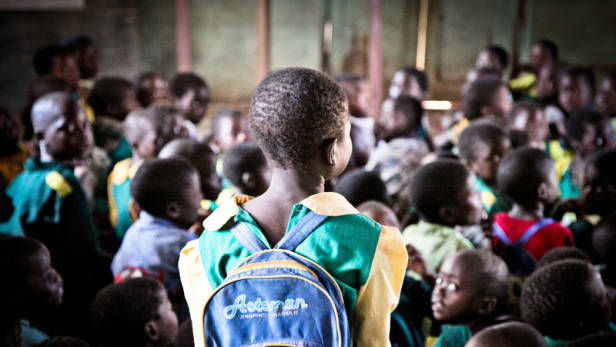
El nuevo informe titulado La privatización educativa en América Latina: Una cartografía de políticas, tendencias y trayectorias muestra que, en las últimas décadas, América Latina ha sido la región con un mayor crecimiento continuo de la privatización en el sector educativo. La zona destaca tanto por presentar la tasa más elevada de matriculaciones en educación primaria privada del mundo como por el crecimiento más significativo en la oferta del sector privado. Este punto también se aplica a la educación secundaria; de hecho, América Latina encabeza junto al África subsahariana los porcentajes de mayor nivel de alumnos en el sector privado.

Un informe único

A pesar de la magnitud de este fenómeno, la información relevante publicada al respecto es escasa. Por este motivo, el estudio actual adquiere una especial relevancia, ya que los investigadores consiguen identificar una tipología de trayectorias de privatización de la educación a nivel regional.

Entre los ejemplos se incluyen la supresión de los derechos educativos fundamentales como consecuencia de la «libertad de elección» característica de la privatización como reforma estructural que se observa en Chile, que cuenta actualmente con uno de los sistemas educativos más desiguales del mundo por este motivo (OCDE, 2014). En Argentina, las antiguas relaciones entre lo público y lo privado que se establecieron entre en 1940-1960 han favorecido la liberalización de las escuelas privadas.

A través de estos y otros ejemplos, el informe analiza este fenómeno en el contexto político de cada país concreto. La enorme diversidad de enfoques representada por estas trayectorias revela que América Latina es una región especialmente apta para reflexionar y participar en un diálogo teórico y social sobre la economía política de las reformas educativas.

Sobre los investigadores

El informe La privatización educativa en América Latina: Una cartografía de políticas, tendencias y trayectorias es obra de los investigadores Antoni Verger, Mauro Moschetti y Clara Fontdevila, de la Universidad Autónoma de Barcelona. Este año, Fontdevila y Verger han recibido un premio de la prestigiosa Comparative International Education Society(CIES) por un estudio similar sobre la economía política de las reformas educativas mundiales.

Haga clic aquí para descargar el informe completo (en español).

Fuente: https://www.ei-ie.org/spa/detail/15001/am%C3%A9rica-latina-a-la-cabeza-de-la-privatizaci%C3%B3n-educativa-mundial

Comparte este contenido:

REDUCA Lanza su primer documento de Posicionamiento frente a la Educación en América Latina

En Reduca adoptamos la visión de que el derecho a la educación no es solo el derecho a ir a la escuela, es el derecho a aprender con sentido.

América Latina/ REDUCA/Luz Yesenia Moscoso Ramírez

Encargada Temática De REDUCA

«Hoy, a pesar de las mejoras observadas en varias dimensiones, los sistemas educativos de la región están fracasando en su intento. De acuerdo con los datos del Programa para la Evaluación Internacional de Alumnos (PISA), solamente 63% de los jóvenes de 15 años tiene un desempeño mínimo aceptable en matemáticas. Sabemos también que 27% de los y las estudiantes de secundaria presentan edad superior a la que les corresponde en su nivel educativo. Y de los 117 millones de niños, niñas y jóvenes en edad escolar en la región, 6,5 millones no asisten a la escuela, y 15,6 millones se encuentran con rezago».

Reduca es una red de catorce organizaciones de la sociedad civil constituida en 2011, en Brasilia, con el compromiso compartido de participar y contribuir activamente para que los niños, niñas y jóvenes de América Latina ejerzan plenamente su derecho a una educación inclusiva, equitativa y de calidad, promoviendo el ejercicio democrático en los países de la región.Hoy REDUCA Lanza su primer documento de posiconamiento a la oponión pública donde expresa entre otras cosas que:

  • América Latina es la región más desigual del mundo y las políticas de educación vigentes sólo reproducen el ciclo de la desigualdad, impidiendo que los más vulnerables encuentren en ellas medios para la movilidad económica y social. La firma de tratados por la calidad de la educación no ha bastado para avanzar en el tema.
  • El aumento en el gasto público no ha llevado a la mejora de la calidad por no ser claramente orientado al propósito de garantizar el aprendizaje a todos los niños y niñas de la región. La educación ha subido en el orden de prioridades ciudadanas y también su presencia en los discursos políticos, pero los programas siguen siendo políticas de gobierno y no de Estado.
  • Las administraciones entrantes suelen priorizar el objetivo de “dejar su marca” con nuevos programas, descontinuando las acciones de gobiernos anteriores sin evaluar su impacto en el aprendizaje. Frecuentemente, los programas que se emprenden carecen de fundamentos que partan de evidencia científica que apunte para sus potenciales resultados.

En el periodo de 2014 a 2016, Reduca consolidó su capacidad de trabajo conjunto alrededor de tres temas cruciales:valorización de docentes y directivos, educación durante la primera infancia e inclusión educativa [1]. Alrededor de estos temas la red desarrolló su cultura colaborativa y observó la realización de logros potencializados por la actuación conjunta.

Para descargar todo el documento has clic en el siguiente enlace: 

Fuente: http://lasillavacia.com/silla-llena/red-de-la-educacion/historia/reduca-lanza-su-primer-documento-de-posicionamiento-frente

Comparte este contenido:

La mitad de los estudiantes chinos padece intimidación escolar

Asia/China/Pueblo en Línea 

Los estudiantes chinos más pequeños son las víctimas más frecuentes del acoso escolar y los varones lo padecen mucho más que las mujeres, reveló una reciente encuesta realizada por el Instituto de Investigación Educativa Siglo XXI.

El equipo de investigadores interactuó con 1.003 estudiantes de 12 escuelas de Beijing.

Los testimonios de los estudiantes confirmaron que casi la mitad de ellos habían sido, en algún momento del curso escolar, golpeados o derribados con mala intención por sus compañeros de clase. Además, alrededor del 6 % declaró que sufrieron acosos diarios por delicuentes ajenos al centro escolar.

La encuesta también encontró que los estudiantes de escuelas “de a pie” experimentaron un mayor nivel de intimidación que sus compañeros de instituciones de mayor rango. También la investigación precisó que los hijos de familias de bajos ingresos son más propensos a ser intimidados en la escuela.

“Ser intimidado puede tener un impacto negativo en el desarrollo personal y en el desempeño académico del alumno”, aseguró Zhou Jinyan, jefe del estudio e investigador del Instituto de Capital de la Universidad Normal de Beijing para la Economía de la Educación.

«A los niños que son intimidados, de adultos les resultará difícil confiar en los demás», admitió Zhou. «También carecerán de confianza en sí mismos y responderán con ansiedad, ira, resentimiento o depresión, socavando el control de sus vidas«.

En los últimos años, el acoso en las escuelas chinas ha despertado una preocupación generalizada y ha sido frecuentemente reportado por los medios de comunicación.

El caso más reciente sucedió en la destacada escuela primaria Zhongguancun No. 2, ubicada en distrito Haidian de Beijing. Para burlarse de él, un estudiante de cuarto grado le arrojó a su compañero de clase un cubo de basura en la cabeza. Esto le causó a la víctima un síndrome de nerviosismo agudo.

La Procuraduría Popular Suprema de China informó que en los primeros once meses del 2016 recibió cerca de 1.900 acusaciones vinculadas al acoso escolar, generándose 1.100 detenciones y 2.300 procesamientos.

Shi Weizhong, subdirector de la Oficina de Asuntos de la Procuraduría Juvenil, insistió en que “la gran mayoría de las quejas presentadas ante las autoridades involucran a delincuentes, y en que la proporción de mujeres delincuentes va en aumento”.

“También hubo un cantidad notable de acusaciones de intimidación que involucran a estudiantes entre 14 y 18 años”, añadió Shi.

Como contrapeso al flagelo, Zhou propone mejorar la comunicación entre maestros, padres y estudiantes. Además, urge establecer relaciones más armoniosas entre los propios niños chinos.

“Lo más importante es que los padres participen activamente en la educación de sus hijos, ya que el compañerismo materno y paterno han demostrado ser una herramienta muy eficaces contra la intimidación escolar y sus efectos negativos”, concluyó Zhou.

Fuente: http://mba.americaeconomia.com/articulos/notas/la-mitad-de-los-estudiantes-chinos-padece-intimidacion-escolar

Imagen tomada de: https://beijingtoday.com.cn/_media_/2016/03/1-49-1140×500.jpg

Comparte este contenido:

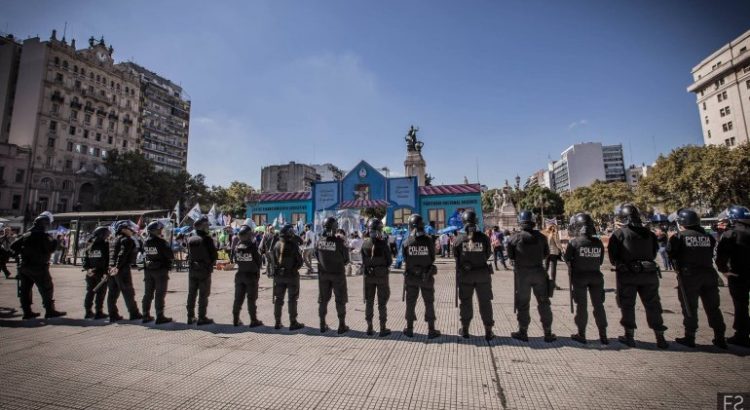
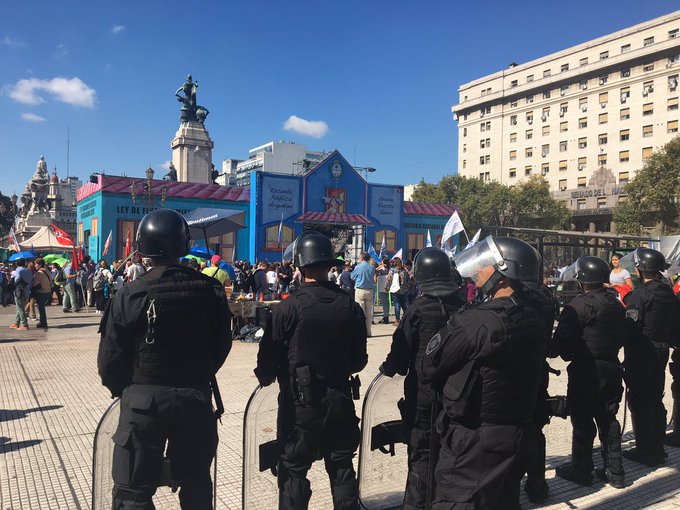
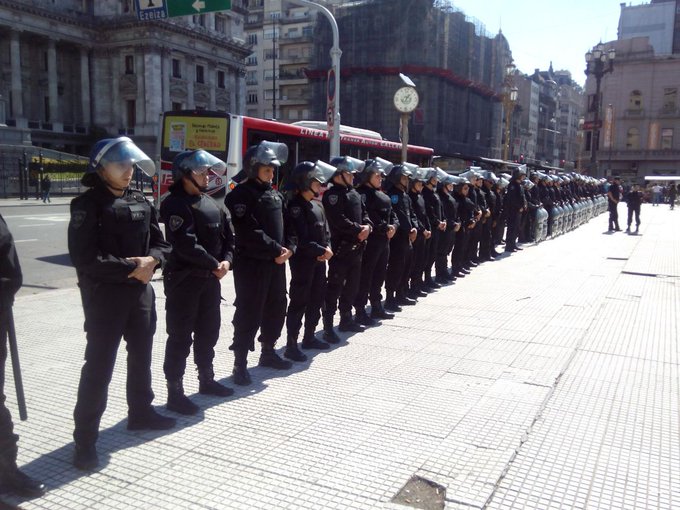
En Argentina tensión frente al Congreso: la policía rodeó a la escuela itinerante de los docentes

Decenas de policías rodearon la escuela itinerante instalada fuera del Congreso. El operativo duró algunos minutos y las fuerzas de seguridad se retiraron sin dar ninguna explicación.

«Fue una actitud patoteril, amenazante», dijo Alejandro Demichelis, el vocero de Ctera que estaba en la escuela al momento de la llegada de los policías.

Ver imagen en TwitterVer imagen en Twitter

«Venían acompañando una marcha de bancarios y por un momento se desplazaron para formar el cordón fuera de la Escuela. No hay explicaciones para esta actitud patoteril», dijo Demichelis a El Destape.

El hecho ocurrió cuando los maestros reclaman que el aula se quede hasta el 5 de mayo. Cuando quisieron instalarla por primera vez, fueron víctimas de una feroz represión porque el Gobierno porteño argumentó que no tenían permiso para estar allí.

Fuente: http://www.eldestapeweb.com/tension-frente-al-congreso-la-policia-rodeo-la-escuela-itinerante-los-docentes-n27988

Comparte este contenido:

La Internacional de la Educación asegura que en Uruguay hubo un cambio discursivo a favor de la educación privada

Uruguay/Abril de 2017/Fuente: La Diaria

La Internacional de la Educación, federación que agrupa a sindicatos de la educación de todo el mundo, publicó el documento La privatización educativa en América Latina: una cartografía de políticas, tendencias, y trayectorias. En el capítulo sobre Uruguay asegura que es de los países de la región en que la educación privada tuvo un desarrollo limitado, pero en las últimas décadas se observan “síntomas de cierto impulso pro-mercado”; llaman a esa trayectoria “privatización latente”.

La Internacional destaca que el porcentaje que cubre la educación privada se mantuvo constante, entre 15% y 20%, durante todo el siglo XX. Si bien existen formas de transferencia de recursos públicos al sector privado, no hay ningún programa de subsidio en un sentido estricto. Comparado con el resto de los países de América Latina, las instituciones católicas son menos preponderantes y coexisten con otras de tipo cultural, como “la escuela alemana, italiana y judía”. Explican el escaso desarrollo del sector privado por la fuerte tradición laica del país.

El documento señala que en las últimas décadas emergieron ofertas con orientación comercial, dirigidas a un público menos vinculado con las clases dirigentes. Durante la dictadura aumentó la cantidad de alumnos de clase media en institutos privados, en especial en secundaria y, más allá de la fluctuación de la matrícula, lo que se verifica es un cambio “significativo en el orden discursivo”: se asocia a la educación privada con la eficiencia, y hay una percepción de que la educación pública está en crisis. “Si bien este cambio no se traduce inmediatamente en un crecimiento del sector privado, contribuye a crear un clima propicio a las propuestas de reforma educativa de corte privatizador”, señala el documento. Durante los últimos diez años se propusieron reformas, que no prosperaron, pero demuestran un cambio en la agenda política.

“Entre los grupos sociales y políticos que proponen el impulso de establecimientos de financiamiento público y gestión privada destacan los partidos en la oposición, como el Partido Colorado [PC], y colectivos ligados a la Iglesia Católica. Estos grupos proponen medidas de índole diversa, incluyendo un aumento de las exenciones tributarias a las empresas o instituciones privadas que contribuyan al financiamiento de establecimientos educativos, o subsidios directos mediante un mecanismo de vouchers, inspirado en el que ya se implementa en el nivel preescolar. En el año 2013, por ejemplo, el proyecto de ley impulsado por el senador Pedro Bordaberry proponía el financiamiento público de aquellas instituciones de gestión privada que ofrezcan un servicio educativo a tiempo completo acompañado de servicio de alimentación en zonas desfavorecidas y, si bien la propuesta no prosperó, se puede considerar sintomática del giro discursivo que se pone de relieve en Uruguay”.

Más allá del bloqueo de las políticas pro mercado en el ámbito educativo, otras leyes sí crean un clima propicio para la iniciativa privada en materia de provisión de servicios sociales. “La reforma tributaria de 2007 estableció una exoneración fiscal de 82,5% para donaciones empresariales a entidades educativas y sociales, e implicó en la práctica una transferencia indirecta de recursos públicos al sector privado”. Hasta ahora no se tradujo en un aumento de las iniciativas privadas, pero sí ha tenido un efecto de consolidación de las dinámicas preexistentes, “a la vez que ha alentado la creación de un reducido núcleo de nuevos establecimientos de gestión privada y de acceso gratuito. Se trata de instituciones ligadas a órdenes religiosas y/o mantenidas con donaciones privadas, dirigidas a un alumnado en situación de vulnerabilidad socioeconómica, y que se caracterizan por una amplia oferta extracurricular así como por una jornada escolar extendida”.

Fuente: https://ladiaria.com.uy/articulo/2017/4/la-internacional-de-la-educacion-asegura-que-en-uruguay-hubo-un-cambio-discursivo-a-favor-de-la-educacion-privada/

Imagen: http://archivo.e-consulta.com/blogs/educacion/?p=1217

Comparte este contenido:

World Bank says world is experiencing a ‘learning crisis’ for school leavers

Africa/Abril de 2017/Fuente: Devex

Resumen: El mundo está experimentando una «crisis de aprendizaje», con muchos niños pobres y vulnerables aún siendo excluidos de la escuela, y muchos de los que asisten, emergen con bajos niveles de alfabetización y aritmética que hacen que sea difícil encontrar trabajo, de acuerdo con un informe del Banco Mundial. A los educadores globales se les dio un vistazo preliminar del próximo Informe de Desarrollo Mundial 2018 durante una sesión en el Foro de la Sociedad Civil, una serie de eventos paralelos que forman parte de las Reuniones de Primavera del Banco Mundial en Washington, DC. El informe se centrará por primera vez en la historia del estudio insignia de la institución. Los investigadores que trabajan en el informe dijeron que optaron por centrarse en la educación porque las persistentes deficiencias que identifican son en gran parte no reconocidas por los gobiernos y el sector de desarrollo. «Queremos dejar claro para la comunidad de desarrollo en su conjunto este problema de la exclusión ocultada y la educación de aquellos que necesitan el impulso de la educación», dijo Halsey Rogers, co-directora del próximo informe.

The world is experiencing a “learning crisis” with many poor and vulnerable children still being excluded from school, and many of those who do attend emerging with low literacy and numeracy levels that make it hard to find work, according to a forthcoming World Bank report.

Global educators were given a sneak preview of the upcoming 2018 World Development Report during a session at the Civil Society Forum, a series of side events part of the World Bank Spring Meetings in Washington, D.C. The report, titled “Learning to Realize Education’s Promise,” will focus on education for the first time in the history of the institution’s flagship study.

Researchers working on the report said they chose to focus on education because the persistent shortcomings they identify are largely going unacknowledged by governments and the development sector.

“We want to make it clear for the development community as a whole this problem of the hidden exclusion and education failing those who need the boost from education the most,” Halsey Rogers, co-director of the forthcoming report, said.

The WDR2018, which will be officially launched at the next set of World Bank meetings in October, will address what World Bank Senior Economist Shwetlena Sabarwal described as a “learning crisis” in low- and middle-income countries, where many students are leaving school with low literacy and numeracy levels and without the skills needed to get jobs, she said.

These deficits are likely to be felt even more keenly as markets continue to globalize and advances in technology and automation transform the workforce, making it even harder for students to catch up, Sabarwal said.

“What this means is that when students finish primary school, having spent 4 or 5 years at great personal and opportunity costs to attend school, they are leaving without literacy or numeracy skills. This is what we call the learning crisis,” she said.

For example, in Malawi and Zambia, more than 80 percent of students at the end of the second grade (aged 7) could not read a single word, while in India three-quarters of grade 3 (aged 8) students could not calculate a simple two-digit subtraction. Among older children across 10 Francophone African countries, studies reveal that nearly half of grade 6 students (aged 12) had only basic maths skills and 71 percent could only make basic inferences from reading, according to a concept note published in January.

Sabarwal also referred to “persistent gaps” between levels of achievement between rich and poor students and also between genders, so much so that in some cases “schooling exacerbates social inequity,” she said.

Middle-income countries are also experiencing the learning crisis, Sabarwal said, with attainment levels failing to keep pace with more developed countries. In some instances the highest performing students in middle-income countries perform worse than the lowest performing students in high-income countries, she said. For example, this occurs in Algeria, the Dominican Republic, Republic of Kosovo, and Tunisia, according to the concept note.

Talking about some of the causes of this learning crisis, Sabarwal referred to insufficiently prepared teachers and high absenteeism rates; education and training systems that are out of date and not linked to the needs of the economy; and funding that never reaches the classroom.

The forthcoming report will argue for an increased emphasis on measuring learning and data, drawing on lessons from within and outside the school system to improve education outcomes, such as looking at health and nutrition of the child and addressing technical and political barriers.

The report’s recommendations draw on new thinking, such as advances in cognitive neuroscience, which better our understanding about how children learn; innovative approaches to teacher management; and recent evaluations about education interventions, Rogers said.

The WDR2018 will emphasize the need for better information and metrics about education levels, saying that the learning crisis is currently not being acknowledged by many governments because of a lack of data — “very few countries have systematically measured learning before it’s too late,” Sabarwei said.

“Counties need to start acting as if learning really matters to them — systematically measuring learning and skills, which will allow them to track progress and find gaps,” she added.

However, focusing on measurement and metrics can actually work against school children as standardized testing and a push for results leads to scripted approaches to teaching and an excessive emphasis on examinations, according to Linda Odour-Noah, research consultant at the East African Centre for Human Rights Education.

Odour-Noah said she “did not see daylight” during her final years at school in Kenya due to the obsession with grades and performance.

“Too much of an emphasis on results can lead to schools engaging in teacher-centric approaches and scripted approaches, which don’t elevate needs for children,” she said.

She also criticized the WRD2018 outline for not focusing enough on financing for education, pointing to a “worrying trend of decreasing education budgets” in Kenya, which dropped from 22 percent to 16 percent over the past few years. “There is no chance we can assure accessible, quality education if we are not financing it sufficiently,” she warned.

Katie Malouf, policy advisor at Oxfam International, agreed that the report needs to focus more on financing. “There is a loud silence on the importance of financing for education and the relationship between financing and learning,” she said, pointing to recent research from the OECD’s Programme for International Student Assessment showing a “clear correlation between expenditure on education and learning outcomes increasing.”

Fuente: https://www.devex.com/news/world-bank-says-world-is-experiencing-a-learning-crisis-for-school-leavers-90093

Comparte este contenido:

Political Indoctrination in Chinese Colleges

China/Abril de 2017/Fuente: The Jamestown

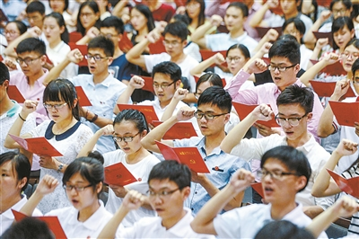
Resumen: En un sistema en el que los ministros están incentivados a informar sólo una buena noticia, el ministro de Educación de China censura pública de los fracasos en la educación ideológica y política (思想 政治 教育, IPE) en las universidades chinas fue una sorpresa (FRI, 12 de marzo). Se está llevando a cabo una campaña para intensificar el IPE desde la conferencia de diciembre de 2016 sobre el trabajo ideológico y político en las universidades y colegios de China. En la conferencia, el presidente chino Xi Jinping reafirmó enérgicamente la supremacía del marxismo y el socialismo en las instituciones chinas de enseñanza superior, y presionó para fortalecer el trabajo ideológico y político para adoctrinar a los 37 millones de estudiantes universitarios del país (Xinhua, 9 de diciembre de 2016).

In a system where ministers are incentivized to report only good news, China’s Minister of Education public censure of failures in ideological and political education (思想政治教育; IPE) at Chinese universities came as a surprise (FRI, March 12). A campaign has been underway to intensify IPE since a December 2016 conference on ideological and political work in China’s universities and colleges. At the conference, Chinese President Xi Jinping strongly reaffirmed the supremacy of Marxism and socialism in Chinese institutions of higher learning, and pressed for strengthening of ideological and political work to indoctrinate the country’s 37 million college students (Xinhua, December 9, 2016). Yet the Minister of Education’s criticisms indicate that IPE is not proving successful.

The Status Quo of IPE

Chinese colleges have a long history of radicalism that stirs fear among Party elites. Whether it was the Red Guard movement, the 1989 student demonstrations, or the recent nationalist protests, the college campus, with its proclivity for freethinking, is a place where the Party cannot afford to let go of the reins. Chinese universities are firmly controlled by the state through finances and appointment of administrative leadership. Even outwardly independent private colleges are falling under the control of newly installed Party secretaries with the clear intention of being the “backbone of ideological and political work (China Wenming Online, January 13).”

According to surveys completed by Chinese researchers, the Party enjoys majority support among college students—with one poll showing that 73.3 percent “support” or “strongly support” the Party’s leadership. [1] Although we must be aware that China’s political climate deeply influences how interviewees answer a survey, research has shown that the Party does have a healthy level of support among college students. [2] Nonetheless, student support for IPE, the Party’s signature indoctrination program, is comparatively low.

Mixing Marxism, patriotism, and some traditional Chinese values, IPE aims to rally mass support for the Party, its ideology, and its governance. Taught as a required course, one study shows that 64.4 percent of students are “unsatisfied” with IPE, with another 17.9 percent “very unsatisfied.” [3] Likewise, 50 percent of respondents in another study find IPE “almost pointless,” but forced themselves to attend due to school rules. Plagiarism and cheating are common due to students’ falling enthusiasm. [4] Despite interest in Red Culture (红色文化), a set of state sponsored cultural values based on the Chinese Communist Party’s revolutionary experience—a notable minority (28.3 percent) of students find Red Culture events (a component of IPE) boring. Over half (53.2 percent) said they were forced to attend, and 60.5 percent view these events as irrelevant to real life. [5]

Why is IPE so Unpopular?

Political indoctrination is rarely fun, especially for students living in a relatively open society. While students demand more discussions, debates and field work, IPE teachers can only continue with monotonous lectures because any exercise involving critical analysis will shatter the perfect image of Marxism. [6] Thus, while Chinese college students loathe IPE for being a “single-voice class” (一言堂) where the teacher dominates the conversation, changes are less likely to come as it could possibly destroy IPE in its entirety. [7]

IPE is fighting an uphill battle in three areas. The increasing Internet usage by Chinese college students is corroding the hold of official ideology. For example, the officially championed myth of the Chinese Communist Party as the mainstay in expelling Japanese invaders is slowly losing believers, because more and more students are learning the truth from the Internet. [8] Eighty percent of Chinese college students spend more than two hours a day surfing the Web, 92 percent say they use the Internet as a source of information, and 88.9 percent use Weibo (Chinese equivalent of Twitter) and WeChat (Chinese equivalent of WhatsApp)—two apps that allow students some modicum of privacy when discussing current affairs. [9]

The arrival of organized religion to Chinese campuses poses another threat to official ideology. Besides offering mental comfort, organized religious groups serve as a social safety net for students, in comparison to communist political organizations that are fraught with corruption and exclusivism. Recent studies show that interest in religion is gaining strength in Chinese colleges, even in the Communist Youth League. [10] Forty-nine percent of students do not know that Party members must be atheists, and a third (31.4 percent) do not mind campus proselytizing—an act forbidden by the state. [11] While the growing interest in religion has not openly challenged the Party’s dominance of campuses, one trend might spell trouble in the near future. In one survey of Xinjiang colleges, 5.8 percent of respondents believe one can force a religion on others. [12] More alarmingly, 8.6 percent agree with the extreme position that spreading one’s religion using violent means is permissible. [13]

IPE educators face additional difficulties in areas dominated by ethnic and religious minorities, in particular among Tibetans and the Turkic Muslims of Xinjiang. Few of these groups played major roles in the events of the 20th century that conditioned the contemporary Chinese psyche. Compared to Mongols and Hui Muslims that allied with Chinese communists in the fight against Japan, Tibetans and Turkic Muslims played next to no role in the in the War of Resistance Against Japan (1937–1945) which forms the core of the CCP’s national narrative. Moreover, Marxism’s anti-religion doctrine makes IPE difficult when teaching Tibetan college students who hold Lamaism in high regard. Most Tibetans live their entire life according to Buddhism precepts and hold deep reverence for their religious leaders. To teach religion as obsolescent is not only deeply offensive to Tibetans, but also counterproductive to IPE in general. [14] The same can be said for Xinjiang, where ethnic Turkic Muslims constitute more than half of the province’s population. Although students would pay lip service to the curriculum just so they can graduate, the doctrinaire system of pedagogy is not truly winning over hearts and minds.

The Role of Political Counselors

Outside of the classroom, Political Counselors (政治辅导员; PCs) take care of a student’s all-around needs while attending college, and are tasked with shaping his/her ideological and political values. As the “backbone of ideological and political education for college students,” PCs are “the organizer, implementer and mentors of college students in everyday ideological and political education and management” (Ministry of Education, July 23, 2006).

Working closely with selected student cadres, the PCs spread the Party’s message when students are outside of the classroom. Although the law stipulates that there should be one PC to every 200 students, in reality, personnel shortage makes the ratio much higher. One to 300 or 400 is not an unusual number. In extreme cases, it has been reported that a PC have to take care of 1,000 students, making the job impossible. [15]

Besides being over-encumbered, 56 percent of PCs are unsatisfied with their salary and benefits. To add to the already tense environment, PCs are governed by a dual command regime, where school and department leadership can sometime issue conflicting orders. [16]

Under these circumstances, it is not a surprise to find that some PCs do not even agree with the Party line themselves. One poll shows that 31.92 percent of PCs do not believe in the Marxist dogma that a communist society is inevitable. Straying from the government narrative, close to half (47.1 percent) of PCs do not believe that the income gap will close in ten years. [17]

The Role of Protection Divisions

If IPE teachers and PCs are the softer side of political indoctrination, then Protection Divisions (保卫处) are the “stick” that police political behavior. Present in every university bureaucracy, the Protection Division have several functions—public safety, fire prevention, registering visitors and temporary workers—and most importantly, political policing. Underneath each Protection Division there is a Political Protection Section (政保科; PPS). While taking on different names at different colleges, the mission of the PPS remain more or less the same—propagate official ideology and counter any attempts by “hostile forces” in influencing students. Although the PPS do not have law enforcement power, a power reserved for the public security police, it does have the power to investigate. [18] Political Protection Informants (政保信息员), selected from the student body, serve as the PPS’s “eyes and ears (耳目)” (Xi’an Shiyou University, June 6, 2014).

Given the secrecy surrounding its work, most PPSs do not publicize their duties, but the PPS of the Harbin Institute of Technology, self-referred to as the Political Protection and State Security Office (政保国安办), openly declares its responsibilities as the following:

  1. Responsible for propaganda and education of the national security concept, enemy awareness, and political stability.
  2. Responsible for understanding, controlling, tracking, and ideological education of key people that can influence political stability.
  3. Responsible for carrying out research and information gathering; grasp the ideological trends among faculty and students in a timely and accurate manner to provide the basis for higher-level leadership decision-making.
  4. Cooperate with public security and state security police in detecting and investigating cases endangering state security.
  5. Responsible for security of important leaders and foreign dignitaries. Assist relevant agencies in implementing security measures for foreign experts, teachers, exchange students, compatriots from Hong Kong, Macau, Taiwan, and visiting foreign staff.
  6. Assist relevant agencies to prevent and punish infiltration, incitement, and sabotage of schools by domestic and foreign hostile forces, illegal religious forces, and ethnic separatist forces.
  7. Assist relevant agencies in secure management of the campus’s computer network system and identification of sources of harmful information.
  8. Assist relevant agencies in confidential work.
  9. Conduct political review of school staff in accordance with the requirements of relevant agencies.
  10. Assist relevant agencies in managing student associations.
  11. Conduct basic business work. Establish and improve the management of various data files.
  12. Assist other sections and offices in completing tasks. Complete any other mission assigned by the division director (Harbin Institute of Technology).

In essence, PPS is the monitor of campus security and ideological uniformity, in addition to serving as the workhorse of counterintelligence. While IPE staff focus on pedagogy, it is the PPS’s mission to keep out unofficial people and ideas. This repressive regime is likely to receive greater state investment due to the risks associated with liberalizing IPE.

Conclusion

Among Chinese college students, support for the Party and government remain strong—at least on paper. However, most students have shown their dissatisfaction with IPE and their inability to intake additional political coursework void of liberal teaching methods. In the future, the state will likely strengthen IPE in the following ways. Firstly, the state will try to assert greater control of the cyber sphere by clamping down on alternative sources of information popular among students—also by intensifying propaganda and counterpropaganda on Weibo and WeChat. Secondly, more PCs will be trained to alleviate the current personnel shortage. Thirdly, greater attention will be diverted to indoctrination in ethnic areas, especially to the Tibetan and Turkic Muslims most susceptible to what the state calls the “three evils” of terrorism, separatism and religious extremism. Finally, there will be a renewed pushback against the spread of religion in colleges, a trend, if unchecked, will present significant challenges in winning over China’s brightest young minds.

Fuente: https://jamestown.org/program/political-indoctrination-chinese-colleges/

Comparte este contenido:
Page 4024 of 6193
1 4.022 4.023 4.024 4.025 4.026 6.193