América del Sur/Argentina/Abril del 2017/https://www.clarin.com
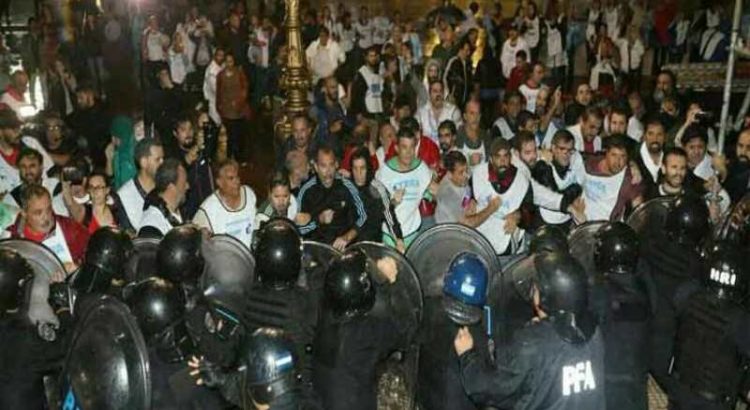
Tal como se anticipaba, varios piquetes complicaban esta maañana el acceso a la Ciudad de Buenos Aires. En todos los casos, las protestas realizadas por partidos de izquierda, se daban en medio de importantes operativos de seguridad de Gendarmería nacional, Prefectura y Policía, que intimaban a los manifestantes a desalojar. Y en algunos puntos, en especial sobre la Panamericana, esto generaba momentos de tensión por un posible desalojo.
Desde el sur por el Puente Pueyrredón el ingreso está totalmente interrumpido por un piquete muy nutrido, que afecta ambas manos de circulación, y que es custodiado de cerca por una importante presencia de personal policial y de Prefectura.
Fuerte operativo por el corte en la Panamericana. (Juan Manuel Foglia)
También se registra un piquete muy importante sobre el acceso Norte, en la ruta Panamericana a la altura de la ruta 197, que impacta en la mano que ingresa a la ciudad de Buenos Aires. Allí, la Gendarmería negociaba con los manifestantes y se vivían algunos momentos tensos por un posible desalojo del piquete. Allí las fuerzas de seguridad intentaban liberar al menos un carril para la circulación.
Paro del 6 de abril: cortes y piquetes programados en Buenos Aires
Poco antes de las 8, se registraron algunos incidentes menores, que incluyeron empujones y gritos, entre los manifestantes y el personal de seguridad en el Puente Pueyrredón.
La circulación de vehículos también era complicada en la esquina de Corrientes y Callao, donde un grupo de de militantes de izquierda, entre otras agrupaciones, cortaban esa esquina. De todas formas, el tránsito en la Ciudad era muy fluido, ya que hay menor ingreso de vehículos y no hay colectivos en las calles.
Las estaciones de pago de peaje están liberadas, por lo cual se pasa sin pagar, a la vez que el estacionamiento en la Ciudad durante la jornada es libre y gratuito.
Paro de transporte del 6 de abril: trenes, colectivos y vuelos desde Aeroparque y Ezeiza afectados
Más tarde, también habrá piquetes en 9 de Julio y Corrientes, en el acceso Oeste (altura hospital Posadas), en General Paz y Constituyentes y a las 11 frente al hotel Hilton, donde realizará sus deliberaciones el capítulo latinoamericano del Foro Económico Mundial.
Although this is the final reading of the bill in the Lords, its parliamentary journey may not be over. This is because of the likely prospect of much back and forth between the Lords and Commons – known as parliamentary “ping-pong”.
While that plays out, here’s an update on what’s happened so far.
What is the bill?
The Higher Education and Research Bill aims to improve competition and choice in higher education.
It follows on from the white paper, Success as a Knowledge Economy, and sets out the government’s plans to reform the organisation and regulation of the sector.
These changes include making it easier for new providers to offer degrees alongside existing universities.
What is the Teaching Excellence Framework?
The Teaching Excellence Framework (TEF) is a new assessment designed to “measure” and “improve” the student experience and teaching quality in higher education. The TEF results will be used to award gold, silver or bronze ratings to universities. These are intended to help students select where to study.
But the government wants the TEF results to do more than this. For example, the home secretary said the number of visas for international students would be restricted. And for the government, TEF ratings provide an easy and transparent way to decide which universities get to award these places. Universities that do well in the TEF can recruit international students.
Changing the face of higher education.Davide Cantelli/Unsplash
In this way, the TEF is about rewarding organisations on their performance. And this can also be seen in the link between TEF results and fee increases. If universities can demonstrate they are performing satisfactorily they will be rewarded with the power to raise fees – but only by inflation.
This “reward” of raising fees acts as an incentive, encouraging universities to prioritise and deliver on the government’s objectives, as embodied in the TEF. It also creates competition, as universities compete for the rewards on offer.
In theory, competition drives service improvement and efficiency, so the TEF – however flawed it may be – can be seen as a way to address performance issues“ in higher education. And this is done by providing a «performance measure” with consequences attached.
In 1982 the Conservative government commissioned a report to guide higher education policy thinking. This report recommended a series of market based strategies to challenge the “inertia” of academia.
But it was deemed so controversial it was kept secret, and only came to light when released following a 30-year confidentiality classification. Yet some 35 years later, the ideas in the report don’t seem so radical – with the current government pushing for the opportunity to implement change along these lines.
What are the changes?
Since January, the House of Lords has debated the most controversial aspects of the bill, where the TEF received particular criticism.
The details of the TEF were deliberately kept out of the bill – enabling the TEF to evolve overtime and not be set in stone by legislation. However, where the TEF relates to other parts of policy was subject to scrutiny.
Specifically, the Lords voted for an amendment prohibiting TEF results from informing fee increases or the number of students a university could recruit.
Reforming the sector.Tm Gouw/Unsplash
Peers also voted to enshrine in law a requirement for the TEF to be “independently evaluated” – to ensure the validity of the data and metrics. And that any future design changes to the TEF would require full parliamentary approval – removing the government’s discretion to revise it.
These proposed changes were welcomed by those who are oppose to the idea of the TEF being linked to fee rises – such as the National Union of Students.
Peers also voted for amendments which require new providers of higher education to have four years of experience before receiving degree-awarding powers.
What’s happened so far?
The government doesn’t appreciate these attempts to scale back the scope of their reforms. In March the universities minister, Jo Johnson, wrote to peers reaffirming his commitment to the TEF as the government proposes it – indicating that they will try and resist the changes proposed in the Lords.
However, the government has shown it will compromise. In February it made modest modifications to the bill. These amendments were designed to win over peers – but they are largely technical and don’t undermine the big ideas driving policy.
What happens next?
The House of Lords’ amendments are extensive, looking less like minor revisions and more like the recasting of higher education policy. And the government is more likely to reject significant amendments that frustrate their ambitions.
After the third reading in the Lords, the amended bill will go to the Commons for consideration by MPs. Here, the government will be in a stronger position, as, unlike in the Lords, the Conservatives have a majority.
The political and policy factors behind the government’s reform agenda explain why they will not embrace the Lords’ amendments. But the Lords cannot be ignored as both houses must agree the final text of the bill. This means there will be much more political manoeuvring in the coming weeks.
Oceanía/Australia/Abril del 2017/Noticias/https://theconversation.com/
¿Por qué las escuelas quieren que todos los estudiantes se vean iguales?
Reseña:
¿Por qué las escuelas están tan obsesionadas con que todos los niños tengan la misma apariencia? Al final del siglo 20 , las escuelas en Australia han optado por estrictas políticas de uniformes, donde los estudiantes usan un conjunto idéntico de ropa. Señalan que al proporcionar un enfoque general de las políticas de uniforme escolar, las escuelas corren el riesgo de reprimir la identidad cultural y la diversidad. Se establece un debate: ¿Están las pólizas de uniformes escolares por encima? Tradicionalmente, los uniformes en las escuelas han servido para homogeneizar el cuerpo estudiantil y crear un sentido de pertenencia a la escuela. Comparan conductas de estudiantes en diversos países. En fin se centran el la personalidad del niño y la incidencia en su forma de expresión e identidad al portar el uniforme escolar. Concluyen en que las escuelas deben trabajar con su cuerpo estudiantil para enmendar y actualizar sus políticas uniformes, y buscar retroalimentación de la comunidad en general.
Why are schools so obsessed with all children looking the same? Since the later part of the 20th century, schools in Australia have opted for strict uniform policies, where students will wear an identical set of clothes. Often that extends to the style of hair that’s allowed; what backpack, shoes, and even, in some instances, what underwear to wear.
But by providing a blanket approach to school uniform policies, schools risk repressing cultural identity and diversity.
A school in Victoria recently made the news after banning two South Sudanese girls from wearing their hair in cornrows because it didn’t comply with the school’s uniform policy.
The hairstyle is commonly worn by the girls’ cultural group and appropriately suited to the care and maintenance of their hair.
It was reported that the school tried to justify its position by saying that all students have to comply with the rules around school uniform, and that it had asked white students returning from holidays to Bali to remove their braids.
Following a huge backlash over the decision, the school has since backed down. But the decision has since sparked debates around whether school uniform policies are discriminatory, and around the need for schools to embrace their students’ identity and diversity.
Each state has anti-discriminatory law in place that prevents schools from enforcing uniform options that disadvantage students due to sex and culture, among other factors.
Within this law however, there is usually a clause that allows schools to enforce “reasonable” uniform requirements. But what is reasonable can be tricky to define.
Are school uniform policies over the top?
Traditionally, uniforms in schools have served to homogenise the student body and create a sense of school membership.
Most schools argue that requiring everyone to look “uniform” leads to advantageous outcomes including improved academic performance and attendance, and enhanced student discipline.
A recent study, using data from 39 countries, found that wearing uniforms in schools did help students to be better behaved.
Another study in America, however, found that students who were not wearing school uniform performed better academically than those who did wear uniforms. For these students, the research showed that behaviour and attendance were not affected by whether students wore school uniform or not.
Repressing children’s desire to express personality and identity?
In the 1960s and 1970s in Australia, resistance grew to many aspects of the authoritarian practices of school life, including the wearing of a uniform.
The uniform came to be seen as a symbol of student oppression that suppressed the right to self-expression. How one wore one’s hair became a particular source of conflict as students wanted to follow the style of pop stars, and leaders in schools felt this was the slippery slope to anarchy.
Queensland University of Technology professor Jennifer Craik argues that school uniforms are used to
not only control the body and its behaviour but also actively produce the particular attributes of the self that are deemed desirable by the school.
As such, the “desired” options more often that not reflect the dominant cultural and gender group, increasing the likelihood that those in the minority will be further marginalised.
Australia is now so diverse, that to apply a blanket approach following traditional dress requirements is thoughtless at best, and discriminatory at worst. Such restrictive uniform requirements also create tension between students and schools.
Self-expression
Children and young people yearn for the right to self-expression through hair, dress and facial decoration. Outside the school grounds, we see this in hair of varying colour, jeans ripped and tight, facial hair of varying styles, and make-up applied liberally.
We know that as children develop into adolescents they begin to make independent choices and assessments about who they are, who they will be, and how they will act in the world. As such, they often desire increased independence.
Despite this – or perhaps because of it – schools have rigidly detailed uniform policies in place that police all aspects of how students present themselves.
It is not unusual for uniform policies to state that shorts are for boys and skirts are for girls; that hair length for boys must be above the collar; that skirt length must be just below the knee; that jewellery is to be no more than one watch and one pair of studs; that boys are to be clean shaven; and that socks for boys are white, and socks for girls are brown.
Some schools are starting to be more flexible, updating their uniforms and introducing gender neutral options. Carey Grammar in Melbourne for example introduced pants for girls this year. And Mable Park State High School in Brisbane has had a gender-neutral uniform for two years.
However, in schools with such strict policies, it is no surprise that students rebel against these expectations – especially when they do not see this way of dressing reflected in the adults around them in workplaces (in the majority of cases).
Too arbitrary?
Young people may be more prepared to accept the limiting of their choices if the limits applied are not arbitrary, out-dated and in some cases, directly discriminatory.
While some restrictions of choice in school uniforms may be justifiable (for safety reasons, such as leather shoes in home economics), inequity and discrimination have no place in Australian schools.
If schools wish to retain school uniforms, they must ensure that uniform policies do not unfairly impact on one group of students.
Schools should work with their student body to amend and update their uniform policies, and seek feedback from the broader community.
América del Sur/Argentina/Abril del 2017/Reseña/http://www.clacso.org.ar/
Estela Fernández Nadal. Gustavo David Silnik. [Autores]
CLACSO Coediciones.
ISBN 978-987-1891-03-0
CLACSO. CICCUS.
Buenos Aires.
Agosto de 2012
Hinkelamert es un filósofo de una envergadura y una densidad teórica rara vez alcanzada, incluso si consideramos los exponentes más destacados de la filosofía occidental actual, que si no ha obtenido la difusión que merece ni ha sido comprendido en su verdadera dimensión es porque se trata de un autor que escribe en español y que vive, desde hace cincuenta años, en América Latina. Hinkelammert no es un marxista secretamente escondido en las filas de los intelectuales de la Iglesia ni un espíritu religioso, introducido furtivamente y camuflado en el campo del marxismo académico; es un filósofo que, como muy pocos, ha elaborado una interpretación de la Modernidad, y particularmente de la Modernidad tardo-capitalista actual, en la que se desnudan tanto sus deudas y sus continuidades con modalidades de la existencia humana premodernas, como su específica y moralmente ambigua capacidad de cambio y novedad. La comprensión de lo primero y de lo segundo (las continuidades y rupturas de la Modernidad con la Cristiandad, entre otras cosas) exige una revisión radical del concepto de secularización, a fin de permitirnos captar la pervivencia de una mitología tan antigua como resistente, que, con nuevos envoltorios, proporcionados por ideologías profanas, mantiene vivos todos los lugares. Teología profana y pensamiento crítico es un análisis penetrante y sin concesiones sobre las divinidades que pueblan nuestra sociedad secularizada y sobre los mitos que justifican la obediencia a su lógica «racional»; un análisis necesario, en tanto es la base sobre la que tiene que levantarse hoy un pensamiento que aspira a ser crítico, en el sentido emancipatorio en que Hinkelammert entiende ese término: una crítica que, frente al discurso hegemónico que predica la necesidad de salvar el mercado y de someternos a la ley de la oferta y la demanda, se lleva adelante en función de la sobrevivencia de la humanidad, en tanto condición de posibilidad de la conservación de las fuentes de toda riqueza (la naturaleza y el ser humano), amenazadas hoy por la absolutización del mercado. De la Introducción de Estela Fernández Nada.
Au lendemain de la publication des résultats de l’enquête nationale menée par Synoptic et le CGET sur les « cordées de la réussite », et après cinq ans d’existence, il paraît important de faire le point sur les résultats de la cordée « Banlieue-Est, cap vers les sciences ».
Créée en 2008, l’expression « cordées de la réussite » désigne des partenariats entre un établissement d’enseignement supérieur et des établissements de l’enseignement secondaire, collèges, lycées. L’objectif était de promouvoir l’égalité des chances et d’augmenter l’ambition et la réussite des jeunes de milieux sociaux défavorisés dans l’enseignement supérieur. Si en 2008, 100 cordées étaient labellisées, actuellement plus de 375 dispositifs labellisés sont répartis sur le territoire.
Reconnue en 2011, la cordée de la réussite « Banlieue-Est, cap vers les sciences » de l’université Paris Est Créteil Val-de-Marne (UPEC) s’inscrit comme un dispositif cherchant à promouvoir l’ambition des jeunes issus d’une académie située sur un territoire scientifique, économique et industriel très riche. Paradoxalement ce même territoire est extrêmement défavorisé au regard du niveau social de la population et donc des jeunes filles et garçons que cette académie a en charge de former.
Portée par la faculté des sciences et technologie de l’UPEC, notre cordée a pour objectif plus spécifique de promouvoir les filières scientifiques auprès de ces jeunes de banlieue qui très souvent manquent d’ambition, s’autocensurent, ou n’ont pas les réseaux permettant d’atteindre ces formations. Pour mener ses actions, ce dispositif s’appuie sur le principe du « gagnant-gagnant » et, de manière originale, principalement sur les parcours de Licence dédiés aux métiers de l’enseignement, en Sciences de la Vie et de la terre (SVT) et depuis peu, en Mathématiques.
La cordée : une préformation d’enseignants !
Ainsi, depuis 2011, 138 étudiants, dont 108 futurs enseignants ont été impliqués dans des actions de tutorat, d’aide aux devoirs, d’orientation, de promotion des sciences… avec des approches et des relations aux élèves que les étudiants n’auraient pas pu approcher dans une formation « classique » au métier d’enseignant (qui ne débute généralement qu’en Master).
Banlieue-Est, cap vers les sciences.
Cette (pré)-formation originale de futurs enseignants résonne avec l’article récent de nos collègues B. Mabilon-Monfils, A. Jaillet et L. Numa-Bocage. Ce que nous avons développé dans notre cordée de la réussite apporte très certainement quelques arguments en faveur des différentes propositions qu’ils listent pour mieux former nos futurs enseignants : formation disciplinaire et professionnelle dès la L3 (1.1) ; intervention en classe dès la L3 (1.2) ; former autrement (2)…
Avec un peu de recul, qu’il s’agisse de futurs enseignants ou non, les compétences qu’acquièrent les étudiants lorsqu’ils mènent ces actions (concernant l’autonomie, le management, la posture, la communication) leur seront, à n’en pas douter, nécessaires tout au long de leur parcours professionnel et social.
Des actions dès le collège ?
Les autres « gagnants » sont, bien entendu, les 1 000 lycéens et collégiens qui, chaque année, bénéficient des actions menées par nos étudiants. Si l’on s’intéresse à l’impact de la cordée de la réussite « Banlieue-Est, cap vers les sciences » sur les élèves des deux collèges et du lycée présents depuis l’origine, que peut-on observer ?
Classiquement, beaucoup d’efforts ont été concentrés au travers des cordées de la réussite sur le lien lycée-supérieur, mais nos actions indiquent que nous pouvons également agir sur le lien collège-lycée qui est tout aussi déterminant pour l’orientation et l’ambition des jeunes. En effet 60 % des 185 collégiens qui ont participé à notre enquête jugent que la cordée de la réussite – au travers des travaux pratiques pour les 3e qui sont organisés dans leur lycée de secteur – a eu un impact important sur leur choix. Ils se sentent par ailleurs encouragés à poursuivre des études scientifiques.
Profiter de ces travaux pratiques pour visiter le lycée est même une « bonne idée » pour prêt de 80 % d’entre eux ! Cet impact n’a été possible que par une action qui va toucher de manière systématique, tous les élèves de 3e. Si nous nous étions limités aux actions de tutorat, de club sciences, seuls 30 % des collégiens en auraient bénéficié, ce qui montre bien l’importance du lien collège/lycée et d’actions précoces et généralisées pour l’orientation dès la 3e voire la 4e.
Qu’en est-il au Lycée ?
D’un point de vue pratique, nous avons réalisé notre enquête auprès des 120 1re S du Lycée Champlain, où les élèves issus des collèges sources, Boileau et Molière, ne représentent que 21 % des lycéens. 68 % de ces élèves ont déjà été concernés par des actions notre cordée de la réussite, ce qui semble s’expliquer par les actions menées dans les collèges, mais aussi dans les classes de seconde où nous effectuons notamment une conférence scientifique sur l’exobiologie, dynamisée par l’utilisation de boîtiers de vote. Parmi ces lycéens, 62 % d’entre eux envisagent de poursuivent leurs études dans un domaine scientifique, tandis que 12 % ciblent d’autres domaines et 26 % restent indécis quant à leur avenir.
De plus, une grande majorité des lycéens (82 %) plébiscitent la coorganisation et la coréalisation des séances de travaux pratiques entre le lycée et la faculté des sciences, ainsi que l’implication de nos étudiants dans la mise en œuvre et l’encadrement de ces séances avec les lycéens. 59 % recommanderaient d’ailleurs à un camarade de participer à cette cordée de la réussite pour développer leur culture scientifique.
Malgré cela, seuls 20 % des lycéens déclarent que les actions de la cordée de la réussite ont eu une incidence sur leur projet de poursuite d’études dans une filière scientifique ! Ce résultat est assez paradoxal, car si l’on se concentre sur l’évaluation des actions de la Journée nationale des Cordées de la Réussite, il apparaît que la vision de l’université a complètement évoluée pour près de 43 % des lycéens. Ces chiffres seront donc à encore préciser lors des nouvelles enquêtes qui seront réalisées en fin d’année.
Les enseignants : les autres bénéficiaires !
Au sein des cordées de la réussite, en dehors des élèves et étudiants, d’autres populations profitent aussi du système gagnant-gagnant ! Ainsi, les enseignants des collèges rencontrent et échangent avec leurs collègues du lycée, avec les enseignants de l’université, pour la mise en place des ateliers scientifiques, des aides aux devoirs, des travaux pratiques au lycée (pour les 3e) et à l’université (pour les 1re S)…
Les discussions tournent alors autour de l’alignement pédagogique, de l’intégration des actions dans le programme, du développement de nouveaux enseignements, de conférences de découvertes en lien avec les enseignements universitaires (méthodologie, organisation) et les laboratoires de la faculté des sciences… C’est une vraie action de promotion de la culture scientifique et technologique qui est effectuée.
Même si cela n’a pas encore été mesuré, les changements s’opèrent, le regard de l’un vers l’autre évolue ! Les enseignants du secondaire interagissent plus avec ceux du supérieur pour certains points du programme (conférences, prêt de matériel…). Ainsi ils sont de plus en plus nombreux à sauter le pas et participer aux enseignements en Licence. Ils voient comment le supérieur a évolué, ils perçoivent la transformation pédagogique en cours et espèrent ainsi mieux former leurs élèves à la réussite dans le supérieur.
Mais l’inverse est aussi vrai ! L’enseignant de Licence adapte (aussi) ses pratiques grâce à une meilleure appréhension de son public étudiant, suite aux rencontres, collaborations qu’il mène avec ses collègues du secondaire.
Bien entendu, il reste de nombreuses choses à améliorer, mais ce laboratoire de l’ambition et de la réussite qu’est notre cordée de la réussite « Banlieue-Est, cap vers les sciences » nous donne quelques pistes intéressantes pour travailler sur le développement de l’excellence sociale et sociétale qui
« vise à donner à tous les élèves qui ont le potentiel et la motivation, et sans exclure personne a priori, les moyens d’atteindre leur propre niveau d’excellence » (J.-M. De Ketele).
Reseña: En Kenia cada niño y niña al igual que los representantes tienen conocimiento de la prosecución de los estudios al igual que los niveles en la escuela primaria y secundaria. De manera que los profesores hacen hincapié en las altas calificaciones de los exámenes, con largas horas de clase que son sólo una parte de la preparación para el examen final que determina la admisión a la universidad. En este sentido hacen referencia a el sistema actual de educación que comienza con ocho años de escuela primaria seguido por cuatro años cada uno para la escuela secundaria y la universidad. Entre los cambios señalan que los niños serán capaces de aprender a su propio ritmo y no ser peones en un sistema de educación que está obsesionado con altos puntajes medios. Por lo tanto, el nuevo currículo ofrece a los padres la oportunidad de participar en la educación de sus hijos.Estos padres empoderados tomarán la iniciativa de participar en la escuela, en casa y dentro de la comunidad.Más importante aún, el plan de estudios ayudará a asegurar el desarrollo integral de los niños dentro de un ambiente de aprendizaje amistoso.
Every child and parent in Kenya knows all too well that grades matter. During the final year of primary school, pupils sit to write a nationally administered exam that determines their progression to secondary school. Children have to attain high grades in the Kenya Certificate of Primary Education (KCPE) to secure places in the best secondary schools – public or private.
Here too, the teachers emphasise attainment of high grades, perhaps even more than back in primary school. Long hours in class are just a part of the preparation for the final exam which determines admission into university.
Private schools, which many parents opt for, have a financial incentive to pursue high grades for their students. When these schools attain a high mean grade, they draw more students into their ranks which translates into higher revenues.
This obsession with high exam grades means extra pressure on children to cram content in order to pass a series of internal exams leading up to KCSE. It also means that schools have little time to pay attention to learners who are struggling with the challenges of adolescence.
Learners received little guidance on appropriate coping mechanisms that would enable them to deal with the academic pressures and other life changes that they were experiencing. Those that became truant and undisciplined were eventually pushed out of the school because they weren’t meeting the minimum grades expected.
But a fundamental change is about to take place. A new education system is set to replace the 32 year-old 8-4-4 system which has come to symbolise much of what’s wrong with education in Kenya today. The current system of education starts with eight years of primary school followed by four years each for secondary school and university.
The changes mean that children will have an opportunity to be children. They will not be pressured to get high scores so that they can join the so-called ‘good schools’. Children will be able to learn at their own pace and not be pawns in an education system that’s obsessed with high mean scores.
The changes proposed in the new curriculum are aligned to the vision of the new curriculum reform and that is to
enable every Kenyan to become an engaged, empowered and ethical citizen. This will be achieved by providing every Kenyan learner with world class standards in the skills and knowledge that they deserve, and which they need in order to thrive in the 21st century
Children will be children
The new 2.6.3.3.3. curriculum is designed to place children’s needs before those of their teachers, schools and parents. It aims to enable every Kenyan child to be an engaged, empowered and ethical citizen. This will be accomplished by equipping teachers with the means to teach well, within school environments that have adequate resources for every learner.
Effective delivery of the curriculum will require knowledgeable and professional teachers who can use appropriate teaching methodologies including coaching, facilitation, and mentoring. In this way, teachers will be viewed as role models who inspire learners to achieve their potential.
Moreover, teachers will need to adapt this curriculum to meet the requirements, interests, and talents of every child, while diagnosing the learner’s needs and collaborating with other significant people in the child’s life such as parents and members of the local and wider community.
Another change in the new curriculum is elimination of summative evaluation. This refers to exams that were done at the end of 8 years of primary school, four years of secondary school, and four years of high school, in the 8.4.4 system of education. Instead, it spreads out the evaluation throughout the duration of the child’s stay in school.
Children will be assessed based on their competencies, meaning their ability to apply knowledge and skills in performing various tasks within specific settings. This will help determine the individual strengths and weaknesses of the learners.
There will be two types of evaluation in upper primary. Formative assessment will be continuously administered from grades 4-6. This will enable the continuous monitoring of learning and provide regular feedback that teachers can use to improve their delivery.
Summative assessment for a group of randomly selected learners from across the country, will be administered at the end of grade 6. Their performance will be used to gauge the overall ability of all the students transitioning to Grade 7. In doing so, the new curriculum moves away from a one-off summative assessment and embraces an approach where all children’s abilities are recognised and appreciated.
Navigating life’s challenges
They will also be exposed to life skills from pre-primary in addition to all the other subjects that they will be taught. This will ensure that from an early age, children have the opportunity to acquire the necessary skills to help them navigate life’s challenges as they progress with their education.
life skills refer to both psycho social and interpersonal skills that can assist people to make informed decisions, communicate effectively and develop coping and self-management skills that would help lead to a healthy and productive life.
Children in senior secondary will be exposed to community service and physical education. The assessment of this level of education will be based on project work, national examinations and community service, in which parents and other stakeholders will be involved. Moreover, parents and other players will help in identifying opportunities for the learners to apply their competencies. Teachers will then document the learner’s achievement.
This emphasis on parental involvement reflects the importance that the curriculum places on the role of parents. Parental involvement has been a key component of two intervention studies conducted by the African Population and Health Research Centre (APHRC), in Nairobi’s informal settlements.
APHRC research has documented that the school is just one place where the teaching of life skills occurs. In the home and family setting, parents shape the attitudes, skills, and values that young people acquire. The project, Improving Learning Outcomes and Transition to Secondary School, showed that communication between parents and their children improved learning outcomes.
More research shows that parental communication with a child of the opposite gender (father to daughter and mother to son) significantly reduces risky behaviour and delays sexual activity among adolescents.
The new curriculum therefore offers parents the opportunity to be involved in their children’s education. These empowered parents will take the initiative to participate in school, at home and within the community. More importantly, the curriculum will help ensure the holistic development of children within a friendly learning environment.
UNESCO invita a sus Estados Miembros y a las Organizaciones no Gubernamentales que colaboran oficialmente con la UNESCO, en consulta con sus Comisiones nacionales para le UNESCO, a presentar candidaturas para la edición 2017 del Premio UNESCO/Juan Bosch para la Promoción de la Investigación en Ciencias Sociales en América Latina y el Caribe 2017.
La fecha límite de presentación de candidaturas es el 30 de mayo de 2017 a medianoche.
El Premio UNESCO/Juan Bosch para la Promoción de la Investigación en Ciencias Sociales en América Latina y el Caribe fue instituido por el Consejo Ejecutivo de la UNESCO en 2009, por iniciativa del Gobierno de la República Dominicana. Al crear este premio, el Consejo Ejecutivo reconocieron el valioso aporte del Profesor Juan Bosch al estudio de los procesos sociales y políticos de la República Dominicana y de la región del Caribe. Escritor, político, analista de la sociedad y ferviente defensor tanto de valores democráticos como de la cultura de la paz en América Latina y el Caribe, Juan Bosch ejerció, mediante su obra, una gran influencia en la República Dominicana y en toda la región.
El premio tiene por finalidad recompensar cada dos años, las mejores tesis en ciencias sociales de jóvenes de la región de América Latina y el Caribe, que signifiquen una contribución importante respecto a la promoción de la investigación en Ciencias Sociales orientada a mejorar las políticas de desarrollo social.
De acuerdo con sus Estatutos, el Premio consiste en un diploma y la suma de diez mil dólares de Estados Unidos.
Cómo someter su candidatura
Los expedientes con las candidaturas deberán ser presentados en español o en inglés. Estos expedientes deberán llegarnos a más tardar el 30 de mayo de 2017por correo (documentos originales) y por correo electrónico.
Ningún Estado Miembro puede presentar más de tres candidaturas en la misma edición del Premio. Ninguna persona puede presentar su propia candidatura.
Enviar, debidamente firmado y sellado, acompañado de la documentación relevante del o de la candidato(a), a:
Sr Pedro Manuel Monreal Gonzalez
Secretario Ejecutivo del Premio UNESCO/Juan Bosch
UNESCO – Sector de Ciencias Sociales y Humanas
7 place de Fontenoy 75352 Paris 07 SP FRANCE
Tél.: +33 1 45 68 38 62
Correo electrónico: pm.monreal-gonzalez(at)unesco.org
OtrasVocesenEducacion.org existe gracias al esfuerzo voluntario e independiente de un pequeño grupo de docentes que decidimos soñar con un espacio abierto de intercambio y debate.
¡Ayúdanos a mantener abiertas las puertas de esta aula!