Page 4524 of 6194
1 4.522 4.523 4.524 4.525 4.526 6.194

Sudáfrica: Technology key to gear SA pupils into the 4th industrial revolution

Sudáfrica/Diciembre de 2016/Fuente: It News Africa

RESUMEN: La educación robótica comenzó hace más de una década en Sudáfrica. Sin embargo, el 90% de los alumnos en el país todavía no están expuestos a los fundamentos de la robótica. Hace menos de un mes, el departamento de educación redujo el nivel de aprobación de las matemáticas al 20%, elevando la espantosa perspectiva de una generación sin habilidades matemáticas, ya que el mundo en general abraza una cuarta revolución industrial.

Robotic education started over a decade ago in South Africa. However, 90% of pupils in the country are still not exposed to the fundamentals of robotics. Less than a month ago, the education department decreased the pass standard of mathematics to 20%, raising the frightening prospect of a generation without mathematical skills – as the world at large embraces a fourth industrial revolution.

This revolution, also known as Industry 4.0 is building, and South Africa is not prepared. In early 2000, the slow growth of robotics in South Africa was linked to cultural and socio-economic issues. But today, it is an entirely different issue as government seems to still prefer to promote arts and culture above science, technology, engineering and mathematics (STEM). Private schools in South Africa are already ahead of public schools, teaching pupils on robot education and investing in STEM subjects to upskill the pupil’s knowledge for the future.

The Deutsche Schule Pretoria has a robotics lab and with the help of leading global provider of technology and services Bosch, they have an outreach initiative established to share robot skills with those from disadvantaged communities in the Pretoria area. The robotics lab is open to over 130 outreach schools including Nantes and Norridge Park from Eersterust, Christian Boys College as well as Pula Difate, Koos Matli and Sikhanyisele from Mamelodi, with robotic skills and knowledge to build and design robots.

According to Dr. Markus Thill, President of Bosch Region Africa, as part of the Agenda 2063 of the African Union, there are certain elements that are relevant to robotics. The one is education, the second is self-sustainability and the third is industrialisation.

South African pupils, especially those in townships and rural areas need to be empowered to engage in robot education and to take subjects such as IT, science and mathematics – as 15 out of the 20 growing jobs require mathematics and science. At the rate the country is going, in the future the poverty and unemployment rates will only continue to increase.

Thill said, “STEM subjects teach pupils how to code the literacy of the future. This initiative is very close our hearts, we are investing in Africa and in the future. As the continent will need engineers and mechanics.”

DSP pupils are taught robotics in classrooms from kindergarten to high school. The school’s curriculum includes extensive use of robotics and over 200 of the pupils from the Bosch Robotics Lab participate in robotics at national competition level annually.

On 21 November 2016, Bosch sponsored five pupils to travel to New Delhi, India and compete in the World Robot Olympiad. The WRO Competition is open to pupils from all over the world to come in and showcase their robots. The Bosch team was made up of the Hackers from DSP and the Infernos from the outreach school. The Infernos designed a robot that cleans dirty areas while the Hackers created a robot that could play soccer.

Six teams from South Africa qualified for the 2016 World Robot Olympiad, with one team the Mecha Strikers from the Western Cape winning all four games in the Robot Football category. Other categories at the robotics competition – which was attended by more than 450 teams from 50 countries, some as young as 6 years old, while others were approaching university graduation – asked participants to create robotics solutions to reduce or recycle waste, leading teams to create robots that emptied trash bins or pick up up building debris for future use.

“Robot education is very important. It has the ability to curb unemployment and poverty. Currently, the youth are at home with degrees that they cannot use because what they have studied is not what is needed,” says Warren Markley, Head of Robotics at DSP.

Robot education will play a fundamental role in solving some of the problems that South Africa is facing. As pupils who are introduced to STEM subjects are motivated to be involved in creating future technology and are prepared with some of the most invaluable skills such as problem-solving, logical reasoning, critical thinking and creativity.

Therefore, it is critical that pupils not only learn how to use the technology but also compete in world competitions that provides them with the knowledge and understanding of how to create robots. “South Africa has great potential and we believe that if we teach pupils at a young age on how to design and build, we are providing them with the tools to think logically and change something quickly,” says Thill.

Fuente: http://www.itnewsafrica.com/2016/12/technology-key-to-gear-sa-pupils-into-the-4th-industrial-revolution/


Comparte este contenido:

Nueva Zelanda: Religious education not reflecting society

Nueva Zelanda/Diciembre de 2016/Fuente: Otago Daily Times

RESUMEN: En la culminación de una batalla de cuatro años, el padre Jeff McClintock solicitó permiso para presentar una apelación ante la Corte Suprema de Nueva Zelanda en octubre. Su caso impugnó el derecho de la escuela de su hijo a impartir clases de instrucción religiosa cristiana durante la jornada escolar, a la luz de la Ley de Declaración de Derechos que protege la libertad de religión y creencias. Se desestimó por no haber «asunto de importancia pública» en juego o «apariencia de error judicial» si no se concedía el recurso.

In  the culmination of a four-year battle, parent Jeff McClintock sought permission to bring an appeal to the Supreme Court of New Zealand in October. His case contested the right of his child’s school to hold Christian religious instruction classes during the school day, in the light of the Bill of Rights Act which protects freedom of religion and belief. It was dismissed on grounds of there being no «matter of public importance» at stake or «any appearance of a miscarriage of justice» if the appeal were not granted.

The legislation upon which current practices are based is 52 years old.

The issue of religion in education has long been ducked by government and by most educationalists. But immigration has brought a great increase in religious diversity – particularly to New Zealand’s cities where the majority of children live.

Here’s the problem. The Churches Education Commission (CEC) has a legal right to promote Christian beliefs in state primary schools under Section 78 of the 1964 Education Act, if boards of trustees are agreeable. Legislators in the early 1960s rightly assumed religious instruction by church volunteers would meet the approval of the vast majority of parents. At a time when about 90% of the population affiliated to Christianity, Bible in Schools had «social legitimacy». It met a social need. It is much harder to make a case for the social legitimacy of Christian instruction in state schools today.

In order to reconcile religious instruction with the secular education system established by the 1877 Education Act, the idea of school closure was introduced into this legislation. At any time of the school day a classroom could be deemed to be legally «closed» (while actually open) for religious instruction. This arguably has had at least two unforeseen and unintended consequences. Firstly, the separation of religion from the secular curriculum appears to prevent young people in state schools from learning about religions and beliefs.

Teachers and principals interviewed felt the subject of religion was «best avoided» by class teachers, in case of inadvertent indoctrination or causing offence. Some felt the subject was taboo, illegal, or irrelevant in a secular school.

Few made the distinction between religious instruction into a belief, and religious education about a variety of religious world-views. This distinction had not been made clear during teachers’ training or professional development. This means young people are not being given the opportunity to develop religious literacy: they learn to tolerate but not to understand the diverse beliefs making up New Zealand society.

Secondly, that the school was legally closed for Bible in Schools appeared, to a large degree, to allow educationalists to sidestep responsibility for monitoring CEC programmes and resources.

Representatives at the ministry and the NZEI stated they could not be held responsible for an activity outside the curriculum. Some teachers and principals argued they had no responsibility to provide information to parents about Bible in Schools because the school was closed for that lesson.

Because the programme is outside the curriculum, the Education Review Office does not check that parents are consulted frequently or that programmes are appropriate.

Constraints surrounding informed consent, opting-out and complaint processes for parents are numerous. Contrary to the judges’ statement in the McClintock case, my PhD research argues these are issues of public importance and matters of justice are at stake.

It appears religion in state primary schools has been insulated from international developments in religious education. From the 1960s, educationalists in many other plural liberal democracies have been developing appropriate ways to teach about religious diversity at every age of schooling. Immigration policy in New Zealand has created a religiously plural society. Education policy and practice does not adequately reflect this. It’s time for a review of legislation and practice and a debate about religions and beliefs as part of the curriculum.

Fuente: https://www.odt.co.nz/opinion/religious-education-not-reflecting-nz-society

Imagen de archivo

Comparte este contenido:

Banco Mundial Uruguay: Proyecto educativo favorece primera infancia y transición de primaria a secundaria

Uruguay/Diciembre de 2016/Fuente: Banco Mundial

Más de 90 mil alumnos y docentes de educación inicial y primaria se verán beneficiados por un préstamo por US$40 millones aprobado por el Directorio Ejecutivo del Banco Mundial (BM). Parte de los desembolsos del préstamo dependerán del logro de metas específicas, representando así el primer préstamo que incorpora un enfoque basado en resultados para el sector de educación en el Uruguay.

El proyecto beneficiará en forma directa a 86 mil estudiantes y 4 mil maestros, inspectores y directores de Escuelas de Tiempo Completo (ETC), y favorecerá en forma indirecta a 350 mil estudiantes y maestros del sistema de educación inicial y primaria mediante la implementación de nuevos y mejorados mecanismos de monitoreo y evaluación.

“Uruguay ha hecho importantes esfuerzos para mejorar el acceso y la calidad de la educación de los niños y niñas del país, pero aún persisten importantes desafíos. A través de este nuevo proyecto, el Gobierno de Uruguay ha decidido continuar enfrentando las dificultades en materia de tasas de repetición, los cuellos de botella críticos en el proceso de transición entre primaria y secundaria, el acceso incompleto a la educación temprana, así como la necesidad de evaluación adecuada, afirmó Danilo Astori, Ministro de Economía y Finanzas de Uruguay.

El Proyecto Mejora de la calidad de la educación inicial y primaria en Uruguay continuará apoyando la expansión del modelo de Escuelas de Tiempo Completo (ETC), al tiempo que apuntará a mejorar las prácticas de enseñanza y la evaluación en la educación inicial y primaria. Asimismo, financiará proyectos pilotos orientados a fortalecer la transición entre primaria y secundaria.

El modelo de Escuelas de Tiempo Completo inició en Uruguay a mediados de la década de 1990, con el apoyo del Banco Mundial. Su valor agregado proviene principalmente de una extensión del número de horas de clase (de 4 a 7,5), que da tiempo para consolidar lo aprendido, las habilidades no cognitivas, y apoyar a los estudiantes en riesgo de fracaso escolar. Además, este modelo pedagógico apoya una nutrición adecuada (especialmente para los más vulnerables) y permite que los padres, y especialmente las madres, trabajen. Aproximadamente la mitad de los estudiantes que asisten a Escuelas de Tiempo Completo pertenece al 40 por ciento de menores ingresos de la población.

“Las habilidades de los escolares uruguayos – lo que aprenden y saben – determinará el futuro del país. Este proyecto adopta un enfoque integrador en la preparación de los estudiantes, especialmente a los más vulnerables, para la secundaria”, aseguró Jesko Hentschel, Director del Banco Mundial para Argentina, Paraguay y Uruguay. “Apoyamos la expansión del modelo de escuelas de tiempo completo de Uruguay, pero el enfoque va mucho más allá, empezando por los más pequeños, capacitando a los maestros y apoyando las transiciones escolares”, agregó.

El proyecto se enfocará en:

Educación inicial. Contribuirá a que más niños de tres años se incorporen al sistema educativo y reciban educación de calidad. Se prevé la construcción de nuevas aulas y la creación del sistema de formación en servicio para docentes de educación inicial. Contempla también la consolidación del Sistema de evaluación inicial temprana, un mecanismo de retroalimentación para que los maestros comprendan el progreso y las etapas de desarrollo de sus estudiantes y cuenten con información que les permita actuar para que los alumnos alcancen el nivel de desarrollo que corresponde a su edad.

Educación primaria. Financiará la expansión de Escuelas de Tiempo Completo, así como mejoras en las edificaciones y fortalecimiento de la capacidad docente, con especial énfasis en atender a aquellos estudiantes que están rezagados. En materia de infraestructura, se prevé la construcción, rehabilitación y ampliación de aproximadamente 20 ETC, además del mantenimiento de construcciones ya existentes. Se capacitará a supervisores, directores de escuelas y maestros de educación primaria en ETC para fortalecer el desarrollo de competencias cognitivas y las habilidades socioemocionales de los estudiantes rezagados.

Transición primaria – secundaria: Se brindará apoyo a los estudiantes en riesgo durante su transición a la educación secundaria. Específicamente, se brindará entrenamiento a los docentes de sexto grado de ETC en aquellas habilidades necesarias para el éxito de los estudiantes en la educación secundaria tales como organización y técnicas de estudio y fortalecimiento de conocimientos clave como escritura y lectura. Asimismo, el proyecto introducirá un conjunto de alianzas piloto entre colegios de Primaria y Secundaria, con el objetivo de fortalecer la transición de los estudiantes entre dichos niveles.

Monitoreo y evaluación.  El proyecto procurará contribuir a la mejora de la capacidad de monitoreo y evaluación del sistema educativo. Entre las acciones previstas se cuenta la creación de un Sistema de Alerta Temprana que permitirá la detección oportuna de los estudiantes en riesgo y la focalización de los programas específicos de prevención del abandono.

El préstamo del Banco Mundial de US$ 40 millones es de margen variable, y el plazo de pago es de 20.5 años, con un período de gracia de 15 años.

Fuente: http://www.bancomundial.org/es/news/press-release/2016/12/19/wburuguay-education-project-to-focus-on-early-childhood-and-transition-from-primary-to-secondary-school

Comparte este contenido:

Reino Unido: The year education went explicitly political

Reino Unido/Diciembre de 2016/Fuente: Spiked on line

RESUMEN: 2016 fue el año en que algunas escuelas y universidades finalmente se sintieron capaces de aclarar su misión. Durante años, las quincenas de Fairtrade, los miércoles de paseo a la escuela, las semanas anti-intimidación y las clases de relaciones sexuales han estado junto a las pruebas de SAT, las mesas de liga y los resultados de aprendizaje. El instrumentalismo de enseñar a los estudiantes cómo pasar los exámenes, o demostrar unas habilidades genéricas de empleabilidad, ha sido templado por una aparentemente mejor promoción de los valores. Este año, a raíz de la victoria de Donald Trump en las elecciones presidenciales de Estados Unidos, y el voto Brexit, la discusión sobre la necesidad de educación para socializar a los niños en una cierta visión del mundo, inculcar una perspectiva política particular y rectificar los prejuicios Recogido en casa, se ha vuelto mucho más explícito.

2016 was the year some schools and universities finally felt able to come clean about their mission. For years, the Fairtrade fortnights, walk-to-school Wednesdays, anti-bullying weeks and sex-and-relationships classes have sat alongside SATs tests, league tables and learning outcomes. The instrumentalism of teaching students how to pass exams, or demonstrate a few generic employability skills, has been tempered by a seemingly nicer promotion of values. This year, in the wake of Donald Trump’s victory in the US presidential election, and the Brexit vote, discussion about the need for education to socialise children into a certain view of the world, to inculcate a particular political outlook, and to rectify the prejudices picked up at home, has become far more explicit.

In the US, graduates were less likely to have voted for Trump; in the UK, they were more likely to have backed Remain in the EU referendum. Commentators noted the role of schools and universities in promoting tolerance, and called for increased participation in higher education. The chair of the Political Studies Association told universities to ‘celebrate the role of education in promoting engaged citizenship and encouraging individuals to look beyond their own community.’ The chair of Whole Education urged schools to ‘fight against hatred’ and ‘teach young people that diversity is a strength, not a problem; that immigrants contribute an immense amount to this country; that they are valued and respected as much as any other citizen; and that the world is a safer place when countries work together’. Many involved in education were able, finally, to share openly their belief that what students know is less important than the political views they hold, and the values they espouse.

In 2016, the prioritising of values over knowledge has played out in campaigns to ‘decolonise’ the curriculum. Students are taught to judge the merit of works of literature or philosophy by the skin colour of the author. By this logic, anything written by a white man is only worth reading to expose the inherent racism and misogyny in the text. This year, promoting tolerance has meant eradicating the past through movements like Rhodes Must Fall at Oxford University and the removal of plaques to long-dead Belgian kings from Queen Mary University in London. Promoting tolerance has meant banning tabloid newspapers, preventing controversial speaker Milo Yiannopoulos from speaking at his old school, and banning pro-life societies. This is a tolerance that demands that everyone step in line, and think the same way.

Academia’s response to the Brexit vote, and the election of Trump, shows just how ugly this taught-tolerance can be. Prejudices against the majority of voters have been starkly displayed. One academic labelled Leave voters as being driven by ‘primitive emotions’; another described them as ‘uncertain, nostalgic, uncomfortable and bewildered’. To others, they are ‘dumb’, ‘misled’, ‘uninformed’. On US campuses, Trump voters were described as racist, sexist and xenophobic. This barely concealed contempt for the general public has led to people saying, out loud, that voting should come with an intelligence test.

Ironically, the sneering directed at so-called low-information voters has come from the same progressives who derided the teaching of information as only beneficial to people wanting to win pub quizzes. Voters stand accused of ignorance by those who have rejected teaching knowledge as an act of symbolic violence. The disdain at post-truth politics comes from academics who’ve made careers out of insisting that ‘truth’ (always with the obligatory scare quotes) is, at best, multiple and subjective. The academics who mocked former education secretary Michael Gove’s denigration of experts are the same people who build a tick-box curriculum driven by identity rather than intellectual merit.

Fuente: http://www.spiked-online.com/newsite/article/the-year-education-went-explicitly-political/19130#.WGHQcrlGT_s

Comparte este contenido:

Students in East Africa to be able to transfer credits if presidents approve proposal

Africa/Diciembre de 2016/Fuente: KDR Tv

RESUMEN: El Dr. Joseph explicó que el ejercicio que se suponía debía hacerse a finales de este año fue pospuesto debido a los principios de la CAO de procedimientos en la toma de decisiones. El consejo de ministros señaló que la presentación inicial de la declaración al consejo no había pasado por la línea del consejo sectorial de educación, ciencia, tecnología, cultura y deportes. Los estudiantes de la región de África Oriental podrán transferir créditos del próximo mes a instituciones de educación superior si los presidentes de los cinco condados aprueban la propuesta.
Los ministros de educación de la región han acordado un proyecto de declaración para la aplicación de un sistema armonizado de educación superior.

Dr Joseph explained that the exercise which was supposed to be done late this year was postponed due to the EAC principles of procedures in decision making. The council of ministers noted that the initial submission of the declaration to the council had not gone through the line sectoral council for education, science, technology, culture and sports.

Students in the East Africa region will from next month be able to transfer credits to higher education institutions if presidents of the five counties approve the proposal.

Ministers for education in the region have agreed on a draft declaration for implementation of a harmonised higher education system.

“It is our anticipation that the forthcoming summit of heads of state will approve the declaration and pronounce the EAC as a common higher education area,” said Inter-University Council for East Africa Chief Principal, Quality Assurance and Qualifications Framework Dr Cosam Chawanga Joseph.

“Harmonisation of education of higher education or education in general is a process not an event that we are aspiring to achieve as a one-off target,” he added.

The framework was developed by the council in consultation with regulators of national higher education, Commission for University Education Kenya included.

Under the common higher education system, the countries in the region will recognise academic certificates from higher education institutions across the region, and students will be able to transfer credits.

Fuente: http://www.kdrtv.com/students-in-east-africa-to-be-able-to-transfer-credits-if-presidents-approve-proposal/

Comparte este contenido:

Cuba: Al servicio de la esperanza

Cuba/Diciembre de 2016/Autora: Darelia Díaz Borrero/Fuente: Granma

En cada uno de sus metros cuadrados se respira perseverancia, optimismo y amor. Sin obviar las necesidades educativas especiales de sus educandos, la escuela Ernesto Che Guevara, de la capital granmense, se empeña en capacitar para la convivencia en sociedad, a infantes a los que la vida les ha jugado una mala pasada.

Desde su surgimiento en 1992, el centro ha recibido a más de mil educandos. Actualmente, el plantel acoge a una matrícula de 111 niños de toda la provincia, entre ellos sordos e hipoacúsicos, ciegos, con baja visión, estrabismo y ambliopía, sordociegos y con retardo en el desarrollo síquico.

En sus inicios, la escuela no reunía a «principitos» con padecimientos tan disímiles, pero en consonancia con un proceso de integración de la enseñanza especial en el territorio se concentraron, en esta institución, a partir del presente curso escolar, todos los estudiantes con necesidades educativas especiales con diversidad funcional auditiva, visual e intelectual. Entre esa diversidad destaca la sordoceguera, un padecimiento que en este territorio oriental tiene una alta prevalencia.

En consonancia con esa realidad, el mencionado plantel se ha convertido en un centro para la atención educativa a infantes con esas discapacidades.

Según precisó el MsC. Rafael Aguilar Tamayo, el director, en la Che Guevara se fundieron la escuela Antonio Guiteras, de estrabismo y ambliopía, de Bayamo, y Mártires de Pino III, del municipio de Bartolomé Masó, destinada a niños ciegos y con baja visión.

Este proceso favorece no solo la mejor atención especializada, sino además la socialización y el desarrollo de habilidades para su mejor inclusión en sociedad, resaltó.

Para asumir este nuevo reto, la escuela ha recibido una reparación en sus áreas por un costo que supera los 175 000 pesos en moneda nacional, así como se ha beneficiado con una inyección tecnológica.

Esta unificación, añadió Aguilar Tamayo, también ha beneficiado la economía de las familias que antes tenían que trasladarse desde los diferentes municipios a la capital provincial para que sus hijos asistieran a las consultas especializadas, y ahora ese servicio lo reciben en la propia institución, donde los niños que no pertenecen a Bayamo, permanecen de forma interna.

GARANTÍAS DEL CAMBIO
El centro dispone de 122 trabajadores (91 docentes y 31 de apoyo a la docencia), entre los que se encuentran logopedas, sicopedagogos, especialistas en educación auditiva, orientación y movilidad, instructores de lengua de señas cubanas, instructores de habilidades comunicativas, oftalmólogos, audiólogo, rehabilitador físico, instructores de artes, bibliotecaria, profesores de educación física, profesores de computación y auxiliares pedagógicas encargadas de la formación de hábitos.

En la institución, señaló Aguilar Tamayo, se imparte la docencia correspondiente al nivel primario y luego los estudiantes transitan a la secundaria básica o a las escuelas de oficio.

Sin embargo, niños como los de estrabismo y ambliopía, luego de la rehabilitación, en el menor tiempo posible se insertan a la educación primaria tradicional, lo cual es muestra del trabajo arduo que se realiza en el plantel para lograr el máximo desarrollo integral posible en cualquier contexto, que les permita enfrentar, con independencia, su inclusión educativa, destacó.

Entre las materias más atractivas para los pequeños se alza la asignatura de computación. Así lo manifiesta Glennis Gómez, estudiante ciega de 6to. grado, quien exalta la existencia de programas diseñados para niños con sus características.

Otra de las áreas preferidas por los niños es el taller de educación doméstica. Allí aprenden, de la mano de la instructora MsC. Silvia Díaz Costa, a elaborar alimentos, montar una mesa, tender la cama, planchar y a realizar otras actividades que los preparan para enfrentar, con independencia, su inclusión social.

ANHELOS CONQUISTADOS

Sin dudas uno de los logros que mayor satisfacción despierta en el colectivo de la Ernesto Che Guevara es la materialización, desde el curso escolar 2015-2016, de dos salones de edad temprana, en los cuales se atienden a niños de dos a cinco años.

En esas áreas los infantes reciben una atención similar a la de un círculo infantil, pero acorde con sus características especiales.

Entre las que pueden dar fe de la labor que se realiza en esos salones se encuentra la Lic. Juana García Tamayo, maestra de estrabismo y ambliopía, quien explicó que allí se conoce primero el diagnóstico de cada niño y luego son atendidas las diferencias individuales, en consonancia con la edad.

Los salones de edad temprana, agregó, cuentan con una matrícula de ocho niños, los cuales reciben lecciones de lengua materna, educación plástica, musical y física, así como los hábitos alimenticios y de cortesía.

Juana manifestó que es un regocijo enorme poder presenciar cada avance que tienen esos pequeños, y recibir el agradecimiento de las familias; las cuales desde este curso también agradecen que la escuela cuente con un ómnibus para el traslado diario de los 60 alumnos seminternos.

AMOR CON AMOR SE PAGA

El amor ha sido una constante en las más de dos décadas de ininterrumpida labor pedagógica en esta institución, y de ello son testigos los más de mil educandos que han cursado estudios en la Che Guevara.

Por ello no es casual que el centro tenga en su claustro cinco trabajadores que pasaron por sus aulas, quienes ahora devuelven a otros niños el cariño que antes recibieron en este plantel.

Entre ellos se encuentra el joven profesor Lic. Yulvis Triguero López, quien agradece a la escuela las habilidades adquiridas desde edades tempranas, las cuales le servirían para formarse en la especialidad de Informática.

Precisamente ese espíritu de crecimiento espiritual y profesional caracteriza a este centro educativo, que hace más de dos décadas se empeña en brindar una atención de calidad, al servicio de esos a los que el Apóstol denominara: la esperanza del mundo.

Fuente: http://www.granma.cu/cuba/2016-12-25/al-servicio-de-la-esperanza-25-12-2016-23-12-59

Comparte este contenido:

Alemania: Scholars fret about fate of ‘holy grail’ German abbey books

Alemania/Diciembre de 2016/Fuente: Mysa

RESUMEN: Estaba sucia, agobiada y en gran desorden, pero cuando la historiadora del arte Eva Lindqvist Sandgren entró en la biblioteca de la Abadía de Altomuenster, fuera de las monjas del monasterio alemán durante más de cinco siglos, inmediatamente supo que estaba mirando un tesoro importante . Los polvorientos estantes llevaban al menos 500 libros, según su estimación, incluidos los preciosos manuscritos iluminados del siglo XVI, cantos utilizados por la Orden de Bridgettine dirigida exclusivamente por mujeres y procesionales repletos de coloridos ornamentos religiosos y ornamentales en sus márgenes. A diferencia de la mayoría de las bibliotecas de Bridgettine, los tomos habían sobrevivido a la Reforma Protestante, la Guerra de los 30 Años y la «secularización» alemana, cuando el estado tomó la mayoría de las propiedades de la iglesia. Representa la colección más completa de la orden conocida hoy.

It was filthy, cramped and in major disarray, but when art historian Eva Lindqvist Sandgren entered the library in Altomuenster Abbey, off-limits to all but the German monastery’s nuns for more than five centuries, she immediately knew she was looking at a major treasure.

The dusty shelves held at least 500 books, by her estimate, including precious illuminated manuscripts from the 16th century, chants used by the uniquely women-led Bridgettine Order and processionals bursting with colorful religious and ornamental decoration in their margins.

Unlike most Bridgettine libraries, the tomes had survived the Protestant Reformation, the 30 Years War and Germany’s «secularization,» when the state took most church property. It represents the most complete collection of the order known today.

«I had entered a time capsule,» said Lindqvist Sandgren, a senior lecturer at Sweden’s Uppsala University.

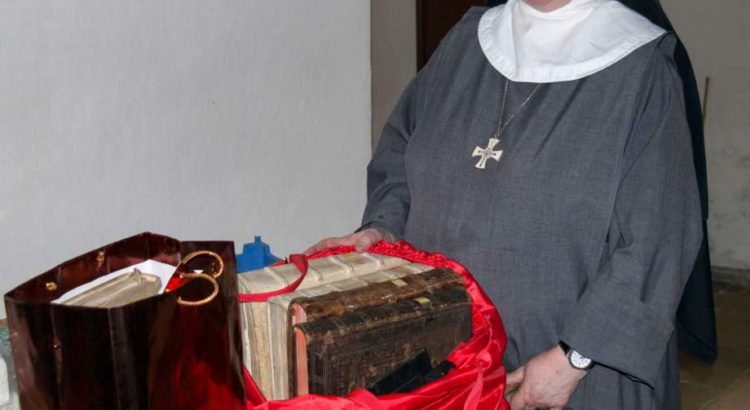
Surprised by the spontaneous decision by Altomuenster’s last remaining nun, Sister Apollonia Buchinger, to open the library, 20 scholars including Sandgren made plans to return and meticulously catalog the remarkable collection. But before they could, the Vatican ordered the abbey in the Bavarian town of 7,500 closed and locked up the library, which also contains some 2,300 statues, paintings and other works of art.

If plans go ahead to close it down, all of the abbey’s property — the books, the artworks, the city block-sized abbey, and the acres of forests and fields that make up the monastery grounds would be turned over to the dioceses of Munich and Freising.

Altomuenster is the end of a subway line from Munich, one of Germany’s most expensive cities, and its land alone is thought to be worth tens of millions of euros (dollars) — assets that Sister Apollonia thinks the dioceses are eager to get their hands on.

Since 1496, the former Benedictine abbey in Altomuenster has housed a female religious order founded by Saint Bridget in Sweden in the 14th century. It is one of three monasteries of the original branch of the scholarly, monastic order operating today. But with its numbers in decline, Sister Apollonia now lives there alone. The Vatican requires at least three nuns to train novices to become nuns, prompting the decision to shut the abbey down.

The Franciscan nun the Vatican put in charge of the closure, Sister Gabriele Konrad, says the collections are just being kept safe, but she’s refused to grant the scholars or anyone else access to the books.

«The value of the library is the ensemble, because it’s never been taken apart and probably nobody’s removed a significant number of books — it’s a working library,» said Corine Schlief, an art historian at Arizona State University who visited the library with Sandgren. «If this should be taken apart and divided up between books that collectors would give tens or hundreds of thousands of dollars for and those only of interest to scholars, it would lose a lot of its value.»

Schlief, Sandgren and other academics have written an open letter to the Vatican, Sister Gabriele and the Munich dioceses — which will inherit Altomuenster’s property once it’s closed — urging that the library be kept together and made available to the public and offering to catalog it.

Volker Schier of Arizona State University, another expert, estimated the Altomuenster collection represents around 80 percent of all known Bridgettine books.

Sister Gabriele and the Munich dioceses insist there is no plan to sell the books, and that their experts are perfectly qualified to handle them.

Scholars had known previously there was a library and had been able to ask nuns to bring them specific books to study in common areas of the monastery. But in October 2015, with such a large group of Bridgettine academics visiting, Sister Apollonia decided it made more sense for them to just look for themselves.

After the Vatican, a month later, ordered the monastery closed and Sister Apollonia appealed for more time, the 62-year-old nun with rosy cheeks appealed to the public for support, starting a blog, a Facebook page and a Twitter account to generate interest. She also gave The Associated Press unprecedented access to areas in the labyrinthine monastery previously restricted to nuns.

Sister Apollonia is convinced that, with help from other Bridgettine Orders to bolster her numbers, she can again start training her own novices. She currently has one postulant, a 38-year-old who left a law career last year, but she cannot advance to become a novice without more nuns to train her.

«They say there are too few, but there are some other women who want to join,» Sister Apollonia said, expressing hope that perhaps the Vatican might be reconsidering the order to shut down.

The Vatican office in charge has refused to comment on its plans.

Sister Gabriele says the decline of Altomuenster has been going on for decades and previous attempts to bring in others had failed. Two Bridgettines from Mexico came in 2012, only to return home after two weeks because they were homesick.

Munich-Freising Vicar General Msgr. Peter Beer, Cardinal Reinhard Marx’s deputy in charge of administration, dismissed speculation of any land-and-treasures grab by the dioceses. He said for cultural, social and religious reasons it was the dioceses’ responsibility to preserve monasteries when they close.

«There’s a false impression that we’re taking in riches and gems and gold and everything imaginable — that’s nonsense,» he told the AP at his office in Munich. «We are taking on costs more than anything.»

His office also downplayed the library’s potential value or historical significance, telling the AP it includes «a large number of antiphonaries from the 18th century, most in very used and some in damaged condition,» and that six antiphonaries — books containing religious chants — from the Middle Ages have «already been studied by scholars.»

That’s made the group of scholars who wrote the open letter and others even more suspicious. From the hundreds of photographs they took, they know there’s much more — including an illuminated manuscript from the 1500s in Belgium, which might be expected to fetch 100,000 euros ($105,000) or more if sold to a private collector, said Schier.

Schier noted that even financially insignificant books are historically important. Ledgers, cookbooks and even antiphonaries help tell how the nuns lived over the centuries.

«Altomuenster is the holy grail,» he said.

Beer bristled at the offer of help from the group of scholars.

«You can be assured that we do not need any help from the U.S.A. to understand how to treat cultural assets of significance for Europe. We have a slightly longer history and slightly longer experience,» Beer said.

Referring to the letter from American and European academics, he added, «It’s a little irritating to have things thrown out in public in an open letter without the facts.»

The dioceses plan to digitize all books dating from before 1803 and make them available online for researchers — but Schlief says that’s not enough.

«Digitization is laudable, but it never replaces the books themselves, which now need to be carefully studied and catalogued,» she said.

For her part, Sister Apollonia said if the Vatican decides to give her more time in the monastery, she’d be more than happy to open the library to the scholars again.

«They need to be made available to the public,» Sister Apollonia said. «Maybe we could charge a fee and it could be a source of income.»

Fuente: http://www.mysanantonio.com/news/education/article/Scholars-fret-about-fate-of-holy-grail-German-10818963.php

Comparte este contenido:
Page 4524 of 6194
1 4.522 4.523 4.524 4.525 4.526 6.194