Saltar al contenido principal
Page 686 of 6179
1 684 685 686 687 688 6.179

Chile: Los niños dañados de la pandemia

Los niños dañados de la pandemia

Francisca Turpaud (40) pensó que el retorno a su trabajo iba a ser pausado. Que volvería con normalidad a los turnos en el hospital, pero que la atención de su consulta particular sería de a poco, atendiendo desde su casa por telemedicina. Al volver, entendió que no podría hacerlo. Algo que no había visto antes estaba ocurriendo.

Turpaud es psiquiatra infanto-juvenil, trabaja en la Unidad de Salud Adolescente del Hospital Sótero del Río y también atiende consulta particular. Después de haber pausado su labor por seis meses, tras ser mamá de gemelas, su celular, de un momento a otro, se llenó de mensajes de madres y padres consultando por una hora para atender a sus hijos. Se trataba de pacientes nuevos, muchos pidiéndole que por favor hiciera una excepción, pues en dos meses no habían encontrado nada. “Se me empezó a repletar la agenda, pero con pacientes graves. No era que ‘mi hijo está un poco ansioso’, me empezaron a llegar casos complejos y ahí me di cuenta de que esto se sentía como una avalancha”, recuerda ella.

El 2020 había sido un año difícil para sus pacientes, antes de su posnatal ya había tenido que hacer algunos sobrecupos, pero nada como con lo que se encontró ahora. Esta vez se dio cuenta de que había algo más: que la pandemia había acumulado una serie de factores que hizo que sus pacientes antiguos estuvieran más graves, y que otros niños nuevos, que nunca habían tenido problemas emocionales, comenzaran a asomar algunos síntomas y estuvieran necesitando de su ayuda.

Niños como Gaspar (11), que desde que dejó de ir al colegio, su mamá, María, cuenta que su mundo se le vino abajo. Ambos viven en la comuna de Las Condes, y Gaspar asiste a un colegio particular de esa zona. Antes del Covid, no eran pocas las horas que dedicaba a actividades extraprogramáticas: estaba en la selección de fútbol, hacía deporte mínimo cuatro veces a la semana y se juntaba seguido con sus compañeros. El encierro y la dificultad para adaptarse a la nueva forma de clases hizo que, de a poco, comenzara a irritarse más de la cuenta, frustrarse por cosas que antes no le importaban o estar más inseguro con su rendimiento académico. Pero lo que al principio parecía un cambio de actitudes, de pronto se transformó en algo más, y María percibió la primera alerta: “En un minuto en que peleamos y se enojó, me dijo ‘yo no sé para qué vivo’. Yo ahí lo agarré, le dije que no hablara tonteras y lo hablé con una psicóloga amiga. Ella me dijo que estuviera atenta, porque lo había expresado. Entonces que lo observara”.

Para María, educadora de párvulos de un colegio de Vitacura, no era fácil enfrentar lo que le estaba pasando a su hijo. Para ella era algo totalmente nuevo y al principio le costó sobrellevarlo. “Como eran ofuscaciones que no había visto antes, yo tampoco reaccionaba bien. No entendía lo que le estaba pasando, entonces le contestaba retándolo más que entendiéndolo. Para mí era una pataleta de cabro chico”, recuerda ella.

Pero en ese observar que le recomendaron se dio cuenta de que lo que le ocurría a su hijo no eran solo pataletas de un día: su autoestima también estaba muy baja. “Me empezó a decir que él se merecía dormir en el suelo, se acostaba en el suelo y trataba de dormir ahí. En eso me contó cómo quería hacerse daño. Esa noche lloramos los dos, lo abracé y le dije que si él dormía en el suelo, entonces yo también”.

Fue entonces que María buscó ayuda. “La psiquiatra y la psicóloga me dijeron que lo preocupante es que a los 11 años los niños no piensan cómo quitarse la vida. Entonces, cuando dicen cómo quieren hacerlo, es preocupante”.

Las nuevas frustraciones

En la sala de clases virtual, Loreto, una profesora de tercero básico de un colegio particular de La Reina, empezó a notar cómo la pandemia afectaba emocionalmente a sus alumnos. La primera alarma vino en mayo del año pasado, cuando los vio a todos más ansiosos por participar. Hacerlo a través de Zoom no era fácil, pues el tiempo era escaso. “Si es que no les tocaba hablar, era llanto. O que los papás nos mandaran un correo diciendo que su hijo habló solo una vez, que por qué no le di la palabra más veces”, cuenta ella.

Las frustraciones vinieron después. Ahí Loreto sintió que esto era grave: cuando veía a sus niños ponerse a llorar porque no podían abrir una página web, o no les resultaba alguna actividad. Sobre todo porque la cámara era una limitación para los profesores, ya que si hubieran estado presencial habrían podido calmarlos y ayudarlos a resolver lo que no podían hacer.

Nicole (33) tuvo que ayudar a su hijo con esa frustración. Diego (10) cursa quinto básico de un colegio en Conchalí. Vive con sus padres, sus dos hermanos, su tío y su abuelo en la misma comuna y padece de asma severa. Esa condición hizo que, pese a que antes era un niño sin problemas emocionales, desarrollara un pánico constante al contagio del virus. Pero, además, con las clases comenzó a frustrarse. Sobre todo cuando le tocaba exponerse a la cámara. “Cada vez que lo hacían leer le venían crisis de pánico. Él no lo podía controlar, era una cosa como que íbamos súper bien con cualquier otra materia, pero lo hacían leer, se equivocaba y se desesperaba”, dice.

Como no entendían qué era lo que le ocurría a su hijo, ambos padres decidieron llevarlo al Hospital Roberto del Río, donde los recibió la psicóloga Jennifer Conejero y otros especialistas para comenzar un tratamiento. “A partir de este caso aparece el tema de la sobreexigencia. Hay niños que se sienten muy ansiosos frente a la cámara, porque ven a estos compañeros y profesor que los están mirando fijamente, mientras que esto en el aula no ocurre. A veces estrategias tan sencillas como apagar la cámara ayudan”, explica Conejero.

El estrés de cumplir con las exigencias académicas es algo que para Francisca Turpaud afecta directamente la salud mental de los estudiantes: “No había visto niños tan angustiados por el cumplimiento de las notas o con pasar de curso. Para que un niño aprenda tiene que hacerlo con la interacción de sus pares. Lo que estamos haciendo ahora es hacerlos aprender en aislamiento, sin ningún refuerzo positivo. Se les está exigiendo que rindan con normalidad, en una situación que es absolutamente anormal”.

Esto se vuelve aún más complejo cuando se trata de edades en las que el desarrollo cognitivo es más intenso. Jonathan Bronstein, psiquiatra infanto-juvenil, académico de la Facultad de Medicina UC y de la Red Salud UC-Christus, las llama ventanas del desarrollo. “Una cosa es lo que estamos viendo como consecuencia inmediata, pero otra es el riesgo de estos períodos críticos del desarrollo, donde lo que no se hace en una determinada edad, puede que cueste mucho desarrollarlo más adelante”.

Quizás por eso, Loreto empezó a preocuparse por sus alumnos. Para ella, el período entre primero y tercero básico es de esas ventanas infalibles, y la dificultad en el aprendizaje venía de antes. “Los niños de tercero básico son niños que en primero aprendieron a leer y a escribir, pero en las pruebas había dos profesoras de apoyo, era súper guiado. Y en segundo básico se empieza a transitar para que lo hagan cada vez más independientes. El problema fue que aquí su primero básico se cortó en octubre con el estallido, por lo que no pudieron terminar bien ese proceso. Y les tocó un segundo básico donde estaban en la casa completamente acompañados en su aprendizaje. No han vivido ese proceso de independencia”.

Pero otro problema venía arrastrándose de antes: “En la última década había habido un aumento sostenido de consultas en salud mental en niños, niñas y adolescentes. Esto tenía que ver por un deterioro general de la salud mental en el país”, cuenta Francisca Turpaud. Las causas no son muy claras, pues explica que también puede deberse a una mayor normalización de buscar ayuda frente a este tipo de problemas. “Es difícil interpretar eso, porque podría ser hasta a un aumento de horas psiquiátricas, mayor acceso a terapias, mayor conciencia de la importancia de la salud mental y no necesariamente a un deterioro, sino a que se puedan detectar y diagnosticar más los trastornos”, añade.

Una generación que reparar

En marzo, no solo fue Francisca Turpaud quien se llenó de pacientes en lista de espera para atender. Entre los demás psiquiatras reconocen que ya es un comentario generalizado, que casi todos están sin horas. “En todos los ámbitos estamos teniendo un número creciente en esta época que no es tan usual comparado con mayo y junio de otros años. Esto es notablemente mayor que un año normal”, sostiene Alfonso Correa, jefe de Psiquiatría de la Clínica Alemana.


Fuente de la Información: https://www.latercera.com/la-tercera-domingo/noticia/los-ninos-danados-de-la-pandemia/6UEJVJJRBVASNJBCYALM75Q3OE/


Comparte este contenido:

España: Los profesores van a la huelga el 18 de junio contra Iceta: “175.000 puestos de trabajo están en juego»

Los profesores van a la huelga el 18 de junio contra Iceta: “175.000 puestos de trabajo están en juego»

La reforma del Estatuto Básico del Empleado Público para acabar con la precariedad de los interinos no convence a los sindicatos.

El próximo 18 de junio, varios sindicatos de Educación han convocado una huelga contra la reforma del Estatuto Básico del Empleado Público (EBEP) que obligará a suprimir los empleos de profesores interinos cuando cumplan los tres años de trabajo. Según la Confederación de Sindicatos de Trabajadores de la Enseñanza (STEs), uno de los convocantes, actualmente hay 175.000 personas en la enseñanza pública no universitaria en situación temporal, por lo que son muchos los empleos en juego. El Gobierno actúa obligado por el Tribunal de Justicia Europeo, que el pasado jueves dijo a España, una vez más, que no es legal concatenar contratos temporales sin parar en la administraciones del Estado. Uno de cada tres empleados públicos no es fijo en nuestro país.

El Ministerio de Política Territorial y Función Pública, que dirige Miquel Iceta, ha elaborado un borrador de la reforma, del que se han filtrado detalles que han provocado la reacción de los sindicatos.

El responsable confederal de STEs, Joserra Merino afirma que la reforma “pone en juego el puesto de miles de personas y vulnera acuerdos de interinidad de muchas comunidades autónomas que se quedarían sin bolsas de empleo”.

Hay profesores que llevan trabajando dos, cinco o 15 años y es injusto que estas personas, que han respondido durante la crisis económica de 2008 y durante la pandemia se queden sin sus puestos de trabajo”, explica el dirigente sindical.

Piden un concurso de méritos

STEs y otros sindicatos del sector de la educación defienden que el estatuto del empleado público contempla la excepcionalidad, en base a la que el Gobierno podría, a través de una ley, convocar un concurso de méritos, en el que se reconociera a esos profesores que ya están demostrando su capacidad y experiencia en las aulas y pudieran pasar a conseguir una plaza indefinida.

El PSOE lo defendía en 2017

De hecho, el PSOE en la oposición, en 2017, “era favorable a una solución de ese tipo cuando presentó una proposición no de ley, que fue aprobada por el Congreso, para que los exámenes no fueran eliminatorios para los profesores interinos y se les computara también los méritos”, recuerda el representante de STE.

La expresidenta del Constitucional dice que es posible

Esta solución iría en la línea de un informe de la presidenta del Tribunal Constitucional entre 2004 y 2011, María Emilia Casas, en el que defiende una reforma legislativa en España para convertir en trabajadores fijos a los empleados públicos que sido contratados de manera temporal durante años, cuya cifra se acerca en todos los sectores al millón de personas.

El dictamen propone la creación de una nueva categoría, la de «personal estabilizado» con carácter indefinido, para cumplir la directiva comunitaria 1999/70/CE y la jurisprudencia del Tribunal de Justicia de la Unión Europea (TJUE), que instan a los estados miembros a prevenir y sancionar, con medidas efectivas y disuasorias, el uso indebido de los contratos temporales sucesivos.

El informe fue encargado por varias organizaciones de empleados públicos al Estudio Jurídico Ejaso ETL Global, donde trabaja la jurista, catedrática de Derecho del Trabajo y la Seguridad Social de la Universidad Complutense de Madrid (UCM), que mantiene que hay una vía “constitucional» para resolver el problema.

La expresidenta del Tribunal Constitucional rechaza que la solución que propone para los interinos vulnere los principios de igualdad, mérito y capacidad en el acceso al empleo público porque ellos ya se han sometido a exámenes de acceso, y el Alto Tribunal ya ha ratificado la validez del reconocimiento de los servicios prestados y la antigüedad como mérito único en la fase de concurso para favorecer la consolidación del personal no permanente.

La jurista justifica la medida en la situación de excepcionalidad que representa la imposición del Tribunal Europeo de Justicia al estado español en esta materia: «La forma más simple de que España adapte su legislación en materia de empleo público a la directiva 1999/70/CE es incorporando la regla de transformación de contratos temporales abusivos en indefinidos».

La respuesta del Gobierno

El Plural ha preguntado al Ministerio de Política Territorial y Función Pública y al Ministerio de Educación sobre sus posiciones y su respuesta a la disconformidad de los sindicatos. Por el momento, el Departamento que dirige la ministra Isabel Celaá ha contestado que está «trabajando» en las mesas de negociación con los representantes de los trabajadores en el Real Decreto de ingreso y acceso a las plazas, es decir, los procesos de oposiciones, pero que para lo demás, dependen «del Estatuto Básico, que corresponde al MInisterio de Administraciones Públicas».

Fuente: El Plural

Fuente de la Información: https://kaosenlared.net/los-profesores-van-a-la-huelga-el-18-de-junio-contra-iceta-175-000-puestos-de-trabajo-estan-en-juego/

Comparte este contenido:

CHINA: ALGUNAS PROVINCIAS CHINAS SUSPENDEN FUSIONES UNIVERSITARIAS DESPUÉS DE PROTESTAS ESTUDIANTILES

CHINA: ALGUNAS PROVINCIAS CHINAS SUSPENDEN FUSIONES UNIVERSITARIAS DESPUÉS DE 
PROTESTAS ESTUDIANTILES
Las autoridades educativas de la provincia de Jiangsu, en el este de China, 
suspendieron un plan para fusionar 
universidades independientes con institutos de formación profesional después de 
que las protestas estudiantiles 
llevaron a un enfrentamiento violento con la policía.

Tales protestas son raras en China porque las autoridades controlan estrictamente 
los movimientos de masas 
para mantener la estabilidad social.

Los estudiantes de Jiangsu que asisten a universidades independientes, y sus 
padres, ven la fusión como una 
devaluación de sus logros. Consideran que una licenciatura de una universidad 
independiente vale más en el 
mercado laboral altamente competitivo de China que un supuesto diploma de 
licenciatura profesional de las 
universidades vocacionales menos prestigiosas, según un medio de comunicación 
controlado por el Partido Comunista, 
el Global Times.

Lo que el Global Times describió como “el fiasco de la fusión” se originó en 
mayo de 2020, cuando el Ministerio 
de Educación de China anunció un plan para reestructurar las universidades 
independientes fusionándolas con escuelas 
vocacionales.

Yang Dali, profesor de ciencias políticas en la Universidad de Chicago, dijo 
a VOA Mandarin que el cálculo del gobierno 
se basa en dos factores: la mayoría de los estudiantes chinos quieren asistir 
a la universidad para avanzar en sus 
oportunidades laborales, y el país está experimentando una falta de talentos 
azules calificados. trabajadores de cuello. 
Las cifras del gobierno muestran que el número de personas en edad laboral 
está disminuyendo, un cambio demográfico 
que se debe en parte a los controles de población, como la política del hijo 
único ahora abandonada.

El 4 de junio, el Ministerio de Educación anunció que haría cumplir la fusión 
en 13 universidades independientes, 
incluidas cinco de la provincia de Jiangsu.

Al día siguiente, estudiantes de cinco universidades independientes se reunieron 
en sus campus para protestar.

El 6 de junio, más estudiantes universitarios independientes protestaron en sus 
campus. El video mostró que hubo 
conflictos físicos entre la policía y los estudiantes del Zhongbei College de la 
Universidad Normal de Nanjing en 
Danyang. VOA Mandarin informó que los estudiantes resultaron heridos.
Según un anuncio de la policía de Danyang en Weibo, una plataforma similar a Twitter, 
los estudiantes habían 
"detenido ilegalmente al decano de la universidad, de apellido Chang, durante más 
de 30 horas".

Además, los estudiantes habían "gritado abuso verbal y bloqueado la aplicación de 
la ley", según el comunicado de la 
policía.

"Para mantener el orden del campus y la seguridad de las personas relevantes, la 
policía tomó las medidas necesarias 
para [liberar] a las personas que están atrapadas y fueron enviadas de inmediato al 
hospital", dijo el departamento 
de policía. Los clips de las redes sociales mostraban a la policía usando porras y 
gas pimienta sobre los estudiantes.

En la noche del 7 de junio, el departamento de educación de Jiangsu anunció que 
suspendería la fusión después de 
que "miles de estudiantes presentaron una petición contra el plan por temor a perder 
su competitividad en el mercado 
laboral", informó Global Times. Y a principios del 8 de junio, las cinco universidades 
de Jiangsu publicaron la 
suspensión de los planes de fusión en sus cuentas oficiales de Weibo.

Las provincias de Zhejiang y Jiangxi también anunciaron la suspensión de las fusiones 
planeadas, luego de protestas en 
las universidades de la provincia de Zhejiang, incluida la Universidad de Tecnología 
de Zhejiang Zhijiang College, 
la Escuela de Negocios de Hangzhou de la Universidad de Zhejiang Gongshang y la Facultad 
de Tecnología e Información 
de la Universidad de Hangzhou Dianzi.

La VOA se puso en contacto con las autoridades educativas de Jiangsu y Zhejiang sobre 
las protestas, pero no recibió 
respuesta.

Teng Biao, un abogado chino de derechos humanos que es profesor invitado en el Centro 
de Derechos Humanos de la 
Familia Pozen en la Universidad de Chicago, dijo a VOA Mandarin en una entrevista 
telefónica que después de las 
protestas, las autoridades chinas están dando un paso atrás para "mantener la estabilidad . 
" Según el Ministerio 
de Educación de China, el país tendrá más de 9 millones de graduados universitarios en 
2021 y más de 10 millones 
en 2022.

La suspensión de la fusión “es solo una concesión superficial. De hecho, la primera 
consideración del Partido Comunista
 Chino no son los derechos de los estudiantes, sino la necesidad de mantener la estabilidad, 
especialmente con la 
proximidad del centenario del PCCh ", dijo sobre las celebraciones de julio." No hay garantía 
de que no vayan tras 
estos estudiantes. después."

El medio de comunicación oficial informó que cinco estudiantes que entrevistó 
el martes dijeron que quieren que 
se termine la fusión, no solo que se suspenda.

Según la BBC, "los colegios independientes son cofinanciados por universidades y organizaciones
 sociales o individuos. 
Los estudiantes que no obtengan los puntajes requeridos en los exámenes para ingresar a la 
universidad pueden 
postularse a estas instituciones, donde aún pueden graduarse con un título universitario, 
pero en costos de matrícula 
más altos ".

En 2020, el puntaje de admisión para la Universidad Normal de Nanjing fue 603, mientras que 
el puntaje para el
Zhongbei College afiliado fue 326, informó Global Times. La matrícula anual de la Universidad 
Normal de Nanjing 
es de $ 780. Zhongbei College cobra $ 2,474.

The Global Times dijo que si las universidades independientes se fusionan con las escuelas 
vocacionales, 
los diplomas de los estudiantes se convertirán en "títulos profesionales de licenciatura" 
en lugar de licenciatura 
en artes o licenciatura en ciencias. Los títulos actualmente otorgados por universidades 
independientes se consideran 
superiores a los títulos profesionales en el mercado laboral altamente competitivo de China.

Según el Global Times, el Ministerio de Educación dijo el domingo que las universidades 
independientes seguirán 
ofreciendo títulos de licenciatura general para sus estudiantes actuales, como se prometió 
cuando se inscribieron.
Yang le dijo a VOA Mandarin que la frustración de los estudiantes y sus padres en estas universidades 
independientes 
es comprensible.

"Están pagando más para obtener títulos de licenciatura. Ahora las autoridades quieren cambiar 
sus títulos a 
la mitad sin consultar a estos estudiantes", dijo en una entrevista telefónica. “En resumen, 
no tomaron en 
consideración los intereses de los estudiantes durante el proceso de formulación de políticas”.

"Para ser honesto, a veces un graduado universitario no necesariamente lo pasará mejor buscando 
un trabajo 
en comparación con un trabajador calificado", dijo Yang a VOA Mandarin. "Creo que el gobierno 
quiere fortalecer
 la educación vocacional y mantener la ventaja de China en trabajadores calificados . "

Fuente de la Información: https://www.voanews.com/east-asia-pacific/some-chinese-provinces-suspend-college-mergers-after-student-protests
 

Some Chinese Provinces Suspend College Mergers After Student Protests

Education authorities in China’s eastern Jiangsu province have suspended a plan to merge independent colleges with vocational institutes after student protests led to a violent confrontation with the police.

Such protests are rare in China because authorities tightly control mass movements to maintain social stability.

The Jiangsu students attending independent colleges, and their parents, see the merger as devaluing their attainment. They view a bachelor’s degree from an independent college as worth more in China’s highly competitive job market than a so-called professional bachelor’s diploma from the less prestigious vocational colleges, according to a Communist Party-controlled media outlet, the Global Times.

What the Global Times described as “the merger fiasco” originated in May 2020, when China’s Education Ministry announced a plan to restructure independent colleges by merging them with vocational schools.

Yang Dali, a political science professor at the University of Chicago, told VOA Mandarin that the government’s calculation is driven by two factors: Most Chinese students want to attend college to advance their job opportunities, and the country is experiencing a lack of skilled blue-collar workers. Government figures show the number of working-age people is decreasing, a demographic change that is due in part to population controls such as the now-abandoned one-child policy.

On June 4, the Education Ministry announced that it would enforce the merger in 13 independent colleges, including five from Jiangsu Province.

The next day, students from five independent colleges gathered on their campuses to protest.

On June 6, more independent college students protested on their campuses. Video showed there were physical conflicts between the police and the students at Nanjing Normal University’s Zhongbei College in Danyang. VOA Mandarin reported students there were injured.

According to a Danyang police announcement on Weibo, a Twitter-like platform, students had «illegally detained the dean of the college, surnamed Chang, for more than 30 hours.»

Also, students had «shouted verbal abuse and blocked law enforcement», according to the police statement.

«To uphold the campus order and safety of relevant individuals, the police took necessary measures to [free] the individuals who are trapped, and they were immediately sent to the hospital,» the police department said. Social media clips showed police using batons and pepper spray on students.

On the evening of June 7, Jiangsu’s education department announced it was suspending the merger after “thousands of students submitted a petition against the plan for fear of losing their competitiveness in the job market,” reported the Global Times. And early on June 8, all five colleges in Jiangsu posted the suspension of merger plans on their official Weibo accounts.

Zhejiang and Jiangxi provinces also announced the suspension of planned mergers, after protests in colleges in Zhejiang Province, including Zhejiang University of Technology Zhijiang College, Zhejiang Gongshang University Hangzhou Business School, and Hangzhou Dianzi University Information & Technology College.

VOA contacted education authorities in Jiangsu and Zhejiang about the protests but did not hear back.

Teng Biao, a Chinese human rights lawyer who is a visiting professor at the Pozen Family Center for Human Rights at the University of Chicago, told VOA Mandarin in a phone interview that after the protests, Chinese authorities are taking a step back to «maintain stability.» According to Chinese Ministry of Education, the country will have more than 9 million college graduates in 2021, and more than 10 million in 2022.

The merger suspension “is just a concession on the surface. In fact, the Chinese Communist Party’s first consideration is not the rights of students, but the need to maintain stability, especially with CCP’s centenary coming up,» he said of the July celebrations. «There’s no guarantee that they will not go after these students afterwards.»

The official media outlet reported that five students it interviewed on Tuesday said they want the merger terminated, not just suspended.

According to the BBC, «independent colleges are co-funded by universities and social organizations or individuals. Students who do not get the required exam scores to enter university can apply to these institutions, where they can still graduate with a university degree – but at higher tuition costs.”

In 2020, the admissions score for Nanjing Normal University was 603, while the score for the affiliated Zhongbei College was 326, the Global Times reported. The annual tuition for Nanjing Normal University is $780. Zhongbei College charges $2,474.

The Global Times said that if independent colleges merge with vocational schools, the students’ diplomas will become «professional bachelor’s degrees» rather than bachelor of arts or bachelor of science degrees. The degrees currently granted by independent colleges are considered superior to vocational degrees in China’s highly competitive job market.

According to the Global Times, the Ministry of Education said on Sunday that the independent colleges will still offer general bachelor’s degrees for their current students, as was promised when they enrolled.

Yang told VOA Mandarin that the frustration of students and their parents at these independent colleges are understandable.

«They are paying more to get bachelor’s degrees. Now the authorities want to change their degrees halfway without consulting these students,» he said in a phone interview. “In short, they didn’t take the students’ interests into consideration during the policy-making process.»

«To be honest, sometimes a college graduate won’t necessarily have a better time looking for a job compared to a skilled worker,” Yang told VOA Mandarin. “I think the government wants to strengthen vocational education and maintain China’s advantage in skilled workers.»

Fuente de la Información: https://www.voanews.com/east-asia-pacific/some-chinese-provinces-suspend-college-mergers-after-student-protests


Comparte este contenido:

Alemania: Angela Merkel, Anchor of European Stability, Stays Focused at Her Final G7

Angela Merkel, Anchor of European Stability, Stays Focused at Her Final G7

The German chancellor, known for her commitment to compromise, is eager to revive deal-making on multilateral policy, joining the world’s top democratic leaders one last time. Can she be replaced?

BERLIN — When Angela Merkel hosted world leaders at a beach resort on Germany’s Baltic Sea Coast in 2007, she was barely into her first term as chancellor, a relative neophyte in global affairs whose vivid green jacket among eight men in dark suits emphasized her status as the only woman in the club.

By the time the Group of 8 — Russia was still a member — had wrapped up the summit in Heiligendamm, Ms. Merkel had signaled her future influence, putting her stamp on the proceedings by winning agreement from President George W. Bush, once a Texas oilman, that climate change was global threat.

Ms. Merkel, center, with the heads of the G8 states in Heiligendamm, Germany, in 2007.


Fourteen years later, Ms. Merkel, who plans to step down as chancellor after the German elections in September, is attending her final G7 summit, this time on the coast of Cornwall. Some things have changed (leaders are not disputing the threat of climate change anymore), and some things have not (Ms. Merkel remains the only elected female leader in the club).

But it is the prospect of Ms. Merkel absent from the table in the future that represents potentially momentous change — for the leading industrialized nations that comprise the group, for a Europe where she has been a dominant leader and by the fact that no other elected female leader has emerged to take her place. (Ms. Merkel did help place one of her protégés, Ursula von der Leyen, as president of the European Commission.)

“Just think of what the picture will look like when she leaves,” said Katja Iversen, an adviser to the Women Political Leaders group, who took part in the gender discussion at the 2018 summit in Canada, where President Donald J. Trump was seated alongside Ms. Merkel and Christine Lagarde, then the head of the International Monetary Fund — and showed up late.

The summits are often much about ritual and photo ops, yet Ms. Merkel has used her mix of clout and charm, and her willingness to negotiate deep into the night, to push issues long overlooked as relevant to the global economy, including climate, sustainability and gender equality.

“When we look at Merkel, many people only see her as an anchor of stability, which she is. Because of her style, knowledge and experience, she can really build trust,” said Stormy-Annika Mildner, executive director of the Aspen Institute Germany in Berlin, who worked alongside Ms. Merkel at previous summits as a representative of the business community. “But a lot of people do not see how important and prescient she has been in placing and shaping topics in the G7 process.”

To many in the West — if not always everyone inside Germany itself — Ms. Merkel is often seen as a defender of liberal democracy who, at different times, acted as a one-woman firewall against Mr. Trump and President Vladimir V. Putin of Russia. Now Germany, and Europe, will turn to new leaders to shape foreign policy on issues such as military spending, Russia and especially China.

“She’s not in a position any more to decide big policy moves,” said Stefan Kornelius, an editor at the Germany daily Süddeutsche Zeitung and one of her biographers. “She’s now a political lame duck and she has less political weight.”

At the height of her powers, Ms. Merkel’s global diplomacy was defined much more by nitty-gritty negotiations than by bombast or political grandstanding. Patience and persistence became her trademarks, even if some wonder whether her compromising style and approach has lost its luster.

Ms. Merkel is often seen as a defender of liberal democracy who acted as a one-woman firewall against Mr. Trump and President Vladimir V. Putin of Russia.

“That’s how she kept Europe together despite the crises over migration, Ukraine, the euro and Trump,’’ Mr. Kornelius said. “But I wonder if in the future the world is about compromise.”

While her public modesty has earned her praise, Ms. Merkel’s lack of vision has been a point of constant criticism, and her negotiating skills repeatedly failed to deliver the policy she had hoped for on trade.

At the 2015 summit, she failed to reach agreement on a trans-Atlantic trade deal, and throughout the years of the Trump administration, she was never able to convince the American president that Germany’s trade surplus was not a problem that could be solved by sanctioning European products. More important, perhaps, her long policy of “change through trade” with China has failed to produce the reforms she envisioned.

Other leaders’ grand plans also fail to inspire her, as was evident in her disinterest over President Emmanuel Macron’s of France’s lofty proposals for revamping the European Union.

Unlike Mr. Macron, who tries to throw the diplomatic ball very far, and if he gets halfway to his goal is happy, Ms. Merkel rolls the ball along with her, “and when it stops, she’ll say, ‘That’s where we wanted to go,’” said Daniela Schwarzer, former head of the German Council on Foreign Relations and now executive director for Europe and Eurasia of the Open Society Foundation.

At her first summit in Heiligendamm, Ms. Merkel pushed for increased governance of global financial markets — one year before the collapse of the U.S. housing market plunged the world into a deep financial crisis — and raised awareness about sustainability. She also elevated global health as an issue, securing billions to fighting the spread of AIDS, malaria and tuberculosis in Africa.


But her big success was getting Mr. Bush to re-engage on a global agreement on climate policy. Although she had initially hoped that Mr. Bush would commit to more ambitious cuts in CO2 emissions, Ms. Merkel instead took the compromise she was able to secure and continued to build on it.

Eight years later, in 2015, at her second turn as the G7 host, she opened the summit by addressing the problem of plastics polluting the oceans. Then she secured a commitment from participating countries to work toward reducing global greenhouse gas emissions between 40 percent and 70 percent by 2050, a step that helped midwife the Paris Agreement later that year.

“She has very concrete ideas what she wants to get out of these meetings,” said Claudia Schmucker, the head of Geoeconomics at the German Council on Foreign Relations.

The iconic image from that summit showed Ms. Merkel facing President Obama, her arms outstretched in a gesture as expansive as the Alps that soared behind her, signaling renewed cooperation after the two had buried differences over intelligence and the National Security Agency’s activities in Europe.


Fuente de la Información: https://www.nytimes.com/2021/06/12/world/europe/angela-merkel-germany-g7.html

Comparte este contenido:

Francia: Leftist protesters denounce far-right ‘corruption’ of French society

Leftist protesters denounce far-right ‘corruption’ of French society

Parties from the left of French politics have united for “freedom marches” in dozens of cities across France to rally against far-right ideology.

Politicians, trade unions, environmental groups, human rights NGOs and others turned out to denounce right-wing extremist hatred, which they say is influencing French law.

Organisers say they’re particularly angry about how debate over immigration and security by the far right has saturated the political agenda.

They also oppose the “climate of racism and intolerance” that they argue is corrupting French society.

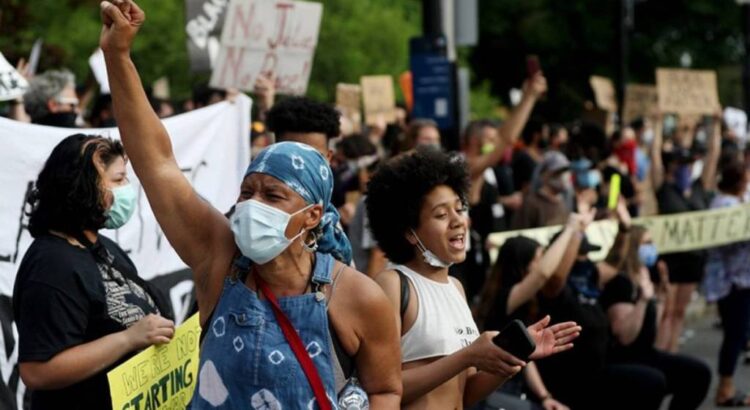
Thousands of people joined more than 140 demonstrations in cities including Marseille, Rennes, Strasbourg, Nantes and Bordeaux.

At the Paris march, leader of the far left France Unbowed party, Jean-Luc Mélenchon, reacted with humour after being hit with a flour bomb at Place de Clichy.

“The white suits me,” he told reporters at the scene. “It’s OK, it was only flour. I am alive, everything is fine.”

A man identified as the flour bomber told BFMTV he had not intentionally targeted Mélenchon, though members of France Unbowed said they were upset he was not arrested.

Deep divisions

Despite the show of unity Saturday, there was no common slogan at the marches, which French media described as “disorganised”.

Political divisions have continued to dog the French left as the country shifts into campaign mode ahead of next year’s presidential elections.

Centrist President Emmanuel Macron and far-right National Rally leader Marine Le Pen are set to dominate the polls as left-wing parties struggle to find their footing.

France Unbowed, Europe Ecology – The Greens, and the French Communist Party are forging ahead with their campaigns, while the Socialist Party is yet to decide if it will field its own candidate.

Fuente de la Información: https://www.modernghana.com/news/1087541/leftist-protesters-denounce-far-right-corruption.html


Comparte este contenido:

China: The Party Is Not Forever

The Party Is Not Forever

Human beings approaching 100 normally think about death. But political parties celebrating their centennial, as the Communist Party of China (CPC) will on 1 July, are obsessed with immortality. Such optimism seems odd for parties that rule dictatorships, because their longevity record does not inspire confidence.

The fact that no other such party in modern times has survived for a century should give China’s leaders cause for worry, not celebration. One obvious reason for the relatively short lifespan of communist or authoritarian parties is that party-dominated modern dictatorships, unlike democracies, emerged only in the 20th century.

The Soviet Union, the first such dictatorship, was founded in 1922. The Kuomintang (KMT) in China, a quasi-Leninist party, gained nominal control of the country in 1927. The Nazis did not come to power in Germany until 1933. Nearly all of the world’s communist regimes were established after World War II.

But there is a more fundamental explanation than historical coincidence. The political environment in which dictatorial parties operate implies an existence that is far more Hobbesian – “nasty, brutish, and short” – than that of their democratic counterparts.

One sure way for dictatorial parties to die is to wage a war and lose, a fate that befell the Nazis and Mussolini’s Fascists in Italy. But most exit power in a far less dramatic (or traumatic) fashion.

In non-communist regimes, long-standing and forward-looking ruling parties, such as the KMT in Taiwan and Mexico’s Institutional Revolutionary Party (PRI), saw the writing on the wall and initiated democratising reforms before they lost all legitimacy.

Although these parties were eventually voted out of office, they remained politically viable and subsequently returned to power by winning competitive elections (in Taiwan in 2008 and Mexico in 2012).

In contrast, communist regimes trying to appease their populations through limited democratic reforms have all ended up collapsing. In the former Soviet bloc, liberalising measures in the 1980s quickly triggered revolutions that swept the communists – and the Soviet Union itself – into the dustbin of history.

The CPC does not want to dwell on that history during its upcoming centennial festivities. Chinese President Xi Jinping and his colleagues obviously want to project an image of confidence and optimism. But political bravado is no substitute for a survival strategy, and once the CPC rules out reform as too dangerous, its available options are extremely limited.

Before Xi came to power in 2012, some Chinese leaders looked to Singapore’s model. The People’s Action Party (PAP), which has ruled the city-state without interruption since 1959, seems to have it all: a near-total monopoly of power, competent governance, superior economic performance, and dependable popular support.

But the more the CPC looked – and it dispatched tens of thousands of officials to Singapore to study it – the less it wanted to become a giant version of the PAP. China’s communists certainly wanted to have the PAP’s hold on power, but they did not want to adopt the same methods and institutions that help maintain the PAP’s supremacy.

Of all the institutional ingredients that have made the PAP’s dominance special, the CPC least likes Singapore’s legalised opposition parties, relatively clean elections, and rule of law. Chinese leaders understand that these institutions, vital to the PAP’s success, would fatally weaken the CPC’s political monopoly if introduced in China.

That is perhaps why the Singapore model has lost its lustre in the Xi era, whereas the North Korean model – totalitarian political repression, a cult of the supreme leader, and juche (economic self-reliance) – has grown more appealing. True, China has not yet become a giant North Korea, but a number of trends over the last eight years have moved the country in that direction.

Politically, the rule of fear has returned, not only for ordinary people, but also for the CPC’s elites, as Xi has reinstated purges under the guise of a perpetual anti-corruption campaign. Censorship is at its highest level in the post-Mao era, and Xi’s regime has all but eliminated space for civil society, including NGOs. The authorities have even reined in China’s freewheeling private entrepreneurs with regulatory crackdowns, criminal prosecution, and confiscation of wealth.

And Xi has assiduously nurtured a personality cult. These days, the front page of the People’s Daily newspaper is filled with coverage of Xi’s activities and personal edicts. The abridged history of the CPC, recently released to mark the party’s centennial, devotes a quarter of its content to Xi’s eight years in power, while giving only half as much space to Deng Xiaoping, the CPC’s true saviour.

Economically, China has yet to embrace juche fully. But the CPC’s new Five-Year Plan projects a vision of technological self-sufficiency and economic security centred on domestic growth. Although the party has a reasonable excuse – America’s strategy of economic and technological decoupling leaves it no alternative – few Western democracies will want to remain economically coupled with a country that sees North Korea as its future political model.

When China’s leaders toast the CPC’s centennial, they should ask whether the party is on the right track. If it is not, the CPC’s upcoming milestone may be its last.

Minxin Pei is Professor of Government at Claremont McKenna College and a non-resident senior fellow at the German Marshall Fund of the United States.


Fuente de la Información: https://theaseanpost.com/article/party-not-forever

Comparte este contenido:

Estados Unidos: Legislative roundup | Feds attempt to advance equity, Leandro plan moving forward, social studies standards could be stalled

Legislative roundup | Feds attempt to advance equity, Leandro plan moving forward, social studies standards could be stalled

It’s been a big week for education both nationally and in North Carolina. From movement in the long-running Leandro case to federal action on equity, here is a look back at some of the major things that happened.

U.S. Department of Education makes move on equity

The federal Department of Education announced Wednesday a series of actions to advance educational equity. You can read the press release here.

Those actions include:

— The release of a report that delves into how COVID-19 disproportionately hit “K-12 and postsecondary students in underserved communities.”

 Guidance around a provision to ensure high poverty school districts don’t see a drop in state per-pupil funding “below their pre-pandemic levels.” It’s a provision in the latest round of federal COVID-19 relief funds

— An equity summit series that launches June 22. Click here to join.

“The actions aim to not only address inequities exacerbated by the COVID-19 pandemic, but encourage schools more broadly to reimagine their education systems and practices and infuse equity into all of their work, so that every student has access to rigorous, culturally responsive, and fulfilling instruction,” the release states.

It also says this is part of an attempt to fulfill an executive order from President Joe Biden “to advance racial equity and support for underserved communities across the federal government and build our schools and communities back better than before the pandemic.”

“This is our moment as educators and as leaders to transform our education systems so they are truly serving all of our nation’s students,” said U.S. Secretary of Education Miguel Cardona in a press release. “While COVID-19 has worsened many inequities in our schools and communities, we know that even before the pandemic, a high-quality education was out of reach for too many of our nation’s students and families. Our mission at the Department is to safely reopen schools for in-person learning, dramatically increase investments in communities that for too long have been furthest from opportunity, and reimagine our schools so that all students have their needs met. We must take bold action together to ensure our nation’s schools are defined not by disparities, but by equity and opportunity for all.”

Leandro plan goes forward

We already reported on this, but it’s worth revisiting the fact that Judge David Lee signed an order on Monday to implement an eight-year plan to meet the state’s constitutional obligation to provide the opportunity for a sound, basic education to all the state’s students.

“If the State fails to implement actions described in the Comprehensive Remedial Plan … it will then be the duty of this Court to enter a judgment granting declaratory relief and such other relief as needed to correct the wrong,” the order stated.

Here is what Every Child NC had to say about the order:

Big federal money for education

We also reported this week on legislation that passed the House allocating almost $360 million in federal funds to the state’s public schools. The bill also has a provision that would delay the implementation of the state’s new controversial social studies standards. Read all about this below.

We’re getting a budget?

There was also action on the budget front this week, with House and Senate leaders finally agreeing to a spending limit for the budget. This is important because it was starting to look like the lack of an agreement was going to mean no comprehensive budget for the next two years. The tea leaves are looking better on that, but it’s possible there won’t be a final budget by the end of the fiscal year (which ends when June does).

The Senate also passed its tax cut package this week. Read about that here.

Read about the budget agreement below.

Adjunct high school teachers

A Senate bill that would let people with college degrees teach certain high school classes sans teaching license passed the House, and therefore the full General Assembly. It awaits the governor’s signature or veto now.

It would allow college graduates to teach as adjuncts in high school in “core academic subjects, fine and performing arts, and foreign language in the individual’s area of specialized knowledge or work experience.” For example, a doctor teaching biology. (That was the example one lawmaker gave.)

Before such individuals could teach, however, they would have to take some classes at a community college or educator preparation program.

Click here for a write-up from the News & Observer.


Fuente de la Información: https://www.ednc.org/2021-06-10-legislative-roundup-feds-attempt-to-advance-equity-leandro-plan-moving-forward-social-studies-standards-could-be-stalled/


Comparte este contenido:
Page 686 of 6179
1 684 685 686 687 688 6.179
OtrasVocesenEducacion.org