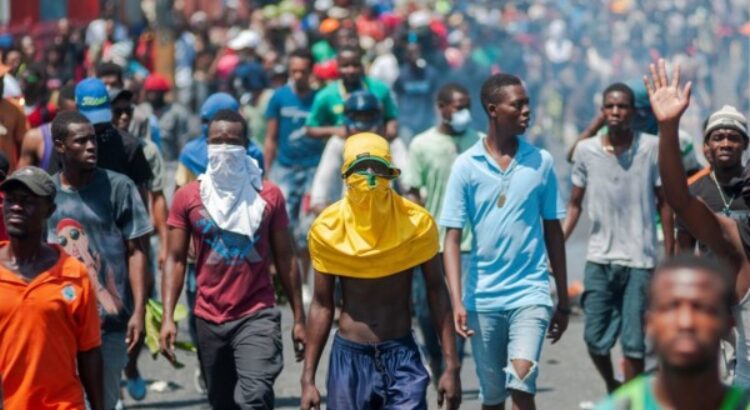
Haití. Trabajadores y trabajadoras convocan a huelga general contra el régimen de Moïse
El autócrata Moïse cuenta con el respaldo de la pentagonista Organización de Estados Americanos, OEA
El Colectivo de Abogados para la Defensa de los Derechos Humanos, la Brigada Sindical Anticorrupción (BSAC), el Movimiento Unido de Trabajadores Haitianos (MUTH) y la Central Nacional de Trabajadores son algunos de los convocantes a las protestas del próximo 1 y 2 de febrero contra el régimen de Moïse, sus pretensiones de perpetuarse en el gobierno, y la crisis social y sanitaria que daña a la población.
Los convocantes tienen con el apoyo de innumerables agrupaciones, entre ellos, partidos de oposición, sindicatos de conductores de transporte, profesores y organizaciones de derechos humanos.
La finalidad cardinal de la huelga general y popular es obligar a Moïse a salir de la presidencia el 7 de febrero de 2021, como lo dispone un artículo de la Constitución.
El autócrata Moïse cuenta con el respaldo de la pentagonista Organización de Estados Americanos, OEA.
Fuente de la Información: https://kaosenlared.net/haiti-trabajadores-y-trabajadoras-convocan-a-huelga-general-contra-el-regimen-de-moise/
India Farm Protests Highlight Country’s Youth Unemployment Crisis
NEW DELHI – Hundreds of young, educated men like Manveer Singh who defy the typical image of the Indian farmer are among the sea of protesters camped along a highway at Delhi’s borders to demand the scrapping of three new farm laws.
The 27-year-old postgraduate in information technology turned to farming after struggling for five years to find a job that would pay a modest wage.
Manveer Singh, a postgraduate, helps prepare a community meal for protesters in India. (A. Pasricha/VOA)
“After my education, I was hoping to get a white-collar job, and I gave many interviews,” Singh says, as he sits outside his tractor trolley – one of scores that have turned into homes for farmers who have come from neighboring states like Punjab. “But I never got any offer that pays more than $ 140 a month.”
Violence this week in which hundreds of farmers stormed into New Delhi and breached the historic Red Fort and more clashes Friday at one of the main protest sites have raised questions about the future course of what have been called the world’s largest protests.
The farmers blame politicians for instigating the skirmishes and are vowing to persevere with their two-month struggle, which is dominated by farmers from the predominantly agricultural state of Punjab.
The young, educated people who have come on tractors and trolleys to Singhu, on New Delhi’s outskirts, highlight India’s growing problem of joblessness among young people. It is the epicenter of the farm protests.
The tractors in which farmers have traveled are seen as the symbol of their protest, in India. (A. Pasricha/VOA)
As they sit browsing their smartphones and help in cooking and serving community meals, they say tilling family farms is their only security in a state where unemployment among young people at 21.6 percent exceeds the national average of about 17.5 percent.
The protest was triggered by three new laws that open up sale of farm produce to private players. The government says this will modernize a sector that desperately needs an overhaul and improve farm incomes by attracting private investment.
But protesters fear the reforms will benefit private buyers at their expense, hurting agricultural incomes, eventually forcing them to sell their land by driving them into debt. The government currently buys crops like rice and wheat grown extensively in Punjab at a fixed price.
Losing their lifeline
Young people say being exposed to market forces is particularly worrisome for them. Punjab was one of India’s richest states until a few decades ago, but its failure to create an industrial or services sector has resulted in the paucity of jobs, making farming their lifeline.
Kulwinder Singh, who has been at the protest site for two months, symbolizes the frustration of young people. His hopes of becoming a teacher never bore fruit. But the seven-acre family farm of the 32-year-old makes it possible for him to sustain his family.
Kulwinder Singh has been at the protest site in India for two months. (A. Pasricha/VOA)
“I have a bachelor’s degree in education, and after that I did another course, which I hoped would get me employment,” he says. “But there are no jobs.”
It’s a story repeated by many young people here. Since the stir began two months ago, Hardev Singh has been crawling into his tractor truck every night to spend the cold Delhi winter with other family members. Although he has a job, the loss of livelihoods during the pandemic has made him insecure.
“In case I lose my job, at least I can farm my land. If I don’t have that fallback, what will I do?” asks Singh. “I won’t even have food to eat.”
Protesters huddle inside tractors during Delhi’s cold winter. (A. Pasricha/VOA)
Old and young farmers on the borders say the recent violence will not deter them from making the highways their home until their demands are met. The protesters have rejected the government’s offer to put the laws on hold for up to a year and a half, and they remain adamant the laws must be repealed.
Hardev Singh points to the example of some states, where allowing the sale of farm produce failed to draw investment or higher prices. “We will take the fight to the end,” says Singh. “Until the laws are scrapped, we will sit here peacefully.”
Growing frustrations
But tensions are rising at protest sites. At the Singhu border, police used tear gas and batons to break up clashes Friday between farmers and a group of people demanding the farmers vacate the highway.
Although the government has assured them that no one can take their land, the protesters remain unconvinced.
Farmers cook and serve community meals at the largest protest site outside Delhi, in India. (A. Pasricha/VOA)
The anger at these protest sites, say economists, highlights India’s failure to create enough non-farming jobs for a country where two-thirds of the 1.3 billion population is under 35.
Economist Santosh Mehrotra, author of the book “Reviving Jobs: An Agenda for Growth,” calls youth unemployment “the most serious issue that the country faces.” He says India has not done enough to move people out of agriculture into alternate livelihoods.
Protesters sit on highways in India that have turned into their homes. (A. Pasricha/VOA)
He points out that while a number of young people in Punjab have been able to migrate due to a huge Punjabi diaspora overseas, those left behind face the challenge of underemployment on farms that have become smaller in size as they pass down to subsequent generations.
As they live out that crisis, Manveer Singh is disconsolate as he peels radishes for a community meal. “We have such a huge population that we and even our future generations have no hopes of finding a job.”
The frustration among young people poses a huge challenge to Prime Minister Narendra Modi, who came to power six years ago promising development and jobs — a promise that the young people at the protest site say he has failed to meet.
Fuente de la Información: https://www.voanews.com/south-central-asia/india-farm-protests-highlight-countrys-youth-unemployment-crisis
Germany on Friday announced its plans to restrict incoming travel from a handful of countries, including Britain and Ireland, in an attempt to curb the spread of infectious coronavirus variants, going beyond the measures recommended by the European Union.
“It’s about stopping the entry of a highly infectious virus,” Horst Seehofer, Germany’s interior minister, said on Thursday, a day before the federal cabinet approved the restrictions.
Under the new travel ban — which also applies to passengers coming from Portugal, Brazil, South Africa, Lesotho and Eswatini (formerly known as Swaziland) — German residents will be able to return home, but non-German residents from the areas in question will be refused entry, even with a negative coronavirus test.
While multiple known infectious variants have been found in Germany, including the B.1.1.7 variant at a hospital in Berlin, which then had to go into lockdown, health authorities believe they can still prevent variants from spreading and driving new infections.
The changes will go into effect over the weekend and will be in place until at least Feb. 17. It follows a temporary halt in travel for all passengers coming from the United Kingdom and South Africa, which was lifted a few days after it was enacted. All nonessential travel remains discouraged.
Fuente de la Información: https://www.nytimes.com/2021/01/29/world/germany-wont-allow-some-nonresidents-to-enter-the-country-even-with-a-negative-test.html
CEO of Heavens Laboratory calls for closure of basic schools
By Mark Abisah
The Chief Executive Officer of Heavens Diagnostic Services Ltd., in Sunyani, Nana Bredu Antwi Berko has called on President Akufo-Addo to as a matter of urgency shut down all basic Schools in the country to contain further spread of Covid-19 cases among children.
Speaking to Margaret Fafali Amematsia, the Host of Suncity 97.1 FM’S Morning Show, dubbed “Suncity Morning Drive”, Nana Bredu said, measures put in place by authorities to ensure the safety of the Kids are not being implemented properly by the School authorities, a situation he said could be dire if Basic Schools were not closed immediately.
Nana Bredu Antwi recalled one occasion where a class one pupil went to School with a blue nose mask but returned home with a pink one.
“Our children are our future we know! we want the best for them, but what does a parent benefit if his children acquire knowledge and lose their lives?” he inquired.
He expressed concern about the overloading of School buses and the wanton disregard for social distancing and nose mask-wearing protocols among basic School pupils.
The Biomedical Scientist called for comprehensive education on Covid 19 prevention protocols for both teaching and non-teaching staff.
President Akufo-Addo in his 21st Covid 19 update announced that all Kindergarten, primary, and JHS students should go back to school after almost nine months of closure over Covid-19 concerns.
Meanwhile, Komfo Anokye Teaching Hospital in Kumasi is recording an upsurge in Covid 19 cases among children. Nine children, including an 11-day old baby, tested positive for Covid 19 within 10 days in the facility.
Fuente de la Información: https://www.modernghana.com/news/1058602/ceo-of-heavens-laboratory-calls-for-closure-of.html
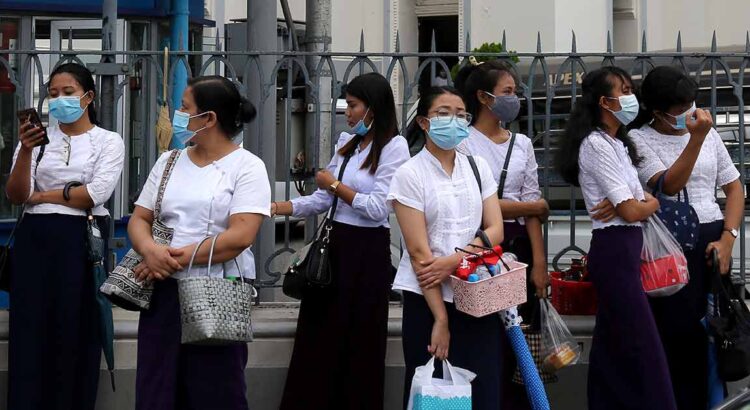
Women wearing face masks wait for the bus in Yangon on 29 May, 2020. (AFP Photo)
30 January 2021
In 2020, Hollywood mogul, Harvey Weinstein was found guilty of sexual assault – including rape. At least 80 women accused him of sexual misconduct stretching back decades including Hollywood stars like Gwyneth Paltrow and Selma Hayek.
The case against Weinstein prompted the #MeToo movement which encouraged victims to come forward and report sexual misconduct/harassment by powerful men.
The movement started in October 2017, garnered international momentum. In its coverage, there has been widespread discussion about the best ways to stop sexual harassment and abuse – for those who are currently being victimised at work, as well as those who are seeking justice for past abuse and trying to find ways to end what they see as a culture of abuse.
There is a general agreement that a lack of effective reporting options is a major factor that drives unchecked sexual misconduct in the workplace.
False reports of sexual assault are very rare, but when they do happen, they are put in the spotlight for the public to see. This can give the false impression that the majority of reported sexual assaults are false. However, according to a study published in the journal of Violence Against Women, false reports of sexual assault only make up two to 10 percent of the total number of reports – yet, it is one of the main reasons why women refuse to break their silence.
The #MeToo movement quickly moved from the entertainment industry to the government sector in the United States (US). At least 138 government officials have been publicly reported for sexual harassment/assault since the 2016 United States (US) general election.
A study by Georgetown University in 2018 found that sexual assault is already one of the most underreported violent crimes in the US, with 70 percent of victims never reporting to the police. Imagine then, the extent of the underreporting that could be going on in Southeast Asian countries where the subject is taboo and victim-blaming is prevalent.
Victim Blaming
Although Asian countries like Japan, South Korea and India have seen increasing numbers of women speaking out against sexual misconduct, women in Southeast Asian countries have largely remained silent. Some headway had been observed in the Philippines in 2018, where women flooded social media and the streets in protests against President Rodrigo Duterte’s sexist comments, under the hashtag #BabaeAko (I Am Woman).
In Indonesia, reporting sexual harassment can land a woman in jail. Baiq Nuril Maknun, a 41-year-old school administrator from the city of Lombok who recorded her school principal’s sexually suggestive phone calls was slapped with a six-month jail sentence plus a IDR500 million (US$35,880) fine.
“Our law enforcers lack sensitivity and understanding when it comes to sexual harassment and violence cases,” said Dhyta Caturani, founder of Jakarta-based women’s rights activists collective PurpleCode.
“Nuril’s case shows they aren’t siding with victims but punishing them instead. This is how Indonesia’s law enforcement view the victims of sexual harassment and violence, so I won’t be surprised to see if there will be other Nurils in the future.”
Last year, a video posted by Norazizi Samsudain, a Malaysian educator, about his views on rape went viral on social media. In response to an infographic on the causes of rape which was released by the Women’s Centre for Change (WCC), he disputed it and proceeded to blame victims for causing rape through their clothing and behaviour.
In the now-deleted video, he said that only two out of 10 cases are “real” rape cases. He believes that the majority of cases involve consensual sexual encounters where women turn around and accuse men of rape when things go wrong.
He received a major backlash from the public. The WCC even responded in a statement: “Norazizi’s statements are not only factually wrong, they are misleading and dangerous.”
“Most victims end up never reporting the crime, choosing instead to suffer in silence. Women do not simply make up stories to falsely accuse men. This idea is a convenient myth with no basis in reality,” continued the WCC.
In 2019, a survey by research company, YouGov Omnibus found that the main reasons people chose not to report sexual harassment are embarrassment and a feeling that no one would do anything about the problem as well as fear of repercussions – such as victim blaming.
The judicial systems in these countries have weak processes to defend and protect women as well as men against sexual misconduct. Daring to speak out in some of these deeply patriarchal societies comes with enormous risks, which leave perpetrators to walk free and target their next victim.
Fuente de la Información: https://theaseanpost.com/article/aseans-victim-blaming-culture
“It’s a singular role for an educator who has demonstrated excellence in the classroom, an exceptional commitment to their students and profession and skills in public speaking and advocacy,” their website reads.
“As an educator, I don’t see problems, but rather I see opportunities for solutions,” Stover said during her acceptance of the award. “I am humbled to be a teacher leader as we continue to find creative ways to improve the educational opportunities for every child in North Carolina regardless of zip code.”
Stover’s path to the classroom is somewhat unusual. When I met Stover in August 2020, she told me her dream was to join the U.S. Air Force and become a pilot, but her eyesight prevented her from doing that. Instead, she joined the Air Force as an intelligence officer, where she served for several years and met her husband.
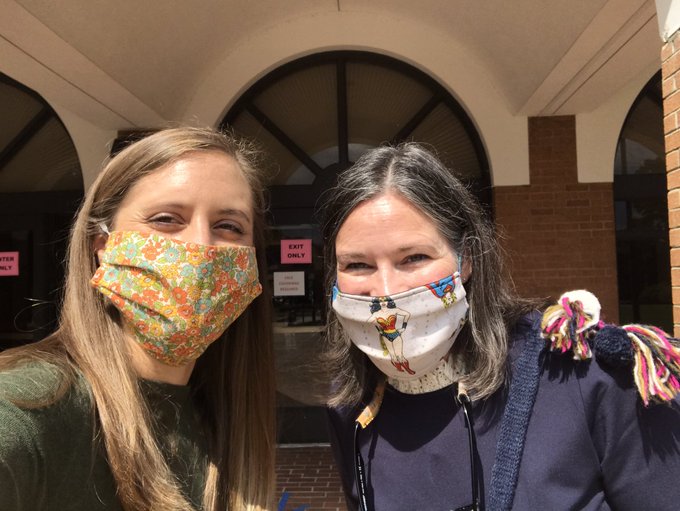
Great to meet @BWFUND NC 2020 Teacher of the Year @StoverScience! Loved hearing about her journey from the Air Force to the classroom. #nced@EducationNC
Stover left the Air Force and started teaching in Florida through the federal Troops to Teachers program. After relocating to California and working as an educational consultant for the National Science Teaching Association, Stover and her husband moved to Fayetteville, and Stover began teaching at Cumberland International Early College High School.
As a teacher, Stover has found her ikigai, a Japanese term for one’s purpose in life. “Teaching is my ikigai,” she told me.
“My ikigai is helping my students develop academically, socially and emotionally as they transition from adolescence into adulthood,” she wrote in her NCTOY submission. “I have found that one of the most important parts of being a teacher is the relationships I form with my students.”
Hear from Stover about her journey to the classroom, teaching during the pandemic, and more in this Tar Heel Teachers at Home interview:
Mbabazi de Uganda apunta a un puesto destacado en la Unión Africana
Addis Abeba, Etiopía | EL INDEPENDIENTE | La profesora de Uganda Pamela Kasabiiti Mbabazi es una de las ocho que han sido nominadas para competir como vicepresidenta en las elecciones de la Comisión de la Unión Africana (AUC) de la próxima semana en Addis Abeba.
El Prof. Mbabazi, de 51 años, es el presidente de la Autoridad Nacional de Planificación de Uganda. Ella es la única candidata del país de África Oriental que participará en las elecciones del 6 de febrero que se ejecutarán utilizando un nuevo formato que será sensible al género y la representación regional equitativa.
“Tengo la intención de liderar políticas que aprovechen a la población joven de África. África está dotada de una población joven que debe optimizarse para crear los dividendos demográficos deseados para el continente. Esta es una de mis motivaciones clave para mi candidatura ”, dijo recientemente.
Mbabazi competirá contra tres hombres y cuatro mujeres. Las mujeres son la Dra. Monique Nsanzabaganwa de Ruanda, vicegobernadora del banco nacional de Ruanda, Hasna Barkat Daoud, abogada de Djibouti y ex ministra de gobierno; Martha Ama Akyaa Pobee, diplomática de Ghana; y Fatoumata CM JallowTambajang, ex vicepresidente de Gambia.
Esta es la primera elección de las AUC desde que comenzó el proceso de reforma de la UA en 2017 bajo la dirección del ejecutivo del presidente de Ruanda, Paul Kagame.
La nueva estructura de las AUC estará compuesta por ocho miembros. Son el presidente, el vicepresidente y seis comisionados.
Los ocho ex comisionados se han reducido a seis, con la fusión de las funciones de Comisionado de Paz y Seguridad con Asuntos Políticos y de Comisionado de Desarrollo Económico con Comercio e Industria. Las nuevas reglas estipulan que los seis puestos de comisionado se distribuirán equitativamente por género en las tres regiones que no están representadas a nivel de presidente y vicepresidente.
El presidente, Faki Moussa Mahamat de Chad, se postula sin oposición por un segundo mandato de cuatro años. Sin embargo, aún se enfrentará a la votación, ya que las reglas establecen que aún debe obtener los votos de no menos de 37 de los 55 Jefes de Estado que votarán el 7 de febrero.
El último ugandés en intentar competir en la UA, el ex vicepresidente Dr. Specioza Wandira Kazibwe fue en 2017. Faki Moussa Mahamat ganó la votación final, varias rondas después de que el Dr. Kazibwe se quedara fuera de la carrera.
Fuente de la Información: https://www.independent.co.ug/ugandas-mbabazi-eyes-top-african-union-job/
OtrasVocesenEducacion.org existe gracias al esfuerzo voluntario e independiente de un pequeño grupo de docentes que decidimos soñar con un espacio abierto de intercambio y debate.
¡Ayúdanos a mantener abiertas las puertas de esta aula!












 Users Today : 118
 Total Users : 35497788
 Views Today : 143
 Total views : 3617436