Page 517 of 622
1 515 516 517 518 519 622

Nigeria: Ogun Private School Owners Protest Over Multiple Levies, Others

Nigeria/25 junio de 2016/Fuente: Allafrica

Resumen:

Protesta del propietario de Ogun escuela privada a través de gravámenes Múltiples, Otros

Las puntuaciones de los propietarios de escuelas privadas bajo los auspicios de la Asociación Nacional de Propietarios de Escuelas Privadas, capítulo Ogun han llevado a cabo una protesta por supuestas múltiples gravámenes y cargas por el gobierno del estado.

Los propietarios de escuelas privadas que irrumpieron en la Unión de Nigeria Secretaría periodistas, Oke Ilewo, Abeokuta lamentaban el 50 por ciento de aumento en los cargos por el primer certificado de estudios examination.They dijo que se ha aumentado de N500 a N2,000.

Hablando en nombre de los propietarios, el presidente de la asociación, Alhaji Rilwan Hassan, dijo que el gobierno también ha aumentado las tasas para el certificado de examen de la Educación Básica en un 50 por ciento de N2,500 a N5,000.

Él explicó que no había disparidad entre las tasas que deben abonarse por las escuelas públicas y privadas para el gobierno del estado en estos dos exámenes.

Hassan dijo que la asociación había escrito tantas cartas a las autoridades competentes, incluido el Alake de Egbaland, Oba Adedotun Gbadebo, para intervenir en la situación, pero no hay respuesta.

El dijo: «Hemos llegado a apelar a través de usted y el público en general para ayudar llamamiento a Su Excelencia, el gobernador del estado de Ogun, el senador Ibikunle Amosun, para dar un respiro sobre temas que nos afectan como titulares de los centros privados y los padres que confían su niños en nuestras manos, que también son contribuyentes.

«Queremos que el gobierno a las decisiones sobre los cargos por BECE, FSLC, la señalización, la tasa de vecindad, las tasas de renovación y múltiples impuestos inversa.

___________________________________________________________

Scores of the private schools owners under the aegis of National Association of Proprietors of Private Schools, Ogun chapter have staged a protest over alleged multiple levies and charges by the state government.

The Private schools owners who stormed the Nigeria Union of Journalists Secretariat, Oke Ilewo,Abeokuta lamented 50 per cent increase in the charges for the First School Leaving Certificate examination.They said it has been increased from N500 to N2,000.

Speaking on behalf of the proprietors, the President of the association, Alhaji Rilwan Hassan, said the government had also increased the fees for the Basic Education Certificate Examination by 50 per cent from N2,500 to N5,000.

He explained that there was disparity between fees and charges payable by the public and private schools to the state government on these two examinations.

Hassan said that the association had written so many letters to the relevant authorities, including the Alake of Egbaland, Oba Adedotun Gbadebo, to intervene in the situation but no response.

He said, «We have come to appeal through you and the general public to help appeal to His Excellency, the Governor of Ogun State, Senator Ibikunle Amosun, to give respite over issues affecting us as owners of private schools and the parents who entrust their children in our hands, who are also tax payers.

«We want the government to reverse decisions on charges for BECE, FSLC, signage, tenement rate, renewal fees and multiple taxes.

«The disparity is what we say we don’t want, we are not saying there is no justification for the increment because of stationery, but for it to have been jacked up by 400 per cent, it is quite disheartening. We are not enjoying any benefit as private schools owners.

«We are assisting the government to employ staff into our schools and a lot of us are on loans. It is a social service we are rendering.»

Hassan said pupils from the private schools in the state have been doing well in the West African Examinations Council, where 55 private secondary schools were among the best performed schools, last year.

He said, «We are among the best 1,000 schools in WAEC last year, no single public school in Ogun State in the last WAEC is among the 1,000 and we have 55 private schools from Ogun State, that are among.»

Reacting to the allegation, the State Commissioner for Education, Modupe Mujota, said the increments were necessary given the current economic reality in the country.

Mujota said the increments were not a routine exercise adding that they have not been touched in the last four years.

She said, «The intention of the government was not to kill the schools adding that the decision was in line with the school fees being charged .

Fuente de la Noticia:

Nigeria: Ogun Private School Owners Protest Over Multiple Levies, Others

Comparte este contenido:

Costa de Marfil: African Ministerial Forum Stresses Urgency to Accelerate ICT Integration in Education to Achieve Africa’s Agenda 2063 and the SDGs

África/Costa de Marfil/Junio 2016/Autor: Editor / Fuente: allafrica.com

Resumen:  El Segundo Foro Ministerial Africano sobre la integración de las tecnologías de la información y las comunicaciones (TIC) en la educación y la formación, bajo el lema: «Impulsar sociedades del conocimiento integradoras en África para aplicar el Programa de África 2063 y los ODS terminaron el jueves 9 de junio en Abiyán con una conclusión más importante: es urgente acelerar la integración de las TIC en la educación y capacitación para desarrollar habilidades del siglo 21, avanzar en la sociedad del conocimiento y lograr Agenda de África 2063 y los Objetivos de Desarrollo sostenible (ODS).

The Second African Ministerial Forum on the integration of information and communications technology (ICT) in education and training under the theme: ‘Advancing inclusive knowledge societies in Africa to implement Africa’s Agenda 2063 and the SDGs’ ended on Thursday, June 9 in Abidjan with a major conclusion: it is urgent to accelerate ICT integration in education and training to develop 21st century skills, advance knowledge society and achieve Africa’s Agenda 2063 and the Sustainable Development Goals (SDGs).

Governments as well as education and training stakeholders are particularly invited to:

Move from policy to action by developing national and regional strategies and programs, as well as accountability mechanisms matching the ambition of the Global Agenda 2030 and Africa’s Agenda 2063;

Create an enabling environment for fostering partnerships to accelerate the implementation of ICT integration in education and training systems;

Accelerate the use of ICT to offer all learners an equal opportunity to access quality education;

Integrate skilling in digital technologies into all technical and vocational skills development programs;

Promote youth employment and self-employment through holistic training combining the mastery of the latest technologies, providing support for professionals and an incubation period for the creation of start-ups that include logistical and financial support;

Establish sustainable financing strategies through the development of partnerships with foundations, technical and financial partners, telecommunication regulators and operators as well as various digital solidarity funds;

Create multifunctional digital spaces accessible to all the actors of society (pupils, students, youth, women and other economic actors) to support education, health and environments conducive to business;

Design and deliver learning pathways tailored to the needs of children and young people affected by crises and conflicts as well as to the needs of other marginalized groups;

Implement mechanisms for prior learning assessment and certification of vocational and technical skills outside formal institutions, so as to promote access to employment, employability and mobility of young people;

Encourage, through incentives, the creation of training content drawing on indigenous cultures;

Build technological alliances to ensure that the latest advances in equipment and operating systems are extended to the African continent;

Provide schools with access to mini-networks and systems to ensure power supply.

Officially opened on June 8, 2016 by the Prime Minister of Côte d’Ivoire, Daniel Kablan Duncan, and closed by the Minister of National Education of Côte d’Ivoire, Kandia Camara, the Forum attracted more than 150 participants from 37 countries.

In their respective speeches, Oley Dibba-Wadda, Executive Secretary, Association for the Development of Education in Africa (ADEA); Bruno Koné, Minister of Digital Economy and Posts, Côte d’Ivoire; Kandia Camara, Minister of National Education of Côte d’Ivoire; John Galvin, Director of Intel Education; and Warren La Fleur, Microsoft’s Education Lead for West, East and Central Africa; reaffirmed their commitment to further support ICT integration in education and training in Africa.

In his address, the Ivorian Prime Minister commended especially the Association for the Development of Education in Africa (ADEA), for its technical support to the consultations on the issue of ICT integration in education in Africa.

On the way forward, the Ivorian Minister of National Education, Kandia Camara, said, «The Forum has shown that African countries are firmly engaged in the path of digital technology. Like Côte d’Ivoire, they aspire to become emerging countries and integrating ICT in education is a fundamental element towards achieving this.»

ADEA’s Executive Secretary, Dibba-Wadda said, «ICT integration in the education sector is a technical and policy issue that would guarantee continuous training to both the teacher and the learner.»

Jerome Morrissey, CEO of the Global e-Schools and Communities Initiative (GESCI) , underlined «the pivotal importance of education and skills development for future social cohesion, employment and for wider knowledge society development [… ] This means that countries must now re-focus on improving their education model through the incorporation of digital technologies,» he said, reminding the meeting that such a focus concurs with SDG 4 to «ensure inclusive and equitable quality education and promote life-long learning opportunities for all.»

Participants at the Forum included African Ministers and policy-makers in charge of education, higher education and scientific research and ICT; experts in the field of education and ICT from technical agencies, universities and research institutes; representatives of the private sector in the field of ICT; regional and international experts involved in the development and implementation of ICT integration policies in education; representatives of co-operation and development agencies; and representatives of pan-African bodies and regional economic communities working in the field of education and training.

Twenty-two African countries participated in the Forum including Angola, Benin, Burkina Faso, Côte d’Ivoire, the Democratic Republic of Congo (DRC), Djibouti, the Republic of Guinea, Kenya, Liberia, Madagascar, Mauritius, Morocco, Mozambique, Namibia, Niger, Nigeria, Senegal, South Africa, Tanzania, Togo, Zambia and Zimbabwe.

The 2nd African Ministerial Forum on the integration of ICT in education and training was organized by the Government of Côte d’Ivoire through the Ministry of National Education, the Association for the Development of Education in Africa (ADEA), the Global e-Schools and Communities Initiative (GESCI), the African Development Bank Group (AfDB), Intel, the United Nations Educational, Scientific and Cultural Organization (UNESCO), the international Organization of the Francophonie (OIF) and Microsoft.

Visit the Forum’s website at http://www.africaictedu.org for further information.

Media contacts:

– Stefano De Cupis, Senior Communications Officer, ADEA, T. +225 2026 4261, s.decupis@afdb.org

– Said Dosso, Communication Assistant, Ministry of National Education, Côte d’Ivoire, T. +225 2022 2957, youngsaid13@gmail.com

– Thanh-Hoa Desruelles, Senior Expert, Advocacy, Partner Relations and Communications, GESCI, T. +33/ (0) 4 99 43 59 22, thanh-hoa.desruelles@gesci.org

Forum Coordinators:

– Brahima Sangare, Advisor to the Minister, Ministry of National Education, Côte d’Ivoire, bsangson@yahoo.fr

– Tarek Chehidi, Senior Programme Development Specialist, GESCI, tarek.chehidi@gesci.org

– Shem Bodo, Senior Programs Officer, ADEA, s.bodo@afdb.org

Fuente de la noticia: http://allafrica.com/stories/201606241014.html

Fuente de la imagen: https://www.google.co.ve/search?q=abiy%C3%A1n&client=ubuntu&hs=L8E&channel=fs&biw=1366&bih=671&source=lnms&tbm=isch&sa=X&ved=0ahUKEwj23eeB5cPNAhVCdj4KHQJ1COgQ_AUIBigB#imgrc=TnqprUrv5GhIUM%3A
Comparte este contenido:

La ciencia, al servicio del desarrollo africano

Tenerife/25 Junio 2016/Fuente: El día 

Intelectuales y científicos africanos, además de estudiantes becarios de diversos países del continente africano participarán en la segunda edición de CampusÁfrica, que del 11 al 29 de julio se celebrará en La Laguna (Tenerife) bajo el lema «La ciencia al servicio del desarrollo africano».

Uno de los directores de CampusÁfrica es el catedrático de Parasitología de la ULL, Basilio Valladares, quien explicó que se han trasladado a este encuentro los objetivos de desarrollo sostenible de Naciones Unidas para el periodo 2015-2030.

Así, durante el campus se hablará de calidad biológica medioambiental, así como del diagnóstico de enfermedades tropicales, y telemedicina, pero también del desarrollo de vacunas, además de abordar las estrategias para el control de las enfermedades tropicales.

Se han trasladado al encuentro los objetivos del desarrollo sostenible de la ONU

También se hablará de proyectos de jóvenes universitarios africanos, de la función de las fundaciones como promotoras de la ciencia en África y de la cooperación científica universitaria euroafricana.

Basilio Valladares destacó la importancia que tiene establecer acuerdos para que Canarias y los países africanos se desarrollen de forma paralela, y recordó que entre los diecisiete objetivos de Naciones Unidas están la educación y la salud.

El desarrollo de los países de la zona occidental y de Canarias va parejo, por lo que debemos ayudarnos de manera mutua, indicó Valladares.

También director del Instituto Universitario de Enfermedades Tropicales y Salud Pública de Canarias, Basilio Valladares comentó que muchas veces no nos damos cuenta de que cerca de las islas miles de personas sufren y mueren a causa de enfermedades que en los países occidentales no preocupan.

Fuente: http://eldia.es/sociedad/2016-06-24/0-ciencia-servicio-desarrollo-africano.htm

Comparte este contenido:

Kenya: Teachers Sign Historic Deal on New Salaries

Kenya: Teachers Sign Historic Deal on New Salaries

Africa/Kenia/Junio de 2016/All Africa

Resumen: Los maestros y su empleador firmaron el martes un acuerdo de negociación colectiva que introduce una indemnización diaria estándar para las personas que trabajan fuera de sus lugares de destino.El acuerdo, el primero entre los sindicatos y la Comisión de Administración maestros, está destinado a resolver los conflictos perennes más dietas y remuneración básica que han visto el aprendizaje regularmente perturbado debido a la huelga de los maestros.

By Ouma Wanzala and Rebecca Okwany

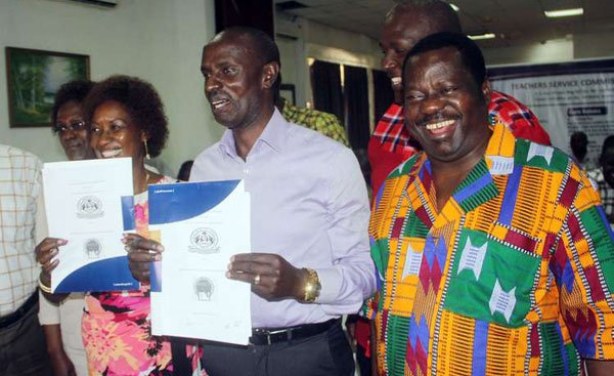
Teachers and their employer on Tuesday signed a Collective Bargaining Agreement that introduces a standard daily subsistence allowance for those working outside their duty stations.
The agreement, the first ever between the unions and the Teachers Service Commission, is meant to resolve perennial disputes over allowances and basic pay which have seen learning regularly disrupted owing to strikes by teachers.
A teacher in job group G (P1) in Nairobi, Mombasa, Kisumu, Malindi, Kilifi, Lamu, Kwale and Naivasha will now get a Sh6,300 daily subsistence allowance while those in job group P,Q and R in the same area will get Sh14,000.
P1 teachers in Nyeri, Eldoret, Kericho, Kakamega, Kisii, Embu, Nanyuki, Nakuru, Lodwar and Garissa will earn Sh4, 900 while a principal, senior principal and a chief principal in the same area will get Sh10,500.
Those in other areas will earn Sh4,200 for P1 while the principal, senior principal and chief principal will get Sh8, 400.
Those travelling to foreign countries will also receive daily subsistence allowances depending on the country, with the highest paid teacher travelling to Iraq earning Sh70,000 a day while the lowest paid teacher will get Sh52,500 .
Lesotho will attract the lowest rate with travellers there earning Sh21, 300 for the highest grade and Sh15, 400 for the lowest.
Previously, headteachers had absolute discretion on the allowances paid to teachers working out of their work stations but now the trips will have to be budgeted for by either the Treasury or the schools themselves.
The agreement, which was signed by Kenya National Union of Teachers secretary general Wilson Sossion and TSC chief executive Nancy Macharia, emphasises the over arching role of the Salaries and Remuneration Commission’s advice in determining allowances and basic pay.
NEGOTIATE BASIC SALARY
«The parties undertake to negotiate on the basic salary in the next cycle of negotiations,» says the agreement signed on the sidelines of the ongoing Kenya Secondary School Heads Association conference in Mombasa.
The agreement states that the highest paid teacher will continue to earn a basic salary of Sh109, 089 while the lowest paid will take home Sh16, 692 a month.However, they will benefit from scores of allowances including leave, commuter, responsibility, special school, readers /facilitation /aid, house and hardship allowances and medical benefit. The agreement was rushed to allow both parties to begin negotiations for another CBA starting next month to cater for the period between July 1, 2017 to June 30, 2021.
«It will remain in force and bind all parties until a new collective agreement is negotiated,» states the agreement, effectively blocking teachers from going on strike to press for higher pay.
Teachers have been depending on work boycotts to push for salary increments but the signing of CBAs binds them to wait for a four-year period before they can begin negotiations for an increment.
Both parties on Tuesday described the agreement as historic, saying it is the first in 48 years and would mark the start of a harmonious relationship between the two.
«From today, there is going to be harmonious relations between us and TSC. This is the first time TSC top management and KNUT have worked very closely to deliver a document that has eluded teachers of this country for the last 48 years,» said Mr Sossion.
DISPUTE RESOLUTION MECHANISM
He said the document had been well negotiated without coercion from either party, adding that the union was satisfied with it since it would protect the gains the unions have made with regard to teachers’ pay.
He said TSC had openly engaged the union in drawing up the document and that both parties had been having meetings since last month.
«This CBA formalises obligation of the parties and union members to adherence to the provisions of the Code of Regulations and Code of Conduct and Ethics for Teachers 2015 as the primary documents in the management of teachers,» said Mrs Macharia.
She added that it the document had re-stated the role of the SRC in the determination of remuneration payable to teachers in the public sector and would lead to the improvement of the quality of learning.
The CBA would also introduce an alternative dispute resolution mechanism so as to avoid strikes.
TSC chairperson Lydia Nzomo said TSC existed to protect learners and that one of the ways of doing so was by ensuring that learning was not disrupted by strikes.
«The learner is protected when industrial harmony is there and they are sure learning is taking place when they are supposed to learn and that they will get psychological and physical protection in schools,» said Dr Nzomo.
Dr Nzomo thanked Knut for working with TSC on the CBA.
Knut chairman Mr Mudzo Nzili said the CBA was proof of harmony between the union and the TSC.
More on This
Foto. : Laban Walloga / Daily Nation jefe de los profesores Comisión de Administración Nancy Macharia y Kenia Sindicato Nacional de Profesores de intercambio de copias Wilson Sossion Secretario General de la ACB que firmaron el 21 de junio 2016 a la playa del hotel Mombasa. En el fondo es TSC presidente Lidia Nzomo y de la izquierda es KNUT presidente Mudzo Nzili
Fuente: http://allafrica.com/stories/201606220129.html

Comparte este contenido:

Una voz africana rebelde contra la injusticia

Por: Marco A. Gandásegui, Hijo

¿Puede África darle lecciones al resto del mundo? En particular, ¿a los pueblos de América nuestra? Aminata Traoré, quien fuera ministra de Cultura y Turismo de Mali y candidata a la Secretaría General de las Naciones Unidas, genera fuertes debates cuando se refiere a los problemas mundiales de la coyuntura actual: el terrorismo, la democracia y el desarrollo.

Los medios silencian las voces africanas. Parecieran no existir. Los periodistas Alex Anfrus y Elodie Descamps entrevistaron a Aminata Traoré en forma extensa. Aquí reproducimos lo esencial del mensaje que proyecta su voz a un mundo convulsionado y víctima del despojo.

¿Cómo analiza el fenómeno terrorista que asola África y todo el mundo?

En primer lugar hay que analizar rigurosamente las causas: ¿Por qué ahora? ¿Y por qué por todas partes? Precisamente porque se han globalizado la injusticia, la desesperación y el desprecio. En la década de 1990, como consecuencia de las políticas de ajuste estructural, sonó la alarma: ‘cada año hay entre 100 000 y 200 000 jóvenes diplomados que llegan al mercado laboral y el modelo económico no crea empleo ‘. ¿Qué se puede hacer? A menudo los jóvenes solo pueden elegir entre el exilio y el fusil. Estos dos fenómenos contemporáneos y concomitantes están vinculados intrínsecamente al lamentable fracaso de un modelo económico que Occidente no quiere cuestionar.
Para muchos medios y analistas el yihadismo emanaría directa y principalmente de la religión. ¿Considera suficiente esa explicación?

Si fuese así, ¿por qué no surgió mucho antes ese pensamiento del radicalismo religioso? Fue a partir de las décadas de 1980 y 1990 cuando numerosas personas abandonadas por culpa de las políticas neoliberales fueron a las mezquitas y al Corán a buscar respuestas al desempleo y a la exclusión. Si no hubiese sido así, en Irak los generales de Sadam Hussein no habrían encontrado islamistas en Abu Ghraib para sentar las bases del Estado Islámico. ¿Cómo llegaron a introducirse en los en los barrios pobres? ¿Por qué fascinan también a la ‘clase media ‘? Hay un vacío ideológico abismal que no se quiere reconocer.

Si en la actualidad los pueblos dispusieran de más justicia, más empleo y más respeto se podrían garantizar la paz y la seguridad, pero eso supondría que los que dominan deberían renunciar a parte de sus privilegios. No pueden. Eso sería hacerse el harakiri reconociendo que se equivocan. El modelo no crea empleo y no responde a las demandas sociales. Para disfrutar hoy de la paz, una paz auténtica y estable, y de la seguridad humana —que no hay que confundir con la ‘segurización ‘— hay que introducir en el debate los asuntos mineros, petroleros y otros. Garantizar la seguridad humana a los individuos por medio del empleo, la sanidad, la educación y otros servicios sociales básicos considerados gastos improductivos.

¿Cuáles son, desde su punto de vista, los desafíos de la sociedad civil y de los intelectuales africanos del siglo XXI?
Hay que ir más lejos en el trabajo de desmontaje de las ideas recibidas y de descontaminación de las mentes sobre el crecimiento, la emergencia y otras historias absurdas. Si el sistema fuese bien, ¿por qué se encontraría Europa en una crisis existencial que la está conmocionando? Pienso que las soluciones prestadas han revelado sus límites a la luz de nuestras experiencias, de nuestras vivencias, de nuestras aspiraciones. Por desgracia una gran parte de los que se denomina ‘la sociedad civil ‘ no se atreve a levantar las cuestiones que enfadan a los ‘donantes ‘. Localmente no pueden hacer nada sin la ayuda de la ‘comunidad internacional ‘.

Aminata Traoré concluye recordando a Patrice Lumumba, el héroe moderno de África:
A muchas personas que habrían podido y quisieron hacer cosas se lo impidieron. El asesinato de Patrice Lumumba fue el acto fundacional del caos político. Los asesinatos políticos a lo largo de las décadas de 1960 y 1970 traumatizaron y disuadieron a los dirigentes que querían fundirse con sus pueblos.
En la actualidad, cuando hablamos de la sociedad civil, a menudo está formateada, es prudente e incluso timorata. Ahora está surgiendo un sentimiento de revolución interna frente a la segunda recolonización del continente que no deja indiferentes a los africanos. Hay que capitalizar esos esfuerzos de cuestionamiento para desarrollar nuestra capacidad de proposición, de anticipación y de acciones transformadoras de nuestras economías y de nuestras sociedades en el sentido del interés común.

África se prepara para darle lecciones al resto del mundo.

Fuente: http://laestrella.com.pa/opinion/columnistas/africana-rebelde-contra-injusticia/2394716

Comparte este contenido:

Kenya: Kenya to make secondary school education free

Kenya: Kenya to make secondary school education free

Ministerio de Educación/Kenya/junio de 2016/IOL

RESUMEN: El presidente Uhuru Kenyatta, anunció el miércoles que el gobierno va a convertir la educación secundaria en escuelas públicas gratuitas en Kenia a partir de 2019.
Kenyatta dijo que su gobierno estaba resuelto a garantizar que todos los niños de las escuelas primarias de tránsito público a la escuela secundaria pública estudien sin tener que abandonar debido a problemas financieros. El presidente dijo que el presupuesto nacional publicado recientemente aumentó el gasto diario en educación secundaria en un 33 por ciento a 32 millones de chelines kenianos, y se prepara para hacer la educación secundaria universal y gratuita para garantizar el 100 por ciento de transición de primaria a secundaria.
«Estamos haciendo todo esto para mejorar la calidad de la educación y aliviar la carga de los padres mediante la eliminación de los obstáculos de acceso a la educación secundaria», dijo el presidente.

Por: Roseleen Nzioka
Mombasa – President Uhuru Kenyatta on Wednesday announced that the government will make secondary school education in public schools in Kenya free starting from 2019.
Kenyatta said his government was determined to ensure that all children in public primary schools transit into public secondary school without having to drop out due to financial problems.
The president said the recently released national budget increased the Free Day Secondary Education expenditure by 33 percent to 32 billion Kenyan shillings as it prepares to make universal secondary education free to ensure 100 percent transition from primary to secondary school.
“We are doing all this to improve the quality of education and ease the burden on parents by removing impediments of access to secondary education,” the president said.
President Kenyatta was speaking in Mombasa where he addressed the 41st Kenya Secondary School Heads Association (KESSHA) annual national conference.
He told the gathering of head teachers and principals that they must embrace prudent management of the funds.
“Prudence is not limited to funds disbursed by the Government – this includes funds collected from parents as well. As accounting officers in your institutions, you are fully responsible for management of the resources,” President Kenyatta told the secondary school heads.
He traced the introduction of Free Day Secondary Education back to 2008 when the government started paying a subsidy of Sh10,265 (US$102.65) for each student a year, saying the scaling up of the figure to Sh12,870 (US$128) in 2015 had seen a phenomenal growth in enrollment in high schools.
“The Free Day Secondary Education programme has paid handsome dividends – transition rates from primary to secondary schools have improved substantially from 60 percent in 2008 to 86.7 percent in 2015,” President Kenyatta said.
The central place of education in national development is crucial, the president said, adding that the government would continue to invest heavily in education.
On national examinations, the president said the government had undertaken far-reaching actions aimed at improving administration of the national tests.
“My government has embarked on critical changes in streamlining examination administration so that cases of cheating are eradicated,” the president said.
He said there would be harsh punishment for those who cheat and those who abet the vice, citing a 10-year jail term for the culprits.
The president said as the country takes a leap into national prosperity, Kenya requires a critical mass of knowledgeable and skilled citizens to deal with the challenges of the this century.
President Kenyatta challenged the school heads to sharpen the social skills and attitudes of the students saying: “The youth require guidance and understanding, not judgment and condemnation to be able to navigate through this turbulent period of their lives.”
Education Cabinet Secretary Fred Matiang’i said his ministry would ensure that exams are administered in a credible manner to guard against cheating and other malpractices.
Matiang’i said his ministry is also improving infrastructure in schools so that students can learn in a conducive environment that would boost the success of education.
Other speakers at the event included Mombasa Governor Hassan Joho, teacher unions’ officials and head teachers’ association chairman John Awiti.
Earlier in the day at State House, Mombasa, President Kenyatta had met with top officials of the two teachers’ unions, Kenya National Union of Teachers (KNUT) and Kenya Union of Post Primary Education Teachers (KUPPET) and the teachers’ employer, the Teachers Service Commission.
Kenyatta applauded the two unions for the recent signing of a Collective Bargaining Agreement (CBA) with the Teachers Service Commission which put to rest years of disruptive strikes by teachers over their salaries.
Kenyatta praised the landmark agreement that covers 2013 – 2017, saying for the first time there was a platform on which future discussions and negotiations between the employee (unions) and the employer (TSC) would be held.
He added: “As you will recall, a few months ago I asked the TSC and the Kenya National Union of Teachers (KNUT) to sit together as reasonable people and find a way forward in establishing a harmonious relation in the education sector.”
The CBA, signed on Tuesday, introduces, among other things, an alternative dispute resolution mechanism that will end the perennial strikes that have dogged the education sector in the past.
The head of state pointed out that harmonious relations between the TSC and teachers’ unions cannot exist in an environment of confrontation. The two must look for a way that will ensure the education of Kenyan children is not put at risk, especially during their crucial time when they are doing their exams, he said.
President Kenyatta also assured the teachers as well as other public servants that his government was committed to safeguarding their welfare.
TSC Chairperson Lydia Nzomo said the CBA protects the pupils by ensuring that they learn in an environment where there is industrial harmony.
Union officials said that for the first time teachers have a pact with their employer that fully protects their rights.
KNUT Secretary General Wilson Sossion and Chairman Mudzo Nzili said the successful implementation of the CBA would entrench the tripartite relationship between the government, the TSC and the KNUT to deliver high quality education.
File photo: Kenya’s President Uhuru Kenyatta. Credit: AP

Fuente: http://www.iol.co.za/news/africa/kenya-to-make-secondary-school-education-free-2037775

Comparte este contenido:

La Sociedad de Carreras colaborará ayudando a niños de Ruanda

Ruanda/23 de junio de 2016/Fuente: andaluciainformacion

La Sociedad de Carreras de Caballos de Sanlúcar ha firmado un convenio de colaboración con la asociación gaditana de Museke. Este convenio, que han firmado el presidente de la Sociedad de Carreras, Rafael Hidalgo y la presidenta de Museke, Carmen Gil, contempla la colaboración y difusión de las actividades y de la obra y fines de la asociación en las redes sociales y página web de las Carreras de Sanlúcar, además de poner a disposición de Museke toda la infraestructura necesaria para las labores de promoción y captación de socios.

Museke es una asociación sin ánimo de lucro, con sede en la capital gaditana, cuya misión es la puesta en marcha de proyectos que garanticen la cobertura de necesidades básicas de alimentación, vivienda, higiene y educación en comunidades empobrecidas de Africa y proveer de alimentos, vestido, comedores e ilusión a los niños de Ruanda, en la región de Ruhengeri, al norte del país, centrando la ayuda y colaboración en el hospital de Nemba, fundado y mantenido por la Diócesis de Navarra y Médicos Mundi.

Museke, trabaja también en proyectos como la manutención de niños en edad de escolarización, la construcción de viviendas para familias sin recursos, taller de oficios e idiomas y la construcción de una granja de gallinas.

El presidente de la Sociedad de Carreras de Caballos de Sanlúcar, Rafael Hidalgo, ha mostrado su satisfacción en poder colaborar con una asociación que está ayudando a los niños ruandeses, mientras que la presidenta de Museke, ha agradecido las muestras de apoyo que ha recibido desde las Carreras de Sanlúcar con la firma de este acuerdo.

Fuente: http://andaluciainformacion.es/sanlucar/605313/la-sociedad-de-carreras-colaborara-ayudando-a-ninos-de-ruanda/

Imagen: http://andaluciainformacion.es/cms/media/articulos/articulos-423330.jpg

Comparte este contenido:
Page 517 of 622
1 515 516 517 518 519 622