Saltar al contenido principal
Page 103 of 400
1 101 102 103 104 105 400

Segregated student’s life changes after getting access to regular classrooms in Washington

By: Taylor Mirfendereski, Susannah Frame.

Sam Clayton, a 14-year-old with Down syndrome, was profiled in KING 5’s “Back of the Class” series about special education failures in Washington state.

— It wasn’t Sam Clayton’s xylophone performance of “Twinkle Twinkle Little Star” that brought his parents to tears recently.

It was the roaring applause and standing ovation from Sam’s classmates that followed his performance as the opening act at his high school’s band concert in May.

“I got really really choked up and thought, ‘This is amazing,’” Sam’s mother, Sandy Clayton, said. “This, in such a huge way, was a recognition of Sam.”

Sam, 14, just finished his freshman year at Decatur High School in Federal Way. He was born with Down syndrome.

Until Sam’s performance on the school stage, Sandy and Rob Clayton had never before seen so many other kids recognize their son. The school year prior, at a middle school dance, they watched Sam’s classmates ignore him while he spent 45 minutes in the school gymnasium dancing alone.

«Not one child came and interacted with him. No one came and said, ‘Hi Sam,'» Sandy Clayton said. «He experiences every emotion every other kid feels. He knew he was alone.»

For this family, the band concert applause was yet another milestone in a year full of academic and social progress for Sam. It symbolized the incredible change that can happen to children with disabilities when school administrators make one simple adjustment to their education: inclusion with students who don’t have disabilities.

“It still boggles my mind that no one came by and said hello to him [at the dance], and now, he just walks down the hall — it’s not even a special occasion— and the kids are saying hi to him,” Sandy Clayton said.

This school year, Sam’s freshman year of high school, was the first time in three years that Federal Way school administrators allowed him inside general education classrooms, learning alongside non-disabled peers for nearly 40 percent of the day. At Taf @ Saghalie Middle School, Sam spent every day in a segregated classroom with other students with disabilities, including lunch.

“[The inclusion is] changing his life significantly,” his dad, Robert Clayton, said.

Sam, who previously struggled to meet his academic goals, was the subject of the second investigation in KING 5’s “Back of the Class” series in May 2018. The investigation found that Washington schools exclude students with disabilities from general education settings more often than schools in nearly every other state in the country.
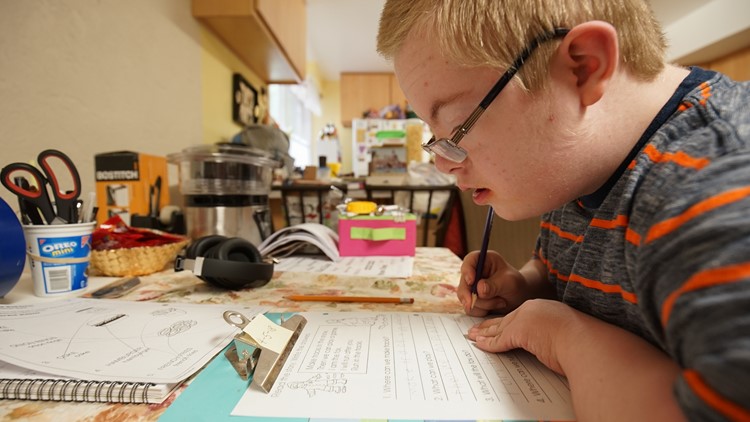
Sam Clayton - April 2018
Sam Clayton completes a school worksheet at his Federal Way home on April 5, 2018.
Taylor Mirfendereski

That’s not supposed to happen under state and federal law. Public schools in the United States are required to provide specialized educational services to all children with a disability recognized under the Individuals with Disabilities Education Act (IDEA).

That law guarantees that the more than 150,000 special education students in Washington have the right to go to school in the “least restrictive environment.” It means they should get the opportunity — to the maximum extent appropriate — to learn in a general education setting around children who are not disabled, even if they can’t keep up academically or if schools have to provide extra support.

«I see all too often that kids are removed from the regular classroom unnecessarily when they are capable of learning with the right support,” said Kathy George, a Seattle-based attorney and a special education expert.

Just over half of Washington’s 6 to 21-year-olds with disabilities spend 80 percent or more of their day in general education classes. Only seven states have a lower percentage of special education students in regular classes, according to an analysis of the U.S. Department of Education’s 39th Annual IDEA report to Congress, published in 2017.

Five percent of Washington’s students with intellectual disabilities spend the majority of their day in regular classrooms. Only two states in the country — Nevada and Illinois — have worse inclusion rates in that category, according to the same report.

Source of the review: https://www.king5.com/article/news/investigations/segregated-students-life-changes-after-getting-access-to-regular-classrooms-in-washington/281-51c6a966-b467-4947-954a-6495a455210e
Comparte este contenido:

Nueva York se queda sin maestros de escuela pública: éxodo de 41%

Redacción: El Diario NY

«El Departamento de Educación prepara a los nuevos maestros para que fracasen», denunció el Contralor.

Una alarmante cifra de 41% de los maestros de la ciudad contratados durante el año escolar 2012-13 abandonó el sistema durante sus primeros cinco años en el trabajo, y la tendencia viene así desde hace una década.

El contralor de la ciudad, Scott Stringer, advirtió el lunes que el éxodo de educadores en las escuelas públicas de la ciudad está destruyendo la continuidad del aula, y pidió un nuevo programa de “residencia” para frenar la renuncia través de una mejor capacitación.

“Hay una crisis de retención de maestros en la ciudad de Nueva York”, sentenció.

“Con demasiada frecuencia, el Departamento de Educación (DOE) prepara a los nuevos maestros para que fracasen”, dijo Stringer a los reporteros en “NYC Mission Society”, en Harlem.

Según el estudio, una pérdida de cerca del 40% en los primeros cinco años ha sido constante desde 2008-09, obligando al DOE a buscar instructores nuevos cada año, según el informe.

Como resultado, hay una escasez crónica de personal en áreas clave y casi un tercio de todos los maestros de la ciudad tienen ahora menos de cinco años de experiencia.

“No podemos seguir aceptando un status quo donde perdemos la mitad de nuestros maestros en la fuerza laboral cada cinco años“.

Para capacitar mejor a los maestros, Stringer está pidiendo al DOE que adopte un programa de “residencia” que ofrezca a aspirantes a instructores un estipendio de $30 mil dólares para trabajar en una escuela de la ciudad durante su último año de posgrado.

Los participantes recibirían tutoría directa de otro maestro durante ese año antes de ser contratados formalmente el año siguiente.

Stringer dijo que los vecindarios más pobres a menudo son los más afectados por los educadores que huyen.

El plan de Stringer cuenta con el respaldo sindical y del presidente de la Federación de Maestros de Estados Unidos (UFT), Michael Mulgrew.

“A la UFT le encantaría ver una colaboración sólida con las universidades locales y un programa de residencia de maestros que ayude a que todos los maestros entrantes tengan un comienzo más sólido en su profesión”.

Stringer también pidió más maestros de color, y señaló que 60% de los educadores de la ciudad son blancos en un sistema escolar predominantemente minoritario.

El lunes se unió al senador estatal Brian Benjamin, quien se hizo eco del llamado a más maestros negros e hispanos.

Un portavoz del DOE dijo que el departamento ya estaba implementando algunas de las estrategias de Stringer.

“Continuaremos fortaleciendo nuestro enfoque holístico para reclutar y retener maestros, y estamos orgullosos de que nuestra tasa de retención de maestros sea más alta que el promedio nacional”, dijo el portavoz Doug Cohen, citado por New York Post.

Fuente: https://eldiariony.com/2019/06/25/nueva-york-se-queda-sin-maestros-de-escuela-publica-exodo-de-41/

Comparte este contenido:

Los ingresos por educación serán la próxima víctima prevista en la guerra comercial entre Estados Unidos y China

Redacción: América Economía

Cada año, un número récord de estudiantes han arribado a los Estados Unidos para asistir a uno de los 4.000 colegios o universidades de gran prestigio del país.

los expertos en educación estadounidenses les preocupa que la disminución de las relaciones con China tenga un impacto financiero negativo en los colegios y universidades de EE. UU. «Está disminuyendo rápidamente», señaló Anthony Ogden, vicerrector adjunto para la participación mundial en la Universidad de Wyoming, sobre el número total de estudiantes internacionales que vienen a los Estados Unidos para estudiar.

La educación no es ligera en la imagen de importación de los Estados Unidos. Los ingresos en las instituciones postsecundarias que otorgan títulos universitarios fueron de US$649 mil millones en 2017, según el Centro Nacional de Estadísticas de la Educación.    

Durante las últimas dos décadas en todo el mundo, cada año, un número récord de estudiantes han arribado a los Estados Unidos para asistir a uno de los 4,000 colegios o universidades de gran prestigio del país. Más importante aún, los estudiantes internacionales suelen pagar la matrícula completa y aumentar los ingresos para las escuelas.

Los estudiantes internacionales, encabezados por China, contribuyeron con más de US$30 mil millones a la economía de los Estados Unidos en el año académico 2014-2015, según NAFSA, Asociación de Educadores Internacionales y el Departamento de Comercio de los Estados Unidos.

NAFSA, un grupo sin fines de lucro con sede en Washington que apoya la educación internacional, estima que los estudiantes extranjeros crearon o mantuvieron más de 455.000 empleos en los Estados Unidos, casi nueve veces más que la cantidad de mineros de carbón estadounidenses. El valor de la educación es casi el doble de los ingresos de las principales exportaciones agrícolas de Estados Unidos en 2017, que son US$21.6 mil millones de la soja.

Grandes implicaciones    

Pero esta tendencia podría haber llegado a su fin, dijo Ogden, y agregó que en 2018 se registró una disminución general en el número de estudiantes internacionales que asisten a escuelas estadounidenses de 1.12 millones a menos de un millón.

Solo en el último año, el número de estudiantes internacionales que están en los Estados Unidos disminuyó por primera vez en décadas en un 2,7%, según los datos de titulares de visas de estudiantes publicados recientemente por la Oficina de Inmigración y Control de Aduanas de los Estados Unidos.

En una entrevista exclusiva con Xinhua, Ogden, un educador de carrera con 30 años de experiencia en reclutamiento y relaciones internacionales en universidades como la Universidad Estatal de Michigan, dijo que si la inscripción en China disminuye como se esperaba, las instituciones de todo el país pronto experimentarán un gran dolor. «El año pasado fue el primer año que ha estado en declive», dijo Ogden. «Tiene enormes implicaciones para las escuelas que recurren a estudiantes internacionales para obtener ingresos», agregó.

En la última década, el número de estudiantes de China que vienen a los Estados Unidos se ha cuadruplicado a casi 400.000. Cuando Barack Obama fue elegido presidente de los Estados Unidos en 2008, había 80.127 estudiantes chinos en los Estados Unidos, según Statista. Para cuando Obama dejó el cargo en 2016, ese número había aumentado a 350.000 e incluso había aumentado hasta 363.341 en 2017, según datos del Instituto de Educación Internacional (IIE).

Los expertos de la industria dijeron a Xinhua que parece que la cantidad de estudiantes de China está a punto de caer en picada y los educadores estadounidenses se están retorciendo las manos preguntándose cómo evitar miles de millones de dólares en pérdidas si esto sucediera.

Fuente: https://mba.americaeconomia.com/articulos/notas/los-ingresos-por-educacion-seran-la-proxima-victima-prevista-en-la-guerra-comercial

Comparte este contenido:

Estados Unidos sufre el peor desempeño en el ranking mundial en 16 años

América del Norte/EEUU/Universityworld

l sistema de educación superior de los Estados Unidos ha registrado su peor desempeño en 16 años y está acelerando su tasa de declive, según la 16ª edición del QS World University Rankings . 

El ranking, publicado el 19 de junio, ve como el 72.6% de las 157 universidades clasificadas en los EE. UU. Se deterioran. EE. UU. También ha registrado su número más bajo de 100 universidades principales (29) desde 2016, y cuatro menos que el año pasado (33). 

El Reino Unido también tuvo un año pobre, con su tercer peor desempeño desde que comenzó el ranking, con un 66% de universidades perdiendo lugares, aunque la disminución fue menor que en 2017 (con un 70.5% de universidades cayendo) y 2018 (70.6%) . 

Ben Sowter, director de investigación en QS, dijo que el sector estadounidense está experimentando un nivel de declive sin precedentes.

“Está claro que la comunidad académica global ha disminuido de manera persistente la confianza en el sistema de educación superior de los EE. UU. En los últimos cuatro años. 

«Este desgaste de la confianza se ha visto agravado por el empeoramiento de la proporción de estudiantes internacionales, en comparación con sus pares globales, y la evidencia de que el estado de América antes inapelable como líder de investigación mundial está cada vez más amenazado». 

Pero hay buenas noticias para China, Australia y el Medio Oriente. , que ganó terreno:

  •  Más de dos tercios de las universidades australianas subieron en los rankings. 
  • China ahora tiene 19 de las 200 mejores universidades de investigación del mundo, en comparación con 12 en 2016.
  • • El Medio Oriente tiene dos de las 200 mejores universidades por primera vez, con la Universidad Rey Abdulaziz de Arabia Saudita (186) como el nuevo líder regional.

Está surgiendo una fuerte tendencia negativa que puede reflejar una menor inversión en la enseñanza y puede afectar negativamente el reclutamiento de estudiantes internacionales: en las 302 universidades de los EE. UU., Reino Unido, Australia y Canadá, 216 han registrado un peor desempeño en la «proporción de profesores por alumno», la medida de QS de Capacidad docente institucional. 

Lo más alto de la clasificación se mantiene sin cambios, ya que EE. UU. Ocupa los tres primeros lugares: el Instituto de Tecnología de Massachusetts nuevamente lidera la Universidad de Stanford y la Universidad de Harvard. Tiene cinco en el top 10, con el Instituto de Tecnología de California colocando un lugar en el quinto lugar, y la Universidad de Chicago bajando un lugar en el décimo. 

Países de la UE cierran brecha en el Reino Unido

El Reino Unido tenía cuatro en el top 10, pero la Universidad de Cambridge cayó a su posición más baja, la séptima, mientras que Oxford subió de un lugar al cuarto. El University College de Londres ocupó el octavo lugar, subió dos puestos, superando al Imperial College de Londres en el noveno puesto, un lugar. 

Según QS, los datos muestran que las universidades de la UE-27 están cerrando la brecha con respecto a las del Reino Unido. En 2016, el año del referéndum de la Unión Europea en el Reino Unido, la brecha entre la posición universitaria promedio en el Reino Unido y la UE27 fue de 94,7 rangos. Esa brecha ahora se ha reducido a 68.2 rangos: una reducción del 28%.

QS dice que esto se debe en gran parte a la trayectoria del desempeño de investigación de cada cohorte. Desde 2016, el rango promedio alcanzado por las universidades del Reino Unido para ‘Citas por Facultad’ – la medida del impacto de la investigación institucional de QS – ha disminuido en 71,4 lugares, mientras que el promedio de la UE27 ha mejorado marginalmente (+3 rangos). 

El suizo ETH Zurich (6º) ha superado a la Universidad de Cambridge por primera vez, para convertirse en la segunda mejor universidad del continente. 

La producción de investigación de China compite con la de EE. UU.

Mientras tanto, las dos principales universidades de China continental han alcanzado su posición más alta en el ranking, y la producción de investigación china ahora compite con la de Estados Unidos. 

Las principales universidades de Asia son la Universidad Nacional de Singapur y la Universidad Tecnológica de Nanyang, Singapur (ambas 11).

Pero la Universidad Tsinghua de China subió un lugar hasta el 16 y la Universidad de Pekín subió ocho lugares hasta el 22º. Ambas instituciones han aumentado durante cinco años consecutivos. La Universidad de Fudan es ahora 40, hasta cuatro lugares. Ahora ha aumentado en 31 lugares desde 2015. 

Además, el impacto de la investigación china sigue mejorando. De las 42 universidades clasificadas en China, 32 han mejorado su desempeño para el indicador de «Citas por Papel» de QS, mientras que nueve han bajado de rango. 

Ocho de las 100 principales universidades de investigación del mundo ahora son chinas, tres más que el año pasado.

Las 10 principales universidades de China produjeron 428,191 artículos de investigación en el período de cinco años utilizado por QS para evaluar el impacto de la investigación; Las 10 mejores universidades de los Estados Unidos produjeron 443,996. QS destacó que esto significa que la brecha de producción ahora es de solo 15.805 documentos, y se está «cerrando año con año». 

Sowter concluyó que uno de los principales diferenciadores entre los sistemas de educación superior que están viendo mejoras y los que no lo son es la financiación. 

«China, cuya trayectoria de investigación es diametralmente opuesta a la de los Estados Unidos, ha pasado dos décadas y media creando e implementando una estrategia de financiamiento nacional integral que, más que nunca, ha dado frutos este año», dijo.

«Por el contrario, la reciente solicitud del gobierno de Trump de un recorte de US $ 7,1 mil millones a los fondos del Departamento de Educación es el tercer año consecutivo en que busca reducir los fondos federales para el sistema educativo de los EE. UU.» 

Dijo que esos recortes van acompañados de fondos estatales igualmente estrictos. Por ejemplo: el sistema de la Universidad de California, una joya del ecosistema de investigación de los EE. UU., Continúa recibiendo acciones de las asignaciones del Fondo General del estado que se encuentran en mínimos históricos. 

«Junto con los ataques propuestos al presupuesto nacional de ciencia, el clima para la educación terciaria de los EE. UU. Parece tan problemático como el clima global, cuyas fortunas, y las fortunas de la humanidad, requieren que EE. UU. Mantenga su compromiso con la investigación universitaria de vanguardia».

En contraste, las universidades chinas están disfrutando de los «beneficios significativos de una inversión inteligente y exigente», dijo. 

«Es muy posible que la edición del próximo año de QS World University Rankings haga que las 10 mejores universidades de China contribuyan con un mayor volumen de investigación al mundo que la mejor de los EE. UU.». 

Sin embargo, sigue existiendo una gran brecha en el impacto de la investigación. Mientras que las 10 mejores universidades de China están produciendo casi la misma investigación que sus equivalentes en los EE. UU., La investigación en los EE. UU. Sigue gozando de casi el doble del nivel de impacto. «Por lo tanto, la próxima frontera para la educación superior china es tomar medidas para garantizar que el impacto de la investigación coincida con la productividad de la investigación», dijo Sowter.

Las clasificaciones, producidas por la consultora global de educación superior QS, o Quacquarelli Symonds, clasifican a las 1.000 universidades más importantes del mundo según la reputación académica, la empleabilidad de los graduados, la proporción entre estudiantes y personal, el rendimiento en investigación y la internacionalización. 

Fuente: https://www.universityworldnews.com/post.php?story=20190621130009586

Comparte este contenido:

Estados Unidos: Does Angie Motshekga understand ramifications of decisions on education?

As an English Home Language FET educator, it was and still is extremely frustrating to receive learners in Grade 10 who could barely spell, write coherently or even speak proper English.

Also, being a Mathematics, Physical Science and Technology educator, it irks me no end to see the pathetic results at the end of each term.

Despite not teaching these subjects, I was interested and still am, to see the children’s performance here. I tutor these PRIVATELY because parents fear that their children would fail.

As a music teacher, I am perturbed at how music, art, etc were first removed from the curriculum, then reintroduced as CREATIVE ARTS. This, at many schools, is being treated as a non-entity – learners are literally given marks without doing anything.

Educators bully educators, principals victimise and harass, also bully, contract educators into marking/assessing lazy permanent educators’ tasks.

The threat of a contract NOT being renewed is held over them. In most cases, the victims remain silent because they have families to support. There is no recourse for these educators, for in most if not all cases, they do not belong to a union.

Educators’ safety is of grave concern. Lately, attacks on educators have escalated, resulting in death – most of them are learner related.

Learner arrogance towards educators is on the rise because they know that there is a long and tedious process before they can be either suspended or expelled.

Similarly, their attitude towards their education is a cause for concern simply because they know that they CANNOT or rather MAY NOT fail.

I can mention a plethora of qualms that I have, but it will fall on deaf ears. Do you understand the ramifications of your ministry’s decisions?

Do you EVER consult with those at grassroots level to gauge whether what you have decided to implement is beneficial to our learners?

‘Til now, I am of the opinion that you and your ministry have failed our children. It is time that you accept responsibility for your decisions.

Fuente de la Información: https://www.iol.co.za/capetimes/opinion/does-angie-motshekga-understand-ramifications-of-decisions-on-education-27384200

Comparte este contenido:

Estados Unidos: Education is the key to escaping a life of poverty and poor health

It’s the time of the year when we celebrate those who have progressed in their educational endeavors. Pomp and circumstances are in full swing for many who have graduated from high school or college preparing to move on to their next chapter in life. For me, graduating with my baccalaureate degree in nursing remains my most significant achievement to date, especially because I had entered college very unprepared and still recovering from a horrific foster care experience. Not sure of what the future held, I persevered as if my life depended on it. Little did I know how right I was

Everyday there are many others like me who have progressed against a number of odds. Their resilience and tenacity are something to be admired. Consider Tupac Mason, a homeless youth from Memphis, who recently scored three million dollars in scholarship money. Tupac’s story is particularly inspiring given the increase in the number of the homeless students who may never finish school. According to Education Leads Home, a national campaign devoted to improving the outcomes of homeless children, 87 percent of homeless youth are more likely to drop out of school.

While information about homeless students varies across the country, the growing numbers of homeless students and related graduation rates is quite daunting. Findings from the report “Homeless Students In America’s Public Schools” revealed a tremendous growth in the number of homeless students in Pre K to 12 in America’s public schools. More than 1.3 million children were identified as being homeless during 2013 -2014, representing a 7 percent increase from the previous year and doubling the number of homeless students in 2006-2007.

Initially only five states collected high school graduation rates for homeless students. Graduation rates for homeless students in all of the reporting states lagged behind the graduation rates for all students, including low income students. Thankfully, federal legislation now requires all states to report the graduation and performance rates of homeless students commencing with data for the 2017-2018 school year.

Tupac’s ability to complete his high school education in the midst of unimaginable odds may be one of the strongest predictors of his ability to escape from a life of homelessness and poverty. And while college is not for everyone, there is a strong correlation among education attainment, earning potential and even health. According to the U.S. Bureau of Labor Statistics, individuals with less than a high school diploma earn less and are more likely to be unemployed compared to individuals with a higher level of education.

In 2018, individuals with less than a high school diploma had a median weekly earnings of $553.00 and a 5.4 percent rate of unemployment. Individuals with a high school diploma and no college had a median weekly earnings of $730.00 and a 4.3 percent rate of unemployment. Median weekly earnings increase with the increase in educational attainment. Being employed is a critical first step to eliminating the gripping effects of homelessness and poverty.

Education is also linked to health status and life expectancy. Increasingly experts have identified income and education as two of the most important factors influencing life expectancy and health status measures. Graduation from high school is now a leading health indicator for the nation as outlined in Healthy Pe ople 2020.

Individuals who drop out of high school are more likely to self-report poor health, engage in risky behaviors and experience a number of chronic conditions such as cardiovascular disease, diabetes, asthma, stroke and hypertension. Many individuals who do not complete high school have less access to resources needed to maintain their health and well-being. Limited employment options further reduce access to key resources including access to health care. While more needs to be known about the relationship between life expectancy and education, researchers surmise that education is one of the strongest predictors of life expectancy.

Over the course of my life I have benefited from being able to complete my education and become a nurse. While I realize that college is not for everyone, completion of one’s education provides one of the strongest pathways for escaping homelessness, finding employment and becoming a contributing member of society. All children deserve an opportunity to complete their education and move on to become productive citizens. Perhaps Tupac Mason’s story will send a clarion call that more needs to be done to assist homeless students in achieving their dreams.

There is an urgent need for the nation to move our homeless children out of hidden view and provide them with stable environments, resources and support that will enable them to complete their education. The adoption of social policies that integrate educational disparities along with health considerations has the potential to mitigate some of the immediate and long term negative effects of being homeless. Our ability to do so will not only impact the lives of homeless students, but our nation as a whole and generations to come.

Janice Phillips RN, is an associate professor at Rush University College of Nursing and the director of Nursing Research and Health Equity at the Rush University Medical Center and a Public Voices fellow of the OpEd Project.

Fuente de la Información: https://thehill.com/opinion/healthcare/449974-education-is-the-key-to-escaping-a-life-of-poverty-and-poor-health

Comparte este contenido:

Black education decline

New York Mayor Bill de Blasio says that the city’s specialized high schools have a diversity problem. He’s joined by New York City Schools Chancellor Richard A. Carranza, educators, students and community leaders who want to fix the diversity problem. I bet you can easily guess what they will do to «improve» the racial mix of students (aka diversity). If you guessed they would propose eliminating the Specialized High Schools Admissions Test as the sole criterion for admissions, go to the head of the class. The Specialized High Schools Admissions Test is an examination that is administered to New York City’s eighth- and ninth-grade students. By state law, it is used to determine admission to all but one of the city’s nine specialized high schools.

It’s taken as axiomatic that the relatively few blacks admitted to these high-powered schools is somehow tied to racial discrimination. In a June 2, 2018, «Chalkbeat» article (https://tinyurl.com/y64delc3), de Blasio writes: «The problem is clear. Eight of our most renowned high schools – including Stuyvesant High School, Bronx High School of Science and Brooklyn Technical High School – rely on a single, high-stakes exam. The Specialized High School Admissions Test isn’t just flawed – it’s a roadblock to justice, progress and academic excellence.»

Let’s look at a bit of history to raise some questions about the mayor’s diversity hypothesis. Dr. Thomas Sowell provides some interesting statistics about Stuyvesant High School in his book «Wealth, Poverty and Politics.» He reports that, «In 1938, the proportion of blacks attending Stuyvesant High School, a specialized school, was almost as high as the proportion of blacks in the population of New York City.» Since then, it has spiraled downward. In 1979, blacks were 12.9% of students at Stuyvesant, falling to 4.8% in 1995. By 2012, The New York Times reported that blacks were 1.2% of the student body.

What explains the decline? None of the usual explanations for racial disparities make sense. In other words, would one want to argue that there was less racial discrimination in 1938? Or, argue that in 1938 the «legacy of slavery» had not taken effect whereby now it is in full bloom? Genetic or environmental arguments cannot explain why blacks of an earlier generation were able to meet the demanding mental test standards to get into an elite high school. Socioeconomic conditions for blacks have improved dramatically since 1938. The only other plausible reason for the decline in academic achievement is that there has been a change in black culture. It doesn’t take much to reach this conclusion. Simply look at school behavior today versus yesteryear.

An Education Week article reported that in the 2015-16 school year, «5.8% of the nation’s 3.8 million teachers were physically attacked by a student.» The Justice Department’s Bureau of Justice Statistics and the Department of Education’s National Center for Education Statistics show that in the 2011-12 academic year, there were a record 209,800 primary- and secondary-school teachers who reported being physically attacked by a student. Nationally, an average of 1,175 teachers and staff were physically attacked, including being knocked out, each day of that school year.

In the city of Baltimore, each school day in 2010, an average of four teachers and staff were assaulted. A National Center for Education Statistics study found that 18% of the nation’s schools accounted for 75% of the reported incidents of violence and 6.6% accounted for half of all reported incidents. These are schools with predominantly black student populations. It’s not only assaults on teachers but cursing and disorderly conduct that are the standard fare in so many predominantly black schools.

Here are questions that might be asked of de Blasio and others who want to «fix the diversity problem» at New York’s specialized schools: What has the triumph of egalitarian and diversity principles done for the rest of New York’s school system? Are their academic achievement scores better than students at New York’s specialized schools? The most important question for black parents: What has been allowed to happen to cripple black academic excellence?

Source of the article: https://www.theitem.com/stories/black-education-decline,329045

Comparte este contenido:
Page 103 of 400
1 101 102 103 104 105 400
OtrasVocesenEducacion.org