Page 163 of 400
1 161 162 163 164 165 400

EEUU: Baltimore city is suing Trump administration over cuts to teen pregnancy prevention education

EEUU/March 27, 2018/BY DR. LEANA S. WEN/Source: http://thehill.com

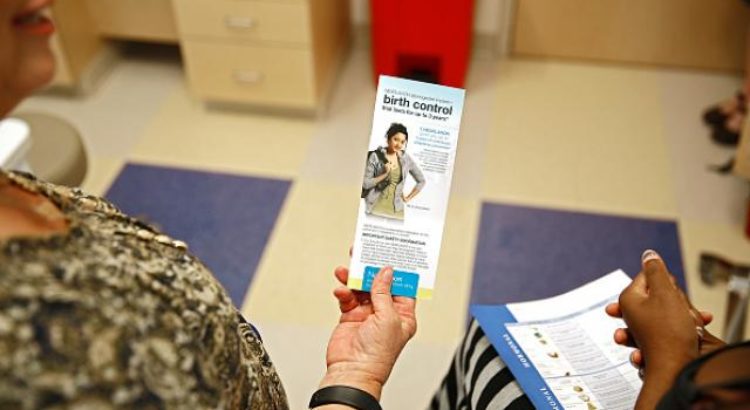
Baltimore City joined a lawsuit brought by Healthy Teen Network against President Trump, challenging a decision by the U.S. Department of Health and Human Services (HHS) to cut funding from evidence-based teen pregnancy prevention education.

In June 2015, the Baltimore City Health Department (BCHD) was awarded an $8.6 million grant to implement comprehensive, evidence-based teen pregnancy prevention education in all of the City’s more than 120 middle schools and high schools.

In July 2017, BCHD received notice from HHS that the grant period would be terminated two years early. This termination amounts to a reduction in overall grant funding to $5.1 million — a funding cut of $3.5 million. Despite multiple phone and written requests for explanation, Baltimore City has not received a response from HHS as to why our program is being terminated.

This cut is not just cruel — it’s unprecedented. Funding for Teen Pregnancy Prevention Initiatives (TPPI) was appropriated by an act of Congress — a statutory mandate — specifically dictating to HHS the parameters under which the funding was to be distributed. The funding appropriated is still available for the five-year grant period.

There is no reason to terminate it early. HHS made its decision despite the early success of the program and strong evidential foundation, violating the Administrative Procedure Act’s requirements that agency decision making not be arbitrary, capricious, an abuse of discretion, or contrary to law.

The funding cut means that 20,000 students in Baltimore will no longer have evidence-based curricula, creating a vacuum of critical health education for vulnerable youth. In addition to eliminating education on physiology, as well as STD and HIV prevention, the funding cut also removes the financial support necessary to train teachers and build capacity for health education. Last year, BCHD trained 115 teachers to deliver evidence-based teen pregnancy prevention programs. These facilitators ensured that more than 10,000 Baltimore City teens received this valuable education during the 2016-2017 academic year alone.

The Trump administration’s actions also jeopardize the newly-formed Youth Advisory Council, which is comprised of Baltimore City teens who serve as peer health advocates and share information about reproductive health. For the participants in this program, their education goes well beyond health: the program gives them control over their lives and empowers them to make the best choices for themselves. One participant told us, “Without this education, I likely would have been a teen mom and my future would have been very different.”

As a doctor and public health official, I have seen how much this evidence- and science-based grant has helped Baltimore. In particular, I am deeply concerned about three major areas if funding is curtailed.

First, this will slash educational attainment and economic opportunities for our youth. This cut comes at a time when Baltimore City has made remarkable progress, reducing teen pregnancy by 61 percent since 2000. Numerous studies show us that reducing teen birth rates increases young girls’ ability to graduate from high school and to have economic stability for themselves and their families.

Second, these funding cuts will increase costs for our City and for our country. In 2010, teen pregnancy and childbirth accounted for nearly $10 billion in costs nationwide. We should be doing everything we can to empower our youth to succeed and to thrive.

The devastating impacts of these cuts extend beyond Baltimore City: These cuts will affect 81 grantees across the country, totaling $213.6 million. As a result, it is estimated that 580,000 students will no longer be provided with essential evidence-based reproductive health education.

Third, these cuts will adversely affect health outcomes for our most vulnerable mothers and children. Teen mothers give birth at higher rates to preterm, low birth-weight babies, who are more likely to have worse health outcomes. Adolescent and teen pregnancy is also associated with increased risk of infant mortality.

There are also poorer long-term health outcomes for the mothers themselves. I voice my concern not just as a doctor, but as a new mother to a seven-month-old son. Parents want nothing more than to have a healthy child. If we have a strategy that will improve health outcomes for our women and children, then the last thing we should do is cut funding that could hurt generations to come.

In Baltimore, we do not see this funding cut as a number. We see the faces of 20,000 teens who will not receive critical pregnancy prevention education. We see the effect on their futures and on their children’s futures. We see the impact on our communities. We fear what this means for valuing science and evidence, and for how we can continue to fulfill our responsibility of protecting health and ensuring well-being.

Leana S. Wen M.D. is the health commissioner of Baltimore City. Follow her on Twitter @DrLeanaWen.

Source:

http://thehill.com/opinion/healthcare/379869-baltimore-city-is-suing-trump-administration-over-cuts-to-teen-pregnancy
 

Comparte este contenido:

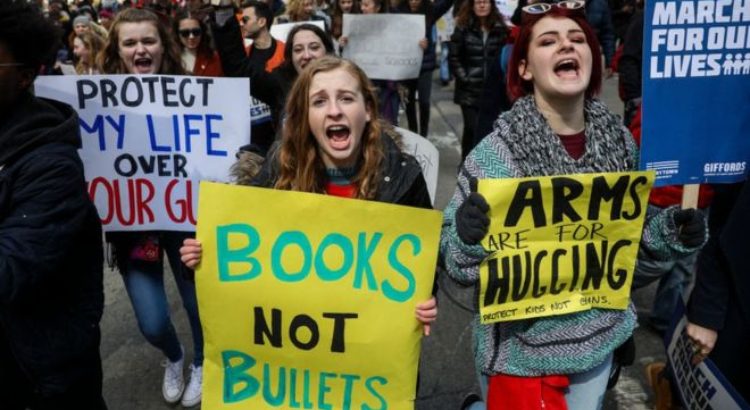
«Libros, no armas»: las multitudinarias protestas en EE.UU. contra la violencia con armas de fuego en la jornada de #MarchForOurLives

Estados Unidos/26 de Marzo de 2018/BBC

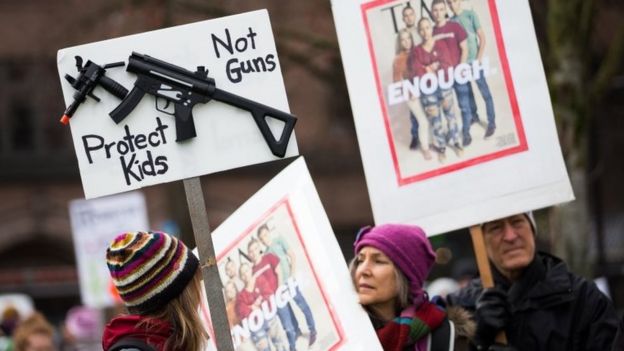
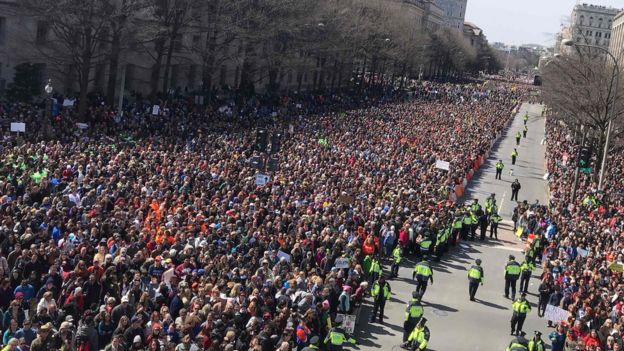
Bajo el lema #MarchForOurLives, o Marcha por Nuestras Vidas, cientos de miles de personas participan este sábado en manifestaciones en Estados Unidos para exigir leyes más estrictas para el acceso civil a las armas.

Encabezadas principalmente por jóvenes estudiantes, las manifestaciones masivas se desarrollan en grandes ciudades como Washington D.C., Chicago, Nueva York, Los Ángeles, Seattle, Boston, Filadelfia y Houston.

Pero también había convocatorias a manifestaciones en más de 800 localidades, así como en ciudades de otros países como Londres, Ginebra, Sídney y Tokio.

Marcha en WashingtonDerechos de autor de la imagenAFP
Image captionLa manifestación en Washington D.C. fue la más concurrida de las que se realizaron en todo Estados Unidos.

La convocatoria llega después de que en febrero un adolescente mató a 17 personas en una escuela de Parkland, Florida, hecho que se suma a otros casos de tiroteo masivos que han dejado cientos de víctimas en los últimos años en EE.UU.

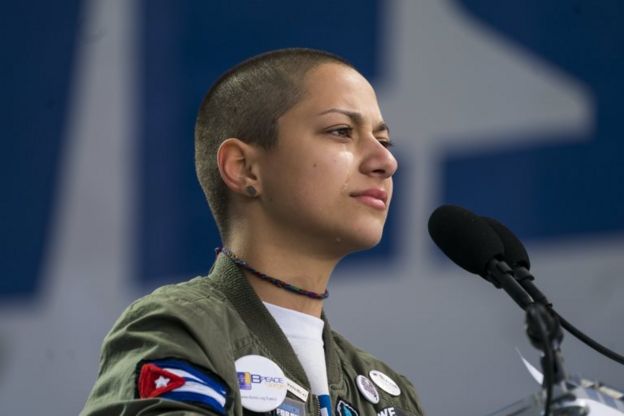
Emma Gonzalez, una líder del movimiento estudiantil surgido tras el tiroteo de Parkland, protagonizó uno de los momentos más conmovedores al pronunciar su discurso en el escenario principal de la marcha en Washington D.C.

Primero nombró a cada una de las 17 víctimas mortales y a continuación se mantuvo varios minutos ante el micrófono, en silencio. Algunos pensaron que necesitaba apoyo y le gritaban «¡Estamos contigo, Emma!».

Pero Gonzalez rompió el silencio y dijo: «Desde que aparecí aquí han pasado 6 minutos y 20 segundos», el mismo tiempo que el atacante de Parkland se tomó para disparar a los estudiantes.

«Luchen por sus vidas antes de que sea el trabajo de alguien más», concluyó su discurso, el cual fue ovacionado por la multitud.

Emma Gonzalez

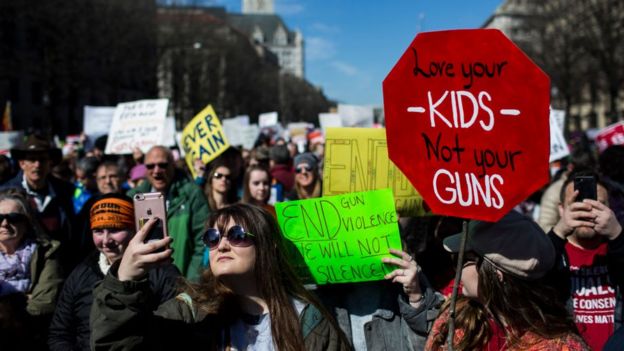
Los manifestantes exigen que haya cambios en las leyes que hasta ahora permiten la compra de armas con relativa facilidad, así como la prohibición de la venta de rifles automáticos y mayores controles de seguridad en las escuelas.

En Washington D.C., el sitio de concentración más grande, los organizadores esperaban la participación de medio millón de personas. Imágenes aéreas mostraban grandes multitudes en el corazón de la capital de Estados Unidos.

Marcha en WashingtonDerechos de autor de la imagenAFP
Image captionLos organizadores esperaban medio millón de personas en la capital de Estados Unidos.

El problema divide a los estadounidenses.

El derecho a portar armas está protegido por la Segunda Enmienda de la Constitución. La influyente Asociación Nacional del Rifle (NRA, por sus siglas en inglés) tiene un gran peso sobre los legisladores de EE.UU. que han rechazado cambiar las leyes.

Manifestantes en WashingtonDerechos de autor de la imagenGETTY IMAGES
Image captionLos manifestantes demandaban controles más estrictos en la venta de armas.
Una protesta en ChicagoDerechos de autor de la imagenGETTY IMAGES
Image captionEn Chicago se desarrolló otra de las manifestaciones más numerosas de la jornada.

Alrededor del 69% de los estadounidenses cree que las leyes sobre armas de fuego deberían ser más estrictas, según una nueva encuesta de Associated Press y el Centro de Investigación de Asuntos Públicos,

En octubre de 2016, el 61% pensaba que deberían incrementarse los controles en la venta de armas.

Manifestantes en WashingtonDerechos de autor de la imagenGETTY IMAGES
Image captionQué tan estrictas deben ser las leyes para el acceso a las armas es un tema que divide a los estadounidenses.

Este sábado, la Casa Blanca emitió una declaración reconociendo a los «muchos jóvenes estadounidenses valientes que ejercen sus derechos» como el de la manifestación.

«¡No más armas!»

El periodista Jon Sopel, de la BBC en Washington, relató que los manifestantes marcharon con fotografías de estudiantes y maestros asesinados en tiroteos escolares.

Coreaban consignas como «¡No más armas!» y «¡No más NRA!».

Hubo oradores, la mayoría líderes estudiantiles, que expresaban enérgicos llamados a los políticos para atender el problema de la violencia armada.

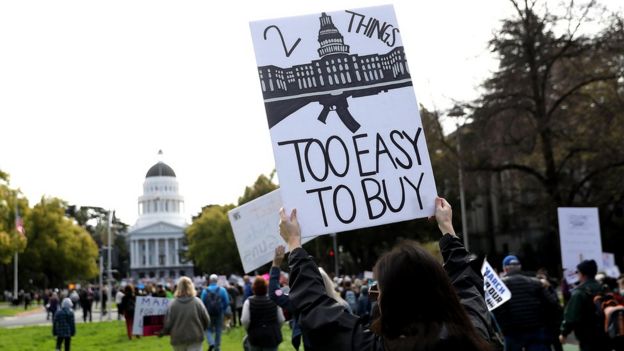
Una manifestante con un cartelDerechos de autor de la imagenGETTY IMAGES
Image caption«2 cosas muy fáciles de comprar», decía el cartel de una manifestante con los dibujos de la sede del Congreso de EE.UU. y un rifle.

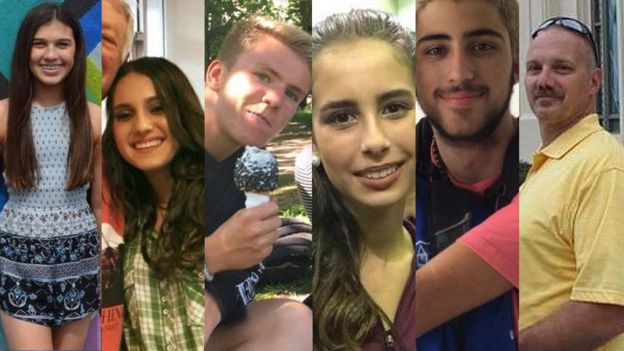
Mirando la foto de su novio Joaquín Oliver, una de las víctimas mortales de Florida, Victoria González dijo: «Era mi alma gemela».

El día de San Valentín, el 14 de febrero, comenzó como un gran día para ella: «Joaquín y yo intercambiamos regalos por la mañana y él me acompañó a clase. Estaba muy feliz».

Pero más tarde ese día recibió la noticia de que era una de las 17 personas asesinadas en la escuela Marjory Stoneman Douglas.

6 de las víctimas del tiroteo en Parkland
Image captionJoaquín Oliver (segundo de derecha a izquierda) fue una de las 17 víctimas mortales del tiroteo en Parkland, Florida.

«Estoy aquí hoy para que nadie tenga que enfrentar esto de nuevo», dijo a la BBC antes de la marcha.

«Me da mucha esperanza ver cuánta gente está aquí apoyándonos. Parece que todo el mundo está de nuestro lado», dijo.

«Momento decisivo»

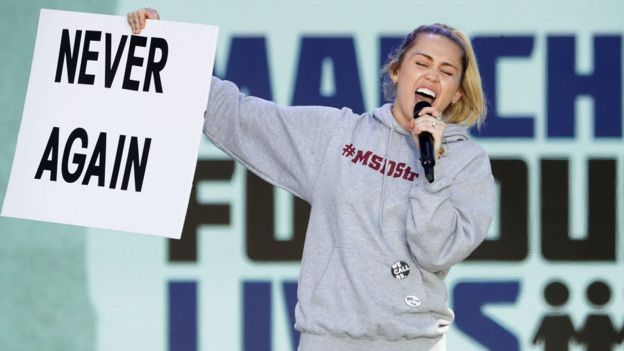
Artistas como Ariana Grande, Miley Cyrus, Jennifer Hudson y Lin-Manuel Miranda, el hombre detrás del exitoso musical Hamilton, actuaban en un gran escenario.

Miley CyrusDerechos de autor de la imagenGETTY IMAGES
Image caption«Nunca más», decía el cartel de Miley Cyrus, quien actuó en el escenario principal de #MarchForOurLives.

También hubo una manifestación en Parkland, donde ocurrió la matanza de febrero, en la que familiares de las víctimas hablaron ante una gran concurrencia.

En una manifestación en Houston, Texas, el alcalde Sylvester Turner calificó las protestas como un «momento decisivo en la historia« de Estados Unidos y anunció que se formará una comisión para buscar soluciones a la violencia armada a nivel local.

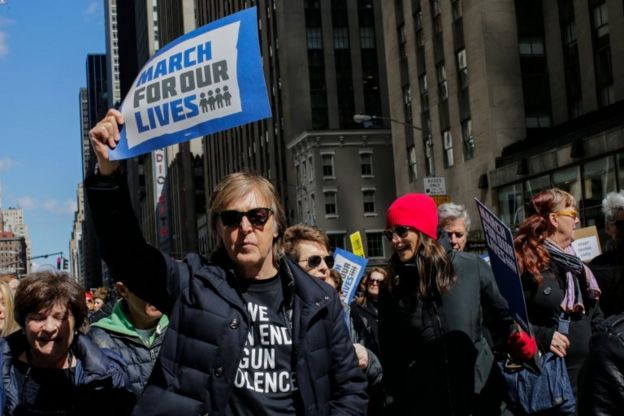
Paul McCartney en Nueva yorkDerechos de autor de la imagenAFP
Image captionEl músico británico Paul McCartney se manifestó en Nueva York y recordó que uno de sus amigos, John Lennon, murió por la violencia de las armas en esa ciudad.

La Casa Blanca informó que el gobierno está tomando medidas para abordar la violencia armada, incluida la prohibición de los «bump stocks», los adaptadores que permiten que un rifle haga descargas automáticas.

Además, el gobierno de Trump dijo que promulgará una ley para detener la violencia escolar, y que mejorará la seguridad en centros de estudio con la capacitación de estudiantes, personal educativo y la policía local.

Fuente: http://www.bbc.com/mundo/noticias-internacional-43529060

Comparte este contenido:

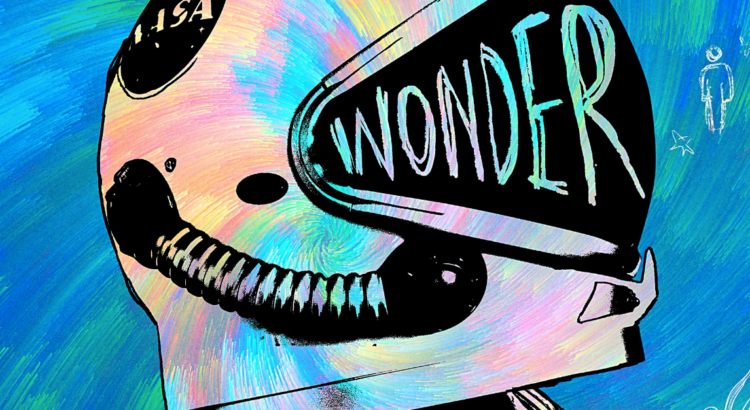
Película: Wonder

Reseña: Auggie Pullman (Jacob Tremblay) es un niño que nació con una malformación facial. Ahora, tras diez años de hospital en hospital y de largos periodos en su casa, tendrá que hacer frente a un gran reto: asistir por primera vez a la escuela. Gracias al apoyo de sus padres, Isabel (Julia Roberts) y Nate (Owen Wilson), Auggie tratará de encajar entre sus nuevos compañeros y profesores, demostrando que pese a su físico es un niño como otro cualquiera.

Fuente: https://www.youtube.com/watch?v=S6AXHRx_0xk


Comparte este contenido:

United States: 5 Conferences for Early Childhood Education in 2018

United States / March 26, 2018/Bestchoiceschools

Resumen: 5 conferencias para la educación de la primera infancia en 2018

Early Childhood Education Conferences

  • National Association for the Education of Young Children
  • Opening Minds USA
  • The Young Child Expo and Conference
  • Infant and Early Childhood Conference
  • The Future of Education Technology Conference

If your career involves educating young children in any capacity, you may be interested in discovering excellent options for conferences focusing on early childhood education. Plan now if you want to attend any of the following conferences and conventions, all of which will take place in 2018:

1. National Association for the Education of Young Children 2018 Conventions

Dates: November 14-17, 2018; June 10-13, 2018

The NAEYC is a large, national nonprofit organization which hosts multiple events each year. This organization makes a variety of resources available including two annual conferences plus webinars, books and other publications. A typical conference spans five days and includes hundreds of speakers and sessions. Attendees include teachers, school administrators, childcare providers, university faculty, students, researchers, development coaches and consultants.

Related20 Best Online Schools for Early Childhood Education 2017-2018

2. Opening Minds USA

Dates: February 7 – 10, 2018

This four-day event offers continuing education opportunities for certified teachers, registered nurses and other professionals involved in educating young children. There are also multiple breakout sessions, lectures and demonstrations. Typical attendees include teachers, university faculty, healthcare professionals and social workers.

3. The Young Child Expo and Conference

Dates: January 17-19, 2018; May 1-4, 2018

This conference offers a number of different educational opportunities including the option to take classes and receive credit for continuing education units at both the undergraduate and graduate levels. Your hosts at the conference are the Graduate School of Education at Fordham University and Los Niños Services. Typical conference attendees include teachers, pediatricians, nurses, college professors and students.

4. Infant and Early Childhood Conference

Dates: May 2-4, 2018

Past sessions at this conference have focused on autism, visual impairment, preventing child abuse, positive reinforcement of children through behavioral therapy, creating a language rich preschool classroom, family leadership, strengthening families and many others. Typical event attendees include parents, foster caregivers, childcare providers, teachers, students, healthcare professionals, therapists, applied behavior analysts, counselors and psychologists.

5. The Future of Education Technology Conference

Dates: January 23 – 26, 2018

This is a four-day event focusing on implementation of the latest education technology methods. Typical attendees include professionals involved in varied aspects of education and learning technology including educators, special education teachers, district administrators, regional administrators, information technology professionals and instructional coordinators.

These are five interesting educator’s conventions in the USA that are worth the trip. These are not your only choices for beneficial childhood development conventions in 2018, but they’re some of your most noteworthy and well-attended options. If you’re outside the USA or interested in homeschooling educator’s conferences, the following are links to a few additional resources you might like to know about:

International Education Conferences in 2018

2018 Homeschooling Conventions for the Earliest Years of Childhood Education and Beyond

  • Great Homeschool Conventions — These conventions will be of interest to Christian homeschoolers focused on educating children of all ages, including preschoolers through high schoolers.
  • Homeschool Conferences — This is a master list featuring links to dozens of different homeschooling conferences and events all around the USA.

If you’re interested in helping young children to learn, develop and discover the world around them, you’re sure to find these conferences motivating, stimulating and inspiring. You’ll definitely want to put these early childhood education conferences on your travel itinerary for 2018.

Fuente: https://www.bestchoiceschools.com/lists/5-conferences-for-early-childhood-education-in-2018/

Comparte este contenido:

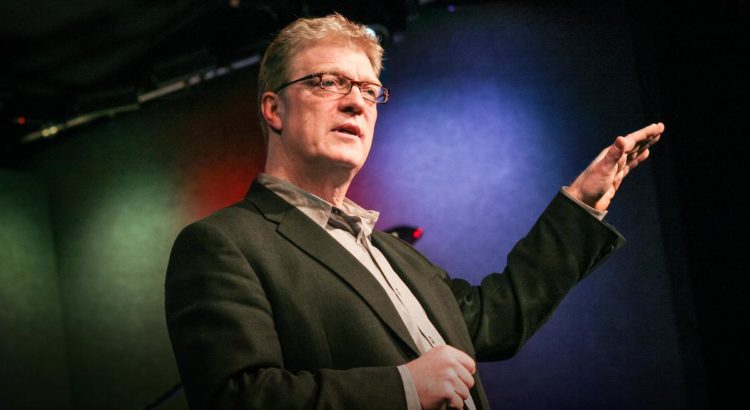
United States: Schools kill creativity – education expert

United States / March 26, 2018/Newshub

Resumen: El experto en educación, Sir Ken Robinson, quiere revolucionar la forma en que funciona la educación, diciendo que el sistema actual prioriza una definición estrecha del intelecto.

Education expert Sir Ken Robinson wants to revolutionise how education works, saying the current system prioritises a narrow definition of intellect.

«There was a time that being educated meant you could speak Latin. Then there was a time that it meant having gone to university. I’m trying to get people to think differently.»

Sir Ken, a professor at the University of Warwick, says education systems worldwide have become overly focused on a narrow kind of ability that we call «academic work».

«What happens is we often confuse academic ability with intelligence more generally and I think that’s something we really need to revisit.»

Sir Ken has given a TED Talk on the subject, titled ‘Do schools kill creativity?’ viewed over 50 million times online.

He says being educated should mean understanding the world around you and how it came to be the way it is.

«Being educated means being literate in a cultural sense.»

He says that while subjects such as science and math are important, equally important subjects such as art and music and drama are being pushed out, to children’s detriment.

«I think it’s important that everyone practices the sciences in a creative and inquisitive way but I think it’s equally important for them to practice the arts».

When discussing standardised testing, Sir Ken says the evidence everywhere is that they don’t work. He says an emphasis on grades has caused us to «los a sense of the vitality of education and how it ought to work».

«We aren’t manufacturing sprockets. These are people. Young people whose education has a crucial bearing on the life they lead and whether or not they discover the possibilities that lie in themselves.»

He says education should be more personal to the individual student but acknowledges that there should be a broadly agreed framework for the curriculum.

«What personalisation means in this case is making sure that teaching is differentiated to the different talents and rates of learning of individual children. Teaching isn’t just a process of transmission, it’s a relationship.»

Sir Ken thinks that teaching is as much about knowing how to engage students as it is about being an expert in your field.

«My contention is that creativity is as important in education as literacy and should be given the same status.»

Fuente: http://www.newshub.co.nz/home/shows/2018/03/schools-kill-creativity-education-expert.html

Comparte este contenido:

Educar para un mundo cambiante

Por: David Perkins

Visualizar lo que podría tener un valor dentro de los contenidos que enseñamos en las escuelas es, sin duda, un acto fundamental de imaginación educativa. Hasta ahora, siempre nos hemos centrado en educar para lo conocido. Sin embargo, apostar por que el mañana se parecerá al ayer no parece muy adecuado. Necesitamos un programa más audaz. Llamémoslo educar para lo desconocido que, lejos de ser una paradoja inabordable, puede resultar atractivo y estimulante.

Lograrlo pasa, según David Perkins, por identificar grandes temas de comprensión, grandes preguntas y grandes destrezas, entendiendo grande como esencial, aquello que nos capacita ampliamente durante toda la vida para desenvolvernos bien ante cualquier situación. ¿Puede esta visión darnos quizá la esperanza de que, a través de la educación, podemos acceder a lo desconocido, abordar sus giros e imprevistos, y situarnos en el camino hacia la sabiduría?

En este  sentido,  David Perkins plantea la necesidad de repensar los contenidos curriculares a través de las siguientes tres claves fundamentales:

1.Definir cuáles son los grandes temas de comprensión

Los grandes temas de comprensión lo son normalmente en cuatro sentidos:
• Grandes en información: comprenderlos ayuda a desvelar el funcionamiento de nuestro mundo físico, social y artístico, y también el de otros mundos.
• Grandes en actos: comprenderlos nos proporciona el poder para actuar con eficacia desde diferentes puntos de vista: profesional, social, político y otros.
• Grandes en ética: comprenderlos nos empuja hacia formas de pensar y conductas más éticas, humanas y comprometidas.
• Grandes en oportunidad: hay muchas probabilidades de que algunos de estos temas se comprendan en momentos claves y en muy diversas circunstancias.

2. Establecer qué son grandes preguntas
¿Qué es lo que hace grandes a las grandes preguntas? Al igual que ocurre con los grandes temas de comprensión, las grandes preguntas lo son en cuanto a que ofrecen información, actos, ética y oportunidad.

Las preguntas también son contenido. Conocer una gran pregunta, mantenerla viva en la mente y desarrollar la habilidad de plantearla es poseer una especie de pasión y poder para moverse por el mundo. Aunque estemos profundamente condicionados para pensar que lo que aprendemos son respuestas, las grandes preguntas son algo que merece la pena aprender.

3. Elegir las grandes destrezas
Las grandes destrezas inciden en cómo podría gestionarse mejor la vida desde una perspectiva personal e interpersonal. De cara a la vida que probablemente tendrán los alumnos en el futuro, es importante desarrollar habilidades y actitudes capaces de hacer frente a grandes desafíos, como la autocomprensión, la empatía, la ética y la colaboración, y, por supuesto, el pensamiento eficaz.

Las grandes destrezas personales e interpersonales facilitan la percepción de uno mismo en el mundo, te guían para que realices actos prácticos y nutren las actitudes éticas y el comportamiento, además de crear numerosas oportunidades para su aplicación. Por ello, constituyen una pieza clave de la respuesta a la pregunta ¿qué merece la pena aprender?

Fuente: https://aprenderapensar.net/2017/01/09/educar-para-un-mundo-cambiante/

Comparte este contenido:

Película: El caso de Cristo

Reseña: Un investigador que bebe compulsivamente mientras conecta con cordeles datos y fotografías enganchados a un corcho no es la primera imagen que a uno le viene a la cabeza cuando se habla de “cine espiritual”. Sin embargo, es precisamente el núcleo de El caso de Cristo, una suerte de thriller en la onda de Zodiac Todos los hombres del presidente que utilizará la tensión de un proceso detectivesco para hablar de la fe.

El protagonista, periodista galardonado y ateo declarado, pone todas sus habilidades en juego cuando su mujer se convierte al cristianismo: no puede concebir que ella crea una mentira. El director Jon Gunn y los guionistas Brian Bird y Lee Strobel presentarán esta historia de intriga y drama matrimonial que surge a partir de una sugerente premisa: ¿puede la fe superar la prueba del racionalismo cerril?

Fuente: https://www.cinemanet.info/2018/01/9-peliculas-de-cine-espiritual-a-tener-en-cuenta-en-2018/

Comparte este contenido:
Page 163 of 400
1 161 162 163 164 165 400