Page 307 of 397
1 305 306 307 308 309 397

Matrimonio gay y diversidad sexual dividen a México

América del Norte / México / 25 de septiembre de 2016 / Por Orlando Oramas Leon

México, 25 sep (PL) El matrimonio gay, motivo de encontradas manifestaciones en esta capital y otras ciudades del país, divide hoy a la sociedad mexicana, en un tema donde las iglesias, católica y cristianas empujan de su lado.

No se trata de un tema ajeno a otros lares latinoamericanos, aunque en opinión de este corresponsal, en México se registran avances tanto legales (varios estados aprobaron el matrimonio igualitario) como en el quehacer cotidiano.

Eso al menos en esta capital, donde las parejas del mismo sexo, travestis y otros integrantes de la llamada comunidad lésbico gay, bisexual, travesti, transexual, transgénero e intersexuales (Lgttbi) están representadas incluso ante la Cámara de Diputados.

Soy gay y soy diputado, dijo a Prensa Latina el legislador José Alfonso Suárez, del Movimiento de Regeneración Nacional (Morena), un partido de reciente inscripción que vino de menos a más para ser fuerte en esta capital.

Sus comentarios ocurrieron durante una concentración del movimiento Lgttbi en la rotonda del Ángel de la Independencia, lugar emblemático para celebrar victorias futbolísticas, otras, y también para protestar contra políticas gubernamentales.

Allí estaban apostados decenas de policías de tránsito adscritos al gobierno de la ciudad, porque del otro lado se movilizaba otra manifestación, mayor, de quienes se oponen no solo al matrimonio igualitario, sino al respeto a la diversidad sexual.

De ese lado el Frente Nacional por la Familia marchó y anunció un movimiento cívico permanente, que solicitó un encuentro con el presidente Enrique Peña Nieto, cuya iniciativa por el matrimonio igualitario está en manos (engavetada) en el Congreso.

Fuente: http://www.prensa-latina.cu/index.php?o=rn&id=28954&SEO=matrimonio-gay-y-diversidad-sexual-dividen-a-mexico
Comparte este contenido:

EEUU: In NYC, Protesters March Against Police Murder

América del Norte / Estados Unidos / 25 de septiembre de 2016 / Por: Left Voice

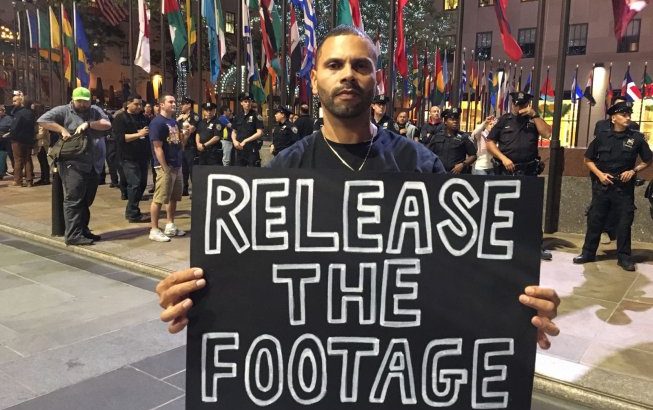
On Saturday night, about 200 protesters gathered at sundown in Manhattan. They held a brief rally and marched through Central Park to Rockefeller Center several blocks away.

On Saturday night, about 200 protesters gathered at sundown in Manhattan. The protest was organized by Hoods4Justice, demanding justice for Terence Crutcher and «Don’t reform it, abolish the police.»

They held a brief rally and marched through Central Park to Rockefeller Center several blocks away. Over 100 cops followed alongside the marchers on motorcycle and on foot, forcing protesters off the street and onto the curb.

Video: Left Voice

A pre-recorded announcement blared from NYPD loudspeakers perched on the street: “Pedestrians are not permitted to walk in the street or roadway. Pedestrians are also prohibited from obstructing sidewalks…If you unlawfully obstruct pedestrian traffic…you can be placed under arrest.”

Undeterred, the crowd marched on and their chants rang out, “NYPD, KKK, how many kids did you kill today,” “F-T-P! Fuck the Police!” “How do you spell racist? N-Y-P-D! How do you spell murderer? N-Y-P-D,” and “If we don’t get no justice, they don’t get no peace!”

There have been protests every day in Charlotte, North Carolina, since a police officer shot and killed Keith Lamont Scott on Tuesday.

Fuente: http://www.leftvoice.org/In-NYC-Protesters-March-Against-Police-Murder

Comparte este contenido:

EE.UU: Pasó de trapear a revolucionar la limpieza con datos

América del Norte/EE.UU/25 Septiembre 2016/Fuente:El Financiero /Autor: New York Times Syndicate

Simon Brooks se mudó a Silicon Valley para emprender con una app que tenía en mente, en vez de eso, en 2015 echó a andar Squiffy Clean, una empresa de limpieza comercial que utiliza un algoritmo para calcular el precio con base en los datos que recopila sobre los sitios.

Un jueves por la noche, en octubre del 2013, Simon Brooks empacó sus pertenencias y condujo hacia el oeste, a Silicon Valley, pensando que iba camino a crear la siguiente aplicación tipo Scrabble, el juego de palabras, a la que llamó Gadzookery.

Tenía poco que perder. Brooks debía más sobre su casa en Louisville, Kentucky, de lo que valía. Su matrimonio se había terminado, y había estado trabajando en restaurantes y bares durante dos años, desde que la crisis financiera lo obligó a dejar su empleo como agente hipotecario.

“Metí a mis perros y mis maletas en el coche, y manejé a Dojo”, contó Brooks.

Se estaba refiriendo a Hacker Dojo en Silicon Valley, un espacio comunitario para empresas emergentes de tecnología, cuyos miembros (por lo general, las tarifas empiezan en 125 dólares mensuales) tienen acceso las 24

El espacio de piratería resultó ser la clave para su nueva empresa; solo que no como él lo había imaginado.

Brooks llegó con 12 mil dólares y una versión aproximada de su juego de palabras educativo. Esperaba reunir a un equipo en Dojo que lo ayudara a reconstruirlo, pero, una vez allí, no encontró ni a los desarrolladores que requería, ni un cuarto para rentar. Terminó en moteles.

Cuatro meses después, ya se le había acabado el dinero y vivía en su Lexus 1999. Cuando el gerente de Dojo solicitó a un voluntario que limpiara los baños y la cocina cada tarde a cambio de una membresía gratuita, Brooks levantó la mano.

Sin darse cuenta, había dado el primer paso para crear su empresa emergente: una compañía de limpieza que depende de lo analítico para mejorar la eficiencia y fijar los precios.

Larry Maloney, un miembro fundador de Hacker Dojo, dijo que la gente estaba inconforme con la calidad del trabajo que hacían los limpiadores antes de que Brooks se ofreciera de voluntario.

Normalmente, dijo Maloney, el Dojo olía algo rancio, en gran medida, debido a los desarrolladores que trabajaban tarde por la noche. “Con Simon”, dijo, “olía limpísimo”.

No fue una hazaña fácil. El Dojo es un espacio extenso de más de mil 485 metros cuadrados. Nunca cierra y es típico que tenga al menos 300 visitantes cada día.

Después de ocho meses, la administración se deshizo de la pequeña empresa local que le hacía la limpieza y empezó a pagarle a Brooks 400 dólares mensuales por sus servicios.

Ocho meses después de eso _ tras haber pasado unos dos años tratando infructuosamente de crear la aplicación Gadzookery _ Brooks se puso a examinar seriamente el mercado de la limpieza comercial.

“Era un sector de 51 mil millones de dólares”, que consistía, en su mayor parte, de pequeñas compañías, dijo. Brooks vio una oportunidad. La administración de Hacker Dojo estuvo de acuerdo en darle un adelanto de un mes para comprar el equipo y los suministros que necesitaba para empezar, y echó a andar Squiffy Clean en el 2015.

Existen unas 100 mil firmas de limpieza comercial en Estados Unidos hoy en día, notó John Barrett, el director ejecutivo de ISSA, una asociación gremial del sector de la limpieza en el mundo. Las 50 más grandes representan cerca de 30 por ciento de los ingresos, según un informe sectorial que publicó Dun & Bradstreet, lo cual deja bastante espacio para que las otras firmas capturen clientes.

Más de 90 por ciento de las empresas de servicios de limpieza son propiedad de un solo dueño, según un informe de IBISWorld, una firma de investigación sobre el sector. Sin embargo, el mayor movimiento está al nivel de las empresas emergentes, dijo Barrett .

“La rotación excesiva es increíble”, dijo.

Hasta ahora, Brooks ha evitado esa rotación. Seis meses después de empezar, estaba ganando suficiente para mudar su negocio del Hacker Dojo a una oficina en Palo Alto.

Es inusual en el sector que su compañía tenga alta tecnología. Recopila más de 700 puntos de datos, como el tiempo que se lleva trapear una décima parte de un metro cuadrado, y utiliza la información para mejorar y refinar sus métodos de limpieza, así como para establecer los precios.

“Tenemos un cliente con un edificio de 8 mil pies cuadrados (743 metros cuadrados), nos zambullimos en los datos e hicimos cambios a la forma de hacer la limpieza, como combinar ciertas tareas o cambiar el orden en el que se hacen, y ahorramos 600 dólares en costos mensuales de mano de obra”, dijo Brooks. “Los márgenes en el sector son tan bajos que tenemos que quitar toda la mano de obra que podamos”.

La mayoría de las compañías de limpieza pequeñas cobran por la cantidad de horas de trabajo, pero Squiffy Clean creó un algoritmo para calcular el precio con base en los datos que recopila sobre los sitios de la limpieza.

Asimismo, la empresa también está desarrollando tecnología para evitar las demandas fraudulentas de compensaciones por parte de los trabajadores. Usará los datos para ayudarse a determinar si ocurrió algún incidente.

Barrett en ISSA dice que aun cuando las grandes compañías en el negocio de la contratación de la limpieza utilizan métodos de alta tecnología, es muchísimo menos común entre las pequeñas.

En comparación con otras empresas que limpian oficinas, Squiffy Clean paga, en lo general, un salario por hora más alto (alrededor de 17 dólares la hora). El salario por hora medio en el sector es de 11.27 dólares, según la Oficina de Estadísticas Laborales de Estados Unidos. También, les da acciones de la empresa a los limpiadores y hace de su seguridad una alta prioridad. Dos empleados que trabajaron para Handy, el servicio de limpieza residencial, por ejemplo, lo demandaron en el 2014 por violaciones a la ley del trabajo.

Iniciar cualquier negocio, sin importar la tecnología, es difícil, y todavía más cuando el fundador es indigente. Sin embargo, Brooks estaba sano física y mentalmente, y contaba con el apoyo de Maloney y otros en Hacker Dojo.

En marzo, Brooks recaudó 10 mil dólares por medio de Kiva, la plataforma de préstamos par a par. Squiffy Clean también tiene presencia en AngelList, la plataforma de inversiones en empresas emergentes y está en pláticas con potenciales inversionistas.

Hoy, Squiffy Clean, todavía en su fase piloto, atiende al área de la bahía de San Francisco, desde San José hasta Palo Alto. La compañía tiene cinco clientes iniciales. Su sitio web recién reestructurado da a los clientes potenciales una cotización de precio garantizado en 15 segundos, comentó Brooks.

Uno de los primeros clientes de Squiffy Clean fue Singularity University, un centro de investigación en Silicon Valley y acelerador de empresas emergentes.

“Muchas personas ven al trabajo de limpieza solo como una forma de ganar dinero, pero Simon lo abraza como el trabajo muy importante que es y asume un enfoque muy científico al respecto”, comentó Tom LeGan, el gerente de instalaciones en Singularity. “También es muy compasivo con sus empleados. No ves eso en muchas corporaciones, ya no digamos en una compañía de servicios de limpieza”.

Brooks todavía sigue enfrentando muchas de las dificultades que tienen otras empresas emergentes en la zona de la bahía, incluido un mercado laboral muy tenso.

“Todos estamos tratando de atraer a los mejores ingenieros y el sector de la limpieza no es sexi, así es que es duro”, explicó.


Fuente de la noticia: http://www.elfinanciero.com.mx/tech/paso-de-trapear-a-revolucionar-la-limpieza-con-datos.html

Fuente de la imagen: http://www.elfinanciero.com.mx/files/article_main/uploads/2016/09/23/57e5daf021284.jpg

Comparte este contenido:

EE.UU: Prevención de enfermedades de transmisión sexual y pruebas para los estudiantes universitarios

América del Norte/EE.UU./24 de septiembre de 2016/www.huffingtonpost.com/Por: Robert Segal

Los estudios muestran que sólo el 52% de los estudiantes usar un condón durante las relaciones sexuales. Como muchos hombres y mujeres jóvenes están fuera de los colegios y universidades en todo el país – algunos por primera vez – este es el comienzo de una nueva era de libertad y exploración. Con esta nueva libertad también viene de conocer gente nueva y tener nuevas experiencias, incluyendo el consumo de alcohol y de citas. Cuando se combinan, sin embargo, estas nuevas experiencias pueden llevar a riesgos asociados con el sexo sin protección y enfermedades de transmisión sexual (ETS).

Mientras que los estudiantes (edades 15-24) sólo representan una cuarta parte de la población sexualmente activa, que representan la mitad de todos los nuevos casos de enfermedades de transmisión sexual en los EE.UU. cada año, de acuerdo con los CDC y los estudios muestran que sólo el 52 por ciento de los estudiantes usar un condón durante el acto sexual. Eso significa que los jóvenes están recibiendo una educación sobre enfermedades de transmisión sexual el camino difícil – a contraer la clamidia, la gonorrea, verrugas genitales y el VIH al doble de la tasa de todos los otros grupos de edad.

Podría haber muchas razones para esta tendencia.

  • Anticoncepción Oral– Como muchos estudiantes salen a los anticonceptivos orales, que renuncian al uso de condones aumentando así sus posibilidades de contraer o propagar una ETS.
  • Tecnología– El aumento de los sitios de citas y aplicaciones puede hacer que sea más fácil para las personas que tienen «gancho-ups» y el sexo casual que conduce a un mayor riesgo para ellos y sus socios.
  • La falta de educación– Irónicamente, la mayoría de los colegios y universidades no hacen la educación sexual un requisito en su plan de estudios general. Los estudiantes se queden con los mismos mitos y la desinformación que han recibido en la escuela secundaria por lo general de sus pares.
  • Falta de Comunicación– Con poca experiencia en las relaciones, la mayoría de los jóvenes les resulta más difícil hablar de sexo que en realidad tienen. Eso significa que no hay discusión sobre la historia sexual, la salud, la monogamia o incluso la anticoncepción, lo que les deja de tomar sus posibilidades.
  • Bajo la Influencia– Uno de los factores más destructivos en situaciones de carga sexual es la introducción de alcohol. Hombres y mujeres jóvenes pueden tener poca experiencia en relación a su edad. Con la libertad de vivir por su cuenta y alteraciones en el juicio, que no pueden estar tomando las precauciones apropiadas durante sus experiencias sexuales.

Para tomar las precauciones necesarias y evitar la propagación de enfermedades de transmisión sexual o contracción, la mayoría de los principales colegios y universidades tienen centros de salud del campus. Estos centros pueden proporcionar información, chequeos y algunos, incluso las pruebas y el tratamiento. Para las escuelas que no ofrecen pruebas y tratamiento, los estudiantes que tienen la tecnología en la punta de sus dedos deben investigar las tendencias de salud digitales como LabFinder.com. El servicio puede ayudar a los estudiantes ocupados en la búsqueda de localizaciones próximas a hacerse la prueba así como el libro y acceder a sus resultados de las pruebas de ETS – de forma rápida y discretamente.

Tomado de: http://www.huffingtonpost.com/entry/std-prevention-and-testing-for-college-students_us_57db06afe4b053b1ccf295f9?section=us_college

Comparte este contenido:

Assassination Talk, the Banality of Evil, and the Paranoid State of American Politics

Por: Henry Giroux

During a campaign rally in North Carolina, Donald Trump suggested that “Second Amendment people” would take care of Hilary Clinton for picking Supreme Court judges who favor stricter gun laws. The Clinton campaign and many others saw this as a veiled endorsement of an assassination attempt.[1] These inflammatory, if not dangerous, comments are part of a wider movement in American politics to empty political discourse of any substance, turning it mostly into a form of rhetorical theater designed to mimic a larger culture of stupidity, idiocy, and spectacle. The spectacle of titillating and infantilizing consciousness and public discourse with a flood of shocks, sensations and simplistic views has become the hallmark of a broken political system now largely controlled by the ideological extremists who inhabit big corporations, hedge funds, and the ranks of the ultra-rich. It is a strategy that mixes what Hannah Arendt once called the “banality of evil” with what the eminent historian, Richard Hofststadter has called the paranoid style of American politics.[2]

Trump’s rhetoric, along with the discourse of other extremists, echoes Hannah Arendt’s insight that totalitarianism is produced, in part, by making human beings superfluous, ignoring their voices, and silencing them in fascistic discourses of certainty, absolutes, and unaccountability that allow no space for critical thinking, informed judgment, and critical agency. Trump’s speeches and his off-the-cuff comments bear an eerie resemblance to what Arendt once called in her famous book on Adolf Eichmann “the banality of evil,” in which she defines the roots of totalitarianism being shaped by a type of thoughtlessness, the inability to think, and the disavowal of any form of self-reflection and critical inquiry. For some theorists such as Richard J. Bernstein, Arendt was largely interested in understanding how ordinary people with banal motives can commit horrendous crimes and how such actions were connected to making human beings superfluous as critical, thinking agents.[3] He is only partly right. Arendt connected the dethroning of the political and the emergence of a kind of anti-politics to the inability or reluctance of individuals to “imagine what the other person is experiencing…a kind of stupidity (in which) obedience is idealized.”[4] Trump and other ideological and political fundamentalists exemplify a kind of thoughtlessness in which informed judgment and dialogue are replaced by a rigid ideological embrace of certainty, the eschewing of doubt, and a willingness to sacrifice critical inquiry to the realms of emotion, anger, and contempt for others.

Language in the service of violence is on full display in Trump’s use of the term “loser,” a term that he carries over from his Reality TV shows and is used in many of his political speeches. Trump’s use of the term, echoing Hofstadter, denotes a language in the service of humiliation, but there is also a deeper structure of meaning that is indebted to the current fascistic embrace of “total war” and a “survival-of-the fittest” ethos in which winning and losing become the central organizing principles of a neoliberal society. As the discourse of war and excessive competition moves into the realm of the market place, consumption also serves to reward winners and debase losers based upon a fetishistic notion of consumption. Subjecting the majority of the polity to the discourse of humiliation and disdain and praise for the small number of winners who constitute the .01 percent of the population create an affective economy of misdirected rage, resentment, and retaliation, which finds its most egregious expression in the hateful and racist discourses of authoritarianism, buttressed by a kind of stupidity that is as banal as it is dangerous. The economic and pedagogical forces at work in the production of the banality of evil in reinforced in the registers of atomization, loneliness, and humiliation that often provide fertile ground for the rise of the fascistic sovereign. This was evident at the 2016 Republican National Convention when Donald Trump told his adoring crowd that “I am your voice. I alone can fix it. I will restore law and order.” As Yoni Appelbaum points out in The Atlantic, Trump “did not appeal to prayer, or to God. He did not ask Americans to measure him against their values, or to hold him responsible for living up to them. He did not ask for their help. He asked them to place their faith in him.”[5] And in doing so, he was greeted with sporadic emotional outburst that amounted to disturbing expressions of racism, hyper-nationalism and calls for lawlessness. According to Applebaum, “when Trump said, ‘I am your voice,’ the delegates on the convention floor roared their approval. When he said, “I alone can fix it,” they shouted their approbation. The crowd peppered his speech with chants of ‘USA!’ and ‘Lock her up!’ and ‘Build the wall!’ and ‘Trump!’ It booed on cue, and cheered when prompted.”[6]

In this instance, neoliberal values support and amplify what the Richard Hofstadter called the “paranoid style in American politics.” Writing in the 1960s in the aftermath of the McCarthy period, Hofstadter made clear that the animosities, anger, “heated exaggerations, suspiciousness, and conspiratorial fantas[ies]” that characterize such a style were deeply rooted in American politics and history and did not simply apply “to men with profoundly disturbed minds.”[7] Such a paranoid style could only be understood with a broader social, cultural, and political context specific to a distinctive historical era. Hofstadter performed a theoretical service in providing a language for unpacking the new authoritarianism in American society. Building on Hofstadter’s insights, Trump represents more than the fascistic celebration of the heroic leader, there is also a systemic attempt to empty politics of its democratic impulses, repress debate and dialogue, and construct an anti-politics that thrives on conflict, on an enemy/friend divide, fueled by a rhetoric of demonization, objectification, and hatred. Under such circumstances, language becomes militarized, serving as an expression of politics in which persuasion becomes armed, wedded to the production of desires, modes of agency, and forms of identification compatible with political and economic forms of authoritarian domination. The friend/enemy divide creates the boundaries, borders, gate keeping, and circle of certainties that intensify the paranoid state of mind in the American polity while at the same time creating the foundation for new forms of totalitarianism unique to American society.

What is distinct about the current era is that such extremism has moved to the center of politics and has become the hallmark of a period characterized by the destruction of civil liberties, the emergence of what Mike Lofgren calls The Deep State,[8] mass surveillance, the militarization of everyday life, the widespread spectacle of violence, and a culture steeped in the mobilization of mass fear and cruelty. Donald Trump’s take over of the Republican Party alone cannot explain the emergence and embrace of right-wing populism among millions of Americans who as Beverly Bandler observes: “sport idiocy as a ‘badge of honor,’ cling to the discredited, silly birtherism, brazenly support serial lying, rampant xenophobia, racism, misogynism, [and] suggest that [Trump’s] political opponent is ‘the devil’.”[9]

We live in an era when knowledge has been replaced by information, and propaganda seeps into every institution in American society fueled by the billions of dollars provided advertisers, the Koch brothers, hedge fund criminals, bankers, the ultra-rich, and big corporations, all of whom provide the pedagogical parameters for what can be considered to falsely be acceptable ideas, views, and frames of reference. Screen culture is the new force of politics and it is signed, sealed, and delivered by powerful corporate interests, with some exceptions in the mainstream media and certainly a sprinkling of alternative views in online progressive sites such as Truthout, Truthdig, Counterpunch, and others, though such sites operate at the margins of American society. Combine the control by the rich of commanding cultural apparatuses such as the media and public and higher education with the Supreme Court ruling, Citizens United, which allowed politics to be flooded and controlled by big money and you have what Tom Engelhardt has rightly called the “first 1% elections” coupled with a dominant public pedagogy infused with insults, stupidity, insults, racism, and a toxic “sea of words and images.”[10]

Arend’t’s notion that evil becomes banal when it is normalized, supported by a culture in which thinking is seen as an act of stupidity and thoughtlessness provides the foundation for mass violence is crucial to understanding one of the most fundamental elements of American politics—an attack on all vestiges of critical thought and the institutions that support them. Hofstadter makes clear that such extremism has to be understood within broader historical, political, and cultural context and cannot be addressed in limited vocabulary of the eccentric or outlandish personality.

Both Arendt and Hofstadter offer fertile ground for addressing the question of what might be learned from the rise of the political and economic structures of domination in the current historical moment. Implicit in their work is the notion that any viable understanding of politics has to address the role of the educative nature of a politics as a powerful force that demoralizes and infantalizes consciousness, stunts any viable notion of agency, and embraces view of war that thrives on demonization, exclusion, and the production of losers. Central to such a task is expanding the notion of the political to include a notion of public pedagogy that would be fundamental to addressing matters of identity, consciousness, and agency. The teaching machines of the current era are not limited to simply schools but are found in multiple sites in society. Hence, addressing the ideological and structural forces that celebrate the inability to think, readily eliminate institutions and public spheres that make thinking possible, intensify the connection between non-thinking, thoughtlessness and the routinization of misery, human suffering, along with the destruction of the eco system should be at the heart of any viable movement for political and economic change. At stake here is the creation of a politics willing to address the distinctive challenges posed by the emergence of a digital age in which culture, power, and politics become more integrated and serve to reconstitute the ways in which people relate to themselves, others, and the larger world. What Arendt and Hofstadter teach us is that the task of politics in the age of an overabundance of information and knowledge is not to make politics a discourse limited to structural forms of domination but to broaden its meaning as part of a wider project of which pedagogy is central to how it understands, addresses, and shapes the world, particularly how it shapes memory, consciousness, and individual and social agency.

The emergence of Donald Trump, and the deeply corrupt Republican and Democratic political parties on the current American political scene exemplify how ignorance breeds corruption and endears a large number of people to falsehoods, venality, and carnival barking. The corruption of both the truth and politics is made all the easer since the American public have become habituated to overstimulation and live in an ever-accelerating overflow of information and images. Experience no longer has the time to crystalize into mature and informed thought. Leon Wieseltier is right in stating that “words cannot wait for thoughts and patience [becomes] a liability.”[11]Opinion outdoes reasoned and evidence based arguments and the power of expression degenerates into a spectacle. News has become entertainment and echoes reality rather than interrogating it. Popular culture revels in the spectacles of shock and violence.[12] Universities now labor under the burden of a neoliberal regime that celebrate the corporate model made famous by McDonalds. Knowledge is now instrumentalized, standardized, and collapses the distinction between education and training. Knowledge is packaged for easy consumption resulting in curricula that resemble a fast-food menu[13].

Many of the commanding institutions that produce and distribute ideas—from the media to higher education—have become disimagination machines, tools for legitimating ignorance, stoking paranoid fantasies, legitimating conspiracy theories, and are central to the formation of an authoritarian politics that is gutting any vestige of democracy from the ideology, policies, and institutions that now shape American society. Education has lost its moral, political, and spiritual bearings just as teachers, union members, and other public servants across the country are being belittled and attacked by economic and religious fundamentalists. One consequence is that an increasing number of public spheres have become corporatized, employ a top-down authoritarian styles of power, mimic a business culture, and infantilizes the larger polity by removing the public from all forms of governance. Clearly all of these defining relations produced in a neoliberal social order have to be challenged and changed.

The rise of thoughtlessness and the inability to think along with the demonization of vulnerable others constitute a political epidemic and do not augur well for democracy. Americans live in a historical moment that annihilates thought. A culture of cruelty and a survival-of-the-fittest ethos in the United States is the new norm and one consequence is that democracy is on the verge of disappearing or has already disappeared! Where are the agents of democracy and the public spaces that offer hope in such dark times? What role will progressives play at a time when the very ability of the public’s ability to translate private troubles into broader systemic issues is disappearing? How might politics itself be rethought in order to address the pedagogical and structural conditions that contribute to the growing intensification of violence in all spheres of American society? What role should intellectuals, cultural workers, artists, writers, journalists, and others play as part of a broader struggle to reclaim a democratic imaginary and exercise a collective sense of civic courage? What is now clear is that not only is pedagogy linked to social change but also to the production of modes of agency and the institutions that make radical change possible. Education as a political force makes us both the subjects of and subject to relations of power. The key is to expand that insight so as to make education central to politics itself. That is a lesson we can learn from both Arendt and Hofstadter.

Notes.

[1] Surprisingly, a good take on this issue can be found in Thomas L. Friedman, “Trump’s Wink Wink to ‘Second Amendment People’,” The New York Times, [August 9, 2016] Online:http://www.nytimes.com/2016/08/10/opinion/trumps-ambiguous-wink-wink-to-second-amendment-people.html?_r=0; see also, David S. Cohen, “Trump’s Assassination Dog Whistle Was Even Scarier Than You Think,” Rolling Stone Magazine, [August 9, 2016]

Online: http://www.rollingstone.com/politics/features/trumps-assassination-dog-whistle-was-scarier-than-you-think-w433615

[2] Hannah Arendt’s notion of the banality of evil was first used in her 1963 book, Eichmann in Jerusalem: A Report on the Banality of Evil. Hofstadter phrase the paranoid style of politics gained prominence in his book of the same title.

[3] Richard J. Bernstein, The Abuse of Evil: The Corruption of politics and Religion since 9/11, (Polity Press, 2005).

[4] Hannah Arendt, Hannah Arendt: The Last Interview and Other Conversations, (Brooklyn, NY: Melville House Publishing, 2013), p. 50.

[5] Yoni Applebaum, “I Alone Can Fix it,” The Atlantic (July 21, 2016). Online;http://www.theatlantic.com/politics/archive/2016/07/trump-rnc-speech-alone-fix-it/492557/

[6] Ibid., Applebaum.

[7] Richard Hofstadter, “The paranoid style in American politics.”Harper’s (November 1964). Onlinehttp://www.harpers.org/archive/1964/11/0014706. As mentioned above, his more extensive treatment of this idea appears in Richard Hofstadter, The Paranoid Style in American Politics (New York: Vintage, Reprint Edition, June 10, 2008).

[8] Mike Lofgren, The Deep State: The Fall of the Constitution and the Rise of a Shadow Government (New York: Viking, 2016).

[9] Beverly Bandler, “Paranoid Right-Wing Extremism,” email posting on August 12, 2016 (personal correspondence).

[10] Tom Engelhardt, “Better than reality television: The 2016 election is proving to be the greatest show on Earth,” Salon (August 10, 2016). Online: http://www.salon.com/2016/08/10/better-than-reality-televisio_partner/

[11] Leon Wieseltier, “Among the Disrupted,” International New York Times (January 7, 2015). Online: http://www.nytimes.com/2015/01/18/books/review/among-the-disrupted.html?_r=0

[12] Brad Evans and Henry A. Giroux, Disposable Futures: The Seduction of violence in the Age of the Spectacle (San Francisco: City Lights, 2016).

[13] Ulrich Beck, Twenty Observations on a World in Turmoil (London: Polity Press, 2010, especially pages 53-59

Fuente del articulo: http://www.counterpunch.org/2016/08/12/assassination-talk-the-banality-of-evil-and-the-paranoid-state-of-american-politics/

Fuente de la imagen: http://hablemosyopinemos.blogspot.com/2009/05/paranoia-porcina-porsiaca.html

Comparte este contenido:

Estados Unidos, Indonesia Strengthen Ties in Higher Education Sector

América del Norte/Estados Unidos/Septiembre de 2016/Fuente: TEMPCO

RESUMEN: Los Estados Unidos y el Ministerio de Investigación, Tecnología de Indonesia, y de Educación Superior (RISTEK dikti) llevaron a cabo un evento el miércoles 21 de septiembre de 2016, para celebrar los avances en la educación superior en Indonesia en los últimos cinco años. Aproximadamente 150 personas asistieron al evento, incluyendo el director general de desarrollo institucional Dr. Patdono Suwignjo,  Brian McFeeters, encargado de negocios en Estados Unidos,  la Agencia de los Estados Unidos para el Desarrollo Internacional (USAID) y el director de Misión Erin McKee del Ministerio. Durante los últimos cinco años,  el proyecto de la USAID ha trabajado en colaboración con RISTEK  para aumentar la capacidad y mejorar el rendimiento de 50 instituciones de educación superior de todo el país de Indonesia. USAID apoya HELM  en el desarrollo de habilidades en áreas tales como liderazgo, administración, gestión financiera, control de calidad, y la investigación, el objetivo último de proporcionar un mundo de clase, educación de calidad para los estudiantes de Indonesia.

The United States and the Indonesian Ministry of Research, Technology, and Higher Education (RISTEK DIKTI) held an event on Wednesday, September 21, 2016, to celebrate advancements in higher education in Indonesia over the past five years.

Approximately 150 people attended the event including Ministry’s director general of institutional development Dr. Patdono Suwignjo, United States Charge d’Affaires Brian McFeeters, and United States Agency for International Development (USAID) Mission director Erin McKee.

Over the last five years, USAID’s US$19 million Higher Education Leadership and Management (HELM) project has worked in partnership with RISTEK DIKTI to build capacity and improve performance of 50 Indonesian higher education institutions across the country. USAID HELM supported these institutions in building skills in such areas as leadership, administration, financial management, quality assurance, and research, the ultimate goal to provide a world-class, quality education for Indonesian students.

«It is essential to empower higher education institutions to create systems that support access to resources, networks, professional development, and management. These systems are critical to improving the quality of higher education in Indonesia,»Patdono said in a press release received by Tempo on Wednesday, September 21, 2016.

McFeeters said that the changing economic landscape in Indonesia requires an educated and skilled workforce that is well-adapted to a knowledge-based economy.

«The United States is proud to partner with the Government of Indonesia in initiatives ranging from innovative research, expanding access to high quality basic and vocational education, to strengthening the higher education system,» Mcfeeters added.

In the period of 2011-2016, USAID HELM has crafted programs attaining a number of achievements, including helping 1,561 study programs in universities to be accredited with ranking A or B, based on the data published by the National Higher Education Accreditation Body (BAN-PT).

«USAID is honored to be able to hand over the USAID HELM achievements to our Government of Indonesia partners today. We hope our investment over the past five years have further empowered higher education institutions to provide students with a world-class education,» said USAID mission director Erin McKee.

Fuente: http://en.tempo.co/read/news/2016/09/21/074806281/US-Indonesia-Strengthen-Ties-in-Higher-Education-Sector

Comparte este contenido:

The Importance of Preserving and Promoting Languages: A Liberal Arts Perspective

Por: Michael Zimmerman

I recently wrote about what the death of the last thylacine (Tasmanian tiger) 80 years ago can teach us about the power the liberal arts has to solve wickedly difficult problems. That piece and its focus on extinction led to a discussion with my good friend and Russian language scholar Ben Rifkin about another serious extinction crisis: the dramatic loss of languages we are experiencing around the globe. What follows are our joint thoughts on that problem and the importance of promoting educational practices that encourage thinking across disciplines.

A frighteningly high rate of species extinction has become the defining characteristic of the Anthropocene era but species aren’t the only things being lost at an alarming rate. Languages are disappearing as well with equally serious consequences.

Linguists cannot say with certainty how many human languages are spoken today. One linguist’s language may be another’s dialect. For instance, some classify the “languages” of Danish, Norwegian and Swedish as “dialects” of a “Scandinavian language” because they share structures, vocabulary, cultural experiences and because they are generally mutually comprehensible. On the other hand, others classify the “eight dialects” of Chinese as “distinct languages,” because, for example, Cantonese, Shanghainese and Mandarin do not share vocabulary and are mutually incomprehensible, even though they share a common orthography. Thus, linguists speculate that there are as few as 5,000 and as many as 9,000 languages.

What’s not in question, however, is that the number of languages is decreasing rapidly. Languages, like species, may be characterized as endangered and they go extinct when the last speaker of a language dies. When that happens, the languageand culture disappear with little trace, typically because many of the languages we’re losing have not left written or recorded evidence behind. Indeed, many extinct languages were only spoken, not written.

Languages become endangered and die out for many reasons. Sadly, the physical annihilation of communities of native speakers of a language is all too often the cause of language extinction. In North America, European colonists brought death and destruction to many Native American communities. This was followed by US federal policies restricting the use of indigenous languages, including the removal of native children from their communities to federal boarding schools where native languages and cultural practices were prohibited. As many as 75 percent of the languages spoken in the territories that became the United States have gone extinct, with slightly better language survival rates in Central and South America, slightly worse survival rates in Australia.

Even without physical annihilation and prohibitions against language use, the language of the “dominant” cultures may drive other languages into extinction; young people see education, jobs, culture and technology associated with the dominant language and focus their attention on that language. The largest language “killers” are English, Spanish, Portuguese, French, Russian, Hindi, and Chinese, all of which have privileged status as dominant languages threatening minority languages.

While there are a few cases of language revival, such as Czech, Gaelic, Hebrew and Navajo, generally languages tend to move in one direction on the spectrum from thriving through endangered to extinct.

Why do these extinctions matter?

When we lose a language, we lose the worldview, culture and knowledge of the people who spoke it, constituting a loss to all humanity. People around the world live in direct contact with their native environment, their habitat. When the language they speak goes extinct, the rest of humanity loses their knowledge of that environment, their wisdom about the relationship between local plants and illness, their philosophical and religious beliefs as well as their native cultural expression (in music, visual art and poetry) that has enriched both the speakers of that language and others who would have encountered that culture.

While some argue that the world would be a better place if everyone spoke English, we believe that the world would be profoundly impoverished by the reduction of distinct languages and cultures.
As educators deeply immersed in the liberal arts, we believe that educating students broadly in all facets of language and culture, as well, of course, in the arts and sciences, yields immense rewards.

Some individuals educated in the liberal arts tradition will pursue advanced study in linguistics and become actively engaged in language preservation, setting out for the Amazon, for example, with video recording equipment to interview the last surviving elders in a community to record and document a language spoken by no children.

Certainly, though, the vast majority of students will not pursue this kind of activity. For these students, a liberal arts education is absolutely critical from the twin perspectives of language extinction and global citizenship. When students study languages other than their own, they are sensitized to the existence of different cultural perspectives and practices. With such an education, students are more likely to be able to articulate insights into their own cultural biases, be more empathetic to individuals of other cultures, communicate successfully across linguistic and cultural differences, consider and resolve questions in a way that reflects multiple cultural perspectives, and, ultimately extend support to people, programs, practices, and policies that support the preservation of endangered languages.

There is ample evidence that such preservation can work in languages spiraling toward extinction. For example, Navajo, Cree and Inuit communities have established schools in which these languages are the language of instruction and the number of speakers of each has increased. Speakers of Hawai’an, Quechua and Saami have also benefited from purposeful efforts to preserve their languages and cultures and to engage the younger generation in their native language and culture.

Simply put, when students have access to a world-class liberal arts education, they have a better chance at becoming citizens of the world, making it richer, more diverse and harmonious.

Tomado de: http://www.huffingtonpost.com/michael-zimmerman/the-importance-of-preserv_b_12088728.html?section=us_college

Comparte este contenido:
Page 307 of 397
1 305 306 307 308 309 397