Page 1323 of 1685
1 1.321 1.322 1.323 1.324 1.325 1.685

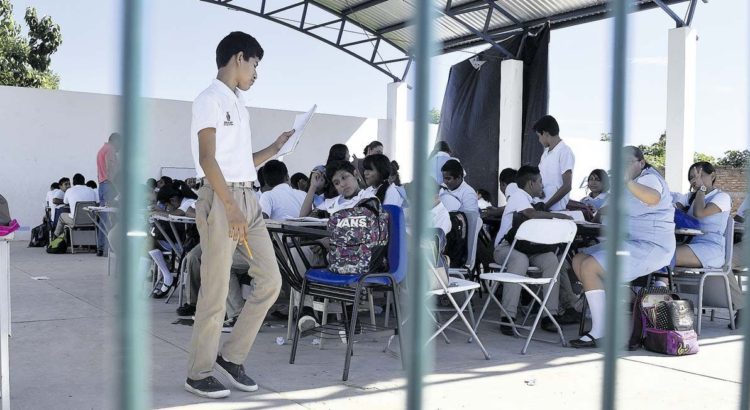
México: Lanza SNTE plan de defensa por la educación.

América del Norte/México/20.09.2016/Autor y Fuente:http://www.elpulsolaboral.com.mx/

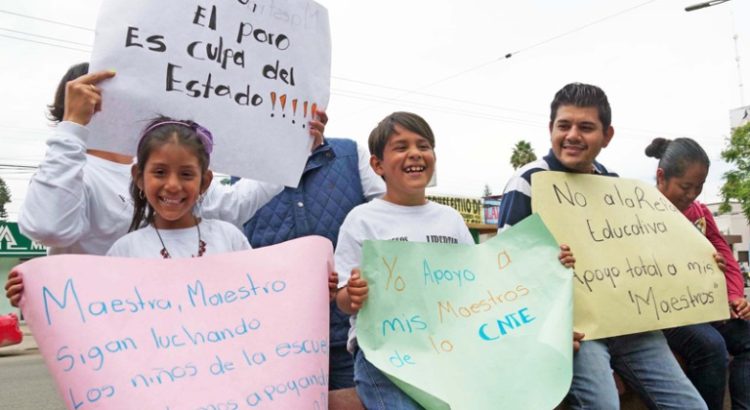
El Sindicato Nacional de Trabajadores de la Educación (SNTE) lanzó el programa “Defensa de la escuela y de la educación pública”, con el objetivo de que ambas se mantengan como un bien público nacional.

En una ceremonia efectuada en el Teatro Juárez, previo a los festejos del Centenario de la Constitución Política de los Estados Unidos Mexicanos, el dirigente magisterial, Juan Díaz de la Torre, destacó que “el Artículo 3 Constitucional contempla una de las garantías sociales más trascendentes que nos legaron los constituyentes de 1917”.

Agregó que dicha garantía se refiere a que el Estado debe hacer efectivo el derecho de todos a una educación pública, laica, gratuita y obligatoria y, con las recientes reformas a los Artículos 3 y 73 de la Constitución, cumplir con una educación de calidad.

Ante el gobernador de Guanajuato, Miguel Márquez Márquez, Díaz de la Torre recordó que como representante del magisterio, el SNTE asume la corresponsabilidad histórica de mantener la unidad del gremio, la estabilidad del sistema educativo nacional, así como el carácter público y gratuito de la escuela y la educación que, a nivel mundial, están teniendo un embate privatizador.

Señaló que la tendencia privatizadora en algunos casos es muy fuerte y en otros incipiente. “En México hay algunos, afortunadamente pocos pero poderosos económicamente, que quieren ver a la educación como un negocio, pero la escuela pública tiene un valor de patrimonio de todos los mexicanos”, dijo.

Aseveró que defenderla y ponerla a debate significa la posibilidad de llamar la atención para mejorarla, para transformarla, y que la sociedad mexicana tiene que conocer el valor de la escuela; “aquellos que la pudieran ver como un negocio, que se den cuenta de que no pasarán”.

Fuente: http://www.elpulsolaboral.com.mx/sindicatos/1299/lanza-snte-plan-de-defensa-por-la-educacion

Imagen: http://www.elpulsolaboral.com.mx/img/articles/lanza-snte-plan-de-defensa-por-la-educacion-yQwwU/MgOO4_defensa.jpg

Comparte este contenido:

EE.UU: Student Debt, School Funding Bills Pass as Summer Recess Ends

América del Norte/EE.UU/20 de septiembre de 2016/http://observer.com

———————————————————-

Two education bills pass as Republicans take a jab across the aisle. PolitickerNJ

TRENTON — The first session day following the New Jersey legislature’s summer recess saw two prominent education bills win approval in the State Assembly and Senate respectively. That approval came as Governor Chris Christie was marking the case for reversing the stat´s landmark Abbot School District decision, and the Assembly’s Republican minority had harsh remarks for Democrats’ refusal to entertain a compromise with the governor on school funding.

The first of those two bills, sponsored by Senate President Steve Sweeney (D-3), would create a commission that would devise a way for the state to fully fund its underfunded school funding formula, which has gone underfunded by as much as $1 billion a year during Christie’s tenure. That proposal, which passed in the Senate, would bypass Christie to create the commission with no need for his signature.

The second would end the state’s practice of forcing parental cosigners to continue paying off their children’s student loans, even in the event of their death. New Jersey is an outlier among similar states in its aggressive collection practices and received negative attention in the press after a ProPublica investigation showed one woman still paying off her son’s loans after his murder. That bill, sponsored by Assemblymen Vince Mazzeo (D-2) and Andrew Zwicker (D-16) among others, passed in the Assembly.

“To expect a student’s family or other survivors to pay their college loan debt in the event of their death is cruel and unacceptable.  We can do better than that,” he wrote.

“To expect a student’s family or other survivors to pay their college loan debt in the event of their death is cruel and unacceptable.  We can do better than that,”

Assembly Minority Leader Jon Bramnick (R-21) criticized the Democratic caucus for a back-to-school board list that neglected to offer a compromise with Christie on schools. Christie favors reversing rulings resulting from the State Supreme Court’s historic Abbot vs. Burke decision, and offering the same apportionment of funding to all schools across the state regardless of need.

That step would offer a significant budget windfall for schools and lower property tax bills for residents of suburban districts that currently receive little state aid, but would also cause massive budget cuts in impoverished urban schools. Bramnick, saying that he is not wedded to the governor’s proposal, decried the day’s legislative agenda for not including any bills to lower property taxes. Democrats, he said alluding to Sweeney’s plan, should compromise with Christie on schools.

“What are the Democrats voting on today?  Nothing,” he said. “I ask all of you while people are exiting this state to call upon the Democrats to at least have an open discussion on property tax relief.”

Assemblywoman Holly Schepisi echoed Bramnick, saying of a compromise between the school funding plans that the parties should “at least have that discussion.” She said many working class in her Bergen County district would benefit from an overhaul of the current system.

“I want someone to explain to me why a child in Fairlawn… why they should only receive a thousand dollars or less per year as a student, and a child in Asbury Park is worth over $30,000 in our state?  It makes no sense to me.”

Sweeney said that he expects his proposal to address property tax relief in a statement after the vote, where he pointed to the roughly $50o million dollars currently being given to recent urban success stories like Jersey City and Hoboken under an outdated formula.

“We have some school districts that are spending 50 percent more than they should be and some that are spending 50 percent less,” Sweeney wrote. “Some towns are receiving three times the amount of aid they should be and some are receiving only one third. We need a plan to restore fairness and equity to New Jersey’s school aid formula that doesn’t shortchange our children and doesn’t put upward pressure on local property taxes.”

Fuente de la Noticia:

Student Debt, School Funding Bills Pass as Summer Recess Ends

Comparte este contenido:

México: Tras regreso a clases haremos valer instalación de mesas de diálogo: CNTE Chiapas

América del Norte/México/20 Septiembre 2016/Fuente y Autor: radioformula

El dirigente de la Sección 7 de la Coordinadora Nacional de Trabajadores de la Educación en Chiapas, José Luis Escobar, aseveró que lo único que puede vulnerar la decisión definitiva de regresar a clases es el incumplimiento del gobierno en lo ofrecido; «mientras tanto, es definitiva y volvemos todos».

En entrevista para el programa «Fórmula Detrás de la Noticia», dijo esperar que el gobierno cumpla y no haya agravios que impliquen la imposición de la reforma educativa, que haya apoyo a infraestructura y social a los alumnos con calzado, mochilas, útiles escolares y disminución del precio del pasaje en algunas ciudades de Chiapas. 

Ante esto, precisó que desde el 2013, no hay maestros cesados, notificados, ni víctimas de descuentos por estar en algún movimiento. 

«Lo que sí nos preocuparía es que el gobierno intentara imponer alguno de los instrumentos de esta reforma educativa y entonces sí detonaría que otra vez volvamos a las calles, pero la reforma educativa en Chiapas desde el 2013 no opera».

Asimismo, José Luis Escobar reiteró que están convencidos que una vez que regresen a clases, tienen que hacer valer el ofrecimiento del gobierno de la instalación de las mesas de diálogo a nivel nacional independientemente de las locales que tengan para atender problemas de carácter local.

Llamó a la Secretaría de Gobernación y a la Secretaría de Educación Pública revisar, y empezar a construir una verdadera reforma educativa que tome en cuenta a los maestros y alumnos.

Fuente de la noticia:

http://www.radioformula.com.mx/notas.asp?Idn=626872&idFC=2016&sURL=

Fuente de la imagen:

http://www.radioformula.com.mx/images/notas/20160919_09_51_CnteChiapas_GF.jpg

Comparte este contenido:

Neoliberal Savagery and the Assault on Higher Education as a Democratic Public Sphere


By Henry A. Giroux

Across the globe, a new historical conjuncture is emerging in which attacks on higher education as a democratic institution and on dissident public voices in general – whether journalists, whistleblowers, or academics – are intensifying with alarming consequences for both higher education and the formative public spheres that make democracy possible. Hyper-capitalism or market fundamentalism has put higher education in its cross hairs and the result has been the ongoing transformation of higher education into an adjunct of the very rich and powerful corporate interests. Marina Warner has rightly called these assaults on higher education, “the new brutalism in academia.”[i] It may be worse than she suggests. In fact, the right-wing defense of the neoliberal dismantling of the university as a site of critical inquiry is more brazen and arrogant than anything we have seen in the past. What we are witnessing is an attack on universities not because they are failing, but because they are public. This is not just an attack on political liberty but also an attack on dissent, critical education, and any public institution that might exercise a democratizing influence on the nation. In this case the autonomy of institutions such as higher education, particularly public institutions are threatened as much by state politics as by corporate interests. How else to explain in neoliberal societies such as the U.S., U.K. and India the massive defunding of public institutions of higher education, the raising of tuition for students, and the closing of areas of study that do not translate immediately into profits for the corporate sector?

The hidden notion of politics that fuels this market-driven ideology is on display in a more Western-style form of neoliberalism in which the autonomy of democratizing institutions is under assault not only by the state but also by the rich, bankers, hedge fund managers, and the corporate elite. In this case, corporate sovereignty has replaced traditional state modes of governance that once supported higher education as a public good. That is, it is now mostly powerful corporate elites who despise the common good and who as the South African Nobel Prize winner in literature, JM Coetzee, points out “reconceive of themselves as managers of national economies” who want to turn universities into training schools equipping young people with the skills required by a modern economy.”[ii] Viewed as a private investment rather than a public good, universities are now construed as spaces where students are valued as human capital, courses are defined by consumer demand, and governance is based on the Walmart model of labour relations. For Coetzee, this attack on higher education, which is not only ideological but also increasingly relies on the repressive, militaristic arm of the punishing state, is a response to the democratization of the university that reached a highpoint in the 1960s all across the globe. In the last twenty years, the assault on the university as a center of critique, but also on intellectuals, student protesters, and the critical formative cultures that provide the foundation for a substantive democracy has only intensified.[iii]

Coetzee’s defense of education provides an important referent for those of us who believe that the university is nothing if it is not a public trust and social good; that is, a critical institution infused with the promise of cultivating intellectual insight, the civic imagination, inquisitiveness, risk-taking, social responsibility, and the struggle for justice. Rather than defining the mission of the university by mimicking the logic of the market in terms of ideology, governance, and policy, the questions that should be asked at this crucial time in American history might raise the following issues: how might the mission of the university be understood with respect to safeguarding the interests of young people at a time of violence and war, the rise of a rampant anti-intellectualism, the emerging specter of authoritarianism, and the threat of nuclear and ecological devastation? What might it mean to define the university as a public good and democratic public sphere rather than as an institution that has aligned itself with market values and is more attentive to market fluctuations and investors than educating students to be critically engaged citizens? Or, as Zygmunt Bauman and Leonidas Donskis write: “how will we form the next generation of … intellectuals and politicians if young people will never have an opportunity to experience what a non-vulgar, non-pragmatic, non-instrumentalized university is like?”[iv] As public spheres – once enlivened by broad engagements with common concerns – are being transformed into “spectacular spaces of consumption”,[v] financial looting, the flight from mutual obligations and social responsibilities has intensified and resulted in not only a devaluing of public life and the common good, but also a crisis in the radical imagination, especially in terms of the meaning and value of politics itself.[vi]

What I am suggesting is that the crisis of higher education is about much more than a crisis of funding, an assault on dissent, and a remaking of higher education as another institution designed to serve the increasing financialization of neoliberal driven societies; it is also about a crisis of memory, agency, and the political. As major newspapers all over the country shut down and the media becomes more concentrated in the hands of fewer mega corporations, higher education becomes one of the few sites left where the ideas, attitudes, values, and goals can be taught that enable students to question authority, rethink the nature of their relationship with others in terms of democratic rather than commercial values, and take seriously the impending challenges of developing a global democracy.

The apostles of predatory capitalism are well aware that no democracy can survive without an informed citizenry, and they implement a range of policies to make sure that higher education will no longer fulfill such a noble civic task. This is evident in the business models imposed on governing structures, defining students as customers, reducing faculty to Wal-Mart workers, imposing punishing accounting models on educators, and expanding the ranks of the managerial class at the expense of the power of faculty.

As politics is removed from its political, moral, and ethical registers – stripped down to a machine of social and political death for whom the cultivation of the imagination is a hindrance, commerce is the heartbeat of social relations, and the only mode of governance that matters is one that rules Wall Street. Time and space have been privatized, commodified, and stripped of human compassion under the reign of neoliberalism. We live in the age of a new brutalism marked not simply by an indifference to multiple social problems, but also defined by a kind of mad delight in the spectacle and exercise of violence and what the famed film director, Ken Loach, has called “conscious cruelty.”[vii] America is marked by a brutalism that is perfectly consistent with a new kind of barbaric power, one that puts millions of people in prison, subjects an entire generation to a form of indentured citizenship, and strips people of the material and symbolic resources they need to exercise their capacity to live with dignity and justice.

For those of us who believe that education is more than an extension of the business world and the new brutalism, it is crucial that educators, artists, workers, labour unions, and other cultural workers address a number of issues that connect the university to the larger society while stressing the educative nature of politics as part of a broader effort to create a critical culture, institutions, and a collective movement that supports the connection between critique and action and redefines agency in the service of the practice of freedom and justice. Let me mention just a few. 

First, educators can address the relationship between the attack on the social state and the transformation of higher education into an adjunct corporate power. As Stefan Collini has argued, under the regime of neoliberalism, the “social self” has been transformed into the “disembedded individual,” just as the notion of the university as a public good is now repudiated by the privatizing and atomistic values at the heart of a hyper-market driven society.[viii] Clearly, in any democratic society, education should be viewed as a right, not an entitlement. This suggests a reordering of state and federal priorities to make that happen. Much needed revenue can be raised by putting into play even a limited number of  reform policies in which, for instance, the rich and corporations would be forced to pay a fair share of their taxes, a tax would be placed on trade transactions, and tax loopholes for the wealthy would be eliminated. It is well known that the low tax rate given to corporations is a major scandal. For instance, the Bank of America paid no taxes in 2010 and “got $1.9 billion tax refund from the IRS, even though it made $4.4 billion in profits.”[ix]

In addition, academics can join with students, public school teachers, unions, and others to bring attention to wasteful military spending that if eliminated could provide the funds for a free public higher education for every qualified young person in the country. While there is growing public concern over rising tuition rates along with the crushing debt students are incurring, there is little public outrage from academics over the billions of dollars squandered on a massive and wasteful military budget and arms industry. As Michael Lerner has pointed out, democracy needs a Marshall Plan in which funding is sufficient to make all levels of education free, while also providing enough social support to eliminate poverty, hunger, inadequate health care, and the destruction of the environment. There is nothing utopian about the demand to redirect money away from the military, the powerful corporations, and the upper 1 percent. 

Second, addressing these tasks demands a sustained critique of the transformation of a market economy into a market society along with a clear analysis of the damage it has caused both at home and abroad. Power, particularly the power of the largest corporations, has become more unaccountable and “the subtlety of illegitimate power makes it hard to identify.”[x] Disposability has become the new measure of a savage form of casino capitalism in which the only value that matters is exchange value. Compassion, social responsibility, and justice are relegated to the dustbin of an older modernity that now is viewed as either quaint or a grim reminder of a socialist past. This suggests, as Angela Davis, Michelle Alexander, and others have argued, that there is a need for academics and young people to become part of a broader social movement aimed at dismantling the repressive institutions that make up the punishing state. The most egregious example of this is the prison-industrial complex, which drains billions of dollars in funds to put people in jail when such funds could be used for expanding public and higher education.We live in a country in which the police have become militarized, armed with weapons from the battlefields of Iraq and Afghanistan.[xi] The United States prison system locks up more people than any other country in the world, and the vast majority of them are people of color.[xii] Moreover, public schools are increasingly modeled after prisons and are implementing policies in which children are arrested for throwing peanuts at a school bus or violating a dress code.[xiii] The punishing state is a dire threat to both public and higher education and democracy itself. The American public does not need more prisons; it needs more schools, free health services, and a living wage for all workers.  

Third, academics, artists, journalists, and other young people need to connect the rise of subaltern, part-time labour – or what we might call the Walmart model of wealth and labour relations – in both the university and the larger society to the massive inequality in wealth and income that now corrupts every aspect of American politics and society. No democracy can survive the kind of inequality in which “the 400 richest people…have as much wealth as 154 million Americans combined, that’s 50 percent of the entire country [while] the top economic 1 percent of the U.S. population now has a record 40 percent of all wealth and more wealth than 90 percent of the population combined.”[xiv] Senator Bernie Sanders provides a statistical map of the massive inequality at work in the United States. In a speech to the U.S. Senate, he states:

Today, Madam President, the top 1% owns 38% of the financial wealth of America, 38%. And I wonder how many Americans know how much the bottom 60% own. They want people to think about it. Top 1% own 38% of the wealth. What do the bottom 60% own? The answer is all of 2.3%. Top 1% owns 38% of the financial wealth. The bottom 60% owns 2.3%. Madam President, there is one family in this country, the Walton family, the owners of Wal-Mart, who are now worth as a family $148 billion. That is more wealth than the bottom 40% of American society. One family owns more wealth than the bottom 40% of American society…That’s distribution of wealth. That’s what we own. In terms of income, what we made last year, the latest information that we have in terms of distribution of income is that from 2009-2012, 95% of all new income earned in this country went to the top 1%. Have you all got that? 95% of all new income went to the top 1%, which tells us that when we talk about economic growth, which is 2%, 3%, 4%, whatever it is, that really doesn’t mean all that much because almost all of the new income generated in that growth has gone to the very, very, very wealthiest people in this country.[xv]

Democracy in the United States, and many other countries, has been hijacked by a free-floating class of ultra-rich and corporate powerbrokers and transformed into an oligarchy “where power is effectively wielded by a small number of individuals.”[xvi] At least, this is the conclusion of a recent Princeton University study, and it may be much too moderate in its conclusions. 

Fourth, academics need to fight for the rights of students to get a free education, for them to be given a formidable and critical education not dominated by corporate values, and to have a say in the shaping of their education and what it means to expand and deepen the practice of freedom and democracy. In many countries such as Germany, France, Denmark, Cuba, and Brazil, post-secondary education is free because these countries view education not as a private right but as a public good. Yet, in some of the most advanced countries in the world such as the United States and Canada, young people, especially from low income groups have been excluded from getting a higher education and, in part, this is because they are left out of the social contract and the discourse of democracy. They are the new disposables who lack jobs, a decent education, hope, and any semblance of a life better than the one their parents inherited. They are a reminder of how finance capital has abandoned any viable vision of a better future for young people. Youth have become a liability in the world of high finance, a world that refuses to view them as an important social investment. 

Fifth, there is a need to oppose the ongoing shift in power relations between faculty and the managerial class. Too many faculty are now removed from the governing structure of higher education and as a result have been abandoned to the misery of impoverished wages, excessive classes, no health care, and few, if any, social benefits. As political scientist Benjamin Ginsburg points out, administrators and their staff now outnumber full time faculty producing two-thirds of the increase in higher education costs in the past 20 years. This is shameful and is not merely an education issue but a deeply political matter, one that must address how neoliberal ideology and policy has imposed on higher education an anti-democratic governing structure. 

Sixth, it is important to stress once again that education must be viewed not simply as a practice endemic to schooling but goes on throughout society through a range of cultural apparatuses extending from the mainstream media to various aspects of screen culture. Education is at the center of politics because it is crucial to how agency is formed, how people view themselves and their relations to others. Educators and other cultural workers must acknowledge that domination is as much ideological as it is economic and structural. This means taking on the challenge of embracing the symbolic and ideological dimensions of struggle as part of the struggle against oppression and domination. Educators need to launch pedagogical campaigns aimed at dismantling the common sense logic of neoliberalism: people are only consumers, government is the enemy, the market should govern all of social life, social bonds are a pathology, self-interest is the highest virtue, and last but not least the market should govern itself. University faculty must join together and find ways to press the claims for economic and social justice and do so in a discourse that is aimed at multiple audiences and is both rigorous and accessible. Universities need to defend not only the idea of the university as a democratic public sphere but also faculty as public intellectuals capable and willing to question authority, hold power accountable, and be critical of existing affairs.

Finally, seventh, the fight to transform higher education cannot be waged strictly inside the walls of such institutions by faculty and students alone. As radical social movements more recently in Spain, Portugal, and India have made clear, there is a need for new social and political formations among faculty, unions, young people, cultural workers, and most importantly social movements, all of which need to be organized in part for the defense of public goods and what might be called the promise and ideals of a radical democracy. Any struggle against the anti-democratic forces that are mobilizing once again all over the world must recognize that power is not global and politics is local. A financial elite operates now in the flow and international spaces of capital and have no allegiances to nation-states and can impose their financial will on these states as we have seen recently in some European countries. Resistance must address this new power formation and think and organize across national boundaries. Resistance on a global level is no longer an option, it is a necessity.

Neoliberal societies now live in the shadow of the authoritarian corporate state, but the future is still open. The time has come to develop a political language in which civic values and social responsibility – and the institutions, tactics, and long-term commitments that support them – become central to invigorating and fortifying a new era of civic engagement, a renewed sense of social agency, and an impassioned international social movement with the vision, organization, and set of strategies capable of challenging the neoliberal nightmare that now haunts the globe and empties out the meaning of politics and democracy.

Photo: Google Images


[i] Marina Warner, “Dairy,” The London Review of Books 36:17, September 11, 2014.

[ii]JM Coetzee, “JM Coetzee: Universities head for extinction” Mail & Guardian, November 1, 2013.

[iii] Ibid.

[iv] Zygmunt Bauman and Leonidas Donskis, Moral Blindness: The Loss of Sensitivity in Liquid Modernity, (Cambridge, UK: Polity Press, 2013), p. 139.

[v] Steven Miles, Social Theory in the Real World (Thousand Oaks, Sage, 2001), p. 116.

[vi] Joshua Kurlantzick, Democracy in Retreat (New Haven: Yale University Press, 2013).

[vii] Fran Blandy, “Loach film on shame of poverty in Britain moves Cannes to tears,” Yahoo News, May 13, 2016.

[viii] These two terms are taken from Stefan Collini, “Response to Book Review Symposium: Stefan Collini, What are Universities For,” Sociology 1-2 (February 5, 2014).

[ix] Michael Snyder, “You won’t believe who is getting away with paying zero taxes while the middle class gets hammered,” InfoWars.com, February 19, 2013.

[x] Susan George, “State of Corporations: The Rise of Illegitimate Power and the Threat to Democracy,” in Transnational Institute and Occupy.com. State of Power 2014: Exposing the Davos Class (February 2014).

[xi] Radley Balko, Rise of the Warrior Cop: The Militarization of America’s Police Forces (New York: Public Affairs, 2013), and Jill Nelson, ed. Police Brutality (New York: Norton, 2000).

[xii] Michelle Alexander, The New Jim Crow (New York: The New Press, 2010).

[xiii] Henry A. Giroux, Youth in a Suspect Society (New York: Palgrave, 2012).

 [xiv] David DeGraw, “Meet the Global Financial Elites Controlling $46 Trillion in Wealth,”Alternet, August 11, 2011.

[xv] Sen. Bernie Sanders, “A Threat to American Democracy,” RSN, April 1 , 2014

[xvi] Tom McKay, “Princeton Concludes What Kind of Government America Really Has, and It’s Not a Democracy,” Popular Resistance, April 16, 2014.


Bio:
Henry A. Giroux
 is University Professor for Scholarship in the Public Interest at McMaster University in Hamilton, Ontario. His many books include Theory and Resistance in Education(1983), Critical Theory and Educational Practice (1983), Teachers as Intellectuals: Toward a Critical Pedagogy of Learning (1988), Border Crossings: Cultural Workers and the Politics of Education (1992),Living Dangerously: Multiculturalism and the Politics of Culture (1993), Pedagogy and the Politics of Hope Theory, Culture, and Schooling (1997), Impure Acts: The Practical Politics of Cultural Studies(2000), Public Spaces/Private Lives: Democracy Beyond 9/11 (2003), Take Back Higher Education: Race, Youth, and the Crisis of Democracy in the Post Civil Rights Era (co-authored with Susan Searls Giroux, 2004), The Terror of Neoliberalism: Authoritarianism and the Eclipse of Democracy(2004), The University in Chains: Confronting the Military-Industrial-Academic Complex (2007),Youth in a Suspect Society: Democracy or Disposability? (2009), America’s Education Deficit and the War on Youth (2013), and America’s Addiction to Terrorism (2016).

Comparte este contenido:

UNICEF advierte sobre crisis global en educación y pide inversiones

UNICEF/20 Septiembre 2016/Fuente: Prensa Latina
El Fondo de Naciones Unidas para la Infancia (UNICEF) advirtió hoy que el planeta vive una crisis global en materia de educación, ante la cual reclamó mayores recursos para el sector.
 En una nota de prensa circulada aquí, la agencia de la ONU precisó que más de dos tercios de los niños en edad escolar en los países pobres no aprenderán las habilidades básicas de la enseñanza primaria para 2030, pese a las metas recogidas en la Agenda de Desarrollo Sostenible adoptada hace un año.

Esos menores seguirán atrapados en un ciclo de pobreza y sin los conocimientos necesarios para contribuir con sus sociedades y economías, lamentó el Fondo, a propósito de las decenas de jefes de Estados o de Gobierno presentes aquí para el comienzo mañana del segmento de alto nivel de la Asamblea General de Naciones Unidas en su 71 Período de Sesiones.

Según Unicef, urge que los gobiernos nacionales incrementen las inversiones en educación.

‘Cada niño, en cada país, en cada barrio y en cada hogar, tiene el derecho no solo de sentarse en un aula, sino de recibir una educación de calidad’, afirmó el director ejecutivo de la agencia, Anthony Lake.

Unicef publicó hoy un reporte sobre el tema, en el que llama la atención acerca de los desafíos existentes y de la importancia de aumentar las inversiones en materia de la enseñanza.

El informe refleja problemas como el hecho de que 330 millones de estudiantes de los niveles primario y secundario no alcanzan los conocimientos básicos, y el mayor impacto de las dificultades en las niñas que en los niños.

Fuente de la Noticia:  
http://prensa-latina.cu/index.php?o=rn&id=27120&SEO=unicef-advierte-sobre-crisis-global-en-educacion-y-pide-inversiones
Comparte este contenido:

Regresan a clases más de un millón de alumnos de Chiapas, México

América del Norte/México/20 Septiembre 2016/Fuente: Prensa Latina

Más de un millón 776 mil 630 alumnos de 122 municipios del estado mexicano de Chiapas retornaron hoy a clases normales, tras el paro de labores de maestros de la Coordinadora Nacional de Trabajadores de la Educación (CNTE).
 Así lo aseguró la Secretaría Estatal de Educación.

Los niños y jóvenes vuelven a 19 mil 336 escuelas de los sistemas y subsistemas de educación, así como 80 mil docentes, añadió la Secretaría.

El viernes último profesores de la CNTE finalizaron el paro de labores iniciado el pasado 15 de mayo, en rechazo a la reforma educativa, y retiraron el plantón instalado en Tuxtla Gutiérrez, la capital del estado.

Los maestros afiliados a las Secciones siete y 40 del Sindicato Nacional de Trabajadores de la Educación se comprometieron a integrarse a la enseñanza.

La dependencia educativa reconoció a los docentes la decisión de poner fin al conflicto y retornar a las aulas para incorporarse al ciclo escolar 2016-2017, que dio inicio el 22 de agosto en el país.

Chiapas era el único estado que se mantenía en paro de labores.

Grupos magisteriales en México se oponen a la implementación de la reforma educativa, la cual incluye una evaluación del desempeño profesional, al calificarla de punitiva y privatizadora.

Fuente de la Noticia: 
http://prensa-latina.cu/index.php?o=rn&id=27268&SEO=regresan-a-clases-mas-de-un-millon-de-alumnos-de-chiapas-mexico
Comparte este contenido:

EE.UU: An American tragedy: why are millions of trees dying across the country?

 América del Norte/EE.UU./20 de septimebre de 2016/www.theguardian.com

A quiet crisis playing out in US forests as huge numbers of trees succumb to drought, disease, insects and wildfire – much of it driven by climate change

Resumen: Árboles han sido infectados conun virusque provoca en ellos una enfermedad misteriosa que ha asolado sólo los bosques tropicales del de Estados Unidos. La plaga que devastando los bosques estadounidenses en todo el oeste. Un ecólogo forestal de la Universidad de Hawai se encuentra realizando un estudio. Las hojas se vuelven amarillas, a continuación, marrón, más de unas pocas semanas – un cambio sorprendente para un árbol de hoja perenne. Esta hoy en día la mayor amenaza para nuestros bosques nativos que en años se ha visto. Si esto se extiende a través de toda la isla, que podría colapsar todo el ecosistema nativo «. Los científicos aún no están seguros de dónde vino o cómo tratarla. Lisa Keith, investigadora de la patología de las plantas en el Departamento de Agricultura de Estados Unidos, dijo que cuando se analizó la enfermedad «de inmediato la enfermedad del olmo holandés vino a la cabeza». Pero esto era diferente a todo lo que ella, o cualquier otra persona, nunca había tratado.

JB Friday hacked at a rain-sodden tree with a small axe, splitting open a part of the trunk. The wood was riven with dark stripes, signs of a mysterious disease that has ravaged the US’s only rainforests – and just one of the plagues that are devastating American forests across the west.

Friday, a forest ecologist at the University of Hawaii, started getting calls from concerned landowners in Puna, which is on the eastern tip of Hawaii’s big island, in 2010. Their seemingly ubiquitous ohi’a trees were dying at an astonishing rate. The leaves would turn yellow, then brown, over just a few weeks – a startling change for an evergreen tree.

“It was like popcorn – pop, pop, pop, pop, one tree after another,” Friday said. “At first people were shocked, now they are resigned.

“It’s heartbreaking. This is the biggest threat to our native forests that any of us have seen. If this spreads across the whole island, it could collapse the whole native ecosystem.”

Almost six years later and nearly 50,000 acres of native forest on the big island are infected with rapid ohi’a death disease. Rumors abound as to its origin: did it emerge from Hawaii’s steaming volcanoes? A strange new insect? Scientists still aren’t sure of where it came from or how to treat it.

Lisa Keith, researcher in plant pathology at the US Department of Agriculture, said that when she analyzed the disease “right away Dutch elm disease popped into my head”. But this was unlike anything she, or anyone else, had ever dealt with.

“I’m not sure if there’s been anything else like this in the world,” she said. “The potential is there for major devastation.” Keith said the disease hadn’t yet spread to crops, like coffee, but it threatens a whole family of metrosideros trees and shrubs found mainly in the Pacific.

But the plight of the ohi’a is not unique – it’s part of a quiet crisis playing out in forests across America. Drought, disease, insects and wildfire are chewing up tens of millions of trees at an incredible pace, much of it driven by climate change.

‘Mountainsides dying’

Forestry officials and scientists are increasingly alarmed, and say the essential role of trees – providing clean water, locking up carbon and sheltering whole ecosystems – is being undermined on a grand scale.

California and mountain states have suffered particularly big die-offs in recent years, with 66m trees killed in the Sierra Nevada alone since 2010, according to the Forestry Service.

In northern California, an invasive pathogen called Sudden Oak Death is infecting hundreds of different plants, from redwoods and ferns to backyard oaks and bay laurels. The disease is distantly related to the cause of the 19th-century Irish potato famine, and appears to have arrived with two “Typhoid Marys”, rhododendrons and bay laurels, said Dr David Rizzo, of the University of California, Davis.

“We’re talking millions of trees killed, whole mountain sides dying,” Rizzo said.

Oozing from the bark of a live oak (Quercus) suffering from Sudden Oak Death.
Pinterest
Oozing from the bark of a live oak (Quercus) suffering from Sudden Oak Death. Photograph: Inga Spence/Getty Images/Visuals Unlimited

Despite its name, the pathogen slowly saps the life from oaks over the course of two to five years, turning them sickly brown. The disease spreads mostly through water, like rain splashing off an infected leaf on to a healthy neighbor. Rizzo said wind-driven rain could carry it miles at a time, and that it already ranged from the Oregon border down through the forests of Big Sur.

The pestilence appears to have arrived in the US through nursery plants in the 1980s, said Matteo Garbelotto, a professor at the University of California, Berkeley, who researches the genetics of the disease and trees that resist it. Garbelotto said researchers have found three distinct “subspecies” of the pathogen in the US – only one of which has escaped into the wild.

“There’s a bit of concern here that maybe we’re not doing enough to prevent introduction of other two lineages,” he said. Authorities have quarantined 15 counties to keep infected plants from leaving, but Garbelotto fears that authorities lack the resources to do more.

Native American tribes are helping Rizzo’s research near Oregon, and Garbelotto’s team developed a mobile app that users can direct at a given tree to determine its risk for disease, and what they can do to protect it.

“It’s a little bit like talking about mosquito abatement and malaria,” Garbelotto said of efforts to protect some trees by isolating them. “You try to reduce the number of vectors, eliminate immediate neighbors, a bit like putting a mosquito net around the tree.”

‘Insect eruptions’

Five years of drought in the west have not only starved trees of water but weakened their defenses and created conditions for “insect eruptions” across the US, said Diana Six, an entomologist at the University of Montana. Bark beetles and mountain pine beetles, usually held in check by wet winters, now have more time to breed and roam. The latter have already expanded their range from British Columbia across the Rockies, to the Yukon border and eastward, into jack pine forests that have never seen the bug.

The outbreak is “something like 10 times bigger than normal, I would argue a lot more than that,” Six said. “Basically a native insect is acting outside of the norm, because of climate change, and become an exotic in forests it’s never been before. We haven’t seen very good outcomes of exotics moving into native forests.”

Thousands of trees killed by mountain pine beetles in western Rocky Mountain national park.
Pinterest
Thousands of trees killed by mountain pine beetles in western Rocky Mountain national park. Photograph: National Parks Service

Boosted by climate change, various beetles and the fungi they carry have already wiped out millions of acres of trees, and Six and Rizzo both warned of cascading effects. In the redwoods, Rizzo said, the loss of tanoaks and their relatives would strip away nut-producing species, leaving birds and mammals that rely on them without food. The loss of mountain pines, Six said, threatens grizzly bears and the critical snowpack that supplies water to life below.

“There’s virtually nothing you can do to stop the beetles, either, unless they’ve killed everything and run out of food,” Six said. “Or unless the climate cools, and I don’t think anyones expecting that anytime soon.”

In Hawaii, warming temperatures have helped spread four types of beetles that bore into ohi’a bark to feed. The beetles carry disease spore on their wings, in their guts and in the sawdust of burrows, spreading it from tree to tree.

The beetles are part of scolylinae, a “very destructive family” that is also decimating trees in California, according to Curtis Ewing, an entomologist at the University of Hawaii.

“They are exploding around the world due to global warming,” he said. They appear unstoppable: spraying each tree with insecticide would be time-consuming and made futile by rain, and pheromone-laced traps also appear ineffective. The university’s arboretum has started collecting ohi’a seeds in the face of a doomsday scenario that was recently unimaginable for such a common tree.

‘An ecological emergency’

Scientists in Keith’s lab have made some progress, finding that the fungal disease was part of the common ceratocystis family. It was probably imported to Hawaii by an ornamental plant, but a global DNA database drew a blank; this was an entirely new strain.

The effects of the goldspotted oak borer beetle in California.
Pinterest
The effects of the goldspotted oak borer beetle in California. Photograph: Mike Blake/Reuters

“I would’ve thought that with the extensive information there, there would’ve been a match,” Keith said. “It’s a worry.”

The spores look golden under the microscope and give off a fruity smell. Once they grip a tree the fungus clogs up the vascular system that trees use to draw water upwards. Leaves die, then the tree itself.

While research continues for a treatment, scientists’ current priority is containment. Movement of ohi’a between islands is prohibited, but with an uncertain source, there’s little else to do other than cut down infected trees and burn them.

“This is an ecological emergency,” said Hawaii senator Brian Schatz. “It requires everyone working together to save Hawaii island’s native forests.”

In western valleys of dead trees, a few still stand unharmed. Six said genetic research has begun to try to understand why some survive the swarms of millions of insects. “The only thing that’s really going to help our forests move into the future with climate change is adaptation,” she said. “Forests need to actually adapt with genetic change.”

In a few decades, Americans might not even recognize forests they see, Rizzo said. When his grandfather grew up near Philadelphia, he said, gigantic chestnut trees towered over eastern forests.

“When I show people photos they think they’re redwoods,” Rizzo said. When he hiked the Appalachian trial in the 1980s he found tiny sprouts of chestnuts, three-inches wide, stunted by an invasive blight that had wiped out the old giants.

“It changed chestnut forests to oak and hickory forests,” he said. “We know we can’t get rid of some of these blights. We may have to learn to live with them.”

Tomado de: https://www.theguardian.com/environment/2016/sep/19/tree-death-california-hawaii-sudden-oak

Comparte este contenido:
Page 1323 of 1685
1 1.321 1.322 1.323 1.324 1.325 1.685