Page 1454 of 1684
1 1.452 1.453 1.454 1.455 1.456 1.684

EE.UU.: El Supremo entrega derrota en inmigración, triunfo parcial en acción afirmativa

LasAmericasNews/02 de julio de 2016/Por: Paula T. Castellanno/Washington DC.-

El fallo no pasó, alerta para los que aplicaron para este proceso cuidarse del fraude no hay nada que aplicar, nohay cuota que pagar por la Acción Ejecutiva. Cuidate de no cometer ninguna felonia para evitar ser deportado ya que no aplica.

La Corte Suprema de Estados Unidos confirmó el jueves que la Universidad de Texas puede usar la raza como un factor en su proceso de admisión, pero tras un voto 4-4, las órdenes ejecutivas del presidente Obama respecto a la inmigración y los programas DACA/DAPA permanecerán bloqueadas.

“El anuncio de la Corte Suprema abre la puerta para la separación forzada de madres y niños, padres y niños, y padres y madres. Esta decisión tendrá consecuencias sociales radicales como las familias están devastadas a causa de la deportación,” afirmó Sherrie Kossoudji, profesora asociada de trabajo social y economía en la Universidad de Michigan.

Ella ha escrito numerosos artículos sobre la situación jurídica de los trabajadores inmigrantes en los EE.UU. y los incentivos para cruzar la frontera ilegalmente.

Jason De León, un profesor asistente de antropología que por años ha estudiado la migración de México a Estados Unidos en el borde cerca del desierto de Sonora, añadió que la decisión constituye “un revés de los pequeños pasos que Obama ha tomado hacia una reforma de inmigración racional y pone de relieve la negativa de los republicanos actuales para entretener las medidas que reflejan algunas de las esgrimidas por la administración Reagan a mediados de la década de 1980 para hacer frente a este problema recurrente.

“Por otra parte, se trata de un retroceso en términos de construcción de confianza política en la comunidad latina en los Estados Unidos y es un fracaso más de la derecha de reconocer que la inmigración es un tema clave que, en el largo plazo, no puede ser tratado eficazmente con el uso de retórica xenófoba o bloqueos simplistas de índole legal o física”.

Richard Primus, un experto en derecho, e historia y teoría de la Constitución de Estados Unidos es el ex secretario de la jueza Ruth Bader Ginsburg de la Corte Suprema y comentó el fallo 4-3 respecto a la acción afirmativa del caso Fisher v. Universidad de Texas en Austin.

“Fisher es el triunfo de la perspectiva de la jueza Ginsburg sobre la acción afirmativa”, dijo. “La toma de decisiones conscientes de la raza es ahora claramente aceptable.”

Pero Richard Friedman, profesor de derecho en la Universidad de Michigan, es un experto en evidencia e historia del Tribunal Supremo de Estados Unidos, dijo que hay que ver la decisión con cuidado.

“La opinión del juez Kennedy por una escasa mayoría de una Corte de siete miembros, parece diseñada para resolver este litigio particular, el cual tiene una historia única, y decidir lo menos posible”, dijo. “Incluso la Universidad de Texas no puede estar segura de que su programa sobrevivirá otro desafío en varios años.”

“Quizás uno de los aspectos más notables de la opinión es que el juez Kennedy adopta (la idea) de los beneficios de los procesos de admisión integrales que tienen en cuenta la raza y sugiere que planes como el ‘10% de Texas’ son constitucionalmente vulnerables.”

Tomado de: http://lasamericasnews.com/index.php/es/noticias-es/inmigracion/8337-el-supremo-entrega-derrota-en-inmigracion-triunfo-parcial-en-accion-afirmativa

Comparte este contenido:

México: Estudiantes crean plástico biodegradable con caña de azúcar

México: Estudiantes crean plástico biodegradable con caña de azúcar

Novedad estudiantil/México/julio de 2016/Informador.Mx

La investigación pretende generar un material que proteja al medio ambiente

Un grupo de estudiantes mexicanos de ingeniería logró obtener plástico biodegradable del bagazo de caña de azúcar, lo que podría reducir los costos en la obtención de este tipo de materiales y ayudaría a proteger el medio ambiente.

En una entrevista con la Agencia Informativa del Consejo Nacional de Ciencia y Tecnología (Conacyt), la estudiante del Instituto Tecnológico de Colima (Itec), Verónica Citlali Salazar, señaló que el proyecto denominado BioCane pretende crear un plástico biodegradable que proteja al medio ambiente con el residuo de la industria cañera.

«Con este proyecto se logrará reducir la generación de plásticos derivados del petróleo, se le dará más vida útil a los rellenos sanitarios y se reducirá la contaminación atmosférica, ya que últimamente se quema el bagazo de la caña de azúcar», indicó la alumna de ingeniería ambiental.

Por su parte, el asesor del proyecto, Olimpo Lúa Madrigal, mencionó que con este trabajo se aprovechará el residuo que surge de los ingenios de azúcar, el cual se usa de manera indebida al tirarse o quemarse.

«Aunque, en algunas partes, el bagazo se da como alimento para ganado, todavía no se ha aprovechado al 100 por ciento. Por ello se pretende convertirlo por medio de un proceso en bioplástico para que tenga varias aplicaciones, como película de empaque o para hacer ángulo perfil que se utiliza para los empaques de limón o de mango», puntualizó.

Para obtener el material, los estudiantes sometieron al bagazo de la caña de azúcar a un proceso de secado y triturado para conformar una pasta, que luego se depositó en moldes hasta lograr su enfriado, lo que generó una estructura molecular parecida al plástico.

Fuente: http://www.informador.com.mx/tecnologia/2016/669313/6/estudiantes-crean-plastico-biodegradable-con-cana-de-azucar.htm

Comparte este contenido:

Estados Unidos: The real problem isn’t teachers

América del Norte/Estados Unidos/Julio de 2016/ washingtonpost

RESUMEN: En abril, un tribunal de apelaciones en California confirmó las leyes del estado con respecto a la tenencia de maestros y despidos por el vuelco de la decisión anterior por un tribunal inferior para la revisión de los estatutos de protección de trabajo en vista del caso muy publicitado “Vergara v. California”. Los demandantes en Vergara eran estudiantes de la escuela públicas respaldadas por un grupo de reforma de la defensa escuela llamada “estudiantes materia” y afirmaron que las leyes de protección laboral para los maestros son la razón por la que los niños pobres y de minorías terminan con los maestros más ineficaces. La corte encontró que las pruebas no demuestran que los estatutos impugnados causan inevitablemente impacto en los demandantes afirmó. Activistas de la reforma y antisindicales han prometido continuar la lucha legal contra las leyes de protección del trabajo docente que dicen ser contra los estudiantes. Tales retos legales son sólo una parte de lo que muchos profesores consideran que es una guerra en su profesión por los reformadores escolares y los políticos que han tratado de «interrumpir» la educación pública con los sistemas y programas que los educadores piensan robarles su profesionalismo y generar daños al proceso de aprendizaje.

Por: Valerie Strauss
In April, an appeals court in California upheld the state’s laws regarding teacher tenure, dismissal and layoffs by overturning a lower court’s earlier decision to scrap job-protection statutes in the highly publicized Vergara v. California case. The plaintiffs in Vergara were public school students backed by a school reform advocacy group called Students Matter, and they claimed that job protection laws for teachers are the reason that poor and minority children wind up with more ineffective teachers who are hard to fire. The court found that “the evidence did not show that the challenged statutes inevitably cause” the impact the plaintiffs claimed. Reform and anti-union activists have promised to continue the legal fight against teacher job protection laws that they say work against students.
[California appeals court upholds teacher tenure, a major victory for unions]
Such legal challenges are just part of what many teachers consider to be a war on their profession by school reformers and policymakers who have attempted to “disrupt” public education with systems and programs that educators think rob them of their professionalism and hurt the learning process.
Teachers unions again made national news this week when the Supreme Court denied a petition from plaintiffs in Friedrichs v. California Teachers Association to rehear the case. A group of California teachers had challenged a law that they said violates their First Amendment rights by requiring them to pay dues to the state’s teachers union. California is one of about 20 states in which public employees are required to either join the union or pay a fee to support the union’s collective-bargaining activities — which support all workers, whether or not they are union members.
With this decision, it seems to be a good time to look again at how teachers are faring. Here’s a post about how and why teachers have become scapegoats for problems in public education and what should be done to change the dynamic. It was written by Alexander W. Wiseman, associate professor and director of the Comparative and International Education (CIE) program at Lehigh University’s College of Education. He has more than 20 years of professional experience working with government education departments, university-based teacher education programs, community-based professional development for teachers and as a classroom teacher in both the United States and East Asia.

By Alexander W. Wiseman
Recent U.S. education reform efforts — such as the Vergara vs. California lawsuit filed on behalf of nine students and similar suits in Minnesota and New York — point to teacher job protections negotiated by unions as a root cause of a troubling reality: unequal access to high-quality education. But this is at the least a distraction and at the most a purposeful misdirection of attention from the real problem.
Critics argue that the rules governing the hiring and firing of teachers, such as tenure, have the unintended consequence of burdening the most economically disadvantaged schools with the least effective or prepared teachers, thereby providing a sub-par education to the very students who need public education the most.
It does not take an expert to spot the absurdity of blaming the unequal distribution of highly effective teachers for the fundamental inequalities that pervade American society. Unequal access — to education, to jobs, to bathrooms, for goodness sake — because of one’s race, gender, sexual orientation, economic status, geography or nationality pervades our society. The damage inflicted on our young people as a result of these inequities vastly outweighs the ill effects of a handful of bad teachers.
Teachers are such easy scapegoats. Having worked in and with education systems in the United States, Saudi Arabia, Indonesia, South Africa, and Germany, I can confidently declare teacher shaming to be a worldwide phenomenon. In this country, myths depicting teachers as either lazy clock-punchers or rousing saviors — chronicled recently in a New York Times article, “Why teachers on TV have to be either incompetent or inspiring” — only serve to perpetuate the idea that if a kid fails to learn, his teacher is wholly to blame.
The high-profile lawsuits in California, Minnesota and New York have raised two important questions:
One, how much responsibility for unequal education can be reasonably laid at the feet of public schools and teachers — and how much belongs to the broader community for failing to dismantle persistent and durable barriers to equal opportunity such as poverty, systemic racism and income inequality?
Two, is the way we currently measure teacher quality helpful, or even accurate?
Given pursuits such as the Vergara trial, it seems clear that the balance between a school’s responsibility and the community’s is currently too heavily weighted in the school’s direction. When it comes to addressing the challenges we face as a nation, access to high quality education must be a part of the solution — but it cannot be the whole package.
For example, access to a good education is not going to make up for the fact that mom and dad lack jobs or that their full-time jobs do not pay enough to keep the family clothed, housed, healthy, and fed. The highest-quality teachers in the world do not have the power to lift an individual student out of poverty if the country’s system of wealth distribution is rigged against her. Teachers and public schools are not equipped to end the systemic racism that underlies the fact that five times more young black men are shot dead by U.S. police than young white men and that one in three black men can expect to go to prison in their lifetime. There are some problems in the community that cannot be surmounted by education alone, yet education and teachers are persistently portrayed as a panacea for all of society’s ills.
Collectively, we are failing to accurately measure teacher quality and, thus, failing to help teachers succeed. The current discourse on teacher quality focuses disproportionately on teachers’ influence on students’ test scores. Test scores are only one piece of the larger picture of teacher and student success. Positive changes in a student’s attitude toward a subject, as well as increased confidence, is linked with improved academic success and must be included in any assessment of teaching quality.
Education questions and answers, in your inbox weekly.
Context also plays an important role in a teacher’s craft and is rarely considered. What are teachers doing in the classroom? How are they teaching? Are they simply babysitting or are they helping their students to engage the curriculum? And, are they modifying it for the students depending on their needs?
In addition, a teacher’s background — socio-economic status, gender, ethnicity, race, level of education, whether they are teaching in the field in which they are trained — as well as the backgrounds of his or her students come into play. Incorporating some of these factors into teacher evaluations would not only allow for a more complete assessment of a teacher’s quality than test scores alone, it would also provide a professional development road map by which to help teachers training and improvement.
If we want highly effective teachers in every classroom, we must re-balance the scales, admit that teachers and schools can bear only so much of the responsibility for unequal access to education, and accept that some of the fault is in our collective failure to provide equal opportunity.
For U.S. education to live up to its promise as “the greater equalizer,” we must abolish outdated ideas that teachers are either incompetent or Jaime Escalante. Developing an evaluation system focused on helping teachers succeed is one way to start.
Fuente: https://www.washingtonpost.com/news/answer-sheet/wp/2016/06/30/the-real-problem-isnt-teachers/

Comparte este contenido:

ONU pide la liberación de los 25 presos en Oaxaca considerándola arbitraria

ONU/Mexico/01 de julio de 2016/Cencos.org

Por Viridiana Ramírez

El grupo de Detenciones Arbitrarias de la ONU adoptó opiniones respecto a las 25 detenciones y encarcelamiento de personas integrantes de la Organización Social Frente Popular Revolucionario (FPR) en Oaxaca, considerándolas arbitrarias, ya que se violentaron los derechos humanos de los detenidos al realizarlas.

También, expresaron su preocupación ante las violaciones sistemáticas que tienen lugar en México, contra los defensores de derechos humanos, ciudadanos que ejercen sus derechos fundamentales, y sus fallos en los procesos penales.

John Ackerman, investigador de la UNAM, mencionó que cada día se confirma más que el gobierno mexicano ha emprendido un ataque sistemático en contra de la sociedad civil, y desprecia las voces internacionales en materia de derechos humanos.

Eligio Hernández, coordinador de prensa de la sección 22 de la CNTE, señaló que ellos están seguros que los culpables de estas detenciones arbitrarias son los mismos que han actuado en contra de la coordinadora, y condenan al gobierno por negar la libertad a ciudadanos por pensar diferente, reunirse y manifestarse.

Por todo lo mencionado, el Centro de Derechos Humanos y Asesoría a Pueblos Indígenas (CEDHAPI); Presidenta del Comité de Familiares de los Presos Políticos del 7 de junio; Defensoría de los Derechos Humanos por la Justicia (DDHJ) y la Comisión Magisterial de Derechos Humanos de la Sección 22 (COMADH), exigen el cumplimiento inmediato de la resolución emitida por el Grupo de Trabajo de Detenciones Arbitrarias de la ONU y que se ponga en libertad a los 25 presos del estado de Oaxaca, la reparación integral de daños obre la tortura y tratos inhumanos a los que afirman fueron sometidos y la compensación económica.
fuente: http://www.cencos.org/notas-cencos/onu-pide-la-liberacion-de-los-25-presos-en-oaxaca-considerandola-arbitraria

Comparte este contenido:

Estados Unidos: Is it time to eliminate tenure for professors?

América del Norte/Estado Unidos/julio de 2016/The Conversatión

Resumen: La Universidad Estatal de Florida descartó recientemente la tenencia para la entrada de nuevos profesores para la facultad. Los Nuevos profesores de esta universidad pública serán contratados sobre la base de contratos anuales que la escuela puede negarse a renovar en cualquier momento

The State College of Florida recently scrapped tenure for incoming faculty. New professors at this public university will be hired on the basis of annual contracts that the school can decline to renew at any time.
The decision has been highly controversial. But this is not the first time tenure has come under attack. In 2015, Wisconsin Governor Scott Walker called for a reevaluation of state laws on tenure and shared governance. As of March 2016, a new policy at the University of Wisconsin has made faculty vulnerable to lay offs.
The tenure system provides lifetime guarantees of employment for faculty members. The purpose is to protect academic freedom – a fundamental value in higher education that allows scholars to explore controversial topics in their research and teaching without fear of being fired.
It also ensures that faculty can voice their opinions with university administration and ensure that academic values are protected, particularly from the increasingly corporate ideals invading higher education institutions.
Our research on the changing profile of university faculty shows that while the university enterprise has transformed dramatically in the last hundred years, the tenure employment model remains largely unchanged. So, has the tenure model become outdated? And if so, is it time to eliminate it altogether?
Growth of adjunct faculty
The demographic of higher education faculty has changed a lot in recent years. To start with, there are very few tenured faculty members left within higher education.
Tenure-track refers to that class of professors who are hired specifically to pursue tenure, based largely on their potential for producing research. Only 30 percent of faculty are now on the tenure-track, while 70 percent of faculty are “contingent” . Contingent faculty are often referred to as “adjuncts” or “non-tenure track faculty.” They are usually hired with the understanding that tenure is not in their future at that particular university, and they teach either part-time or full-time on a semester-to-semester or yearly basis.
Most contingent faculty have short-term contracts which may or may not be renewed at the end of the contract term. As of 2010, 52 percent of contingent faculty had semester-to-semester part-time appointments and 18 percent had full-time yearly appointments.
Researchers suggest that the increase in contingent appointments is a result of the tenure model’s failure to adapt with the significant and rapid changes that have occurred in colleges and universities over the last 50 years.
The most significant of these changes is the rise of teaching-focused institutions, the largest growth being in the community college, technical college and urban institutions that have a primary mission to educate students with little or no research mission. Between 1952 and 1972 the number of community colleges in the United States nearly doubled, from 594 to 1141, to accommodate a large increase in student enrollments, leaving four-year institutions to focus on research and development.
Campuses changed, not tenure system
Most commentators have described the growth of contingent faculty as a response to financial pressures in the 1990s.
But our research shows that this growth actually began in the 1970s when market fluctuations caused unexpected growths in college enrollment. Between 1945 and 1975, college enrollment increased in the United States by 500 percent. However, rising costs and a recession in the late 1970’s forced administrators to seek out part-time faculty to work for lower wages in order to accommodate these students. The practice increased dramatically thereafter.
In addition to enrollment changes, government funding for higher education decreased in the late 1980s and ‘90s. The demand for new courses and programs was uncertain, and so campuses needed more flexibility in faculty hiring.
Further, over the last 20 years new technologies have created new learning environments and opportunities to teach online.
Tenure-track faculty incentivized to conduct research were typically not interested in investing time to learn about new teaching technologies. Consequently, a strong demand for online teaching pushed institutions into hiring contingent faculty to fill these roles.
As a result, what we have today is a disparity between the existing incentive structures that reward research-oriented, tenure-track faculty and the increased demand for good teaching.
Why the contingent faculty model hurts
Critics of tenure argue that the tenure model, with its research-based incentives, does little to improve student outcomes. But the same can be said of the new teaching model that relies so heavily on contingent faculty – it is not necessarily designed to support student learning.
Research on contingent faculty employment models illustrates that they are poorly designed and lack many of the support systems needed to foster positive faculty performance.
For example, unlike tenure-track faculty, contingent faculty have little or no involvement in curriculum planning or university governance, little or no access to professional development, mentoring, orientations, evaluation, campus resources or administrative support; and they are often unaware of institutional goals and outcomes.
Furthermore, students have limited access to or interaction with these faculty members, which research suggests is one of the most significant factors impacting student outcomes such as learning, retention and graduation.
Studies have shown that student-faculty interaction provides students with access to resources, mentoring and encouragement, and allows them to better engage with subject material.
Recent research on contingent faculty has also identified some consistent and disturbing trends related to student outcomes that illustrate problems related to new faculty workforce models. These include poor performance and lower graduation rates for students who take more courses with contingent faculty, and lower transfer rates from two-year to four-year institutions.
Using transcripts, faculty employment and institutional data from California’s 107 community colleges, researchers Audrey Jaeger and Kevin Eagan found that for every 10 percent increase in students’ exposure to part-time faculty instruction, they became 2 percent less likely to transfer from two-year to four-year institutions, and 1 percent less likely to graduate.
Additionally, studies of contingent faculties’ instructional practices suggest that they tend to use fewer active learning, student-centered teaching approaches. They are also less engaged with new and culturally-sensitive teaching approaches (strategies encouraging acknowledgment of student differences in a way that promotes equity and respect).
Consequently today, when the pool of Ph.D. students is growing, the number of tenure-track positions available for graduates is shrinking. As a result, a disconnect has evolved between the types and number of Ph.D.s on the job market in search of tenure, and the needs of, and jobs available within, colleges and universities.
Some estimates show that recent graduates have less than a 50 percent chance of obtaining a tenure-track position. Furthermore, it is graduates from the top-ranked quarter of graduate schools who make up more than three quarters of tenure-track faculty in the United States and Canada, specifically in the fields of computer science, business and history.
A new tenure system?
We appear to be at a crossroads. The higher education enterprise has changed, but the traditional tenure model has stayed the same. The truth is that universities need faculty who are dedicated to teaching, but the most persuasive argument in support of tenure – its role in protecting academic freedom– has come to be too narrowly associated with research.
Academic freedom was always meant to extend to the classroom – to allow faculty to teach freely, in line with the search for truth, no matter how controversial the subject matter. Eliminating tenure completely will do little to protect academic values or improve student performance.
Instead, the most promising proposal that has emerged many times over the last 30 years is to rethink the traditional tenure system in a way that would incentivize excellent teaching, and create teaching-intensive tenure-track positions.
Under an incentive system, when considering whether to grant tenure, committees can take into account excellence in teaching, by way of student evaluations, peer review, or teaching awards. For faculty on a teaching-intensive track, tenure decisions would be made based primarily on their teaching, with little or no weight given to research.
Though not every contingent faculty member would be eligible for such positions, these alternative models can change the incentive structures inherent in the academic profession. They may be able to remove the negative stigmas surrounding teaching in the academy and may eliminate the class-based distinctions between research and teaching faculty that have resulted from the traditional tenure model.

Foto: There are fewer tenured faculty in the higher education system. St. Ambrose University, CC BY-NC
Studies show lower graduation rates as a result of the faculty workforce model. Sakeeb Sabakka, CC BY

Fuente:
https://theconversation.com/is-it-time-to-eliminate-tenure-for-professors-59959?utm_medium=email&utm_campaign=Latest%20from%20The%20Conversation%20for%20June%2028%202016%20-%205130&utm_content=Latest%20from%20The%20Conversation%20for%20June%2028%202016%20-%205130+CID_6225528da3143d2bcbf2ce92bc2cc92c&utm_source=campaign_monitor_us&utm_term=Is%20it%20time%20to%20eliminate%20tenure%20for%20professors


Comparte este contenido:

EE.UU.: Alcaldesa Muriel Bowser reconoce los esfuerzos de estudiantes en graduación

LasAmericasNews/ 01 de julio de 2016/Por: El «Buho T». Washington DC

La Escuela Carlos Rosario reconoció a más de 300 estudiantes adultos, de 16 años en adelante, por terminar programas de entrenamiento de carreras, GED e inglés como segundo idioma en una ceremonia el jueves, 16 de junio. Durante su discurso, la honorable alcaldesa Muriel Bowser elogió a los graduados por entender que con la educación van a lograr cambiar la trayectoria de sus vidas.

La estudiante hondureña Yorlenys Maradiaga, quien es una nueva ciudadana y representante del gobierno estudiantil, ofreció un discurso a sus compañeros graduandos. Yorlenys compartió consejos sobre el poder de la educación que le dio su madre, quien sólo completó el segundo grado y hoy vuelve a comenzar sus estudios.

“No estaríamos aquí si no fuera por alguien que nos ayudó a ver que con la educación tenemos muchas más oportunidades en la vida,” dijo Maradiaga.

La ceremonia resaltó los logros de 147 estudiantes de entrenamiento de carreras en los sectores de salud, tecnología y artes culinarias. Estos graduados han obtenido certificaciones profesionales que los ayudarán a comenzar y acelerar sus profesiones. Asimismo, 91 estudiantes y graduados del GED serán reconocidos, incluyendo a 30 estudiantes que pasaron el examen oficial del GED.

“Los empleadores de la región de Washington piden una fuerza laboral hábil y bilingüe”, dijo Allison Kokkoros, CEO de la Escuela Carlos Rosario. “El modelo de la Escuela Carlos Rosario y nuestros graduandos el día de hoy son la respuesta a ese reclamo. Nos llena de orgullo reconocer a nuestros graduados y sus contribuciones a nuestra región”.

Esta ceremonia incluyó un reconocimiento especial a estudiantes y empleados de la Escuela que han obtenido la ciudadanía estadounidense en los pasados dos años –muchos de los cuales votarán por primera vez en las próximas elecciones. El programa de ciudadanía de la Escuela ha existido por más de dos décadas.

La ceremonia concluyó con el otorgamiento de $162,800 en becas a 44 graduados y egresados que continúan su educación más allá de la Escuela, en instituciones como la Universidad del Distrito de Columbia y la George Washington University.

Tomado de:

Tomado de: http://lasamericasnews.com/index.php/es/noticias-es/local/washington-dc/8341-alcaldesa-muriel-bowser-reconoce-los-esfuerzos-de-estudiantes-en-graduacion

Imagen: https://www.google.com/search?q=Alcaldesa+Muriel+Bowser&biw=1366&bih=623&tbm=isch&imgil=Tw1K2JQYuuUqKM%253A%253BwzCvmIdJX9C1MM%253Bhttp%25253A%25252F%25252Fsomosdecuba.com%25252Falcaldesa-del-distrito-de-columbia-dc-muriel-bowser-visita-a-cuba%25252F&source=iu&pf=m&fir=Tw1K2JQYuuUqKM%253A%252CwzCvmIdJX9C1MM%252C_&usg=__1cQAABDTdtG3nhVVH-W3-yqTtMI%3D&ved=0ahUKEwiJ6rW21dDNAhWH8x4KHbRpACgQyjcIJw&ei=bot1V4n7GIfne7TTgcAC#imgrc=Tw1K2JQYuuUqKM%3A

Comparte este contenido:

“Lucha de maestros mexicanos inspira a profesores del mundo”: docentes de Suecia

México/01 Julio 2016/Fuente: Regeneración

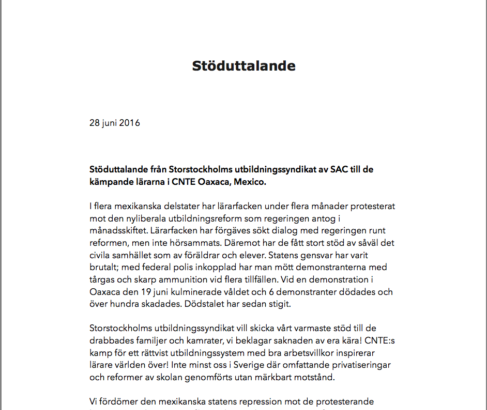
Desde Suecia, el Sindicato de Educación Storstockholms utbildningssyndikat, se solidarizó con la lucha de la CNTE y con los maestros oaxaqueños ante la represión y asesinatos de Nochixtlán.

Desde Suecia, el Sindicato de Educación Storstockholms utbildningssyndikat, se solidarizó con la lucha de la Coordinadora Nacional de Trabajadores de la Educación (CNTE) y con los maestros oaxaqueños ante la represión y muerte de manifestantes el 19 de junio en Nochixtlán, Oaxaca.

“La lucha por un sistema de educación justo con buenas condiciones de trabajo por el que lucha la CNTE inspira a los profesores de todo el mundo. Aquí en Suecia se dio una amplia privatización de la educación ya que la reforma educativa neoliberal se realizó sin encontrar mayor resistencia”: escriben los docentes de Storstockholms utbildningssyndikat y condenan la represión del Estado mexicano hacia los maestros.


Aquí el texto de su comunicado:


Declaración de apoyo del Sindicato de Educación de SAC (Suecia) a los maestros que luchan en la CNTE en Oaxaca, México.

En varios estados de México los sindicatos de maestros han por varios meses protestado contra la reforma educativa neoliberal adoptada por el gobierno al final del mes. Los sindicatos de maestros han buscado en vano el diálogo con el gobierno sobre la reforma, pero recibió un gran apoyo tanto de la sociedad civil como de los padres e estudiantes. El estado ha en lugar, por la policía federal, respondido con gases lacrimógenos y violencia en varias ocasiones. En una manifestación en Oaxaca el 19 de de junio culminó la violencia y seis manifestantes murieron y quedó más de un centenar de heridos. Desde entonces, el número de muertos se ha elevado.

El Sindicato de Educación de SAC deseamos enviar nuestro más cálido apoyo a las familias y amigos de las víctimas, lamentamos la ausencia de sus seres queridos! La lucha de la CNTE para un sistema de educación justa con buenas condiciones de trabajo inspira a los profesores de todo el mundo! No menos importante aquí en Suecia, donde una amplia privatización y reforma de la escuela se completaron sin resistencia significativa.

Condenamos la represión del Estado Mexicano contra los profesores que protestan! Las protestas sociales no aceptamos que estan criminalizadas por el estado! La lucha continúa!

Saludos cordiales,

Storstockholms utbildningssyndikat av SAC.


Fuente: http://regeneracion.mx/lucha-de-maestros-mexicanos-inspira-a-profesores-del-mundo-docentes-de-suecia/

Comparte este contenido:
Page 1454 of 1684
1 1.452 1.453 1.454 1.455 1.456 1.684