Page 733 of 1685
1 731 732 733 734 735 1.685

Marcha por la Ciencia en Washington y 200 ciudades del mundo

Estados Unidos/14 de Abril de 2018/Vonoticias

Los científicos saldrán de sus laboratorios y marcharán en Washington y más de 200 ciudades en todo el mundo el sábado para protestar por las políticas gubernamentales en temas que van desde cambio climático hasta violencia con armas que según dicen ignoran evidencia científica.

La actividad tiene lugar un año después de la primera Marcha por la Ciencia, tres meses después del inicio del gobierno del presidente Donald Trump, cuando investigadores temían que la ciencia sería dejada de lado en el fervor del presidente por eliminar regulaciones gubernamentales.

Este año, “Pienso que nuestros peores temores están dando resultado”, dijo Chris Zarba, quien se retiró en febrero como jefe del consejo asesor sobre ciencia de la Agencia de Protección Ambiental, EPA, por sus siglas en inglés. Esos paneles evalúan la evidencia que guía las decisiones sobre regulaciones ambientales del gobierno.

En octubre del año pasado, el administrador de EPA, Scott Pruitt, emitió una directiva que cambió las reglas que gobiernan la membresía en esos paneles.

Pruitt prohibió que investigadores que recibieron subvenciones de EPA. Indicó que fondos de la agencia podrían comprometer su objetividad.

Fuente: https://www.voanoticias.com/a/marcha-por-la-ciencia-washington-eeuu-epa-donald-trump/4347346.html

Comparte este contenido:

Estados Unidos: Arizona obstaculiza educación a Dreamers; quieren que paguen más por colegiaturas

Estados Unidos/14 de Abril de 2018/El Sol del Centro

La corte estatal determinó que universidades y colegios comunitarios no tengan beneficios como descuentos.

La Suprema Corte de Arizona dictaminó hoy que las universidades colegios comunitarios de la entidad no pueden otorgar colegiaturas baratas, reservadas para los residentes del estado, a los jóvenes inmigrantes indocumentados beneficiarios del programa DACA.

El tribunal emitió un breve dictamen este lunes en el que señala que susmagistrados estuvieron de acuerdo por unanimidad con la decisión expresada por la Corte de Apelaciones de Arizona.

Ésta se refiere a que las leyes federales y estatales vigentes no permiten que los Colegios Comunitarios de Maricopa otorguen colegiaturas para residentes a los beneficiarios del Programa de Acción Diferida para Llegados en la Infancia (DACA).

El dictamen precisa que una opinión completa que explicará la decisión del tribunal se dará a conocer antes del 14 de mayo. La Suprema Corte se adelantó a emitir el dictamen para permitir que los estudiantes del Colegio Comunitario de Maricopa tengan tanto tiempo como sea posible para planear, de acuerdo con la decisión.

La diferencia en el costo de las colegiaturas entre estudiantes dentro y fuera del estado en colegios comunitarios y universidades de Arizona es significativo y pudiera decidir el futuro de muchos jóvenes. Se estima que en Arizona residen unos 30 mil jóvenes beneficiarios del programa DACA.

Los estudiantes residentes en el estado pagan en la Universidad Estatal de Arizona una colegiatura de 10 mil 640 dólares este año, mientras quelos estudiantes no residentes pagan 26 mil 470 dólares.

Los residentes pagan 86 dólares por hora de crédito en los Colegios Comunitarios del Condado de Maricopa, en comparación con 241 dólares para no residentes. De acuerdo con el fallo de la Suprema Corte, los jóvenes DACA deberán pagar desde ahora la colegiatura más cara.

La ley de Arizona prohíbe los beneficios públicos, como la matrícula en el estado para estudiantes sin estatus legal, pero los beneficiarios de DACA están autorizados a permanecer y trabajar temporalmente en Estados Unidos.

La Suprema Corte de Arizona comenzó a analizar el caso luego de que una corte de apelaciones dictaminó que los colegios no podían cobrar la matrícula estatal a los jóvenes inmigrantes beneficiarios del programa DACA. Los colegios comunitarios apelaron ante la Suprema Corte.

Los colegios comunitarios y las universidades de Arizona han permitido que los beneficiarios del DACA paguen las colegiaturas como residentes del estado, mientras el caso se mantenía bajo revisión. Otras entidades cómo Texas otorgan desde hace años colegiaturas baratas de resientes a jóvenes indocumentados

Fuente: https://www.elsoldelcentro.com.mx/mundo/arizona-obstaculiza-educacion-a-dreamers-quieren-que-paguen-mas-por-colegiaturas-daca-1601312.html

Comparte este contenido:

United States: Where will the struggle lead Kentucky teachers?

United States / April 14, 2018/Socialistworker

Resumen: Las protestas representan la continua urgencia del recrudecimiento que ha convertido a Kentucky en otro sitio de las rebeliones de los maestros que barrieron al oeste de Virginia Occidental a través de estados que anteriormente se consideraban conservadores como «el país Trump»

Pranav Jani talked to Kentucky teachers on a visit to the state about how their struggle has developed–and what this weekend’s plans for more protests will bring.

KENTUCKY TEACHERS, education workers and their supporters will gather once again on April 13 and 14 for rallies at the state Capitol in Frankfort.

The protests represent the continuing urgency of the upsurge that has made Kentucky another site of the teachers’ rebellions that swept west from West Virginia through states formerly considered to be conservative «Trump country.»

At the same time, the demonstrations today and tomorrow highlight some of the dynamics and debates that teachers need to consider for the movement to succeed.

At the start of April, an estimated 12,000 teachers and supporters descended on Frankfort, sparked into rebellion specifically by a disastrous attack on public employees’ pensions passed late on March 29 under the camouflage of legislation about sewer construction.

The next morning after this late-night legislative sleight of hand, teachers–led by the grassroots group #KY 120 United–shut down schools in 20 counties through coordinated sick-outs, and many traveled to the capital to send a message to lawmakers.

The tactic of the sick-out was used effectively again on April 2 as politicians considered anti-worker budget and tax legislation. Schools that weren’t closed because of spring break in most of Kentucky’s 120 counties were shut down again, and the turnout in Frankfort was the biggest yet.

Though some educators continued sick-outs or other protests in that first week of April, many looked ahead to April 13–when the legislators’ recess ended and lawmakers would convene again–as the next date for a mobilization.

Developments between April 2 and April 13 highlight the questions that need to be addressed if the movement that shook Kentucky at the start of the month is going to be able to break the stranglehold on public education that is choking teachers, education workers, students and parents.

Above all, the need for a united mobilization of teachers–which was the basis for putting pressure on the legislature last week–is clear.

IN MY trip to Kentucky on April 9 and in conversations over the last two weeks, I’ve had the opportunity to speak with teachers who are in the thick of the struggle, parents and activists who are building solidarity, and supporters who understand its historical impact.

These individuals’ dedication to local organizing and the long-term struggle bodes well for the movement. At the same time, people spoke of the challenges they face–from the actions of politicians and school officials, but also debates within the movement–as they try to continue a struggle that has been months and months in the making.

All this has made for a complicated picture in the period between April 2 and April 13–when work stoppages have been attempted, but not continued; when the politicians have been forced to shift, but have slithered into new positions; and when grassroots groups have been built, but have had to fight hard to stay unified.

As we know from history, no movement or struggle ever develops evenly, going from advance to advance.

The situation in Kentucky is complicated by dynamics that will be familiar from past struggles: debates over what to do next when pressure on lawmakers isn’t enough; discussions about whether or not to strike; the complications of people in different communities with different considerations needing to figure out how they can speak with one voice.

As in all struggles, there’s an ongoing debate about the politics and aims of the movement.

As James Miller, a teacher at duPont Manual High School in Louisville said, some people are fighting only to stop the attack on teachers’ pensions or head off measures to undermine public education–whereas others, including himself, want:

to seize this opportunity to demand significant improvements to public education instead of merely defending the status quo. We want to protect our students by demanding the elimination of legislation that would further criminalize Black and Brown youth and an end to zero-tolerance policies. We want to protect our students’ families by opposing regressive sales taxes and flat taxes.

More than 3,000 people have signed a petition created by Miller that ties the fight for schools to the larger struggle for social justice.

Teachers of all views are still in motion to put forward their grievances–and they know they have the support of many people around them.

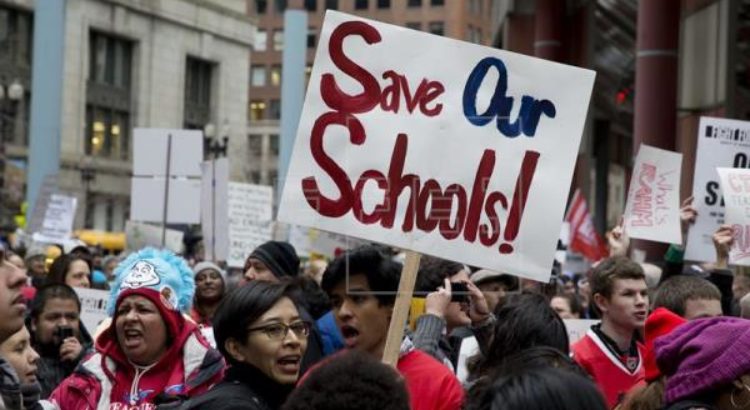
Krystal Spencer, with Save Our Schools Kentucky and one of the organizers of the rallies on April 13 and 14, says she’s confident that the rallies will be big, «hopefully bigger than [April 2].»

Citing the many groups that are coming together–including Indivisible, Planned Parenthood, Kentuckians for the Commonwealth, and university groups–Spencer noted how many of these organizations don’t represent teachers, but are participating.

Meanwhile, I heard reports of radicalized teachers who are calling off work this Friday and sending delegations to Frankfort–while working patiently with local groups in their schools who aren’t ready for a strike and have never heard the word «wildcat,» but remain very curious about the strategy.

THE LEGISLATIVE details in Kentucky are complicated, but they are important for understanding the strategic obstacles that teachers have to face.

Even as protesters were leaving the statehouse after their biggest demonstration on April 2, the Republican-led legislature passed a budget bill and a tax «reform» bill that are anti-worker and anti-poor. Yet the GOP claims the balance between the two would benefit education.

The legislature put these bills on the desk of Gov. Matt Bevin, a Tea Party favorite, and then left for a short recess until April 13.

Several teachers’ groups aimed to continue the momentum generated by April 2, with calling sick-outs, grassroots food drives and marching through their towns. But the Kentucky Education Association (KEA) send out a memo to members saying that the union didn’t support work stoppages at this time, and everyone should look to April 13.

On April 6, for example, the union issued a statement that, unfortunately, echoes some of the rhetoric that education bosses use against all teachers’ strikes: «Our students need us to show up for them in classrooms and schools. We urge educators statewide not to allow our united efforts to be compromised by continued calls for action that deprive students, parents and communities of the educational services we provide.»

Meanwhile, between April 2 and April 13, crafty Republican politicians and their ruling-class masters were busy creating a lose-lose situation for those seeking a legislative solution to the attack on education and the social crises in Kentucky–while adding lots of confusion to the process.

On April 9, Bevin vetoed the budget and tax bills put forward by his own party, stating that he wants more «comprehensive tax reform» and a «balanced budget»–code words for deeper tax cuts for the wealthy and austerity for the 99 Percent. This set up a challenge to the legislature to try to override the vetoes on April 13 and 14. Bevin signed the pension bill that sparked the teachers’ uprising.

The Democratic minority in the legislature, which has religiously opposed Bevin, supportshis vetoes and will vote against overriding them, on the basis that they are opposed to the budget and tax bills that passed.

On the other hand, the KEA and its affiliates have called for Bevin’s vetoes to be overridden–a de facto defense of the Republican legislature’s bills.

The logic of the position was explained in a statement from the Jefferson County Teachers Association (JCTA), which contended that, while the union «does not agree with some of the regressive ways the revenue bill generates new revenue, but without a revenue bill, Kentucky will lose hundreds of millions of dollars in funding for public education.»

The unions are right that Bevin vetoed these bills from the right, not the left. But it seems problematic to accept the original legislation, which are clearly regressive and harmful in various ways, as a kind of lesser evil.

Indeed, as so many teachers and supporters expressed in face-to-face discussions, what galvanized them to take action is the general and ongoing attack on education in the midst of a deep social crisis in Kentucky–not a dispute between two versions of budget cuts, two versions of tax cuts for the rich, and two versions of tax hikes that hit poor and working people.

EVEN ACTIVISTS who have organized outside the KEA have debated what path to follow in this confusing situation.

Internal discussions within the #KY 120 United this week revealed disagreement about whether or not to call for work stoppages, and whether or not to settle for the legislature’s original budget and tax bills.

Most of the teachers and others I met remained sympathetic to both the KEA and KY 120 United, even if they disagreed with the positions they have taken regarding the legislation.

After Bevin’s open and disparaging attacks on KEA as «a problem,» there was no question about this–even when one teacher defending the KEA against Bevin said she wished they would be «more of a problem.»

Thus, people who are part of KEA, KY 120 United and school-specific groups, many at the same time, are seeking for teachers to figure things out together as part of a longer struggle against a tough set of opponents. Perhaps some of the momentum of April 2 has fallen off, and no one wants to be pushed into choosing between Republican Plan A and Republican Plan B.

Plus, if we look at what teachers and supporters did accomplish in the «in-between» period, it’s clear how powerful the movement is at the grassroots level. With many teachers not being sure about an ongoing strike, a preparation period may have been exactly what was needed.

In Jefferson County–the state’s most populous county that includes Louisville and the surrounding area, there was an attempt to close schools through sick-outs on April 9, though participation wasn’t strong enough to shut down the schools.

In Pike County in eastern Kentucky, along the border with West Virginia, teachers laid out a week of actions leading up to April 13, including pressuring the Chamber of Commerce for supporting the pension bill.

FOR TEACHERS and activists I met from Northern Kentucky and Lexington, the «in between» meant local meetings with activists, talking to parents about the importance of taking action, and working with others to discuss building solidarity.

«Teachers in my building are hungry for info and action in a way they haven’t been before,» said Molly Seifert, a teacher at Beechwood High School in Northern Kentucky. Seifert noted that the organizing meetings she was part of now drew about 10 times more people than KEA meetings months before.

«I’m advocating for ‘the Pike County plan’ for the rest of the week: local action and then Frankfort on Friday,» Seifert said. «I’m also advocating for a long-term group like this that meets regularly and builds on this momentum.»

Laura McMullen, a teacher at Holmes Middle School in Covington, said: «We were ready last week, and we’re still ready.»

McMullen described the impact of the social crisis, especially in poor schools like hers:

Our class sizes are already at cap. So with all of these resources being pulled, and teaching a group of 31-32 kids, how can I ensure that all their needs are getting met, that their IEPs (Independent Education Plans) are being followed…Our school has a very high rate of special needs kids, and our transience rate is very high, with so many kids homeless at any given time.

So when they cut funding for those kids, for after-school programs, for extracurriculars, what are they going to do? We feed kids breakfast, lunch and dinner–where are those kids going to get that? Busing is very expensive–we have no way to bus these students. If the goal isn’t to bankrupt public schools, then I’m not really sure I know what it is.

Rose Curtin, a parent in the Newport Independent Schools system and member of a local School-Based Decision-Making Council and a Family Resource Center board, explained how poorer, non-white schools would be particularly devastated by the legislation being considered:

I’ve served on hiring boards, and I already know how hard it is to hire teachers to come into a high-poverty, urban school where there are a lot of challenges, and I strongly believe that this is meant to target those places first.

Because Fort Thomas schools are not going to have a hard time, with a wealthy tax base and a lot of extra support. They’re not going to struggle to get new teachers the way that I suspect we in Covington and Newport are going to in order to get people to come in, especially if there’s no pensions and they have significant student debt burdens.

THE EFFORTS of Kentucky activists to build solidarity is inspirational–and exactly what will be required to combat a social crisis with no real legislative solution in sight.

In Seifert’s region, KY 120 United made «plans of reaching out to parents in meetings at local libraries,» she said. «For the first time in my 17 years of teaching, activists from Boone County, Kenton County, Dayton Independent, Beechwood and Covington Independent are working together on a project like this.»

Curtin, who is also a member of the Democratic Socialists of America’s Metro Cincinnati and Northern Kentucky branch, heads up the Kentucky Teachers Strike Fund, to organize concrete solidarity should educators decide to walk out.

From the experience of a family member who lost her job after participating in a strike, Rose is aware of «just the amount of work that a work stoppage is [and] the financial and emotional effects that it has.» The fund, organized jointly by four DSA chapters across Kentucky, was formed after consulting with DSA members in West Virginia who had set up a similar fund for a coalition of groups.

Drew Van’t Land, an organizer for the Kentucky Workers League in Lexington, talked about organizing solidarity through helping working-class parents who might have trouble with childcare, and helping to «combat the narrative that their interests are somehow not aligned with those of the teachers.»

Everyone I talked to, even if skeptical about the future given the difficulty of the task before Kentucky teachers, underlined the gains that the struggle had already made.

Geoff Sebesta of the Lexington DSA said that teachers’ self-organization and solidarity had contributed to «the legislature being clearly scared as hell.»

«The floodgates have been opened by what’s happened in West Virginia,» said Drew Gerbel, the sibling of a teacher and an activist in his own right. «The example has been set. Look what power exists in the working class. But I don’t think people realize it 100 percent yet.»

It does take time for people across a whole state and with so many different circumstances and ideas to realize that strength–and there are no guarantees that the teachers will be able to win what they are fighting for.

But with all that remains to be done, something fundamental has already been gained. As Miller said to me:

There are too many unknowns to predict the future….But one thing will not change: Kentucky teachers are angry, and they will not be easily placated.

Already dozens of Kentucky educators have registered to run for state and local offices in campaigns specifically targeting incumbents who voted in favor of the governor’s anti-public education agenda. Already hundreds of Kentucky teachers have repeatedly swarmed the state Capitol in rowdy protests. Already thousands of Kentucky teachers have participated in a wildcat sick-out strike.

The future is unpredictable, but it will belong to us.

Fuente: https://socialistworker.org/2018/04/13/where-will-the-struggle-lead-kentucky-teachers

Comparte este contenido:

Estados Unidos: Donald Trump ordena un ataque contra Siria

Estados Unidos/14 de Abril de 2018/El Nuevo Día

El presidente de Estados Unidos tomó la acción en conjunto con Francia y Reino Unido.

Estados Unidos lanzó «ataques de precisión” contra blancos asociados con el programa de armas químicas de Siria, confirmó esta noche el presidente Donald Trump.

En un discurso pronunciado desde la Casa Blanca, Trump dijo que una “operación combinada” con Francia y Reino Unido está en curso.

La acción bélica que tomó el primer ejecutivo se debe a que el sábado pasado el presidente sirio Bashar Assad llevó a cabo una “significativa escalada de un patrón de uso armas químicas por parte de ese terrible régimen”.

Trump aseguró que Estados Unidos no busca con este ataque «una presencia indefinida» en Siria y prometió que retirará sus tropas una vez que el Estado Islámico sea totalmente derrotado.

Pidió, además, una «oración por nuestros nobles guerreros» que participan de la operación contra el régimen sirio al concluir su mensaje.

Mientras daba su mensaje desde Washington, fuertes explosiones iluminaban el cielo de la capital siria mientras. Poco después, la agencia estatal siria, SANA, aseguraba que las fuerzas de defensa aérea del país «están haciendo frente al ataque estadounidense-franco-británico contra Siria».

En referencia a Rusia e Irán, Trump preguntó: “¿Qué tipo de nación quiere asociarse con el asesinato masivo de hombres, mujeres y niños inocentes?”.

“Esta noche, les pido a todos los estadounidenses que recen por nuestros nobles guerreros y nuestros aliados mientras llevan a cabo sus misiones. Oramos para que Dios traiga consuelo a los que sufren en Siria”, dijo el presidente.

Esta es la segunda ocasión en que Trump ordena ataques en Siria. En abril de 2017 autorizó el lanzamiento de misiles Tomahawk contra una base aérea siria en represalia por el uso de gas sarín contra civiles por parte de Assad.

https://youtu.be/8PDgOQtPRDI

De inmediato, Mac Thornberry (Texas), el presidente del Comité de Fuerzas Armadas de la Cámara de Representantes, apoyó la decisión de Trump.

«El uso que hace Asad de armas químicas contra civiles inocentes es inaceptable. Igualmente preocupante es que ese ataque es parte de una tendencia en el uso de armas químicas por todo el mundo, con el  apoyo de  Rusia. Estados Unidos y nuestros aliados no pueden tolerar estos ataques. Apoyo la decisión del Presidente de llevar a cabo esta huelga junto con nuestros aliados. Sigue habiendo preguntas difíciles sobre el futuro de nuestra política en Siria, pero esas preguntas no deberían restar justicia a las acciones de esta noche», dijo el republicano.

Por su parte, el vicepresidente estadounidense, Mike Pence, abandonó hoy prematuramente la ceremonia de inauguración de la VIII Cumbre de las Américas y regresó a su hotel en Lima, mientras la prensa especulaba sobre el posible anuncio de Washington relativo a Siria.

Pence, quien debía asistir a la ceremonia de inauguración y después a un banquete, se dirigió a su hotel poco después de llegar al Gran Teatro Nacional de Lima, mientras la Casa Blanca convocaba en Washington a los periodistas sin dar más explicaciones.

Trump se reunió hoy con su equipo de Seguridad Nacional para evaluar su respuesta al presunto ataque químico del pasado fin de semana en Siria, al que había prometido responder de forma «contundente» y probablemente por la vía militar.

Fuente: https://www.elnuevodia.com/noticias/eeuu/nota/donaldtrumpordenaunataquecontrasiria-2414562/

Comparte este contenido:

La película Indian Horse profundiza en la oscura historia de las escuelas residenciales de Canadá

La película sobre un sobreviviente de la escuela residencial Ojibway es producida por Clint Eastwood

América del Norte/Canada/www.cbc.ca

Indian Horse se basa en la aclamada novela del autor canadiense Richard Wagamese sobre un sobreviviente de la escuela residencial Ojibway que enfrenta el racismo y las barreras sistémicas a medida que se convierte en un formidable jugador de hockey. (Devonshire Productions)

Cuando el director canadiense Stephen S. Campanelli mostró su nueva película Indian Horse  a su mentor, Clint Eastwood, el cuatro veces ganador del Oscar no estaba seguro.

En los cines el viernes, el drama se basa en la aclamada novela del escritor canadiense Richard Wagamese, sobre un sobreviviente de una escuela residencial de Ojibway que enfrenta el racismo y las barreras sistémicas a medida que se convierte en un formidable jugador de hockey.

La historia ofrece una visión clara de la historia brutal del sistema de escuelas residenciales en Canadá, y Eastwood fue derribado.

«No lo creía», recordó Campanelli, que creció en Montreal y vive en California, en una entrevista en el Festival Internacional de Cine de Toronto, el pasado septiembre.

«Él estaba como, ‘¿Qué? ¿Los canadienses hicieron esto?’ Dije: «Sí, créelo o no». Él dijo: ‘¿Cómo es que nadie sabe sobre esto?’ Yo dije: ‘Bueno, lo harán pronto’ «.

Eastwood luego firmó como productor ejecutivo para ayudar a promocionar la película.

Una historia que abarca 30 años

«Él dice: ‘La gente necesita ver esta película'», recordó Campanelli, quien ha trabajado con Eastwood como operador de cámara durante más de 20 años.

Los canadienses Sladen Peltier y Ajuawak Kapashesit, junto con el actor estadounidense Forrest Goodluck, retratan al protagonista Saul Indian Horse en tres etapas diferentes de su vida.

La historia abarca 30 años, ya que sigue el viaje angustioso de la familia de Saul y sus experiencias a fines de la década de 1950 en una escuela residencial católica de Ontario, donde los estudiantes enfrentaron abusos y se vieron obligados a abandonar su propio idioma y cultura.

Clint Eastwood firmó como productor ejecutivo de Indian Horse luego de que el director Stephen S. Campanelli le mostrara la película. (Vince Bucci / Associated Press)

Saul se enseña a sí mismo a jugar al hockey y se mueve en las filas del deporte, pero después de una serie de ataques racistas contra él, se da por vencido y tiene que enfrentar su doloroso pasado.

«Creo que una película como esta realmente ayudará a mucha gente a entender, porque en realidad no saca muchos golpes, pero sigue siendo muy cinematográfica», dijo Kapashesit, que es de herencia Ojibway y Cree y nació en Moose. Fábrica, Ont.

«Creo que esta película va a abrir las compuertas de verdades en términos de la historia de este continente», agregó Goodluck, que es miembro de las tribus Dine, Mandan, Hidatsa y Tsimshian y tiene su sede en Albuquerque, Nuevo México.

Dennis Foon escribió el guión de la película, que se rodó en las frías temperaturas invernales y en terrenos abruptos en Sudbury, Ontario, y Peterborough, Ontario.

Los personajes hablan el idioma Ojibway, que se traduce en subtítulos.

Otros miembros del elenco incluyen a la recién llegada Edna Manitowabi, quien interpreta a la abuela de Saul y es una sobreviviente de la escuela residencial.

«No es común que obtenga papeles como este que sean muy veraces y no sean de ninguna manera explotadores», dijo Kapashesit, y señaló que su abuelo y otros miembros de su familia fueron a escuelas residenciales.

«Mantener la conversación en marcha»

Campanelli dijo que el objetivo era mantener las raíces del libro y sus orígenes indígenas y «no hollarizarlo».

Al mismo tiempo, quería darle «una apariencia de gran presupuesto y no hacer que se vea como una pequeña pequeña película canadiense».

«Nuestro mayor objetivo para esta película es mantener la conversación», dijo Campanelli, «para poder darles a las personas una opinión que diga: ‘Wow, no puedo creer que esto haya ocurrido. ¿Cómo puedo ayudar?’ Tengamos una llamada a la acción, hagamos algo al respecto, enloquezcamos, llamemos al gobierno o lo que podamos hacer para ayudar a que continúe así «.

«Porque va a tomar un tiempo. La reconciliación no es algo rápido. Va a tomar el esfuerzo de todos para que funcione».


Fuente: http://www.cbc.ca/news/entertainment/indian-horse-canada-dark-history-1.4614448
Comparte este contenido:

México: Maestros deben tomar decisiones sobre calidad educativa: Martha Araiza

América del Norte/México/20minutos

La candidata a la gubernatura de Jalisco por el partido Nueva Alianza, Martha Rosa Araiza Soltero, manifestó hoy que las decisiones sobre la calidad educativa las deben tomar los maestros. Así se… La candidata a la gubernatura de Jalisco por el partido Nueva Alianza, Martha Rosa Araiza Soltero, manifestó hoy que las decisiones sobre la calidad educativa las deben tomar los maestros.

Así se expresó tras rechazar la propuesta realizada por otro aspirante a la gubernatura, quien se pronunció por involucrar en el esquema de la educación «a una de las instituciones que se ha caracterizado por sus intenciones de privatizar la educación, en detrimento de la educación pública, laica, gratuita y de calidad». La abanderada del partido Nueva Alianza puntualizó que «las decisiones sobre la calidad educativa las tomamos los maestros, los padres de familia y los alumnos».

«Me sorprende escuchar que otro candidato está empoderando a organismos civiles al respecto de la educación», manifestó. Subrayó que los candidatos de Nueva Alianza están a favor de tener escuelas dignas, «en donde sus espacios sean confortables, con plantillas completas de maestros; que a los docentes se les cumpla, porque al magisterio se le debe mucho».

Ver más en: https://www.20minutos.com.mx/noticia/354134/0/maestros-deben-tomar-decisiones-sobre-calidad-educativa-martha-araiza/#xtor=AD-1&xts=513356


Comparte este contenido:

EEUU: Oklahoma Teachers Begin 110-Mile March To Protest Education Funding

América del NOrte/EEUU/huffingtonpost.com

Resumen: Los educadores en Oklahoma están dejando claro que no se dan por vencidos en su lucha por el aumento de los fondos de las escuelas públicas. El miércoles, más de 100 personas salieron de Webster High School en Tulsa en un  viaje de siete días al Capitolio estatal en Oklahoma City para exigir mayores presupuestos de educación. «Estamos dispuestos a caminar 100 millas para nuestros estudiantes «, dijo Patti Ferguson-Palmer, presidenta de la Asociación de Maestros del Aula de Tulsa, a The Tulsa World. «¿Qué está dispuesto a hacer la Legislatura de Oklahoma? No todos somos jóvenes y en forma «. El miércoles marcó el tercer día consecutivo que los maestros de Oklahoma y sus seguidores han protestado por años de recortes profundos y recortes salariales para los educadores. El lunes, los maestros de todo el estado protagonizaron una revuelta masiva cuando salieron de las escuelas, con muchos  enjambrando al edificio del Capitolio en Oklahoma City. «¿Por qué estamos caminando?», Preguntó Alicia Priest, presidenta de la Asociación de Educación de Oklahoma, el lunes. «Hay 700,000 razones por las cuales: nuestros estudiantes. Y se merecen algo mejor. … Ven sillas rotas en clase, libros de texto obsoletos pegados con cinta adhesiva y tamaños de clase que se han disparado «. Miles de maestros  dejaron de trabajar el martes, y muchos distritos escolares anunciaron que permanecerían cerrados por al menos el resto de la semana. «Oklahoma es mejor que esto, y los educadores continuarán caminando hasta que lleguemos a un acuerdo que nuestros estudiantes se merecen», dijo Priest. Mientras tanto, la gobernadora republicana Mary Fallin comparó a los maestros que desean mejores recursos con » un adolescente que quiere un auto mejor». «


Educators in Oklahoma are making it clear they aren’t giving up in their fight for increased public school funding.

On Wednesday, more than 100 people set out from Webster High School in Tulsa on a seven-day trek to the state Capitol in Oklahoma City to demand bigger education budgets.

“We are willing to walk 100 miles for our students,” Patti Ferguson-Palmer, president of the Tulsa Classroom Teachers Association, told The Tulsa World. “What is the Oklahoma Legislature willing to do? We are not all young and fit.”

Wednesday marked the third day straight that Oklahoma teachers and their supporters have protested years of deep cuts and salary slashes for educators.

On Monday, teachers across the state staged a massive revolt when they walked out of schools, with many swarming the Capitol building in Oklahoma City.

“Why are we walking?” Alicia Priest, Oklahoma Education Association president, asked on Monday. “There are 700,000 reasons why: our students. And they deserve better. … They see broken chairs in class, outdated textbooks that are duct-taped together, and class sizes that have ballooned.”

Thousands of teachers were off the job again on Tuesday, with many school districts announcing they would remain shut down for at least the rest of the week.

“Oklahoma is better than this, and educators will continue to walk out until we get a deal that our students deserve,” Priest said.

Meanwhile, Republican Gov. Mary Fallin compared teachers wanting better resources to “a teenager wanting a better car.

Comparte este contenido:
Page 733 of 1685
1 731 732 733 734 735 1.685