
Por: Michael Zimmerman
En los últimos meses, el Evergreen State College ha sido promovido como el ejemplo arquetípico de los problemas asociados con la corrección política corrompida. Los videos de los estudiantes y miembros de la facultad que usan lenguaje sucio y abusan de los miembros de la comunidad compañeros se han vuelto virales. Las imágenes fijas de los estudiantes que manejan los murciélagos del béisbol y que actúan como fuerza de policía del vigilante se pueden encontrar en todas las esquinas del Internet. Las imágenes de decenas de miembros armados de la Patrulla del Estado de Washington, vestidos con equipo antidisturbios, patrullan el campus ofrecen una mirada aterradora a lo que sucede cuando los administradores del campus pierden el control de una universidad.
In recent months, The Evergreen State College has been promoted as the archetypal example of the problems associated with political correctness run amok. Videos of students and faculty members using foul language and abusing fellow community members have gone viral. Stills of students wielding baseball bats and acting as a vigilante police force can be found on all corners of the internet. Images of scores of armed members of the Washington State Patrol, clad in riot gear, patrolling campus offer a frightening look at what happens when campus administrators lose control of a college.
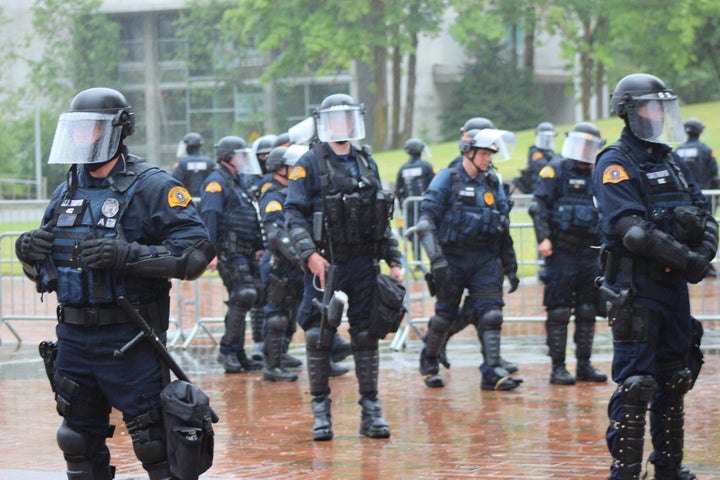
With a bit of distance, it is well worth looking back and asking what can be learned from this situation. Were conditions at Evergreen so idiosyncratic that any knowledge gleaned has only local value or might Evergreen’s situation provide us with a broader perspective on the current state of higher education? I believe the latter is the case and that therefore it is worth exploring two closely linked facets of the Evergreen experience: the cause of the uproar; and campus leadership.
The story that’s being promoted everywhere is that one faculty member’s resistance to Evergreen’s 2017 incarnation of its “Day of Absence” is at the center of the turmoil. In 2017, instead of people of color voluntarily absenting themselves from campus for a day to demonstrate the importance they play in the community, as had been the case for many years, white individuals were encouraged to leave campus. In mid-March Professor Bret Weinstein argued that:
There is a huge difference between a group of coalition deciding to voluntarily absent themselves from a shared space in order to highlight their vital and under-appreciated roles (the theme of the Douglas Turner Ward play, Day of Absence, as well as the recent Women’s Day walkout), and a group or coalition encouraging another group to go away. The first is a forceful call to consciousness which is, of course, crippling to the logic of oppression. The second is a show of force, and an act of oppression in and of itself.
The implication has been that Professor Weinstein’s comments were so outlandishly racist that people caring about social justice had to rise up and call for his dismissal from his faculty position. If that were the case, however, the question must be asked why it took until 23 May, over two months after his note was disseminated, for the protest to occur. The Day of Absence itself occurred over one month prior to the protest. And, of course, all of this ignores the fact that Professor Weinstein’s note was simply and strongly presenting an alternative perspective to the structure proposed for the Day of Absence while affirming the power and importance of the original configuration as a way of combatting racism.
The reality of what occurred is far more complex, and, in fact, far more insidious than the caricature presented in most media reports. Regardless of what some would have us believe, the exclusion of white people from campus was not a mandate; no one was required to leave. But the pressure for white individuals to leave campus, to demonstrate that they were good allies to people of color, was very real. And many, students, faculty and staff alike, were confused by the structure of the day. How could they not be confused? Consider parts of just three of many notes that were sent to all faculty and staff members prior to the Day of Absence by supporters of the event:
- I feel strongly about honoring the call for white-identified people to absent themselves from campus…
- This change to DOA/DOP [Day of Absence/Day of Presence] this year (where allies travel off campus and POC [people of color] stay on campus) is beautiful.
- I think the role reversal of this year’s DoA is brilliant in that it encourages Evergreen’s white population to take accountability for their active participation in unlearning racial prejudice in a way that staying on campus wouldn’t.
So why was Professor Weinstein the epicenter of the student protest and why did it occur when it did, so long after he offered his critique of the Day of Absence?
The answer to the first question revolves around the unique role that Professor Weinstein has played on campus during his time on the faculty. As much as it might like to think of itself as an open and tolerant environment, Evergreen isn’t very accepting of voices that question the Evergreen orthodoxy. While this might be seen as a terribly ironic situation for a liberal arts college to find itself in, this has been the Evergreen reality for quite some time and the result is that a large number of faculty members, perhaps the majority of them, simply absent themselves from most discussions. Professor Weinstein is not one of those who have opted for self-censorship. He has always been willing to ask questions, to point out what he sees as flaws in ideas, and to offer suggestions for improvement.
He has played that role to a great extent and to the frustration of many this academic year, a year almost completely focused on the twin concepts of equity and inclusion on campus. Indeed, George Bridges, Evergreen’s relatively new president, reformulated a college-wide Equity Council and provided them with a very wide charge. The group consisted of 28 members, six of whom were current faculty members and they set to work to outline a strategic equity plan.
The Council created a plan without any public input and scheduled a meeting in the middle of November to present it to the campus community having announced that it had already received the blessing of President Bridges. The plan, as presented, was built on a statistical analysis of retention, achievement and graduation data and proposed to make significant changes to faculty hiring practices as well as to the structure of the curriculum. The meeting offered no opportunity for open discussion of the plan and was structured as an opportunity to celebrate the plan’s creation. Building on the region’s Salish culture, the meeting concluded with attendees being asked to metaphorically climb into a canoe to embark on a journey to equity. The implication was that if people failed to board the canoe, they would be left behind. Indeed, the sentiment was expressed by some that if you were unwilling to get on board, perhaps Evergreen was not the place you should be working.
Professor Weinstein responded in an email by raising some questions but, more importantly, calling for open discussion of the ideas, strategies and directions outlined in the plan. He did so carefully and politely, never once criticizing any individual. Consider, as an example, the following from one of Professor Weinstein’s early emails:
Maybe it isn’t mine to say because the canoe isn’t from my culture, but this canoe metaphor felt like it was appropriated for the ironic purpose of cloaking an unstoppable train. You are either onboard, or you are not. You can attempt to derail this proposal, or you can accept where the train is going.
From what I have read, I do not believe this proposal will function to the net benefit of Evergreen’s students of color, in the present, or in the future. Whatever type of vehicle it is, I hope we can find a way to discuss this proposal on its merits, before it moves farther down the line.
In response, he was branded a racist and an obstructionist. A faculty member who sat on the Equity Council explicitly called him a racist in two different faculty meetings. When Professor Weinstein asked for an opportunity to defend himself, he was told that a faculty meeting was not the appropriate venue for such a defense. When he asked what the appropriate venue was, he was told that no such venue existed because he was a racist. Neither the president nor the interim provost interceded to make it clear that leveling such charges against a fellow faculty member was unacceptable within the college community. When Professor Weinstein spoke privately with both of those administrators about these incidents, they both acknowledged the inappropriateness of the behavior but each said that it was the responsibility of the other to do something about it. Neither administrator took any public action in response.
But even that tells only part of the story. As mentioned above, the Equity Strategic Plan was built on a statistical foundation. When the validity of that foundation was called into question, including by a robust analysis by an Evergreen alum currently in graduate school, the same faculty member who publicly called Professor Weinstein a racist began attacking scientists generally claiming that their reliance on data was dismissive of the concerns of students. President Bridges, upon being presented with the alum’s statistical critique, promised a response but none has been forthcoming.
Despite all of this, Professor Weinstein continued to call for open discussion of the strategic plan with no response other than personal attacks on him being ratcheted up. It became clear why Professor Weinstein’s appeal for dialogue drew such enmity when the same faculty member who publicly called him a racist was reported to have said that the Equity Council didn’t want such discussion because the plan might not survive such scrutiny intact. A number of senior administrators voiced the same fear with one going so far as to say that expecting a public review of the plan after it had been approved by the Equity Council which had so many people of color on it was an example of white supremacy.
Although Professor Weinstein had a fair number of colleagues supporting him behind the scenes, his was the main voice heard on campus. His voice was neither strident nor impolite but it was relentless. And its dominant message was a plea for discussion. On the few occasions when he raised any specific objections to the plan, he did so by arguing that he thought the proposed action would actually harm rather than help students of color. In an environment where you were either on the equity canoe or you were lost at sea, Professor Weinstein’s voice was seen by many as a disruptive force that needed to be silenced which explains why he became the center of attention once the protests began.
But none of that explains why the protests occurred when they did. For that we need to go back to the beginning of the 2016-17 academic year. Evergreen’s academic year begins with an all-campus convocation. That event includes a talk by the author of a book all incoming students read over the summer. This year a number of students attempted to take over convocation and refused to permit the speaker to address the campus community. President Bridges managed to convince the students that they’d have a chance to be heard after the College’s invited guest spoke. Afterwards, the president sent out a note to the full campus community apologizing for his actions saying that he should have let the students speak when they wanted – that their voices were every bit as important as that of the author of the common read.
Fast forward to the day following the 2016 presidential election. Two campus events were scheduled for that day: a board of trustees meeting; and the dedication of the newly remodeled and renamed Purce Hall. Students upset by the election surrounded the trustees and berated them for their racist attitudes. The meeting was cancelled and hours later the building dedication was similarly disrupted – despite the fact that Purce Hall was named for Evergreen’s immediately preceding president, an African American who served as president for 15 years. Despite the chaos associated with both events, no students were brought up on disciplinary charges.
Fast forward to the installation of Evergreen’s new police chief, Stacy Brown, herself a graduate of Evergreen, early in winter quarter. This event, too, was disrupted by students and during the disruption the vice president for student affairs was pushed and a microphone was wrestled from her hands. She was almost knocked to the ground by two students. Because of the way the vice president was treated, disciplinary proceedings commenced against the two students who pushed her. No other student faced disciplinary consequences for the disruption.
Fast forward to the week prior to the protests. There was an ongoing, mostly online discussion among students about limiting a program to be taught the following fall to students of color. One student objected asking how it would appear if the reverse were ever to be the case; if a program were to be limited to white students. (The program in question was to be taught by the faculty member who publicly called Professor Weinstein a racist.) The student raising the objection received a good deal of abuse and then, he claimed, he was physically confronted in the cafeteria. This student, himself a student of color, went to the campus police department to file a complaint against the two students he said assaulted him. The police began an investigation later that evening and one of the students interrogated was the leader of the protest that soon followed. Given that one of the complaints raised by the protestors was that the police were targeting certain individuals, black trans students in particular, and given that the students accused of pushing the vice president and accosting the student in the cafeteria were black trans individuals, it seems reasonable to assume that the protests were, in part, designed to deflect unwanted attention for possibly inappropriate actions.
It’s also worth exploring the climate in which the Evergreen student protesters were immersed, a climate that encouraged their behavior. A series of anecdotes will make my point.
Let’s begin with the faculty member who publicly called Professor Weinstein a racist. On 14 November, two days prior to the meeting at which the Equity Council’s strategic plan was released, she made the following post on Facebook: “SERIOUSLY JUST BE QUIET. ONLY APPOINTED/APPROVED WHITES CAN SPEAK (AND ONLY WHEN SPOKEN TO). When that post, a post by a member of the Equity Council, was brought to the attention of President Bridges, he opted to do nothing publicly.
An even more disturbing Facebook post by this faculty member generated no response from the administration but actually gained defenders from the faculty ranks. The post was in response to a note written by Professor Weinstein’s wife, Heather Heying, also a faculty member at Evergreen. After Professor Weinstein was warned by Evergreen’s police chief to stay away from campus because his safety couldn’t be guaranteed, and after administrators were held hostage in their offices by a student group, the interim provost wrote a note saying that if anyone felt unsafe, they should come and speak with him or one of the deans. Professor Heying thought this note was both insensitive and disingenuous since obviously her husband was unsafe in the eyes of the police chief and he was advised against setting foot on campus. The faculty member responded to this note by posting this on Facebook: “Oh lord, Could some white women at Evergreen come and collect Heather Heying’s racist ass. Jesus”
Administratively, Evergreen has an uncomfortable relationship with the concept of free speech, especially for a liberal arts college and even more so for a public institution. A year and a half ago, long before the current protests, the vice president for student affairs and another senior administrator were going around campus removing posters they felt would make people uncomfortable. The posters neither incited violence nor constituted hate speech, but in the eyes of those administrators, they deserved to be censured.
The response made by the vice president for student affairs when student protestors were roaming the campus armed with baseball bats and tasers made it clear that differences of opinion could be frightening. She wrote to students living in the residence halls, in part:
We are aware of a small group of students coordinating a community patrol of housing and campus. We acknowledge and understand the fear and concerns that are motivating these actions. We also understand that these students are seeking to provide an alternative source of safety from external entities as well as those community members who they distrust.
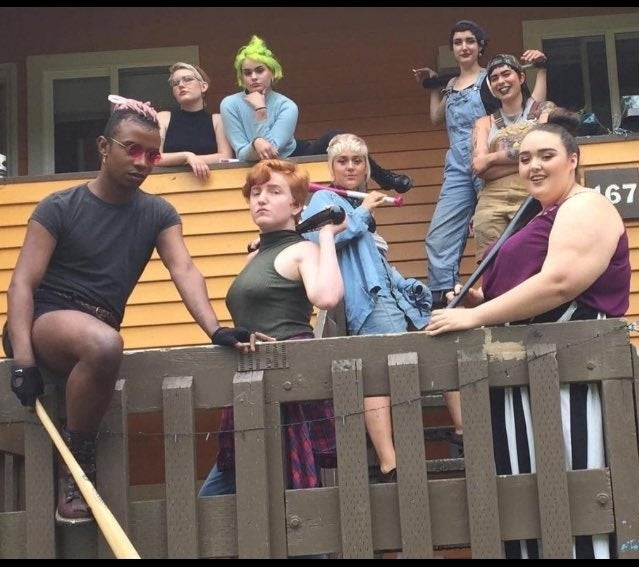
Yes, she went on asking students to put down their baseball bats (“Community patrols can be a useful tool for helping people to feel safe, however the use of bats or similar instruments is not productive.”) but simply giving credence to the idea that the presence of fellow students not involved in the campus protest could warrant a “community patrol” is troubling.
An event that occurred the week following the student protests provides yet another example of what free speech means on the Evergreen campus. Unrelated to any of the activities that had taken place, a small group of Christian fundamentalists came to campus, as they do every year and as they do on virtually every campus, and began reading Bible verses. The following paragraph comes from a note the vice president for student affairs sent the campus community praising the community’s response to these visitors: “During the counter-demonstration many of the students who engaged did so in reasonable ways to respond to the speech of the demonstrators that they found objectionable and hurtful.” What were the “reasonable ways” students responded. The videos of the incident show students surrounding those preaching and shouting at them, making it impossible for anyone to hear what they were saying.
The administrative message from all of this is very clear: freedom of speech is only for speech with which you agree and aggressively silencing those with whom you disagree is fair game.
Given all of this, can there be any surprise that students acted as extremely as they did? Given their role models, can there be any surprise that they refused to let President Bridges speak, even when they asked him a direct question? Given that, very early in the process, President Bridges used foul language when discussing Professor Weinstein with students (and then immediately said, “Don’t put this on tape!), can there be any surprise that students used similar language in response? Given that President Bridges praised them for their courage for demonstrating, capitulated to virtually all of their demands and promised that no one would be punished for their behavior, can there be any surprise that the protesters continued to make additional demands?
Make no mistake about it. Overt racism and institutional racism are serious problems in our society, problems that need to be addressed. But meaningful corrections can only occur in response to real problems. When, as has been the case on the Evergreen campus, requests for examples of racism are met with the charge that such requests are in and of themselves racist, it is unlikely that any progress will be made.
The Evergreen campus has become a place where identity politics takes precedence over every other aspect of social intercourse. It has become a place where it is acceptable for colleagues to levy personal attacks on colleagues in response to differences of opinion and even in response to calls for dialogue. It has become a place where it is acceptable to shout down those with whom you disagree. And it has become a place where the administration watches from the sidelines, apparently fearful of antagonizing anyone.
But that is not what leadership is about. Leadership means treating all members of a community with respect and demanding that others do the same. It also means publicly holding community members responsible for their behavior. Finally, it means having and upholding a set of principles, even when doing so might be uncomfortable.
Evergreen is not alone in the constellation of institutions of higher education facing these problems. It is, however, a place that has allowed extremists to dominate and discussion to die. Others will do well to learn from the mistakes made on this campus.
A personal note: I served for five years (2011-2016) as provost and vice president for academic affairs at The Evergreen State College. During the 2016-17 academic year, President Bridges changed my appointment such that while I retained the title of vice president for academic affairs, I was assigned to work on off-campus issues. In that capacity, I was uninvolved in the protests that took place this spring. As of 1 July 2017, I no longer hold an administrative appointment at Evergreen and thus I feel free to publicly share my perspective on the situation, something I felt uncomfortable doing while still ostensibly a part of the administration.
Fuente: http://www.huffingtonpost.com/entry/the-evergreen-state-college-implosion-are-there-lessons_us_5959507ee4b0f078efd98b0e





 Marta Cristina Azaola.


 Users Today : 14
 Total Users : 35461350
 Views Today : 32
 Total views : 3421743